
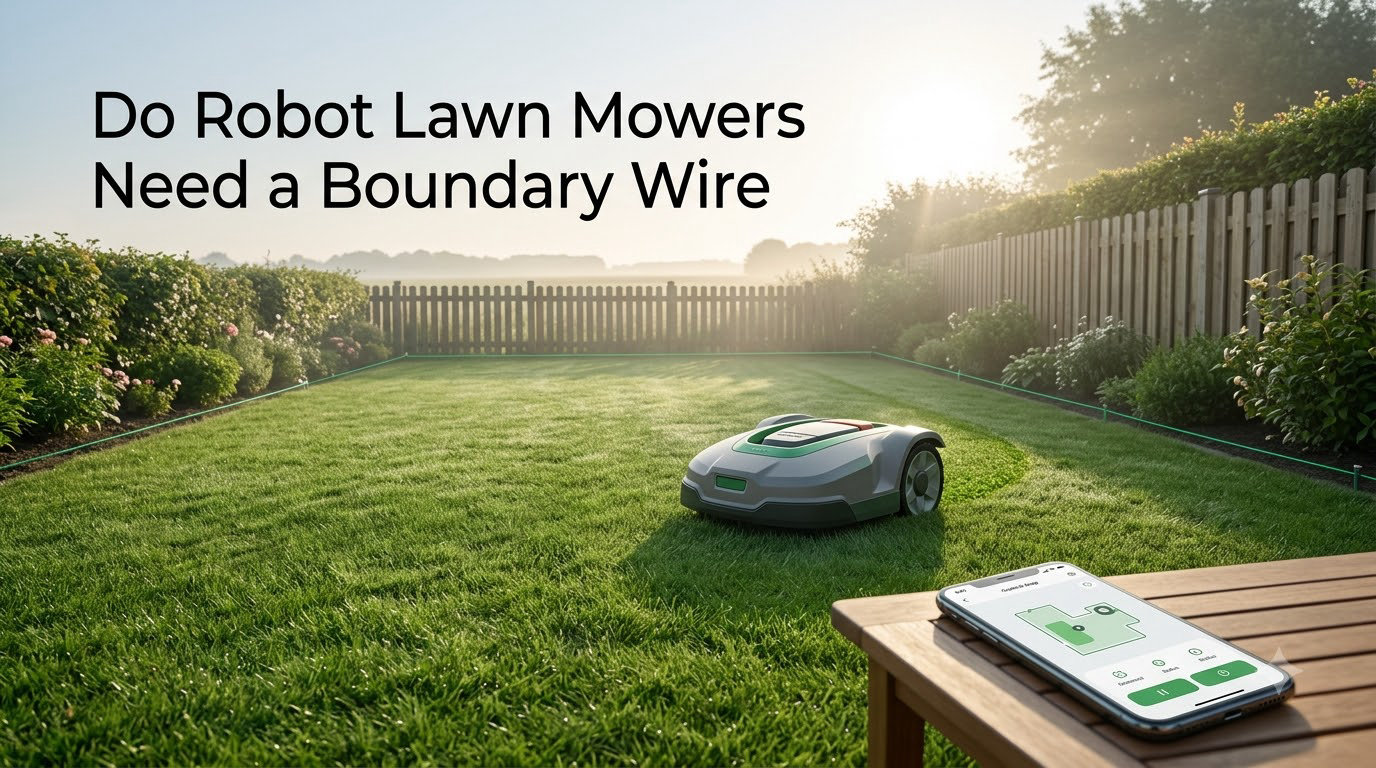
No, robot lawn mowers do not all need a boundary wire anymore. Traditional models still rely on a buried perimeter wire, but wire-free models in 2026 use GPS, LiDAR, or AI camera vision to create virtual boundaries instead. The right choice depends on your yard size, layout, and how much installation effort you want to take on.
I have spent the last several years testing robot mowers across multiple properties, from small urban lawns to a half-acre yard with steep slopes and dozens of trees. The question I get asked most often is exactly what you are asking: do these machines still need that annoying wire in the ground? Let me walk you through what I have learned.
Table of Contents
What Is a Boundary Wire and How Does It Work?
A boundary wire is a thin insulated cable that you install around the edge of your lawn and around any obstacles the mower should avoid. It works by sending a low-voltage electrical signal through the wire, which creates a magnetic field around the perimeter.
The robot mower has sensors on its front and sides that detect this magnetic field. When the mower approaches the wire, it knows it has reached the edge of its working area and turns around. This is the same basic technology that invisible dog fences have used for decades.
There are three common ways to install a boundary wire. You can bury it a few centimeters underground, stake it just above the grass with plastic pegs, or lay it on hard surfaces along edges. Most manufacturers recommend burying it for a cleaner look and to prevent accidental damage from rakes or aerators.
The wire itself is usually 2.5 to 3.5 mm thick and made of copper or copper-clad steel. A good quality boundary wire will last 10 to 20 years if installed correctly, but it can be damaged by rodents, aggressive digging, or freeze-thaw cycles in the soil. If you are wiring a robot power system for any project, our guide on how to wire a robot power system safely covers the electrical fundamentals in more detail.
Do Robot Lawn Mowers Need a Boundary Wire Today?
Do robot lawn mowers need a boundary wire in 2026? The honest answer is: it depends on the model. Many entry-level and mid-range mowers still require one, but a growing share of new releases are fully wire-free.
Traditional brands like Husqvarna’s Automower line, Worx Landroid, and Gardena Sileno all use boundary wires as their default setup. They work well, the technology is mature, and replacement parts are easy to find. If you already have a wired system installed and it works, there is no urgent reason to switch.
Wire-free models have gone from niche to mainstream in the last two years. Segway Navimow, Mammotion LUBA, ECOVACS Goat, and the new Husqvarna EPOS series all create virtual boundaries without any wire at all. You draw the boundary on a smartphone app, set no-go zones, and the mower uses satellites, lasers, or cameras to stay where it should.
Here is the simple way I explain it to friends: if you are buying a budget robot mower under one thousand dollars, expect to install a wire. If you are spending over fifteen hundred, you can almost certainly skip the wire entirely. The technology has finally caught up with the marketing.
Wire-Free Navigation Technologies Explained
Wire-free does not mean magic. Each navigation system uses real hardware and software to figure out where the mower is and where it should not go. There are three main approaches you will see in 2026.
RTK GPS Positioning
RTK stands for Real-Time Kinematic positioning. It is a high-precision version of GPS that gets accuracy down to about 2 centimeters instead of the usual 2 to 5 meters. To do this, the mower or its base station communicates with both satellites and a fixed reference station, which corrects the signal in real time.
RTK GPS works incredibly well in open areas with clear sky view. It struggles when tall trees, buildings, or overhangs block parts of the sky. The reference station is usually mounted on a roof or pole, and the mower can lose its position if it travels too far from the station or if satellite coverage drops.
Brands like Segway Navimow and Mammotion LUBA use RTK GPS as their primary navigation method. It is the most common wire-free technology on the market right now because it works in most residential yards.
LiDAR Sensors
LiDAR (Light Detection and Ranging) works by spinning a laser and measuring how long it takes to bounce back from objects. The mower builds a 3D map of its surroundings in real time. LiDAR is excellent at detecting obstacles and works in complete darkness.
The downside is that pure LiDAR mowers can struggle with edge precision. They know what is in front of them but may have a harder time knowing exactly where the property line is. Many manufacturers now combine LiDAR with GPS or cameras for better results.
LiDAR sensors also add to the cost. You will see them in premium models, often paired with other sensors. Our piece on how planetary gearboxes work in robot joints gives more context on the precision engineering inside these machines.
AI Camera Vision
Camera-based systems use one or more wide-angle cameras, often paired with machine learning models, to recognize grass edges, obstacles, and boundaries. Modern AI can distinguish between grass and pavement, identify toys and pets, and follow a virtual fence you draw on the app.
Camera systems work well in good lighting but can struggle at night or in heavy rain unless the cameras have infrared or low-light support. They are getting better every year, and brands like Terramow and some ECOVACS models rely heavily on this approach.
Sensor Fusion
The newest and most reliable wire-free mowers use sensor fusion, combining two or more of the above systems. A common setup pairs RTK GPS for absolute positioning with cameras or LiDAR for obstacle detection. This gives the best of all worlds: accurate boundaries, good obstacle avoidance, and reliable performance in tricky conditions.
RTK GPS vs LiDAR vs Camera: Which Is Best?
No single technology wins in every situation. Here is how I would rank them based on real-world testing in different yards.
For accuracy of the boundary itself, RTK GPS is hard to beat when it has a clear sky view. For obstacle detection, LiDAR is the most consistent. For edge recognition and complex landscaping, AI cameras shine once they have mapped the area. The mowers with the fewest user complaints in 2026 tend to use at least two of these together.
If your yard is mostly open with a few trees, RTK GPS alone will work great. If your yard is heavily wooded, look for a model with LiDAR or strong camera AI. If you have a complex layout with multiple zones and narrow passages, sensor fusion is worth the extra cost.
Cost-wise, RTK GPS systems are usually the most affordable wire-free option. LiDAR adds around 30 to 50 percent to the price. Camera-only systems can be cheaper, but performance varies more between brands.
Pros and Cons of Wire vs Wire-Free Robot Mowers
Both approaches have real strengths. Here is the honest comparison I share with people shopping for their first mower.
Wired systems are reliable, well-understood, and usually cheaper. Installation is the main pain point, especially if you have a large or irregularly shaped yard. Repairs can be a hassle if the wire breaks underground, and you have to be careful when aerating or doing other yard work.
Wire-free systems are far easier to set up. You walk the mower around the yard once, draw boundaries on the app, and you are done. Changes to the layout take minutes instead of hours. The trade-offs are higher upfront cost, occasional navigation hiccups, and dependence on good satellite coverage or lighting conditions.
For a small, simple lawn, the choice barely matters. For a large property with multiple zones, wire-free saves a full day of work. The math changes again if you live somewhere with frequent storms, heavy tree cover, or steep terrain. Match the system to your yard, not the other way around.
Popular Wire-Free Robot Mower Brands
If you decide to go wire-free, these are the brands worth looking at in 2026.
Segway Navimow offers several RTK GPS models at competitive prices, with a strong smartphone app and reliable performance in average-sized yards. Mammotion LUBA brings all-wheel drive and handles slopes up to 75 percent, which is unusual for robot mowers. ECOVACS Goat pairs LiDAR with cameras for wire-free mapping in complex yards. Husqvarna EPOS is a professional-grade wire-free system designed for larger properties and commercial use.
Each of these has trade-offs in price, features, and what kind of yard they handle best. Reading recent user reviews on forums like r/roboticLawnmowers is the fastest way to see how a specific model performs in yards similar to yours.
Which Type Should You Choose for Your Lawn?
Start with your yard, not the brand. Ask yourself three questions. How large is the area? How complex is the layout? How much tree cover or building obstruction is there?
If your lawn is under 500 square meters, mostly rectangular, and has open sky view, a budget wired mower will serve you well. If your lawn is larger than 1000 square meters, has multiple zones, or changes shape often, wire-free pays for itself in saved installation time. If your yard is heavily wooded or has tricky satellite coverage, look for a wire-free model with LiDAR or sensor fusion.
Budget matters too. Wired mowers start around four hundred dollars. Wire-free models usually start around one thousand and can go well past four thousand for premium systems. The middle of the market is the most competitive right now, with solid RTK GPS options between twelve hundred and two thousand dollars.
For a deeper look at the technology behind robotic systems generally, our guide on what a logic level shifter is and when you need one explains some of the electronics that keep these machines running smoothly.
Frequently Asked Questions
Can you use a robot mower without perimeter wire?
Yes, you can use a robot mower without a perimeter wire if you buy a wire-free model. These mowers use RTK GPS, LiDAR sensors, or AI cameras to create virtual boundaries through a smartphone app. Traditional wired models still require the physical cable, but most new releases in 2026 offer a fully wire-free option.
What robot lawnmower does not require a boundary wire?
Popular wire-free models include the Segway Navimow series, Mammotion LUBA, ECOVACS Goat, and Husqvarna EPOS. These mowers use satellite positioning, LiDAR, or AI cameras to navigate without any buried wire. Each brand offers different strengths, with some better for open lawns and others for complex, multi-zone properties.
Do robot mowers need boundary wires around all trees?
No, robot mowers do not need boundary wires around every tree if you have a wire-free model. You can set no-go zones around trees directly in the app. Wired models do require you to loop the wire around each tree you want the mower to avoid, which adds installation time for yards with many obstacles.
What is the best boundary wire to use for a robot mower?
The best boundary wire is a solid-core copper or copper-clad steel wire, typically 2.5 to 3.5 mm thick, with durable insulation. Most manufacturers ship compatible wire with the mower, and replacement wire from the same brand is usually the safest bet. Avoid thin aluminum wire since it breaks more easily underground.
Which robot lawn mower navigation technology is best?
No single technology is best for every yard. RTK GPS is the most accurate for boundary precision with open sky view. LiDAR excels at obstacle detection in any lighting. AI cameras handle edge recognition well once they have mapped the area. The most reliable mowers in 2026 use sensor fusion, combining two or more technologies for better performance in challenging conditions.
Do robotic lawn mowers use GPS?
Many modern robotic lawn mowers use GPS as part of their navigation, especially wire-free models with RTK positioning. Wired models do not need GPS because the perimeter wire handles boundary detection. GPS-enabled mowers can also offer theft tracking, which is a useful bonus for expensive machines.
What are the negatives of robotic lawn mowers?
The main negatives of robotic lawn mowers are upfront cost, slower mowing than traditional mowers, and occasional navigation issues on wire-free models. Wired systems require a tedious boundary wire installation that can be damaged over time. Some users also report frustration with random spinning on early-generation models, though current mowers handle turns much better.
Final Verdict on Boundary Wires
So, do robot lawn mowers need a boundary wire? In 2026, the answer is clearly no for the majority of new buyers. Wired systems are still around and still work, but wire-free models have reached the point where they are reliable, accurate, and worth the higher price for most homeowners. The technology has matured, prices are coming down, and the installation headache is mostly gone.
Pick the system that matches your yard, not the one with the best marketing. If you want to dig deeper into the engineering side of robotics, our complete guide to backlash in robot gearing is a good next read.