
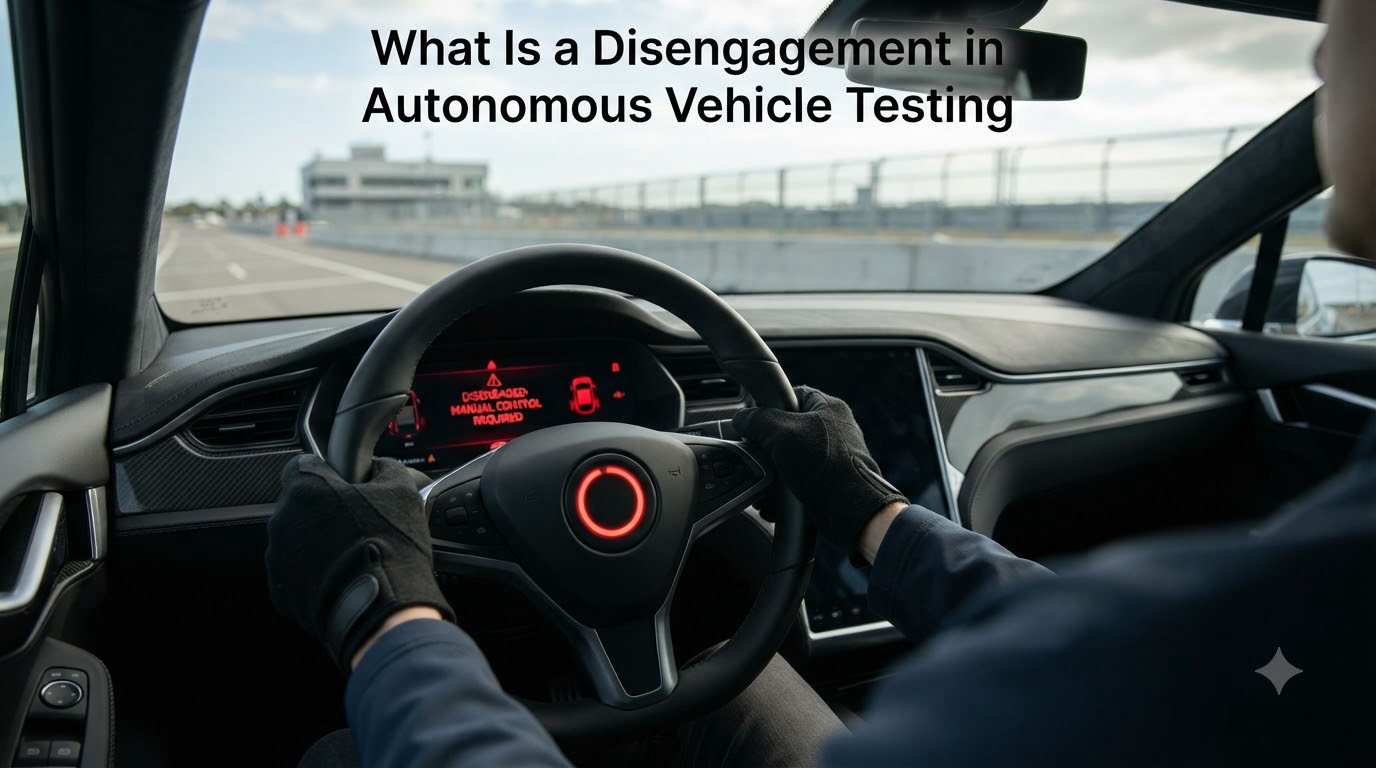
A disengagement in autonomous vehicle testing is the moment when a self-driving car stops driving itself and either hands control to a human safety driver or falls back to a minimal-risk condition. It is the single most important safety event regulators, engineers, and the public use to judge whether an autonomous system is ready for public roads.
I have spent weeks reading through California DMV reports, academic studies, and forum discussions to put together this guide. Below, I will walk you through the official definition, how a disengagement actually works inside the car, the SAE automation levels that frame every report, and how to read disengagement data without being misled by flashy numbers.
Table of Contents
What Is a Disengagement in Autonomous Vehicle Testing
The official California DMV definition says a disengagement is “a deactivation of the autonomous mode when a failure of the autonomous technology is detected or when the safe operation of the vehicle requires the safety driver to take immediate manual control.” That sentence is the standard every testing permit holder in California must report against.
In plain language, a disengagement is any event in which the Automated Driving System (ADS) stops being in charge of the vehicle. The handoff can be triggered by the software, by a perception failure, by a confusing traffic situation, or by a human safety driver pressing a button or grabbing the wheel. Each event, no matter how small, gets logged.
This metric matters because it is the only standardized, regulator-mandated way to compare the maturity of different self-driving programs. If you want to know whether Waymo, Cruise, Pony.ai, or any other company is really getting better, disengagement data is where the answer lives.
For broader context on how autonomous technology is evolving across industries, our report on advances in autonomous mobile robots shows that the same sensing-and-decision challenges apply to warehouse robots and delivery bots, not just cars.
How Disengagements Work in Self-Driving Cars
Inside the vehicle, a disengagement is the end of a short decision chain. The ADS continuously evaluates whether the driving task is still within its Operational Design Domain (ODD) and whether all its sensors, maps, and software modules are confident in what they see.
When something looks wrong, the system issues a takeover request. The safety driver either accepts the handoff and resumes manual control, or in higher-level systems the vehicle itself executes a minimal-risk maneuver like pulling to the shoulder. The moment either branch fires, a disengagement is recorded.
Forum users on r/SelfDrivingCars often describe the experience like this: the steering wheel icon flashes, a chime sounds, and within a second the driver is back in command. That is a planned or reactive disengagement, and it is the bread and butter of every test report.
Safety drivers are not just passengers. They are trained operators who log the reason for each takeover, from “perception confused by sun glare” to “construction zone not in the map.” Those reason codes become the dataset regulators and researchers analyze.
The 6 SAE Levels of Driving Automation Explained
SAE International’s J3016 standard defines six levels of driving automation, from no automation (Level 0) to full automation under all conditions (Level 5). The levels are the language every disengagement report uses to describe what the system was doing at the moment of the event.
- Level 0 – No Automation: The human driver does everything. No ADS is engaged, so no disengagements apply.
- Level 1 – Driver Assistance: The car controls either steering or speed, but not both. Disengagements here usually refer to turning off adaptive cruise control or lane centering.
- Level 2 – Partial Automation: The car can steer and accelerate at the same time, but the human must monitor constantly. Most consumer “self-driving” features live here, including Tesla Autopilot and FSD (in their current form).
- Level 3 – Conditional Automation: The ADS handles the full dynamic driving task within a specific ODD, but may request a human to take over. The first production Level 3 system in the US was Honda’s Traffic Jam Pilot in Japan.
- Level 4 – High Automation: The ADS performs the full driving task within a defined ODD and does not require a human driver. Waymo’s robotaxi service in Phoenix and San Francisco operates at this level.
- Level 5 – Full Automation: The ADS drives everywhere a human can, with no ODD limits. No vehicle on public roads has reached this level.
Disengagement reporting is most meaningful for Level 3 and Level 4 testing. Below Level 3, the human is always the legal driver, and disengagement data is essentially user-experience telemetry rather than safety evidence.
Critical vs Routine Disengagements
Not every disengagement is a crisis. Regulators and researchers split them into two broad buckets, and the distinction is critical for interpreting any report you read.
Critical disengagements are events where the vehicle was about to do something unsafe, illegal, or outside its capability, and either the system or the safety driver intervened to prevent harm. A community description I kept seeing on r/SelfDrivingCars captures it well: “the car was about to do something illegal or dangerous, and someone supervising took over.”
Routine disengagements cover everything else. The safety driver gets bored, traffic clears up, the mapped ODD ends, or a planned route shift requires manual driving. These events still get logged because California law requires it, but they tell you much less about safety readiness.
A company that reports thousands of disengagements per year but mostly routine ones is in a very different position than a company with few total disengagements that include several critical events. The reason code on the form is what separates the two.
California DMV Disengagement Report Requirements
Since 2015, the California Department of Motor Vehicles has required every company holding an autonomous vehicle testing permit to submit an annual disengagement report. The report must list every event, the location, the circumstances, and a brief description of what caused the takeover.
Permit holders are required to disclose the total miles driven in autonomous mode during the year, the number of disengagements, and the disengagement rate expressed as miles per disengagement. They also describe the version of the ADS being tested, because a software update can change behavior between reports.
The DMV publishes these reports on its website, which has made California the de facto transparency hub for AV testing in the United States. Other states, including Arizona, Texas, and Nevada, have their own rules and reporting schedules, but California’s dataset is the most analyzed.
Funding flows are a useful proxy for how seriously the industry is taking this work. Our coverage of Moove’s $250M raise for autonomous vehicle infrastructure shows that even non-OEM players are now building the operational backbone for fleets that will eventually be measured by these same reports.
What Disengagement Rates Tell Us About AV Safety
The headline number everyone quotes is miles per disengagement, the average distance a system drives between takeover events. It is a useful starting point, but it is also the most easily gamed metric in the AV industry.
A higher miles-per-disengagement number is generally better, because the system handled more driving before needing help. But the figure can grow simply because the company is testing in easier weather, on plowed mapped streets, or with more experienced safety drivers. It does not by itself prove the system is safe.
Researchers, including a widely cited Nature Scientific Reports study on automated vehicle disengagement causes and effects, have shown that disengagement frequency correlates with crash risk only when you control for road type, traffic density, and weather. Across 280,000 miles of test data, the study found only two crashes tied to disengagement events, a useful benchmark for the field.
For consumer-facing deployment, look at how the rate changes year over year for the same ODD, not at the absolute number. A company whose miles-per-disengagement figure doubles between reports on the same city streets is genuinely improving.
For a real-world example of how testing milestones are progressing toward commercial launch, our PlusAI autonomous truck milestones coverage shows how trucking fleets are starting to use disengagement data to time commercial deployment.
How to Interpret Disengagement Reports as a Consumer
When you read a disengagement report, focus on three things. First, the ODD: a robotaxi tested only in good weather in Phoenix tells you almost nothing about performance in your city. Second, the reason codes: a long list of “perception confusion” entries is a yellow flag, while a long list of “planned route changes” is mostly neutral.
Third, the trend. A single year’s number is a snapshot. Three years of numbers, on the same ODD, with a steadily growing miles-per-disengagement rate, is a real signal of progress.
Treat disengagement data as one input among many, not as a verdict. It is the most transparent safety metric we have for autonomous systems in 2026, but it is not the same as real-world crash data from a deployed fleet.
Frequently Asked Questions
What are the 6 levels of autonomous vehicles?
The SAE J3016 standard defines six levels: Level 0 (no automation), Level 1 (driver assistance such as adaptive cruise), Level 2 (partial automation like Tesla Autopilot), Level 3 (conditional automation where the system drives but may ask the human to take over), Level 4 (high automation within a specific area, such as Waymo’s robotaxis), and Level 5 (full automation everywhere with no human needed).
What are the biggest failures of autonomous vehicles?
The most common failure categories are perception errors (confusing a truck side for sky, misreading construction zones), bad weather that blinds sensors, mapping mismatches when the road differs from the high-definition map, software bugs in planning modules, and edge-case behavior at unprotected turns or in dense pedestrian traffic. These show up as the leading reason codes in California DMV disengagement reports.
Is Waymo level 4 or 5?
Waymo’s current robotaxi service in Phoenix, San Francisco, and Los Angeles is Level 4. The system drives itself within its approved ODD without a human safety driver, but it cannot operate in every condition a human can handle. True Level 5 has not been demonstrated on public roads by any company.
How are autonomous vehicles tested?
Autonomous vehicles are tested through a layered approach: simulation, closed-course track testing, and public-road driving with a safety driver. On public roads, every takeover event is logged as a disengagement. In California, permit holders must file annual disengagement reports to the DMV that include miles driven, total events, and reason codes for each event.
What did Elon Musk say about self-driving cars?
Elon Musk has repeatedly predicted that Tesla would solve full self-driving, framing it as a software problem rather than a hardware or regulatory one. He has claimed that Tesla vehicles would operate as robotaxis and reach Level 5 autonomy, though regulators and most researchers disagree with that timeline. Tesla’s current Autopilot and FSD systems remain classified as Level 2 by SAE and the DMV.
Final Thoughts on Disengagement in Autonomous Vehicle Testing
A disengagement in autonomous vehicle testing is more than a glitch log. It is a window into how close a self-driving system is to true readiness, and it is the only metric the industry agrees to publish.
As autonomous technology continues to mature in 2026, the companies that win public trust will be the ones that publish clear, consistent, and improving disengagement data, and that help consumers actually understand what those numbers mean.