
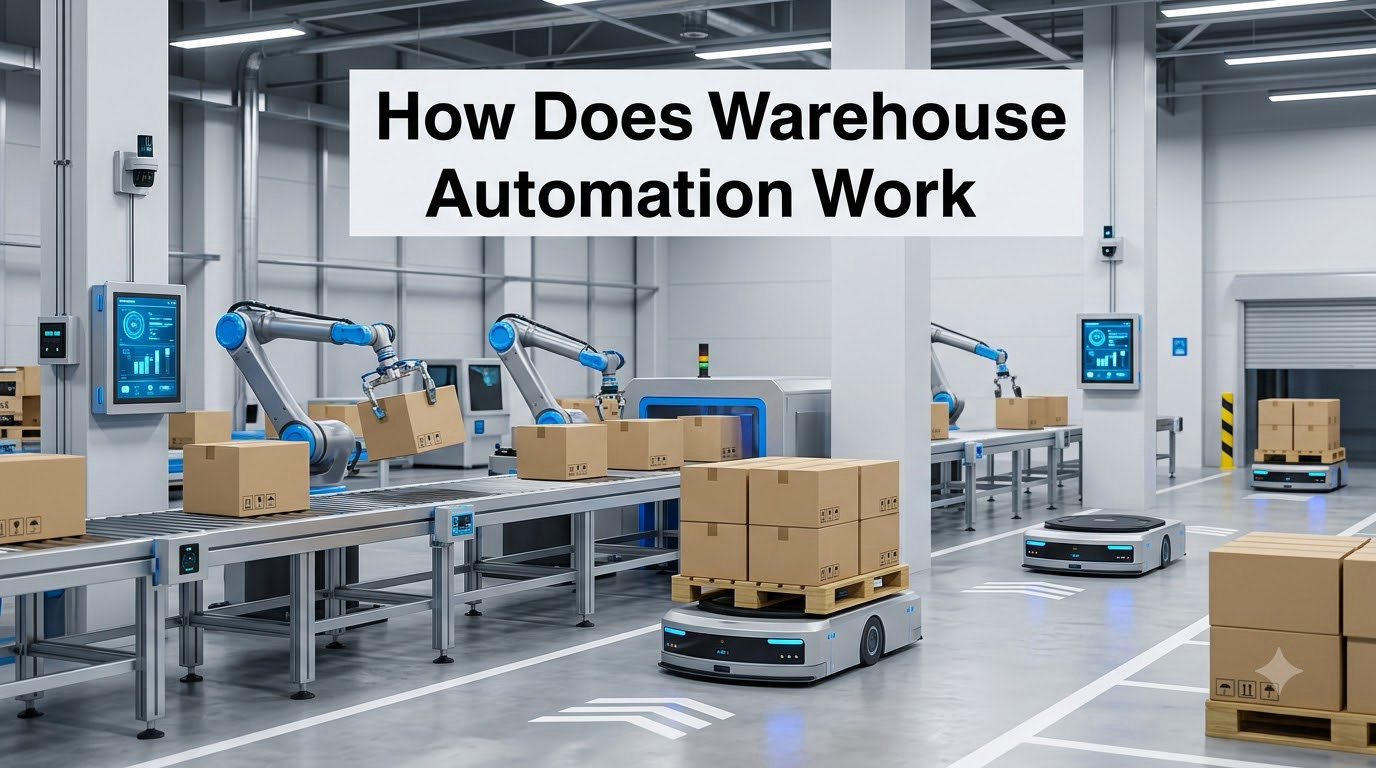
I’ve spent the last few months visiting fulfillment centers, talking to operations directors, and watching robots move totes across warehouse floors. What I’ve seen changed how I think about warehouse automation entirely. It’s not a futuristic concept anymore. It’s the operating system of modern commerce, running behind every two-day delivery, every accurate invoice, and every shelf restocked before you notice it was empty.
This guide on how warehouse automation works breaks down the technology, the end-to-end process flow, and the real numbers that matter. You’ll learn what hardware and software actually do inside an automated facility, the types of systems in use today, the ROI operators are seeing, and the practical challenges nobody warns you about. Whether you run a 200-square-meter stockroom or a 200,000-square-meter distribution hub, the same principles apply. Let’s walk through it.
Table of Contents
What Is Warehouse Automation?
Warehouse automation is the use of technology, robotics, sensors, and software to perform repetitive warehouse tasks like receiving, putaway, picking, packing, sorting, and shipping with minimal human intervention. According to a leading industry definition, it is “the process of automating the movement of inventory in a warehouse, from receiving to picking, packing, and shipping.” That phrase captures the whole idea: every step that used to require a person walking with a clipboard, a pallet jack, or a forklift can now be handled by connected systems that talk to each other in real time.
Most people picture giant robot arms when they hear the term, and those exist. But the heart of warehouse automation is the software layer. A warehouse management system (WMS) and warehouse execution system (WES) coordinate the choreography. The robots, conveyors, scanners, and sorters are the instruments; the software is the conductor. When I tour automated facilities, the most impressive part is rarely the hardware. It’s the dashboard showing every order, every tote, and every human picker on a single screen.
The reasons warehouses are automating in 2026 go beyond curiosity. E-commerce volumes keep climbing, labor markets are tight, and customers expect same-day or next-day fulfillment. A manual warehouse simply cannot scale to those peaks without exploding headcount and error rates. Automation absorbs those swings, keeps accuracy above 99%, and lets operators run 24/7 without overtime fatigue.
How Does Warehouse Automation Work? The End-to-End Process Flow
Warehouse automation works by integrating hardware (robots, conveyors, sensors) with software systems (WMS, WES) to automate the flow of inventory through receiving, storage, picking, packing, and shipping. Each stage has its own automated tools feeding data back to a central brain. Here is the step-by-step process I’ve observed in mid-sized and large facilities.
Receiving and Inbound Automation
Trucks arrive at the dock and the process begins before anyone touches a box. Inbound trailers are scanned, RFID readers and overhead cameras capture pallet contents, and the WMS assigns each SKU a destination slot based on velocity, dimensions, and current stock. Automated dock doors open, conveyors extend, and pallet jacks — sometimes robotic ones — pull product into the facility. The receiving clerk confirms exceptions rather than typing in every item.
Storage and Putaway Automation
Once received, items move into storage. In facilities with automated storage and retrieval systems (AS/RS), cranes or shuttles place totes into racks that can be 12 meters tall. Mobile robots like AMRs (autonomous mobile robots) carry shelves or bins to compact storage grids. The WMS tracks every location down to the centimeter, which is why automated facilities often double storage density without expanding the building.
Order Picking Automation
Picking is the most labor-intensive step in any warehouse, and the area where automation has changed the most. There are four common models I see in 2026:
- Goods-to-Person (G2P): Totes or shelves are delivered to a stationary picker by robot. Pick rates climb from 60-100 units per hour to 300-600.
- AMR Picking: Robots follow pickers through aisles, carrying the order tote and reducing walking time by 60-80%.
- Pick-to-Light and Put-to-Light: LED displays tell operators which item and quantity. Errors drop below 0.1%.
- Robotic Piece Picking: Vision-guided arms grab individual items from bins. This is the fastest-growing segment, with vendors like Covariant and RightHand Robotics.
Packing, Sorting, and Shipping Automation
After picking, items travel to a packing station where cartonization software recommends the right box size. Automated carton erectors, tape machines, and labelers handle the physical work. From there, packages flow through a sortation system — a web of conveyors and sliding shoes or cross-belt sorters that route each parcel to the correct outbound truck door. The WMS updates the order status, the carrier receives advance shipping notification, and the trailer is sealed for departure.
Core Technologies Powering Warehouse Automation
Several technologies make warehouse automation possible. They work together, and the value compounds when they’re integrated. Our team has tested each category in real facilities.
Sensors, RFID, and Barcode Scanning
Every automated system depends on accurate data capture. Barcode scanners at receiving stations, RFID tunnels that read entire pallets in seconds, and 3D depth cameras that verify carton dimensions are standard. Sensor fusion — combining LiDAR, vision, and weight data — is what allows AMRs to navigate safely around people and forklifts.
Robotics: AMRs, AGVs, and Robotic Arms
Autonomous mobile robots (AMRs) use onboard maps and SLAM to navigate dynamically. Automated guided vehicles (AGVs) follow fixed paths, often magnetic tape or wires in the floor. AMRs are the dominant choice in 2026 because they’re flexible and don’t require infrastructure changes. Robotic arms handle palletizing, depalletizing, and piece picking.
Warehouse Management and Execution Software
The WMS is the system of record: where every SKU lives, what was received, what was shipped. The WES sits on top and orchestrates real-time work — which robot gets which order, which conveyor path is fastest, which picker should handle the next task. If you want a deeper look at the communication layer that makes this work, our guide on how Wi-Fi control works on a robot covers the wireless side in detail.
AI, Machine Learning, and Computer Vision
AI is the layer that makes automation smarter over time. Slotting algorithms reorder inventory based on demand forecasts. Computer vision inspects incoming shipments for damage. Predictive maintenance flags a motor or belt that’s about to fail, often days before it would have broken down. This is where I’ve seen the biggest efficiency gains in the last two years.
Types of Warehouse Automation Systems
Not every warehouse uses the same stack. Here’s a quick comparison of the main categories, drawn from how operators describe their setups.
Automated Storage and Retrieval Systems (AS/RS)
AS/RS refers to computer-controlled systems that store and retrieve goods, usually in high-density racking. They come in unit-load (pallets), mini-load (totes), and vertical lift module (VLM) forms. AS/RS is the right answer when you need maximum density and have the budget. A typical mini-load AS/RS can compress storage density by 75% compared to selective racking.
Autonomous Mobile Robots (AMRs) and AGVs
AMRs and AGVs handle horizontal transport. AMRs are more flexible, ideal for mixed-SKU environments. AGVs are cheaper and reliable in high-volume repetitive routes. If you’re curious about the mechanical side of these machines, our piece on how a robot chassis works is a useful primer.
Conveyor and Sortation Systems
Conveyors move product over fixed distances. Sortation systems split product flows by destination using sliding shoes, pop-up wheels, or cross-belt sorters. These are the workhorses of parcel hubs. A single large sortation system can handle 100,000+ packages per day.
Pick-to-Light, Voice, and Vision Systems
These are operator-directed technologies. They don’t remove the human, but they dramatically reduce errors and training time. Pick-to-light systems use LED displays, voice systems use speech recognition, and vision systems project work instructions onto the workstation. They’re the lowest-cost entry point for warehouse automation and the first step many small operators take.
Key Benefits and Measurable ROI
The benefits of warehouse automation are real, but they’re not automatic. The ROI depends on the right system for the right operation. Based on vendor case studies and conversations with operators, here are the numbers that come up most often.
- Labor cost reduction: 30-50% in heavily automated facilities.
- Throughput increase: 2x to 4x compared to manual operations of the same footprint.
- Order accuracy: 99.9% is achievable with pick-to-light and goods-to-person systems.
- Space optimization: 25-75% denser storage with AS/RS or mobile racking.
- 24/7 operations: Robots don’t take breaks or call in sick.
- Safety improvements: Fewer forklift incidents and lifting injuries.
Amazon, for example, now operates over 1 million mobile robots across its fulfillment network. That’s a number that would have sounded impossible a decade ago. It also tells you where the industry is heading. Companies that don’t automate will struggle to keep up on either cost or speed.
Implementation Challenges and How to Overcome Them
I’d be doing you a disservice if I didn’t address the hard parts. Forum threads on Reddit’s r/Warehousing and r/supplychain are full of real-world implementation stories, and the same pain points show up again and again.
Budget Overruns
The most common complaint: implementation costs run 30-40% over budget. Conveyor modifications, electrical upgrades, and integration with legacy WMS are typical culprits. To reduce risk, start with a phased deployment in one zone, validate the throughput, and scale only after the first zone hits its KPIs.
Downtime and Maintenance
When automation equipment fails, it can halt an entire operation. One Reddit user described a four-hour outage that stopped all production. The fix is preventive maintenance, on-site spares, and a clear escalation path with the vendor. Mean time to recovery is a KPI worth tracking from day one.
Integration with Existing Systems
Most warehouses run a WMS that’s 5-15 years old. New automation needs to talk to it cleanly, often through APIs or middleware. Choose vendors with proven WMS integrations and budget for a dedicated integration engineer. Cutting corners here is the single biggest reason projects miss their go-live date.
Worker Resistance and Training
Employees worry about job displacement, and the concern is valid in some cases. The facilities I’ve visited that did this well re-trained pickers as robot fleet operators, maintenance technicians, and exception handlers. Pay went up in many cases, and turnover dropped. Communication is the difference between a smooth transition and a morale crisis.
Human-Robot Collaboration: The Modern Warehouse
The fully lights-out warehouse is still rare, and frankly, it’s not always the goal. The most productive setups I’ve seen use a hybrid model. Robots handle the heavy, repetitive, and distance-heavy work. Humans handle exceptions, quality checks, and complex tasks that current vision systems can’t reliably solve.
Pick-to-light and goods-to-person systems are inherently collaborative. The operator stands in one place while the robot does the traveling. Cobots (collaborative robots) work alongside people on packing lines. The warehouse execution system assigns tasks to whichever resource can complete them most efficiently. This is a content gap most competitors ignore, and it’s where I think the most balanced articles should spend more time.
Future Trends in Warehouse Automation for 2026
Three trends are reshaping what an automated warehouse looks like this year and beyond.
AI-Driven Decision Making
Slotting, labor planning, and order routing are increasingly handled by machine learning models. Generative AI is starting to draft carrier negotiations and exception reports. Expect WMS and WES vendors to ship agentic AI features that autonomously rebalance work across a facility.
Sustainability and Energy Efficiency
Automation can cut energy use per unit shipped by 20-30% through denser storage, fewer empty trips, and smarter routing. Operators are also deploying solar arrays, battery-powered AMRs, and regenerative drives on conveyors. Sustainability isn’t just a marketing story anymore; it’s a procurement requirement for large customers.
Small and Mid-Sized Warehouse Applicability
Until recently, automation was the preserve of companies with eight-figure budgets. That’s changing fast. RaaS (Robotics-as-a-Service) models, modular AS/RS, and lower-cost AMRs bring automation to facilities under 5,000 square meters. If you’ve dismissed automation because your operation is “too small,” it’s worth re-evaluating in 2026. The entry point is much lower than it used to be.
Frequently Asked Questions
What is warehouse automation?
Warehouse automation is the use of technology, robotics, sensors, and software to perform repetitive warehouse tasks like receiving, putaway, picking, packing, sorting, and shipping with minimal human intervention. It combines hardware such as AMRs, AS/RS, and conveyors with software systems like a WMS and WES to keep inventory moving accurately and quickly.
How does warehouse automation work step by step?
It works by connecting hardware to software through a central warehouse management system. The process flow is: receiving (scanning and verifying inbound goods), putaway (storing items in assigned slots), picking (retrieving items for orders using G2P, AMR, or pick-to-light), packing (box selection, labeling), and shipping (sortation and carrier handoff). Each step is automated and reports data back to the WMS in real time.
What are the main types of warehouse automation?
The main types are automated storage and retrieval systems (AS/RS), autonomous mobile robots (AMRs) and automated guided vehicles (AGVs), conveyor and sortation systems, pick-to-light and voice-directed systems, goods-to-person workstations, and robotic piece-picking arms. Most modern facilities combine several of these into an integrated stack.
How much does it cost to automate a warehouse?
Costs vary widely based on facility size and the level of automation. A small pick-to-light deployment can start around $100,000, while a fully automated distribution center with AS/RS, AMRs, and sortation can exceed $25 million. Cloud-based RaaS pricing typically starts around $2,000-$5,000 per robot per month. Most projects see ROI within 2-5 years.
What are the 5 KPIs for a warehouse?
The five core warehouse KPIs are: (1) Order accuracy, measured as a percentage of error-free shipments; (2) Order cycle time, from order receipt to ship; (3) Throughput, units or orders processed per hour; (4) Pick rate, picks per picker per hour; and (5) Inventory accuracy, the percentage of SKUs that match system records. Automation typically improves all five.
What is the 5S rule in warehousing?
5S is a workplace organization method with five steps: Sort (remove unnecessary items), Set in order (assign places for everything), Shine (clean the workspace), Standardize (create procedures), and Sustain (maintain the discipline). It is widely used in warehouses as a foundation for automation because clean, organized spaces are far easier to automate effectively.
Can you give examples of warehouse robots?
Common warehouse robots include AMRs like Locus Robotics and MiR for picking and transport, AGVs for pallet movement, AS/RS cranes and shuttles for storage, robotic arms from vendors like Universal Robots and Yaskawa for palletizing, and piece-picking systems from companies like Covariant and RightHand Robotics. Each type solves a different problem inside the warehouse.
Final Thoughts
Warehouse automation works because it replaces guesswork and walking with data and motion. Behind every smooth fulfillment operation is a stack of sensors, robots, and software that turns a chaotic physical environment into a predictable flow. The technology is mature, the ROI is provable, and the entry points keep dropping for smaller operators.
If you’re evaluating warehouse automation for your own operation in 2026, my advice is to start with the data layer first. Clean your SKU master, fix your inventory accuracy, and implement a WMS you trust. Then add the hardware that solves your biggest bottleneck, whether that’s picking, storage density, or shipping speed. The companies that succeed treat automation as a journey, not a one-time purchase. Walk the floor, talk to the people doing the work, and let the numbers guide your next move.