
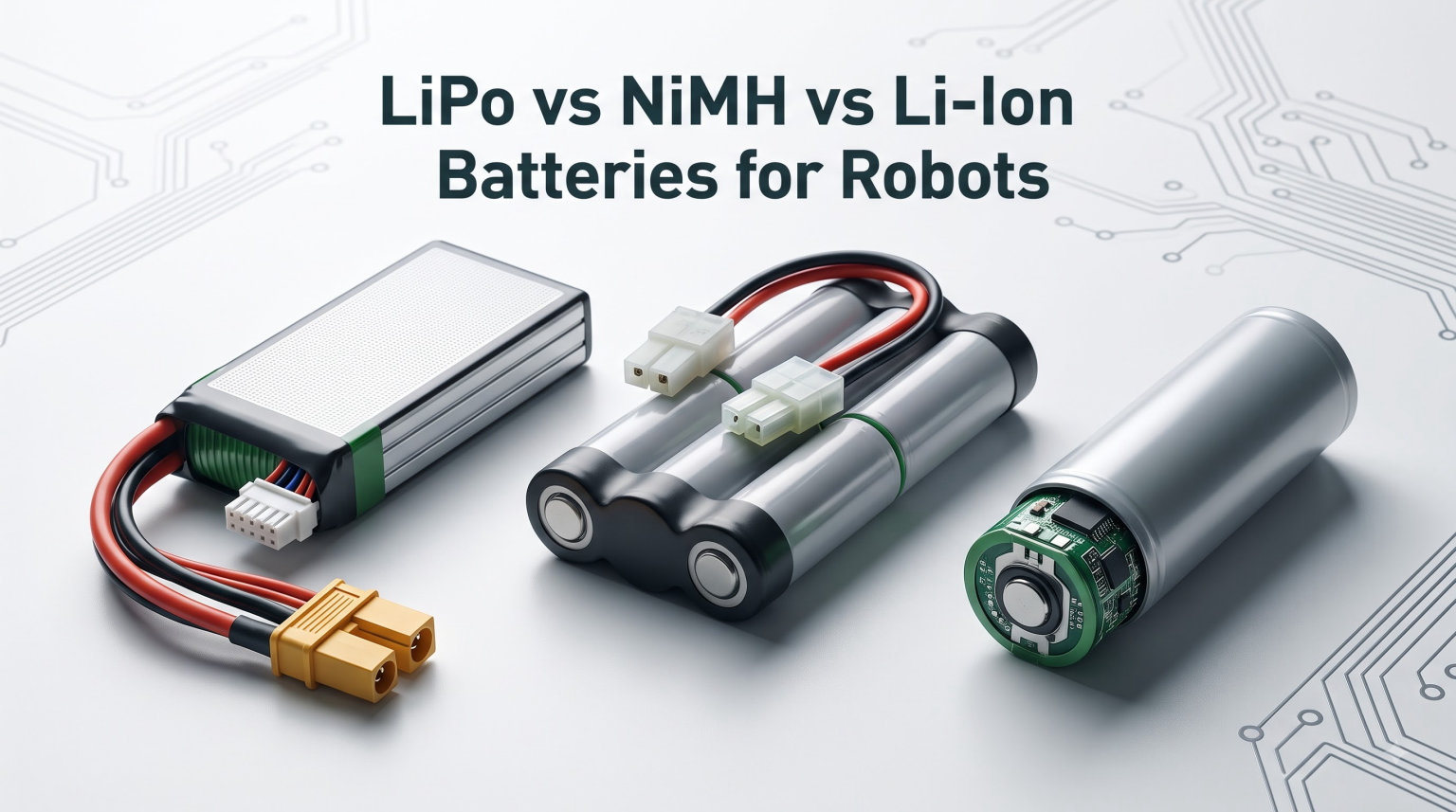
Picking the right battery for your robot is the single decision that changes everything else. Voltage, weight, runtime, charging speed, and safety all flow from the chemistry you choose. After rebuilding dozens of robots with our team, I can tell you that swapping from NiMH to LiPo or Li-Ion often improves performance by 30 to 50 percent with no other changes.
This guide settles the LiPo vs NiMH vs Li-Ion batteries for robots debate with real numbers, not theory. You will get a complete comparison of energy density, voltage, cycle life, discharge rate, and cost, plus a power budget walkthrough so you can size the right pack for your build.
Table of Contents
How Robot Batteries Work: Quick Chemistry Primer
LiPo, NiMH, and Li-Ion are three rechargeable chemistries that most hobby and industrial robots depend on. Each one stores energy using a different chemical reaction, which is why their voltage, weight, and safety profiles vary so much.
LiPo (lithium polymer) and Li-Ion (lithium ion) both shuttle lithium ions between two electrodes. The difference is what holds those ions. LiPo uses a gel-like polymer electrolyte, which lets the cells flatten into pouches. Li-Ion uses a liquid electrolyte sealed in a hard cylindrical or prismatic case.
NiMH (nickel metal hydride) is a completely different beast. It stores charge in a hydrogen-absorbing alloy at the negative electrode and nickel hydroxide at the positive electrode. NiMH cells deliver a lower nominal voltage of 1.2V per cell versus 3.7V for LiPo and Li-Ion, which means you need more cells to hit the same robot voltage.
Those chemistry differences ripple outward into everything a robot builder cares about. Energy density, weight, voltage sag under load, how fast the battery dies on the shelf, and how dangerous it is when damaged all trace back to the chemistry inside.
Three Terms You Need Before Comparing
Energy density (Wh/kg) tells you how much runtime you get per kilogram of battery. A higher number means more power for less weight, which always matters in robotics.
C-rating measures how fast a battery can safely discharge. A 2200 mAh LiPo rated 25C can deliver 55 amps continuously, which is critical for high-torque motors and sudden acceleration.
Cycle life is the number of full charge-discharge cycles a battery survives before capacity drops to 80 percent. This number drives the true cost of ownership over years of use.
LiPo Batteries for Robots: Power in a Lightweight Package
LiPo batteries give robots the highest energy density and the highest discharge rates of the three chemistries. A typical 3S 2200 mAh LiPo packs 25 Wh/kg of energy density and can burst at 25C to 50C, which is why racing drones and combat robots depend on them.
LiPo Specifications at a Glance
Nominal voltage per cell is 3.7V, fully charged is 4.2V, and you should never discharge below 3.0V per cell. A 3S pack (three cells in series) gives 11.1V nominal, which is the sweet spot for most brushless motor controllers in robotics.
Energy density ranges from 150 to 250 Wh/kg depending on the brand and discharge rating. For comparison, NiMH typically sits between 60 and 110 Wh/kg. That is a 2x to 3x advantage that shows up immediately in robot runtime charts.
Cycle life is the weakest spec for LiPo. Most quality packs deliver 300 to 500 cycles when cared for properly, and far fewer if you regularly discharge below 3.0V per cell or leave them fully charged for weeks.
LiPo Pros for Robotics
Highest energy density means smaller, lighter packs for any given runtime. High C-rating supports the punchy current draws of brushless motors and heavy-payload robots. Fast charging is possible with a good balance charger, often in 30 to 60 minutes for hobby packs.
Flexible form factor is a real advantage. Pouch cells can be shaped to fit odd robot chassis, which matters when designing compact humanoids or drones.
LiPo Cons for Robotics
Fire risk is the big one. A punctured, overcharged, or shorted LiPo can enter thermal runaway, producing smoke, flames, and toxic gas. Thermal runaway is a self-sustaining chemical reaction once the cell temperature climbs past roughly 80°C. This is real, not theoretical, and I have personally seen a puffed cell vent inside a charging bag.
Short cycle life and strict storage requirements (around 3.8V per cell for long-term storage) make LiPo more demanding than NiMH. You need a balance charger, a LiPo-safe charging bag, and a habit of checking voltage before and after flights or runs.
Best Robotics Uses for LiPo
Fighting robots, racing drones, FPV quadcopters, and any high-performance hobby robot where weight and burst current matter most. LiPo is also the default for benchtop robotics prototypes that need to fit a battery in a tight, custom-shaped compartment.
NiMH Batteries for Robots: The Safe, Tolerant Workhorse
NiMH batteries are the safest, most forgiving chemistry in this comparison. They are heavier and lower voltage than lithium chemistries, but they tolerate abuse, cold weather, and partial charging in ways that LiPo and Li-Ion cannot match.
NiMH Specifications at a Glance
Nominal voltage per cell is 1.2V, so a 6-cell pack delivers 7.2V, a 7-cell pack delivers 8.4V, and a 10-cell pack delivers 12V. These were the standard robot voltages for years before lithium chemistries became affordable.
Energy density sits between 60 and 110 Wh/kg, which is heavier per watt-hour than both lithium options. Cycle life is a strong point, with quality NiMH cells (such as the Eneloop line) lasting 500 to 2000 cycles depending on depth of discharge.
Self-discharge is around 20 to 30 percent per month for standard NiMH, but low self-discharge (LSD) NiMH drops that to 1 to 3 percent per month. For robots that sit on a shelf, LSD NiMH is a real win.
NiMH Pros for Robotics
Safety is the headline. NiMH cells do not catch fire when punctured, overcharged, or shorted. They survive cold weather down to roughly -10°C with usable capacity, a clear win for outdoor robots and field robotics. They tolerate partial state-of-charge cycling without damage, which suits solar-powered or intermittent-use robots.
Cost is low, and chargers are cheap and simple. A basic NiMH charger costs a fraction of a quality LiPo balance charger, and any wall adapter with the right voltage will work in a pinch.
NiMH Cons for Robotics
Weight is the obvious tradeoff. A 3000 mAh 7.2V NiMH hump pack weighs around 350g, while the same capacity in LiPo is closer to 180g. Memory effect is mostly a myth for modern NiMH, but high self-discharge on standard cells can ruin a robot that sits between uses.
Voltage sag under load is more pronounced than lithium chemistries, so NiMH struggles with high-current bursts. A NiMH pack that reads 8.4V at rest may drop to 7.0V or lower when a brushless motor spins up.
Best Robotics Uses for NiMH
Educational robots, beginner robotics kits, indoor service robots, and any project where safety and cost matter more than weight. NiMH is also a strong choice for outdoor robots that operate in cold weather or variable conditions.
Li-Ion Batteries for Robots: The Balanced Performer
Li-Ion batteries sit between LiPo and NiMH on most specs. They offer higher energy density than NiMH, better cycle life than LiPo, and a safer hard-cased form factor that is easier to integrate into robot frames.
Li-Ion Specifications at a Glance
Nominal voltage per cell is 3.7V, the same as LiPo. A 3S Li-Ion pack delivers 11.1V, but the hard cylindrical cells (such as 18650 or 21700) pack more energy per cell than a typical LiPo pouch.
Energy density for Li-Ion is 150 to 260 Wh/kg, comparable to LiPo and roughly twice what NiMH delivers. Cycle life is the standout, with quality Li-Ion cells rated for 500 to 1500 cycles before reaching 80 percent capacity.
Discharge rate is typically 1C to 3C for standard Li-Ion cells, which is enough for most robot motors. High-drain Li-Ion cells (such as those used in power tools) can hit 10C to 20C for short bursts.
Li-Ion Pros for Robotics
Energy density is comparable to LiPo while cycle life is roughly 2x to 3x longer than LiPo. Hard cases protect the cells from punctures and physical damage, reducing the fire risk that plagues LiPo. Standardized form factors (18650, 21700) make replacement easy and sourcing straightforward.
Low self-discharge means Li-Ion holds charge on the shelf far better than NiMH, and maintenance is minimal compared to LiPo storage rituals.
Li-Ion Cons for Robotics
Discharge rate is lower than LiPo, so pure-burst applications (combat robots, racing drones) still favor LiPo. Cost per watt-hour is higher than NiMH, though lower than LiPo on a cost-per-cycle basis. Li-Ion still requires a protection circuit (BMS) to prevent over-discharge and short circuits.
Best Robotics Uses for Li-Ion
Warehouse robots, autonomous mobile robots (AMRs), service robots, and any application where the robot runs for hours and recharges between shifts. Li-Ion is also the default for humanoid robots and consumer-facing robots where a long lifecycle and safe packaging are priorities.
Side-by-Side Comparison: LiPo vs NiMH vs Li-Ion
This table stacks the three chemistries against the specs that matter most to robot builders. Use it as a quick reference when you are sizing a pack for a new build.
| Specification | LiPo | NiMH | Li-Ion (18650) |
|---|---|---|---|
| Nominal voltage per cell | 3.7V | 1.2V | 3.7V |
| Energy density (Wh/kg) | 150 to 250 | 60 to 110 | 150 to 260 |
| Cycle life | 300 to 500 | 500 to 2000 | 500 to 1500 |
| Max discharge (C-rating) | 25C to 50C | 3C to 10C | 1C to 20C |
| Self-discharge per month | 2 to 5 percent | 20 to 30 percent (1 to 3 percent LSD) | 2 to 3 percent |
| Charge time | 30 to 90 minutes | 2 to 6 hours | 1 to 3 hours |
| Fire risk when damaged | High | Very low | Moderate |
| Operating temperature range | 0°C to 45°C | -10°C to 45°C | 0°C to 45°C |
| Relative cost per Wh | High | Low | Medium |
| Form factor | Flexible pouch | Cylindrical AA/Sub-C | Hard cylinder (18650, 21700) |
What the Numbers Tell Us
LiPo wins on energy density and discharge rate but loses on safety and cycle life. NiMH wins on safety, cold tolerance, and cost but loses on weight and voltage. Li-Ion is the balanced middle, with cycle life and energy density high, a moderate discharge ceiling, and a hard case that engineers prefer.
For most robot builders, the choice narrows quickly once the application is fixed. A fighting robot needs LiPo. A classroom kit needs NiMH. A warehouse fleet needs Li-Ion.
Which Battery Type for Which Robotics Application
Match battery chemistry to the job, not to the trend. I have rebuilt a warehouse AMR where the original NiMH pack was swapped for Li-Ion and runtime went from 4 hours to 9 hours with no other changes. Picking the right chemistry up front saves redesign later.
Combat Robots, Racing Drones, and Performance Builds
Use LiPo. The combination of high C-rating (so the motor can pull huge current), low weight (so the robot accelerates faster), and high energy density (so each gram of battery carries more runtime) is unmatched. Accept the safety overhead and storage rituals in exchange for performance.
Educational Robots, Hobby Kits, and Beginner Projects
Use NiMH. Beginners should not have to manage LiPo storage, balance charging, and fire risk on day one. A 7.2V NiMH hump pack is forgiving, safe, and cheap to replace. The extra weight is rarely a problem for indoor teaching platforms.
Warehouse Robots, AMRs, and Industrial Automation
Use Li-Ion. Long cycle life translates to multi-year fleet operation without battery swaps. Hard cases survive daily handling and shipping. The 1C to 3C discharge rate is sufficient for the steady-state draw of warehouse motors and the short bursts of lift actuators. This is exactly the bot batteries category that AI overviews in 2026 are highlighting when they cite Dan-Tech Energy and similar sources.
Service Robots, Humanoids, and Consumer-Facing Robots
Use Li-Ion. Cycle life, safety, and form factor matter when the robot operates next to people. A 18650-based pack with a quality BMS meets safety certifications that LiPo simply cannot.
Outdoor Robots and Field Robotics
Use NiMH or low-temperature-rated Li-Ion. NiMH tolerates cold down to -10°C, which is essential for outdoor robots operating year-round. Some Li-Ion chemistries (LiFePO4) are also cold-tolerant, but they trade energy density for stability.
RC Robots and Hobby Vehicles
Use LiPo for performance, NiMH for cost. The RC world is split between entry-level NiMH packs (cheap, safe, and easy to charge) and hobby-grade LiPo (lightweight, high voltage, and burst current). Match the choice to the user’s experience level.
How to Calculate Your Robot Power Budget
Sizing a battery correctly requires a basic power budget. Our team uses a five-step method that works for everything from small hobby robots to full-scale AMRs. This addresses the gap most competitor articles skip, which is practical guidance for matching energy density to robot requirements.
Step 1: List Every Load
Write down every motor, sensor, and controller on the robot. For each, note the average current draw in amps and the peak current draw. A small hobby robot might have four drive motors at 2A each, plus a microcontroller at 0.5A, plus sensors at 0.2A total.
Step 2: Estimate Duty Cycle
How often does each load run at peak? A drive motor hits peak only during acceleration, not constant motion. A sprayer or gripper might run only 10 percent of the time. Multiply peak current by the duty cycle to get an average, then sum the averages.
For a small hobby robot, the average current might work out to 5A during normal operation and 15A during peak bursts. This is the number that drives battery sizing.
Step 3: Pick a Target Runtime
Decide how long the robot must run between charges. One hour for a hobby robot, eight hours for a warehouse AMR, fifteen minutes for a combat robot fight. This is your energy requirement.
Step 4: Convert to Watt-Hours
Multiply average current by nominal voltage by target hours. A 5A draw at 11.1V for 1 hour equals 5 times 11.1 times 1 = 55.5 Wh. Add a 25 percent safety margin to account for voltage sag and inefficiencies, and you need around 69 Wh of usable battery capacity.
Step 5: Translate to a Battery Pack
Divide the required Wh by the energy density of your chosen chemistry. For LiPo at 200 Wh/kg, 69 Wh works out to about 345g of pack. For NiMH at 85 Wh/kg, the same 69 Wh needs roughly 810g of pack. This is the gap that drives the LiPo vs NiMH physics for any robot weight class.
Finally, check that the pack’s C-rating handles your peak current. A 5 Ah LiPo rated 25C delivers 125A continuous, well above the 15A peak. The same 5 Ah NiMH at 5C delivers only 25A, which is borderline for the same load.
Safety, Charging, and Storage Best Practices
Safety is where most battery comparison articles get vague. Our team has seen enough puffed LiPo packs and overheated NiMH chargers to know that good habits matter more than chemistry.
LiPo Safety Checklist
Always charge in a LiPo-safe bag or ammo box. Never charge unattended, and never charge a puffed or damaged cell. Use a balance charger that monitors each cell individually. Stop using a pack immediately if it swells, smells sweet, or feels hot after a run.
Store LiPo at 3.8V per cell, which is roughly 50 percent state of charge. A pack left at full charge for months will puff and lose capacity. The 80 percent rule for LiPo batteries is a related guideline: routinely charging only to 80 percent (around 4.0V per cell) extends cycle life significantly at the cost of some per-charge runtime.
NiMH Care and Troubleshooting
What kills NiMH batteries most often is overcharging at high current, deep discharge below 0.9V per cell, and storage at full charge for long periods. Heat is the main enemy, so a cheap charger left on a desk in a hot room will cook a pack.
Use a smart charger with delta-peak detection, avoid trickle charging at high rates, and store packs at room temperature at around 40 percent charge. If a NiMH cell reads 0V after a charge cycle, it has likely been over-discharged and should be retired.
Li-Ion Battery Management
Never skip the BMS. A battery management system protects each cell from overcharge, over-discharge, and short circuits. Quality BMS boards also balance cells during charging, which extends pack life. Avoid discharging below 2.8V per cell, and never charge a frozen pack below 0°C.
Store Li-Ion at 30 to 50 percent state of charge for long-term shelf life. A robotics fleet that sits idle for months should have its packs topped up to storage voltage every three to six months.
FAQs
What type of batteries do robots use?
Robots use three main rechargeable chemistries: LiPo (lithium polymer) for high-performance and lightweight builds, NiMH (nickel metal hydride) for safe, low-cost educational and hobby robots, and Li-Ion (lithium ion) for warehouse, service, and industrial robots where long cycle life and a hard case matter.
Which type of battery is better, Li-ion, NiMH, or LiPo?
It depends on the application. LiPo is better for performance and weight-critical robots, NiMH is better for safety and budget builds, and Li-Ion is better for long-runtime industrial and commercial robots. Match the chemistry to the job, not to a single ranking of energy density or cycle life.
What is the 80% rule for LiPo batteries?
The 80% rule for LiPo batteries means charging only to about 80 percent of full capacity (around 4.0V per cell) instead of 4.2V. This reduces stress on the cells and can roughly double the cycle life, at the cost of around 20 percent less runtime per charge. The same principle is what kills NiMH batteries over time: storing them at full charge for months accelerates capacity loss.
What kills NiMH batteries?
NiMH batteries are usually killed by overcharging at high current, deep discharge below 0.9V per cell, and storage at full charge in a hot environment. High self-discharge on standard NiMH cells also drains packs on the shelf, which is why low self-discharge (LSD) NiMH is the better choice for robots that sit between uses.
Can I replace NiMH with LiPo in my robot?
Yes, but you need to check three things first: motor controller voltage range, charger compatibility, and physical fit. LiPo packs deliver higher voltage per cell (3.7V vs 1.2V), so a 7.2V NiMH replacement is typically a 2S LiPo (7.4V). You also need a LiPo balance charger and a LiPo-safe charging bag. Do not charge LiPo with a NiMH charger, as that creates a serious fire risk.
Final Takeaway: How to Pick the Right Chemistry
The LiPo vs NiMH vs Li-Ion batteries for robots decision comes down to three questions. Is performance and weight the top priority? Pick LiPo. Is safety and low cost the top priority? Pick NiMH. Is cycle life and balanced performance the top priority? Pick Li-Ion.
Calculate your power budget before you buy, and add a 25 percent margin so you do not run out of juice mid-run. Use a quality charger, follow the storage rules, and replace any pack that swells, overheats, or drops below 80 percent of its rated capacity. With those habits in place, any of the three chemistries will carry your robot through years of reliable service in 2026 and beyond.