
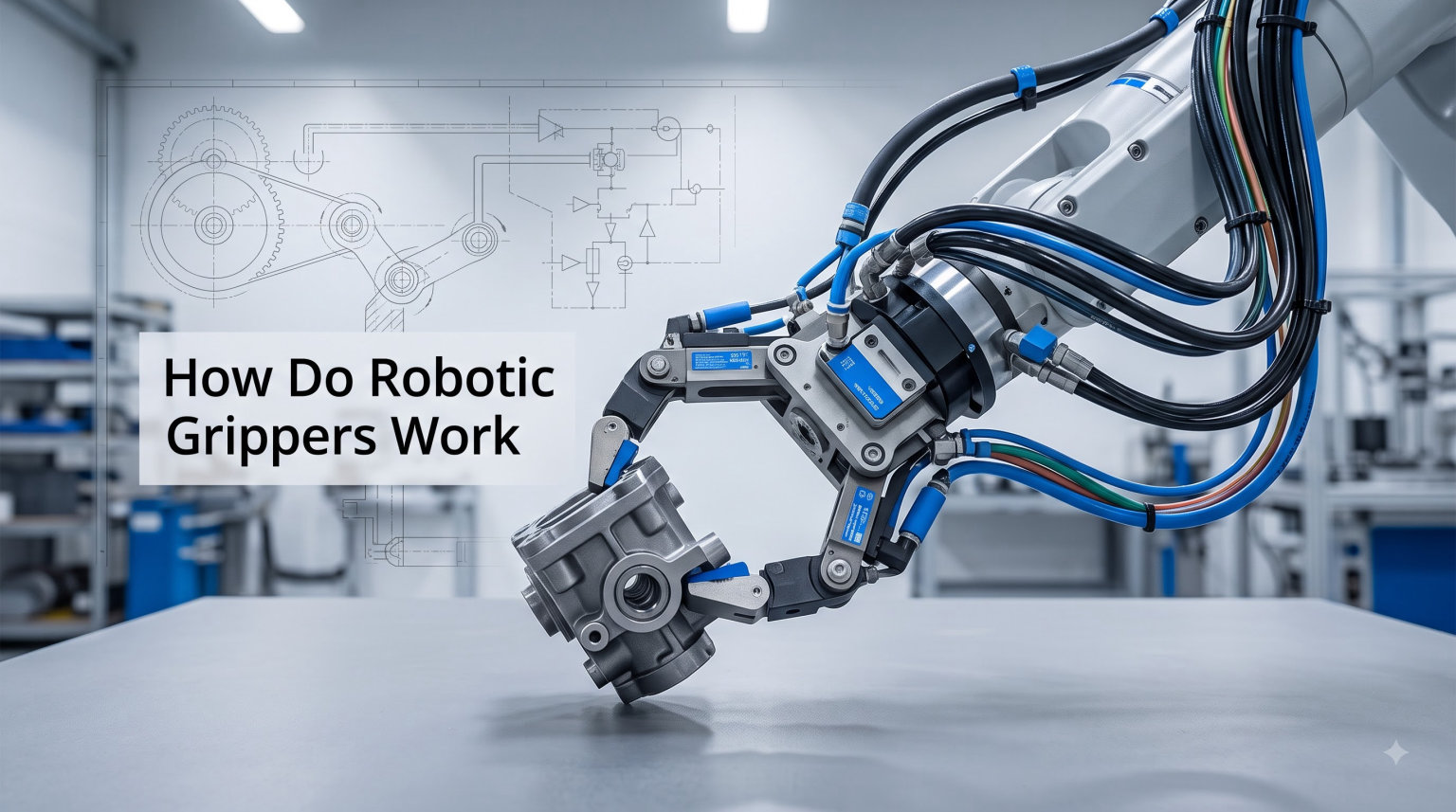
Robotic grippers are the end-effectors that let machines grab, hold, and move objects the same way our hands do. If you have ever watched a factory robot pick up a part and place it perfectly, the gripper did the heavy lifting. Understanding how do robotic grippers work means looking at a blend of actuators, sensors, and smart control systems that work together in milliseconds.
Our team has spent years building and testing robot arms for projects ranging from simple hobby setups to full industrial automation lines. We have broken down the mechanisms, component by component, so you can understand exactly what happens between the moment a robot reaches for an object and the moment it sets that object down.
By the end of this guide, you will know the working principle behind every major gripper type, the key components that make grasping possible, and how modern sensors tell a robot exactly when to move. We also cover the newest advances in soft robotics and AI-driven adaptive handling that are reshaping the field in 2026.
One thing that stands out from the robotics community: beginners consistently recommend soft grippers because they cause fewer problems with fragile or irregularly shaped objects. That insight shapes how we explain each gripper type below.
Table of Contents
How Do Robotic Grippers Work: The Core Mechanism
Robotic grippers work by using an actuator to generate controlled force that moves fingers, jaws, or suction cups into contact with an object, then sensors confirm the grip before the arm moves. The actuator can be pneumatic (air-powered), hydraulic (fluid-powered), or electric (motor-driven). Each power source trades off speed, precision, and grip force differently.
Think of the mechanism in four steps. First, the robot arm positions the gripper near the target object using pre-programmed coordinates or vision guidance. Second, the actuator activates, closing the fingers around the object or creating suction against its surface.
Third, force sensors measure how much pressure the gripper is applying and adjust to avoid crushing the item. Fourth, the control system confirms a secure hold and signals the arm to move. The entire sequence happens in under a second for industrial systems.
The working principle of a gripper always comes down to generating and controlling force. A mechanical gripper clamps an object between two or more jaws. A vacuum gripper creates negative air pressure that holds a flat or smooth object against a suction cup.
A magnetic gripper uses an electromagnetic field to pull ferrous materials. The physics changes between types, but the goal stays the same: maintain enough force to hold the object without damaging it. Every gripper type solves this challenge differently.
Here is where grip force matters enormously. Too little force and the object slips, too much and you crush it. Modern grippers solve this with closed-loop control systems.
A force sensor measures pressure in real time and feeds that data back to the controller, which adjusts the actuator instantly. This feedback loop is what separates a precision gripper from a simple clamp. The response time for these adjustments is measured in milliseconds.
The robotic grasping process becomes even more impressive when you consider speed. Industrial grippers complete the entire sequence from approach to secure hold in under a second. That speed comes from coordinated communication between the gripper, the arm, and the central controller.
Forum discussions from robotics hobbyists reveal a common frustration: grippers that require complex air supply setups are harder to work with than electric alternatives. This is why no-air-supply designs are gaining popularity, especially for first-time builders who want plug-and-play simplicity.
Types of Robotic Grippers
There are six main types of robotic grippers, each using a different physical principle to grab objects. Understanding the differences helps you match the right gripper to the right task. We cover vacuum, pneumatic, servo-electric, magnetic, soft robotics, and jamming grippers below.
Vacuum Grippers
Vacuum grippers use negative air pressure to hold objects against one or more suction cups. A vacuum pump or venturi generator removes air from inside the cup, creating a pressure difference between the cup interior and the surrounding atmosphere. That pressure difference generates the holding force.
These grippers excel at handling flat, smooth, or porous surfaces. You will see them everywhere in packaging lines picking up cardboard boxes, in logistics centers moving totes, and in glass manufacturing lifting sheet after sheet. They struggle with objects that have rough, uneven, or highly curved surfaces where a seal cannot form.
Most vacuum systems allow you to adjust suction pressure. This adjustability matters when handling delicate items like wafers or food products. Multi-cup configurations spread the holding force across a larger contact area, which improves stability for bigger payloads.
Pneumatic Grippers
Pneumatic grippers use compressed air to drive pistons that open and close mechanical fingers or jaws. When air enters the cylinder, it pushes the piston, which translates the motion through a linkage to the gripping fingers. The air supply typically runs at 60 to 90 PSI in industrial settings.
These are the workhorses of factory automation. They are fast, reliable, and simple to maintain. Two-jaw pneumatic grippers are the most common configuration, but three-jaw versions exist for centering cylindrical objects.
The trade-off is that pneumatic grippers offer limited control over grip force unless you add a separate pressure regulator. One drawback the robotics community frequently mentions is the need for an external air compressor and tubing. This complicates setup for smaller projects.
However, for high-cycle-rate industrial applications, nothing beats the speed and durability of pneumatic actuation. The simplicity of the internal mechanism means fewer parts to fail and longer service intervals between maintenance.
Servo-Electric Grippers
Servo-electric grippers use electric motors paired with position encoders to control finger movement with high precision. The servo motor drives a lead screw or rack-and-pinion mechanism that moves the jaws. The encoder reports exact finger position back to the controller at all times.
This is where grip force control truly shines. Because the motor’s torque directly correlates to applied force, the controller can maintain a specific grip pressure within fractions of a newton. You can program different force levels for different parts without changing any hardware.
This makes servo-electric grippers the go-to choice for handling delicate electronics or parts with varying fragility. The ability to precisely control both closing speed and grip force gives electric grippers a major advantage over pneumatic versions.
You pay more upfront, but you gain flexibility, quieter operation, and no need for compressed air infrastructure. For collaborative robot applications, servo-electric is increasingly the standard choice in 2026.
Magnetic Grippers
Magnetic grippers use electromagnets or permanent magnets to lift and hold ferrous metal objects. Electromagnetic versions can switch the magnetic field on and off electrically, which gives you control over when the object releases. Permanent magnet versions use a mechanical release mechanism.
These grippers are ideal for handling sheet metal, steel plates, and other iron-based materials in manufacturing and scrap handling. They require no physical contact force to maintain a hold, which eliminates the crushing risk entirely. The limitation is obvious: they only work with magnetic materials.
In sheet metal fabrication and CNC machine tending, magnetic grippers offer speed advantages because they can pick up flat stock instantly without needing to position jaws around it. The downside is that residual magnetism can sometimes affect thin or sensitive parts.
Soft Robotics Grippers
Soft robotics grippers use flexible, elastomeric materials that deform around objects to create a gentle, conforming grip. Instead of rigid jaws, these grippers use soft fingers made from silicone or similar polymers that curl, bend, or inflate when pressurized with air.
This technology is a breakthrough for handling fragile, irregular, or variable items. Soft grippers can pick up a ripe tomato without bruising it, grab a chicken breast of any size, or handle an oddly shaped part without reprogramming. The soft material conforms to the object’s shape, distributing force evenly across the contact surface.
The robotics community strongly recommends soft grippers for beginners because they are forgiving by nature. You do not need to worry about crushing delicate objects or programming exact grip force. Food handling, agriculture, and pharmaceutical applications are driving rapid adoption of soft robotics technology.
Jamming Grippers
Jamming grippers use a membrane filled with granular material, typically coffee grounds or glass beads, that shifts between fluid and solid states. When the gripper presses against an object with the membrane in its loose, fluid state, the granules flow around the object’s shape. Then a vacuum pump removes air from inside the membrane, causing the granules to jam together and lock into a rigid mold of the object.
This is one of the most versatile gripper designs ever created. A single jamming gripper can pick up a coin, a raw egg, a bolt, or a foam ball without any reconfiguration. The granular material conforms to any shape, and the vacuum transition locks that shape instantly.
It solves the problem of gripping irregularly shaped objects that defeat rigid-jaw grippers. The physics behind jamming is a phenomenon called granular jamming. When packed loosely, the granules slide past each other like a liquid.
When air is evacuated, friction between particles increases dramatically and the whole mass behaves like a solid. Releasing the vacuum returns the material to its fluid state, dropping the object cleanly. Researchers continue to refine the membrane materials and granule types to improve durability and grip consistency.
Jamming grippers remain somewhat niche in commercial applications, but they represent one of the most creative approaches to robotic grasping. They are particularly promising for applications where a single gripper must handle an unknown variety of object shapes and sizes.
The following comparison table summarizes the key characteristics of each gripper type to help you quickly identify the right option for your project.
| Gripper Type | Power Source | Best For | Key Advantage | Main Limitation |
|---|---|---|---|---|
| Vacuum | Compressed air | Flat, smooth surfaces | Fast pickup, no clamping force | Needs smooth surface for seal |
| Pneumatic | Compressed air | General industrial use | Fast, durable, cost-effective | Limited force control |
| Servo-Electric | Electric motor | Delicate, variable parts | Precise force and speed control | Higher cost |
| Magnetic | Electromagnet | Ferrous metal objects | No crushing risk, instant grip | Only works with magnetic materials |
| Soft Robotics | Pneumatic | Fragile, irregular objects | Gentle, self-adapting grip | Lower payload capacity |
| Jamming | Vacuum | Any shape, mixed objects | Universal grasping | Slower cycle, membrane wear |
Key Components of a Robotic Gripper
Every robotic gripper, regardless of type, is built from four core components: fingers or jaws that make physical contact, actuators that generate motion, sensors that provide feedback, and a frame that holds everything together. Understanding how each part works explains why grippers behave the way they do.
Fingers and Jaws
Fingers and jaws are the contact surfaces that physically touch and hold the object. Mechanical grippers use rigid jaws, often faced with rubber or textured pads to increase friction. Two-jaw designs are the most common, but three-jaw and multi-finger configurations exist for more complex manipulation tasks.
The jaw geometry determines what shapes a gripper can handle effectively. Flat jaws work well for boxes and blocks. V-shaped jaws center cylindrical parts automatically. Articulated fingers with multiple joints can wrap around irregular shapes, mimicking human hand dexterity.
The contact surface material matters as much as the geometry. Soft rubber pads grip smooth surfaces without scratching them. Metal jaws with serrated teeth lock onto heavy parts securely. The right pad material prevents slippage while protecting the object’s surface finish.
Actuators
Actuators are the muscles of the gripper. They convert energy from an external source into the mechanical motion that opens and closes the jaws. The three main types are pneumatic cylinders, hydraulic cylinders, and electric servo motors.
Pneumatic actuators use compressed air to move a piston inside a cylinder. They are fast and generate high force relative to their size. The air supply is easy to control with simple valves. However, pneumatic systems lack fine position control unless you add expensive proportional valves.
Hydraulic actuators use pressurized fluid instead of air. They deliver enormous grip force, making them the choice for heavy-duty applications like lifting engine blocks or handling large castings. The trade-off is that hydraulic systems are messy, slow, and require significant infrastructure.
Electric servo actuators use a motor and transmission to move the jaws. A servo motor gives you exact control over position, speed, and force simultaneously. This precision makes electric actuators the fastest-growing category in 2026, especially for collaborative robots that work alongside humans.
Sensors and Feedback Systems
Sensors are what separate a smart gripper from a dumb clamp. They tell the control system how hard the gripper is squeezing, whether it has made contact with the object, and whether the object is slipping. Without sensors, a gripper operates blind.
Force sensors measure the pressure the jaws apply to the object. This is the most important sensor for preventing damage. The controller uses force feedback to maintain grip pressure within a programmed range.
If the reading drops, the gripper tightens. If it spikes, the gripper backs off. This real-time adjustment happens continuously throughout the grip cycle.
Tactile sensors detect contact and surface properties. They can tell the difference between a smooth surface and a textured one, or between a rigid object and a soft one. Advanced tactile arrays map pressure distribution across the entire contact surface, giving the robot a sense of touch comparable to human skin.
Proximity sensors detect when an object is near the gripper before physical contact happens. Optical, capacitive, and inductive proximity sensors allow the gripper to slow its approach speed and avoid slamming into the object. This is especially important for fragile items.
Position encoders in servo-electric grippers report the exact jaw opening distance. The controller uses this data to confirm the object size matches expectations. If the jaws close less than expected, the object may be larger than anticipated or missing entirely.
Frame and Structure
The frame is the skeleton that holds all the components together and mounts the gripper to the robot arm. It needs to be rigid enough to resist deflection under load but light enough to avoid wasting the arm’s payload capacity. Aluminum is the most common material, with carbon fiber appearing in high-performance designs.
The mounting interface connects the gripper to the robot arm’s wrist or end-effector flange. Standard mounting patterns like ISO 9409 ensure compatibility across different arm brands. A well-designed mounting system allows quick gripper changes, which matters in flexible manufacturing environments where one robot handles multiple tasks.
Cable and tubing management is an often-overlooked structural concern. Pneumatic and electric grippers need air lines or power cables routed through or alongside the arm. Poor cable management leads to snags, wear, and eventually failure.
The best gripper designs integrate routing channels into the frame itself. This keeps cables protected and out of the way during operation. It also simplifies maintenance when a cable or tube needs replacement.
How Robots Know When to Move
Robots know when to move through a combination of programmed instructions, sensor feedback, and closed-loop control systems. The gripper does not act on its own. It communicates continuously with the robot controller, reporting grip status and waiting for movement authorization.
Here is how the decision sequence works in practice. The gripper closes on the object and the force sensor confirms adequate grip pressure. That signal travels to the robot controller, which interprets it as a success condition.
Only then does the controller send the command to the arm motors to begin movement. If the sensor reports insufficient force, the controller can command the gripper to tighten further or abort the pick entirely. This prevents the robot from lifting an object it has not securely grasped.
In more advanced systems, vision systems and proximity sensors add another layer of decision-making. A camera mounted on the arm or above the workspace identifies the object’s position and orientation. The robot adjusts its approach path accordingly.
Once the proximity sensor detects the object is within grabbing range, the arm slows down and the gripper activates. For collaborative robots, the safety layer is critical. If a force sensor detects unexpected resistance during movement, the cobot stops immediately.
This protects human workers who might be in the path. The same sensor data that confirms a successful grip also serves as a safety system during operation. Programmers define the trigger conditions for movement using if-then logic.
If grip force exceeds threshold X, then move to position Y. If grip force remains below threshold after closing, then retry or alert the operator. This conditional programming is what makes modern robots flexible enough to handle variations in object size, shape, and position without human intervention.
Applications of Robotic Grippers
Robotic grippers are used across virtually every industry that involves physical material handling. The specific gripper type and configuration always depend on the objects being handled, the environment, and the required cycle speed. Here are the most common applications driving adoption in 2026.
Manufacturing and Assembly
In manufacturing, grippers perform pick-and-place operations, assembly tasks, and machine tending. A pneumatic gripper might load raw stock into a CNC machine, while a servo-electric gripper assembles delicate electronic components. The precision and repeatability of modern grippers eliminate the variation that human hands introduce.
Automotive assembly lines rely heavily on grippers for installing fasteners, positioning panels, and handling heavy subassemblies. Hydraulic grippers handle the largest components, while electric versions manage smaller, more precise placement tasks. The ability to run 24 hours a day without fatigue is what makes robotic grippers essential on these lines.
Healthcare and Pharmaceuticals
Healthcare applications demand exceptional precision and cleanliness. Grippers used in pharmaceutical manufacturing operate in sterile environments, handling vials, syringes, and tablet packaging. Stainless steel construction and cleanroom-compatible materials are standard requirements.
Surgical robotics represent the most demanding application of all. The grippers on surgical robot systems perform tasks inside the human body, requiring sub-millimeter precision and force sensitivity that exceeds even the best human surgeon’s capabilities. Force feedback in these systems is so refined that the surgeon operating the controls can feel tissue resistance through the robotic interface.
Food Handling and Agriculture
Food handling is where soft robotics has made its biggest impact. Traditional rigid grippers damage soft produce, baked goods, and raw proteins. Soft grippers solve this by conforming to each item’s shape and applying gentle, even pressure.
In agriculture, grippers are used for harvesting delicate crops like strawberries and tomatoes. Vision-guided soft grippers identify ripe fruit and pick it without bruising. The variable nature of organic products, where no two items are exactly the same size or shape, makes adaptive grippers essential for this application.
Researchers in Korea demonstrated just how far grip technology has come with a gripper weighing only 130 grams that can lift objects weighing up to 100 kilograms. This strength-to-weight ratio opens possibilities for agricultural and industrial applications that were previously impossible.
E-commerce and Logistics
E-commerce fulfillment centers are the fastest-growing market for robotic grippers. Millions of individual products, each with a different shape, size, and weight, must be picked from bins and packed into shipping boxes. This is one of the hardest challenges in robotics, and gripper technology is what makes it solvable.
Vacuum grippers dominate logistics because they handle cardboard boxes and poly bags efficiently. For bin-picking of mixed items, adaptive grippers with suction and finger combinations are becoming the standard. The goal is a single gripper that can pick a tube of toothpaste, a book, and a stuffed animal from the same bin without retooling.
Choosing the Right Gripper for Your Application
Choosing the right gripper starts with understanding your object, your environment, and your performance requirements. The wrong choice leads to dropped parts, damaged products, and costly downtime. The right choice makes your automation project run smoothly from day one.
First, consider the object characteristics. What is its weight, size, shape, and surface material? Flat objects favor vacuum grippers, while metal parts open up magnetic options.
Irregular or fragile items point toward soft or jamming grippers. Standardized parts work well with simple pneumatic jaws. The object itself usually narrows your options quickly.
Next, evaluate your environment. A cleanroom requires stainless steel and sealed components. A food processing line needs washable, food-grade materials. A foundry needs heat-resistant grippers that tolerate dust and debris.
Environmental constraints often eliminate certain gripper types immediately. Matching the gripper material and sealing to the workspace conditions prevents premature failure and contamination issues.
Then look at payload capacity. Your gripper must handle the maximum object weight with a safety margin of at least two to one. But payload is not just about lifting strength.
It also includes the gripper’s own weight, which reduces the effective capacity of the robot arm. A heavy gripper on a light arm leaves very little room for the actual workpiece. Always check the combined weight against your arm’s rated payload.
Cycle speed is the next factor. Pneumatic grippers cycle fastest, making them ideal for high-throughput operations. Servo-electric grippers are slower but offer the precision needed for delicate or variable parts.
Soft and jamming grippers are the slowest but handle the widest range of object types. Your production rate requirements will dictate which trade-off makes sense.
Force control capability is a key differentiator that forum users consistently mention. If your application requires handling parts of varying fragility, servo-electric grippers with programmable force settings are worth the investment. If every part is the same, a simple pneumatic gripper will do the job at a fraction of the cost.
Finally, consider integration simplicity. Community discussions reveal that hobbyists and small-scale builders strongly prefer grippers that do not require external air supplies. Electric grippers that plug directly into the robot controller eliminate compressors, tubing, and regulators.
For first projects, this simplicity reduces setup time from days to hours. Plug-and-play compatibility with major robot brands like Universal Robots, Dobot, and others is a feature that the robotics community values highly.
The Future of Robotic Grippers
The future of robotic grippers is being shaped by three converging trends: AI-driven adaptive handling, advanced soft robotics, and breakthrough tactile sensing. Together, these technologies are closing the gap between robotic and human manipulation capabilities at an accelerating pace.
AI-driven adaptive handling uses machine learning to let grippers figure out the best grasp strategy on their own. Instead of programming every pick position and force level, the robot experiments with different approaches and learns which works best. Computer vision combined with reinforcement learning lets a gripper identify an unfamiliar object, plan a grasp, and execute it successfully on the first try.
Soft robotics continues to advance rapidly. New materials with self-healing properties, embedded sensors, and variable stiffness are pushing the boundaries of what soft grippers can handle. Researchers are developing soft grippers that can switch between compliant and rigid states on command, combining the gentleness of soft materials with the strength of traditional designs.
Tactile sensing is the area where the technology is moving fastest but receives the least attention. Next-generation tactile sensors use optical, capacitive, and barometric technologies to give robots a sense of touch that rivals human skin. These sensors can detect texture, temperature, and even the onset of slippage before the object actually moves.
This level of sensory awareness will eventually let robots handle tasks that currently require human dexterity. Open-source gripper designs are also accelerating innovation by letting researchers and hobbyists share and iterate on new ideas freely. The pace of development in 2026 suggests we are entering a period of rapid transformation in gripper capabilities.
Frequently Asked Questions About Robotic Grippers
What is the mechanism of robotic arm gripper?
A robotic arm gripper mechanism works by using an actuator (pneumatic, hydraulic, or electric) to move jaws, fingers, or suction cups into contact with an object. Force sensors measure the applied pressure, and a control system adjusts the grip to hold the object securely without crushing it. The gripper communicates with the robot controller to confirm a successful hold before the arm moves.
How do robotic arms know when to move?
Robotic arms know when to move through a combination of sensor feedback and programmed logic. The gripper’s force sensors confirm that adequate grip pressure has been achieved, and that signal is sent to the robot controller. Only when the controller receives confirmation of a secure grip does it send movement commands to the arm motors. Vision systems and proximity sensors add additional decision-making layers.
What is the working principle of gripper?
The working principle of a gripper is to generate and control force to hold an object securely. Mechanical grippers clamp objects between jaws, vacuum grippers use negative air pressure against suction cups, magnetic grippers use electromagnetic fields for ferrous materials, and soft grippers use flexible materials that conform to object shapes. In every case, sensors provide real-time feedback to maintain the correct grip force.
What are the different types of robotic grippers?
The main types of robotic grippers are vacuum grippers (use suction for flat surfaces), pneumatic grippers (use compressed air for fast industrial clamping), servo-electric grippers (use motors for precise force control), magnetic grippers (use electromagnets for ferrous metals), soft robotics grippers (use flexible materials for fragile items), and jamming grippers (use granular material that stiffens under vacuum to grip any shape).
Conclusion
Understanding how do robotic grippers work comes down to one core idea: generating and controlling force to hold objects securely. Whether that force comes from compressed air, an electric motor, a vacuum pump, or an electromagnet, the goal is always the same. The gripper must maintain enough force to prevent the object from slipping while staying gentle enough to avoid damage.
The technology has come a long way from simple pneumatic clamps. Soft robotics, jamming grippers, and AI-driven adaptive handling are opening up applications that were impossible just a few years ago. As tactile sensing continues to improve, the gap between robotic and human manipulation will keep shrinking.
If you are building your first robot project, start with an electric gripper for simplicity. If you are automating a production line, match the gripper type to your specific object and cycle requirements. The right gripper makes all the difference between a system that runs reliably and one that constantly needs adjustment.