
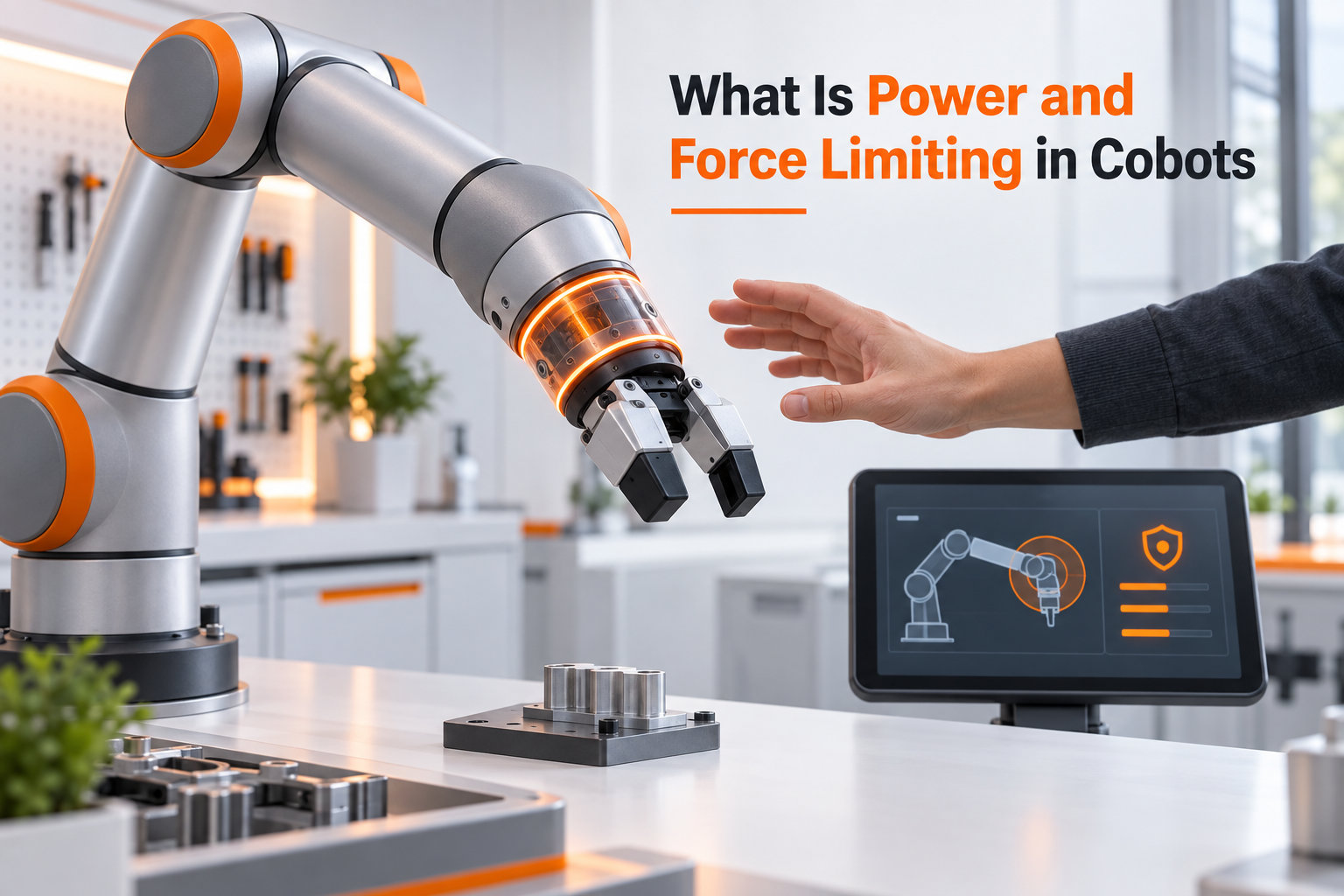
Power and force limiting (PFL) is a collaborative robot safety mode in which embedded sensors detect abnormal forces during contact and automatically stop or reduce the robot’s movement. If you have ever wondered why some industrial robots can work shoulder-to-shoulder with people while others live behind yellow cages, the answer usually comes down to PFL. I have spent years around factory floors, and I can tell you that this single feature has done more to open automation to small and mid-sized operations than almost any other advance in modern robotics.
In this guide, I will walk you through exactly what power and force limiting means, how the underlying sensor technology keeps people safe, the international standards that govern it, and where PFL still falls short. I will also break down the four collaborative operation modes side by side so you can see where PFL fits in the bigger picture.
Table of Contents
What Is Power and Force Limiting in Cobots?
Power and force limiting is one of four collaborative operation modes defined for cobots, the others being safety-rated monitored stop, speed and separation monitoring, and hand guiding. PFL is the mode most people picture when they hear the word “cobot,” because it is the only mode that allows sustained physical contact between a moving robot and a human operator.
At its core, a PFL cobot is engineered to keep both the energy it can deliver and the contact force it can exert below defined biomechanical injury thresholds. Rather than relying on fences, light curtains, or scanners to keep people out, the robot itself becomes the safety device. Embedded sensors in each joint measure torque, and when an unexpected resistance is detected, the controller commands a stop or reversal within milliseconds.
The approach was formalized because traditional industrial robots can be genuinely dangerous. A heavy industrial arm moving at full speed carries enough kinetic energy to crush bones in an instant. PFL attacks that problem at the design level by reducing mass, adding compliant materials, rounding edges, and capping both speed and joint torque. It is a layered strategy, and no single layer is enough on its own.
How Does Power and Force Limiting Work?
PFL works through a continuous control loop. Every joint in the cobot is fitted with sensors that report the torque they are experiencing in real time. The controller compares the measured torque against a model of what the robot expects to see based on its current motion. When the two diverge beyond a threshold, the controller flags a contact event.
Once a contact is flagged, the response is almost instant. A typical PFL cobot will stop or reverse direction in under 50 milliseconds, which is fast enough to keep the transient contact force below the injury limits defined in ISO/TS 15066. After the stop, the robot holds its position until a human supervisor resets the system, or it resumes its task automatically if the contact was brief and below force limits.
Two physical principles make the approach practical. The first is backdrivability, the ability of the drivetrain to be pushed back by an external force without damage. Harmonic drives, low gear ratios, and series elastic elements help. The second is low inertia, achieved by keeping the robot light, often under 30 kilograms total, and keeping its moving payload small.
For comparison, a traditional industrial robot may weigh 1,000 kilograms or more and operate at speeds of 2 meters per second. A PFL cobot typically runs at 250 to 1,000 millimeters per second when collaborating, and caps its payload to keep kinetic energy manageable. The math is unforgiving, and that is the point.
Key Sensor Technologies Behind PFL Cobots
Sensor technology is the heart of any PFL cobot. Without accurate, low-latency measurement of joint torque, the safety function simply does not exist. In my time comparing units from different vendors, I have seen three sensor strategies dominate the market.
Direct joint torque sensors sit between the motor and the load. They measure strain on a known element, usually a flexure with strain gauges, and translate that strain into a torque reading. This is the cleanest approach and the one used by Universal Robots, Fanuc CRX, and Techman. The advantage is high accuracy and a fast response. The trade-off is cost and a slightly heavier joint.
Current sensing estimates torque indirectly by measuring the current drawn by each joint motor. Because motor current is roughly proportional to torque, this approach avoids dedicated torque hardware. It is cheaper, but it is also noisier and less sensitive to slow external forces. It tends to appear in lower-cost collaborative arms where a small sacrifice in safety margin is acceptable for the price point.
Series elastic actuators and force feedback add a mechanical spring between the motor and the output. The spring deflection is measured, giving very accurate force information. Kuka’s LBR iiwa is the classic example. The compliant element also softens impacts, adding another layer of safety on top of the electronic detection.
There is a growing distinction worth noting between reactive and proactive collision detection. Reactive detection waits for the unexpected torque spike to register, as described above. Proactive detection uses machine learning models trained on normal motion data to predict an imminent contact before the spike occurs. Only a handful of vendors have shipped proactive features as of 2026, but I expect that to change quickly as AI edge processors become cheaper.
Safety Standards: ISO 10218 and ISO/TS 15066
PFL is not a marketing term. It is governed by an international standards framework that sets hard numbers for what “safe” means in collaborative operation. Two documents matter most.
ISO 10218-1 and ISO 10218-2 cover the safety requirements for industrial robots and robot systems. They define the four collaborative operation modes and the high-level design rules a manufacturer must follow. The 2011 revision introduced the collaborative framework that vendors still use today, and the standards were updated again in 2025 to clarify risk assessment expectations.
ISO/TS 15066 is the technical specification that turns the framework into numbers. It provides biomechanical limits for quasi-static and transient contact on each major body region. A risk assessment must show that any possible contact event stays below these limits. The most cited values are 150 newtons of quasi-static force and 210 newtons of transient force for the torso, with lower limits for more sensitive areas like the face and neck.
The table below summarizes the most commonly referenced limits. These are the targets the cobot’s control system and risk assessment are measured against.
Biomechanical limits for collaborative robot contact, drawn from ISO/TS 15066:
Torso, quasi-static contact: 150 N maximum force, 50 N/cm squared maximum pressure.
Torso, transient contact: 210 N maximum force, 70 N/cm squared maximum pressure.
Head and face, quasi-static contact: 65 N maximum force, 35 N/cm squared maximum pressure.
Hand and finger, transient contact: 280 N maximum force, 50 N/cm squared maximum pressure.
Lower leg and knee, transient contact: 220 N maximum force, 80 N/cm squared maximum pressure.
Skull and forehead, transient contact: 150 N maximum force, 50 N/cm squared maximum pressure.
Meeting these numbers in practice is harder than it looks. Every link in the chain matters, including joint torque accuracy, response time, end-effector shape, payload mass, and approach speed. I have watched integrators spend weeks tuning a single application to keep measured contact forces inside the published limits.
Power and Force Limiting Vs Other Collaborative Modes
ISO 10218 defines four collaborative operation modes, and PFL is just one of them. Picking the right mode for a given application is often the most important decision a system integrator makes, so it helps to see them side by side.
Safety-rated monitored stop is the simplest. The robot runs at full industrial speed when no operator is in the workspace, then enters a safe stop the moment someone enters. Productivity is high, but contact is forbidden by design, so the robot effectively stops being “collaborative” whenever a person is nearby.
Speed and separation monitoring keeps the robot moving while a person is present but reduces its speed based on the measured distance between the two. It is dynamic and allows high throughput when the operator steps back, but it requires reliable distance sensing, often vision or safety-rated scanners, and a clean cell layout.
Hand guiding lets a worker physically move the robot to teach a path or perform a task. The cobot uses force feedback to detect the human’s input and follow it. This is the mode you see in teach-pendant-free programming setups and in some assistive applications.
Power and force limiting is the only mode that allows sustained physical contact during automatic operation. It is also the most restrictive in terms of payload and speed. For applications where contact is rare, SSM is often faster. For applications where contact is constant, PFL is the only practical choice.
Real-World Applications and Limitations
PFL cobots shine in tasks that involve frequent operator interaction at modest speeds and forces. Common applications include machine tending on small CNC mills, light assembly of electronics and consumer goods, screwdriving, quality inspection, and packaging. In these settings, the cobot handles the repetitive part of the job while the operator focuses on tasks that require judgment or dexterity.
It is important to be honest about the limits. A common pain point I have seen in shop floor discussions is the misconception that PFL makes a cobot inherently safe at any speed. It does not. Even a 3 kilogram cobot arm moving at its maximum collaborative speed can bruise soft tissue or worse, especially if a pinch point is created between the robot and a fixture. Safety is a function of the entire system, including the tool, the workpiece, and the surrounding fixtures.
Rounded edges, padded covers, and non-pinching joint designs help, but they do not replace a proper risk assessment. The honest take is that PFL reduces the severity of an incident. It does not eliminate the possibility of one. Operators still need training, and integrators still need to validate force and pressure measurements in the final installed configuration.
If you are evaluating a PFL cobot for your shop, ask the vendor for measured transient and quasi-static contact data on the actual end-effector you plan to use, not on a generic test block. Ask for the controller update rate, the documented reaction time, and the joint torque sensor accuracy. The numbers you write into your risk assessment must come from the final assembled system, not from a brochure.
Frequently Asked Questions
How do force torque sensors work in collaborative robots?
Force torque sensors in collaborative robots use strain gauges mounted on a flexure inside each joint. As external forces act on the arm, the flexure deforms slightly and the strain gauges measure that deformation. The controller converts the strain reading into a torque value and compares it to the expected torque for the current motion. When the measured value exceeds the expected value by a calibrated threshold, the system flags a contact event and triggers a stop within milliseconds.
What are the four types of collaborative robot operations?
The four collaborative operation modes defined in ISO 10218 are safety-rated monitored stop, speed and separation monitoring, hand guiding, and power and force limiting. Safety-rated monitored stop halts the robot when a person enters the workspace. Speed and separation monitoring dynamically adjusts robot speed based on operator distance. Hand guiding allows a worker to physically move the robot. Power and force limiting is the only mode that allows sustained physical contact during automatic operation, with embedded sensors and control limits keeping contact forces below defined injury thresholds.
What is ISO/TS 15066 and why does it matter?
ISO/TS 15066 is a technical specification that provides biomechanical force and pressure limits for collaborative robot contact events. It translates the high-level safety requirements of ISO 10218 into specific numeric limits for each body region, including maximum force in newtons and maximum pressure in newtons per square centimeter. The document matters because it gives integrators and risk assessors a concrete, testable target. A collaborative application is not considered compliant until measured contact forces and pressures during a worst-case event stay below the published thresholds.
How fast can a power and force limiting cobot move safely?
In practice, power and force limiting cobots run at 250 to 1,000 millimeters per second during collaborative operation, well below the speeds of fenced industrial robots which can exceed 2,000 millimeters per second. The exact cap depends on the robot model, the payload, the end-effector mass, and the biomechanical limit being targeted. ISO/TS 15066 does not set a universal speed number, but integrators commonly treat 250 millimeters per second as a conservative working maximum when the contact target is a sensitive body region.
What happens when a cobot contacts a human?
When a cobot in power and force limiting mode detects abnormal joint torque, the controller commands a safe stop or reverse motion within roughly 50 milliseconds. The robot holds its position until a human resets the system, or it resumes its task automatically if the contact event was brief and below force limits. The system is designed so that the transient contact force never exceeds the biomechanical thresholds defined in ISO/TS 15066 for the body region at risk, which keeps injuries at the level of a light bump rather than a serious impact.
The Future of Power and Force Limiting in Human-Robot Collaboration
Power and force limiting has been the dominant story in collaborative robotics for more than a decade, and it is still evolving. The most interesting work I am seeing in 2026 is at the intersection of PFL and machine learning, where predictive models flag an imminent collision seconds before the torque spike appears. Combine that with softer materials, smarter end-effectors, and tighter integration with vision and force sensors, and the line between PFL and the other collaborative modes will keep blurring.
For now, the practical takeaway is simple. PFL is what makes a cobot a cobot, but it is a safety tool, not a magic one. Pair it with a real risk assessment, honest speed and payload numbers, and training for everyone who works near the arm. Do that, and you will get the productivity gain without the bruises.