
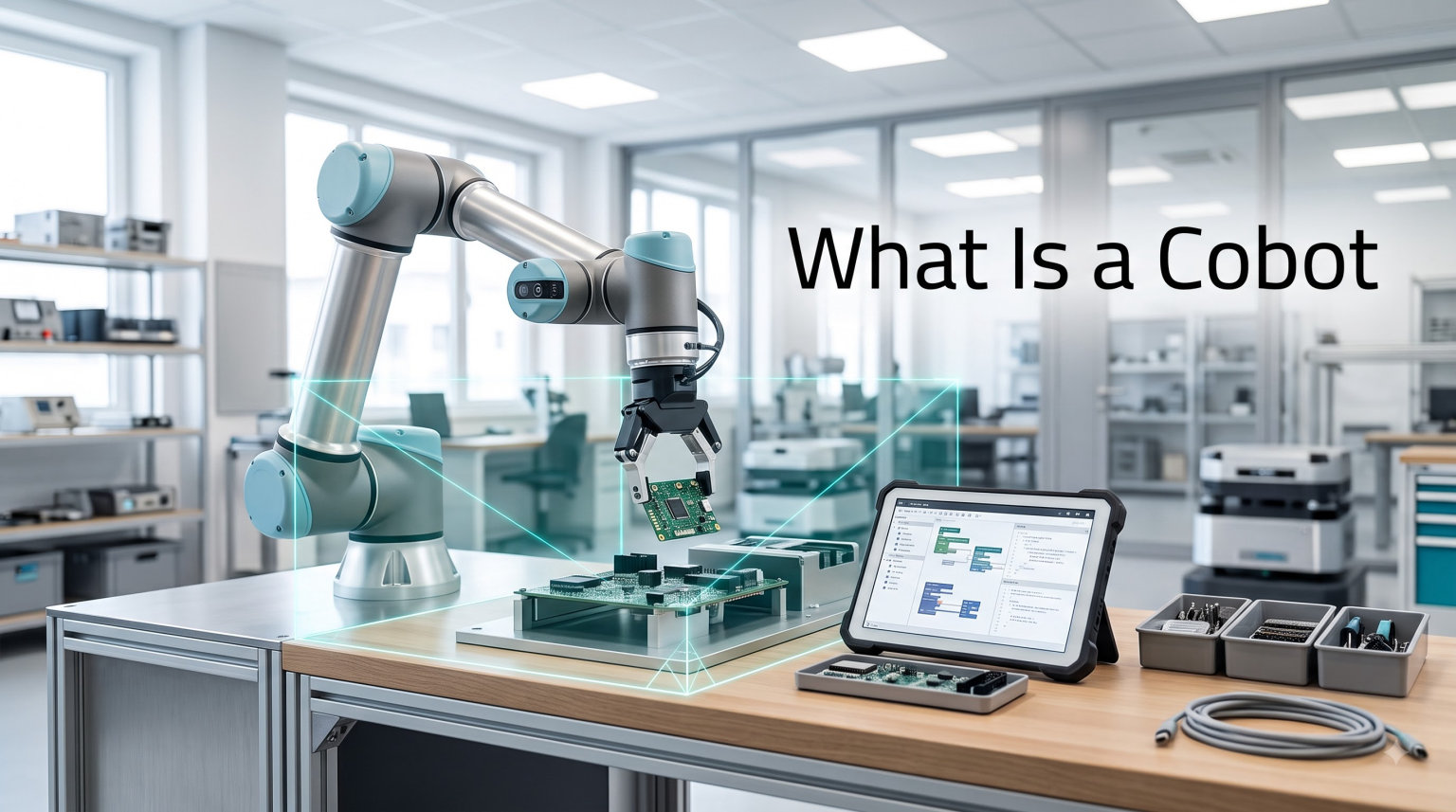
If you have spent any time on a factory floor or in a modern machine shop lately, you have probably noticed something new: a robot arm working right next to a person, with no cage, no fence, and no panic. That is a cobot, and it is changing the way we think about automation.
A cobot, short for collaborative robot, is a robot designed to work safely alongside humans in a shared workspace. Unlike traditional industrial robots that operate inside locked cells, cobots use built-in sensors, force-limiting software, and lightweight construction to make close human-robot interaction possible.
In this guide, I will walk you through what a cobot is, how it differs from a classic industrial robot, the safety features that make collaboration possible, the four main types you will encounter, the applications where cobots shine, and where the technology is heading in 2026 and beyond.
Table of Contents
What Is a Cobot? A Clear Definition
A cobot, or collaborative robot, is a robot intended for direct, close-range human-robot interaction within a shared workspace. The term was first coined in the mid-1990s to describe a new class of robots designed to physically collaborate with people rather than replace them behind steel barriers.
The defining trait of a cobot is safety through design, not safety through isolation. Traditional industrial robots achieve safety by being fenced off from humans. Cobots achieve it through a combination of force sensors, collision detection algorithms, rounded geometry, and software limits that slow or stop the arm when a person enters the workspace.
For a quick definition you can use anywhere, here it is: a cobot is a robot arm built to work safely next to people, using sensors and force-limiting software rather than cages to prevent injury.
This shift in design philosophy matters because it removes one of the biggest barriers to automation: the cost and inflexibility of building dedicated robot cells. A small manufacturer can deploy a cobot on an existing bench, teach it a new task in an afternoon, and redeploy it to a different station next week.
The History of Cobots: From 1996 to Today
The concept of a collaborative robot was first patented in 1996 by J. Edward Colgate and Michael Peshkin, professors at Northwestern University. Their original idea was simple but radical: instead of making a robot fast and powerful enough to keep humans away, design a robot that is inherently safe to touch.
The first commercial cobot, the Load Handling Assistant, was developed in the late 1990s for automotive assembly. It was essentially a motorized, computer-controlled assist device rather than a free-moving arm, but it proved the concept that humans and machines could share physical work.
The real breakthrough came in 2008 when Universal Robots launched the UR5, the first commercially successful six-axis cobot arm. It was affordable, easy to program, and small enough to fit on a tabletop. Suddenly, collaborative robotics was not a research curiosity but a real product category.
Since then, the market has expanded rapidly. Today, major cobot manufacturers include Universal Robots, FANUC, ABB, KUKA, Yaskawa (Motoman), Techman, Doosan, and Franka Emika. By 2026, more than 50,000 cobots are installed worldwide each year, and the segment continues to grow faster than traditional industrial robotics.
Key Characteristics of Collaborative Robots
What makes a cobot a cobot? After reviewing dozens of models and watching them on shop floors, I have come to rely on a handful of defining characteristics. If a robot does not have these features, it is not really a cobot, no matter what the brochure says.
Built-in safety. Force sensors, torque sensors, and collision detection are baked into the arm. When a cobot senses unexpected contact, it stops within milliseconds. This is what removes the need for cages in most low-risk applications.
Ease of programming. Modern cobots ship with graphical interfaces, drag-and-drop programming, and hand-guiding modes. A line worker with no coding background can teach a new part in an hour.
Lightweight design. Most cobot arms weigh between 10 and 35 kilograms. They are easy to move, mount on a table, bolt to a cart, or relocate to a different cell when production needs change.
Flexibility and redeployment. A cobot is not bolted to a single task. You can swap end effectors, change programs, and redeploy the same arm across multiple stations throughout the week.
Speed and force limits. Cobots operate at deliberately limited speeds and payloads compared to industrial robots. This is a feature, not a limitation, because it is what makes the safety case work.
Collaborative workspace. The cobot is designed to share its workspace with humans. In a properly risk-assessed cell, a person and a cobot arm can be working on the same part at the same time.
How Cobots Differ from Industrial Robots
One of the most common questions I hear from manufacturers is simple: what is the difference between a cobot and a robot? It is a fair question, because both look like robot arms and both move in similar ways. The differences, however, are significant and worth understanding before you invest in either.
Here is how they compare across the dimensions that matter most:
- Safety approach. Industrial robots are isolated behind cages, light curtains, and interlocks. Cobots are designed to be safe in direct human contact through force and speed limiting.
- Programming complexity. Industrial robots usually need a skilled integrator or a dedicated robot programmer using a teach pendant. Cobots use graphical interfaces, hand guiding, and teach-by-demonstration.
- Payload and speed. Industrial robots can lift hundreds of kilograms and move at high speed. Cobots are typically limited to 3 to 35 kilograms of payload and slower joint speeds.
- Footprint and weight. Industrial robots weigh hundreds of kilograms and need dedicated cells. Cobots are small enough to mount on a bench and move with a hand truck.
- Deployment time. A new industrial cell can take weeks or months to install and validate. A cobot can be unboxed, mounted, and running a first task in a single day.
- Cost. Industrial cells often cost hundreds of thousands of dollars once you add the robot, the cell, the safety hardware, and the integration. A cobot arm typically costs between 25,000 and 75,000 dollars, with full cells landing well below the cost of a traditional robot installation.
- Use case. Industrial robots excel at high-volume, high-speed production. Cobots shine in high-mix, low-volume work where flexibility matters more than raw speed.
The quick way to remember it: industrial robots are built for speed and payload in fenced cells. Cobots are built for flexibility and safety in shared spaces. Both are useful, and the right choice depends on your product, your volume, and your team.
The Four Types of Cobots
Not all cobots collaborate the same way. The International Federation of Robotics and ISO/TS 15066 recognize four distinct types of collaborative operation, and understanding them is essential for any safety assessment.
1. Safety-rated monitored stop. The cobot operates like a standard industrial robot but stops whenever a human enters the workspace. The robot does not move while the person is present and resumes only after they leave. This is the simplest form of collaboration and is often used for high-payload tasks where the arm needs full strength when no one is nearby.
2. Hand guiding. The operator physically grasps the end of the arm and moves it through the desired path. The cobot records the motion and replays it. This is the classic teach-by-demonstration mode and is ideal for short production runs and complex trajectories that would be hard to program manually.
3. Speed and separation monitoring. The cobot uses sensors, often vision-based, to track the position of nearby humans and adjust its speed accordingly. As a person gets closer, the robot slows down. If the person comes within a defined minimum distance, the robot stops. This allows true side-by-side work with appropriate safeguards.
4. Power and force limiting. The cobot is designed from the ground up so that any contact with a human will not cause harm. Force sensors limit joint torque, and software enforces speed and energy caps. This is the mode most people picture when they think of a cobot working next to a person without barriers.
Most commercial cobot arms support multiple modes, and the right choice depends on the task, the workspace, and the risk assessment. In practice, many manufacturers use a mix, relying on power and force limiting for light assembly and switching to speed and separation monitoring for higher-payload operations.
Safety Features of Collaborative Robots
Safety is the whole reason cobots exist, so it is worth looking at the specific features that make them safe enough to work next to a person without a cage.
Force-torque sensors. Modern cobot arms include sensors at each joint that measure the force being applied. If the cobot pushes against something it did not expect, including a person, the sensor data triggers an immediate stop.
Collision detection software. Beyond raw sensors, cobots run algorithms that compare expected motion to actual motion. A sudden deviation means a collision, and the controller reacts in milliseconds.
Speed and force limits. ISO/TS 15066 defines maximum allowable speeds and forces for collaborative operation, including pressure limits on different parts of the body. A compliant cobot cell is designed around these limits.
Rounded geometry and padding. Cobot arms have rounded links, smooth covers, and often soft padding at pinch points to reduce the risk of injury during contact.
Emergency stop and protective stops. Like any industrial machine, cobots have e-stops, but they also implement protective stops that the system itself can trigger when a safety condition is violated.
Compliance with standards. The two key documents are ISO 10218-1 and ISO 10218-2, which cover robots and robotic systems, and ISO/TS 15066, which is the technical specification specifically for collaborative robot operation. A properly deployed cobot cell includes a documented risk assessment that references these standards.
Even with all of this, no cobot is safe by default. Every installation needs a risk assessment, training, and clear operating procedures. The cobot makes safety easier, but it does not eliminate the need for good engineering.
Common Applications and Use Cases
Cobots are used in a surprisingly wide range of tasks. After visiting dozens of facilities, I have found that the most common applications fall into a handful of categories.
Assembly. Cobots handle small-parts assembly, screwdriving, and component insertion. Their repeatability and ability to hand-guide make them well suited to short production runs where fixturing traditional robots would be too expensive.
Machine tending. One of the most popular uses. The cobot loads and unloads CNC mills, lathes, and injection molding machines, freeing operators to focus on quality and multiple machines at once.
Material handling and packaging. Cobots pick and place parts, pack products into cases, and palletize finished goods. With vision systems, they can handle variations in part presentation that would stump a traditional robot.
Quality inspection and testing. Equipped with cameras and test equipment, cobots perform consistent inspections, dimensional checks, and functional tests. Their repeatability is a major advantage for statistical process control.
Dispensing, finishing, and polishing. Cobots apply adhesives, sealants, paint, and polish with consistent pressure and path accuracy. Hand guiding makes it easy to teach complex surface paths.
Welding. Collaborative welding has grown rapidly, especially for small-batch metal fabrication shops. The cobot holds the torch while the welder programs the path and supervises the work.
Palletizing. While heavier palletizing still favors industrial robots, cobots are widely used for end-of-line palletizing at moderate speeds and payloads.
The common thread is that cobots thrive where tasks are repetitive, ergonomically challenging, or hard to staff, but where volumes do not justify a full industrial cell.
Industries Using Cobots in 2026
One of the biggest gaps I see in competing articles is a clear look at which industries are actually adopting cobots. Coverage tends to focus on automotive and electronics, but the real picture in 2026 is much broader.
Automotive and suppliers. Still the largest segment, including tier-one suppliers doing subassembly, dispensing, and machine tending. Cobots complement rather than replace the heavy industrial robots on body lines.
Electronics and semiconductors. High-precision assembly, PCB handling, and test operations where the small footprint and clean operation of cobots are a major advantage.
Metal fabrication and machining. Small job shops use cobots for machine tending, welding, and finishing. The flexibility of redeployment suits a high-mix environment.
Food and beverage. Packaging, palletizing, and pick-and-place in environments where stainless construction and washdown ratings are required.
Healthcare and life sciences. Lab automation, sample handling, and pharmaceutical packaging are growing niches where cobots’ small footprint and ease of programming matter.
Agriculture and food production. Sorting, packing, and palletizing in post-harvest and processing facilities. The labor savings in these environments can be significant.
Logistics and warehousing. Order picking, induction, and sortation, often paired with mobile robots and conveyor systems. This is one of the fastest-growing cobot segments.
The takeaway: cobots are no longer just for large manufacturers. Small and medium businesses across nearly every sector are finding ways to deploy them.
Benefits and Advantages of Cobots
Why are so many companies investing in cobots? The benefits fall into a few clear categories, and they explain why cobot adoption keeps accelerating.
Improved safety and ergonomics. Cobots take over the dull, dirty, and dangerous tasks that lead to repetitive strain injuries and lost-time accidents. Workers shift to higher-value roles that require judgment and problem solving.
Higher productivity and uptime. A cobot can run a second or third shift without fatigue, increasing machine utilization and output. For many small manufacturers, this alone justifies the investment.
Flexibility for high-mix production. Unlike hard automation, a cobot can be reprogrammed and redeployed in hours. This matters for shops running 20 different part numbers a week.
Faster deployment. Most cobots are running their first task within a day of unboxing. Traditional industrial cells take weeks or months by comparison.
Lower total cost of ownership. While the upfront cost of a cobot arm is meaningful, the total cost is often lower than a traditional cell because there is no need for fencing, large safety systems, or extensive facility modification.
Easier workforce adoption. Because cobots are designed to work with people, not replace them, the workforce tends to accept them faster. Operators can teach the cobot themselves, which builds buy-in and reduces dependence on outside integrators.
The honest version of the cost story: a cobot arm typically runs between 25,000 and 75,000 dollars depending on reach and payload, and a complete cell including fixturing, end effectors, and integration often lands between 50,000 and 150,000 dollars. Compared to a full industrial cell, this is significantly less, but it is still a serious capital investment that needs an ROI case.
For most small and medium businesses, the ROI comes from one or more of these drivers: solving a labor shortage, removing an ergonomic bottleneck, running unattended hours, or increasing consistency and yield on a quality-critical task.
Cobots and AI Integration
The cobot story in 2026 is no longer just about hardware. Modern cobots increasingly ship with onboard vision systems, machine learning, and AI-assisted programming that make them easier to deploy and more capable on complex tasks.
3D machine vision. Built-in or add-on cameras let cobots recognize parts in random poses, inspect defects, and adapt to variation without precise fixturing. This is a major unlock for high-mix production.
AI-assisted programming. Some platforms now suggest trajectories, detect anomalies, and learn from operator corrections. The result is faster setup and less reliance on expert programmers.
Natural language and no-code interfaces. Generative AI is starting to make its way into cobot programming, allowing operators to describe a task in plain language and have the controller generate the underlying program.
Predictive maintenance. AI models trained on joint torque data, vibration, and temperature can predict failures before they happen, reducing unplanned downtime and extending service life.
The trend is clear: cobots are evolving from programmable machines into learning collaborators that are easier to teach and more capable on tasks that would have required custom vision systems just a few years ago.
The Future of Collaborative Robotics
Looking ahead from 2026, the trajectory of collaborative robotics points in a few clear directions.
Higher payloads with the same safety story. New models are pushing payload limits toward 35 kilograms and beyond while keeping the force and speed limiting that defines the category. This opens up palletizing, heavy assembly, and welding applications that were previously the domain of industrial robots.
Mobile manipulation. Combining cobot arms with mobile bases creates mobile manipulators that can navigate a facility and perform tasks anywhere they are needed. This is one of the fastest-growing segments in logistics and light manufacturing.
AI-native cobots. Expect the next generation of cobots to ship with built-in large multimodal models, allowing operators to communicate with them using speech, gestures, and demonstration rather than menus and code.
Lower cost of entry. As the market matures, expect entry-level cobot arms to drop below the 20,000 dollar mark, putting them within reach of even the smallest manufacturers and makerspaces.
Deeper industry penetration. Healthcare, agriculture, food service, and construction are all areas where cobot adoption is still early. As standards evolve and use cases are proven, expect a steady expansion into these new sectors.
The big picture: cobots started as a tool for manufacturers, but they are quickly becoming a general-purpose platform for physical automation, accessible to anyone who can teach a task and perform a basic risk assessment.
Frequently Asked Questions
What is the difference between a cobot and a robot?
A cobot is a collaborative robot designed to work safely next to humans using force-limiting sensors and software, while a traditional industrial robot is built for speed and payload inside a fenced cell. Cobots trade raw performance for flexibility, ease of programming, and the ability to share a workspace with people.
How much does a cobot cost?
A cobot arm typically costs between 25,000 and 75,000 dollars depending on reach and payload. A complete cell, including fixturing, an end effector, and integration, usually lands between 50,000 and 150,000 dollars, which is significantly less than a traditional industrial robot cell once safety fencing and integration are added.
What are cobots used for?
Cobots are most often used for assembly, machine tending, material handling, packaging, quality inspection, dispensing, polishing, welding, and palletizing. They excel at repetitive, ergonomically challenging tasks in low to medium volume production where flexibility and quick redeployment matter more than raw speed.
What are the main safety features of cobots?
The main safety features of cobots include force-torque sensors at each joint, collision detection software, speed and force limits defined by ISO/TS 15066, rounded geometry with padding, and emergency and protective stop circuits. A compliant installation also includes a documented risk assessment referencing ISO 10218.
How do cobots work with humans?
Cobots work with humans by using sensors and software to detect human presence and respond safely. Depending on the mode of collaboration, the cobot may stop when a person approaches, slow down based on distance, or limit contact forces so any collision is below injury thresholds defined in ISO/TS 15066.
What are the four types of cobots?
The four types of cobots defined by ISO/TS 15066 are safety-rated monitored stop, hand guiding, speed and separation monitoring, and power and force limiting. Each describes a different way the robot and human can share a workspace, and the right choice depends on the task, the payload, and the risk assessment.
Conclusion
A cobot, or collaborative robot, is a robot designed from the ground up to work safely alongside people. It uses force sensors, collision detection, and software limits to remove the need for cages, and it trades raw speed and payload for flexibility, ease of programming, and quick redeployment.
If you are evaluating collaborative robots for your facility, the next step is to identify a single, repetitive, ergonomically challenging task where a cobot can take over a portion of the work, then run a proper risk assessment against ISO 10218 and ISO/TS 15066. Start small, document the ROI, and expand from there.
We will keep covering the cobot space here on Smashing Robotics, including platform reviews, application deep dives, and AI integration trends as they evolve through 2026 and beyond.