
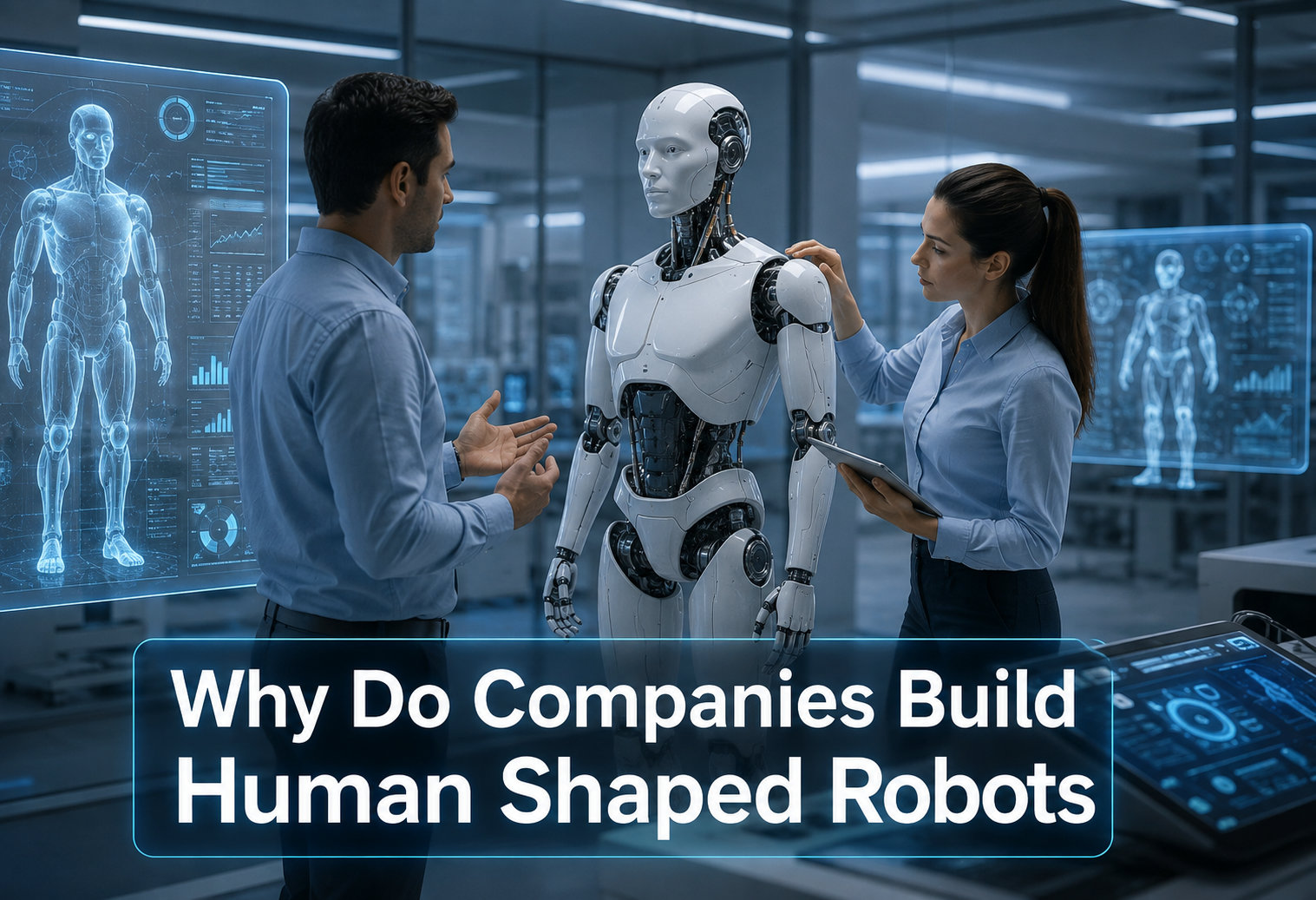
If you have scrolled through tech news lately, you have probably noticed the same thing I have. A new video drops almost every week showing a humanoid robot walking through a warehouse, sorting boxes, or folding laundry. It raises a question I hear constantly from readers: why do companies build human shaped robots when wheels, tracks, and arms on a fixed base look simpler and more efficient?
The short answer is that our entire world is built for human bodies. Doorways, stairs, tool handles, kitchen counters, factory floors, hospital corridors. A robot that shares our shape can drop into those spaces without anyone rebuilding the building. In this guide I will break down the real motivations driving companies like Tesla, Figure AI, Boston Dynamics, and 1X to pour billions into humanoid robots in 2026, and I will also address the fair question of whether wheels would be better.
You will learn the core engineering reasons, the economic pressures from labor shortages and aging populations, the psychological factors that make us trust a face over a box, and the honest technical challenges that still hold humanoid robots back. Let us get into it.
Table of Contents
Why Companies Build Human Shaped Robots: The Core Answer
Companies build human shaped robots because our factories, homes, and cities are already engineered around the human body, and one versatile humanoid robot can replace many single-purpose machines. That single insight drives most of the design and investment decisions you see in the industry.
When a warehouse manager looks at automating, they are not choosing between one robot and another. They are choosing between redesigning their entire facility for a fleet of wheeled robots, or hiring one humanoid that can use the same ladders, carts, and conveyors their human workers already use. The second option is faster, cheaper, and reversible. Here are the top reasons that keep coming up in industry reports and on the floor with operators:
- Humans have already designed the world around human bodies, so a humanoid shape drops into existing infrastructure with no retrofit.
- One humanoid robot can perform many different tasks, replacing a fleet of single-purpose machines.
- Human workers can hand off tasks to a humanoid using the same tools, language, and safety protocols they already know.
- Labor shortages in warehouses, manufacturing, and eldercare are pushing companies toward a flexible automation option.
- A familiar form factor makes people more willing to interact with, and trust, a robot in shared spaces.
Those five reasons are the spine of every pitch deck I have seen from humanoid robot startups. The rest of this article unpacks each one with real examples and data.
Infrastructure Compatibility: Why the Human Form Fits Our World
The single strongest reason companies build humanoid robots is infrastructure compatibility. Buildings, tools, vehicles, and workstations were designed for a body that stands roughly 170 centimeters tall, has two arms with opposable thumbs, and walks on two legs. A humanoid robot inherits all of that for free.
Think about a typical factory floor. There are control panels at chest height, valves that need a human grip to turn, ladders bolted to walls, and carts with handles shaped for human hands. A wheeled robot with a single arm cannot climb that ladder, turn that valve, or push that cart up a curb. A humanoid can, with the same motion a human technician would use. As humanoid robots on Smashing Robotics continue to be covered, this infrastructure argument keeps coming up again and again.
The numbers back this up. Industry analysts estimate that retrofitting a single mid-sized factory for non-humanoid automation can cost anywhere from several hundred thousand to several million dollars, depending on the production line. A humanoid robot that arrives in a crate, walks off the pallet, and starts working with the tools already on the wall is a dramatically cheaper path. For companies that rent rather than own their facilities, retrofitting is not even an option, which makes the humanoid form factor the only practical choice.
There is also a hidden second-order benefit. Because human tools are mass-produced, they are cheap. Grippers for humanoid hands can use off-the-shelf components, and replacement parts are easy to source. A specialized robot arm designed for one factory may need custom tooling that costs more than the robot itself.
Human-Robot Interaction: The Power of a Familiar Form
Beyond physical infrastructure, companies invest in humanoid robots because humans interact more naturally with something that looks like them. A pair of eyes, a head that turns toward you, two arms that gesture, these cues make collaboration feel intuitive rather than mechanical.
I have seen this firsthand at robotics expos. When a humanoid robot waves at a passerby, the response is almost always a wave back, and a smile. When a wheeled delivery robot rolls up to the same person, the response is usually a step to the side. That difference matters when robots are supposed to work alongside people in hospitals, hotels, and homes. The IEEE humanoid robot overview makes the same point: human-like design is partly about social acceptance, not just engineering.
Research on the uncanny valley suggests that nearly-human robots can actually feel creepier than obviously mechanical ones, but in the current generation most companies are deliberately keeping their designs clearly robotic. Visible joints, matte panels, no fake skin. That balance keeps the form familiar enough to be approachable without triggering discomfort.
There is also a learning curve argument. A new warehouse hire does not need a manual to figure out how to work next to a humanoid robot, because the robot takes up the same space, moves at the same speed, and uses the same tools. Training a team to work alongside a fleet of small wheeled robots requires teaching people a new mental model of how the facility flows. That retraining is a real cost that the industry does not talk about enough.
Labor Shortages and the Aging Population: The Economic Driver
Economic pressure is the second great force behind humanoid robot development. Across the United States, Europe, Japan, and South Korea, working-age populations are shrinking while the number of people who need care is growing. There are not enough workers to fill the jobs that need filling, and wages are rising fast in the sectors where humanoids are most likely to deploy first.
Warehouse and logistics companies are the clearest example. The U.S. Bureau of Labor Statistics reports that turnover in warehousing routinely runs above 40 percent per year, and employers struggle to fill shifts even at higher wages. Humanoid robots are pitched as a way to take on the most physically punishing tasks, like loading and unloading trucks, while human workers move into supervisory and exception-handling roles.
Eldercare is the other pressure point. Countries like Japan and Germany are facing steep growth in the population over age 65, and there are not enough caregivers to staff nursing homes and home care at current ratios. Humanoid robots are not going to replace nurses anytime soon, but they can lift patients, fetch items, and provide companionship, which frees trained staff to focus on medical and emotional care.
For companies, the math is simple. If a humanoid robot can replace one or two full-time shifts at a cost lower than a human wage over a five-year horizon, the payback period is attractive, especially when hiring is hard. This is exactly the case that Figure AI, 1X, and Apptronik have been making to their early customers in 2026.
Key Companies Building Humanoid Robots in 2026
Investment in humanoid robots has accelerated sharply, and a handful of companies are setting the pace. Each one takes a slightly different approach to the form factor, the business model, and the target use case, which gives a useful view into where the industry is heading.
- Tesla (Optimus): Tesla is leveraging its work on autonomous driving to build a general-purpose humanoid intended for factory work first, then home use. The bet is on scale, using manufacturing know-how from the vehicle side to drive costs down.
- Figure AI: Figure has focused on industrial deployment and has signed early commercial pilots with manufacturers. Its robots are designed for warehouse and factory floors rather than the home.
- Boston Dynamics (Atlas): Atlas has been the long-running research platform for bipedal mobility. The new electric Atlas is aimed at real commercial applications, and Boston Dynamics has decades of data on dynamic movement.
- 1X Technologies: 1X is going after the home and service market with a humanoid backed by OpenAI. Its focus is on safe, soft-bodied designs that can work around people without heavy industrial guarding.
- Apptronik: Apptronik spun out of the University of Texas at Austin and has focused on industrial pilots, including announced work with automakers.
- Agility Robotics (Digit): Digit has been one of the first to operate in real warehouses for sustained periods, with Amazon and GXO among its pilot partners.
What ties these players together is the bet that the humanoid form factor is the right one for general-purpose automation. You can see more coverage of these companies and others in our physical AI infrastructure powering humanoid robots piece.
Technical Challenges That Explain Why Humanoid Robots Are Hard
I would not be doing this topic justice if I did not also walk through what makes humanoid robots genuinely hard. The form factor that buys you infrastructure compatibility also brings engineering problems that wheeled robots do not face.
Bipedal balance is the first one. Two-legged walking on uneven surfaces, pushing carts, recovering from a shove, none of that is solved in the general case. Most current humanoids can walk on flat floors and ramps, but stairs, ice, gravel, and crowded spaces still cause frequent falls. The control systems that coordinate dozens of joints in real time are pushing the limits of what onboard computers can do.
Dexterous hands are the second challenge. Human hands have about 27 degrees of freedom, and replicating that with electric motors while keeping weight and cost down is unsolved. Most humanoid hands in 2026 have far fewer degrees of freedom and rely on clever grip strategies rather than true dexterity. Tasks like tying a shoelace or handling a deformable object like cloth are still beyond nearly every robot in production.
Power is the third challenge. Walking on two legs is energy-inefficient, and running a humanoid for a full shift requires batteries that are still heavy, expensive, and slow to charge. Our guide to battery technologies powering modern humanoid robots goes deeper into this trade-off, but the short version is that energy density is the bottleneck on useful work time.
Perception and autonomy are the fourth. A humanoid robot needs to see, understand, and act in the same messy environments humans navigate. That requires the kind of multimodal AI covered in the physical AI infrastructure platforms article, but it also requires robust safety systems, because a 70-kilogram robot falling on a person is a serious injury.
Why Not Just Use Wheels? Addressing the Skepticism Directly
This is the question I get most often, and it is a fair one. Wheels are mechanically simpler, more energy efficient, and easier to control. So why bother with a humanoid at all?
The answer comes down to generalization versus optimization. A wheeled robot is great at one thing, and you can build a fleet of them to cover a structured warehouse or factory floor. A humanoid is okay at many things, and one humanoid can move between tasks as needs shift. For a small business with a single loading dock, a wheeled robot is probably the right call today. For a logistics company with ten different workflows and a labor force that turns over constantly, one humanoid that can be reassigned every hour is a better fit.
There is also the matter of unstructured environments. Most of the world, including homes, hospitals, hotels, and small shops, was not designed for robots at all. Stairs, doors, uneven sidewalks, and tight corners are everywhere. A humanoid can handle those without a redesign. A wheeled robot, no matter how clever, cannot climb the stairs to your front door.
The honest version is that wheels and humanoids will coexist. For long-haul, structured tasks, wheels win. For versatile, general-purpose work in human spaces, humanoids are the better long-term bet. Companies are not building humanoids because they are the best robot for every job. They are building them because they are the best robot for the largest, least structured share of the work.
Real-World Applications Where Humanoid Robots Make Sense
Where are humanoid robots actually being deployed today? The use cases that are closest to commercial viability in 2026 cluster into a few clear categories. Each one shows up repeatedly in pilot announcements, factory tours, and customer case studies.
- Warehouse and logistics: Loading and unloading trucks, picking totes, moving carts, and staging pallets. This is the most active pilot segment, with Amazon, GXO, and BMW running live tests.
- Manufacturing: Assisting on production lines, machine tending, and material handling between stations. Automotive plants are the early adopters.
- Eldercare and home assistance: Fetching items, reminding patients to take medication, and providing companionship. This is more research-focused today but has the largest long-term market.
- Dangerous tasks: Working in environments too hazardous for humans, such as parts of nuclear plants, chemical facilities, and disaster response. The humanoid form factor lets these robots use the same tools and hatches as human responders.
- Retail and hospitality: Stocking shelves, carrying luggage, and front-of-house concierge work. Service robots in humanoid form are a small but growing category.
What you will notice is that every one of these tasks happens in human-shaped spaces. That is not a coincidence. It is the entire reason the humanoid form factor exists in the first place.
Frequently Asked Questions
Why are we building humanoid robots?
We are building humanoid robots because our world is already shaped for human bodies. A humanoid robot can use existing tools, climb existing stairs, walk through existing doors, and work in existing buildings without any retrofit. That drops the cost and time of deploying automation dramatically, especially in homes, hospitals, and small businesses that cannot rebuild their facilities around a fleet of specialized robots.
What country is leading in humanoid robots?
The United States, China, Japan, and South Korea are the four leading countries in humanoid robot development. The U.S. leads in venture-backed companies such as Figure AI, Apptronik, and 1X, while China has a deep manufacturing base and a growing list of humanoids from companies like Unitree and Fourier Intelligence. Japan and South Korea bring decades of humanoid research from groups like Honda and KAIST.
What companies build humanoid robots?
The most prominent humanoid robot builders in 2026 include Tesla (Optimus), Figure AI, Boston Dynamics (Atlas), 1X Technologies, Apptronik, and Agility Robotics (Digit). Each one is taking a different angle, from industrial pilots to home service, but they all share the same bet that a human-shaped generalist robot is the future of automation.
What challenges do humanoid robots face when moving?
Humanoid robots struggle with bipedal balance on uneven terrain, recovering from pushes or trips, walking on slippery or loose surfaces, and coordinating the many joints needed for smooth motion. Power and weight are also major challenges, since balancing a tall, top-heavy robot on two legs requires continuous real-time control that drains batteries quickly.
Are humanoid robots a good investment?
For companies facing severe labor shortages and rising wages, humanoid robots can be a good investment, especially for repetitive material handling tasks. For consumers, humanoid robots are not yet a practical purchase outside of research or hobby use. Mass adoption will depend on whether costs fall fast enough to undercut human labor in the next five to ten years.
Why humanoid robots will fail, according to critics
Critics argue humanoid robots will fail because they are mechanically inefficient, far more complex than wheeled or fixed-arm robots, and too expensive to deploy at scale. They also point out that many of the viral videos show choreographed demos rather than sustained real-world work. The honest answer is that some humanoid projects will fail, but the demand for versatile automation in human spaces is real, which is why the category continues to attract billions in investment.
Conclusion
So, why do companies build human shaped robots? Because the alternative, rebuilding every building, every tool, and every workflow around a different kind of robot, is more expensive than building robots that look like us. The humanoid form factor buys infrastructure compatibility, task versatility, intuitive collaboration, and a path through the labor and demographic pressures that every developed economy is facing.
The challenges are real, and not every humanoid program will succeed. But the demand is real too, and the companies pouring billions into this space are betting that one versatile robot is worth more than ten specialized ones. If you want to keep following the technology, our humanoid robots on Smashing Robotics category page is the best place to track the next wave of pilots, products, and breakthroughs.