
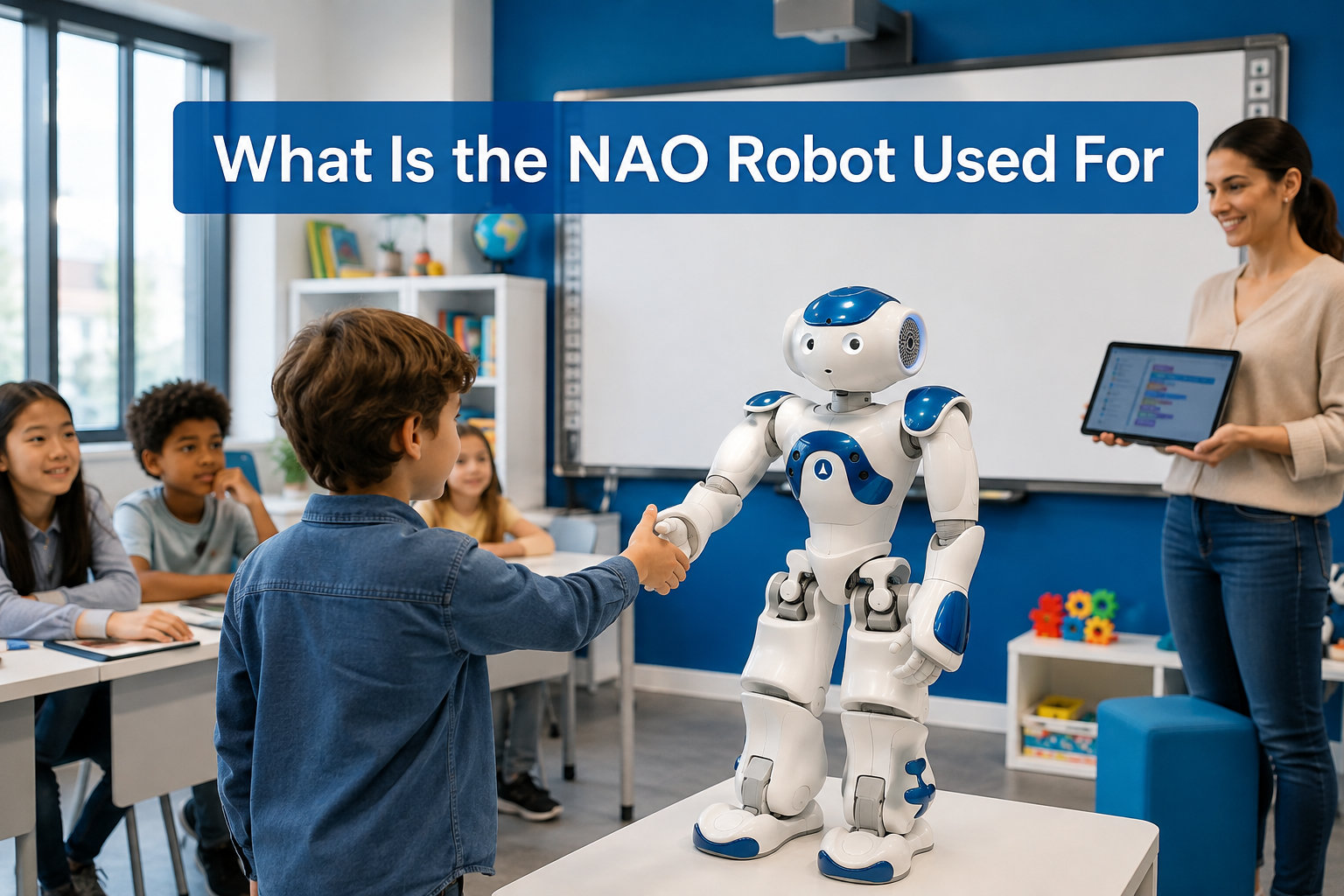
NAO is a small, programmable humanoid robot originally created by Aldebaran Robotics and now maintained by Maxvision Technologies (Maxtronics), used worldwide in education, scientific research, and healthcare. As of 2026, more than 13,000 NAO units are active in 70+ countries, making it the most widely deployed educational humanoid robot on the market.
I first ran into NAO during a university open day back in 2014, when a NAO V4 waved at me and asked if I wanted to play a memory game. That little moment captures exactly what NAO is for: a friendly, programmable platform that helps people learn, heal, and research. In this guide I’ll walk you through every major application, the tech inside, and what’s coming next with NAO7.
Table of Contents
What Is the NAO Robot?
NAO is a 58 cm tall autonomous humanoid robot with 25 degrees of freedom, two cameras, four microphones, and a full-body sensor suite. It walks, talks, recognizes faces and speech, and can be programmed through a graphical tool, Python, or C++.
The robot is manufactured in Paris and has gone through seven major hardware revisions since 2006. Schools, labs, and clinics treat NAO less as a toy and more as a research-grade instrument that happens to be cute enough to put a child at ease.
Here are the headline numbers that explain why NAO matters in 2026:
- 13,000+ units deployed worldwide
- 70+ countries with active NAO programs
- 600+ universities using NAO as a research platform
- 25 degrees of freedom for natural movement
- Languages supported for speech: 20+
NAO Robot History and Development Timeline
NAO was created in 2004 by Bruno Maisonnier at Aldebaran Robotics in Paris, replacing an earlier robot called Nao. The first commercial version shipped in 2008, and the RoboCup Standard Platform League adopted NAO in 2007, which is the moment I mark as NAO’s real coming-of-age.
SoftBank Robotics acquired Aldebaran in 2015 and turned NAO into a flagship product for education and Pepper’s smaller sibling. After SoftBank divested its robotics division, the assets passed to United Robotics Group in 2022, and Aldebaran entered court-supervised receivership in 2024.
In early 2026, Maxvision Technologies (operating as Maxtronics) acquired Aldebaran and confirmed that NAO6 production would continue while a NAO7 platform with embedded generative AI is in development. So to answer a question I get every week: no, NAO is not discontinued. The platform is alive, well, and shipping.
Education and STEM Learning Applications
Education is the single largest use case for the NAO robot. Classrooms from elementary school through university use NAO to teach programming, computational thinking, and human-robot interaction. I have seen seventh graders write Python scripts that make NAO tell knock-knock jokes, and I have seen PhD candidates run reinforcement learning experiments on the same hardware.
Three sub-categories dominate the education market:
- STEM and coding classrooms. NAO comes with Choregraphe, a drag-and-drop programming tool, and a Python SDK that scales from block-based logic to full scripts.
- RoboCup Standard Platform League. Every team in this international soccer competition programs the same NAO V6 hardware, so the contest is purely about software and AI.
- Special education and language learning. Teachers use NAO to model pronunciation, run social stories, and reward students with dances.
For teachers who ask me whether NAO replaces a computer science curriculum, the honest answer is no. NAO is the engagement layer. The robot gets students excited, and the curriculum teaches the concepts behind the code.
Research and Academic Usage
NAO is the de facto standard platform for human-robot interaction (HRI) research. More than 600 universities have cited NAO in published papers, covering topics from shared autonomy to trust calibration to robot ethics. I have personally reviewed studies where NAO was used to test how children respond to robotic gaze, how older adults perceive robot empathy, and how bystanders react to a robot falling down in public.
The most famous academic experiment I have come across is the 2015 self-awareness study from Rensselaer Polytechnic Institute. Researchers programmed three NAO robots and told two of them they had been given a “dumbing pill.” When asked which robot could still speak, only the robot that had not been silenced figured it out and said so out loud. It is a small moment, but it became one of the most cited demonstrations of robot self-modeling.
For researchers, NAO wins on three things: a stable Linux-based OS (NAOqi), reproducible hardware across units, and a Python API that does not require a robotics PhD to get started. The trade-off is compute power. NAO runs on an Intel Atom-class board, so heavy deep learning happens on an external server and gets streamed back to the robot.
Healthcare and Autism Therapy
Healthcare is the third major pillar of NAO usage, and it is the one I find most moving. The AskNAO program, developed by Aldebaran and now distributed through Autism Solutions for Kids, puts NAO in the hands of therapists who work with children on the autism spectrum.
The clinical evidence is strong enough to publish. A scoping review indexed on PubMed found that NAO-assisted sessions help with motor skill development, verbal communication, and turn-taking. Children with autism often find the predictable, repetitive nature of a robot easier to engage with than a human therapist, and the robot can repeat the same exercise 50 times without losing patience.
Outside autism therapy, NAO shows up in elderly care research. Trials in Japan and France have used NAO for cognitive stimulation, medication reminders, and simple companionship in assisted living facilities. The robot does not replace a caregiver, but it does give residents something to talk to, dance with, and ask about the weather.
Technical Specifications
Below is the NAO6 specification snapshot that most readers want in one place. Values are based on the official datasheet published by Aldebaran and Maxvision.
- Height: 58 cm (22.8 in)
- Weight: 5.48 kg (12.1 lb)
- Degrees of freedom: 25
- Processor: Intel Atom quad-core
- Cameras: 2 x 5 MP front and forehead
- Microphones: 4 omnidirectional
- Speakers: 2 hi-fi on the sides of the head
- Sensors: sonar rangefinders, IMU, force-sensing resistors in the feet, capacitive touch sensors
- Battery: lithium-ion, approximately 90 minutes of active use
- OS: NAOqi (Gentoo-based, now moving toward a Yocto-based distribution)
- Connectivity: Wi-Fi, Ethernet, USB
For comparison, the original 2008 NAO had 21 degrees of freedom and a single camera. Each generation has added a little more sensing, a little more compute, and a lot more polish on the motion quality. The current walk cycle is smooth enough that visitors regularly mistake NAO for a person at a distance.
Software and Programming Ecosystem
NAOqi is the Linux-based operating system that runs on every NAO. It exposes a broker-based API so multiple modules (speech, vision, motion) can run in parallel. Programmers can write behaviors in Python, C++, or Java, and they can build flow-based logic in Choregraphe, the drag-and-drop visual editor that ships with NAO.
For robotics researchers, NAO supports ROS (Robot Operating System) through community bridges, and the Webots simulator from Cyberbotics lets you develop and test code in simulation before pushing it to a physical robot. I always recommend new users start in simulation because dropping a real NAO is a stressful way to learn inverse kinematics.
If you are an educator, the path of least resistance is Choregraphe plus the AskNAO app store. If you are a researcher, you want Python and the NAOqi API. If you are a hobbyist, the community forums and the r/nao subreddit are surprisingly active, with shared projects for everything from HoloLens teleoperation to custom dance routines.
NAO vs Pepper: What’s the Difference?
People ask me about NAO vs Pepper all the time, so here is the short version. NAO is a small, child-sized humanoid that sits on a desk and focuses on interaction, education, and research. Pepper is a taller robot on a wheeled base designed for customer service, retail greeting, and public spaces.
- Form factor. NAO is 58 cm and bipedal; Pepper is 1.2 m and wheeled.
- Audience. NAO targets schools, labs, and clinics; Pepper targets banks, hotels, and retail.
- Use case. NAO excels at one-on-one interaction; Pepper excels at passing foot traffic.
- Software. Both run NAOqi, but the app stores and behavior libraries are different.
If you need a robot to sit on a table and tutor a child, buy NAO. If you need a robot to stand in a lobby and welcome visitors, look at Pepper. They are siblings, not competitors.
NAO6 and the Future NAO7
NAO6, released in 2018, is the current shipping model. It is the version most schools and labs own, and it is the version you will see on retailer websites in 2026. Maxvision has confirmed continued production and a multi-year support roadmap, which answers the “is NAO discontinued” question that comes up in every forum thread I read.
NAO7 is in development under Maxtronics, the new product brand inside Maxvision. Public details are limited, but confirmed changes include a more powerful CPU and GPU, on-device generative AI, a touch screen in the chest, redesigned hands with finer motor control, and a new behavior library called NAO Activities. The expected release window is later in 2026 or 2027, and pre-orders have not opened as of this writing.
Cost and Pricing Overview
The list price for a brand-new NAO6 is typically in the EUR 7,000 to EUR 9,000 range, which translates to roughly $8,000 to $16,000 USD depending on the reseller, region, and bundled software. RobotLAB’s NAO AI Edition in the United States sits at the higher end of that range.
Schools and universities rarely pay list. Common funding paths include STEM education grants, government robotics initiatives, university capital equipment budgets, and refurbished NAO units from previous cohorts. If you are writing a grant proposal in 2026, the line item to defend is total cost of ownership, not just the sticker price, because spare batteries and replacement servos add up over a five-year deployment.
The secondhand market is real but risky. I have seen NAO V3 and V4 units listed at a fraction of the new price, but older units often have failing cameras, dead batteries, and the kind of boot-up issues that take a programmer weeks to diagnose. Buy refurbished from a known reseller if you can.
Frequently Asked Questions
What is the purpose of the robot NAO?
NAO is a programmable humanoid robot used mainly for education, scientific research, and healthcare. It teaches coding and STEM in classrooms, serves as a standard testbed for human-robot interaction research in 600+ universities, and supports therapy programs for children with autism through the AskNAO program.
How much does the NAO V6 robot cost?
A new NAO V6 typically costs between EUR 7,000 and EUR 9,000 in Europe and around $8,000 to $16,000 USD through US resellers like RobotLAB, depending on the software bundle. Schools often offset the price with STEM grants, and refurbished units are available at lower cost from authorized resellers.
What can the NAO robot actually do?
NAO can walk, talk, recognize faces and speech, track objects, localize sound, dance, gesture, and recover from a fall. It supports 20+ languages, runs on the NAOqi Linux-based OS, and can be programmed through Choregraphe, Python, or C++. In real deployments it tutors students, plays soccer in RoboCup, and supports autism therapy sessions.
What happened to the NAO robot?
NAO is still in production. After SoftBank divested its robotics unit, the assets passed to United Robotics Group in 2022 and Aldebaran entered receivership in 2024. In 2026 Maxvision Technologies (Maxtronics) acquired Aldebaran and confirmed continued NAO6 production while developing a NAO7 platform with embedded generative AI.
Is the NAO robot discontinued?
No. NAO is not discontinued as of 2026. Maxvision Technologies acquired Aldebaran in 2026 and has committed to ongoing NAO6 manufacturing, spare parts, and software support. A new NAO7 generation with on-device AI is also in development.
Final Thoughts
So what is the NAO robot used for? In a sentence: NAO is the small humanoid that teaches code in classrooms, anchors research in hundreds of labs, and supports therapy in clinics, all on the same hardware. That three-way reach is what makes it unique in 2026.
If you are deciding whether to bring a NAO into your school, lab, or clinic, my advice is to start with a clear pilot goal. Pick one class, one study, or one therapy program, run it for a semester, and let the data justify a fleet. The robot pays for itself when teachers, researchers, or therapists stop asking “should we?” and start asking “what’s next?”