
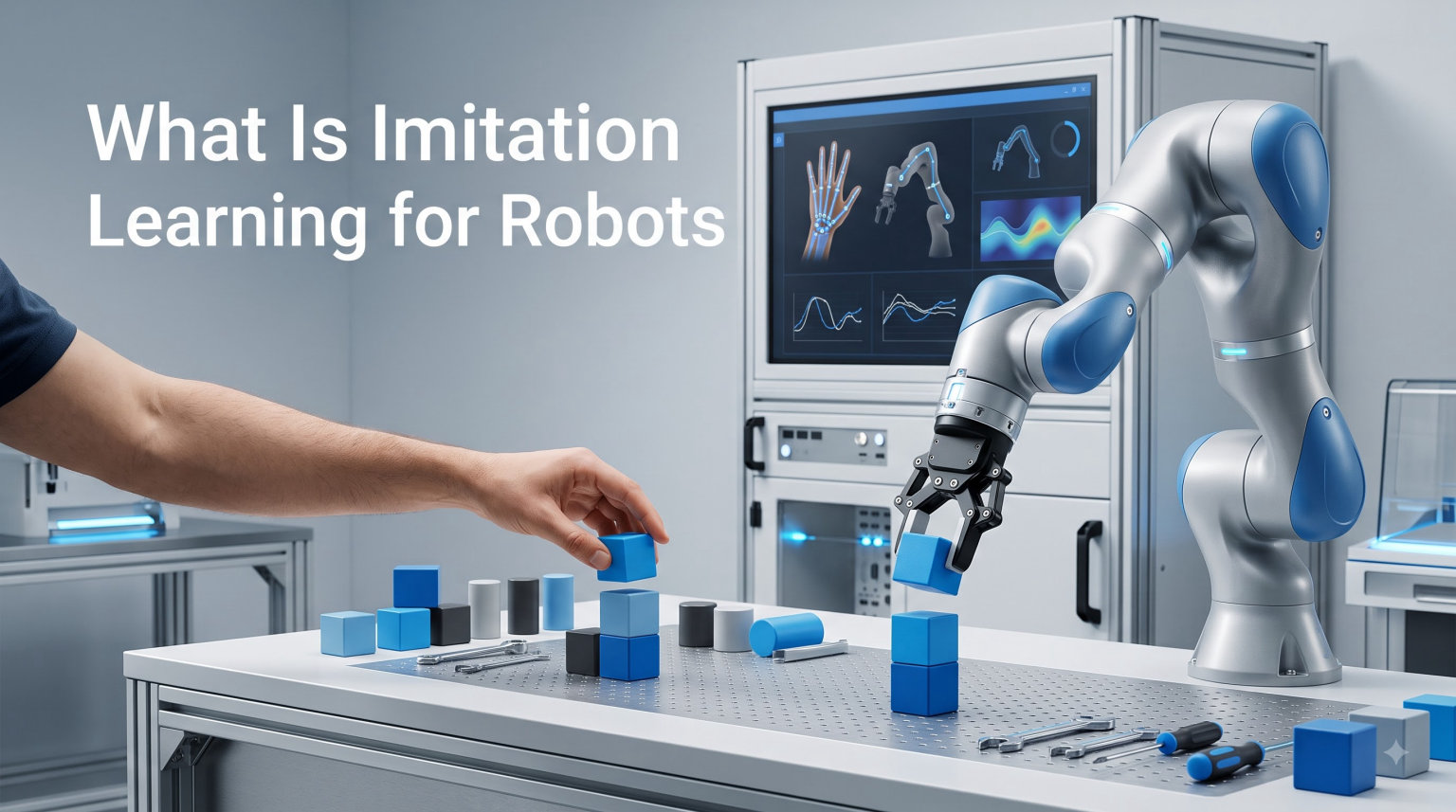
Imitation learning for robots is a technique where machines learn to perform tasks by watching and copying human demonstrations rather than following hand-coded instructions. Instead of programming every motor command, an operator shows the robot what to do, and a neural network learns to reproduce the behavior.
I have spent the last several months digging into how modern robotics teams actually teach manipulation skills to robots. The short version is that imitation learning is now the fastest path from “I want a robot to do this” to “the robot is doing this” for most physical tasks. In this guide I will walk you through what imitation learning is, how imitation learning robots work under the hood, and where the technique is heading in 2026.
If you are new to the field, this is a beginner-friendly explanation. If you already work in robotics, you will find the comparison table, the algorithm overview, and the open-source framework section worth scanning.
Table of Contents
What Is Imitation Learning for Robots
Imitation learning is a robotics AI method where a robot learns a task by observing an expert (usually a human) perform it. The robot records the expert’s actions and learns a policy, which is a mapping from what the robot senses to what it should do. The end result is the same skill the expert showed, available to the robot on demand.
This approach is also called learning from demonstrations, or LfD for short. The core idea is simple: it is far easier to demonstrate a task than to describe it in code. A human can show a robot arm how to pick up a cup in under a minute, but writing the same pick-and-place routine by hand takes hours of careful engineering.
Modern imitation learning robots use deep neural networks to handle this learning. The robot collects pairs of sensor readings and motor commands, then trains a model to predict the right motor commands from new sensor readings. Once trained, the policy runs in real time on the robot and produces actions at typical control rates of 10 to 100 times per second.
The reason this matters right now is that hardware has caught up. Robot arms, humanoid platforms, and dexterous grippers are finally affordable enough that researchers and startups can collect the hundreds or thousands of demonstrations needed to make imitation learning work. In 2026, imitation learning is one of the dominant techniques behind every major humanoid robotics announcement.
How Imitation Learning Works in Robotics
Imitation learning for robots follows a four-step pipeline. Each step has its own pitfalls, and skipping any of them usually breaks the final policy. I will walk through the process the way our team runs it on real hardware.
Step 1: Collecting Expert Demonstrations
The first step is gathering data. An operator (or another robot) performs the task while the system records everything the robot will eventually need to see at runtime. That typically includes camera images, joint positions, gripper state, and the motor commands the expert produced.
There are three common ways to collect demonstrations. Teleoperation uses a joystick, VR controller, or leader arm to drive the real robot. Kinesthetic teaching means the operator physically grabs the robot and moves it through the task. Video observation uses external cameras to record a human doing the task, then translates the human motion into something the robot can mimic. Each method has tradeoffs in cost, quality, and the amount of data you can collect per hour.
Step 2: Encoding State-Action Pairs
Raw demonstrations are not directly usable. The pipeline converts each timestep into a state-action pair: the state captures what the robot sensed, and the action captures what the expert did in response. For a vision-based policy, the state might be an image plus the robot’s joint angles, and the action might be the target joint velocities for the next 0.1 seconds.
This is also where the team decides what the robot will actually see at inference time. If the policy will run with two wrist cameras, the training data needs to come from the same two cameras. Mismatched sensors are one of the most common reasons an imitation learning robot fails when transferred to a new environment.
Step 3: Training the Neural Network Policy
With thousands of state-action pairs in hand, the team trains a neural network to map states to actions. This is a supervised learning problem: given the inputs, predict the outputs the expert produced. Convolutional networks and transformers are common backbones, especially for vision-based policies.
Training typically takes a few hours on a single modern GPU. The loss function penalizes the difference between the predicted action and the expert action, and the network’s weights are updated to minimize that difference across the entire dataset. We usually train for 50 to 200 epochs, saving checkpoints along the way to pick the best one.
Step 4: Deploying and Refining the Policy
The trained policy is deployed on the physical robot and rolled out on the target task. Real-world performance is almost always worse than training performance, which is why the final step is iteration. The team collects more demonstrations on the failure cases, retrains, and redeploys.
Sim-to-real transfer is a common shortcut. You train the policy partly in a physics simulator, then fine-tune it on a small amount of real-world data. NVIDIA Isaac Lab and the LeRobot framework both support this workflow out of the box. In practice, you can cut the amount of real-world data needed by 5 to 10x with good simulation, which dramatically lowers the cost of teaching a new skill.
Imitation Learning vs Behavior Cloning vs Reinforcement Learning
Imitation learning is a broad category that includes behavior cloning as one of its simplest methods. The differences between imitation learning, behavior cloning, and reinforcement learning matter when you are choosing how to teach a new task. Here is a clear comparison to settle the most common point of confusion.
Behavior cloning is a subtype of imitation learning that treats the problem as straight supervised learning. You train a policy to mimic the expert’s actions, and that is it. Imitation learning is the larger family, including behavior cloning and more advanced methods like DAgger and GAIL that involve the robot acting during training. Reinforcement learning is different in kind: the robot learns from its own trial and error, guided by a reward signal, with no expert demonstrations required at all.
| Method | Data Source | When It Works Best | Main Weakness |
|---|---|---|---|
| Imitation Learning (general) | Expert demonstrations, sometimes combined with robot rollouts | Tasks with clear expert behavior and limited need for exploration | Requires high-quality demonstrations and can struggle with new states |
| Behavior Cloning | Static dataset of expert state-action pairs | Simple, repeatable tasks with abundant data | Distribution shift and compounding errors at test time |
| Reinforcement Learning | Self-collected experience plus a reward function | Tasks with a clear reward signal and room for trial and error | Hard to design rewards, sample inefficient, often needs simulation |
The cleanest way to think about it: behavior cloning is imitation learning, but not all imitation learning is behavior cloning. Reinforcement learning is a different paradigm entirely, although the two are often combined in practice.
Main Imitation Learning Algorithms
Several algorithms sit under the imitation learning umbrella. Most modern robotics stacks use one of these four, often combined with classical control or reinforcement learning fine-tuning. I have grouped them by complexity, from simplest to most advanced.
Behavior Cloning (BC) is the baseline. Train a neural network with supervised learning on a fixed dataset of expert demonstrations. It works well when the test conditions match the training conditions, but performance drops sharply when the robot encounters states the expert never visited. This is the famous distribution shift problem.
DAgger (Dataset Aggregation) addresses distribution shift by having the expert correct the robot’s own rollouts. The robot attempts the task, the expert labels what to do at each state, and that new data is added to the training set. DAgger produces policies that are far more robust than pure behavior cloning, at the cost of more expert time.
GAIL (Generative Adversarial Imitation Learning) skips supervised learning entirely. It trains a discriminator network to tell expert behavior apart from robot behavior, and the policy is trained to fool the discriminator. GAIL needs far fewer demonstrations than BC and can match expert performance on hard manipulation tasks, but training is unstable and requires careful tuning.
Inverse Reinforcement Learning (IRL) goes one level deeper. Instead of learning what to do, IRL learns what the expert was trying to optimize, then uses reinforcement learning to find a policy that achieves the same goal. IRL is powerful but computationally heavy, and it is usually reserved for research projects rather than production systems.
Real-World Applications of Imitation Learning Robots
Imitation learning has moved from academic papers to production deployments in the last two years. Here is where the technique is actually shipping today, based on public announcements and our team’s conversations with robotics engineers.
Autonomous driving. Yes, Waymo uses imitation learning. The company has published research showing that imitation learning from human drivers is part of how its motion planning policies are trained, especially for handling rare events and edge cases. Tesla’s FSD stack also leans on imitation learning for portions of its driving policy, alongside end-to-end neural networks.
Industrial manipulation. Robot arms in factories now learn bin picking, cable insertion, and assembly tasks from a few hundred demonstrations. Companies like Covariant, Plus One Robotics, and Locus Robotics use imitation learning at the core of their picking and packaging systems, often combined with classical motion planning for safety-critical moves.
Humanoid robots. The current wave of humanoid announcements, including Figure, 1X, Apptronik, and Tesla Optimus, all rely heavily on imitation learning for manipulation. Operators wear VR rigs and teleoperate the robots, and the resulting demonstrations are used to train policies that the robots then run autonomously. Whole-body locomotion is also increasingly learned from human motion capture data.
Medical and surgical robotics. Surgical sub-tasks like suturing, knot tying, and tissue manipulation have been taught to robot arms through imitation learning. The Intuitive Surgical da Vinci research platform supports teleoperation, and several academic groups have published imitation learning policies that match expert surgeon performance on bench-top tasks.
Service and household robots. Home robots are the next frontier. Companies developing humanoid or wheeled home robots are betting that imitation learning, scaled with foundation models, is the path to robots that can load a dishwasher or fold laundry from a few hundred demonstrations of the task.
Challenges and Limitations of Imitation Learning
Imitation learning is not a silver bullet. Our team has run into the same issues that show up in every public discussion of the field, and they are worth understanding before you commit to the approach for a new project.
Distribution shift. The biggest open problem. A policy trained on expert demonstrations only knows how to recover from states the expert visited. When the robot makes a small mistake and ends up in an unfamiliar state, it can compound the error and fail catastrophically. DAgger, GAIL, and modern data augmentation techniques reduce the problem but do not eliminate it.
Data quality and quantity. Imitation learning is data-hungry. A simple pick-and-place task may need 50 to 200 demonstrations. A long-horizon household task like cleaning a kitchen may need thousands. Collecting that data is expensive, especially when each demonstration takes minutes of teleoperation on a real robot.
Generalization to new environments. A policy trained in one lighting condition, with one set of objects, in one room, often fails in a slightly different setting. Modern research uses visual data augmentation, language conditioning, and large foundation models to improve generalization, but the problem is not fully solved.
Safety at deployment. An imitation learning policy is a black box. It can produce surprising actions in states the expert never visited, which is a real concern for robots operating near humans. Most production systems wrap the policy in a safety layer that limits velocity, force, and workspace, and falls back to a hand-coded controller on out-of-distribution states.
Multi-modal behavior. When a task has multiple valid solutions (for example, grasping a cup from the left or the right), the average of expert actions may be physically impossible. Modern policies handle this with multi-modal outputs, but it remains a sharp edge that beginners run into.
Getting Started With Imitation Learning for Robots
If you want to try imitation learning yourself, the tooling has never been better. Three open-source frameworks cover most of the pipeline today, and each has good documentation and starter tutorials.
LeRobot from Hugging Face is the most accessible starting point. It supports data collection, training, and deployment for common robot arms out of the box, and it works with consumer GPUs. For most hobbyists and researchers, this is the fastest way to go from zero to a working imitation learning policy on a real robot.
Isaac Lab from NVIDIA is the best option for sim-to-real. You can generate millions of synthetic demonstrations in a physics simulator, then fine-tune it on a small amount of real-world data. Isaac Lab is heavier to set up than LeRobot but gives you more control over simulation fidelity and sensor models.
MimicKit and similar research frameworks cover more advanced algorithms like GAIL and IRL. These are mostly useful for academic projects and benchmarking rather than production work, but they are excellent if you want to understand the algorithms from the inside.
For a practical first project, I would recommend teleoperating a low-cost robot arm like the ALOHA or SO-100 for 100 demonstrations of a simple pick-and-place task, then training a behavior cloning policy using LeRobot. You will hit most of the core issues within a single weekend, and you will end up with a working policy that you can actually run on hardware.
Frequently Asked Questions
What is imitation learning in robotics?
Imitation learning in robotics is a machine learning method where a robot learns a task by watching an expert (usually a human) perform it. The robot records the expert’s sensor inputs and actions, then trains a neural network policy that maps observations to motor commands. The trained policy lets the robot reproduce the demonstrated skill on its own.
What does imitation learning mean?
Imitation learning means teaching a robot by showing it what to do, rather than by writing code. The word imitation captures the core idea: the robot imitates the behavior it observes in demonstrations. This is also called learning from demonstrations, or LfD for short.
Does Waymo use imitation learning?
Yes, Waymo uses imitation learning. The company has published research showing that imitation learning from human drivers is part of how its motion planning policies are trained, particularly for handling rare events and edge cases that would be hard to script by hand. Other autonomous driving stacks, including Tesla FSD, also use imitation learning for portions of their driving policies.
What is the difference between imitation learning and behavior cloning?
Imitation learning is the broad category of methods that teach robots from demonstrations. Behavior cloning is the simplest specific method inside that category, treating the problem as straight supervised learning on a fixed dataset of expert state-action pairs. Imitation learning also includes more advanced methods like DAgger and GAIL that involve the robot acting during training, which often produce more robust policies than pure behavior cloning.
What are the main imitation learning algorithms?
The four most common imitation learning algorithms are behavior cloning (BC), DAgger, GAIL, and inverse reinforcement learning (IRL). BC is the simplest and trains a policy with supervised learning. DAgger adds expert corrections during robot rollouts. GAIL uses a discriminator network to match expert behavior. IRL goes further by learning the expert’s reward function, then optimizing it with reinforcement learning.
What are the challenges of imitation learning?
The main challenges are distribution shift, data quantity and quality, generalization to new environments, safety at deployment, and handling multi-modal behavior. Distribution shift is the most studied: a policy can fail when it encounters states the expert never visited, which is why methods like DAgger and GAIL were developed. Collecting enough high-quality demonstrations is also expensive and remains a bottleneck for many teams.
Conclusion
Imitation learning is the technique that turned robot teaching from a programming problem into a demonstration problem. Show the robot what to do, and it learns to do it. That simple idea is now driving the current wave of humanoid robots, autonomous vehicles, and flexible factory automation.
For 2026 and the years ahead, the trajectory is clear. Larger datasets, better foundation models, and tighter sim-to-real pipelines are making imitation learning robots more capable every quarter. If you are starting a project in this space, the tooling is ready, the research is open, and the gap between a research demo and a production system is shrinking fast.