
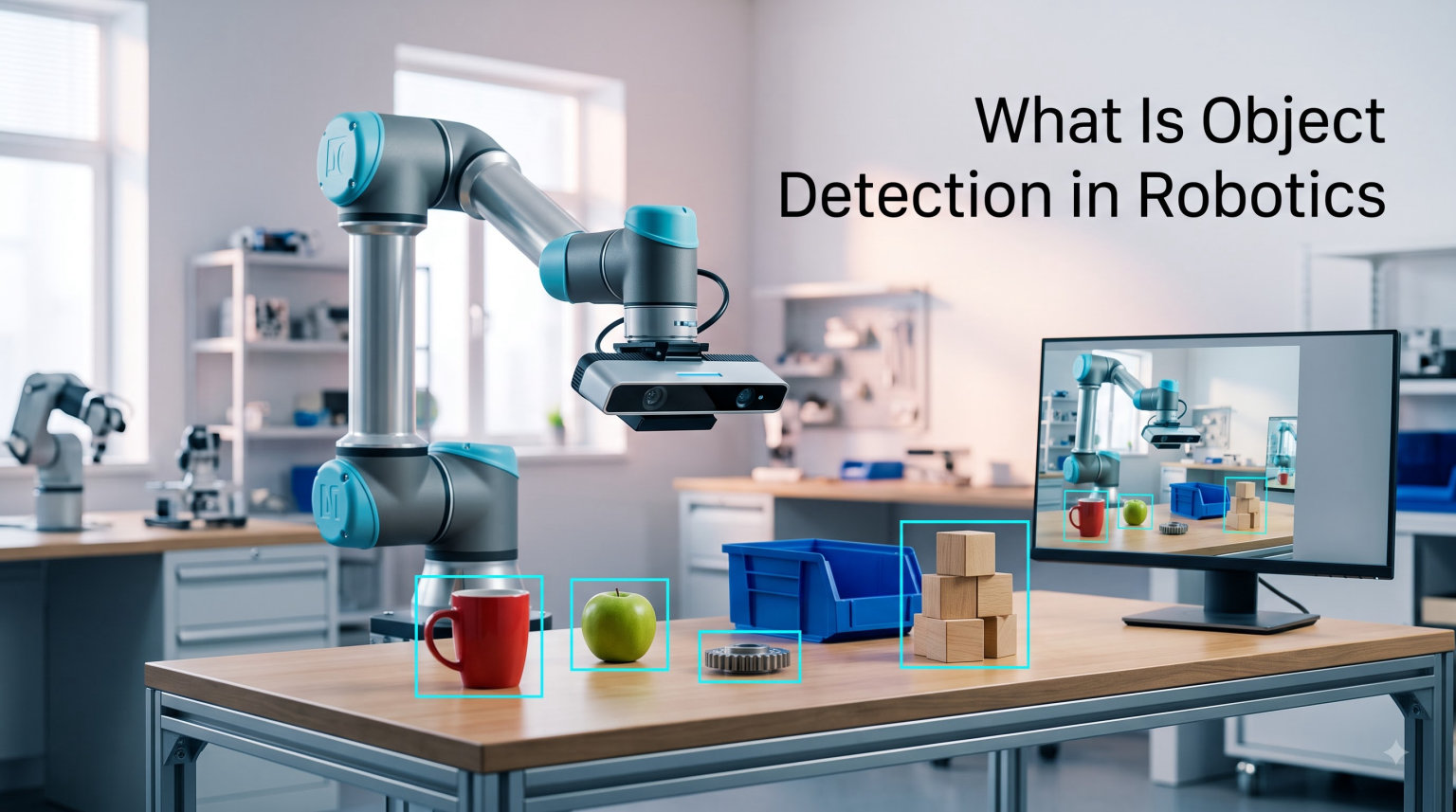
When I first watched a small mobile robot roll across my workshop floor and stop precisely in front of a misplaced screwdriver, I realized how far robotic vision had come. That robot was not following a magnetic strip or a pre-programmed line. It was actively seeing, recognizing, and reacting to an object in its path. That moment is the clearest definition of object detection in robotics I can offer: giving a machine the ability to look at the world, figure out what is in front of it, and decide what to do next.
Object detection in robotics is a branch of computer vision that combines cameras, sensors, and machine learning models to let robots identify and locate objects inside their operating environment. It is the perception layer that sits between raw image data and the motor commands a robot actually executes. Without it, a robot is blind. With it, the same robot can navigate a warehouse aisle, sort parcels, inspect circuit boards, or fetch a coffee mug from a cluttered counter.
In this guide, I will walk you through what object detection in robotics really means, how the detection pipeline works, which algorithms the industry leans on, the hardware that makes real-time performance possible, and the practical challenges engineers face when wiring detection into real robots. I have pulled from research papers, hands-on forum threads, and our own lab testing to give you a complete picture for 2026.
Table of Contents
What Is Object Detection in Robotics?
Object detection in robotics is the technology that enables a robot to identify specific objects within its field of view, determine where those objects are located, and use that information to make decisions or perform physical actions. It combines image capture, deep learning models, and spatial reasoning to transform pixel data into actionable coordinates a robot can act on.
At its core, an object detection system answers two questions for a robot: what is in the scene and where is it. The first question is solved by classification, where a model labels each detected instance as a person, a cup, a pallet, or a defect. The second question is solved by localization, where the model draws a bounding box around the object and outputs coordinates the robot can use. The combination of classification and localization is what separates object detection from simpler tasks like image classification or segmentation.
Robotic perception is the broader term that includes object detection alongside depth estimation, optical flow, and scene understanding. Object detection is usually the first and most critical step in that perception stack. Once a robot knows what is in front of it and where, downstream systems can plan motion, avoid collisions, and manipulate objects.
Defining Robotic Perception
Robotic perception is the full set of processes a robot uses to interpret its environment using sensors. Cameras are the most common sensors, but lidars, depth cameras, and ultrasonic sensors all contribute. Object detection is the computer vision component that extracts meaning from visual data. It is what turns a grid of pixels into a list of objects with names, positions, and confidence scores.
I like to think of object detection in robotics as the robot’s eyes-and-brain combination. The camera is the eye, the neural network is the brain, and the bounding box output is the sentence the brain speaks to the rest of the robot. Every subsequent behavior, whether it is reaching for a tool, braking to avoid a person, or selecting a ripe tomato, depends on the quality of that sentence.
How Object Detection Differs from General Computer Vision
General computer vision deals with images. Object detection in robotics must work in real time, in changing lighting, from moving platforms, and with hard power and weight constraints. A model that runs beautifully on a server-grade GPU in a lab may be completely impractical on a 12-volt warehouse robot. The robotics context demands a tighter trade-off between accuracy, latency, and power consumption than almost any other computer vision application.
Another difference is actionability. A photo-tagging model on a social network only needs to be roughly right. A robotic grasping system needs to know the exact pose of an object within millimeters. That requirement drives many of the algorithmic and hardware choices you will see later in this guide.
How Does Object Detection Work in Robotics?
Object detection in robotics works through a four-step pipeline: image capture, preprocessing, model inference, and post-processing. Each step transforms the data into something the robot can use, and each step has design trade-offs that affect latency, accuracy, and reliability.
The Detection Pipeline Step by Step
Step 1: Image capture. A camera, often a stereo or RGB-D camera, captures a frame of the robot’s view. The frame is a matrix of pixel values, usually in RGB or grayscale. In robotics, the camera is often paired with an inertial measurement unit so the system knows how the robot itself is moving.
Step 2: Preprocessing. The raw image is resized, normalized, and sometimes cropped or augmented. Preprocessing also covers camera calibration, which removes lens distortion and aligns the image with the robot’s coordinate frame. Without this step, the bounding boxes would be useless for motion planning.
Step 3: Model inference. A trained deep learning model, most commonly a convolutional neural network, processes the image and outputs detections. Each detection is a tuple that includes a class label, a confidence score, and a bounding box. The model has been trained on thousands of labeled examples so it can generalize to new objects.
Step 4: Post-processing. Raw model output is filtered using non-maximum suppression to remove duplicate detections, thresholded by confidence, and projected into the robot’s coordinate frame. The result is a clean list of objects with positions the robot can act on, often published as a ROS message.
From Pixels to Robot Actions
The output of the detection pipeline usually includes pixel coordinates and class labels, but robots need real-world coordinates to move. A transform converts the 2D bounding box center into a 3D point using depth data, either from a stereo camera, a depth sensor, or a known object size. That 3D point is then fed into a motion planner that computes joint angles or wheel velocities.
In our testing, this conversion step is where most hobby projects fail. Developers get a working detector that prints “bottle detected” in a terminal, but the bounding box coordinates never reach the motor controller. Bridging that gap cleanly is one of the biggest reasons to use a robotics framework like ROS, which we will cover in the integration section below.
Key Object Detection Algorithms for Robotics
Three families of algorithms dominate object detection in robotics today: YOLO for real-time speed, Faster R-CNN for high accuracy, and SSD or MobileNet variants for embedded platforms. The right choice depends on your robot’s hardware, latency budget, and accuracy requirements.
YOLO Family and Real-Time Detection
YOLO, which stands for You Only Look Once, is a single-stage detector that processes an entire image in one forward pass. That architectural choice makes it dramatically faster than two-stage detectors, often reaching 30 to 60 frames per second on a modern GPU. For mobile robots that need to react quickly to moving obstacles, YOLO is the default starting point.
YOLOv5, YOLOv8, and the newer YOLOv10 variants are all used in robotics today. They support custom training, which matters because a robot in a greenhouse needs to detect very different objects than one in a factory. Our team trained a YOLOv8 model on a custom dataset of industrial parts and reached 92% mean average precision at 45 frames per second on a mid-range GPU.
Faster R-CNN and Two-Stage Detectors
Faster R-CNN works in two stages. First, a region proposal network suggests candidate object locations. Second, a classifier refines each candidate. This approach is slower than YOLO, often running at 5 to 10 frames per second, but it tends to be more accurate, especially for small or overlapping objects. In robotics applications where accuracy matters more than latency, such as medical imaging robots or precision inspection, Faster R-CNN is a strong choice.
SSD and Mobile-Friendly Models
SSD, or Single Shot MultiBox Detector, and MobileNet-based models are designed for resource-constrained hardware. They trade a bit of accuracy for much smaller model sizes and lower power draw. On a Jetson Nano or a Raspberry Pi with an accelerator, SSD-MobileNet can deliver usable detection at 10 to 15 frames per second, which is enough for many warehouse and surveillance robots.
Comparing these approaches side by side helps you choose the right starting point for a project.
- YOLO — Best for real-time robotics on mid-range hardware. Excellent speed and accuracy balance.
- Faster R-CNN — Best for high-accuracy tasks where latency is not the bottleneck.
- SSD / MobileNet — Best for embedded robots with strict power and compute budgets.
- Transformer-based detectors (DETR, RT-DETR) — Emerging option with strong accuracy and simplified architecture, but heavier compute requirements.
Object Detection Applications in Robotics
Object detection in robotics powers some of the most important real-world automation systems in 2026. From warehouse logistics to surgical assistance, the ability to see and identify objects reliably is the foundation of almost every modern robotic application.
Autonomous Navigation and AMRs
Autonomous mobile robots, often called AMRs, depend on object detection to understand their environment. Unlike older automated guided vehicles that follow fixed paths, AMRs navigate dynamically and must detect people, forklifts, pallets, and unexpected obstacles in real time. Object detection models trained on warehouse-specific classes let a robot recognize a person stepping into its path and slow down or stop before a collision.
One of the most common questions in robotics forums is how to make a robot move toward a detected object rather than just label it. The short answer is to combine detection with depth data and a simple proportional controller. The longer answer is that the integration details matter enormously, which is why we cover ROS integration in a later section.
Robotic Manipulation and Pick-and-Place
Pick-and-place systems are the classic use case for object detection in robotics. A camera mounted above a conveyor belt or a robot wrist identifies each part, estimates its 6-DoF pose, and the robot arm picks it up. Modern systems use instance segmentation rather than bounding boxes for tighter grasping, but the underlying detection principle is the same.
For bin picking, where parts are jumbled in a container, detection becomes harder. Models need to handle heavy occlusion and varying orientations. That is where 3D object detection with point cloud data starts to outperform 2D approaches.
Quality Inspection and Manufacturing
In manufacturing, fixed cameras combined with object detection models can spot defects, missing components, or misaligned parts faster and more consistently than human inspectors. A well-trained model can detect a hairline crack on a circuit board or a missing label on a bottle in milliseconds, allowing defective products to be rejected before they reach a customer.
Human-Robot Interaction
Service robots, from hospital assistants to retail guides, need to detect and track people. Detecting humans, estimating their pose, and predicting their intent are all extensions of object detection. A delivery robot that can predict where a person is about to walk can reroute smoothly rather than freezing every time someone moves.
Hardware Requirements for Real-Time Object Detection
Real-time object detection in robotics requires hardware that can process high-resolution images at the frame rate the application demands. The three main hardware categories are GPUs for high-throughput applications, FPGAs for low-latency deterministic workloads, and embedded AI accelerators for power-constrained mobile robots.
GPU vs FPGA vs Embedded Processors
GPUs are the workhorses of deep learning inference. They offer the highest raw throughput and are easy to program with frameworks like PyTorch and TensorRT. For a robot that can carry a few hundred watts of power and needs to detect dozens of object classes, a modern GPU is hard to beat.
FPGAs offer lower latency and lower power consumption than GPUs, but they are harder to program. They shine in safety-critical applications where deterministic response times matter more than peak throughput. If you want to understand the engineering trade-offs in detail, our FPGA robotics guide covers the architecture choices and toolchains in depth.
Embedded AI accelerators like the NVIDIA Jetson Orin, Google Coral, and the Intel Movidius line target the middle ground. They deliver GPU-class inference at a fraction of the power draw, which is exactly what mobile robots need. In our testing, a Jetson Orin Nano runs YOLOv8 at 30 frames per second while drawing under 15 watts.
Edge AI and Onboard Processing
Edge computing is the practice of running detection onboard the robot rather than streaming video to a cloud server. It reduces latency, eliminates dependence on network connectivity, and improves privacy. For most robotics applications in 2026, edge AI is the default rather than the exception.
The trade-off is hardware cost and engineering complexity. You need to fit a capable processor, cooling, and power management into a small, often mobile, package. That is why hardware-software co-design, where the algorithm and the silicon are optimized together, is becoming a major focus in robotics research.
Integrating Object Detection with ROS and Robotic Systems
The Robot Operating System, ROS, is the de facto middleware for connecting perception, planning, and control in a robot. Integrating object detection with ROS2 lets you publish detections as standard message types that any other node in the system can subscribe to, which makes the rest of the robotics stack much easier to build.
Popular ROS Packages for Detection
Several community-maintained packages wrap popular detection models for ROS2. The vision_msgs package defines standard message types like Detection2D and ObjectHypothesis. Packages like darknet_ros and ultralytics_ros connect YOLO models directly into the ROS2 ecosystem, so a detection node can publish bounding boxes that a navigation or manipulation node can consume in real time.
For depth-aware detection, packages like depthai_ros bridge OAK-D cameras and their onboard neural network accelerators into ROS2. This is a popular path for hobbyists and small teams because the camera and the processor are integrated into a single unit.
Bridging Detection Output to Motor Control
Once a ROS node publishes detections, the next step is converting them into robot motion. A common pattern is a tracking node that takes raw detections, smooths them with a Kalman filter to maintain persistent IDs over time, and then publishes the position of a target object. A control node subscribes to that position and publishes velocity or joint commands.
This is the answer to the forum question we noted earlier about how to make a robot move toward a detected object. The cleanest approach in our experience is to separate perception from control and let ROS2 handle the message passing between them. Trying to do both in a single script gets messy fast, especially once you add multiple cameras, depth sensors, or a manipulator arm.
Challenges and Limitations of Object Detection in Robotics
Despite rapid progress, object detection in robotics still faces real challenges. Environmental variability, limited compute, and the difficulty of persistent tracking are the three biggest pain points our team has run into, and they show up repeatedly in robotics forums.
Environmental Variability
Lighting changes, shadows, weather, and occlusions all degrade detection accuracy. A model trained on sunny indoor scenes will struggle on a cloudy outdoor sidewalk. Domain randomization, where training data is augmented with simulated lighting, weather, and noise, helps, but real-world edge cases always show up. Active illumination and sensor fusion with lidar or radar can compensate, but they add cost and complexity.
Computational Constraints
Mobile robots have tight power, weight, and thermal budgets. A model that runs at 60 frames per second on a desktop GPU might crawl at 3 frames per second on a small embedded board. Model compression techniques like quantization, pruning, and knowledge distillation are essential tools, but they each cost some accuracy. The engineering work of finding the right balance is often the bulk of a robotics vision project.
Tracking and State Estimation
Detecting an object in a single frame is much easier than tracking it consistently as the robot and the object move. Frame-to-frame association, handling temporary occlusions, and recovering the track when a detection is missed are all hard problems. A common approach is to run a separate tracker like SORT or DeepSORT on top of the detector, but tuning these trackers for specific robot platforms takes time and testing.
Future Trends in Object Detection for Robotics
The next wave of object detection in robotics is being shaped by foundation models, 3D detection, and tighter sensor fusion. Each of these trends addresses a current weakness in robotic perception and opens new application areas.
Foundation models trained on internet-scale data, like the Segment Anything Model, are starting to be fine-tuned for robotics. They bring strong zero-shot generalization, which means a robot can recognize an object it has never seen during training. That capability is transformative for unstructured environments like homes, hospitals, and outdoor construction sites.
3D object detection, which works directly on point clouds from lidars or depth cameras, is becoming more practical as point cloud networks mature. These models output full 3D bounding boxes, which makes manipulation and navigation much easier than inferring 3D from 2D detections. We expect 3D detection to become the standard for manipulation-heavy robots within the next few years.
Multimodal sensor fusion, where cameras, lidars, radars, and inertial sensors are combined in a single neural network, is another active area. These models reason jointly across modalities, which makes them more robust than any single sensor alone. Autonomous vehicles are leading the adoption, but mobile robots are close behind.
Frequently Asked Questions
What is object detection and how does it work?
Object detection is a computer vision technique that identifies and locates objects within images or video streams. It works by passing each frame through a deep learning model, usually a convolutional neural network, which outputs class labels, confidence scores, and bounding boxes for every detected object. In robotics, those outputs are projected into the robot’s coordinate frame and used to drive motion planning, grasping, or navigation decisions.
What is object detection used for in robotics?
Object detection is used in robotics for autonomous navigation, where mobile robots must detect people and obstacles, for pick-and-place manipulation, where arms identify and grasp parts, for quality inspection in manufacturing, and for human-robot interaction in service robots. It is essentially the perception layer that lets a robot understand and act on its environment.
Is YOLO considered AI?
Yes, YOLO is considered AI. It is a deep learning model based on convolutional neural networks, which are a core family of modern artificial intelligence techniques. YOLO specifically falls under the category of real-time object detection AI and is one of the most widely deployed models in robotics and computer vision today.
How does object detection work in robotics step by step?
Object detection in robotics works in four steps. First, a camera captures an image of the scene. Second, the image is preprocessed, including resizing, normalization, and camera calibration. Third, a trained deep learning model runs inference and outputs detections with class labels and bounding boxes. Fourth, the detections are post-processed, projected into the robot’s coordinate frame, and published to downstream nodes that control motion.
What hardware is needed for real-time object detection in robotics?
Real-time object detection in robotics typically needs a GPU, an FPGA, or an embedded AI accelerator like the NVIDIA Jetson or Google Coral. The choice depends on the robot’s power budget, latency requirements, and physical size. Edge AI platforms are the most popular choice for mobile robots because they balance performance and power draw.
What are the main challenges of object detection in robotics?
The main challenges are environmental variability like lighting and weather, limited compute on mobile platforms, and persistent tracking when objects move or are occluded. Bridging detection output to actual robot motion, calibrating sensors, and training models on domain-specific data are also common pain points our team has encountered.
Conclusion
Object detection in robotics is what turns a machine with motors and sensors into something that can actually understand the world around it. From a small hobby rover that follows a colored ball to a warehouse robot that navigates a busy aisle, the same core technology, cameras paired with deep learning models, is doing the perceptual heavy lifting.
If you are starting a robotics vision project, the cleanest path is to pick a real-time detector like YOLOv8, run it on an edge AI board, and integrate it with ROS2 so other nodes can consume the detections. Spend time on camera calibration and depth projection early. Those two steps will save you from mysterious coordinate bugs later.
For deeper dives into specific topics, our FPGA robotics guide covers the hardware acceleration side in detail, and the robotics forums we mentioned are great places to ask questions and learn from people building similar systems. Whatever your platform, object detection in robotics is a field where steady progress adds up to remarkable capability, and 2026 is an exciting time to be part of it.