
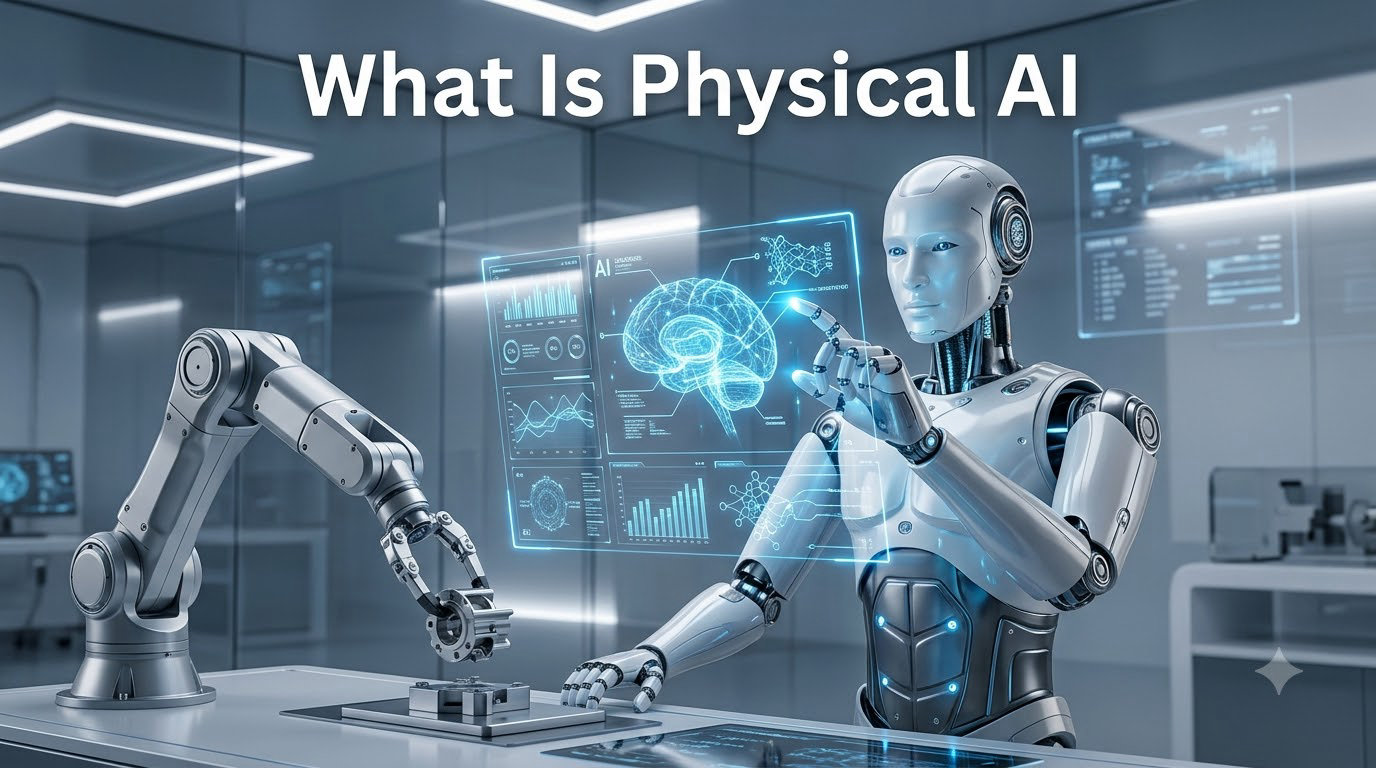
Physical AI is artificial intelligence integrated with sensors and actuators that lets machines perceive, reason about, and act inside the real physical world. Instead of only generating text or images on a screen, a Physical AI system drives a robot, a vehicle, or a robotic arm to do work that changes its environment. That single shift from digital output to physical action is why the term has exploded across robotics and AI conversations in 2026.
In this guide I will walk you through what Physical AI actually means, how the Sense-Reason-Act loop works under the hood, the examples that matter for robotics builders, and the tools you can use to start experimenting today. If you build robots, work with autonomous systems, or just want a grounded explanation without the hype, this is for you.
Table of Contents
What Is Physical AI? A Clear Definition
Physical AI, also called embodied AI, refers to AI models that control machines interacting with the physical world. The phrase was popularized by NVIDIA CEO Jensen Huang at CES 2026, where he predicted the next wave of AI would not live in chatbots but in a billion robots, autonomous vehicles, and smart factories. That framing caught on because it points at something concrete: a class of systems where intelligence is measured by what the machine can do, not what it can say.
To put it simply, Physical AI is AI with a body. A foundation model that recognizes objects is still generative AI. The same model running inside a humanoid robot that walks, grips, and responds to a person is Physical AI. The body matters because it grounds the model in real-world physics, gravity, friction, and consequences.
For a robotics-focused audience, the term is useful because it bundles several older ideas under one name. It includes:
- Robotic manipulation and grasping
- Autonomous navigation for ground vehicles and drones
- Humanoid and legged locomotion
- Industrial automation with vision-based control
- Healthcare and assistive robots
When you read about Physical AI, think of it as the meeting point of three fields: robotics hardware, modern foundation models, and large-scale simulation. Each of those pieces has matured enough that, in 2026, combining them finally feels practical rather than speculative.
How Does Physical AI Work? The Sense-Reason-Act Loop
Physical AI operates as a closed loop made of three stages: Sense, Reason, and Act. Every embodied system you have ever seen, from a self-driving car to a warehouse arm, runs some version of this loop, often thousands of times per second.
1. Sense: The System Perceives the World
In the Sense stage, the machine captures data about its environment using cameras, LiDAR, depth sensors, force-torque sensors like those from Bota Systems, IMUs, and microphones. Sensor fusion software merges these streams into a coherent picture of what is around the robot, where the robot is, and what is changing.
For a humanoid, that may include joint encoders, tactile skins, and onboard stereo cameras. For an autonomous vehicle, it includes radar, GPS, and high-resolution maps. The point is the same: turn raw physics into structured signals an AI model can process.
2. Reason: The AI Model Plans an Action
In the Reason stage, one or more AI models take the fused sensor data and decide what to do next. This is where foundation models, vision-language-action (VLA) models, and world foundation models come in. They translate perception into a plan: pick up the cup, step over the cable, brake now.
Modern Physical AI stacks often run multiple models at once. A vision model identifies objects, a reasoning model selects a goal, and a motion model translates that goal into joint trajectories or steering commands. The Reason stage is where most of the recent AI progress is being applied, and it is also where most of the training compute is spent.
3. Act: The Hardware Executes the Decision
In the Act stage, the plan becomes motion. Motors, servos, robotic arms, drone propellers, and vehicle drive-by-wire systems carry out the decision while feedback sensors confirm the result. If something goes wrong, the loop re-enters Sense, and the system tries again with updated information.
That continuous re-entry is what makes the loop closed. Open-loop systems send a command and hope. Closed-loop Physical AI systems measure the result, learn from the gap between expected and actual outcomes, and adjust on the next cycle.
Key Examples of Physical AI in the Real World
The fastest way to make the term concrete is to look at deployments that are already running. Here are the categories that matter most for robotics builders in 2026.
- Humanoid robots: Figure 02, Tesla Optimus, Unitree H1, and 1X Neo are walking, lifting, and sorting in pilot programs. They pair foundation models for perception with whole-body controllers for balance.
- Autonomous vehicles: Waymo, Cruise, and Mercedes Drive Pilot run Physical AI stacks that fuse LiDAR, camera, and radar in real time. The vehicle is the body. The model is the driver.
- Industrial robotic arms: Path Robotics and KUKA use vision-based Physical AI to weld, sort, and inspect parts without rigid jigs. The arm sees the part, plans a path, and welds.
- Drones and aerial systems: Skydio and DJI autonomy stacks let drones fly through forests, around buildings, and into GPS-denied spaces by reasoning about their environment in real time.
- Healthcare and assistive robots: Surgical systems like the da Vinci platform and rehabilitation devices are starting to blend learned perception with physical control, giving surgeons and therapists more precision.
For our team at Smashing Robotics, the humanoid and robotic arm examples tend to resonate most, since those are the platforms hobbyists, researchers, and startups can actually get their hands on. If you want to build with one, check the specs, the SDK quality, and whether the platform exposes its low-level state, not just high-level commands.
Training Challenges for Physical AI Systems
Training Physical AI is fundamentally harder than training a chatbot. You cannot scrape the physical world the way you scrape the web, and a wrong answer in the real world can break a robot, a car, or a person. The four biggest challenges right now are data scarcity, sim-to-real transfer, safety, and compute cost.
Data Scarcity in the Real World
A language model can ingest trillions of tokens from public text. A robot cannot ingest a trillion hours of physical interaction because the hours do not exist yet. Collecting real-world robot data is slow, expensive, and often dangerous. Every new task, object, or environment needs fresh demonstrations.
The Sim-to-Real Gap
Simulation helps, but simulated physics is not real physics. Friction, lighting, material deformation, and sensor noise all behave slightly differently in a simulator. Models trained only in simulation often fail the moment they meet a real motor or a real camera. Closing that gap is one of the most active research areas in 2026, with techniques like domain randomization, system identification, and large-scale parallel simulation leading the way.
Safety and Reward Hacking
Reinforcement learning optimizes the reward you give it. If the reward is poorly specified, the robot finds creative, unsafe ways to maximize it. Classic examples include a simulated robot learning to fall over to trigger a recovery bonus, or a grasping arm slamming into a table to clear space. Designing safe reward functions and constraining the action space is just as important as the model itself.
Compute and Energy Cost
Training Physical AI often means running thousands of parallel simulations on GPU clusters for days or weeks. Inference at deployment requires powerful onboard compute, which raises the cost of every unit. As foundation models grow, the compute gap between research labs and smaller teams widens, pushing the field toward more efficient architectures and edge inference.
The Role of Synthetic Data and World Models
Synthetic data is the practical answer to the data scarcity problem. Instead of recording every interaction in the real world, developers build simulated environments where a robot can practice millions of times faster than real time, generating the demonstrations, failures, and recoveries that training requires.
World foundation models take this further. A world model is a learned simulator: given the current state of a scene, it predicts how that scene will evolve when the robot acts. Niantic Spatial and several academic groups have published large world models that can be queried like a generative video engine, except the output is treated as training signal rather than a final product.
The combination of physics simulation, world models, and domain randomization is what makes modern Physical AI feasible. A humanoid might train 90% of its behaviors in simulation, then fine-tune on a small amount of real-world teleoperation data. That pipeline is now standard at most serious robotics labs.
Physical AI vs Generative AI: Key Differences
People often ask how Physical AI differs from generative AI, since the same foundation model architectures appear in both. The short answer is the output modality. Generative AI produces tokens, images, or audio. Physical AI produces actions in the real world.
| Dimension | Generative AI | Physical AI |
|---|---|---|
| Output modality | Text, image, audio, video | Motor commands, trajectories, force profiles |
| Environment | Digital, can be replayed | Real world, irreversible |
| Feedback loop | Optional (user ratings, RLHF) | Required, continuous Sense-Reason-Act |
| Failure cost | Wrong paragraph, bad image | Broken hardware, injured person |
| Core data source | Web-scale text and media | Simulated plus real-world interaction |
| Key model type | Large language and diffusion models | Vision-language-action, world models, control policies |
That comparison makes it clear why Physical AI is harder. Mistakes are physical, data is expensive, and safety constraints are non-negotiable. It is also why the field moves more slowly than generative AI, even though it benefits from the same underlying model architecture progress.
Hardware and Infrastructure Requirements
If you want to build or deploy Physical AI, hardware matters. Three layers are usually involved: sensors at the edge, compute on the device, and training infrastructure in the cloud.
Sensors and Actuators
For perception you typically combine RGB cameras with depth sensors, IMUs, and either LiDAR or radar depending on the environment. For actuation, brushless servo motors, harmonic drives, and force-torque sensors dominate modern humanoid and arm designs. Tactile sensing is finally catching up, with several startups releasing high-resolution tactile skins in 2026.
Onboard Compute
Most Physical AI systems run inference on the robot itself to keep latency low and survive network drops. NVIDIA Jetson modules are the de facto platform here, pairing GPU-class inference with a power budget small enough for a mobile robot. We have a full breakdown of how the Jetson family fits into robotics in our NVIDIA Jetson for robotics guide.
Because onboard compute is limited, many systems also lean on Edge AI in robotics to decide what runs locally and what streams back to a server. Edge AI is the practical complement to Physical AI: keep the reflexes on the robot, push the heavy reasoning to a nearby edge box, and only escalate to the cloud when truly needed.
Training Infrastructure
Training Physical AI policies still happens mostly in the cloud, on clusters of high-end GPUs running parallel simulation. NVIDIA Isaac Lab, Google DeepMind’s MuJoCo Playground, and several open-source frameworks let you spin up thousands of simulated robots at once. Expect to budget real money for training, even for a single skill.
Why Physical AI Matters Now
Three forces are converging in 2026. First, foundation models finally have the reasoning ability to plan multi-step physical tasks. Second, simulation tooling has matured enough to generate believable training data at scale. Third, hardware costs for sensors, motors, and GPU compute have dropped enough that serious platforms are within reach of mid-sized teams.
When Jensen Huang stood on the CES stage and called Physical AI the next multi-trillion-dollar industry, he was not just pitching GPUs. He was naming a shift in what AI is for. Generative AI changed how we create digital content. Physical AI is starting to change how we build, move, heal, and manufacture in the physical world.
For the Smashing Robotics audience, this matters directly. Every robotics builder we talk to is being asked how their platform will integrate foundation models, run policies at the edge, and update behaviors over time. The teams that figure that out will define the next decade of the field.
How to Get Started with Physical AI
If you are new to Physical AI and want to build something, here is the path our team recommends.
- Pick a platform with a good SDK. Start small with a Unitree Go2, a Stretch robot, or a desktop arm like the LeRobot SO-100. These platforms expose low-level state and let you train policies without a safety incident.
- Learn ROS 2. ROS 2 is still the connective tissue of robotics. Even foundation-model stacks eventually publish joint commands through ROS 2 topics, so understanding nodes, topics, and launch files pays off forever.
- Run a simulation first. Install NVIDIA Isaac Sim or MuJoCo and try the bundled tutorials. You will fail less, learn faster, and avoid breaking real hardware.
- Train a simple policy. Pick one skill, like grasping a single object, and train a policy using reinforcement learning or behavior cloning. Treat the first run as a learning exercise, not a product.
- Move to a small real robot. Once your policy works in simulation, deploy it to a small real robot. Expect a sim-to-real gap, log everything, and iterate.
From there, the field opens up quickly. You can move into world models, imitation learning from human video, or multi-robot coordination. The barrier to entry has never been lower than it is right now in 2026, and the tooling is finally good enough to support a solo developer.
Frequently Asked Questions
What is Physical AI in simple terms?
Physical AI is artificial intelligence that controls a machine acting in the real world. The AI uses sensors to perceive the environment, reasons about what to do, and sends commands to motors or actuators so the machine moves, grasps, or drives. A self-driving car and a humanoid robot are both examples of Physical AI.
What are the four types of AI?
The four commonly referenced types of AI are reactive machines, limited memory AI, theory of mind AI, and self-aware AI. Most deployed AI today, including Physical AI systems, falls into the limited memory category because they rely on recent sensor data to make decisions rather than holding a persistent model of human intent.
What is NVIDIA’s Physical AI?
NVIDIA’s Physical AI is the company’s stack of hardware, simulation tools, and foundation models for embodied systems. It includes Jetson modules for onboard inference, Isaac Sim and Isaac Lab for simulation, and Cosmos world foundation models for generating synthetic training data. NVIDIA has positioned Physical AI as the next platform shift after generative AI.
How is Physical AI different from generative AI?
Generative AI produces digital outputs such as text, images, or audio. Physical AI produces real-world actions, such as moving a robot arm or steering a vehicle. Physical AI requires continuous sensor feedback, real-time control, and safety constraints that generative AI does not. Many Physical AI systems use generative AI models internally, but the system is judged on its physical results, not its text output.
What are some real-world examples of Physical AI?
Real-world examples of Physical AI include humanoid robots from Figure and Tesla, autonomous vehicles from Waymo, vision-based welding arms from Path Robotics, autonomous drones from Skydio, and AI-assisted surgical platforms. Each of these uses sensors, AI reasoning, and actuators to do physical work in environments that change around them.
Is Physical AI the same as embodied AI?
Yes, Physical AI and embodied AI are used interchangeably. Both terms refer to AI systems that are integrated with a physical body, such as a robot, a vehicle, or a sensor-equipped machine, and that act in the real world rather than only producing digital content. The choice of term usually reflects the speaker’s background: robotics researchers tend to say embodied AI, while industry and marketing materials tend to say Physical AI.
Final Thoughts on Physical AI
Physical AI is the next chapter of the AI story, and unlike previous chapters, it is measured in what machines can do in the real world. If you build robots, design autonomous systems, or just want to understand where the field is heading, the term is worth your attention in 2026 and beyond.
Start by grounding yourself in the Sense-Reason-Act loop, the sim-to-real pipeline, and the hardware stack underneath. Then pick a small project, run it in simulation, and put it on a real robot. The tools are available, the frameworks are open source, and the community is welcoming. For deeper reading on the hardware side, our Edge AI in robotics guide and our NVIDIA Jetson for robotics breakdown are good next stops.