
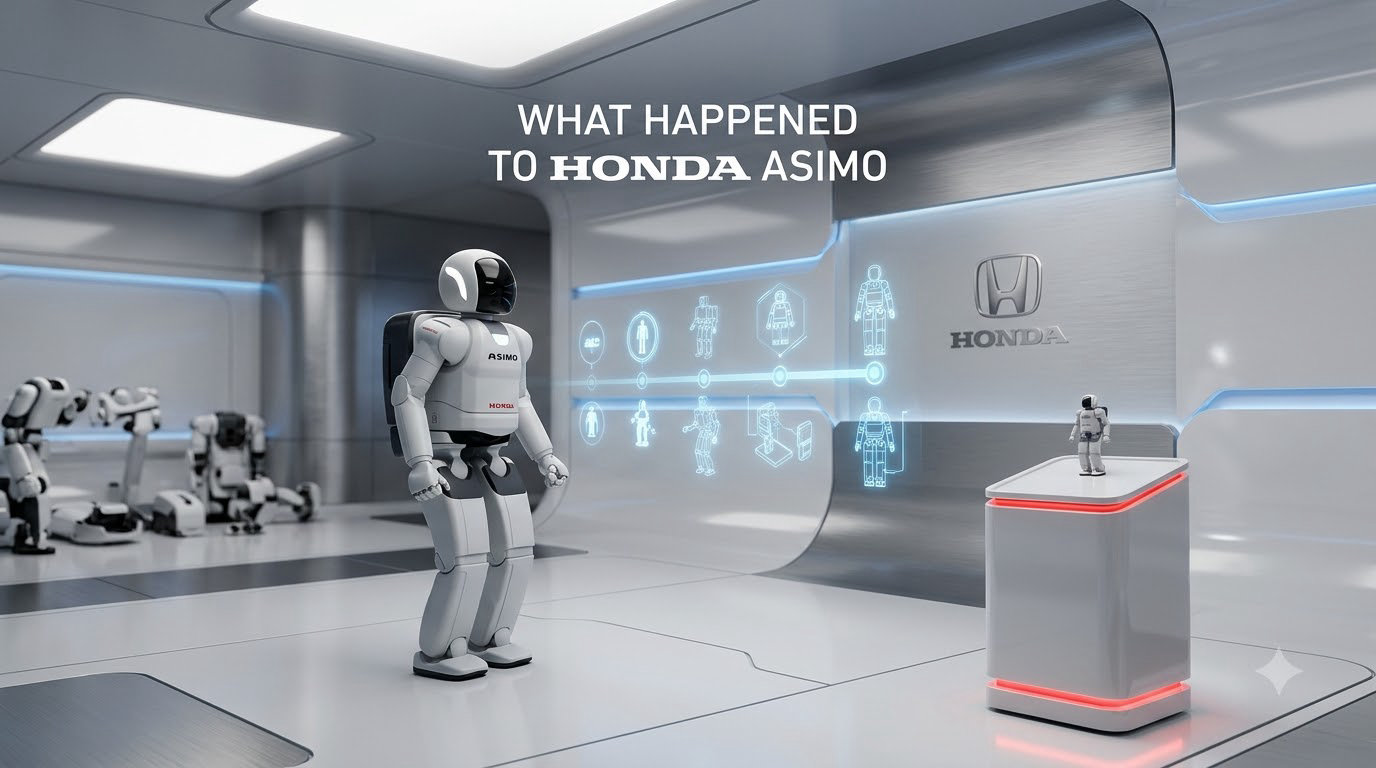
If you have ever wondered what happened to Honda ASIMO, the short answer is this: Honda retired the humanoid robot in March 2022 after more than 20 years of public development. The company announced the end of the ASIMO program once the platform had fulfilled its role as a technology demonstrator, and Honda began redirecting its robotics research toward more practical applications.
I remember watching ASIMO run, kick a soccer ball, and climb stairs during Honda’s promotional videos in the early 2000s. For many of us, that little humanoid was the first time a robot felt human. So when Honda quietly ended the program, it sparked a wave of nostalgia and questions across the robotics community. In this guide, I will walk you through ASIMO’s history, why Honda discontinued it, and where the technology is heading now.
Table of Contents
What Happened to Honda ASIMO? The Short Answer
Honda retired ASIMO in March 2022 after 20 years of public demonstrations. The company stated that the bipedal humanoid had reached the end of its life as a research platform, and Honda would apply the underlying technology to other robotics initiatives like nursing assistance, disaster relief, and remote-controlled avatar systems.
The final ASIMO unit was retired from Honda’s research facilities in Japan, ending a development cycle that began in the late 1980s. While the news disappointed longtime fans, it did not come as a complete shock to industry observers. ASIMO had not received a major hardware update in years, and the program had shifted from public spectacle to internal research years before the official retirement announcement.
The Retirement Timeline
- 2000: ASIMO unveiled to the public as the world’s most advanced bipedal humanoid
- 2011 through 2018: Quiet development period with few public demonstrations
- Early 2022: Honda officially confirms ASIMO program retirement
- March 2022: Final demonstrations and end of the ASIMO era
ASIMO Development History: From E0 to the Final Model
Honda’s humanoid robotics program began in 1986 with the E0 prototype, a pair of robotic legs that could walk in a straight line. Over the next 14 years, Honda refined its bipedal locomotion technology through the E-series and the experimental P-series before unveiling ASIMO in 2000.
ASIMO stood for Advanced Step in Innovative Mobility, and the robot quickly became a global ambassador for Japanese engineering. The original model was 4 feet 3 inches tall and weighed 119 pounds, designed to operate in human environments.
Major Milestones in ASIMO’s Evolution
The 2000 unveiling introduced ASIMO as a smaller, more approachable robot compared to its predecessors. By 2004, Honda had added intelligent autonomous behavior, allowing ASIMO to navigate around moving objects and people.
The 2005 update brought running capability, with ASIMO achieving a stable running gait of 3.7 mph. This was a major breakthrough in bipedal robotics because most humanoid robots at the time could only walk.
By 2011, ASIMO gained improved hand dexterity, allowing it to open bottles, pour drinks, and use sign language. Honda also added autonomous decision-making capabilities powered by onboard AI processors.
The 2014 generation introduced better environmental awareness, with ASIMO able to recognize multiple voices talking simultaneously and respond appropriately. This was the last major public update before development shifted behind closed doors.
Why Honda Retired ASIMO After 20 Years
Honda discontinued ASIMO for a combination of cost, commercialization challenges, and a strategic shift toward practical robotics applications. Each of these factors contributed to the decision.
The Cost Problem
Each ASIMO unit reportedly cost between 2 and 20 million dollars to build, depending on the configuration and included research costs. Even at the lower estimate, that price tag made ASIMO impossible to commercialize for any practical market.
Honda never released ASIMO for sale, and the robot existed primarily as a public relations tool and a research platform. The company invested billions of dollars over two decades without a clear path to revenue from the program itself.
Commercialization Challenges
Despite occasional rumors about a consumer version, Honda never found a viable market for a walking humanoid robot. The use cases remained limited to entertainment, demonstration, and academic research, none of which justified the production cost.
Industrial robots and stationary manipulators could perform most useful tasks at a fraction of the cost. A humanoid form factor made sense for human environments, but the technology was not advanced enough in the 2000s and 2010s to justify the expense outside research settings.
Strategic Shift to Practical Applications
Honda announced it would redirect its bipedal locomotion research toward more immediately useful applications. The company is now focused on avatar robots for remote work, nursing assistance devices, and disaster response technology, where the core balance and movement innovations from ASIMO can be applied to real-world problems.
This pivot reflects a broader industry trend. Companies have realized that human-shaped robots are most useful when they solve specific human problems, rather than serving as general-purpose demonstrations of technical capability.
ASIMO’s Technical Capabilities and Innovations
ASIMO could walk, run, climb stairs, recognize faces, respond to voice commands, and navigate around obstacles autonomously. These capabilities made it the most advanced bipedal humanoid of its era.
Movement and Balance
ASIMO used Honda’s i-WALK technology, which combined real-time balance control with predictive foot placement. The system could adjust the robot’s center of gravity in milliseconds, allowing for smooth transitions between walking, running, and stair climbing.
The robot had 57 degrees of freedom, with articulated joints in the hands, arms, legs, and torso. This range of motion allowed ASIMO to perform delicate tasks like picking up a paper cup without crushing it, or pouring liquid into a glass.
Sensors and Intelligence
ASIMO was equipped with visual sensors, ultrasonic sensors, and force sensors throughout its body. The robot could identify objects, recognize faces, and map its environment in real time using onboard processing.
Voice recognition allowed ASIMO to respond to spoken commands, and gesture recognition enabled natural interaction with human operators. The combination of these systems gave ASIMO a level of social presence that most other robots of its era could not match.
What Replaced ASIMO in Honda’s Robotics Strategy
Honda has not released a direct successor to ASIMO, but the company is actively developing several practical robotics applications using the underlying technology. The focus has shifted from public demonstrations to commercial products.
Honda’s Current Robotics Focus
Honda’s robotics division is now working on avatar robots that allow humans to perform remote tasks in dangerous or inaccessible environments. These systems use ASIMO’s balance and navigation technology in a more focused application.
The company is also developing nursing assistance devices that help caregivers lift and transfer patients, applying the same balance and force-control innovations that made ASIMO possible.
Disaster Relief and Remote Operations
Honda has tested walking robots for disaster relief scenarios, including the Honda Walking Assist Device and experimental avatar systems for emergency response. These applications are more practical than a general-purpose humanoid and have clearer paths to deployment.
Industry observers believe Honda may eventually return to a humanoid platform, but with a specific use case in mind, rather than as a general-purpose technology demonstrator.
ASIMO’s Legacy and Influence on Modern Humanoid Robots
ASIMO inspired an entire generation of humanoid robotics research and remains a cultural touchstone for what robots can achieve. Every major humanoid robot project today builds on work that ASIMO pioneered.
Boston Dynamics’ Atlas robot demonstrates far more advanced agility than ASIMO ever did, but it uses similar principles of balance control and bipedal locomotion. The same is true for Tesla’s Optimus, Figure’s humanoid robots, and the various Chinese-made humanoids entering the market today.
Honda’s choice to retire ASIMO was not an admission of failure. It was a recognition that the platform had achieved its goal of advancing bipedal robotics and that the next phase of development required more focused applications. The technology lives on, even if the robot that showcased it no longer walks the stage.
For those of us who watched ASIMO grow from a clunky prototype into the most famous humanoid robot in the world, the retirement marks the end of an era. But the innovations ASIMO demonstrated continue to drive the robotics industry forward in 2026 and beyond.
Frequently Asked Questions
Why did Honda discontinue ASIMO?
Honda discontinued ASIMO because the robot had reached the end of its life as a technology demonstrator, the cost of development was unsustainable, and the company wanted to focus on practical robotics applications like nursing assistance, disaster relief, and avatar robots. The official retirement announcement came in March 2022.
How much did the ASIMO robot cost?
Each ASIMO unit reportedly cost between 2 million and 20 million dollars to build, depending on configuration and included research costs. The high cost made commercialization impossible, which was one of the primary reasons Honda eventually retired the program.
What is the most advanced humanoid robot in the world?
As of 2026, Boston Dynamics Atlas is widely considered the most advanced humanoid robot for research purposes, while Tesla Optimus and Figure 02 are leading the push toward commercial humanoids. However, ASIMO pioneered many of the balance and locomotion principles these modern robots build upon.
Can you still see ASIMO in action?
ASIMO is no longer making public appearances since its retirement in March 2022. Honda’s headquarters in Japan displays one unit as a static exhibit, and many of ASIMO’s demonstration videos remain available on YouTube for those who want to see the robot in action.
What replaced ASIMO in Honda’s robotics research?
Honda has not released a direct ASIMO replacement. Instead, the company is applying ASIMO’s underlying technology to avatar robots for remote work, nursing assistance devices, and disaster relief systems. These applications use ASIMO’s balance and movement innovations in more commercially practical formats.
The Final Word on ASIMO’s Retirement
What happened to Honda ASIMO is a story of pioneering achievement meeting commercial reality. Honda built one of the most recognizable humanoid robots in history, advanced the field of bipedal robotics by decades, and then made the practical decision to redirect that research toward applications with clearer paths to real-world use.
ASIMO may be gone, but its influence lives on in every humanoid robot that walks, runs, and balances today. The next time you see a Tesla Optimus navigating a factory floor or a Boston Dynamics Atlas performing parkour, remember that ASIMO was the platform that proved bipedal humanoids were possible.
For robotics enthusiasts, ASIMO’s retirement is bittersweet. We lost a beloved ambassador for humanoid technology, but we gained a roadmap for where the industry needs to go next. Honda’s decision to end the program was not a failure. It was the natural conclusion of a research chapter that prepared the ground for the commercial humanoid revolution now underway in 2026 and beyond.