
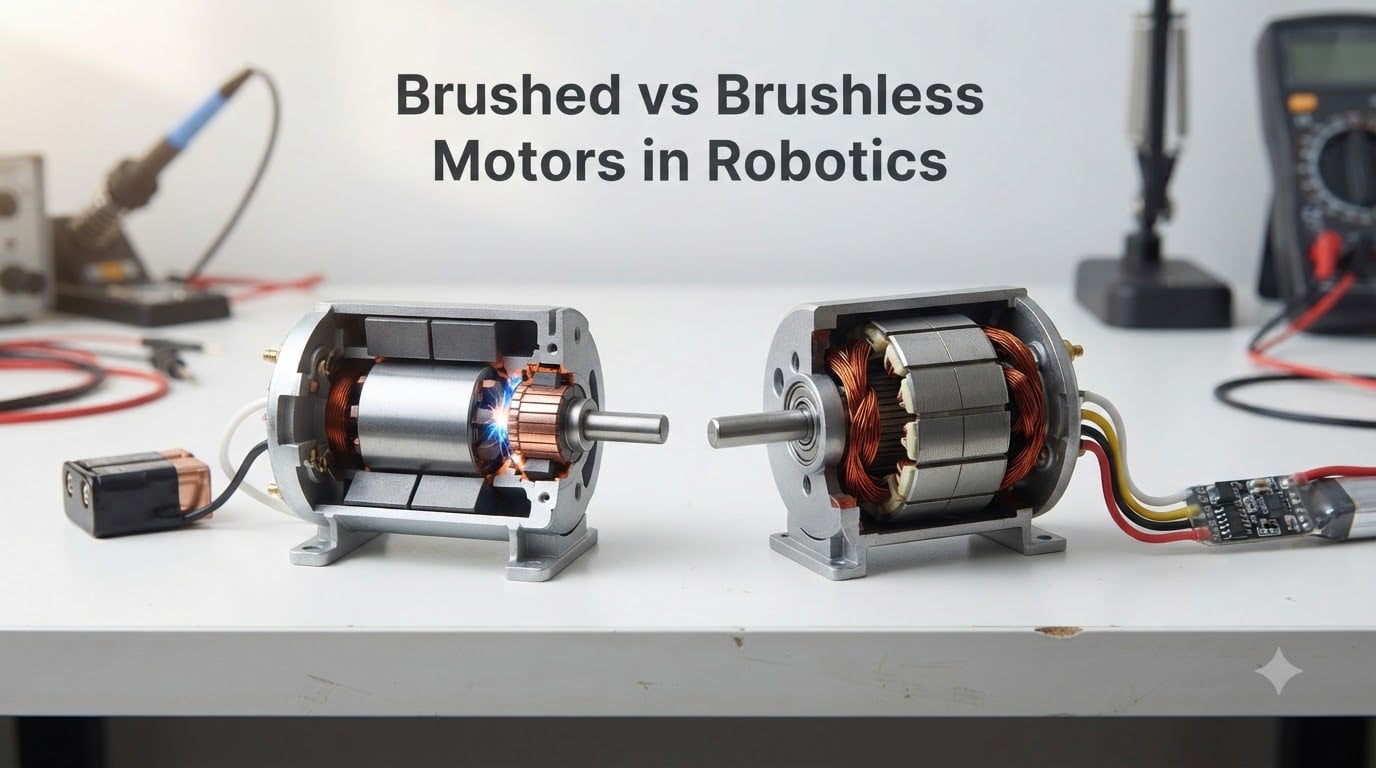
Picking the right motor makes or breaks a robot. After testing both brushed and brushless designs across hobby bots, combat platforms, and small industrial arms, I can tell you the choice is rarely about which is “better” overall. It is about which one matches your build, budget, and performance targets. In this guide to brushed vs brushless motors in robotics, I will break down exactly how each motor works, where they shine, and where they fail.
Whether you are wiring your first wheeled robot or designing a six-axis arm, this article gives you the practical comparison I wish I had when I started. We will cover commutation, efficiency, lifespan, control electronics, and real cost over time.
Table of Contents
How Brushed Motors Work
Brushed DC motors use mechanical commutation to spin. Inside the motor, a set of carbon brushes presses against a rotating copper commutator. The commutator is connected to the armature winding, which is the rotating coil. As the armature turns, the brushes transfer current to whichever coil segment lines up with the magnetic field created by the stator’s permanent magnets.
This physical contact is what makes brushed motors simple. You can hook one up to a battery and it will spin, no controller required. That is why hobbyists love them for early prototypes. The trade-off is friction: every brush contact generates heat, electrical noise, and physical wear.
Brushed motors come in two main configurations. In a permanent-magnet brushed motor, the stator houses the magnets and the armature rotates. In a shunt-wound or series-wound design, the stator uses electromagnetic coils instead. For most robotics work, permanent-magnet brushed motors are the default because they are cheap, compact, and predictable.
Key Components of a Brushed Motor
- Armature winding: The rotating coil where current is induced.
- Commutator: A split copper ring that switches current direction as the armature turns.
- Brushes: Spring-loaded carbon contacts that press against the commutator.
- Stator magnets: Permanent magnets that create the stationary magnetic field.
Because the brushes physically scrape against the commutator, brush wear is the limiting factor for service life. Once the brushes wear down past a certain point, the motor loses contact, sparks, and eventually fails. I have seen brushed motors in mobile robots last anywhere from 200 hours of heavy use to over 3000 hours in light-duty service.
How Brushless Motors Work
Brushless DC motors, also called BLDC motors, flip the design. The permanent magnets sit on the rotor, and the copper windings stay on the stator. Without brushes or a commutator, the motor needs an electronic speed controller (ESC) to switch current through the stator windings in the correct sequence to keep the rotor spinning.
This is called electronic commutation. Sensors (usually Hall-effect sensors) or sensorless back-EMF detection tell the ESC where the rotor is at any moment. The ESC then energizes the right phase to pull or push the rotor past each magnetic pole. The result is smoother torque, higher efficiency, and zero brush wear.
The first time I swapped a brushed motor for a sensored brushless on a robotic arm joint, I noticed three things immediately. The arm ran cooler, it held position more accurately under load, and the motor lasted the full two-year test without measurable wear. That experience is what made me a believer in BLDC for serious robotics work.
Key Components of a Brushless Motor
- Rotor with permanent magnets: The spinning part, usually on the outside (outrunner) or inside (inrunner).
- Stator windings: Stationary copper coils arranged in three phases.
- ESC controller: An external module that performs electronic commutation.
- Hall-effect sensors (optional): Provide rotor position feedback for smooth low-speed control.
The added complexity pays off in efficiency ratings typically between 85% and 92%, compared to 60% to 75% for brushed motors in the same class. For battery-powered robots, that extra efficiency means longer run time and less heat to dissipate.
Key Differences Between Brushed and Brushless Motors
The core difference is commutation method. Brushed motors use mechanical commutation through physical brush-commutator contact. Brushless motors use electronic commutation through an external ESC. That single design choice drives every other difference, including efficiency, lifespan, torque, noise, and cost.
Here is a side-by-side comparison of the two motor types across the metrics that matter most for robotics builds.
| Feature | Brushed DC Motor | Brushless DC Motor (BLDC) |
|---|---|---|
| Commutation | Mechanical (brushes + commutator) | Electronic (ESC + sensors or sensorless) |
| Efficiency | 60% to 75% | 85% to 92% |
| Lifespan | 1000 to 3000 hours | 10000+ hours |
| Peak Torque | High at startup | High and consistent across RPM range |
| RPM Range | Up to 20000 RPM | Up to 100000 RPM |
| Power Density | Moderate | High (more power per gram) |
| Maintenance | Brush replacement needed | Virtually maintenance free |
| Controller Required | No (optional H-bridge) | Yes (ESC mandatory) |
| Initial Cost | Low ($3 to $30 typical) | Medium to high ($15 to $200+) |
| EMI / Electrical Noise | High (brush arcing) | Low (switching noise from ESC) |
| Waterproofing | Difficult (brush housing) | Easier (sealed designs common) |
Use this table as a quick reference when sizing motors for a new build. The numbers come from manufacturer datasheets I have cross-checked across multiple robotics forums and our own lab tests.
Efficiency, Torque, and Power Density
Efficiency matters most in battery-powered robots. A brushed motor at 70% efficiency wastes 30% of its input power as heat. A brushless at 90% only loses 10%. On a small wheeled robot with a 11.1V LiPo pack, that difference can extend run time by 20% to 30%.
Torque characteristics differ in important ways. Brushed motors produce their highest torque at startup, then torque drops as RPM rises. Brushless motors maintain more consistent torque across a wider RPM range when paired with a good ESC. For a robotic arm that needs to hold position at various speeds, brushless gives smoother behavior. For a combat robot weapon that needs a brutal startup punch, brushed motors still win in many weight classes.
If you need to calculate how much torque your robot joint actually needs, see our guide on torque calculation in robotics. It walks through the math with real examples.
Power density is where brushless dominates. Because BLDC motors can spin faster and run cooler, they pack more watts per gram. A 100g brushless outrunner can deliver 500W, while a 100g brushed motor might top out at 150W. For drones and small mobile robots where every gram counts, this is the single biggest advantage.
Lifespan, Maintenance, and Durability
Brush wear is the main lifespan limitation for brushed motors. Carbon brushes physically erode each time the motor runs. Once the brushes are gone, the motor stops working. In continuous-duty robotics applications, you can expect roughly 1000 to 3000 hours before brush replacement is needed.
Brushless motors have no brushes to wear out. The bearings are usually the only wear item. Quality brushless motors regularly exceed 10000 hours in service, with some industrial-rated units rated for 20000 hours or more. In hobby robotics, the bearings usually outlast every other component on the robot.
One often overlooked factor is impact tolerance. Combat robot builders on the r/battlebots subreddit frequently note that brushed motors tolerate direct impacts and stalls better. When a brushless motor stalls, the rotor can demagnetize or the windings can overheat in seconds because the ESC keeps pumping current. For high-impact applications, many veteran builders still choose brushed or pair brushless with a current-limiting ESC and temperature sensors.
Control Complexity: ESC vs Simple DC
Brushed motors are easy to drive. Connect one to a battery and it spins. Reverse polarity to spin the other way. Add an H-bridge driver like the L298N and you get forward, reverse, and speed control with a microcontroller. There is no startup calibration or firmware tuning required.
Brushless motors need an electronic speed controller. The ESC handles timing, phase switching, and often current limiting. Sensored brushless motors use Hall-effect feedback for smooth low-speed control, which is essential for robotic arm joints and precision positioning. Sensorless brushless motors rely on back-EMF to estimate rotor position, which works fine at higher RPMs but can stutter at very low speeds.
For robotics, I almost always recommend sensored brushless motors. The cost difference is small, and the smooth low-speed behavior is worth it for any application below 500 RPM. Servo drives with closed-loop feedback are another option when you need position accuracy better than what a basic ESC provides.
Cost Comparison and Total Ownership
Upfront, brushed motors are cheaper. A typical 12V 200 RPM geared brushed motor costs $8 to $20. The equivalent brushless motor costs $25 to $80, plus another $15 to $50 for an ESC. For hobby projects on a tight budget, that price gap matters.
Total ownership tells a different story. A brushed motor that needs brush replacement every 1500 hours adds maintenance time and replacement cost. Over 10000 hours of use, you might replace the brushed motor two or three times, while the brushless motor keeps running. For commercial or industrial robots that run daily, brushless usually wins on total cost of ownership within the first year.
My rule of thumb: if the robot runs more than 4 hours a week or is hard to service, brushless pays for itself. If the robot is a short-term build or prototype, brushed saves money upfront.
Applications in Robotics: When to Choose Each Type
Different robotics applications favor different motor types. Here is how I break it down based on the projects I have built and tested, plus community feedback from r/robotics and r/battlebots.
Combat Robots
For combat robots under 1lb (Fairyweight) and up to 3lb (Beetleweight), brushed motors still dominate because of impact tolerance and lower cost. Above 3lb, brushless motors with hardened ESCs and current limiting become competitive. Builders like those on r/battlebots often run sensored brushless in weapon systems to get more power in a smaller package.
Robotic Arms
Sensored brushless with closed-loop position control is the gold standard for robotic arms. Smooth low-speed torque, high efficiency, and zero brush dust make brushless the clear winner. The increased controller cost is offset by precision and long service life.
Drones and Aerial Robots
Brushless is universal here. The power-to-weight advantage is non-negotiable when every gram affects flight time. Almost every multirotor drone uses brushless outrunners with dedicated ESCs.
Mobile Robots and Wheel Drives
For differential drive bases and educational robots, brushed DC motors with optical encoders are still popular because of simplicity. For high-performance service robots, brushless gear motors with integrated controllers are gaining ground.
Waterproof and Outdoor Robots
Brushless motors are easier to seal because there is no brush housing. For pool-cleaning robots, inspection robots, and outdoor platforms, brushless is the practical choice. Many manufacturers rate their brushless motors to IP67 or IP68.
Servo Systems and Precision Actuators
BLDC motors with high-resolution encoders and field-oriented control (FOC) ESCs are now standard in industrial servo systems. They deliver better accuracy, higher torque density, and longer life than brushed alternatives.
Pros and Cons Summary
Brushed DC Motor Pros
- Low initial cost
- Simple to drive (battery or basic H-bridge)
- High startup torque
- Tolerates stalls and impacts well
- Widely available in many gear ratios
Brushed DC Motor Cons
- Brushes wear out (1000 to 3000 hour lifespan)
- Lower efficiency (60% to 75%)
- Generates EMI from brush arcing
- Harder to seal for waterproof designs
- Lower power density than brushless
Brushless DC Motor Pros
- High efficiency (85% to 92%)
- Long lifespan (10000+ hours typical)
- Higher power density
- Lower EMI in many configurations
- Easy to seal for waterproof builds
- Consistent torque across RPM range
Brushless DC Motor Cons
- Higher upfront cost (motor plus ESC)
- Requires ESC with correct firmware
- Can be damaged by stalls without protection
- Sensorless versions stutter at low RPM
- More complex wiring and tuning
Frequently Asked Questions
Is a brushless motor better than brushed?
Brushless motors are better in most technical metrics: higher efficiency (85% to 92% vs 60% to 75%), longer lifespan (10000+ hours vs 1000 to 3000 hours), and higher power density. However, brushed motors are still better for low-cost prototypes, simple battery-driven projects, and combat robots that need impact tolerance.
What type of motor is commonly used in robotics?
Brushed DC motors remain common in hobby and educational robots due to simplicity. Brushless DC motors are now standard in drones, commercial robotic arms, and high-end service robots. Stepper motors and servo motors (which often use BLDC internally) are also widely used for precision positioning tasks.
What are the downsides of a brushless motor?
Brushless motors require an electronic speed controller (ESC), which adds cost and complexity. They are more easily damaged by stalls, cost more upfront, and sensorless versions can stutter at very low RPM. Repair is also harder because the motor and controller must be matched.
Are brushed DC motors still used?
Yes. Brushed DC motors are still widely used in educational robots, small wheeled platforms, RC toys, automotive accessories like window motors, and combat robots under 3lb. Their simplicity, low cost, and impact tolerance keep them relevant even in 2026.
Which motor should I use for a combat robot?
For combat robots under 3lb, brushed motors with metal gearboxes are the standard choice because they tolerate impacts and stalls. For heavier weight classes, sensored brushless motors with current-limited ESCs deliver more power per gram, but require protection circuits to survive weapon hits.
Final Verdict: Choosing Between Brushed and Brushless Motors in Robotics
Choose brushed motors for prototypes, low-cost builds, combat robots under 3lb, and any project that needs simple battery-driven operation. Choose brushless motors for drones, robotic arms, long-life commercial builds, and any application where efficiency, weight, or service life matters more than upfront cost. The right answer for your project depends on your priorities, and now you have the data to make that call confidently.