
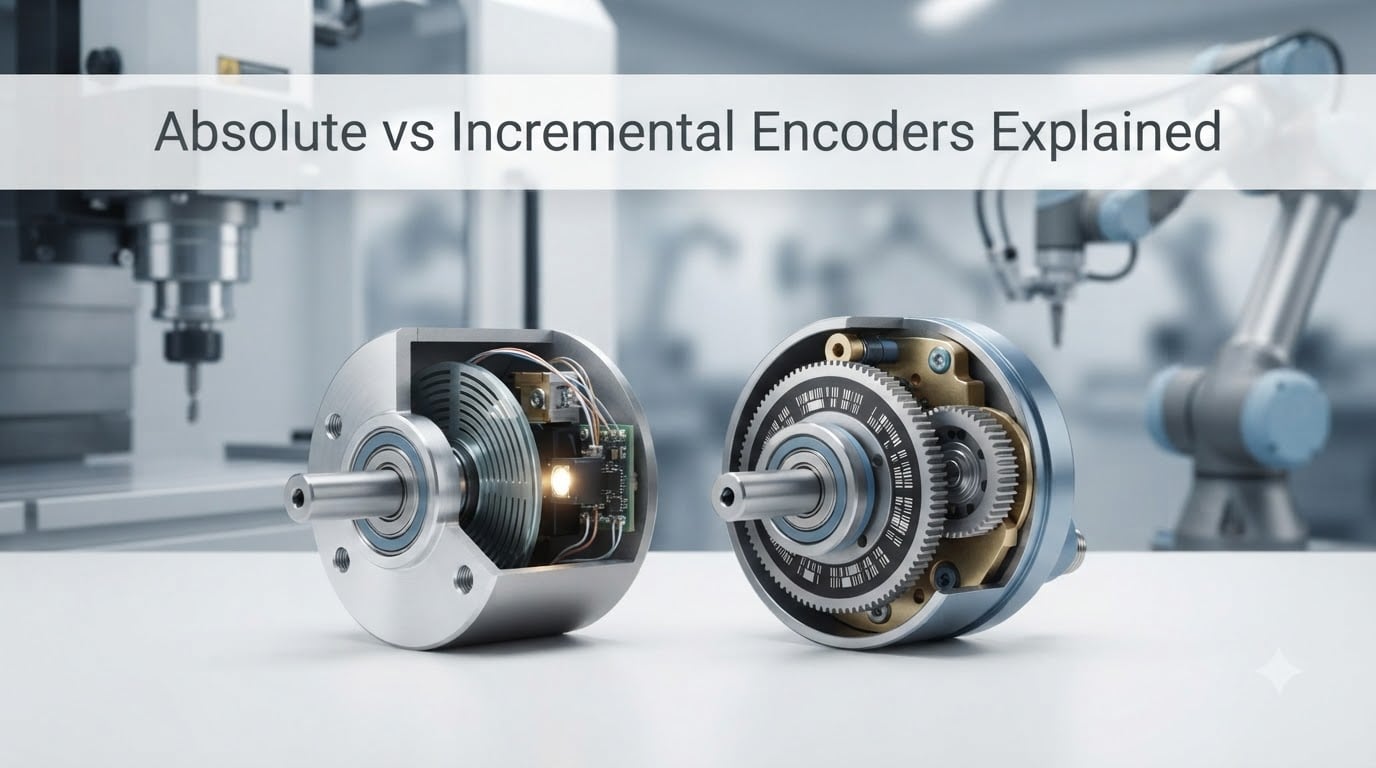
When you need precise position feedback for a rotating shaft, the choice between absolute vs incremental encoders shapes everything from your wiring diagram to your startup routine. Absolute encoders report the actual position of the shaft at any moment, while incremental encoders only indicate changes in position relative to a starting point. That single difference drives the cost, complexity, and behavior of every motion control system that uses them.
I have worked with both encoder types across CNC retrofits, robotic arm joints, and conveyor feedback loops, and the confusion between them comes up constantly. This guide breaks down exactly how each one works, where each one shines, and how to pick the right type for your project.
Table of Contents
What Is an Encoder and How Does It Work?
An encoder is a position sensor that converts the angular position of a shaft into an electrical signal. That signal can be read by a motor controller, PLC, or microcontroller to track how far something has rotated and in which direction.
Encoders fall into two main sensing categories. Optical encoders use an LED, a patterned disk, and a photodetector to read light pulses as the disk turns. Magnetic encoders use a magnetized rotor and Hall effect sensors to detect rotation without fragile glass disks. Both serve the same job: giving your controller a reliable count of shaft movement.
The real split happens in how they report position. That is where the absolute vs incremental encoders distinction comes from. One tells you where the shaft is right now. The other tells you how far it has moved since you last zeroed it.
The Feedback Device in Motion Control
In any closed-loop motion control system, the encoder acts as the eyes of the controller. The controller sends power to a motor, the motor turns a shaft, and the encoder watches the shaft and reports back. Without that feedback, the controller would be guessing about speed and position.
This is why encoder choice ripples into your entire design. If your encoder loses track of position during a power cycle, your machine has to spend time re-homing before it can resume work. That downtime adds up in production environments.
Incremental Encoders Explained
An incremental encoder generates a stream of pulses as the shaft rotates. It does not know where the shaft is, only that the shaft has moved. The controller counts those pulses to figure out position relative to wherever the system started counting.
Most incremental encoders output two channels, called A and B, offset by 90 electrical degrees. This quadrature output lets the controller determine direction: if A leads B, the shaft is turning clockwise, and if B leads A, it is turning counterclockwise. Many encoders also include a third Z channel, sometimes called the index pulse, which fires once per revolution at a known reference point.
Resolution is measured in pulses per revolution (PPR). A 1000 PPR encoder generates 1000 cycles on channel A per full rotation. With quadrature decoding, the controller counts 4000 edges per revolution, often called 4000 counts per revolution or CPR.
The Homing Requirement
Because an incremental encoder only knows relative movement, your system must perform a homing sequence at startup. The machine physically drives each axis until it trips a limit switch or finds the index pulse, then declares that position as zero.
Anyone who has watched a CNC mill boot up and slowly creep toward its home position has seen this in action. It takes time, and it requires mechanical switches or a known physical reference point somewhere on the axis.
What Happens During Power Loss
If power drops while the machine is running, the incremental encoder forgets its count. When power returns, the controller has no idea where the shaft is, and a full homing sequence is required again. This is the most cited drawback in forum discussions about absolute vs incremental encoders.
Absolute Encoders Explained
An absolute encoder outputs a unique digital code for every position within its range. Power it up, read the code, and you immediately know exactly where the shaft is. No homing required.
The most common code pattern is Gray code, where only one bit changes between adjacent positions. This prevents the momentary misreads that can happen with binary code when the controller samples mid-transition. The number of unique codes determines the resolution: a 12-bit single-turn absolute encoder offers 4096 unique positions per revolution.
Absolute encoders come in two main flavors. Single-turn encoders report position within one full rotation and reset to zero every time the shaft passes 360 degrees. Multi-turn encoders track total revolutions using either a geared mechanism or an electronic counter, giving you a unique code for every position across thousands of rotations.
Why No Homing Is Such a Big Deal
In a robot arm with six joints, homing takes six sequential homing sequences. In a large CNC with five axes, the operator waits while each axis finds its reference point. Absolute encoders skip all of that. Power on, read the position, resume work.
For safety-critical systems, this also matters. If a robot arm is in an unknown position after a power glitch, it cannot safely resume motion. Absolute encoders give the controller the position it needs to make a safe decision on the first scan after boot.
Key Differences: Side-by-Side Comparison
Here is the quick-reference table that captures the core differences between absolute vs incremental encoders.
Feature Comparison
Position reporting: Absolute encoders report the exact position at any moment. Incremental encoders report changes relative to a reference point.
Startup behavior: Absolute encoders are ready immediately on power-up. Incremental encoders require a homing sequence.
Power loss handling: Absolute encoders retain position. Incremental encoders lose their count and need re-homing.
Output signal: Absolute encoders output a multi-bit digital code (often Gray code). Incremental encoders output quadrature pulses (A and B channels) plus an optional index pulse.
Wiring complexity: Absolute encoders typically need more wires (parallel output) or a serial protocol like SSI, BiSS, or EtherCAT. Incremental encoders can run on as few as four wires.
Cost: Incremental encoders are generally cheaper for the same resolution. Absolute encoders carry a premium, especially multi-turn versions.
Resolution scaling: Incremental encoders can achieve very high resolution with quadrature decoding. Absolute encoders are limited by bit depth, though 24-bit and higher units exist.
Best fit: Incremental for high-speed, high-resolution, cost-sensitive applications. Absolute for safety-critical, multi-axis, or systems that cannot tolerate homing.
Advantages and Disadvantages of Each Type
No encoder is universally better. Each type has clear strengths and real drawbacks, and the best choice depends on what you actually need.
Incremental Encoder Pros and Cons
Advantages: Lower cost per unit, simple wiring, very high resolution through quadrature decoding, robust performance in high-vibration environments, and a wide selection of off-the-shelf modules.
Disadvantages: Requires homing after every power cycle, loses position on power loss, no absolute reference on its own, and the controller must do pulse counting in real time, which can be processor-intensive at high speeds.
For hobby robotics, FRC competition robots, and many CNC builds, incremental encoders hit the sweet spot of cost and capability. The homing routine is a small price for the savings.
Absolute Encoder Pros and Cons
Advantages: Instant position on power-up, no homing required, survives power loss cleanly, simplifies safety logic, and provides a true reference for multi-axis systems.
Disadvantages: Higher cost, more complex wiring (especially for parallel output), resolution capped by bit count, and multi-turn versions can be expensive. Some so-called absolute encoders actually rely on battery backup or non-volatile memory, which adds a maintenance item.
For industrial automation, surgical robots, and any system where downtime is expensive, the higher upfront cost pays for itself quickly.
Single-Turn vs Multi-Turn Absolute Encoders
Single-turn absolute encoders give you a unique position code for every angle within one full rotation. They are perfect for applications where the shaft only rotates a fraction of a turn, like a valve actuator or a robot joint with limited range.
Multi-turn absolute encoders go further. They track the total number of full rotations, often through an internal gear train that drives a secondary code disk. A 25-bit multi-turn encoder with 12-bit single-turn resolution can distinguish 4096 positions per revolution across 8192 revolutions, giving 33 million unique positions in total.
For robotics, multi-turn is usually what you want. A robot arm joint that can rotate multiple times needs to know both where it is within the current turn and how many turns it has completed. Without multi-turn tracking, you would have to spin the joint through 360 degrees to figure out where it is, which defeats the point.
Battery-Backed Encoders and Power Loss Scenarios
One of the most common points of confusion in forum threads is the difference between true absolute encoders and battery-backed incremental systems. Some manufacturers sell encoders that look absolute but actually use a battery to keep a counter alive during power loss.
If that battery dies, the system reverts to incremental behavior and needs homing. It is a maintenance item that catches people off guard, especially in field installations where battery replacement gets deferred.
True absolute encoders store position in non-volatile memory or use a purely mechanical gear train that never loses track, regardless of power. These designs have no battery to fail, but they cost more. When weighing absolute vs incremental encoders, ask whether the absolute rating includes battery backup or not. It changes the long-term ownership picture significantly.
Common Applications in Robotics and CNC
Incremental encoders dominate in stepper motor feedback, low-cost CNC builds, and consumer 3D printers. The low cost and high resolution fit the bill when homing is fast and infrequent.
Absolute encoders show up in industrial CNC machines, collaborative robot arms, semiconductor wafer handlers, and medical imaging equipment. Any application where a power loss cannot be followed by a long re-homing routine benefits from absolute tracking.
Conveyor systems often use incremental encoders for speed feedback, where absolute position does not matter. Elevators use absolute encoders for floor-level accuracy, where knowing the exact position after a power blip is critical for safety.
How to Choose the Right Encoder for Your Project
Start with three questions. How expensive is downtime in your system? Can your machine physically home itself quickly and safely? What resolution do you actually need?
If downtime is cheap, homing is fast, and you need very high resolution, incremental is the practical choice. If downtime is costly, homing is slow or unsafe, and you need known position on every power-up, absolute is worth the premium.
For robotics specifically, lean toward multi-turn absolute on joints that rotate beyond 360 degrees. For CNC, incremental often works fine if your homing switches are reliable. For battery-powered mobile robots, weigh the cost of multi-turn absolute against the time saved on every boot.
The absolute vs incremental encoders decision is not about which technology is better. It is about which tradeoff matches your system. Match the encoder to the real constraints, and you will save both money and headaches.
Frequently Asked Questions
What is the main drawback of incremental encoders compared to absolute encoders?
The main drawback of incremental encoders is that they lose all position data when power is removed. After any power cycle, the system must perform a full homing sequence to find a known reference point, which takes time and requires mechanical switches or an index pulse. Absolute encoders report the exact shaft position the moment power returns, with no homing required.
What are the four types of encoders?
The four main types of encoders are incremental, absolute, optical, and magnetic. Incremental and absolute describe how position is reported, while optical and magnetic describe the sensing technology. You can have an optical absolute encoder, a magnetic incremental encoder, and so on, because these categories are independent.
What is the difference between absolute and incremental?
An absolute encoder outputs a unique digital code for every shaft position, so it always knows where it is. An incremental encoder only generates pulses as the shaft turns, so it knows how far it has moved but not its current position without a reference point. In short, absolute gives you location, incremental gives you change.
What are the disadvantages of absolute encoders?
Absolute encoders cost more than incremental encoders at the same resolution, often require more wires or a serial protocol, and have resolution capped by their bit depth. Multi-turn versions are especially expensive. Some absolute encoders also rely on battery backup, which adds a maintenance item that can fail in the field.
Do absolute encoders need to be calibrated?
True absolute encoders do not need to be calibrated or homed at startup because they report position directly from their internal code disk. However, battery-backed or counter-based designs may need re-homing if the backup power fails. Mechanical installation still matters for alignment, but the encoder itself does not drift.
Which is better, an absolute encoder or an incremental encoder?
Neither is universally better. Incremental encoders win on cost, resolution, and wiring simplicity. Absolute encoders win on instant position, no-homing startup, and power-loss safety. Choose incremental for hobby projects and high-speed feedback where homing is fast. Choose absolute for industrial, multi-axis, or safety-critical systems where downtime is expensive.
Conclusion
Absolute vs incremental encoders comes down to how you weigh cost against uptime. Incremental encoders give you high resolution and low cost but require a homing routine after every power cycle. Absolute encoders cost more but report exact position the moment they power on, which is a game-changer for multi-axis and safety-critical systems. Match the encoder to your real constraints and you will avoid both overspending and under-engineering.