
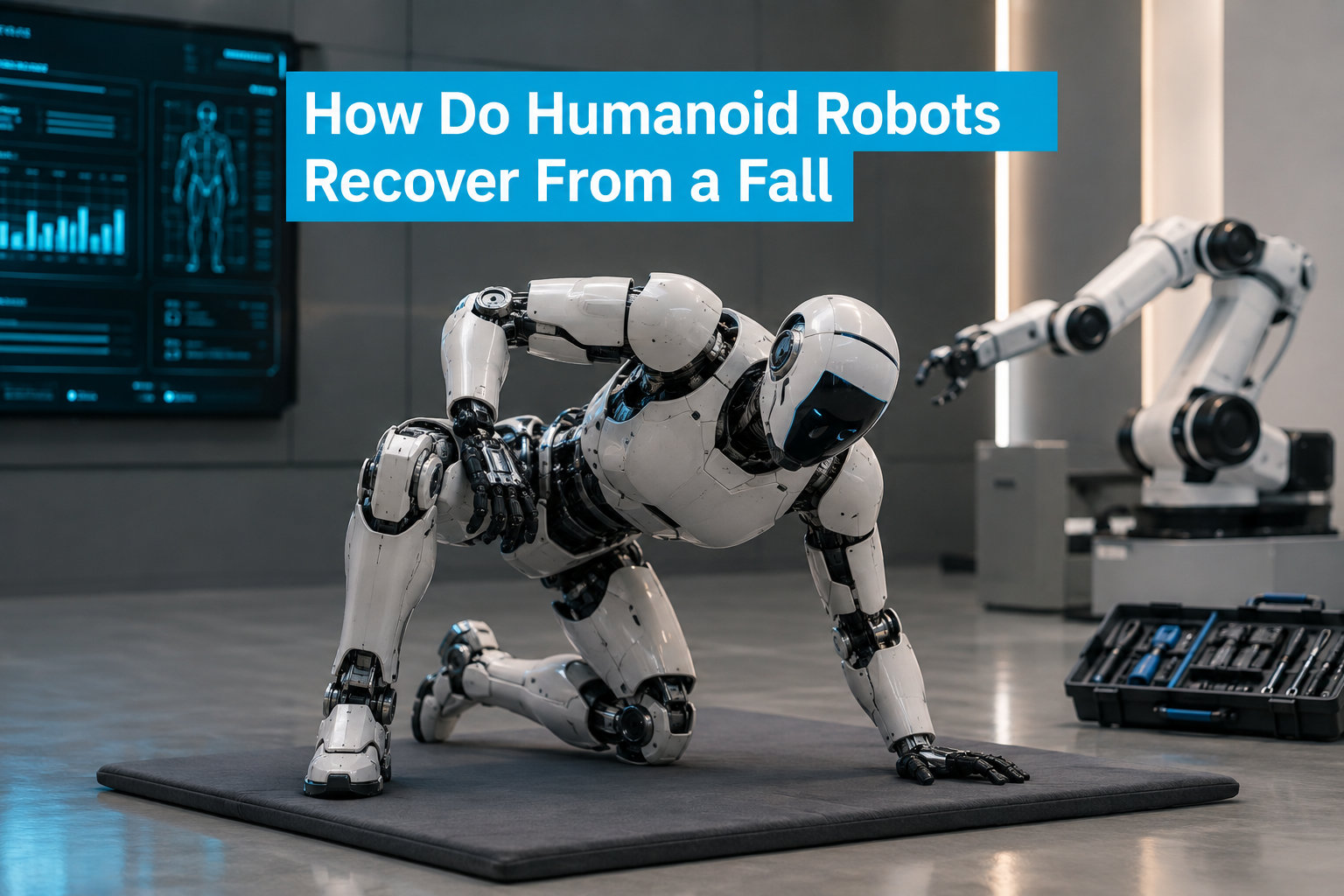
I have spent the last several months reading every humanoid robotics paper, watching dozens of fall demonstrations, and talking with engineers who have built the controllers behind today’s bipeds. The question how do humanoid robots recover from a fall sounds simple, but it sits on top of an entire stack of biomechanics, control theory, and learned policies. In this guide I will walk you through the exact three-phase framework that researchers now use, the math that keeps a robot upright, and the AI systems that let a machine pull itself off the floor without a human lifting it.
Table of Contents
Quick Answer: How Do Humanoid Robots Recover From a Fall?
Humanoid robots recover from a fall through a three-phase process: first they try to prevent the fall using real-time balance control, then they mitigate impact by tucking limbs and engaging compliant joints if the fall is unavoidable, and finally they execute a self-righting motion to stand back up autonomously. Modern platforms like Unitree G1 and Agility Digit combine model-based controllers with reinforcement learning to do all three without human help.
Why Humanoid Robots Fall and Why Recovery Matters
If you have watched a humanoid robot walk on stage and tip over sideways, you have seen the most obvious weakness of bipedal machines. Two legs on a narrow base of support is one of the most unstable ways to move. Every step is a controlled fall forward, and any miscalculation turns a planned step into an unplanned one.
Falls are not just embarrassing. They stall deployments, eat into battery life, wear out actuators, and — when robots operate near people — can cause real injuries. A 2025 incident with a Unitree G1 at a public demonstration made headlines for exactly this reason. That is why fall recovery is treated as a hard requirement, not a nice-to-have, for any humanoid that is meant to leave the lab.
From a research standpoint, falling is also one of the most informative tests of a humanoid platform. Engineers kick their robots on purpose, push them with hockey sticks, and trip them on cables to see how the whole stack of perception, control, and actuation holds up. The robot that gets back up fastest with the least damage is the one that has actually solved the problem.
The Three-Phase Framework for Humanoid Fall Recovery
Every modern humanoid fall-recovery system, from academic prototypes to shipping products, can be broken into three phases. The FIRM project, published in late 2025, formalizes this as a unified policy that handles prevention, mitigation, and recovery in one model. Understanding the three phases is the key to understanding the rest of the field.
Phase 1: Fall Prevention and Balance Control
Before the robot ever hits the ground, the controller is already fighting to keep it upright. Balance controllers run at hundreds of hertz, fusing data from inertial measurement units, joint encoders, and sometimes depth cameras or LiDAR to estimate the robot’s center of mass and center of pressure in real time.
When the controller detects a disturbance — a push, a slippery patch of floor, or a misjudged step — it triggers reactive strategies. These include ankle, hip, and stepping adjustments that move the feet to re-capture the center of mass over the support polygon. If the disturbance is small, an ankle strategy is enough. If it is bigger, the robot takes a step. This entire phase is fall prevention.
Phase 2: Impact Mitigation and Safe Landing
When the controller realizes the fall cannot be prevented, the robot switches from balance to damage control. The system chooses a safe falling posture — often rolling onto the back or side, tucking limbs to protect the head and torso, and using compliant joints to absorb the kinetic energy of impact.
This phase is what separates a damaged robot from a working one. A poorly mitigated fall can crack an arm module or strip a gearbox, while a well-mitigated fall leaves the robot ready to stand up. FIRM’s authors describe this as reducing impact “when unavoidable,” which is the right framing: prevention always comes first, but mitigation is the safety net.
Phase 3: Self-Righting and Stand-Up
Once the robot is on the ground, the third phase kicks in. The robot has to figure out which way is up, plan a get-up motion that respects its joint limits and torque capabilities, and execute that motion. This is the part most people picture when they ask how do humanoid robots recover from a fall.
Self-righting is hard because the robot is in a configuration it almost never visits during walking. Joints may be folded under the body, the ground contact pattern is unusual, and there is very little training data. This is where learned policies — especially reinforcement learning and diffusion-based models — have made the biggest difference in the last two years.
Balance Control Methods That Prevent the Fall in the First Place
Balance control is the single most important layer of fall recovery, because the best way to recover from a fall is to never have one. Three approaches dominate the field today, and most production humanoids use a blend of all three.
Zero Moment Point and the Inverted Pendulum Model
The classic workhorse of humanoid balance is the Zero Moment Point, or ZMP. The ZMP is the point on the ground where the total inertia force from the robot’s motion exactly balances the ground reaction force. As long as the ZMP stays inside the support polygon — the convex hull of the robot’s foot contacts — the robot is statically stable.
For real-time control, engineers usually model the robot as an inverted pendulum pivoting at the ZMP. The controller adjusts joint angles and foot placement to keep that pendulum balanced. ZMP-based controllers are computationally cheap, mathematically clean, and form the backbone of most textbook humanoid balance stacks. They are also the basis of how humanoid robots walk in the first place.
Whole-Body Control and Center of Mass Tracking
ZMP works well for slow, quasi-static walking, but it falls apart during fast or dynamic motions. That is where whole-body control (WBC) comes in. WBC treats the humanoid as a single constrained system and solves for joint torques that achieve a desired task — for example, tracking a center of mass trajectory — while respecting friction cones, joint limits, and contact constraints.
Whole-body control is what allows robots like Boston Dynamics’ Atlas to perform dynamic parkour, and it is also what Google’s Gemini Robotics 2 work uses to bring foundation-model policies to humanoid bodies. We covered Gemini Robotics 2’s whole-body control approach in a recent Gemini Robotics 2 whole-body control explainer, which is worth reading alongside this one.
Disturbance Rejection: Push Recovery and Reactive Stepping
Disturbance rejection is the test of whether a balance controller actually works. Engineers shove their robots with known forces and measure how quickly the controller compensates. The strategies form a clean hierarchy: ankle strategy for tiny perturbations, hip strategy for medium ones, and stepping strategy for big ones that would otherwise push the center of mass outside the support polygon.
Modern controllers fuse all three strategies. When I watched Agility Robotics’ team demo Digit, a single hard push at the shoulder triggered an immediate ankle correction followed by a reactive step in the direction of the push. This is exactly the kind of layered response that separates a real humanoid from a research toy, and it is also why the question of how do humanoid robots recover from a fall is really three questions in one.
Impact Mitigation: How Robots Land Safely
When prevention fails, mitigation decides whether the robot is still useful afterward. The goal is to convert the kinetic energy of the fall into something the hardware can survive, and to land in a configuration that is easy to stand up from.
Compliant Joints and Shock-Absorbing Actuators
Rigid joints break things. Compliant joints bend. Most modern humanoids use series elastic actuators, quasi-direct-drive motors, or air-filled pads at the shoulders, hips, and knees to add a small amount of give. That compliance spreads the impact force over a longer time window, dropping peak loads on gears and bearings.
This is also why servo motor design matters so much for fall survival. If you want the deep background, our servo motors explainer walks through how torque, back-EMF, and gearing decisions affect a joint’s ability to absorb a hit without stripping teeth.
Safe Falling Postures and the D’Alembert Principle
Engineers borrow the D’Alembert principle from classical mechanics to choose which way to fall. In simple terms, a robot can influence its angular momentum mid-fall by moving its limbs, effectively steering itself toward a configuration that absorbs impact well. Falling onto a padded backpack panel is very different from falling onto an outstretched wrist.
A common safe-fall strategy is to rotate the upper body so the robot lands on its back with limbs tucked. The back is broad, the head can be protected by the arms, and the robot ends up in a position that is well-suited to a push-up-style get-up motion. FIRM’s experiments show that choosing this posture based on the direction of the impending impact measurably reduces structural damage.
Hardware Protection Through Collision Geometry
Some protection is built into the robot’s body rather than its brain. Engineers add rounded shoulder covers, dedicated impact panels at the hips, and rubber bumpers around the head and wrists. These features shape the collision geometry so that forces are spread across the strongest parts of the chassis.
It is also worth noting that the CAN bus plays a quiet but critical role here. While the robot is falling, the controller still has to talk to dozens of motor drivers and sensors in real time. A reliable bus like CAN keeps the data flowing even when the robot is upside down, which is essential if mitigation and self-righting are going to work. Our CAN bus guide for robots covers the protocol details if you want to dig deeper.
Self-Righting and Stand-Up: How Robots Get Back on Their Feet
Self-righting is the part of fall recovery that the public actually sees, and it is the part that has improved the most in the last two years. Until recently, most humanoids had to be picked up by a human or lifted with a hoist. Today, the latest platforms can go from prone on the floor to walking in under a minute.
Sensing Orientation After a Fall
The first step is figuring out where the robot is. The IMU gives a noisy estimate of gravity direction, joint encoders tell the controller how each limb is folded, and contact sensors on the limbs and feet identify which body parts are touching the ground. Fusing all of that gives the controller a pose estimate that is good enough to plan a get-up motion.
This is also where reinforcement learning policies shine. Instead of hand-coding every possible starting configuration, a learned policy maps from a state estimate to a recovery action, generalizing across many poses that the engineer never had to explicitly enumerate.
Generating a Get-Up Trajectory
Once the robot knows its pose, it has to pick a recovery motion. There are a few canonical sequences: from prone, push up onto the hands and knees; from supine, roll to the side and push up; from a side-lying position, swing the legs under and use momentum to roll onto the knees. Each sequence is essentially a contact-rich, dynamically constrained motion problem.
Traditional approaches use trajectory optimization to compute these motions offline, then play them back. Learned approaches, like the HumanUP system from early 2025, instead train a two-phase policy that first discovers a rough trajectory in simulation and then refines it with reinforcement learning. The result is more robust to the messy contact dynamics of real floors.
Real Demonstrations on Unitree G1, Digit, and Atlas
Public demos have made the progress visible. Agility Robotics’ Digit now stands up from a variety of fall configurations on dirt, grass, and indoor flooring. Unitree’s G1 has shown rapid recovery from being kicked, often in under 10 seconds. Boston Dynamics’ Atlas has long been the gold standard for explosive get-up motions that look almost human. Each of those platforms solves the same underlying problem with different control stacks, but the visible behavior is the same: fall, recover, keep going.
Machine Learning Approaches to Fall Recovery
If you read the FIRM and HumanUP papers, the field is increasingly dominated by machine learning. Model-based controllers handle the easy cases, but learned policies handle the long tail of weird fall configurations, weird terrain, and weird payloads that humans cannot enumerate by hand.
Reinforcement Learning in Simulation
Almost every modern fall-recovery system starts with reinforcement learning in simulation. The robot is dropped, kicked, and perturbed thousands or millions of times in a physics engine like Isaac Gym or MuJoCo, while a policy learns to maximize a reward that balances staying upright, minimizing impact, and standing up quickly when it does fall.
The trick is reward shaping. A naive reward that just penalizes falling will teach the robot to crouch and not move. Engineers add terms for upright posture, low joint torque, and successful stand-up completion, then carefully tune the weights so the policy learns the right priorities.
Sim-to-Real Transfer and the Domain Gap Problem
Sim-to-real transfer is the process of taking a policy trained in simulation and running it on the physical robot. The hard part is the domain gap: simulation does not perfectly match real friction, actuator dynamics, or sensor noise. Policies that look great in sim can fail catastrophically on hardware.
Engineers close the gap with a mix of domain randomization, domain adaptation, and real-world fine-tuning. FIRM’s approach is interesting because it uses a small number of human demonstrations as skill priors, which gives the policy a head start and avoids the worst sim-to-real pitfalls. HumanUP uses a two-phase curriculum that progressively increases the difficulty of the recovery task.
FIRM, HumanUP, and Diffusion-Based Policies
Diffusion policies are one of the more recent ideas in this space. Instead of outputting a single action, a diffusion model iteratively denoises a trajectory, generating a smooth motion plan that respects the robot’s constraints. This works especially well for getting-up, where the motion has to be coordinated across many joints.
FIRM combines skill priors with an adaptive memory module that lets the policy adjust online based on the current context. The result is a unified system that handles prevention, mitigation, and recovery in one model rather than three separate controllers stitched together. That unification is, in my view, the most important trend in humanoid fall recovery as of 2026.
Biological Inspiration: How Humans and Animals Recover
Roboticists did not invent fall recovery from scratch. Humans and animals have been solving the same problem for millions of years, and the best humanoid systems borrow heavily from biology.
Why Humans Are So Good at Getting Up
Humans are extraordinary at fall recovery. We have flexible spines that absorb shock, a vestibular system that updates our balance model in milliseconds, and a lifetime of practice that has internalized the motor patterns needed to stand up from almost any position. A healthy adult can recover from a stumble on ice in well under a second.
What is striking is how much of that recovery is pre-reflexive. The nervous system does not have to “decide” to step; it just steps. Engineers try to replicate this by pushing as much of the fall response as possible into low-latency feedback loops, with slower learned policies layered on top for the harder cases.
Lessons From Cats, Gymnasts, and Toddlers
Cats are the original reference design for safe falling. Their righting reflex, which lets them reorient mid-air, is a textbook example of using angular momentum and limb positioning to control a fall. The D’Alembert-based safe-falling strategies used in humanoids are essentially engineering versions of what cats do naturally.
Gymnasts show what is possible with years of training, and toddlers show what is possible with almost no training but an astonishing amount of trial and error. Both are useful models. Gymnast-style trajectories inspire motion-planning approaches, while toddler-style learning through repetition inspires reinforcement learning curricula.
What Humanoid Engineers Borrow From Biology
The biggest biological lessons in current humanoid research are about compliance, hierarchy, and practice. Real bodies are not rigid; real motor control is layered; and real skill comes from repetition. Modern humanoids use compliant joints, layered control architectures, and millions of simulated practice trials to get the same effect.
What is still missing is the equivalent of a human vestibular system, which is why inertial sensing and learned policies are so important. We are a long way from a humanoid that recovers as gracefully as a person, but the gap is closing every year.
Comparison Table: Fall Recovery Approaches Across Platforms
It helps to put the major approaches side by side. The table below summarizes how the three most-cited recent frameworks, plus a few representative humanoid platforms, handle the three phases.
| Approach / Platform | Phase 1: Prevention | Phase 2: Impact Mitigation | Phase 3: Self-Righting | Key Strength |
|---|---|---|---|---|
| FIRM (2025) | Unified policy with skill priors | Learned safe-fall posture selection | Diffusion-based get-up trajectory | Single model for all three phases |
| HumanUP (2025) | Minimal (relies on existing balance stack) | Not the focus | Two-phase curriculum learning | Strong get-up policy from sparse rewards |
| Classic ZMP controller | Strong, mathematically grounded | Limited, usually absent | Hand-coded stand-up trajectories | Reliable for slow, structured walking |
| Unitree G1 | Proprietary balance + WBC | Compliant joints and impact panels | Rapid learned recovery demos | Fast real-world recovery from kicks |
| Agility Digit | Whole-body control with reactive stepping | Curved backpack panel and limb compliance | Trained get-up motions on varied terrain | Production-grade reliability in demos |
| Boston Dynamics Atlas | Dynamic WBC with model-predictive control | Hardware-tuned for high-impact events | Highly dynamic parkour-style recovery | Most athletic, most aggressive motions |
Challenges, Limitations, and the Road Ahead
Even with the impressive demos, humanoid fall recovery is far from solved. Three problems stand out.
Hardware Durability After Repeated Falls
Every fall stresses the actuators, gearboxes, and structural joints. Even with compliant designs, repeated impacts accumulate wear, and a humanoid that falls often in a warehouse or on a construction site will need regular maintenance. Engineers are working on modular joint designs and self-diagnostic routines that can flag components before they fail, but the hardware problem is real.
Recovery on Deformable and Uneven Terrain
Most published results focus on flat ground or mild slopes. Recovery on deformable surfaces like grass, gravel, snow, or foam padding is harder because the contact dynamics change in ways that are difficult to model. FIRM and HumanUP both test on these surfaces, and they show measurable performance drops. Closing the sim-to-real gap on deformable terrain is one of the open research questions of the field.
Safety Around Humans and the Path to Deployment
A 200-pound humanoid that falls on someone can cause real harm. This is not just a perception problem; it is a hard engineering problem. Until robots can reliably detect nearby humans, control their fall direction, and arrest their motion on contact, deployment in shared human spaces will be limited. The regulatory environment is also still catching up; recent FCC import limits on humanoid robots are one early sign of that.
The next 24 months will likely bring more unified policies, more learned recovery on rough terrain, and more structured safety certification. If you want to track the broader autonomous-robot wave alongside this, our piece on advances in autonomous mobile robots is a good complement.
Frequently Asked Questions
How do humanoid robots keep their balance?
Humanoid robots keep their balance using a real-time control loop that fuses data from inertial measurement units, joint encoders, and force sensors to estimate the robot’s center of mass and center of pressure. The controller then adjusts joint torques and foot placement using strategies based on the Zero Moment Point, whole-body control, or learned policies to keep the center of mass over the support polygon.
Can humanoid robots get back up after falling on their own?
Yes. The latest humanoid platforms, including Unitree G1, Agility Digit, and Boston Dynamics Atlas, can stand back up without human assistance. Self-righting is typically handled by a learned policy that estimates the robot’s pose on the ground and generates a stand-up motion that respects joint limits and contact constraints.
Does a robot feel pain when it falls?
No. Robots do not have a nervous system and cannot feel pain in a biological sense. What they do have is force and impact sensors that allow the controller to detect a hard hit and trigger protective responses such as shutting down damaged actuators or switching to a safe-fall posture.
What kills a humanoid robot?
The most common causes of robot failure are actuator burnout, gear stripping from repeated impacts, battery depletion, and damage to wiring harnesses or sensors. Falls are a major contributor because they can break structural components and push motors past their torque limits.
What country is leading in humanoid robot development?
As of 2026, the United States, China, and Japan are the most active countries in humanoid robot development. The U.S. leads in research from companies like Boston Dynamics, Agility Robotics, and Figure AI. China, with companies like Unitree, Fourier Intelligence, and UBTech, is scaling production and reducing costs quickly. Japan has a long history of humanoid research through institutions like Waseda University and companies like SoftBank Robotics.
How do humanoid robots walk?
Humanoid robots walk by planning a sequence of footstep locations and using balance controllers to shift the robot’s center of mass over each foot as it lifts and places the other. Most walking stacks combine a Zero Moment Point planner for stable, predictable motion with whole-body control or learned policies that handle disturbances and uneven terrain.
What is the longest distance a humanoid robot has walked?
The longest reported distance walked by a humanoid robot is held by a research platform from the Oregon State University team, whose Cassie robot covered roughly 100 kilometers on a single charge in 2021. The mark is unofficial and was set in a controlled environment, but it remains the most cited long-distance humanoid walking record.
Conclusion
So, how do humanoid robots recover from a fall? They do it in three coordinated phases: balance control tries to prevent the fall, compliant joints and safe-fall strategies mitigate impact if the fall is unavoidable, and learned or hand-crafted self-righting motions get the robot back on its feet. Modern frameworks like FIRM and HumanUP are now unifying those phases into single learned policies trained with reinforcement learning in simulation and transferred to hardware with carefully designed skill priors.
The field is moving fast, and the demos from late 2025 and 2026 already look very different from the humanoids of even three years ago. If you are working on a humanoid stack, start by mapping your system to the three phases and ask where your weakest phase is — that is almost always the one that limits your robot’s real-world reliability. If you are just curious, watch a few of the public Digit and G1 recovery videos and you will see all three phases in action in under a minute.