
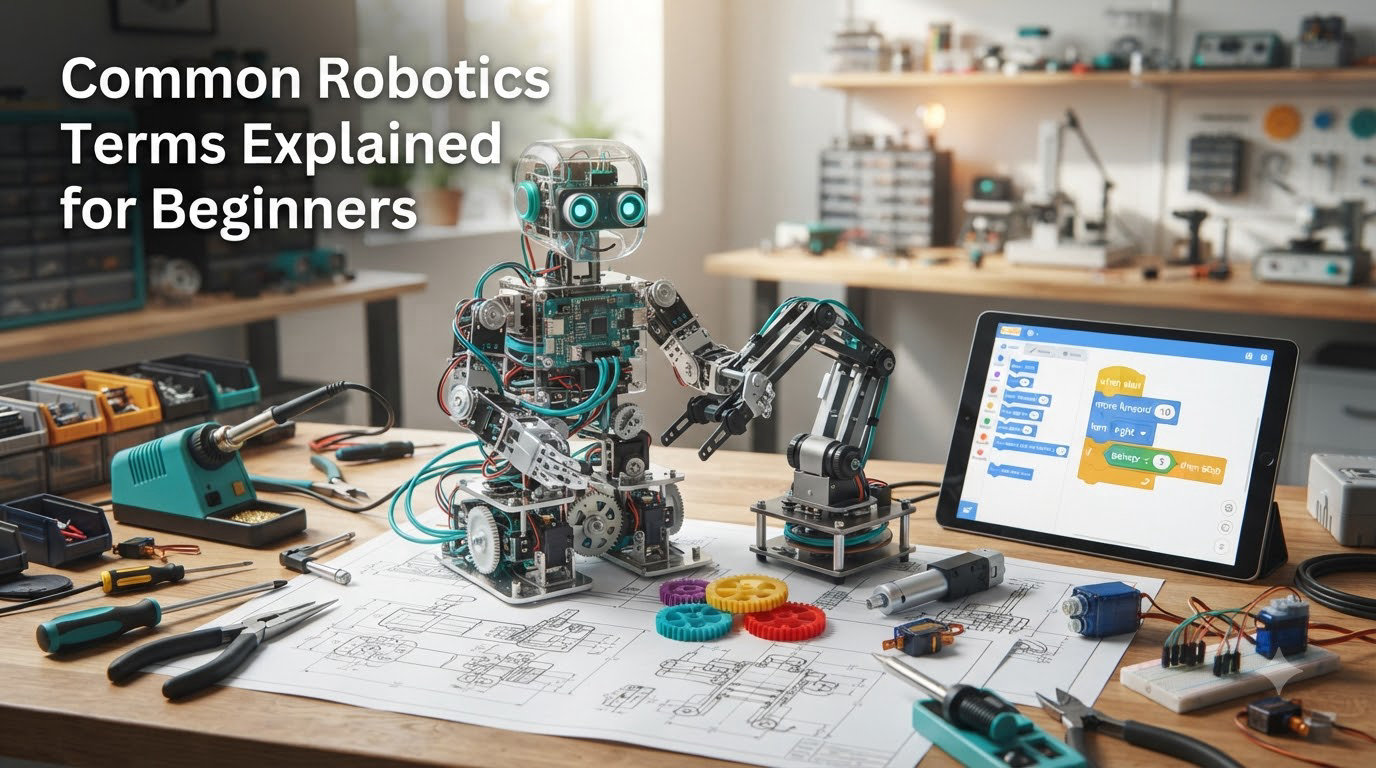
If you have ever watched a robot arm sort packages and wondered how it actually knows where to go, you have already met the problem this guide solves. Robotics terms explained in plain English is the fastest way to move from confused spectator to confident builder. I have spent the last decade teaching beginners, and the same handful of vocabulary words keep showing up. Master those, and the rest of the field opens up.
This guide walks you through the robotics terminology that actually matters. We will cover mechanical basics, sensor language, control systems, and the new AI vocabulary that has reshaped the field in 2026. I will use practical examples for every term so you can connect the word to the real part on a real robot.
Table of Contents
The Big 4 of Robotics and Core Components Every Robot Shares
The big 4 of robotics are sensing, planning, acting, and feedback. Every robot, from a Roomba to a six-axis industrial arm, relies on these four capabilities working together.
Sensing means the robot collects data about itself and its environment. Planning means the software decides what to do next based on that data. Acting means the robot moves, grips, or otherwise affects the world. Feedback means the robot checks the result and adjusts.
When beginners ask me to list the 8 components of every robot, here is the answer I give them:
- Power source: battery, tethered supply, or pneumatic compressor
- Controller: the brain, usually a microcontroller or industrial PLC
- Sensors: cameras, encoders, accelerometers, force sensors
- Actuators: motors, servos, steppers, hydraulics, pneumatics
- End effector: gripper, tool, or specialized hand
- Structure: the frame, links, and joints
- Communication: Wi-Fi, CAN bus, Ethernet, or serial links
- Software stack: firmware, ROS nodes, or motion controllers
Once you can name these eight pieces, the rest of robotics vocabulary starts to fit into a clear mental map. You are not memorizing a random list, you are learning a system.
Actuator and Motor Terms Every Beginner Should Know
An actuator is anything that converts energy into motion in a robot. If a robot moves something, an actuator did the work. The most common beginner question is what is an actuator in robotics, and the short answer is: the muscle of the machine.
You will run into five main actuator types when you start learning robotics terminology.
A servo motor is a closed-loop motor with built-in position feedback. Hobby servos are cheap and perfect for small robots. Industrial servos are far more precise and dominate factory automation.
A stepper motor moves in fixed angular steps. Steppers hold position without needing a brake and are popular in 3D printers and CNC machines. The tradeoff is they can lose steps under heavy load.
A DC motor provides continuous rotation. It is simple, fast, and ideal for driving wheels on mobile robots. Pair it with an encoder and you get precise speed control.
A hydraulic actuator uses pressurized fluid to generate force. Hydraulic systems pack enormous power into small spaces, which is why you see them on excavators and large humanoid robots like some 2026 prototypes.
A pneumatic actuator uses compressed air. Pneumatic systems are clean, simple, and very fast, which is why food and packaging lines use them constantly.
Two more terms you will see immediately are torque (rotational force) and RPM (rotational speed). When you read a motor datasheet, those two numbers plus voltage tell you almost everything you need. If you want a deeper mechanical primer, our piece on gear ratio explains how gearing trades speed for torque.
One last beginner question is what does payload mean. Payload is the maximum weight a robot arm can carry while still meeting its published performance numbers. A 5 kg payload robot cannot reliably lift a 6 kg box, even if the motor is strong enough.
Sensor Terminology in Robotics Explained Simply
Sensors are how robots answer the question what is happening right now. Every robotics glossary for beginners places sensors near the top because no robot can act intelligently without data.
An accelerometer measures linear acceleration. Phones use them to rotate the screen, and robots use them to detect tilt, vibration, or sudden stops.
A gyroscope measures rotational velocity. Pair an accelerometer with a gyroscope and you get an IMU (inertial measurement unit), which is the standard way robots track orientation.
An encoder measures how far a joint has turned. Encoders are mounted on motor shafts and provide the feedback a servo needs to hit exact positions. Without encoders, your robot arm would guess every move.
LIDAR (Light Detection and Ranging) shoots laser pulses and times their return. LIDAR is the workhorse of autonomous vehicles and warehouse robots because it produces accurate distance maps in real time.
A proximity sensor detects nearby objects without touching them. Infrared and ultrasonic versions are common in beginner kits and obstacle-avoiding robots.
A force-torque sensor measures push and twist at a robot wrist. It is the difference between a robot that crashes into your desk and one that gently places a glass on it.
Two more sensor terms beginners meet quickly are depth camera (a camera that measures distance per pixel) and time-of-flight sensor (a small LIDAR-like chip for short range). Both are now standard on humanoid robots shipping in 2026.
End Effector and Gripper Definitions
An end effector is the tool mounted on the end of a robot arm. It is whatever the robot uses to actually do its job. If a robot arm is a hand, the end effector is the finger or the tool it holds.
You will see end effectors split into two big families. Grippers grasp objects, and tools transform objects. Welding torches, paint sprayers, and suction cups are all tools. Parallel-jaw grippers, three-finger grippers, and soft rubber fingers are all grippers.
A vacuum gripper uses suction to pick up flat objects like boxes or sheet metal. It is one of the most common end effectors in logistics because it is forgiving and fast.
A servo gripper uses a small servo to open and close the jaws. It is the classic beginner end effector because it is cheap, simple, and easy to control with a hobby microcontroller.
A soft gripper is made of flexible material that conforms to the object. Soft grippers are popular in 2026 for handling food, medical supplies, and irregular shapes where rigid jaws would fail.
For a deep dive on how to choose and mount the right end effector for your arm, our end effector guide walks through real installations and tradeoffs.
Degrees of Freedom and Kinematics Terms in Robotics
Degrees of freedom, often written DOF, is the number of independent ways a robot can move. Your human arm has 7 DOF, which is why it can reach almost any pose. A standard industrial arm has 6 DOF, which is enough to position its end effector at any point in any orientation within its workspace.
A 3-DOF robot is fine for pick-and-place on a flat surface. A 4-DOF robot adds wrist rotation. A 6-DOF robot is the universal default for general industrial work. Anything beyond 6 DOF is usually a redundant robot designed to navigate around obstacles more cleverly.
Kinematics is the math of robot motion. Two beginner terms show up constantly.
Forward kinematics calculates where the end effector is, given the joint angles. You know the inputs, you solve for the output. This is the easy direction.
Inverse kinematics does the opposite. You know where you want the end effector to be, and you solve for the joint angles that get it there. Inverse kinematics is the harder problem and the one every real robot controller must solve continuously.
The workspace or workspace envelope is the volume of space a robot can reach. Manufacturers publish this as a drawing because it directly determines where you can mount the robot on your factory floor.
Trajectory planning is the process of generating a smooth motion path through the workspace. Good trajectory planning avoids singularities (joint configurations where the math breaks down) and minimizes cycle time.
Two spec-sheet terms you must know are repeatability and accuracy. Repeatability is how closely the robot returns to the same point when told to. Accuracy is how close that point is to the requested point. Industrial robots are usually far more repeatable than they are accurate, which is why you calibrate them.
Control Systems and Programming Terms Beginners Need
Every robot has a control system that turns desired behavior into motor commands. Three terms dominate beginner conversations.
A PID controller stands for proportional, integral, derivative. It is the classic feedback loop that drives almost every motor on earth. P reacts to current error, I reacts to past error, D reacts to how fast error is changing. Tuning PID gains is a rite of passage in robotics.
A feedback loop is any system where the output is measured and used to adjust the input. Cruise control, thermostats, and robot arms are all feedback loops. If your robot does not measure what it is doing, it cannot correct what it is doing.
A microcontroller is a small computer on a single chip. Arduino and ESP32 boards are microcontrollers. They are the standard starting point for hobby robots.
A microprocessor is more powerful than a microcontroller and runs full operating systems. NVIDIA Jetson and Raspberry Pi boards are microprocessors and are the brains of most modern AI-capable robots.
ROS, the Robot Operating System, is the open-source middleware that glues sensors, controllers, and AI together. ROS is not an operating system in the Windows sense. It is a set of libraries and tools for passing messages between robot components.
Beginners also meet nodes (small programs that do one job in ROS), topics (named channels those nodes publish to), and launch files (scripts that start the whole robot stack). ROS 2 is now the standard in 2026 and is what most new commercial robots ship with.
AI and Machine Learning Terms in Robotics
AI is the layer that turns raw sensor data into useful decisions. The robotics terminology in this area has exploded since 2026, and these are the words you will hear most.
Computer vision is the field of teaching machines to interpret images. A camera plus computer vision lets a robot find a part on a conveyor belt or spot a pedestrian on a street.
SLAM stands for Simultaneous Localization and Mapping. SLAM is what a robot does when it explores a new space and builds a map while tracking where it is inside that map at the same time. Every autonomous vacuum uses SLAM.
A neural network is a software model loosely inspired by brain cells. Neural networks power modern vision and language systems. In robotics, they are used to recognize objects, predict motion, and plan paths.
Machine learning is the broader practice of training models from data instead of writing rules. A robot that learned to pick up mugs by practicing is using machine learning.
Reinforcement learning is a subset where the robot learns by trial and error, getting rewards for successful actions. This is how some humanoid robots in 2026 are learning to walk.
Imitation learning is when a robot learns by watching a human demonstrate a task. Many new 2026 manipulation systems are trained this way because it is faster than writing code by hand.
Foundation models are large AI models trained on broad data that can be adapted to many tasks. In robotics, foundation models for vision and language are starting to drive general-purpose robot assistants.
Industrial vs Service Robot Terminology
Robots are usually split into two worlds. Industrial robots work in factories, behind safety fences, doing the same motion millions of times. Service robots work alongside people or in public spaces, doing varied tasks.
A cobot (collaborative robot) is a service-style industrial robot designed to share a workspace with humans. Cobots have built-in force sensing and speed limits to keep people safe.
An AGV (Automated Guided Vehicle) follows markers or maps to move material around a warehouse. An AMR (Autonomous Mobile Robot) is a smarter AGV that navigates dynamically without fixed guides.
A humanoid robot is built to resemble a human body. Humanoids exploded in 2026 with new commercial models from companies like Figure, Tesla, and Agility, and they ship with their own vocabulary: actuators per limb, degrees of freedom total, and battery life per hour of walking.
Two safety terms every beginner should know are risk assessment and safety-rated monitored stop. Risk assessment is the process of identifying what could hurt a person. A safety-rated monitored stop is a robot state where motion is paused until a human clears the area.
Frequently Asked Questions
What are the big 4 of robotics?
The big 4 of robotics are sensing, planning, acting, and feedback. Every robot collects data, decides what to do, moves or manipulates, and then checks the result. These four capabilities work together in every system from a hobby servo arm to a humanoid assistant.
What are 8 components to every robot?
The 8 components every robot needs are: a power source, a controller, sensors, actuators, an end effector, a structure or frame, a communication system, and a software stack. Listing these parts gives beginners a clear map of any robot they pick up or build.
What are some basic terms used in robotics?
Basic terms in robotics include actuator, sensor, end effector, degree of freedom, kinematics, PID controller, microcontroller, encoder, gripper, payload, workspace, repeatability, SLAM, computer vision, and ROS. Mastering these 15 words covers most beginner conversations and reading material.
What is a female cyborg called?
In science fiction, a female cyborg is often called a gynoid or fembot. The term gynoid comes from the Greek root for woman, mirroring the word android which comes from the root for man. Both words describe human-like machines rather than industrial robots.
What is the difference between an actuator and a motor?
A motor is a specific type of actuator that creates rotational motion. An actuator is the broader term for any device that turns energy into motion, including hydraulic cylinders, pneumatic pistons, and linear motors. So every motor is an actuator, but not every actuator is a motor.
What is ROS in robotics?
ROS stands for Robot Operating System. It is open-source middleware that lets robot components share data and coordinate. ROS provides libraries, message-passing tools, and visualization utilities that make it much easier to build complex robots, and ROS 2 is the current standard in 2026.
Conclusion: Building Your Robotics Vocabulary in 2026
You now have a working glossary of the robotics terms explained in plain English. From the big 4 down to PID and SLAM, you have the language you need to read a robot spec sheet, follow a tutorial, or ask a smart question in a forum. Robotics terminology stops feeling like jargon once you connect each word to a real part on a real machine.
Your next step is to pick one section above and go deeper. Build a small servo arm to feel actuator and end effector terms in your hands. Read the gear ratio guide to understand torque tradeoffs. Or install ROS 2 on a Raspberry Pi and watch sensor topics stream in real time. Every term on this page becomes permanent once you have used it.