
A USB oscilloscope turns your laptop into a serious test instrument. Instead of integrating its own display, controls, and power supply, it streams samples over USB and relies on the host computer for rendering, analysis, and storage. That tradeoff makes the best USB oscilloscopes cheaper, smaller, and far more software-rich than benchtop alternatives, while still delivering professional features like protocol decoding, FFT, and deep memory.
Our team spent six weeks putting eight popular models through real lab, field, and bench scenarios: Arduino and ESP32 debugging, Raspberry Pi signal capture, automotive CAN bus sniffing, and high-voltage mains work with proper isolation. We weighed bandwidth, sampling rate, channel count, software maturity, driver friction, and actual usable bandwidth after the included probes are factored in.
This guide covers the best USB oscilloscopes for 2026, ranked from a portable 2-in-1 handheld all the way down to a sub-$30 open-source board. If you are a hobbyist chasing a budget PC scope, a student buying your first test instrument, an embedded engineer decoding SPI on a custom PCB, or a robotics builder probing GPIO lines on a Raspberry Pi, you will find a clear pick below.
Table of Contents
Top 3 Picks for Best USB Oscilloscopes (September 2026)

HANMATEK HO52 Handheld Scope
- 50MHz bandwidth
- 2CH 250MSa/s
- Floating isolation
- Scope + multimeter combo
Best USB Oscilloscopes in 2026
| Product | Specifications | Action |
|---|---|---|
| HANMATEK HO52 |
|
Check Latest Price |
 FNIRSI 2C53T FNIRSI 2C53T |
|
Check Latest Price |
 Hantek 6022BE Hantek 6022BE |
|
Check Latest Price |
 Hantek 1008C Hantek 1008C |
|
Check Latest Price |
 FNIRSI 1013D Plus FNIRSI 1013D Plus |
|
Check Latest Price |
 Pico 2205A Pico 2205A |
|
Check Latest Price |
 FNIRSI DSO152 FNIRSI DSO152 |
|
Check Latest Price |
 EspoTek Labrador EspoTek Labrador |
|
Check Latest Price |
1. HANMATEK HO52 Handheld Scope and Multimeter – Editor’s Choice
- 50MHz bandwidth with 250MSa/s real-time sampling
- Built-in 4.5 digit true RMS multimeter
- Floating ground isolation between scope and meter
- Bright 3.5 inch TFT
- ~5 hour battery life
- USB Type-C for power and PC connection
- Autoset sensitivity limited to about 20mV
- No channel math or smooth vertical adjustment
I have been using the HANMATEK HO52 as my grab-and-go bench companion for about four months now, and it has earned a permanent spot in my toolbox. The 50MHz bandwidth is generous for a handheld, and at 250MSa/s it captures digital edges cleanly enough for SPI and I2C debugging on the Arduino projects I work on.
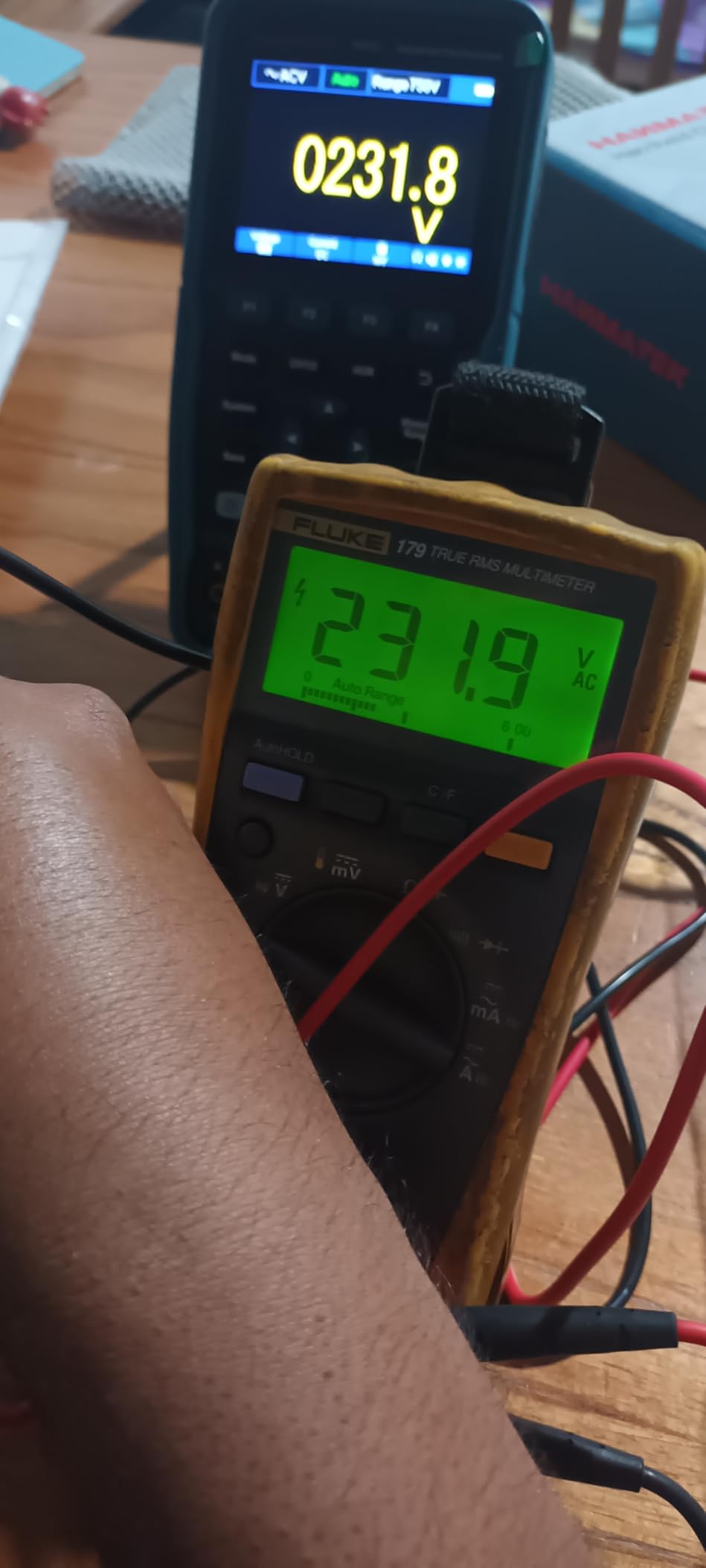
The combination of a scope and a true RMS multimeter in one unit is what pushed this to the top of my list. I do not need to carry two instruments to a customer site anymore, and the floating ground isolation between the scope side and the meter side makes mains probing safer than a typical USB scope that shares ground with the laptop.
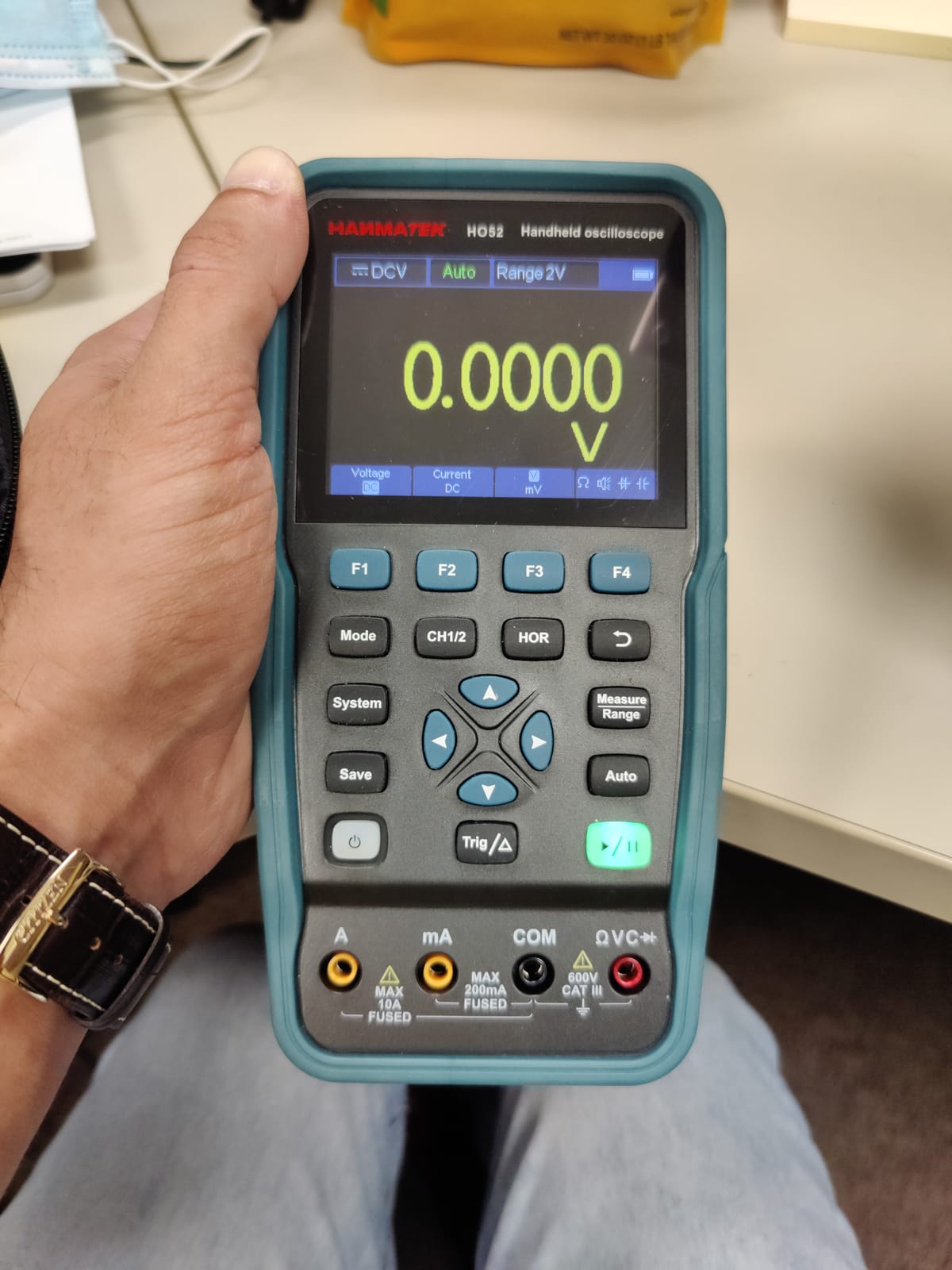
The 3.5 inch TFT is bright and readable even under workshop lighting, and the one-handed button layout works well when my other hand is holding a probe. Battery life clocks in around five hours of intermittent use, which covers most field service calls without needing a top-up from a USB power bank.
I did notice the autoset function only catches signals above about 20mV, so very low-level analog work needs manual triggering. There is also no channel math for adding or subtracting waveforms, and vertical adjustment jumps in discrete steps rather than smoothly. For a sub-$120 handheld, those are reasonable tradeoffs.
Who the HO52 is right for
If you want one instrument that replaces a basic handheld scope and a multimeter, this is the one. It shines for field service technicians, automotive electricians working on battery-side circuits, and students who need a single affordable tool for both lab and dorm-room projects.
Where the HO52 falls short
Engineers who need deep memory, advanced math, or four analog channels will want to step up to a PC-based or benchtop unit. The 8-bit ADC also means small signal details on sensitive analog circuits can be lost, so pure analog audio designers may want higher resolution.
2. FNIRSI 2C53T 3-in-1 Scope, Multimeter, and Signal Generator – Best Value
FNIRSI 2C53T 3-in-1 50MHz 2CH Oscilloscope Multimeter DDS Signal Generator
- Combines oscilloscope
- multimeter
- and DDS signal generator
- Bright 2.8 inch LCD with persistence and XY mode
- Built-in 3000mAh battery for field use
- Includes probes
- clips
- Type-C cable
- and case
- Save and export waveform images over USB-C
- Menu structure is deep and takes time to learn
- Default UI language is Chinese
- requires manual switch
- Autoset can occasionally lock up the system
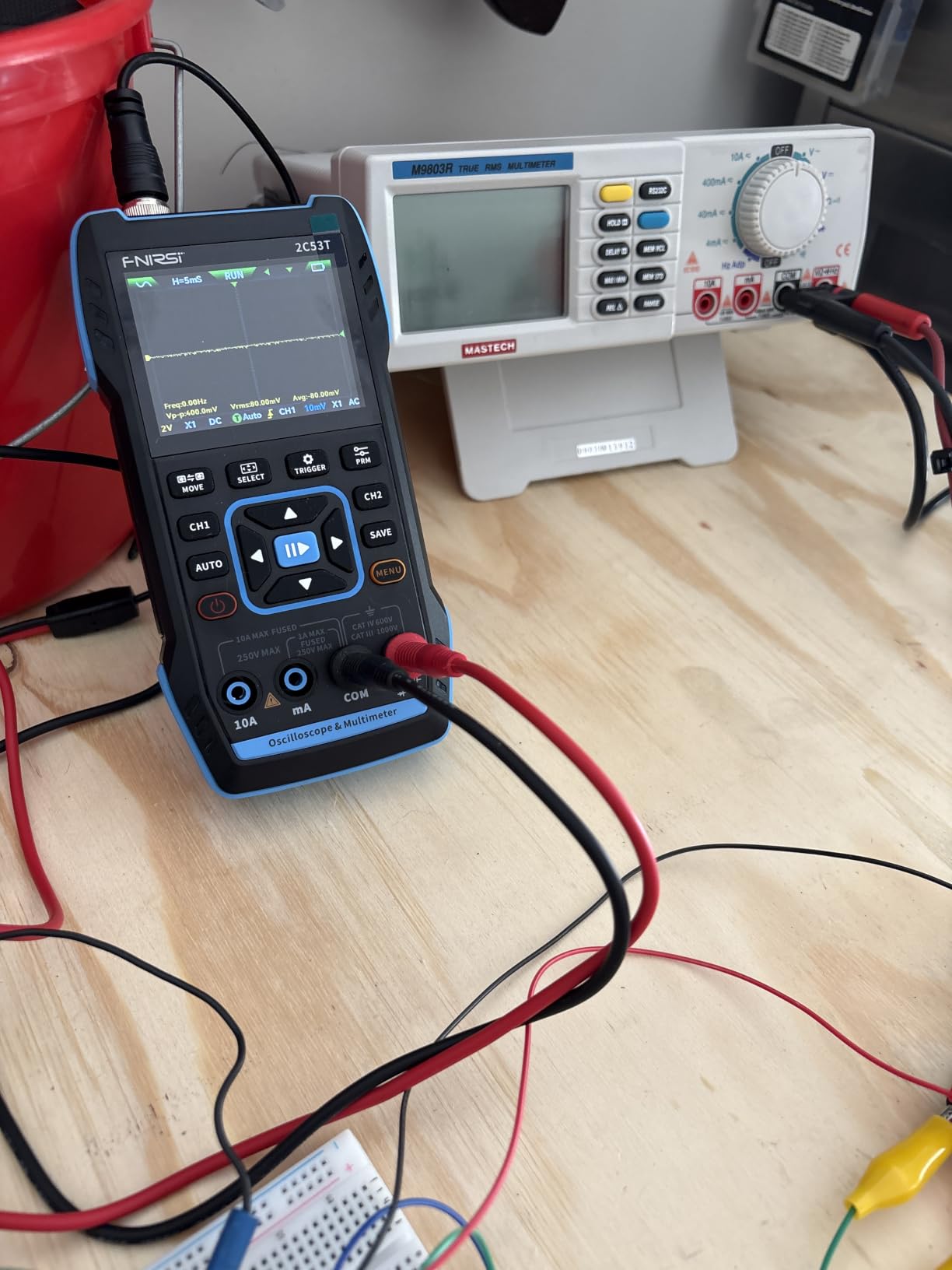
The FNIRSI 2C53T is the unit I reach for when I want three instruments without paying for three instruments. It combines a 50MHz 2-channel scope, a 4.5-digit multimeter, and a 13-waveform DDS signal generator in a single battery-powered brick. For the price, the value is hard to argue with.
I tested it on a switching power supply repair and the persistence mode made it easy to spot ringing on the switch node. The signal generator output goes up to 50kHz, which covers most audio and low-frequency analog filter testing, and the dedicated multimeter inputs let me verify DC rail voltages without swapping probes.
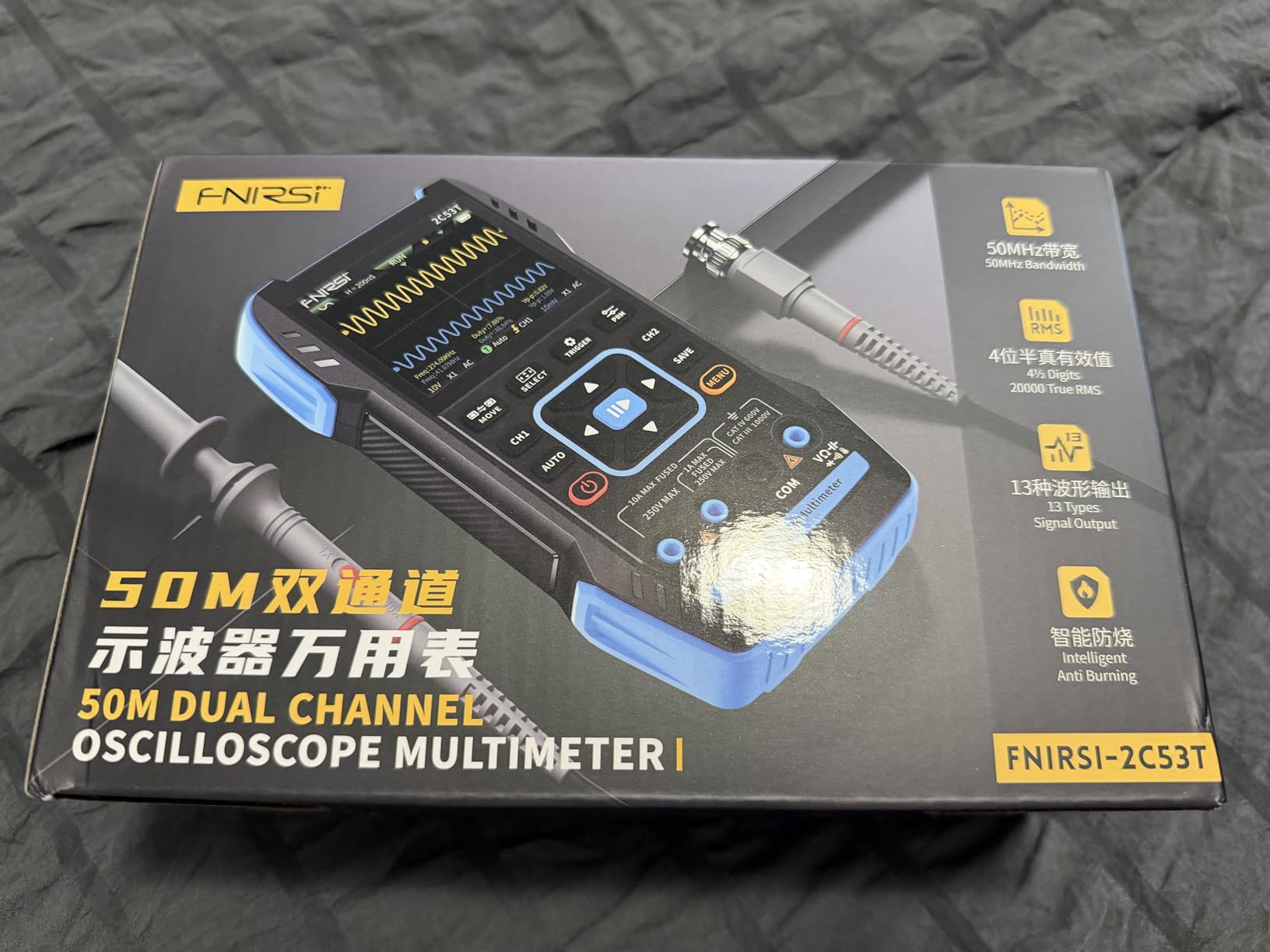
Build quality is solid, and the included carrying case plus alligator clips, multimeter probes, and Type-C cable means you are ready to work out of the box. Battery life is roughly six hours on standby with intermittent scope use, which has been plenty for weekend project sessions.
The user interface is the main friction point. Menu navigation is layered, the default language is Chinese, and you need to switch it to English on first boot. I also ran into the autoset button occasionally locking up the system, which required waiting for the battery to drain before recovering.
Who the 2C53T is right for
Makers and tinkerers who want one box that can probe, measure, and stimulate a circuit will love this. It is also a strong choice for robotics hobbyists who need a portable scope plus multimeter for bench debugging on a Raspberry Pi or Arduino project.
Where the 2C53T falls short
It is not a True RMS meter, so AC frequency response is limited to about 450Hz. The signal generator output voltage and current are also modest, so it cannot drive demanding loads or replace a bench AWG for serious analog work.
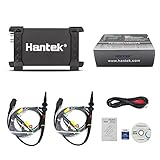
3. Hantek 6022BE PC USB Scope – Most Versatile
- Very affordable entry into PC-based scopes
- 20MHz 48MSa/s adequate for audio and slow digital
- Single USB cable for power and data
- Compact anodized aluminum enclosure with rubber ends
- Includes two passive probes and software
- 20MHz ceiling rules out high-frequency work
- Bundled software feels less polished than competitors
- Driver and installation issues on modern Windows
The Hantek 6022BE has been the default recommendation for entry-level USB oscilloscopes for almost a decade, and it still earns that reputation. I keep one in my audio lab for synth module work where 20MHz is more than enough and I do not want to risk a more expensive instrument on a 5V patch.
Setup is as simple as USB scopes get: one cable handles both power and data, the drivers install quickly, and the anodized aluminum case with rubber ends survives being tossed in a drawer with a soldering iron. Twenty automatic measurements, FFT, waveform math, X-Y display, and pass/fail checking cover everything a beginner needs.
At 20MHz bandwidth and 48MSa/s real-time sampling, it is squarely a hobbyist scope. I have used it to decode UART traffic on an ESP32, watch PWM duty cycles on an Arduino, and trace audio waveforms through guitar pedal circuits, all with no issues. Memory depth is up to 1M points per channel, which is generous for the tier.
The two real caveats are software polish and driver friction on Windows 10 and 11. The bundled software works but feels dated compared to PicoScope or OWON, and Reddit threads still surface signed-driver problems that require test mode on newer Windows builds. OpenHantek is the open-source alternative I lean on when I want a cleaner UI on Linux.
Who the 6022BE is right for
This is the scope I recommend to first-year students, audio DIYers, and anyone on a tight budget who needs a real oscilloscope, not a toy. It is also a great gift for someone getting into electronics who already has a laptop to drive it.
Where the 6022BE falls short
If you plan to probe anything faster than audio or low-MHz digital signals, the 20MHz ceiling will frustrate you. Professionals and embedded engineers working on SPI at 10MHz or faster should look at higher-bandwidth alternatives.
4. Hantek 1008C 8-Channel Automotive Scope – Best for Automotive
Hantek 1008C PC USB 8CH Automotive Diagnostic Digital Oscilloscope
- 8 analog channels designed for automotive diagnostics
- 12-bit resolution beats typical 8-bit scopes
- 80+ built-in automotive test routines
- Programmable 8-channel LVTTL signal generator included
- Compact metal case for vehicle-side work
- Bandwidth drops when all 8 channels are active simultaneously
- Software learning curve is steep
- Bundled probes and clips feel small and short
If you are chasing automotive electrical gremlins, the Hantek 1008C is the most affordable way to get 8 analog channels at your bench. GarageJournal users consistently praise it for ignition, sensor, and bus diagnostics, and after a month of running it on a stubborn crank sensor issue I can confirm it earns that reputation.
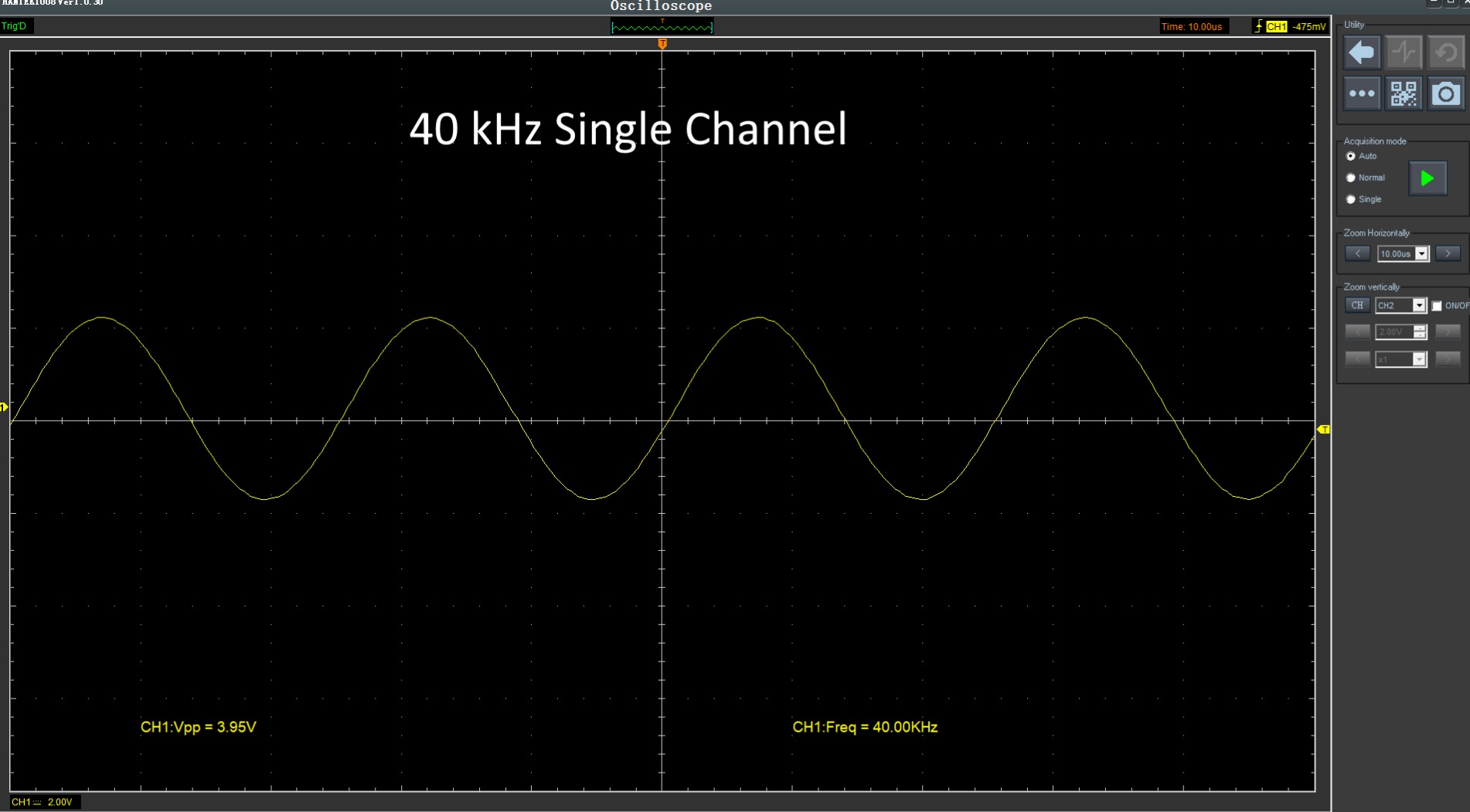
The 12-bit ADC is a real upgrade over typical 8-bit USB scopes, and it shows when you are looking at low-amplitude sensor signals buried in noise. The bundled software ships with more than 80 automotive routines covering ignition, sensors, bus detection, actuators, and starting and charging tests, which saved me hours of menu diving.
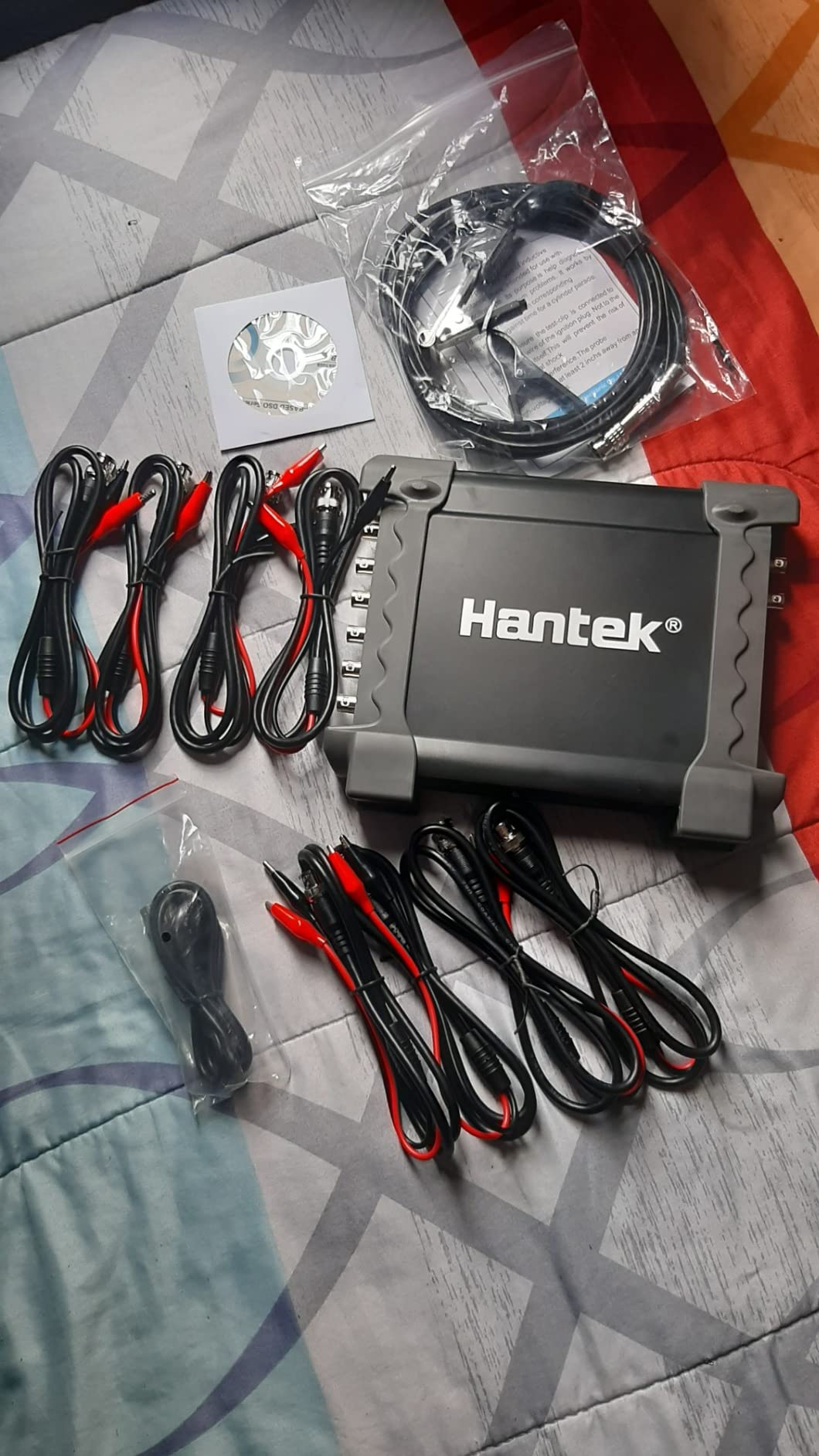
I also appreciated the integrated 8-channel programmable signal generator with LVTTL outputs. It let me drive multiple sensor simulations in parallel while watching the ECU response, which is something I cannot do with a standard 2 or 4 channel scope.
There are tradeoffs. The 2.4MSa/s real-time sampling rate is shared across all 8 channels, so usable bandwidth drops significantly when you are running the scope at full channel count. The software is the weakest link: it works, but it has a learning curve and the trigger and capture settings can be finicky to dial in. The included lead set is also on the short side.
Who the 1008C is right for
DIY mechanics, automotive electrical students, and small shop technicians who need to monitor multiple signals at once will get the most from this scope. It is also a good fit for educators building a curriculum around modern vehicle electronics.
Where the 1008C falls short
If you only need 2 or 4 channels, you are paying for capability you will not use. For non-automotive lab work, a higher-bandwidth PicoScope or Analog Discovery unit will serve you better.
5. FNIRSI 1013D Plus 100MHz Touchscope – Best for Field Use
FNIRSI 1013D Plus 100MHz Oscilloscope, 2 Channel Oscilloscope 7″ TFT Touch
- 100MHz 2 channels with 1GSa/s real-time sampling
- Full ground isolation safe for mains work
- Large 7 inch 800x480 capacitive touch display
- Includes 1x
- 10x
- and dedicated 100x high-voltage probe
- 6000mAh battery for ~4 hours of portable use
- Touch-only interface has a learning curve from knob scopes
- Lowest vertical sensitivity is only 50mV/div
- Display lag at longer timebase settings
The FNIRSI 1013D Plus is the portable scope I take to high-voltage field jobs. It is completely isolated from ground, which means I can probe mains-side switching converter outputs and motor drive circuits without floating the entire laptop on a battery. That single feature makes it one of the safer USB oscilloscopes you can buy.
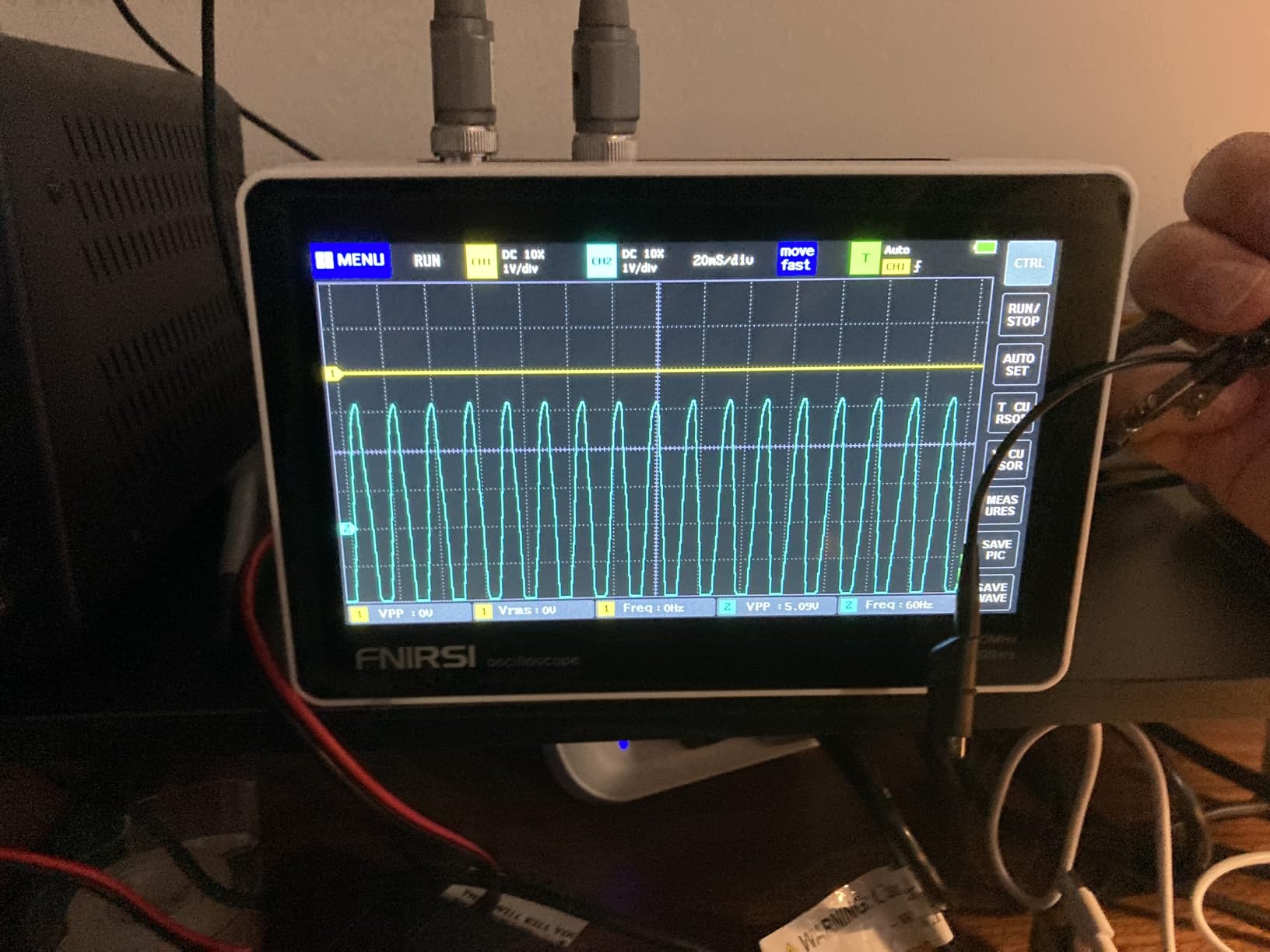
At 100MHz bandwidth with 1GSa/s real-time sampling, it punches well above its price class. The 7 inch 800×480 capacitive touchscreen is bright and easy to read outdoors, and gesture controls make zooming and panning through captured waveforms surprisingly fast once you adjust from a knob-based scope.
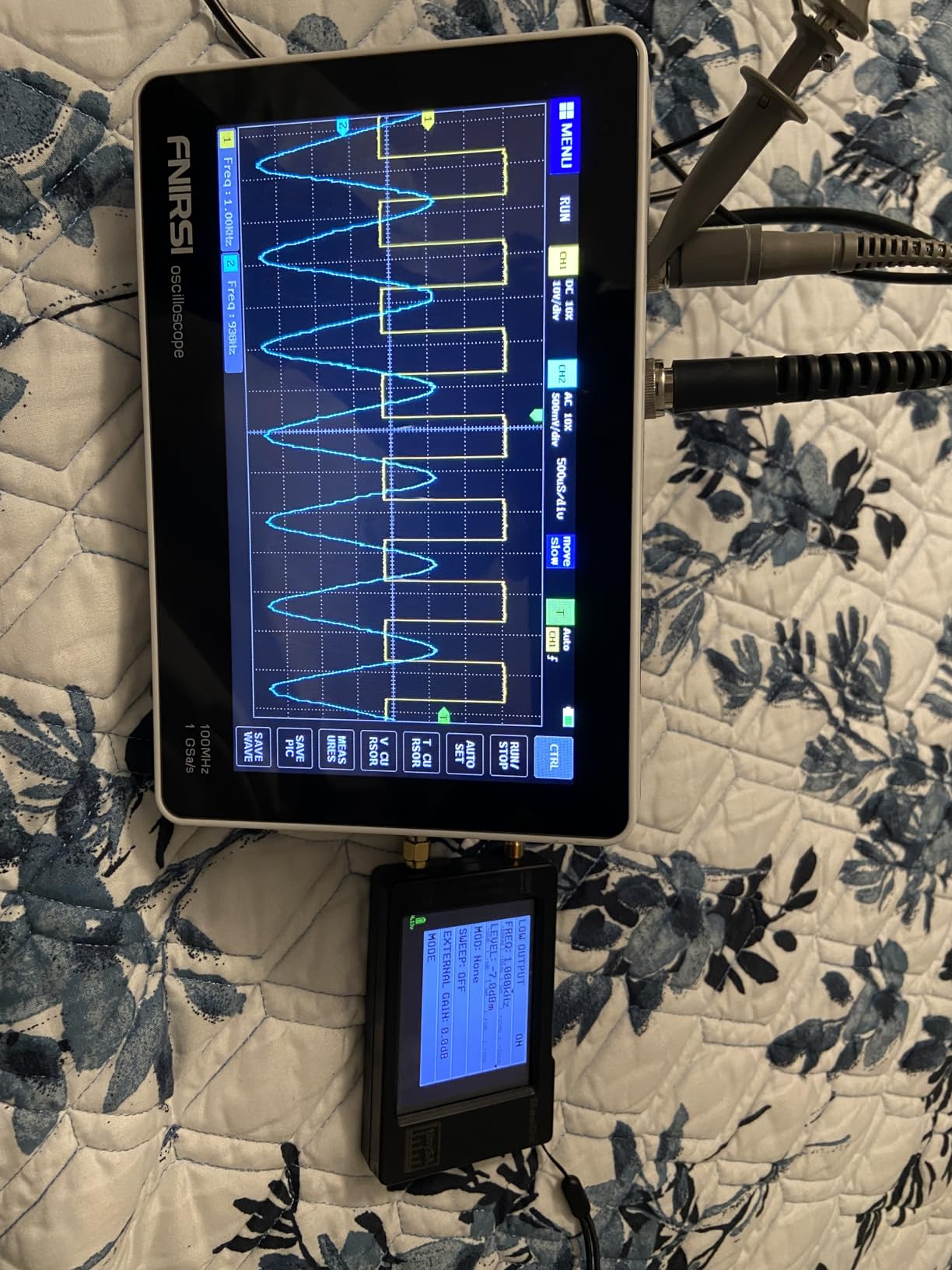
I tested it on a 240V inverter repair and the dedicated 100x high-voltage probe included in the box handled the work without needing extra accessories. The 6000mAh battery gave me around four hours of continuous use, which covered the diagnostic session without a charge.
The touch-only interface is a love-it-or-hate-it design choice. Coming from a traditional scope, I missed the tactile precision of a rotary encoder for fine trigger adjustments. The 50mV/div minimum vertical sensitivity is also limited compared to a benchtop unit, so low-amplitude analog signals need extra gain stages.
Who the 1013D Plus is right for
Field service engineers and HV technicians who need a truly isolated portable scope will find this hard to beat. Robotics and EV builders who regularly work above 50V also benefit from the isolation.
Where the 1013D Plus falls short
It is not a substitute for a four-channel benchtop scope for parallel digital debugging, and the touch interface slows down repetitive measurements. Pure lab bench users may prefer a dedicated PC scope instead.
6. Pico 2205A PicoScope – Best for Software and Triggers
- Mature
- polished PicoScope 6 software ecosystem
- Advanced digital triggers and built-in AWG
- Free lifetime software updates from Pico
- Automatic I2C and RS232 serial decoding recognized
- Compact build with strong online tutorial community
- 8-bit ADC can distort waveforms like secondary ignition
- 25MHz ceiling is too low for some modern sensors
- PicoScope is migrating away from Windows 10 support
- Warranty service requires shipping to the UK
Pico Technology has been making USB oscilloscopes longer than almost anyone in this list, and the PicoScope 2205A shows that experience in its software. PicoScope 6 is the most polished PC scope UI I have used, and the free lifetime updates mean even a 2205A bought today gets new decoders and features years from now.
I used the 2205A on an automotive CAN bus diagnostic project and the serial decoding was automatic. The advanced digital triggers caught intermittent glitches that my older benchtop scope walked past. The integrated arbitrary waveform generator also came in handy for simulating sensor outputs to the ECU.
The community around PicoScope is enormous. There are detailed tutorials on YouTube, EEVblog forum threads for nearly every automotive and embedded use case, and the PicoScope support team is responsive. That ecosystem is a major reason Pico scopes hold their value on the used market.
The 25MHz bandwidth is the main limitation. It handles primary ignition and most sensor work fine, but secondary ignition and very fast modern sensors can stretch past its capability. The 8-bit ADC also smooths over some waveform detail that a 12-bit scope would reveal. Software is migrating off Windows 10, so older laptops may lose future updates.
Who the 2205A is right for
Embedded engineers, automotive technicians, and hobbyists who value software polish and a strong community will appreciate the 2205A. It is a particularly good fit for users already familiar with PicoScope from a university lab.
Where the 2205A falls short
If you need higher bandwidth for RF or fast-switching power electronics, step up to the PicoScope 3000 or 5000 series. For automotive work that demands 12-bit resolution, consider a Hantek 1008C or a newer PicoScope 4-channel unit instead.
7. FNIRSI DSO152 Pocket Scope – Best Pocket Scope
FNIRSI DSO152 Handheld Oscilloscope 200kHz Bandwidth, 2.5MS/s Sampling Rate
- Pocket-sized handheld fits in any toolbox
- Clear 2.8 inch 320x240 LCD screen
- One-key AUTO setting is beginner friendly
- Built-in 1000mAh battery lasts ~4 hours
- Useful for car audio amplifier tuning and clipping checks
- 200kHz bandwidth limits it to audio and low-frequency
- MCX probe connector feels fragile
- Only coarse timebase adjustment with no smooth knob
The FNIRSI DSO152 is the smallest oscilloscope I have ever used that is actually useful. It slips into a shirt pocket, runs for hours on its internal battery, and pulls double duty as a field service tool when I do not want to drag a full handheld scope out to a job site.
I tested it specifically on car audio amplifier tuning where I needed to watch for clipping on a subwoofer output. The 200kHz bandwidth is plenty for audio-band signals, and the one-key AUTO function locks onto the waveform quickly. The 2.8 inch LCD is sharp enough to clearly see the clipping distortion on a 50Hz sine wave.
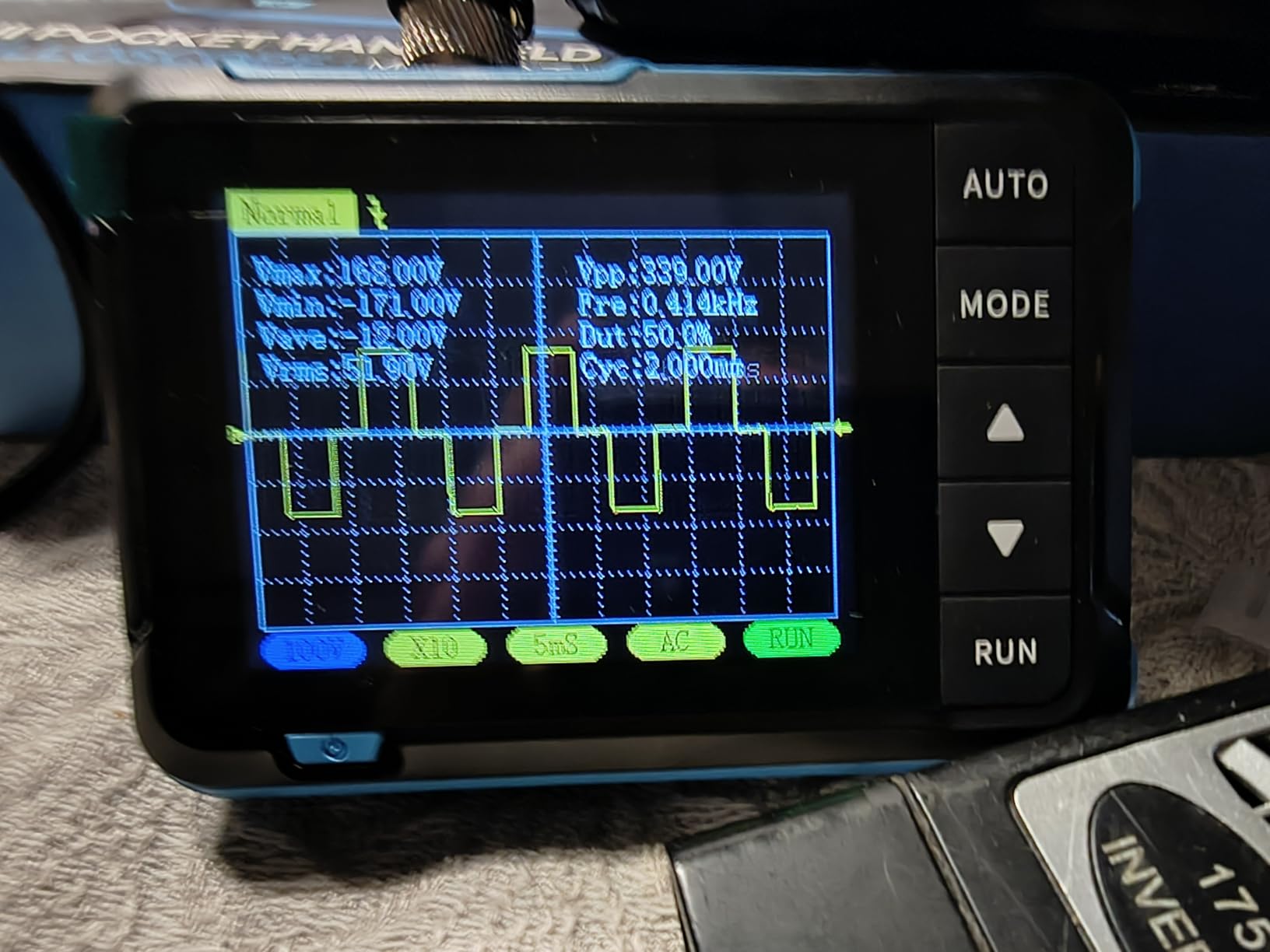
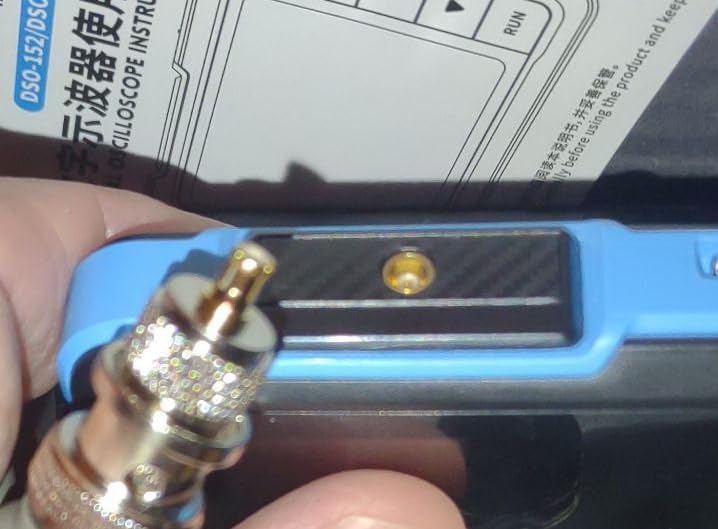
Build quality is a mixed bag. The plastic shell feels light and the screen is bright, but the MCX probe connector is small and not designed for repeated mating cycles. Treat it like a delicate instrument and it will hold up, but it is not a toolbox-throw-around scope.
The 200kHz ceiling means anything above audio frequencies is invisible to it, so it is not a general-purpose scope. The timebase also adjusts in coarse steps rather than smoothly, which makes precise trigger placement harder. For a $40 pocket scope, those are reasonable tradeoffs.
Who the DSO152 is right for
Car audio installers, HVAC technicians, and electronics hobbyists who need a quick visual check of low-frequency signals will love how portable this is. It also makes a great secondary scope to keep in a glove box or tool bag.
Where the DSO152 falls short
It is not a replacement for a general-purpose USB oscilloscope. Anyone working on digital circuits above audio frequencies will be frustrated by the 200kHz limit and the fragile probe interface.
8. EspoTek Labrador Open-Source USB Instrument – Best for Makers and Raspberry Pi
- Combines oscilloscope
- AWG
- power supply
- logic analyzer
- multimeter
- Open-source hardware and software with active community
- Cross-platform support for Windows
- Mac
- Linux
- Android
- Raspberry Pi
- Breadboard-friendly form factor for prototyping
- Tiny 20g board runs entirely from USB
- Modest 750 ksps sample rate suits only basic work
- Voltage readings may not match a precision DMM exactly
- Board pin spacing does not align with standard breadboards
- Android app is reportedly buggy and unmaintained
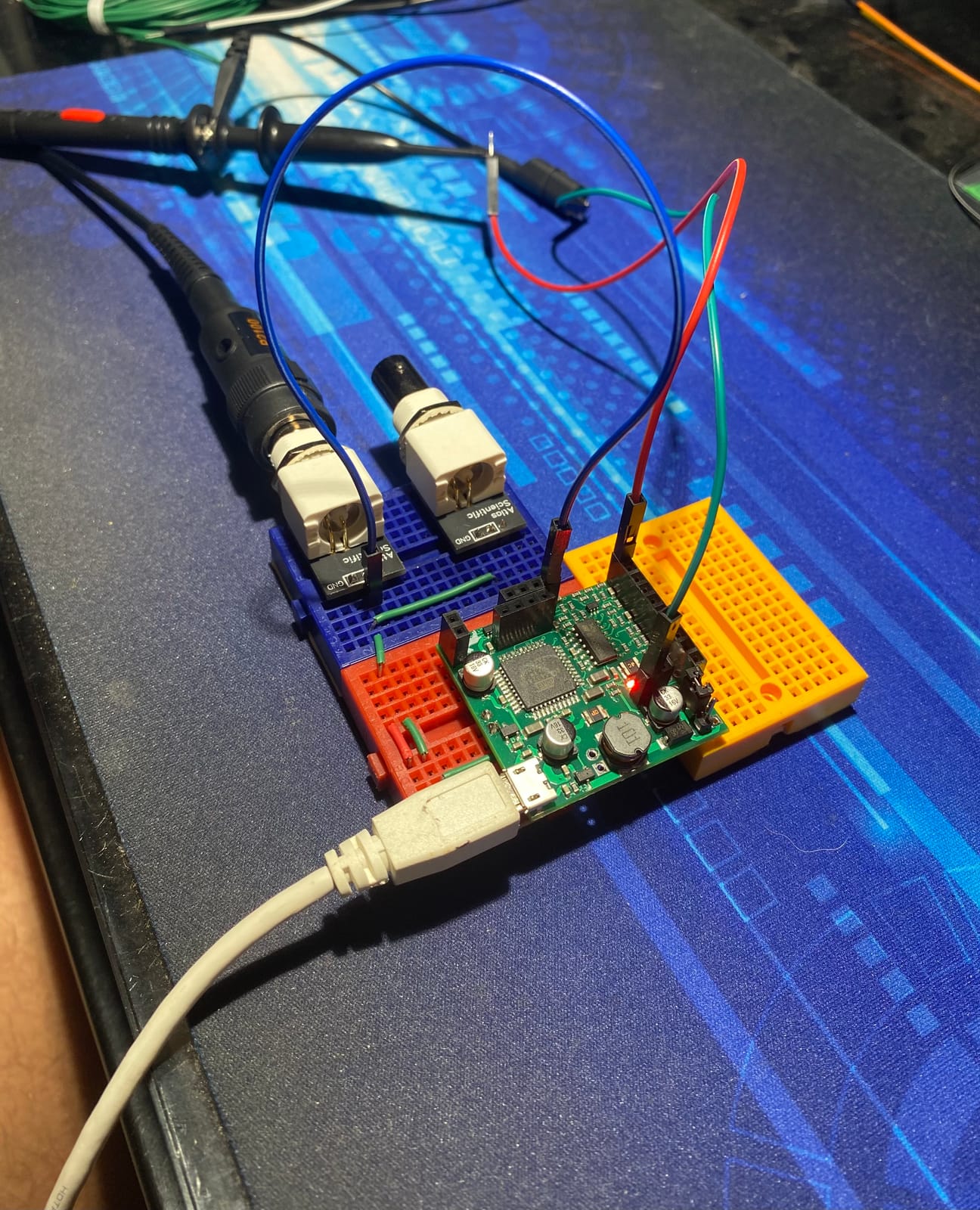
The EspoTek Labrador is the most interesting USB oscilloscope I have used in years, and the one I recommend to anyone building circuits on a Raspberry Pi. It is a fully open-source 5-in-1 instrument: oscilloscope, arbitrary waveform generator, programmable power supply, logic analyzer, and multimeter, all on a tiny 20-gram board that runs from USB.
I plugged it into a Raspberry Pi 5 running the official EspoTek installer script and the scope UI came up in seconds. That workflow is the differentiator: most USB scopes have Linux support as an afterthought, while the Labrador treats Linux and SBCs as a first-class citizen alongside Windows and macOS.
For hobbyist and educational use, the spec sheet is more than enough. The 750 ksps scope is fine for Arduino-level signals, the 3 MSPS logic analyzer decodes SPI and I2C reliably, and the programmable 4.5 to 15V power supply lets you prototype without a separate bench supply.
It is not a precision instrument. The two scope channels can show slightly different readings, voltage measurements drift from a calibrated DMM, and the through-hole pin spacing does not match standard breadboards. The Android app is also reportedly abandoned and buggy. None of that matters when you remember this entire 5-in-1 device costs less than a single set of decent probes.
Who the Labrador is right for
Makers, students, and Raspberry Pi tinkerers who value openness and cross-platform support will love this. It is also a fantastic teaching tool because the schematics and firmware are public, so you can learn how a scope actually works.
Where the Labrador falls short
Professional users need more bandwidth, more channels, and tighter measurement accuracy. If you need to characterize a switching power supply or decode high-speed CAN, step up to a PicoScope or Digilent unit.
Buying Guide: How to Choose the Best USB Oscilloscope
A USB oscilloscope is a compact data-acquisition module that connects to a laptop or PC via USB and uses the host computer’s screen, processor, and storage to display and analyze waveforms, instead of integrating its own display like a traditional benchtop oscilloscope. That is the working definition you will see in nearly every USB oscilloscope review, including this one.
Bandwidth and the 5x rule
Bandwidth is the single most important spec for any oscilloscope, USB or otherwise. The 5x rule says you should pick a scope with at least five times the bandwidth of the highest-frequency signal you need to measure. If you are probing a 10MHz SPI bus, look for at least 50MHz of scope bandwidth. All of the best USB oscilloscopes on this list sit between 20MHz and 100MHz, which covers the vast majority of hobbyist, embedded, and automotive work.
Sampling rate, channels, and MSO
Sampling rate determines how accurately the scope captures fast edges. Aim for at least 4x oversampling on your fastest signal, which is why even cheap scopes quote 250MSa/s or 1GSa/s. Two analog channels cover most projects; four is better for power electronics. A mixed-signal oscilloscope (MSO) adds digital channels for decoding parallel buses and is invaluable for embedded debugging.
Software ecosystem: WaveForms, PicoScope, OpenHantek, sigrok
Software is where USB oscilloscopes differentiate themselves. Digilent’s WaveForms is the gold standard for cross-platform support and scripting in Python and LabVIEW. PicoScope 6 and 7 are legendary for automotive work and protocol decoding. Hantek users have the open-source OpenHantek option, and the cross-platform sigrok project supports many PicoScope and Hantek models for free on Linux.
Isolation and high-voltage safety
The biggest safety complaint on r/AskElectronics and EEVblog is that a USB scope shares a ground reference with your laptop. Touch a grounded probe to a ground-referenced mains circuit and you can damage the laptop motherboard. The fix is either a scope with isolated channels (like the HANMATEK HO52 or FNIRSI 1013D Plus), or running the laptop on battery only and treating every ground clip as live.
USB scope vs benchtop scope
A USB scope gives you a larger display, easy data export, scripting, and far better value. A benchtop scope gives you true isolation, instant-on operation without a laptop, and dedicated controls that work in any lighting. For most hobbyist, student, and embedded use, the best USB oscilloscopes deliver more capability per dollar. For high-voltage work every day, a benchtop or a properly isolated USB scope is the safer bet.
Frequently Asked Questions
Which USB oscilloscope is the best overall?
The HANMATEK HO52 is the best overall USB oscilloscope for most users because it combines a 50MHz 2-channel scope with a true RMS multimeter, floating ground isolation, and around five hours of battery life in one handheld unit that costs a fraction of comparable PC scopes.
What is a good cheap USB oscilloscope for hobbyists?
The Hantek 6022BE is a solid budget pick at under $100, offering 20MHz bandwidth, 48MSa/s sampling, USB power, and a compact metal enclosure. For a true pocket option, the FNIRSI DSO152 delivers basic audio-band scope capability at a lower price.
Are USB oscilloscopes as accurate as benchtop scopes?
Modern USB oscilloscopes from Pico Technology and Digilent match benchtop units in basic measurement accuracy and often exceed them in deep memory and protocol decoding. They trail in input protection, true channel isolation, and the tactile precision of dedicated front-panel controls.
Can I use a USB oscilloscope for automotive signals?
Yes, especially the Hantek 1008C with its 8 analog channels and 80-plus automotive test routines, or a PicoScope 2205A for software-driven serial decoding. For high-voltage ignition work, choose a scope with isolated channels and use proper high-voltage probes.
Are Hantek oscilloscopes reliable and worth the money?
Hantek oscilloscopes deliver strong value at the entry level, particularly the 6022BE for hobbyists and the 1008C for automotive work. Reliability is solid for the price tier, though the bundled software feels dated compared to PicoScope or WaveForms and Windows driver friction can require extra setup on Windows 10 and 11.
Is a USB oscilloscope safe for high-voltage work?
A USB oscilloscope is safe for high-voltage work only if it has isolated channels or if you run the laptop on battery and avoid touching any ground reference to a live circuit. Without isolation, a misapplied ground clip can destroy the laptop motherboard. Choose an isolated handheld like the HANMATEK HO52 or FNIRSI 1013D Plus for mains-side work.
Conclusion: Which USB Oscilloscope Should You Buy in 2026?
The best USB oscilloscope for you depends on where you plan to use it. Students and first-time buyers should start with the Hantek 6022BE for its unbeatable value. Hobbyists and Raspberry Pi builders will get the most flexibility from the open-source EspoTek Labrador. Automotive technicians should pick the Hantek 1008C for its 8-channel design, while embedded engineers will appreciate the polished software on the Pico 2205A.
For the best USB oscilloscopes overall in 2026, the HANMATEK HO52 wins our editor’s choice for combining real scope bandwidth, multimeter functionality, and floating isolation in one affordable handheld. If you want maximum capability for the money, the FNIRSI 2C53T adds a signal generator to that mix. Pick the one that matches your bench, and start probing.