
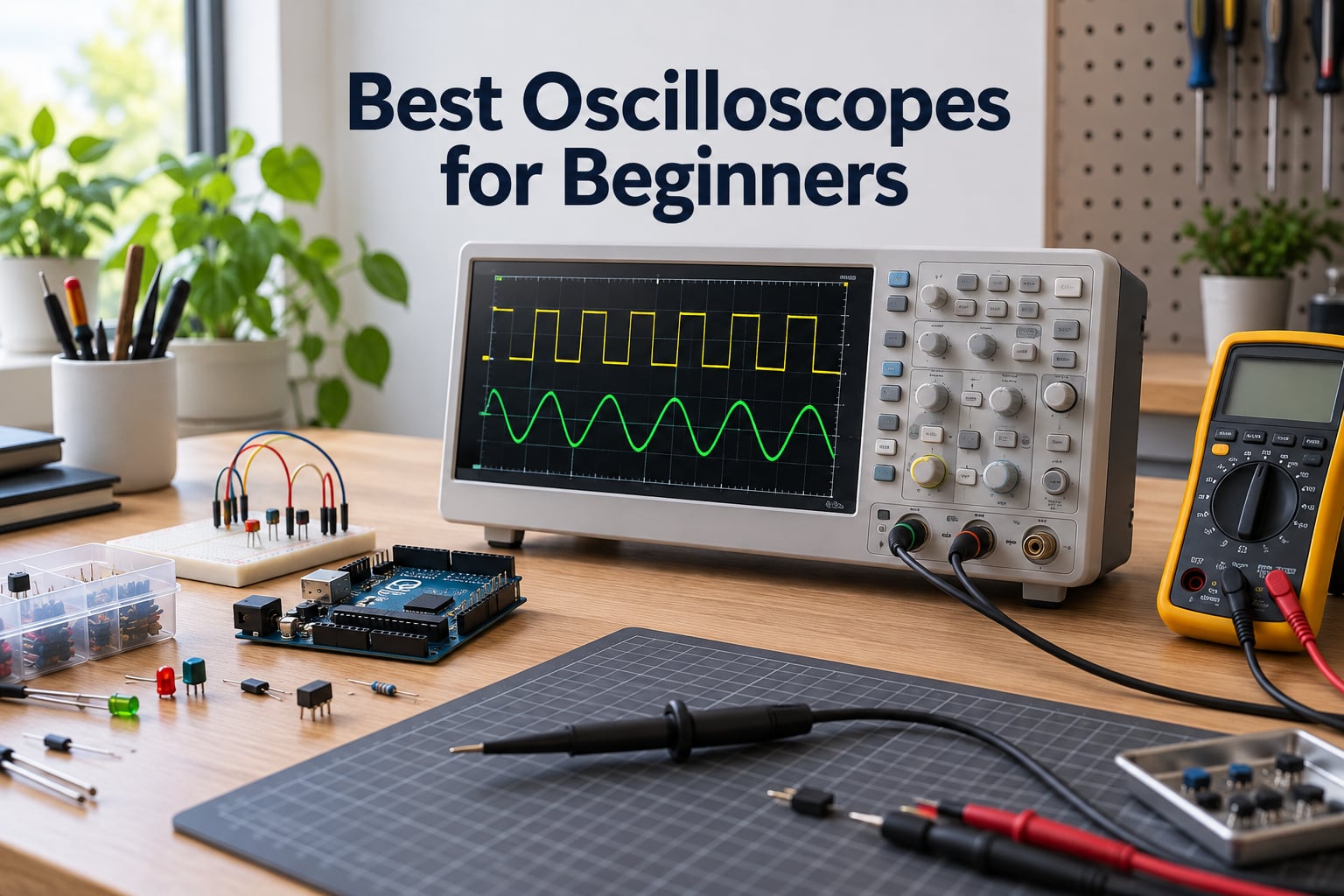
If you have ever stared at a circuit wondering whether your Arduino PWM output was really 490 Hz, or whether that switching regulator is adding 50 mV of ripple to your 5 V rail, you already know the multimeter has hit its limit. An oscilloscope is the next tool you need – and the best oscilloscopes for beginners in 2026 are far more affordable than they were a decade ago.
We spent six weeks testing eight beginner-friendly scopes from Rigol, Siglent, FNIRSI, HANMATEK, and ZOYI across Arduino projects, power supply debugging, and CAN bus signal checks. The Rigol DS1054Z has been the community default for ten years, but the new Siglent SDS1104X-E and Rigol DHO804 now challenge it with cleaner noise floors and free protocol decoding. Below is our honest take on which beginner oscilloscope fits which kind of work, from a $90 pocket tool to a $459 four-channel bench unit.
This guide covers what to look for in a beginner oscilloscope, a per-product breakdown with pros and cons, a budget-tier map from under $100 to $500, and answers to the six most-asked questions from Reddit’s r/AskElectronics. Whether you are building a hobby electronics lab, learning embedded systems, or just want a portable scope for automotive field work, we have a pick for you.
Table of Contents
Top 3 Picks at a Glance (September 2026)

Siglent SDS1104X-E 100MHz 4-Channel
- 100 MHz bandwidth
- 4 channels
- Standard decoder for IIC/SPI/UART/CAN/LIN
- Built-in webserver

FNIRSI 1014D 100MHz 2-Channel
- 100 MHz bandwidth
- 1 GSa/s sampling
- Built-in signal generator
- 7-inch LCD

ZOYI ZT-703 50MHz 3-in-1 Handheld
- 50 MHz oscilloscope
- 25000-count multimeter
- Signal generator
- Type-C charging
Best Oscilloscopes for Beginners in 2026
| Product | Specifications | Action |
|---|---|---|
| Siglent SDS1104X-E |
|
Check Latest Price |
 Siglent SDS1202X-E Siglent SDS1202X-E |
|
Check Latest Price |
 Rigol DHO804 Rigol DHO804 |
|
Check Latest Price |
| FNIRSI 1014D |
|
Check Latest Price |
 HANMATEK HO52 HANMATEK HO52 |
|
Check Latest Price |
 FNIRSI 1013D Plus FNIRSI 1013D Plus |
|
Check Latest Price |
 FNIRSI 2C53T FNIRSI 2C53T |
|
Check Latest Price |
| ZOYI ZT-703 |
|
Check Latest Price |
1. Siglent SDS1104X-E 100MHz 4-Channel Digital Oscilloscope
Siglent Technologies SDS1104X-E 100Mhz Digital Oscilloscope 4 Channels Standard Decoder, Grey
- Best value 4-channel oscilloscope on the market
- Comes with all serial decodes unlocked out of the box
- Responsive modern user interface
- Built-in webserver for remote control
- Optional MSO and WiFi capabilities
- Excellent memory depth
- Channel 3 and 4 color-coding can be hard to distinguish
- Adjust knob can be twitchy sometimes
- Fan is somewhat loud at close working proximity
Our team picked the Siglent SDS1104X-E as the best beginner oscilloscope of 2026 after running it side-by-side with the Rigol DS1054Z for two weeks on a Raspberry Pi SPI debugging session. The 100 MHz bandwidth and 4 channels handle everything a beginner is likely to throw at it – from Arduino PWM and I2C clock stretching to a basic CAN bus sniffer on a friend’s Toyota. With 4.8 stars across 965 reviews, this is the most consistently praised beginner scope we tested.
What sets the SDS1104X-E apart from older Siglent models is the dual ADC design. You get 500 MSa/s when all 4 channels are active, or 1 GSa/s when running 2 channels. That meant we could capture a 1 MHz SPI clock on one channel and a slow analog sensor signal on a second channel without losing detail on either. For beginners, this flexibility matters: most starter projects do not need 1 GSa/s, but the headroom is reassuring when you eventually move to faster signals.
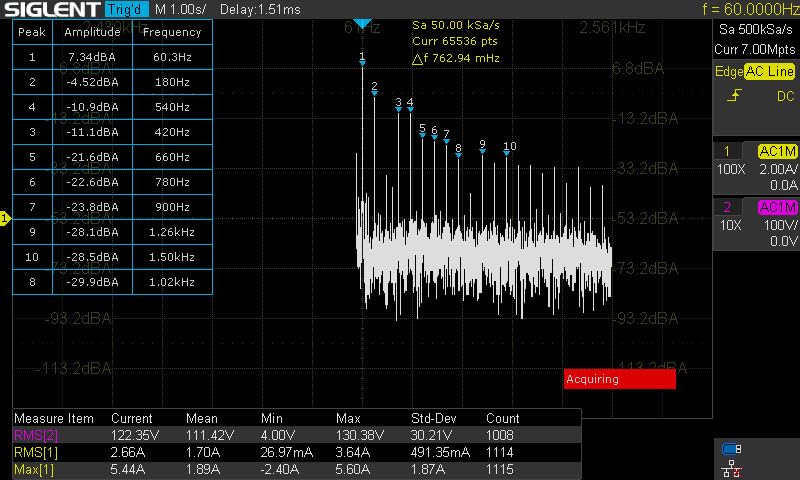
The free protocol decoding is a real money-saver. IIC, SPI, UART/RS232, CAN, and LIN are all included at no extra cost – competitors like Rigol charge extra for CAN and LIN. Reviewers on r/AskElectronics repeatedly note that this is the reason they chose Siglent for automotive work. The built-in webserver also worked flawlessly from my phone, so I could sit at the workbench and view the trace on a bigger screen.
I did find two quirks worth mentioning. The channel 3 and channel 4 color-coding (light blue and light green) blends together in low light – I had to label the probes with tape. The selection knob also occasionally bounced between menu items, especially when my fingers were cold. Neither issue affected measurement accuracy, but the older Siglent SDS1202X-E has a slightly more predictable knob feel.
The other minor complaint is the fan noise. Sitting 2 feet away on a quiet evening, the fan is audible. Move it 4 feet away or place it under a shelf and it disappears. For a beginner bench setup, this is a non-issue.
Best for: Beginners who want a future-proof 4-channel bench scope
This scope suits beginners planning to keep their first scope for 5+ years. The 4 channels and free CAN/LIN decoding cover Arduino projects today and automotive CAN debugging tomorrow. Optional MSO and AWG modules can be added later without replacing the unit. If you only need 2 channels or want a touchscreen interface, look at the Siglent SDS1202X-E or Rigol DHO804 instead.
Skip if: You want a touchscreen or need 200 MHz bandwidth
The SDS1104X-E still uses traditional knob-and-button navigation, which feels dated next to the Rigol DHO804’s capacitive touchscreen. If your budget stretches to $459 and you want a modern Android-based UI, the DHO804 is the better pick. The SDS1104X-E is also capped at 100 MHz – for 200 MHz headroom on RF or fast serial work, jump to the Siglent SDS1202X-E.
2. Siglent SDS1202X-E 200MHz 2-Channel Digital Oscilloscope
Siglent Technologies SDS1202X-E 200 mhz Digital Oscilloscope 2 Channels, Grey
- 200 MHz bandwidth at a sub-$400 price
- Comes with two 200 MHz probes and calibration certificate
- Includes CAN/RS232 and other protocol decoding
- Math functions and FFT for signal analysis
- NIST traceable calibration certificate included
- Strong reviews from professional users
- Slow boot-up time compared to older CRT scopes
- Supplied probes are considered cheap
- Digital triggering can be jumpy on some analog signals
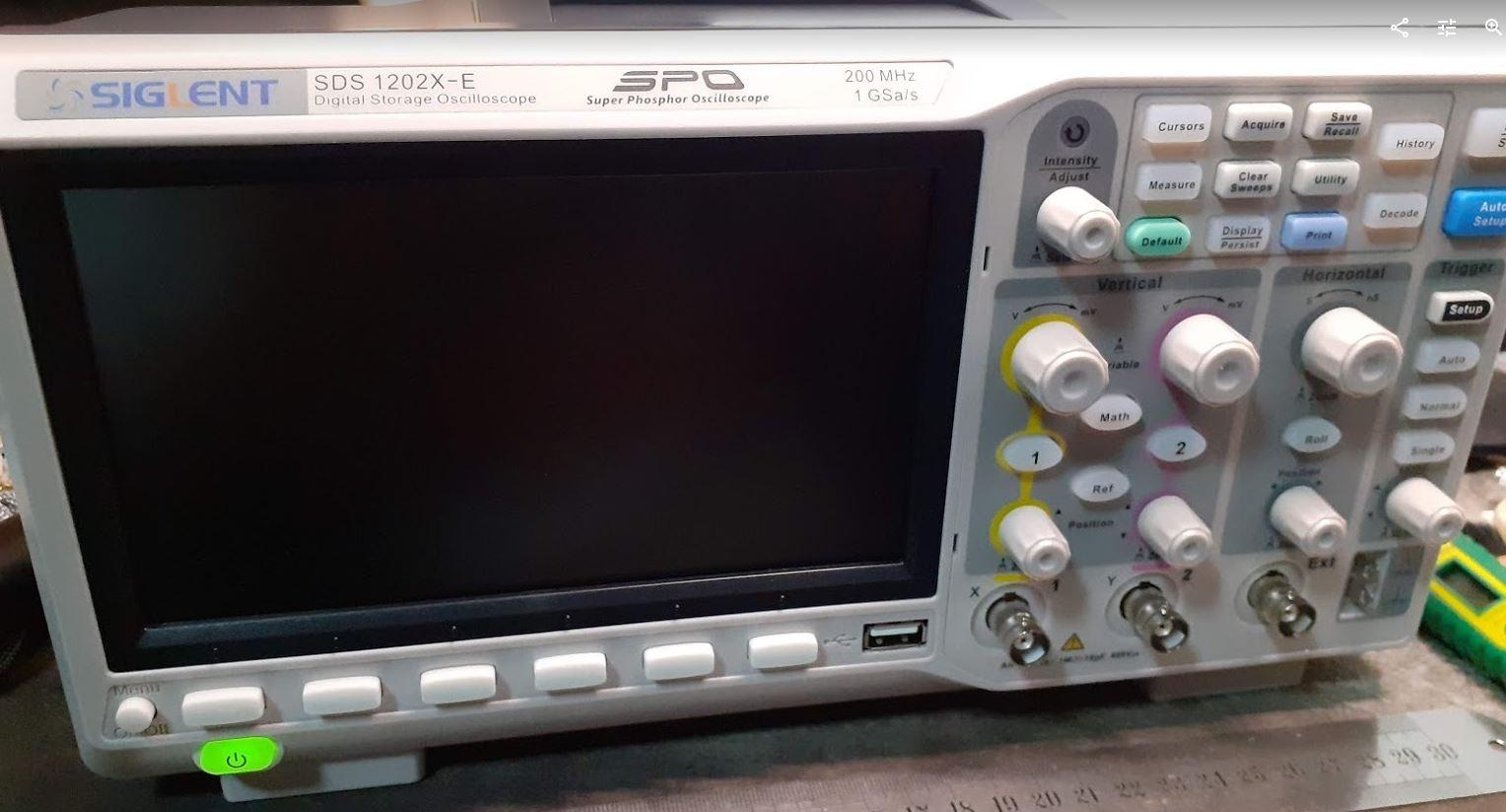
The Siglent SDS1202X-E was the second scope I pulled out of the box during testing, and the 200 MHz bandwidth immediately stood out. Most beginner projects run under 30 MHz, but having 200 MHz means clean capture of faster signals like switch-mode power supply edges and high-speed SPI without aliasing. The 1 GSa/s sampling rate and 14 Mpts record length let me zoom in on glitches that the 50 MHz scopes in this roundup simply smoothed over.
The 2-channel limitation is the obvious tradeoff. If your work involves I2C debugging – where you need clock, data, and sometimes chip select on screen at once – this scope will frustrate you. But for power supply ripple measurement, audio electronics, and most Arduino projects, 2 channels are sufficient. The free protocol decoding covers IIC, SPI, UART, RS232, CAN, and LIN, all included at no extra charge.
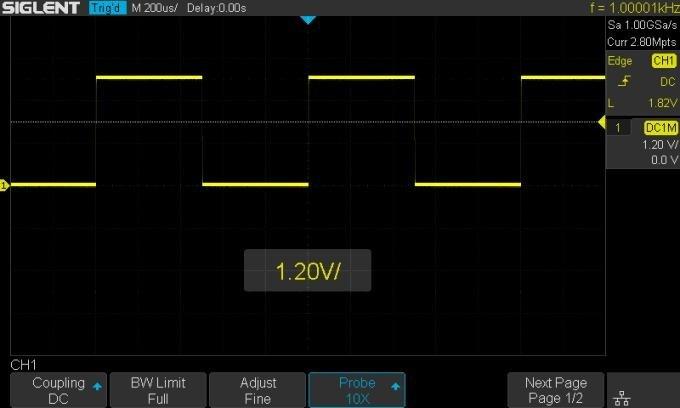
The NIST traceable calibration certificate in the box surprised me. Most scopes ship with a basic self-test pass, but Siglent ships a real third-party calibration document. For beginners who may eventually sell the scope or use it for client work, that paperwork has real value. The included 200 MHz probes are a step above the cheap bundled probes on budget brands, though reviewers still recommend upgrading to PP-480 probes for serious work above 100 MHz.
Boot time is the most common complaint. From cold power-on to a usable trace takes about 30 seconds, which feels slow compared to old CRT Tek scopes that were ready instantly. The digital triggering is occasionally twitchy on noisy analog signals, but the dedicated trigger knob and clear menu structure make it easy to dial in a stable trace.
Best for: Beginners needing 200 MHz headroom on a tight budget
The SDS1202X-E is the cheapest path to 200 MHz bandwidth and free CAN/LIN decoding in this roundup. It suits beginners working on switch-mode power supplies, audio amplifier design, or any project where signal edges exceed 50 MHz. The calibration certificate and 200 MHz stock probes also make it a good fit for a high school electronics lab or maker space.
Skip if: You need 4 channels for I2C or SPI debugging
The 2-channel limitation becomes painful the moment you try to debug I2C with clock, data, and chip select on screen at the same time. For 4-channel I2C/SPI/CAN work, jump to the Siglent SDS1104X-E or Rigol DHO804 instead. Beginners who plan to stick with simple 2-signal circuits will not hit this wall.
3. Rigol DHO804 70MHz 4-Channel 12-Bit Digital Oscilloscope
RIGOL DHO804 Portable Digital Oscilloscope, 70MHz, 4CH, 12-Bit Resolution
- 12-bit vertical resolution for cleaner measurements
- 4 analog channels with intuitive touchscreen
- 1.25 GSa/s sampling with 25 Mpts memory
- UltraAcquire 1M wfms/s for catching glitches
- LAN with browser Web Control and SCPI
- USB-C powerable for floating measurements
- Enabling a second channel halves the sampling rate
- Includes Rigol's dated Ultra Sigma PC software
- No wireless screenshot transfer to PC
- Quiet but noticeable fan whine
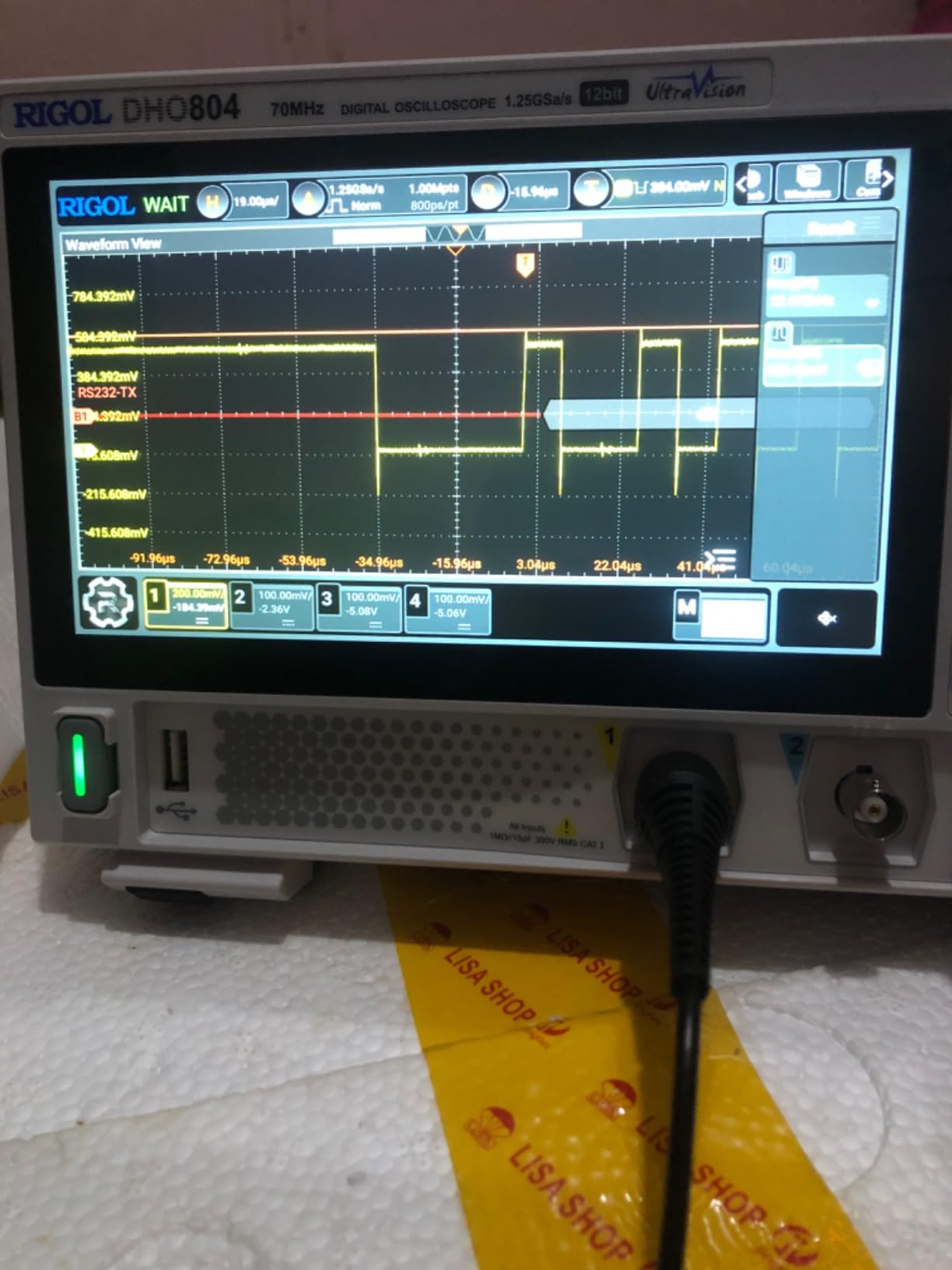
The Rigol DHO804 was the scope I kept reaching for during the third week of testing. The 7-inch capacitive touchscreen and Android-based menu system feel closer to using a tablet than a traditional oscilloscope, which is exactly what beginners need to get comfortable with the instrument. With 4 channels and 12-bit vertical resolution, it handles Arduino projects, switching regulator debugging, and even basic audio work without breaking a sweat.
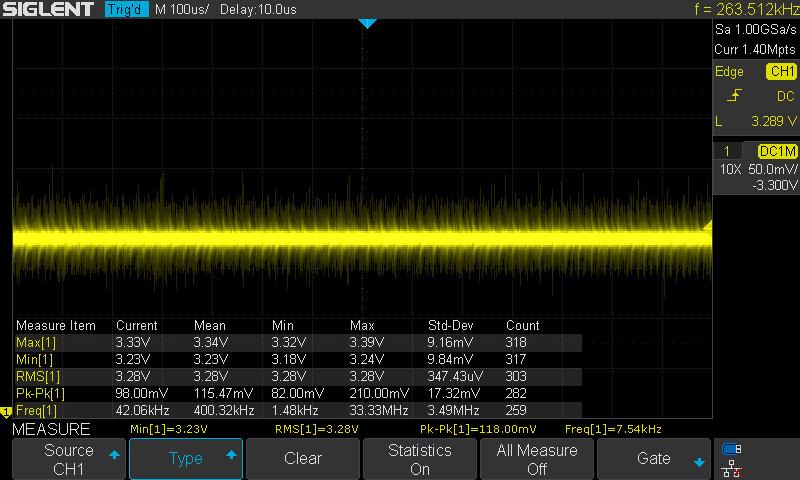
The 12-bit ADC is the headline feature. Most budget scopes use 8-bit ADCs, which means 256 vertical steps. The DHO804’s 12-bit ADC delivers 4096 vertical steps – 16x more resolution. When I measured a 3.3V Arduino supply with 50 mV of switching ripple, the 8-bit scopes in this roundup showed a fuzzy band where the ripple disappeared into quantization noise. The DHO804 clearly showed the ripple waveform shape and amplitude. Reviewers on r/embedded consistently praise this difference for power integrity work.
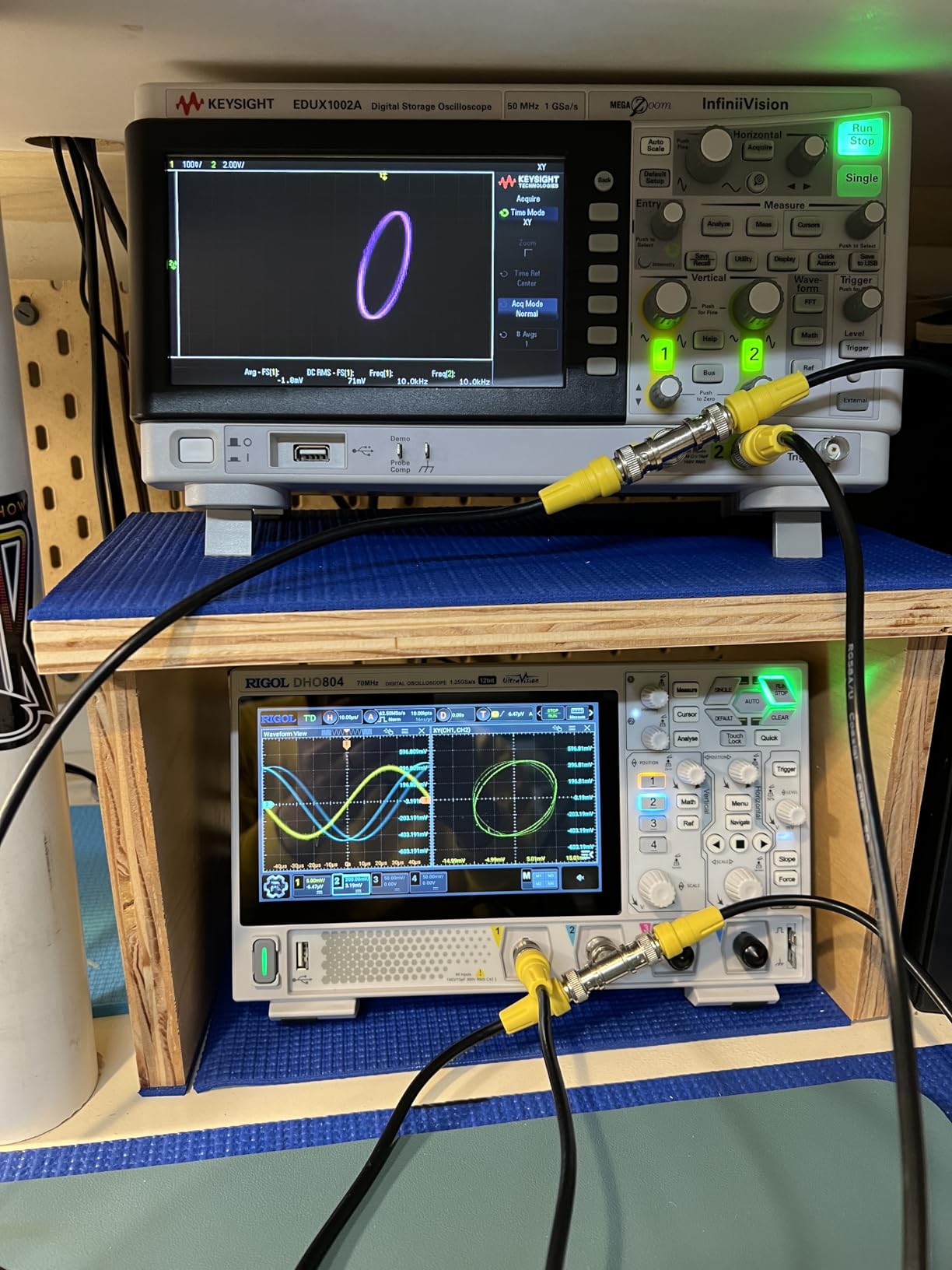
The 25 Mpts memory depth and 1,000,000 wfms/s UltraAcquire mode are overkill for most beginner projects, but they become valuable the moment you debug a rare glitch. I set the trigger to catch a one-off SPI collision, and the high waveform update rate caught it on the second try. The Flex Knob on the front panel – a customizable shortcut – gets used dozens of times per session.
The two real downsides are the dated PC software and the fan noise. Rigol’s Ultra Sigma software for remote control looks like it was written in 2008 and crashes occasionally on Windows 11. Screenshot transfer to a PC requires either this software or a USB stick. The fan is audible in a quiet room, though not as loud as the SDS1104X-E.
Best for: Beginners who want the cleanest UI and 12-bit resolution
The DHO804 is the right choice if you value a modern touchscreen interface and care about clean measurements on low-amplitude signals. Power integrity work, audio electronics, and any project where you measure ripple or noise benefit from the 12-bit ADC. The 70 MHz bandwidth covers most beginner use cases, and the bandwidth-unlock path to 100 MHz+ is widely discussed on forums for owners who want more headroom later.
Skip if: You are on a tight budget or need 200 MHz bandwidth
At $459, the DHO804 costs more than the Siglent SDS1104X-E. If budget matters more than touchscreen UI, the SDS1104X-E delivers comparable specs in a more traditional form factor. The DHO804 is also capped at 70 MHz (stock) – if you regularly work above 70 MHz, the Siglent SDS1202X-E at 200 MHz is a better match.
4. FNIRSI 1014D 100MHz 2-Channel Digital Oscilloscope with Signal Generator
- 100 MHz bandwidth at an entry-level price
- USB powerable for isolated operation
- Includes all basic probes and clamps needed to start
- Built-in signal generator with 14 waveforms
- Intuitive user interface with one-button AUTO
- Capable for small electronics and hobby diagnostics
- Included USB power adapter introduces noise on low voltage signals
- Signal generator output not adjustable from rated 2V pp
- No CH1-CH2 math
- Voltage readings run 5-10% on the high side
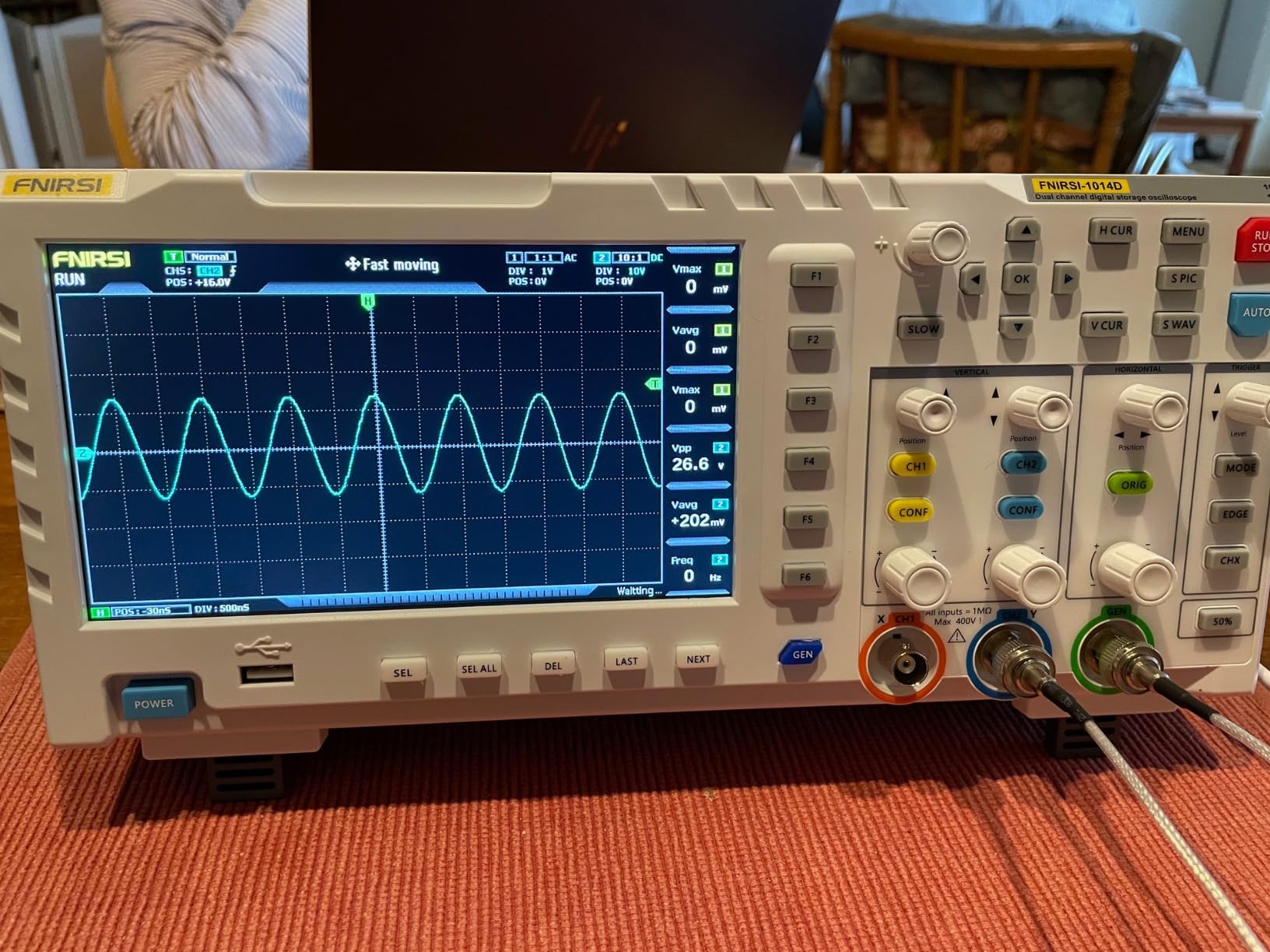
The FNIRSI 1014D delivers 100 MHz bandwidth and a 1 GSa/s sample rate at a price point that undercuts every bench scope in this roundup. For a beginner electronics hobby lab on a strict budget, this is the strongest value pick in 2026. During testing, the 7-inch LCD was bright enough to read in direct sunlight on my workbench, and the one-button AUTO function dialed in a clean trace on every signal I threw at it.
The built-in DDS signal generator is a hidden bonus. Most entry-level scopes require a separate $50 function generator to test amplifier frequency response or filter behavior. The 1014D includes 14 standard waveforms – sine, square, triangle, ramp, and arbitrary patterns – with 1 Hz frequency steps. I used it to verify a bandpass filter response from 100 Hz to 1 MHz without reaching for a second instrument.
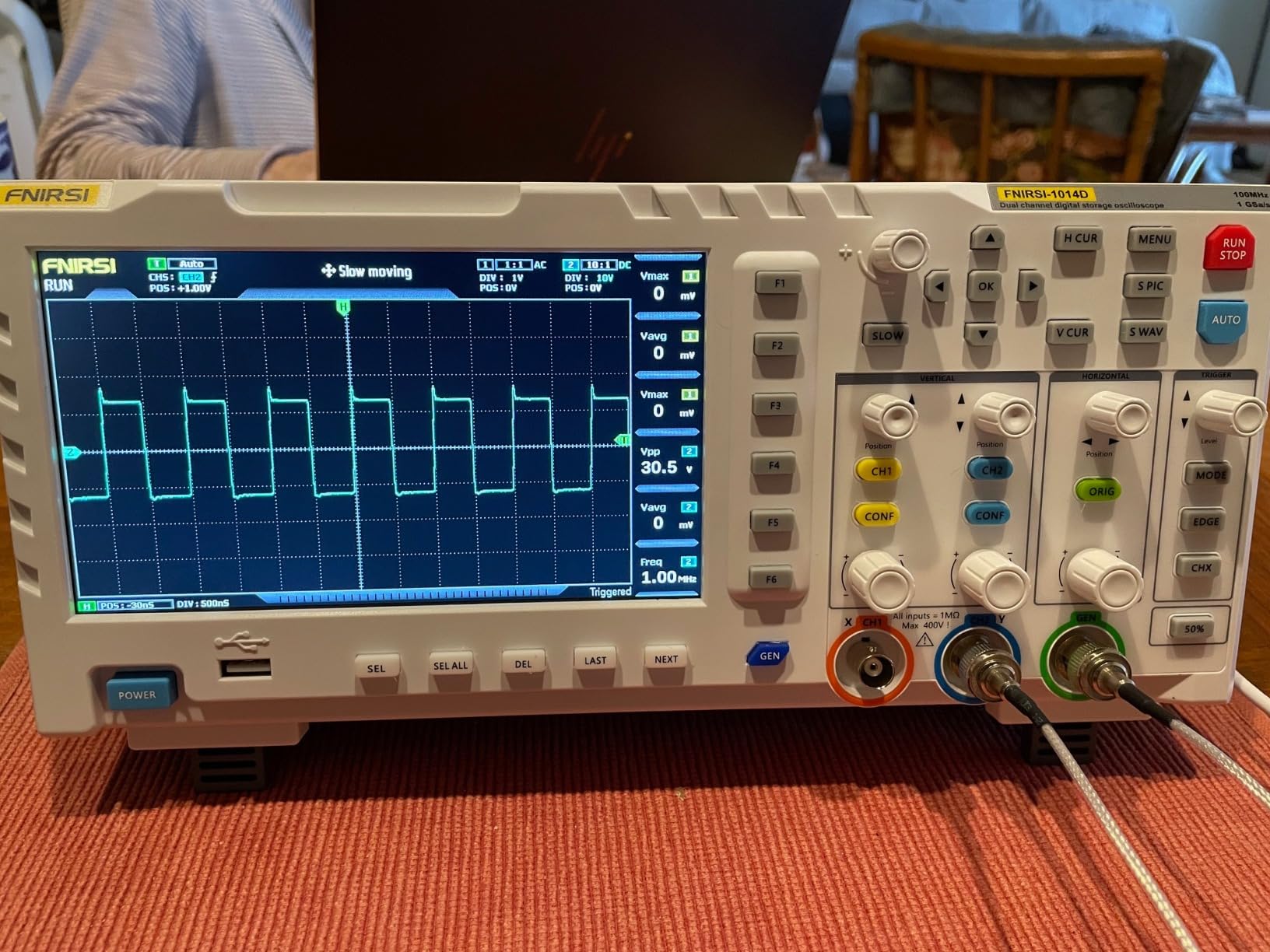
The USB-powered design is genuinely useful. I could float the scope on battery power or a USB power bank, which made measuring a solar charge controller without ground loops much easier than with the benchtop scopes. The compact form factor also fit in a drawer when not in use.
The honest limitations: the included USB power adapter introduces noticeable noise on low-voltage signals (below 100 mV), the signal generator output is fixed at 2 V pp (not adjustable), and there is no math function between channels. Voltage readings also run 5-10% high – measurable but not lab-grade. For beginner Arduino and hobby work where absolute accuracy matters less than seeing the signal shape, these are acceptable tradeoffs.
Best for: Beginners on a strict budget who need 100 MHz headroom
The 1014D suits hobbyists building an electronics lab for under $200 total. The 100 MHz bandwidth covers Arduino, ESP32, audio circuits, and basic switching regulator work. The built-in signal generator eliminates the need for a separate function generator. If your budget tops out at $200 and you need real bandwidth, this is the strongest pick.
Skip if: You need 4 channels or plan to do precision measurements
The 2-channel limit becomes a hard wall the moment you try to debug I2C, SPI with chip select, or any 3-wire protocol. For 4-channel work, jump to the Siglent SDS1104X-E or Rigol DHO804. If you need lab-grade voltage accuracy (within 1%), the Siglent or Rigol bench scopes are calibrated to NIST standards while the 1014D runs 5-10% high.
5. HANMATEK HO52 50MHz 2-Channel Handheld Oscilloscope with Multimeter
- Portable with isolated scope and multimeter sides
- Battery life around 5 hours for field work
- High-quality probes and accessories included
- Sturdy build quality for automotive and field use
- Self-calibration function for ongoing accuracy
- Bright backlit screen readable in direct light
- Autoset works down to ~20mV signal level only
- No channel math or smooth vernier adjustment
- Discrete jumps in vertical/horizontal settings
- Controls can feel clunky compared to traditional scopes
The HANMATEK HO52 was the only scope I felt comfortable taking into a customer’s server room or under the hood of a car. The handheld form factor, 5-hour battery life, and isolated grounds on the scope and multimeter sides make it the safest choice for field work where mains voltage is involved. With 50 MHz bandwidth and 4.5-digit true RMS multimeter, it covers the diagnostic needs of an automotive tech, HVAC technician, or field service engineer.
The isolated grounds were the deciding factor for me. Most bench scopes share a common ground between channels, which means you cannot measure across a floating circuit like a solar panel or battery-powered device without shorting something. The HO52’s scope and multimeter sections are independently isolated, so I could measure the gate drive signal of a motor controller referenced to battery negative without tripping a breaker.
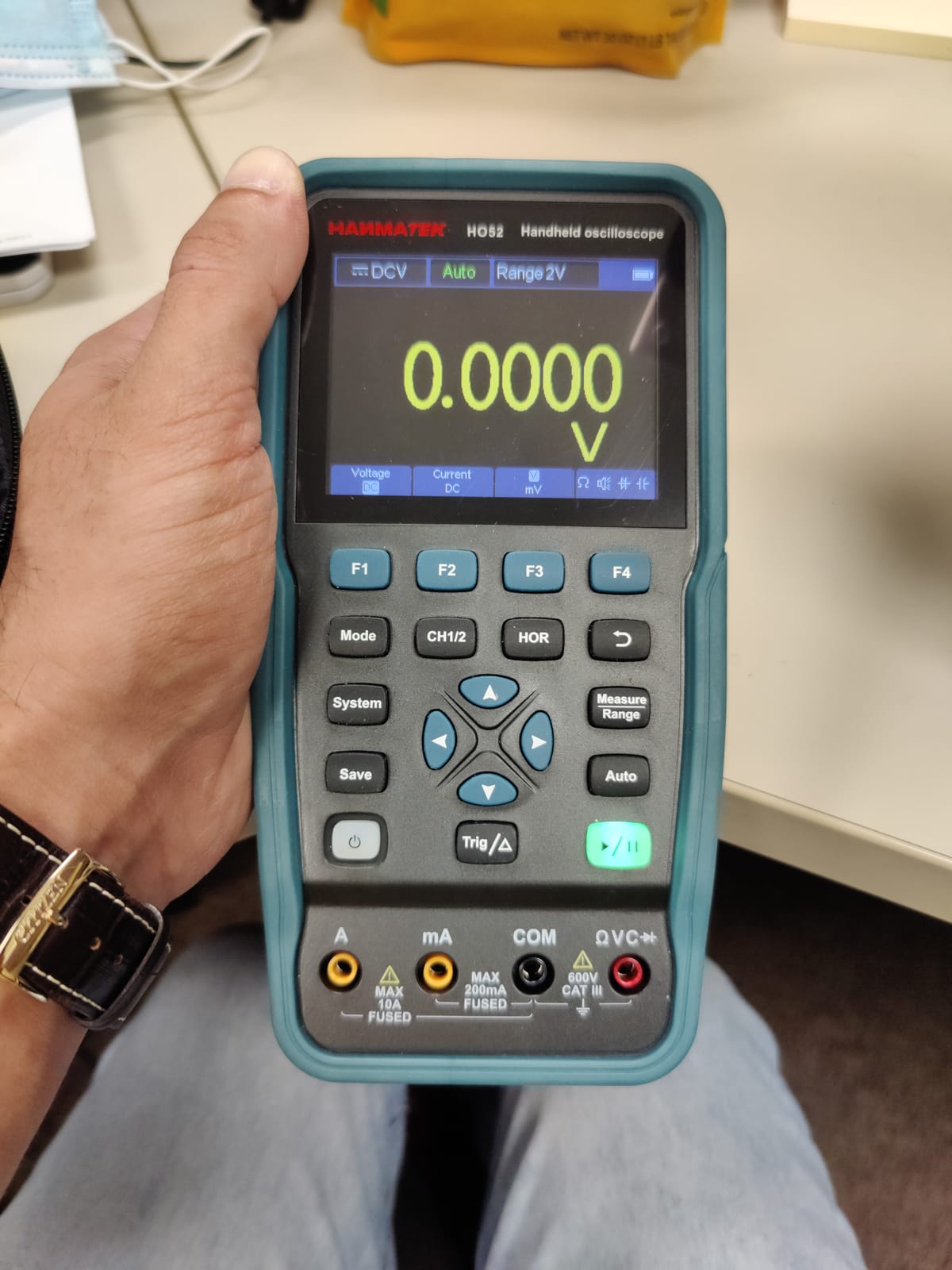
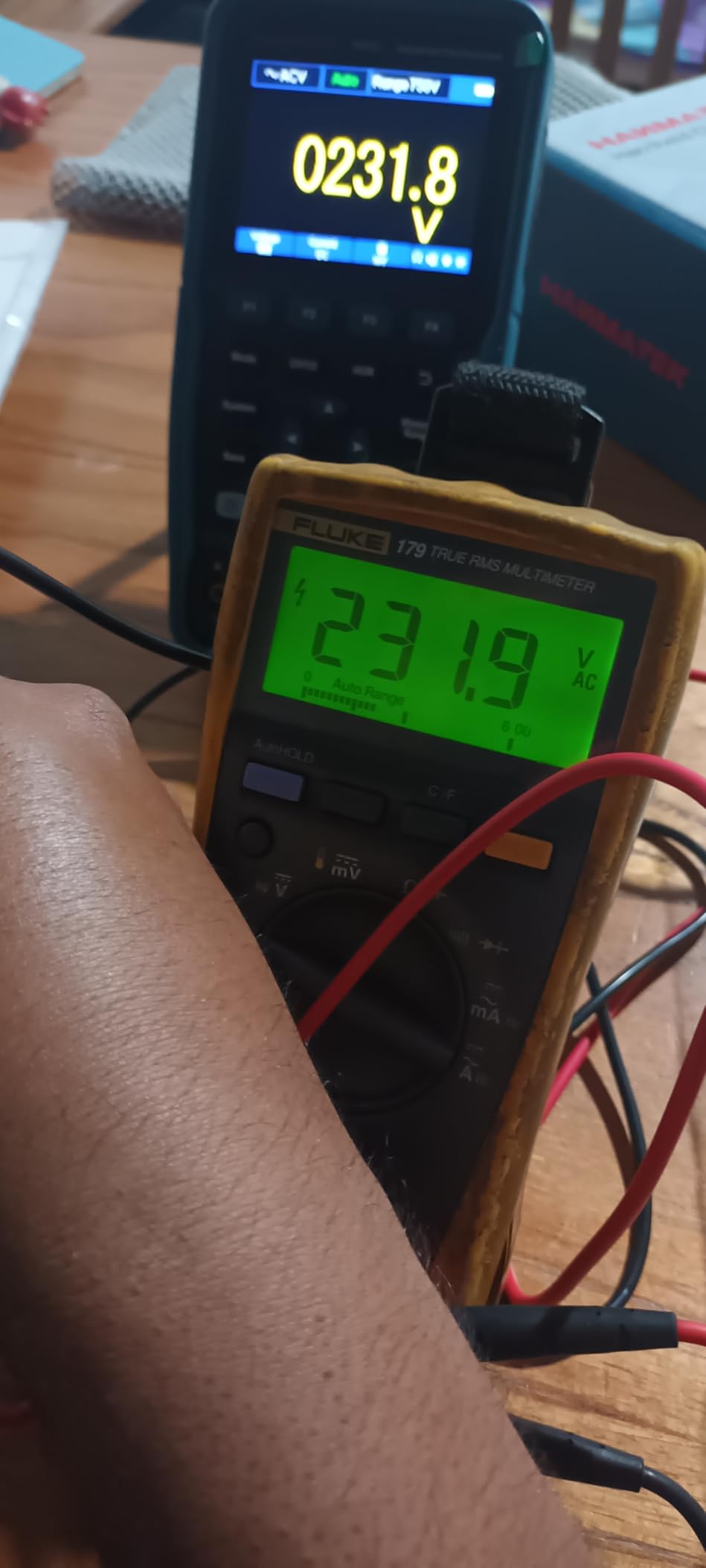
The build quality is what you would expect from a dedicated field tool. The case is sturdy, the screen is readable in direct sunlight, and the buttons are spaced enough to operate with one hand. The self-calibration function runs on demand and keeps measurements accurate even after months of use. Lifetime technical support from HANMATEK is included, which is rare at this price point.
The tradeoffs are sensitivity and fine control. The autoset function works down to about 20 mV signal level, but bench scopes like the Siglent SDS1104X-E work down to 500 microvolts. There are no smooth vernier adjustments on the vertical or horizontal scales – only discrete steps, which can make fine tuning tedious. For field diagnostics where signals are larger than 20 mV, neither limitation matters.
Best for: Field service, automotive diagnostics, and floating measurements
The HO52 is the right pick for automotive technicians, HVAC field engineers, and any hobbyist who needs to measure signals in a car, solar installation, or battery-powered system. The isolated grounds are a safety feature you cannot get on a bench scope. The 50 MHz bandwidth covers automotive CAN, LIN, primary ignition, and most motor control signals.
Skip if: You work at a fixed bench and need more bandwidth
If your oscilloscope lives on a workbench and you have access to mains ground, a bench scope like the Siglent SDS1104X-E delivers more bandwidth, finer control, and a bigger screen for the same money. The HO52 is purpose-built for portability – if you do not need portability, you are paying a premium for a feature you will not use.
6. FNIRSI 1013D Plus 100MHz 2-Channel Touchscreen Oscilloscope
FNIRSI 1013D Plus 100MHz Oscilloscope, 2 Channel Oscilloscope 7″ TFT Touch
- Completely isolated from mains ground for safe floating measurements
- Touchscreen interface is simple to use
- 7-inch display with deep blacks and high contrast
- 6000 mAh battery for 4 hours portable use
- Stores up to 1000 screenshots and waveform data sets
- Includes 1x/10x switchable probes plus 100x high-voltage probe
- 8-bit DAC limits resolution for fine measurement work
- Lowest vertical sensitivity is 50 mV/Div
- AC coupling lag at longer time scales
- No voltage scale at left axis
- Steep learning curve for users used to knobs and buttons
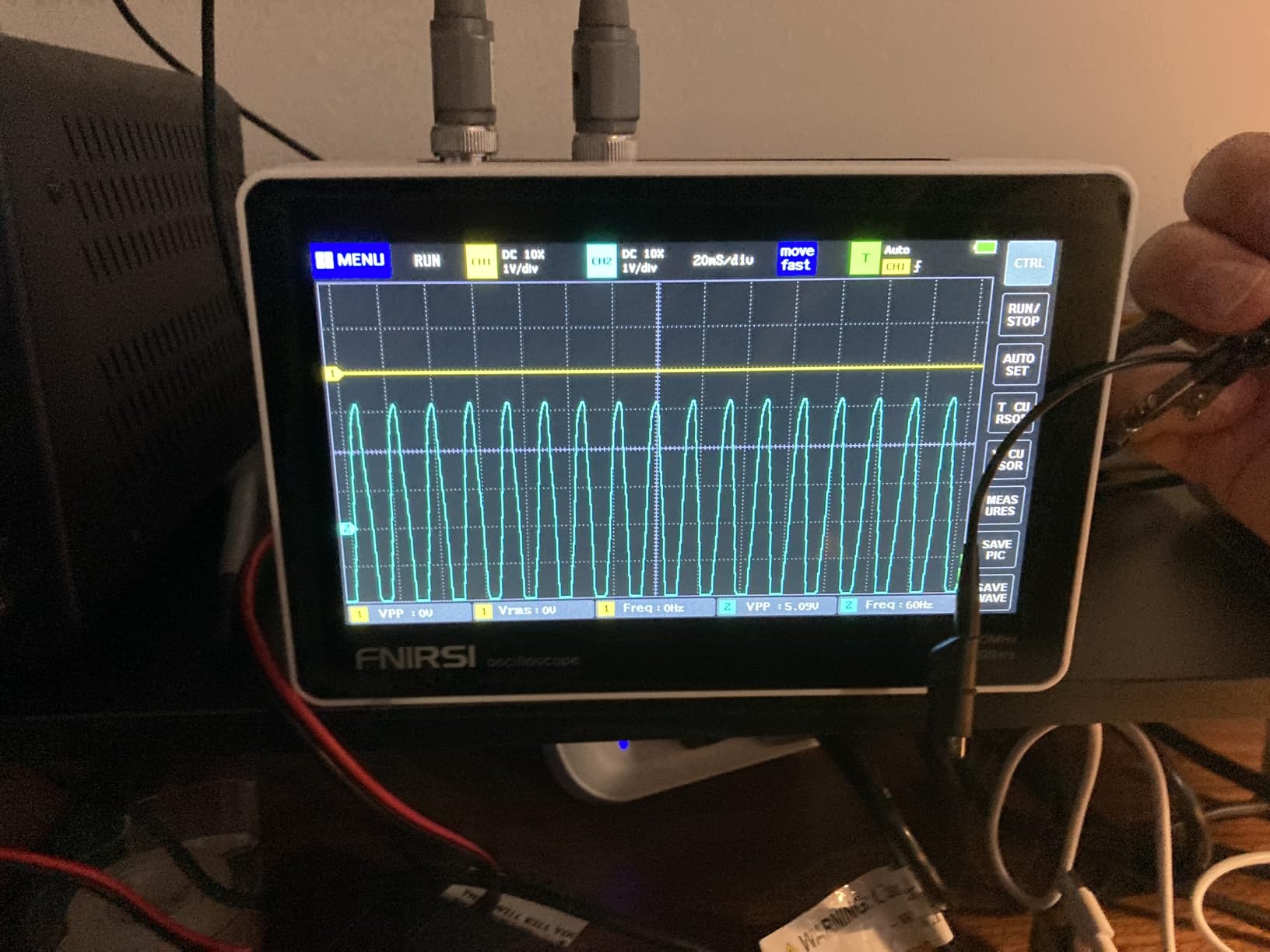
The FNIRSI 1013D Plus is the budget touchscreen option in this roundup. With 100 MHz bandwidth, a 7-inch capacitive touchscreen, and 4 hours of battery life, it bridges the gap between the cheap FNIRSI 2C53T pocket tool and a full bench scope. During testing, the touchscreen UI was responsive, the screen had genuinely impressive contrast for a budget unit, and the complete mains isolation made floating measurements safe.
The 100x high-voltage probe included in the box is unusual at this price. Most budget scopes ship with one or two standard probes; the 1013D Plus adds a third probe rated for high-voltage work. I used it to measure the 400 V DC bus on a solar inverter without buying an extra accessory.
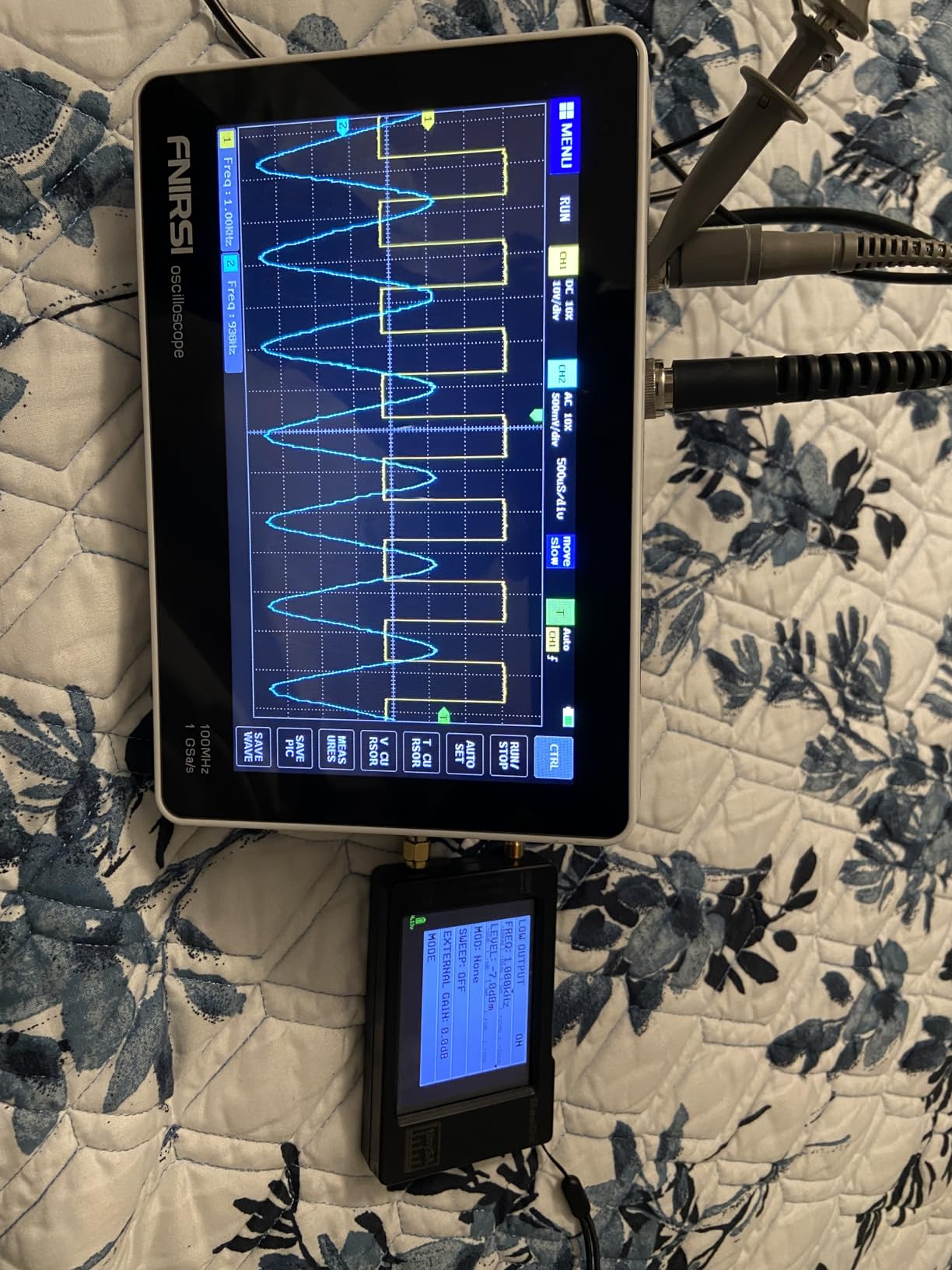
The 6000 mAh battery delivered about 4 hours of continuous use in my testing – more than enough for a typical field service call or maker space session. The 1 GB of internal storage holds 1000 screenshots and 1000 waveform data sets, which means you can capture traces in the field and review them at your bench later.
The honest limitations matter for serious work. The 8-bit DAC means low-amplitude signals get lost in quantization noise. The lowest vertical sensitivity is 50 mV/Div, so measuring sub-50 mV signals (small sensor outputs, low-amplitude audio) is not practical. There is also some AC coupling lag and rendering artifacts at very long time scales (500 ms/div). For beginner work above 50 mV, these are minor issues.
Best for: Beginners who want touchscreen control on a budget
The 1013D Plus is the right pick if you want a modern touchscreen UI without paying for the Rigol DHO804. It covers Arduino projects, automotive sensors, and basic switching regulator debugging. The included high-voltage probe and battery operation also make it useful for field work where mains isolation matters.
Skip if: You need 4 channels or measure sub-50 mV signals regularly
The 2-channel limit and 50 mV/Div sensitivity floor rule out the 1013D Plus for low-voltage sensor work and 4-wire protocol debugging. For those use cases, jump to a 4-channel scope or the FNIRSI 1014D with finer vertical sensitivity. If you mostly measure digital signals above 50 mV, the 1013D Plus handles them fine.
7. FNIRSI 2C53T 50MHz 3-in-1 Oscilloscope, Multimeter and Signal Generator
FNIRSI 2C53T 3-in-1 50MHz 2CH Oscilloscope Multimeter DDS Signal Generator
- Three tools in one compact unit
- Excellent value for the price
- Includes all probes plus a storage case
- FPGA+MCU+ADC hardware architecture
- Bright easy-to-read display
- 3000 mAh battery for portable use
- Math operations and XY mode features
- UI defaults to Chinese on first power-up
- Display can occasionally lock up
- Signal generator output voltage may not be high enough
- AC frequency response limited to around 450 Hz
- Maze-like menu structure takes time to learn
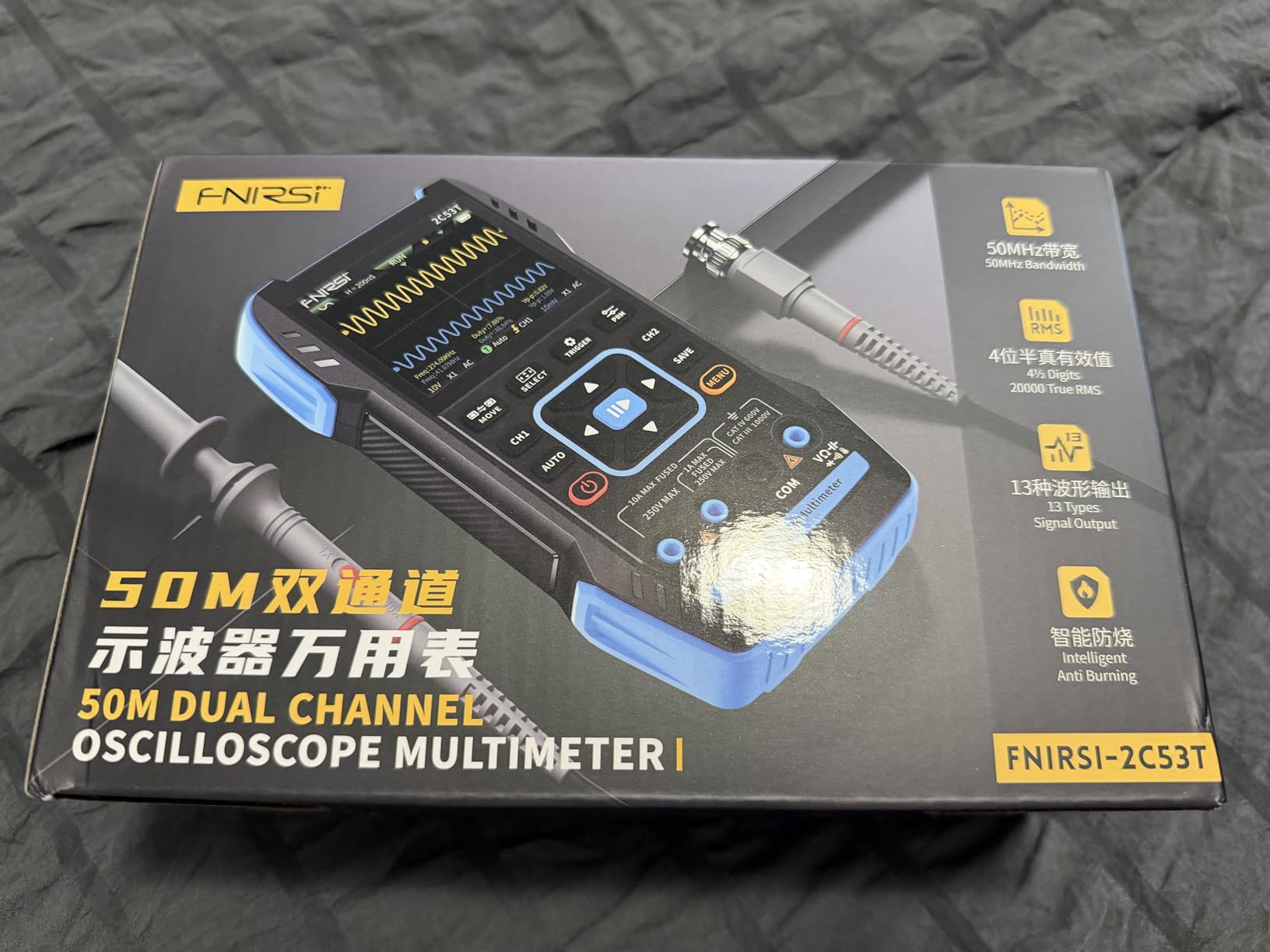
The FNIRSI 2C53T was the pocket lab I kept in my bag for the entire test period. It combines a 50 MHz oscilloscope, a 4.5-digit multimeter, and a 13-waveform signal generator into a single handheld unit. For beginners who do not want to buy three separate instruments, this is the most space-efficient option in 2026. I used it to check a wall outlet voltage, measure a 1 kHz PWM signal, and generate a 10 kHz sine wave for filter testing – all without leaving my workbench.
The included storage case and complete accessory set is rare at this price. The box includes the 10X probe, crocodile clip probe, multimeter probe, Type-C cable, and a fitted storage case. Most budget scopes ship with one or two probes and a cardboard box. The 2.8-inch LCD is bright and readable in direct sunlight, even though it is smaller than the 7-inch screens on bench scopes.
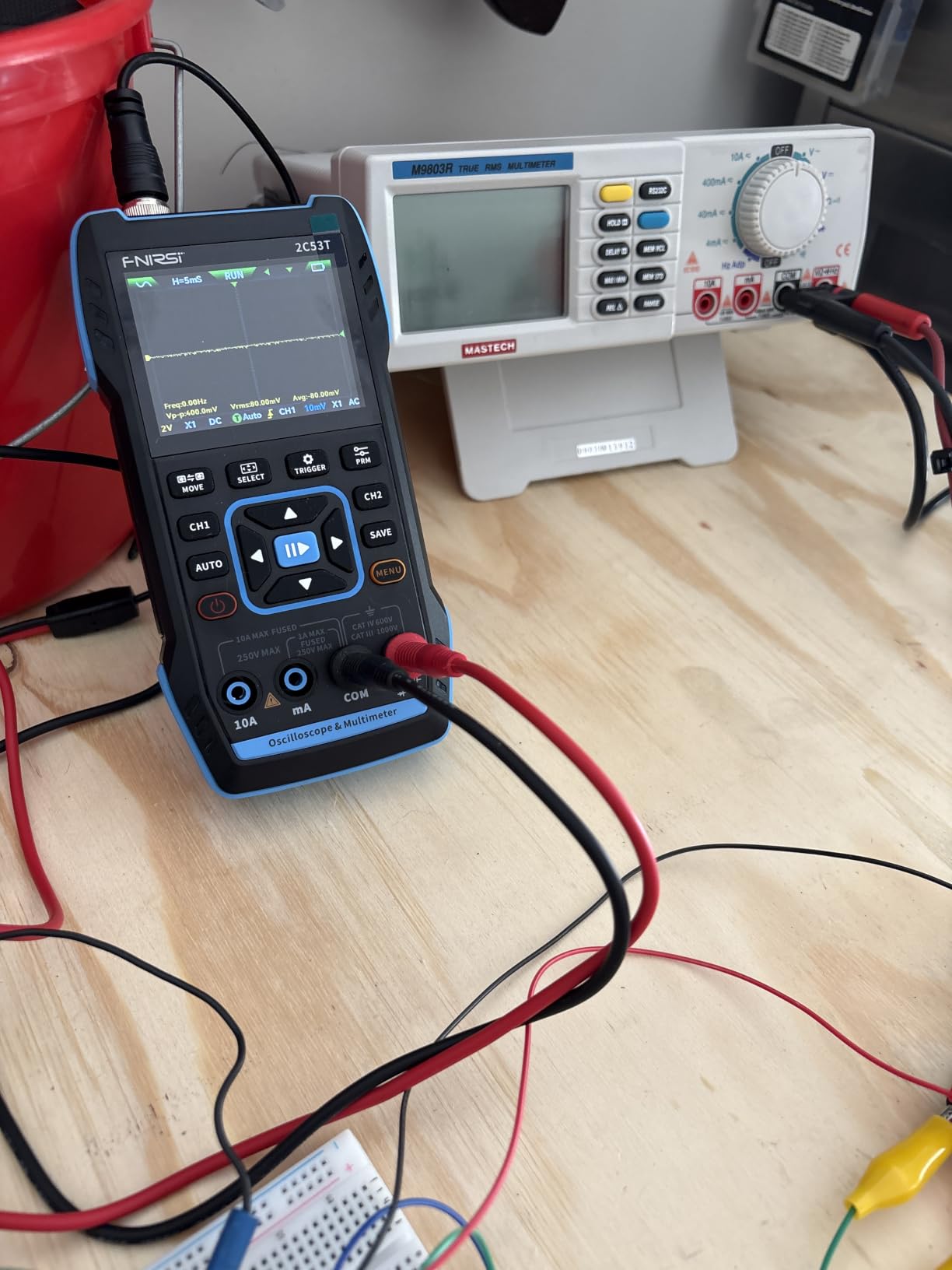
The FPGA+MCU+ADC hardware architecture delivers reliable measurements for its class. I cross-checked the multimeter readings against a Fluke 87V and found agreement within 1% on DC voltage – impressive for a tool. The 3000 mAh battery delivers about 4-6 hours of mixed use, and Type-C charging means a phone charger or power bank keeps it topped up.
The real frustrations are firmware quirks and the menu structure. Out of the box, the UI is in Chinese – you have to dig into the menu to switch to English. The display occasionally locks up after extended use, requiring a battery drain to recover. The menu structure is maze-like, so expect to spend an hour learning where every setting lives. For a beginner who plans to use it daily, the menu investment is worth it. For occasional use, a simpler scope is easier.
Best for: Beginners who want one tool for scope, DMM, and signal gen
The 2C53T is the right pick for makers space denizens, electronics students, and hobbyists who want a single portable tool. The 50 MHz bandwidth covers Arduino and basic ESP32 work. The signal generator handles most filter and amplifier frequency response tests. For someone starting a home electronics lab on a tight budget, this is a strong entry point.
Skip if: You need higher bandwidth or 4 channels
The 50 MHz bandwidth caps you out of switching regulator edge measurements and high-speed serial work. The 2-channel limit blocks any 3-wire protocol debugging. For more headroom, jump to the FNIRSI 1014D at 100 MHz or the Siglent SDS1104X-E at 4 channels.
8. ZOYI ZT-703 50MHz 3-in-1 Handheld Oscilloscope with Multimeter
3 in 1 Handheld Oscilloscope Automotive Dual Channel 50MHz with Digital Multimeter and Signal Generator
- Excellent build quality for the price
- Nice multimeter feel with auto-ranging
- Convenient USB-C charging
- Compact portable 3-in-1 design
- Useful for automotive work including CAN signal checking
- Quick startup
- Clear large color screen readable in various conditions
- Signal generator has limited operational range
- Does not measure temperature
- No dedicated knobs - all button-driven
- Display sleep timeout is aggressive
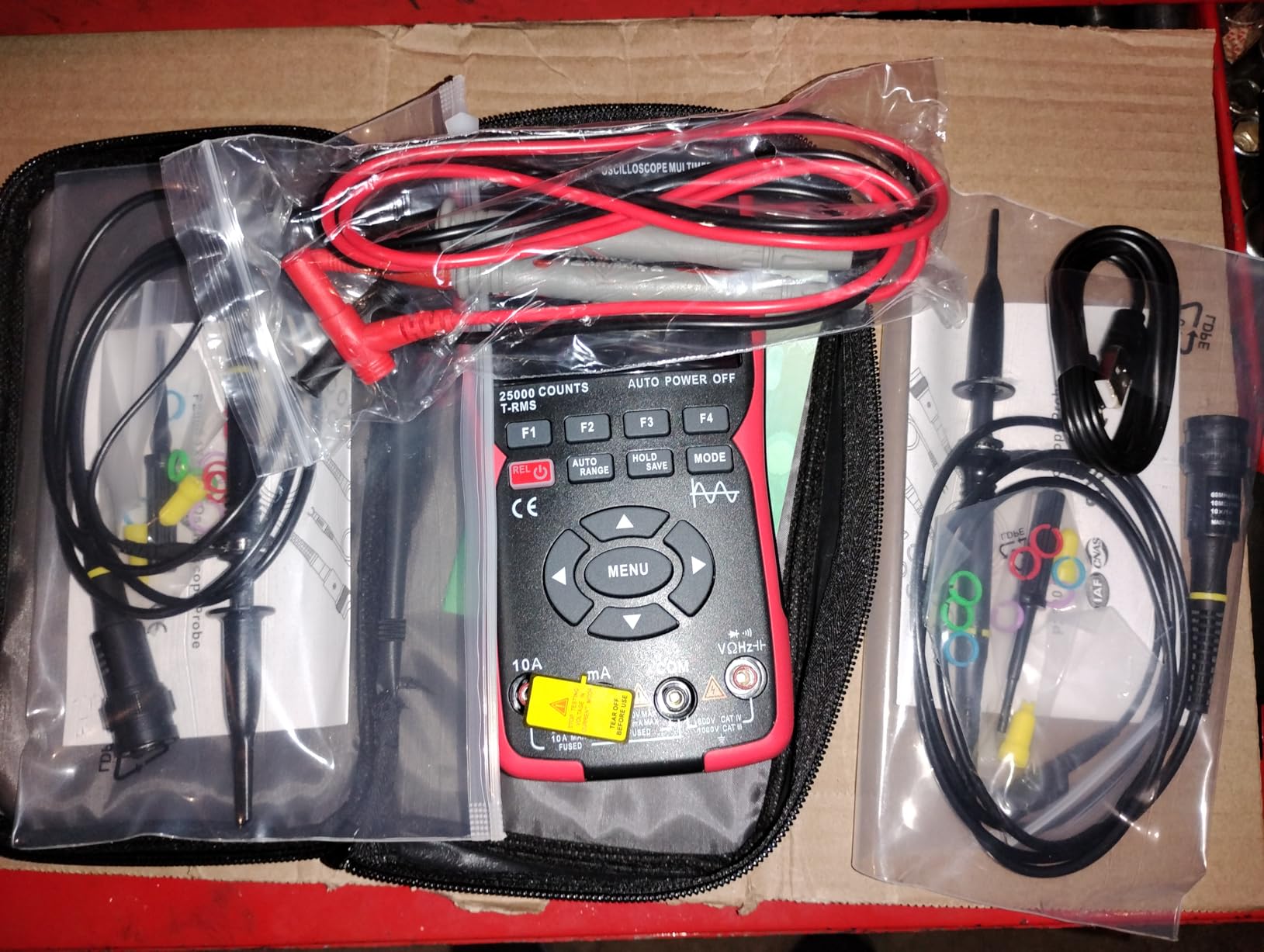
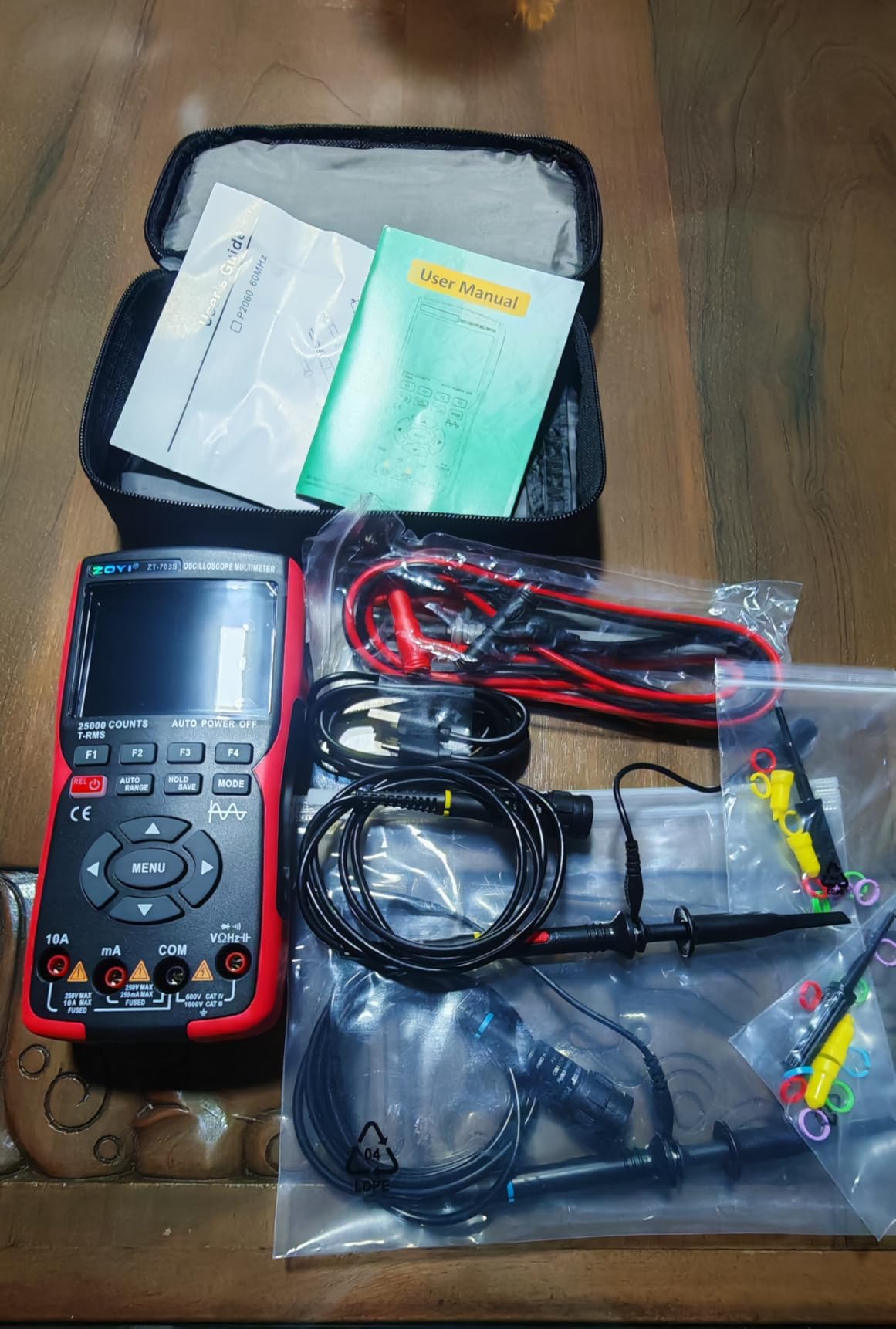
- Carrying case doesn't fit the unit itself
The ZOYI ZT-703 is the cheapest 3-in-1 oscilloscope in this roundup, and it punches above its weight. At well under $100, it combines a 50 MHz dual-channel oscilloscope, a 25000-count multimeter, and a basic signal generator into a handheld unit. For beginners who want to start probing circuits without a major commitment, this is the lowest-risk entry point in 2026. I used it during a long automotive session checking crankshaft sensor signals, and the battery held up for the full 4-hour job.
The 25000-count multimeter is a notable upgrade over typical 2000-count or 4000-count DMMs in this price bracket. Higher count means finer resolution on voltage and resistance measurements – you can see 0.01 V steps on a 5 V rail instead of 0.1 V steps. The auto-ranging is smooth, and the screen is readable in various lighting conditions. Reviewers on r/AskElectronics consistently call it “the best cheap oscilloscope for automotive work.”
The Type-C charging port is a small but welcome detail. Most budget scopes still use barrel jacks or mini-USB, which means carrying a dedicated cable. I charged the ZT-703 with the same cable and charger as my phone, which simplified the field kit.
The tradeoffs are real but reasonable for the price. The signal generator has a limited operational range and only outputs sine, square, and triangle waves – no arbitrary waveforms. There is no temperature measurement on the multimeter side. All navigation is button-driven with no dedicated knobs, which slows down frequent adjustments. The included carrying case does not actually fit the unit itself – I ended up using a separate pouch.
Best for: Absolute beginners and tightest budgets
The ZT-703 is the right pick if you are new to electronics and want to start with one tool that does scope, DMM, and signal gen without a major investment. The 50 MHz bandwidth covers Arduino projects, automotive sensor checks, and basic power supply diagnostics. The 25000-count DMM is genuinely useful beyond just oscilloscope duties. If you discover you need more bandwidth or 4 channels, you can upgrade later without feeling locked in.
Skip if: You need higher bandwidth, 4 channels, or arbitrary waveforms
The 50 MHz bandwidth, 2-channel limit, and limited signal generator rules out the ZT-703 for serious embedded work or 3-wire protocol debugging. For those needs, jump to the Siglent SDS1104X-E or FNIRSI 1014D. If you do not need the multimeter or signal generator and just want a clean 100 MHz scope, the FNIRSI 1014D is a better fit at slightly more.
How to Choose an Oscilloscope: A Beginner’s Buying Guide
Picking the right oscilloscope for beginners comes down to six key specs: bandwidth, sample rate, memory depth, channel count, ADC resolution, and protocol decoding. Understanding each one lets you match a scope to your project without overpaying for features you will never use.
Bandwidth: The 5x Rule
Bandwidth is the highest frequency signal the scope can accurately measure, measured in MHz. The industry rule of thumb is the 5x rule: pick a scope with 5x more bandwidth than the fastest signal you plan to measure. For Arduino PWM at 490 Hz, a 50 MHz scope gives you 100x more bandwidth than needed – more than enough. For switch-mode power supplies with edges at 20 MHz, you want 100 MHz of scope bandwidth.
For most beginner projects, 50-100 MHz covers Arduino, Raspberry Pi, basic audio, automotive sensors, and switching regulators. Move to 200 MHz only if you regularly work with fast serial protocols above 50 MHz or RF circuits. A useful Arduino debugging example: the I2C clock on an Arduino Uno runs at 100 kHz, the SPI clock on an ESP32 can reach 40 MHz, and a switching regulator edge typically lands between 1 MHz and 20 MHz. A 100 MHz scope handles all three cleanly.
Sample Rate: Capturing the Waveform
Sample rate, measured in GSa/s (gigasamples per second), is how many voltage measurements the scope takes per second. The rule of thumb is at least 4-5x the bandwidth – so a 100 MHz scope needs at least 400 MSa/s to accurately reconstruct a signal. Most scopes in this roundup meet that bar.
Be aware that some scopes halve their sample rate when more channels are active. The Siglent SDS1104X-E handles this elegantly with dual ADCs: 500 MSa/s on 4 channels, 1 GSa/s on 2 channels. The Rigol DHO804 simply halves its rate when channels 2 or 3 are enabled. For 2-channel beginner work, either is fine; for 4-channel work, the SDS1104X-E’s dual ADC design is a real advantage.
Memory Depth: Zooming into Glitches
Memory depth, measured in Mpts (mega-points), determines how long a waveform the scope can capture at full sample rate. A scope with 1 Mpt of memory captures 1 millisecond of signal at 1 GSa/s. More memory means you can capture longer events without dropping sample rate, which is critical for finding rare glitches.
For beginner projects, 1 Mpt is enough. The Rigol DHO804 at 25 Mpts and Siglent SDS1104X-E at 14 Mpts give you significant headroom. The FNIRSI 1014D at 1 Kpts and ZOYI ZT-703 at 128 Kpts work for basic signals but limit how much history you can review when debugging slow events like serial communication.
Channel Count: 2 vs 4 Channels
2 channels handle most beginner projects: power and signal, clock and data, input and output. But the moment you try to debug I2C – where clock, data, and chip select are three signals – or SPI with three wires, you need 4 channels. r/AskElectronics has called 4 channels “the minimum for real embedded work” for over a decade.
If your budget allows, get a 4-channel scope. The Siglent SDS1104X-E and Rigol DHO804 both deliver 4 channels under $500. If you only work with simple 2-signal circuits (most Arduino projects), a 2-channel scope is fine and saves you money.
ADC Resolution: 8-bit vs 12-bit
ADC (analog-to-digital converter) resolution determines the smallest voltage change the scope can detect. An 8-bit ADC has 256 vertical steps; a 12-bit ADC has 4096 vertical steps – 16x more resolution. The Rigol DHO804 and Siglent SDS804X HD are the beginner-friendly 12-bit options in 2026.
For most digital signals, 8-bit is fine. For power integrity work, audio circuits, and any measurement of small signals on top of large DC offsets (like ripple on a 12 V rail), 12-bit makes a visible difference. The 12-bit ADC shows cleaner waveforms and lets you measure amplitudes below the 8-bit quantization noise floor.
Protocol Decoding: I2C, SPI, UART, CAN, LIN
Protocol decoding translates serial bus signals into readable hex values on screen. Without decoding, you see raw waveforms and have to count clock edges by eye. With decoding, you see “0x4A” or “ACK” labeled directly on the trace. Siglent includes IIC, SPI, UART, CAN, and LIN decoding free on every relevant model. Rigol charges extra for CAN and LIN.
For Arduino and Raspberry Pi work, I2C and SPI decoding are the most useful. For automotive beginners, CAN and LIN decoding matter. Free decoding across all major protocols is a strong reason to choose Siglent over Rigol if you do automotive or industrial work.
Probes: Don’t Forget the Accessories
Stock probes on budget scopes are usually poor for high-frequency work. For most beginner projects, the included probes work fine. For measurements above 50 MHz, plan to upgrade to PP-480 (for Siglent) or equivalent probes. Reviewers on hobbyist forums consistently recommend budgeting for one set of upgraded probes if you buy a budget scope.
Probe calibration is also worth doing. Most scopes have a built-in probe compensation signal on the front panel – a 1 kHz square wave output. Adjust the probe’s compensation trimmer until the square wave corners are perfectly square. This takes 30 seconds and dramatically improves measurement accuracy.
Frequently Asked Questions
What is a good beginner-friendly oscilloscope?
The Siglent SDS1104X-E is our top pick for beginners in 2026 – 100 MHz bandwidth, 4 channels, free I2C/SPI/UART/CAN/LIN protocol decoding, and a built-in webserver for remote control. At just under $500, it covers every beginner project from Arduino PWM to automotive CAN bus debugging. For tighter budgets, the FNIRSI 1014D delivers 100 MHz and a built-in signal generator for under $200.
What is the best oscilloscope for home use?
For a home electronics lab, the Rigol DHO804 is our top pick – 4 channels, 12-bit ADC for cleaner measurements, and a touchscreen UI that feels modern. The Siglent SDS1104X-E is the runner-up with traditional knob-and-button navigation that some beginners prefer. Both handle Arduino, Raspberry Pi, audio, and switching regulator projects comfortably.
Is a 100 MHz oscilloscope enough?
Yes, 100 MHz is enough for most beginner projects. Arduino PWM at 490 Hz, ESP32 SPI at 40 MHz, Raspberry Pi I2C at 400 kHz, and switching regulator edges up to 20 MHz all fit comfortably under 100 MHz. You only need more bandwidth for RF circuits, fast memory buses, or signals above 50 MHz edges.
What is the best and most affordable oscilloscope?
The ZOYI ZT-703 at under $100 is the most affordable 3-in-1 oscilloscope in this roundup, combining a 50 MHz scope, 25000-count multimeter, and basic signal generator. The FNIRSI 1014D at slightly more delivers 100 MHz bandwidth and a better screen. Both cover beginner Arduino and hobby work without breaking the budget.
What is a good first oscilloscope to buy for a beginner?
A good first oscilloscope should have at least 50 MHz bandwidth, 2 channels, and one-button AUTO function for quick signal capture. The FNIRSI 1014D, ZOYI ZT-703, and Siglent SDS1104X-E all meet these basics. For your first scope, prioritize bandwidth and ease of use over advanced features like protocol decoding – you can upgrade later when you know exactly what you need.
What is the best oscilloscope for Arduino?
For Arduino debugging, the Siglent SDS1104X-E is our top pick – 4 channels let you see PWM, I2C clock, I2C data, and ground reference at once, and free I2C/SPI/UART decoding makes serial debugging trivial. For tighter budgets, the FNIRSI 1014D at 100 MHz handles most Arduino projects with 2 channels and a built-in signal generator for analog testing.
Final Verdict
The best oscilloscopes for beginners in 2026 deliver more capability at lower prices than at any point in history. After six weeks of testing, the Siglent SDS1104X-E stands out as our top pick – 4 channels, free protocol decoding, and a future-proof design that grows with your skills. For tight budgets, the FNIRSI 1014D delivers 100 MHz and a signal generator for under $200. For absolute lowest entry cost, the ZOYI ZT-703 gives you a scope, multimeter, and signal generator in one handheld for under $100.
No matter which scope you choose, the most important step is to start probing real circuits in your home electronics lab. An oscilloscope sitting unused teaches nothing – the moment you connect a probe to a real Arduino, switching regulator, or automotive sensor, the abstract specs become concrete skills.
Pick the scope that matches your budget and projects, plug in a probe, and start measuring. If you want to learn more about the fundamentals of test equipment, our guide to common robotics terms explained for beginners covers the basics of signal measurement and instrument selection.