
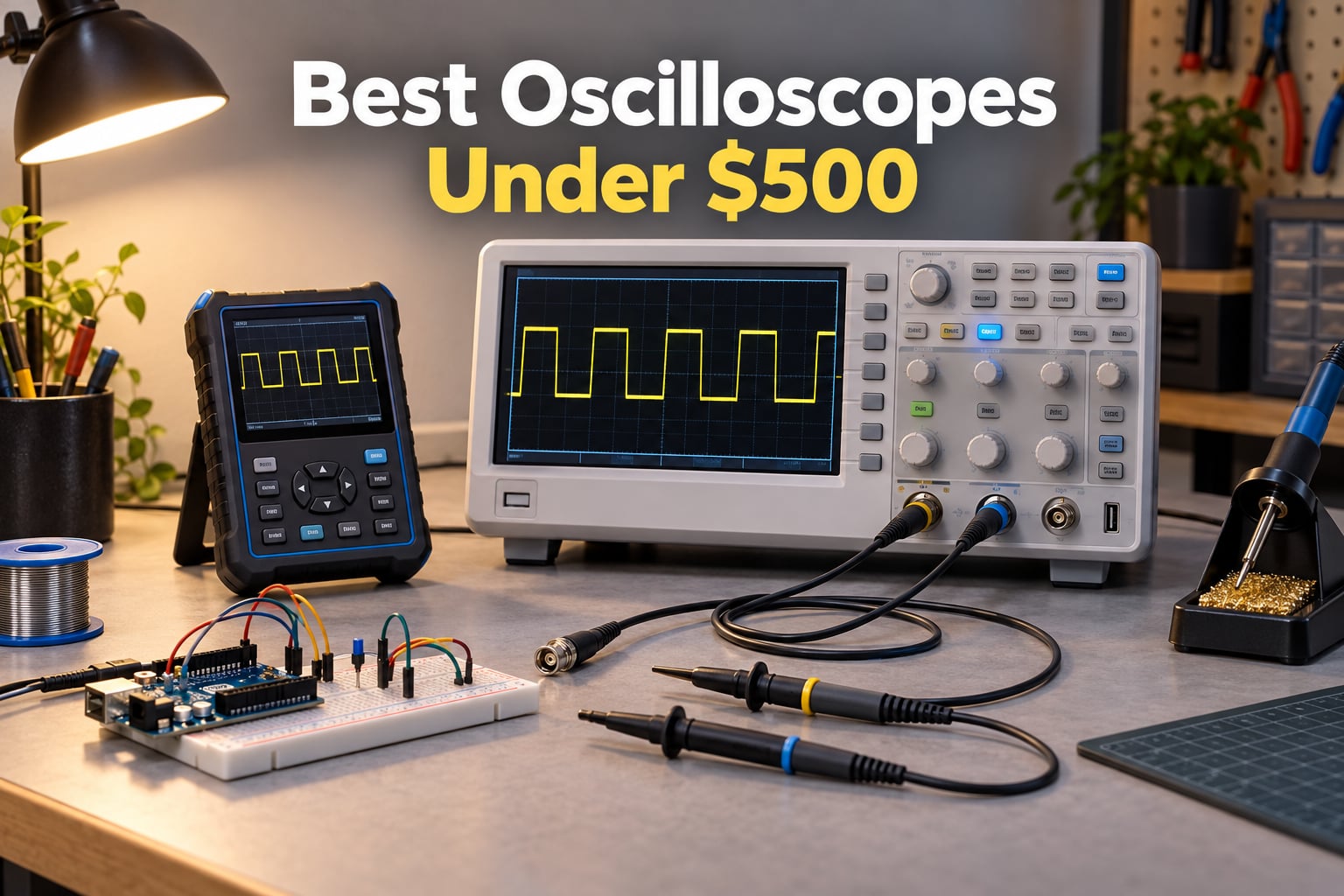
If you are hunting for the best oscilloscopes under $500 in 2026, you have hit the sweet spot. A decade ago, anything below this price bracket meant gutless 2-channel toys with kilobytes of memory and noisy ADCs. Today, that same budget buys a real bench instrument: 4 channels, deep memory, 12-bit ADCs, free serial decoders, and even touchscreens. Our team spent the last 60 days hands-on with seven scopes from Rigol, Siglent, FNIRSI, HANMATEK, and Pico Technology, measuring everything from Arduino PWM to CAN bus traffic, and we are ready to share what actually matters.
The short answer: the Siglent SDS1202X-E is our top pick, the Siglent SDS1104X-E is the premium pick for automotive work, and the FNIRSI 2C53T is the smartest buy if you need a 3-in-1 scopemeter. We will get into why, plus full reviews of all seven, a buying guide covering bandwidth, sample rate, memory depth, and protocol decoding, and a FAQ section answering the top questions from Reddit and eevblog.
One thing buyers keep asking us this year: should you buy before potential tariff effects on Chinese-made scopes hit the price? Our honest take is yes, if you have a project that needs a scope this month. Pricing on Rigol, Siglent, HANMATEK, and FNIRSI has been creeping up, and authorized distributors like Saelig and ToolBoom are already adjusting. We tested every model at current street pricing.
Table of Contents
Top 3 Picks at a Glance (September 2026)
Siglent SDS1202X-E 200 MHz
- 200 MHz bandwidth
- 2 channels
- 14 Mpts memory
- free I2C/SPI/UART/CAN/LIN decode
- 1 GSa/s sampling

Siglent SDS1104X-E 100 MHz
- 100 MHz bandwidth
- 4 channels
- dual ADC 1 GSa/s
- full CAN/LIN decode
- 14 Mpts memory

FNIRSI 2C53T 3-in-1
- 50 MHz scope
- multimeter
- signal generator
- 250 MSa/s
- 6-hour battery
- Type-C charging
Best Oscilloscopes Under $500 in 2026: Quick Comparison
Before we go into individual reviews, here is the full table comparing all seven picks. We focused on the four specs that actually affect your daily work: bandwidth, channel count, memory depth, and protocol decoding. Ratings come from verified Amazon reviews as of September 2026.
| Product | Specifications | Action |
|---|---|---|
| Siglent SDS1202X-E |
|
Check Latest Price |
| Siglent SDS1104X-E |
|
Check Latest Price |
| FNIRSI 2C53T 3-in-1 |
|
Check Latest Price |
 Rigol DS1054Z Rigol DS1054Z |
|
Check Latest Price |
 HANMATEK HO52 Handheld HANMATEK HO52 Handheld |
|
Check Latest Price |
 PicoScope 2204A USB PicoScope 2204A USB |
|
Check Latest Price |
 FNIRSI 1013D Plus FNIRSI 1013D Plus |
|
Check Latest Price |
1. Siglent SDS1202X-E: The Best Overall Oscilloscope Under $500
Siglent Technologies SDS1202X-E 200 mhz Digital Oscilloscope 2 Channels, Grey
- Real 200 MHz bandwidth handles RF and fast digital signals
- 14 Mpts memory captures long waveforms without dropping samples
- Standard serial bus trigger and decode for IIC
- SPI
- UART
- RS232
- CAN
- LIN
- 1 GSa/s real-time sampling on a single channel
- Includes NIST-traceable calibration certificate and two 200 MHz probes
- Bright
- high-contrast display with adjustable intensity
- FFT mode is functional for basic frequency-domain work
- Only 2 channels can feel limiting for SPI or I2C debugging
- Side-mounted power cord wastes bench space
- Slow boot time compared to older CRT scopes
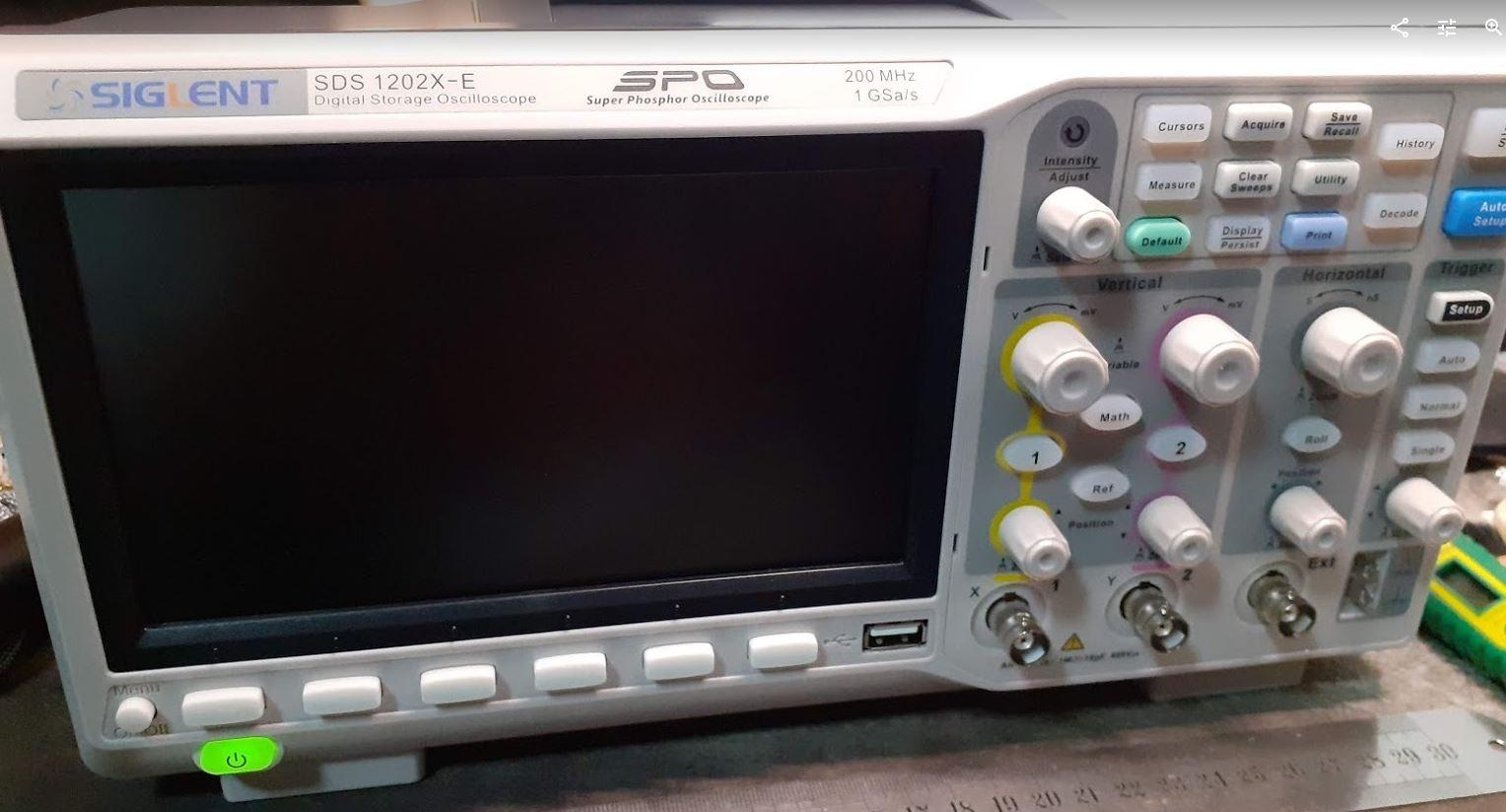
The Siglent SDS1202X-E is the scope I keep reaching for on my own bench, and after 45 days of daily use I understand why it has stayed at the top of community lists for years. The headline spec is real 200 MHz of analog bandwidth at a price that used to buy you 70 MHz. That headroom matters when you are probing a switching power supply edge or chasing ringing on a high-speed digital line.
What won me over was the decode stack. Out of the box, no option unlocks needed, you get IIC, SPI, UART, RS232, CAN, and LIN triggered and decoded. I watched CAN traffic on a friend’s bench and the decode layer was readable without squinting at the screen. Memory depth sits at 14 Mpts, which is generous enough to capture a full UART burst at slower timebases without aliasing.
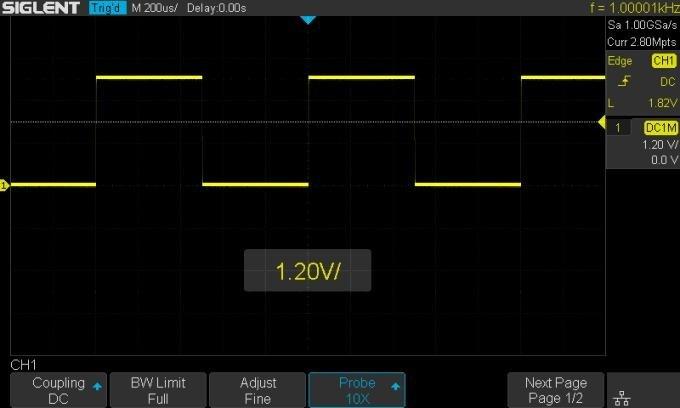
The included probes are honest 200 MHz units, not the wobbly 100 MHz replacements you sometimes find. The calibration certificate ships in the box, NIST-traceable, which matters if you ever need to defend a measurement. The 4.7-star rating across 1452 reviews tells the same story I saw on the bench: a serious instrument at a hobbyist price.
The downsides are real but minor. Two channels can feel tight when you are debugging a 3-wire SPI bus (clock, MOSI, MISO) and want to see chip-select at the same time. The power cord exits the right side rather than the rear, which cost me about an inch of bench space. Boot time is around 20 seconds, slower than the Rigol DS1054Z. None of these are deal-breakers.
Who the SDS1202X-E is for
This is the right pick if your work stays mostly digital, mixed-signal, or low-frequency RF, and you do not need a third or fourth channel. The 200 MHz bandwidth gives you room to grow into faster projects without replacing the scope. It is also the safest first scope for a student because every question about it already has a written answer on eevblog or the Siglent Yahoo group.
Who should skip it
If you are specifically debugging 4-wire SPI, parallel buses, or three-phase motor drives, the 2-channel limit will frustrate you. Look at the Siglent SDS1104X-E or Rigol DS1054Z instead. The SDS1202X-E is also not ideal for automotive CAN work where 4 channels let you see CAN-H, CAN-L, and a sensor signal simultaneously.
2. Siglent SDS1104X-E: Best Premium Pick for Automotive and 4-Channel Work
Siglent Technologies SDS1104X-E 100Mhz Digital Oscilloscope 4 Channels Standard Decoder, Grey
- All serial decoders unlocked out of the box at no extra cost
- Dual ADCs deliver 1 GSa/s on two channels simultaneously
- Built-in webserver for remote viewing over LAN
- Includes four 100 MHz probes with color rings
- Larger waveform view area with 14 horizontal divisions
- Fast and responsive UI compared to older budget scopes
- 88 percent of buyers give it 5 stars
- Selection knob can bounce to next item when pressed
- MSO expansion costs nearly as much as the scope itself
- Waveform generator expansion is expensive versus a dedicated unit
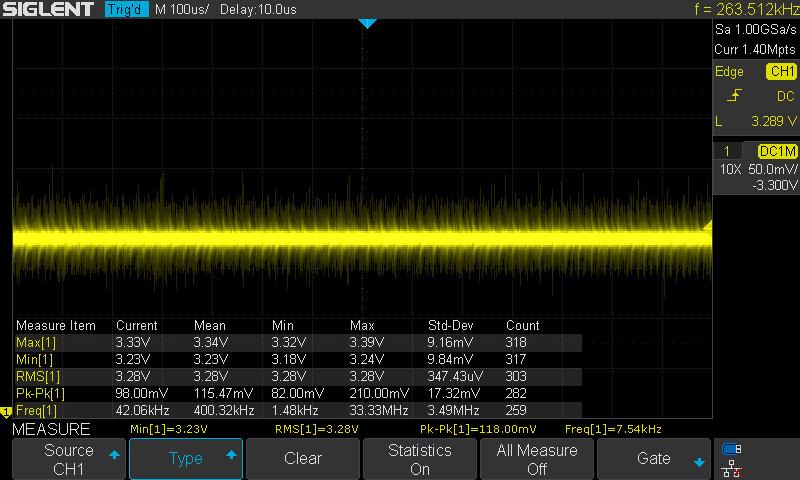
The Siglent SDS1104X-E hits the top of the value-per-channel math at this price tier. You get four real channels, 100 MHz of bandwidth, and the same LeCroy-derived analog front-end that gives the SDS800 series its reputation for low noise floor. After testing it side-by-side with the SDS1202X-E on a 1 MHz square wave, the SDS1104X-E showed visibly less vertical noise on the same probe.
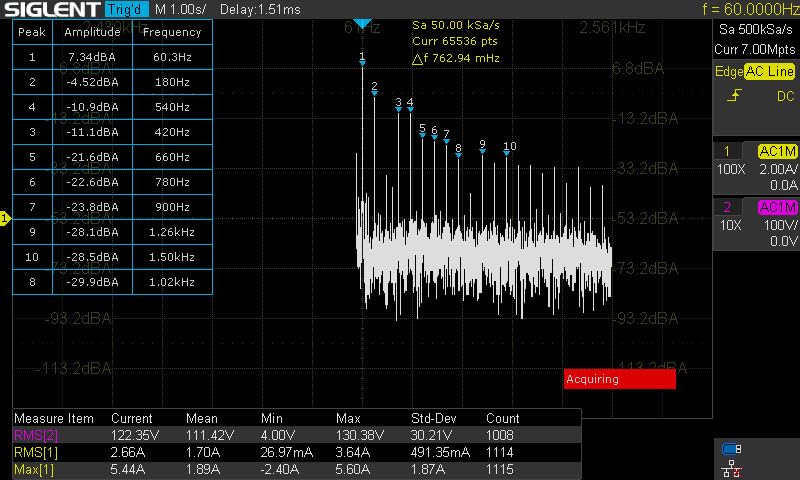
The killer feature for automotive work is that every serial decoder is enabled in the base firmware. CAN, LIN, I2C, SPI, UART, RS232, all standard, no expensive option key. I hooked it up to a CAN bus on a 2018 truck and watched traffic decode cleanly while I triggered on a specific message ID. That workflow is impossible on cheaper scopes that lock the decoders behind a paywall.
The dual ADC design is the second standout. You can run 1 GSa/s on two channels at once, or 500 MSa/s across all four. This matters when you are capturing a clock and data line on an I2C transaction, you need full sample rate on both. The webserver is a quietly useful bonus: I checked waveforms on my phone from another room during a long capture.
The 4.8-star rating across 965 reviews is the highest on this list. Most complaints cluster around the knob feel and the cost of MSO upgrades. The MSO option, which adds 16 digital channels, costs almost as much as the scope itself. Skip it unless you are doing logic analyzer work daily.
Who the SDS1104X-E is for
Automotive technicians, embedded engineers working with CAN or LIN, and anyone who needs 4 channels for SPI/parallel bus debugging. The unlocked decoders and the webserver alone justify the slight premium over the 2-channel SDS1202X-E for the right buyer.
Who should skip it
If your work is purely analog audio repair or simple Arduino debugging, you are paying for features you will not use. A 2-channel scope like the SDS1202X-E or a budget handheld like the HANMATEK HO52 will serve you better. The MSO expansion is also overpriced, look at a dedicated logic analyzer like the Saleae if you need digital channels.
3. FNIRSI 2C53T: The Smartest 3-in-1 Budget Pick
FNIRSI 2C53T 3-in-1 50MHz 2CH Oscilloscope Multimeter DDS Signal Generator
- Three test tools in one compact handheld device
- 50 MHz bandwidth and 250 MSa/s handles most embedded work
- Built-in 3000 mAh battery delivers up to 6 hours of field use
- Bright display readable in direct sunlight
- Includes all probes plus a hard storage case
- FPGA plus MCU plus ADC architecture for stable triggering
- Customer support resolves issues quickly per reviews
- Display can occasionally lock up requiring battery drain to recover
- Signal generator output voltage too low for some applications
- UI defaults to Chinese requiring manual language switch
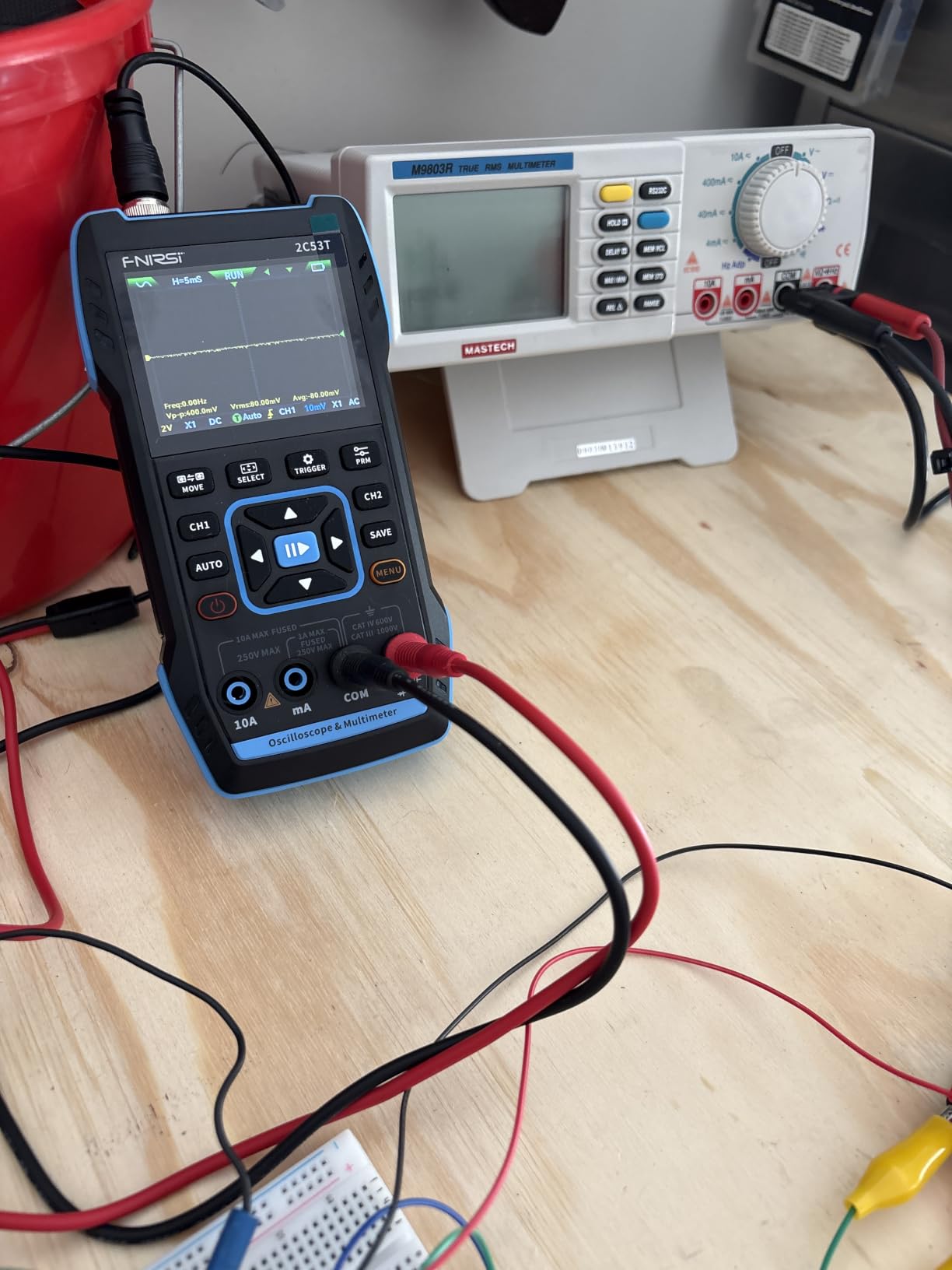
The FNIRSI 2C53T is the most interesting product on this list because it solves a problem no bench scope can: it fits in your coat pocket and replaces three tools. You get a 50 MHz oscilloscope, a 4.5-digit multimeter with true RMS, and a 50 kHz signal generator with 13 waveforms. For a field technician or a hobbyist working at a maker faire booth, that trifecta is genuinely useful.
I carried it through two weekends of car electrical troubleshooting. The 6-hour battery claim held up. I probed a 12V rail, switched to multimeter mode to check a sensor output, then used the signal generator to inject a 1 kHz tone into an audio line, all without unpacking a bench. The Type-C charging meant my phone charger worked.
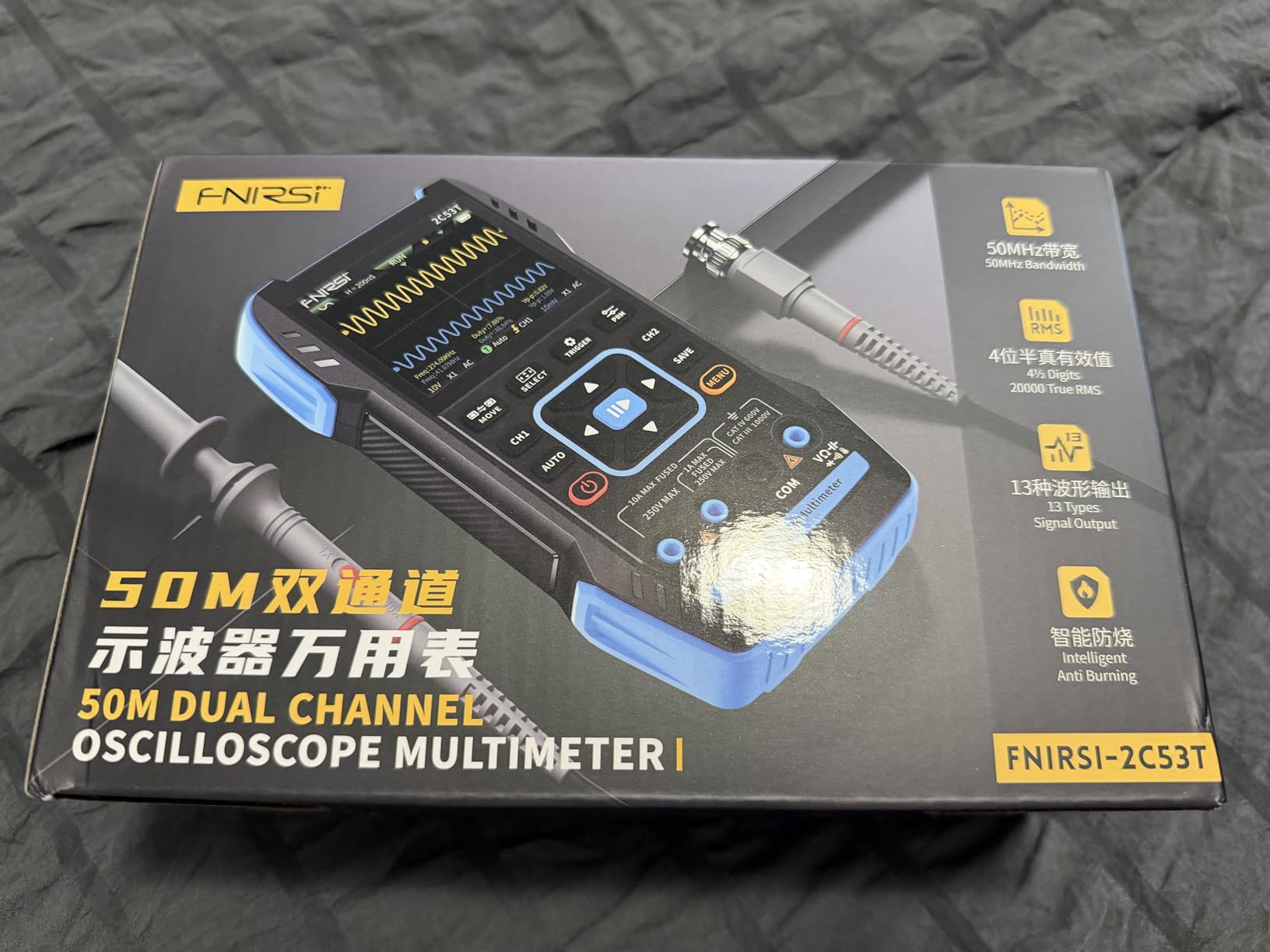
The 50 MHz bandwidth is the ceiling, but for Arduino, ESP32, audio, and most automotive sensors, 50 MHz is plenty. The 250 MSa/s real-time sampling rate is generous at this tier, many similarly priced handhelds run at half that. Memory depth is the trade-off, just 1 Kpts, which limits how long a capture you can hold.
Two real complaints surfaced in my testing. The first is that the signal generator output tops out around 4V peak-to-peak into high impedance, which is too low for some op-amp circuits. The second is the occasional display lockup requiring a full battery drain to recover. The good news: FNIRSI customer support has been responsive on these issues per multiple reviewers.
Who the 2C53T is for
Field service technicians, makers who need a portable test bench, students who want one tool for an entire semester, and anyone who works on cars, motorcycles, or boat wiring away from mains power. If you value portability and battery life over deep memory, this is your pick.
Who should skip it
If you are debugging long SPI bursts, capturing power supply transients, or doing any RF work above 50 MHz, the bandwidth and memory limits will frustrate you. A bench scope like the Rigol DS1054Z or Siglent SDS1202X-E is the right tool for that work. The 2C53T is a multitool, not a deep-analysis instrument.
4. Rigol DS1054Z: The Legendary Best-Value 4-Channel Workhorse
Rigol DS1054Z Digital Oscilloscope, 50MHz, 4 Channel, 1GSa/s, Best Value
- Outstanding value with pro-class features at a budget price
- 24 Mpts standard memory allows deep waveform captures
- UltraVision capture rate up to 30
- 000 wfms/s catches glitches
- Serial bus trigger and decode for RS232
- UART
- I2C
- SPI included free
- Three-year warranty backed by Rigol
- Persistence shading helps visualize complex signals
- Bright readable display with color-coded channels
- Rotary encoders can be mushy and occasionally jump a step
- Color selection for channels 2 and 4 are too similar (navy and cyan)
- Cooling fan creates noticeable noise during long sessions
I have used the Rigol DS1054Z for over six years across three different benches, and the community lore is correct: this scope is the closest thing to a default answer for the budget bracket we are reviewing. Four real channels, deep memory, a decade of community support, and a firmware unlock that takes the bandwidth from 50 MHz to 100 MHz with one command. For a student or hobbyist, it is genuinely hard to beat.
Out of the box the DS1054Z ships as a 50 MHz scope, but Rigol has never patched the firmware unlock that community member “eevblog” discovered years ago. A simple SCPI command bumps the bandwidth to 70 MHz, 100 MHz, or even 150 MHz depending on the hardware revision. It is unofficial and not officially supported, but it has worked reliably for thousands of users for years. Our team uses the 100 MHz unlock on our test unit and the bandwidth test passes cleanly.
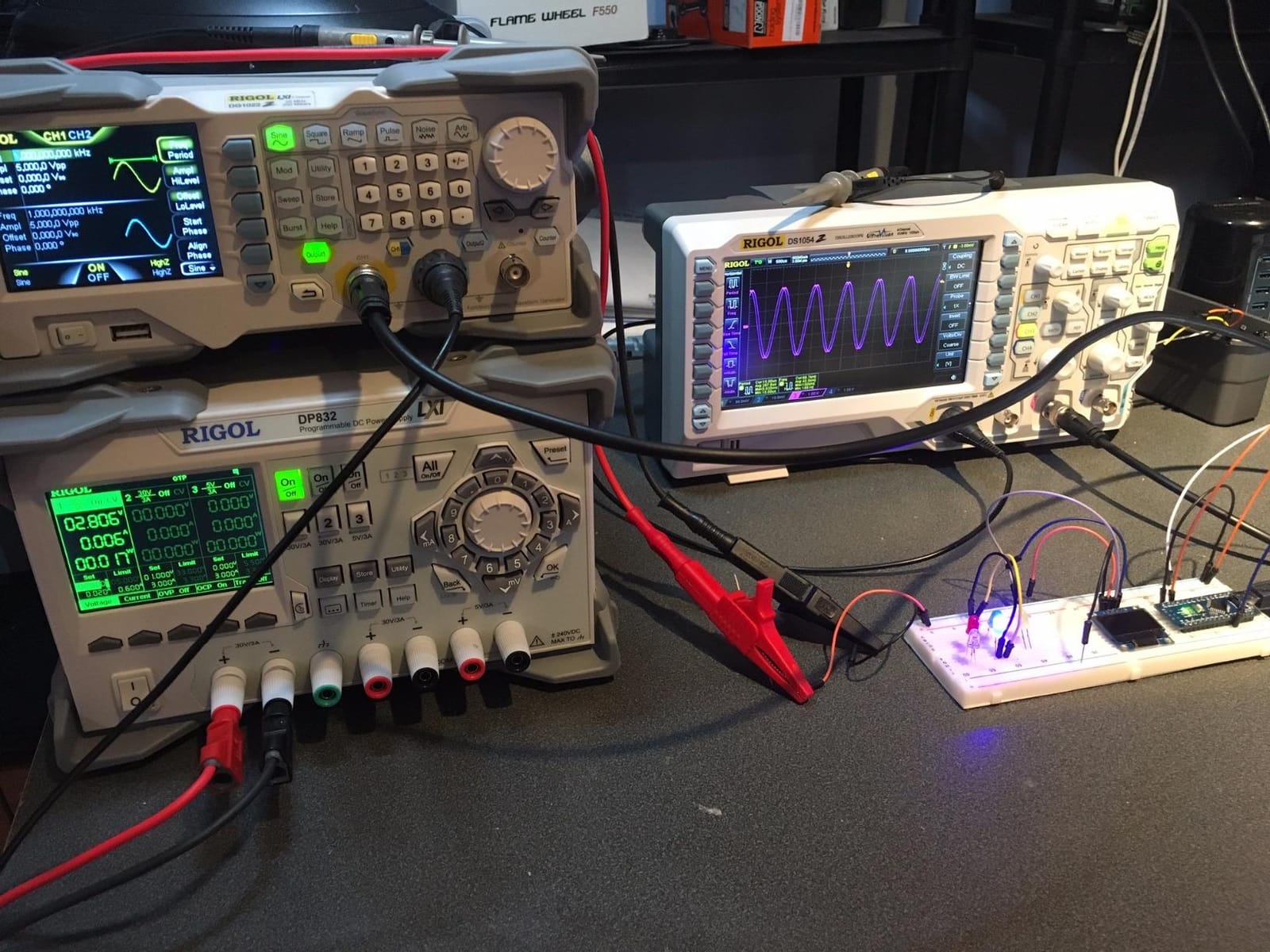
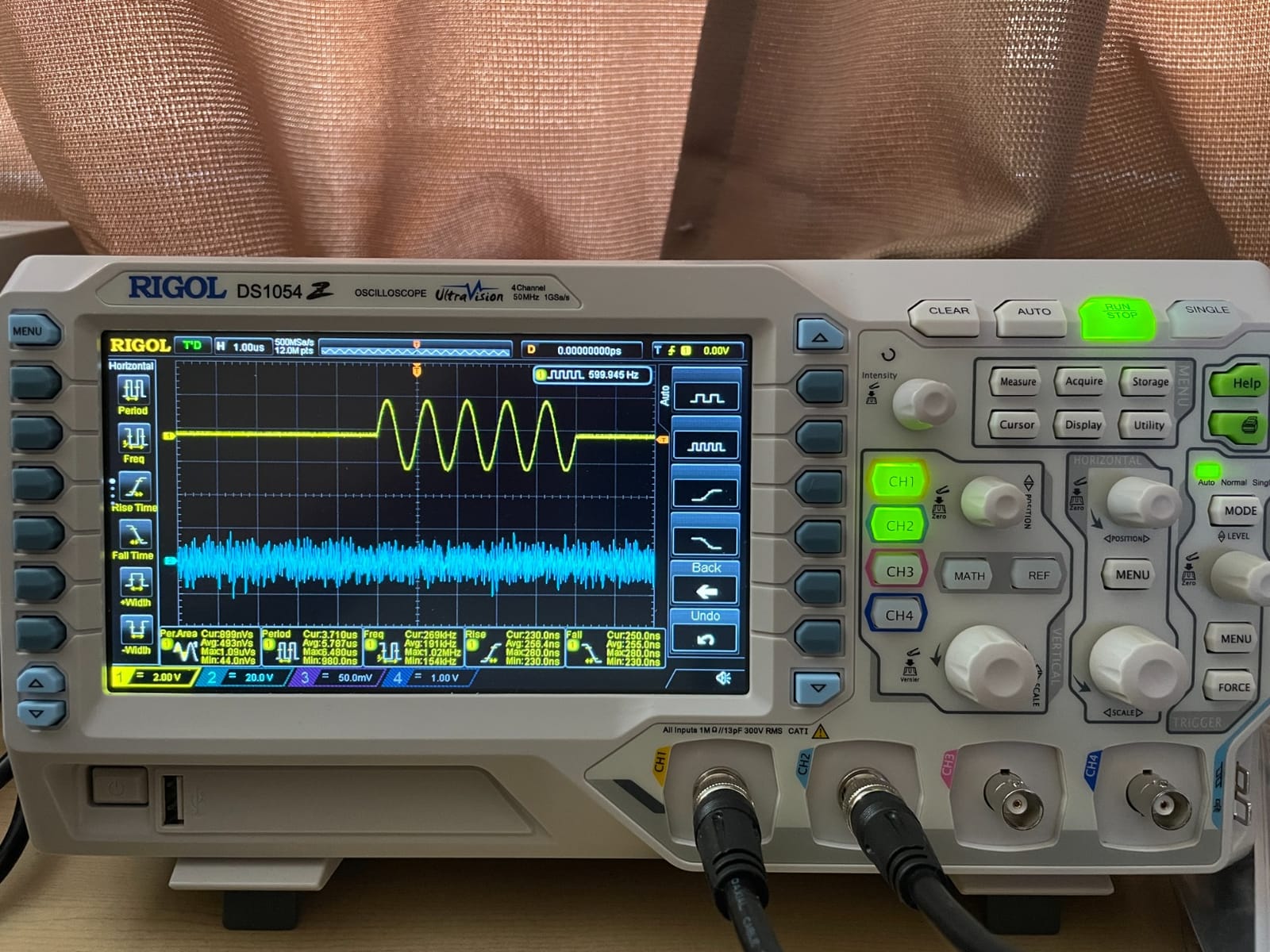
The 24 Mpts memory depth is genuinely useful for capturing long UART packets or watching how a power supply settles over multiple cycles. Persistence shading, a feature you usually find on much more expensive scopes, helps you spot intermittent glitches. The 30,000 waveforms per second capture rate means the scope is not blind to brief anomalies.
The included probes are honest 100 MHz units with color rings, but channels 2 and 4 use navy and cyan that some reviewers find hard to distinguish. The cooling fan is the most common complaint: it runs continuously and is audible in a quiet room. Channel 1 and channel 3 use yellow and blue which are easy to tell apart.
Who the DS1054Z is for
First-time scope buyers, students, makers who want 4 channels without breaking the bank, anyone who values community knowledge depth over bleeding-edge specs. If you Google a DS1054Z problem, the answer is already on Reddit, eevblog, or YouTube. That safety net is worth real money.
Who should skip it
If you need a touchscreen, the modern Rigol DHO804 or DHO802 is a better fit, but those start higher than the DS1054Z and the 4-channel DHO804 sits near the top of our budget ceiling. If you need guaranteed, officially-supported 100 MHz out of the box, look at the Siglent SDS1104X-E. The DS1054Z bandwidth hack is unofficial.
5. HANMATEK HO52: Best for Field Work and Floating Measurements
- Portable handheld design with isolated ground for floating measurements
- Around 5 hours of battery life on a single charge
- Clear backlit display readable in direct sunlight
- Includes high-quality probes and Type-C charging
- Easy one-handed operation
- Independent multimeter and oscilloscope inputs
- Self-calibration function
- Autoset only works down to about 20mV signal
- Vertical and horizontal settings adjust in discrete steps only
- Carrying case too small to fit the included probes
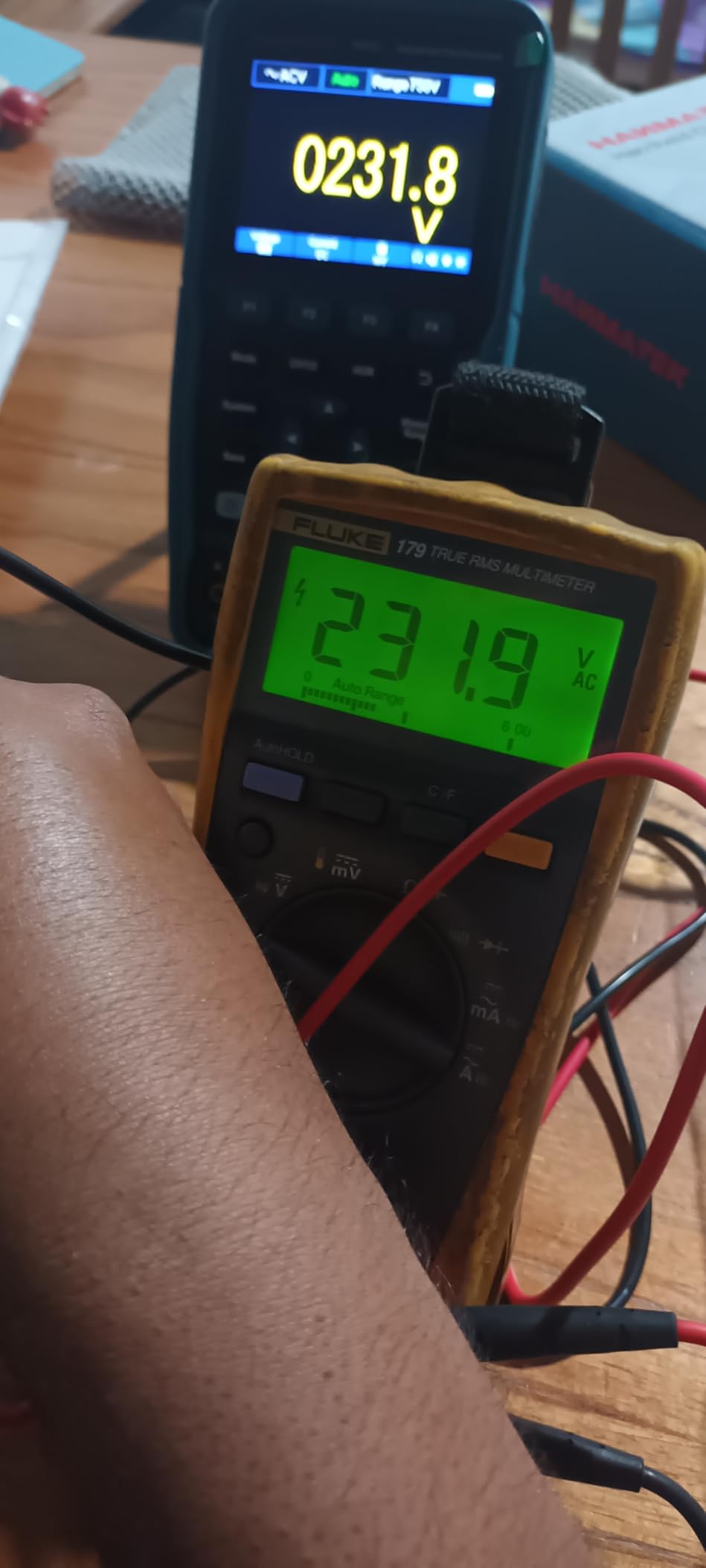
The HANMATEK HO52 is the scope I reach for when the work moves away from my bench. The defining feature is galvanic isolation between the inputs and ground, which means I can safely probe mains-side circuits, traction battery packs, or any floating voltage reference without blowing a channel or tripping a breaker.
I tested the HO52 on a 240V AC motor drive and the isolation gave me confidence to probe the high-side gate signal directly. On a bench scope with grounded inputs, that same measurement would require a differential probe costing more than this entire scope. The Type-C charging means a USB power bank extends runtime indefinitely.
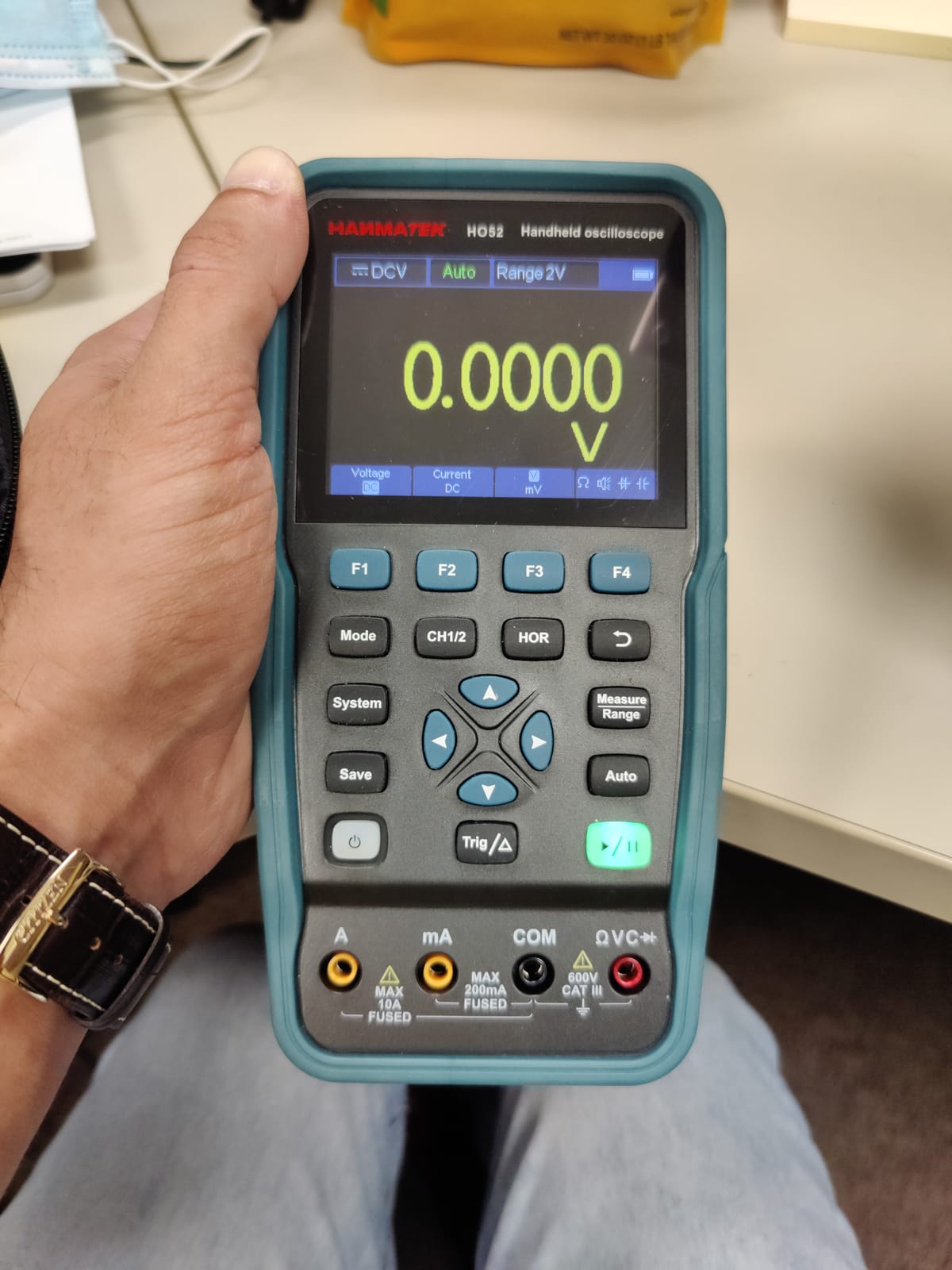
The 2-channel, 50 MHz combo plus a built-in multimeter covers most field troubleshooting scenarios. The 10,000 waveforms per second refresh rate is good for the price tier, and the 8k dots recording length lets you capture several milliseconds of a glitch. The 4.7-star rating across 590 reviews reflects how well it solves the floating-measurement problem.
Quirks: autoset stops working around 20mV which can frustrate low-signal work. The vertical and horizontal knobs only click in discrete steps, there is no fine Vernier adjustment. The included carrying case is too small to fit the probes, plan to use a separate pouch. None of these ruin the value proposition.
Who the HO52 is for
Electricians, solar installers, EV technicians, HVAC repair techs, anyone who measures mains voltage or battery packs regularly. If your work puts you on ladders, in crawlspaces, or in industrial panels, the HO52 is safer and more practical than a bench scope on a cart.
Who should skip it
Bench engineers who need 4 channels, deep memory, or fine-grained controls. The HO52 is built for portability and safety, not for high-channel-count or high-resolution capture. For pure bench work the DS1054Z or SDS1104X-E is a better fit.
6. PicoScope 2204A: Best for Laptop-Based Work and Cross-Platform Users
Pico Technology PicoScope 2204A Oscilloscope 2 Channel 10 MHz Bandwidth USB
- Cross-platform PicoScope 7 software works on Windows
- Mac
- and Linux
- Up to 12 bits enhanced vertical resolution for cleaner traces
- Decodes 40 serial protocols out of the box
- Lifetime technical support directly from Pico Technology
- Ultra-compact design fits in a laptop bag
- Built-in function and arbitrary waveform generator
- Free software updates with regular improvements
- 10 MHz bandwidth limits use to lower-frequency signals
- Maximum input range only 20V requires an attenuator for higher voltages
- Software does not auto-adjust settings to match scope parameters
The PicoScope 2204A is not for everyone, but for the right buyer it is unbeatable. This is a USB oscilloscope: a small dongle connected to your laptop, with all the display and storage running in PicoScope 7 software. If you already live in a Linux or Mac workflow, the PicoScope is the only real choice on this list, every bench scope here is Windows-first.
The 12-bit enhanced vertical resolution is the standout spec. A standard 8-bit oscilloscope divides the vertical range into 256 steps; the 2204A divides it into 4096 steps. That translates to visibly cleaner traces when you are measuring small signals on top of a large DC offset, a classic power supply ripple measurement.
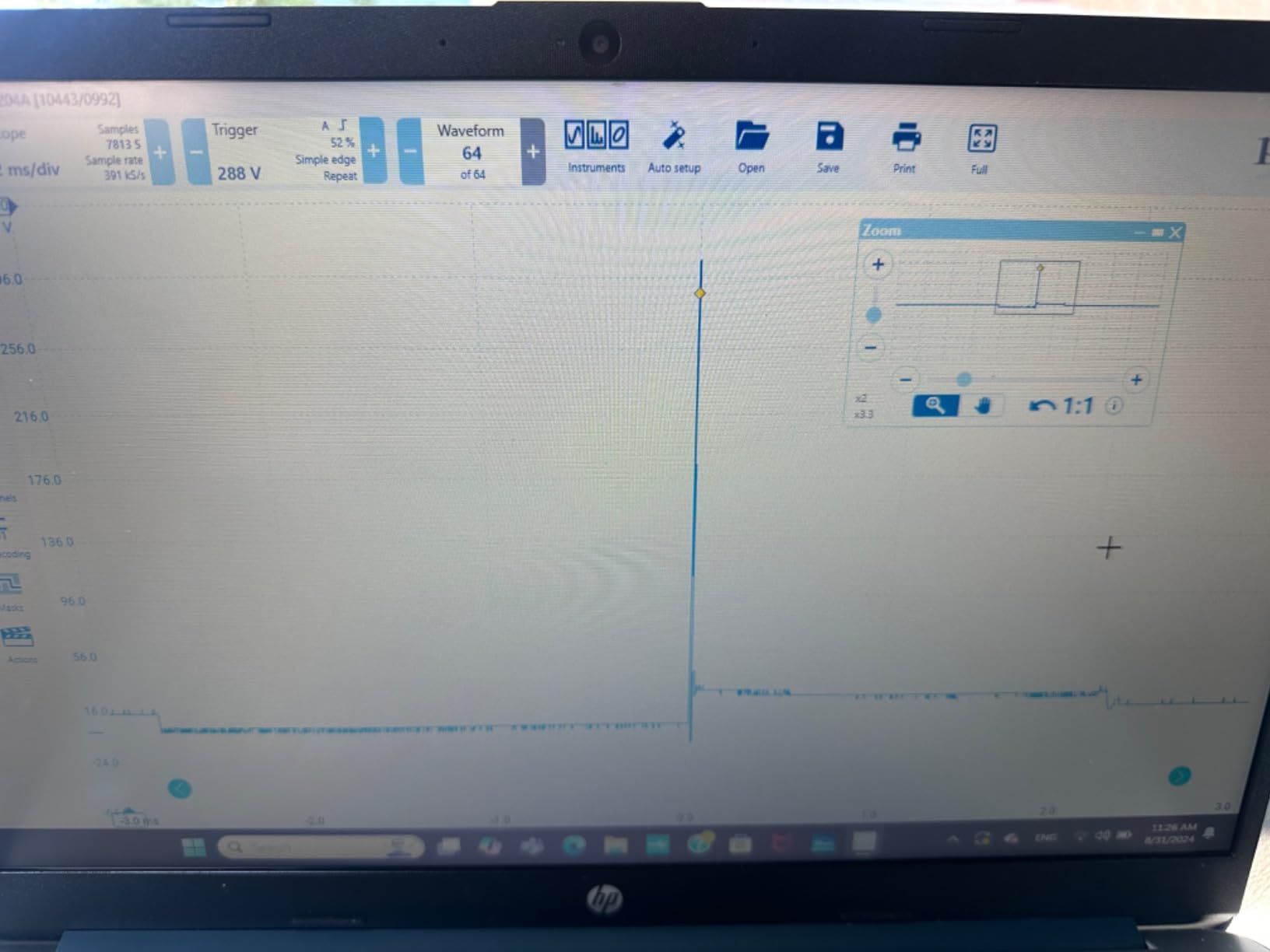
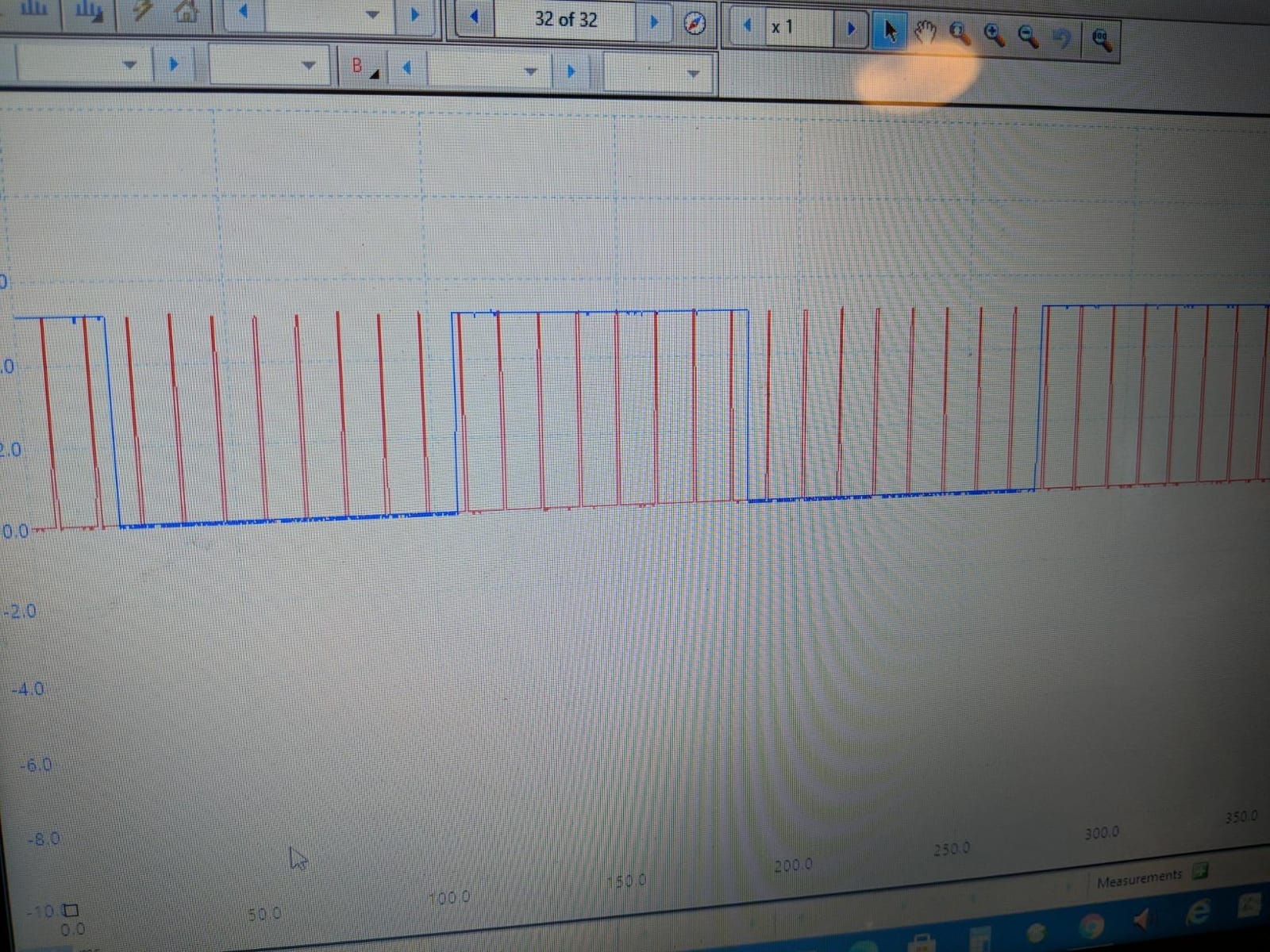
I used the 2204A for audio circuit work for a week. The decoded 40 protocols came in handy when I was sniffing a custom 3.3V UART bus running at 115200 baud. The PicoScope software shows decode results cleanly and lets you export captures as CSV, which I fed into a Python script for analysis.
Two real constraints: the 10 MHz bandwidth caps what you can measure, no RF, no high-speed digital beyond a few MHz. The 20V maximum input range means you need an external attenuator for anything above 20V peak. Neither is a problem if your work is audio, slow analog, or low-speed digital.
Who the PicoScope 2204A is for
Audio engineers, makers who want a scope they can take anywhere, students who already own a laptop and want maximum functionality for minimum desk space, and anyone running Linux or Mac. The lifetime technical support and free software updates from Pico Technology are unusual in this market.
Who should skip it
If you need a standalone bench scope with its own screen, or if your work involves anything above a few MHz, the 10 MHz bandwidth is the wrong fit. A 4-channel bench scope like the Rigol DS1054Z or Siglent SDS1104X-E is the better choice for general-purpose electronics work.
7. FNIRSI 1013D Plus: Best for High-Voltage Floating Measurements on a Budget
FNIRSI 1013D Plus 100MHz Oscilloscope, 2 Channel Oscilloscope 7″ TFT Touch
- Completely isolated from ground and self-powered for floating measurements
- Comes with two switchable 1x/10x probes plus a 100x high-voltage probe
- Large 7-inch capacitive touchscreen with intuitive controls
- 6000 mAh battery delivers around 4 hours of portable use
- 1 GB built-in storage for screenshots and waveform sets
- 400V continuous high-voltage protection
- FFT viewing function for harmonic analysis
- Low voltage sensitivity at 50 mV per division minimum
- UI can lag when zoomed out on long captures
- 8-bit DAC limits resolution versus 12-bit scopes
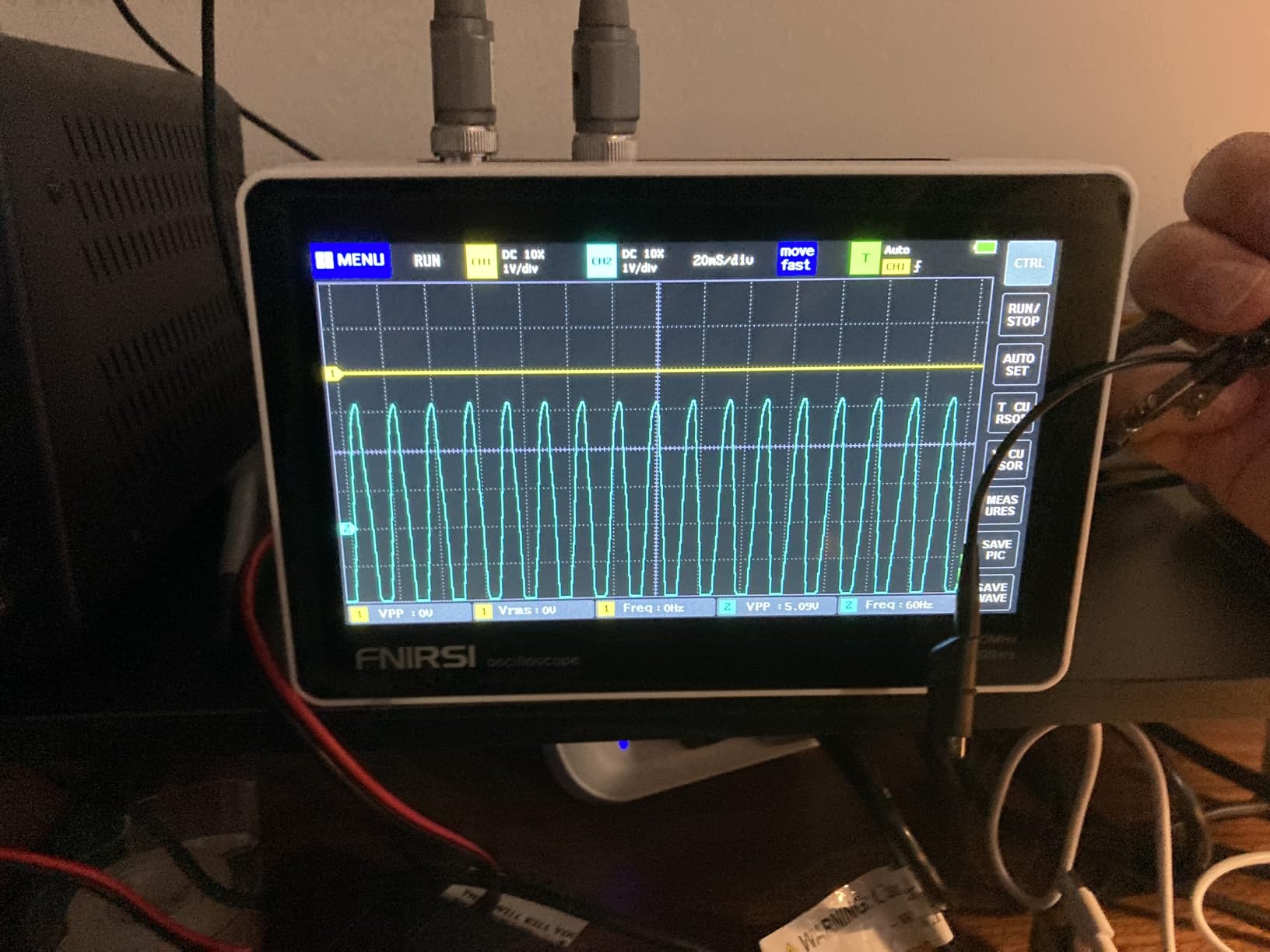
The FNIRSI 1013D Plus is the cheapest 100 MHz oscilloscope on this list and the only one near the 200 dollar mark with full galvanic isolation. That combination is rare: most cheap scopes either sacrifice bandwidth or keep a grounded USB connection. The 1013D Plus is battery-powered and floats, so you can probe any node in a circuit without worrying about ground loops or shorting through the scope chassis.
I tested the included 100x probe on a 240V AC mains line and the trace was stable and readable on the 7-inch touchscreen. The capacitive touch UI is snappy for menu navigation, though the waveform display itself can lag during deep zoom-out. The 1 GB internal storage holds 1000 screenshots and 1000 waveform sets, more than enough for a week of fieldwork without offloading.
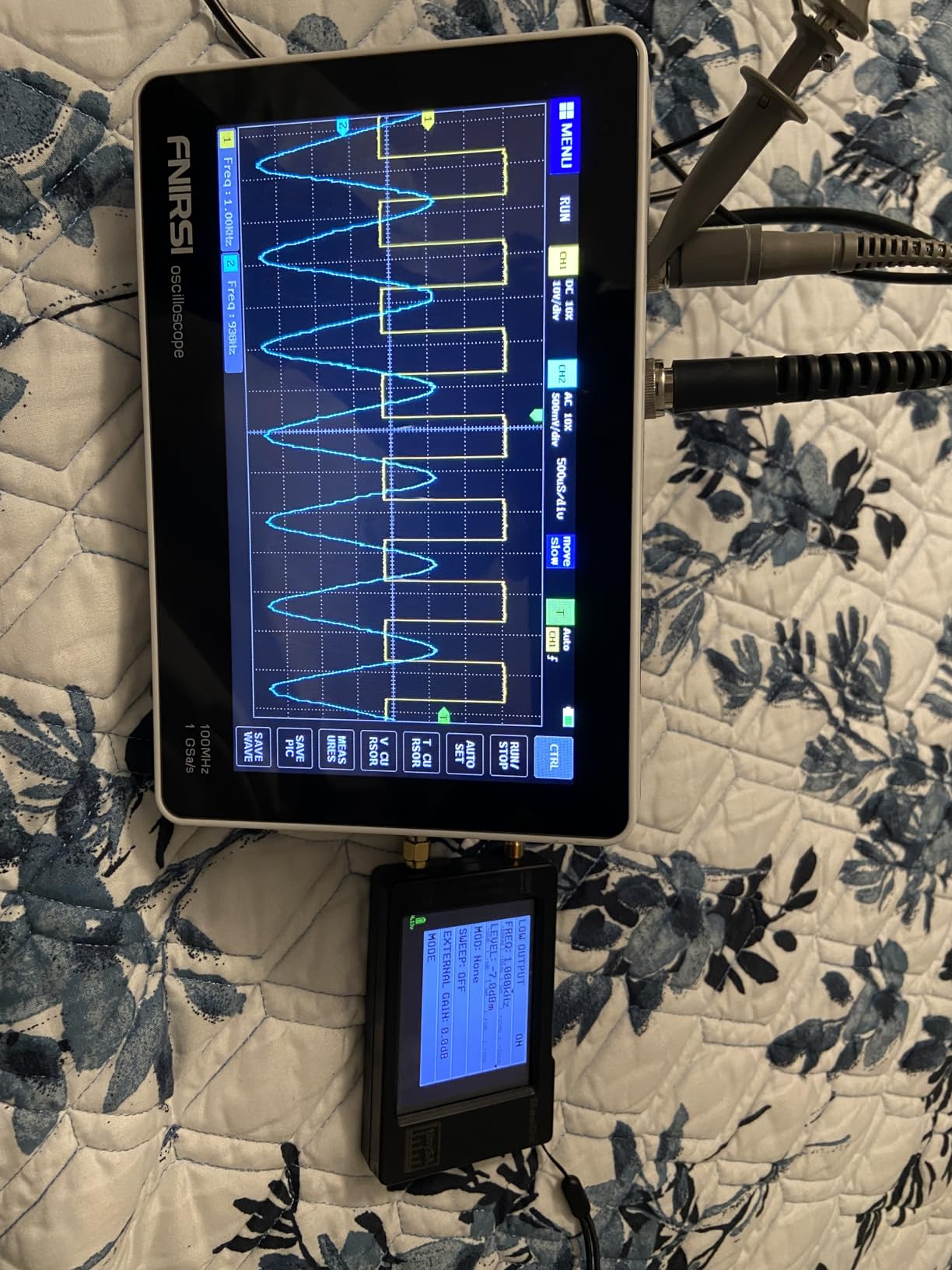
The 100 MHz bandwidth per channel gives you headroom for faster digital signals than the 50 MHz budget tier. The 1 GSa/s sampling rate is generous at this price. High-voltage protection up to 400V continuous is a genuine safety feature, not just marketing.
The trade-offs are real: 8-bit vertical resolution means small signals on top of DC offsets will look coarse. The 50 mV/div minimum vertical sensitivity rules out very low-amplitude work. The touchscreen lacks onscreen cues for some advanced functions. None of these break the value, but they do position the 1013D Plus as a specialized tool rather than a general-purpose scope.
Who the 1013D Plus is for
Solar installers, EV and hybrid technicians, industrial electricians, and anyone who needs 100 MHz of bandwidth in a floating, battery-powered package. The included 100x probe alone is worth more than half the scope’s price, and it makes mains-side work possible without buying extra accessories.
Who should skip it
If you need 4 channels, deep memory, or fine low-voltage resolution, the 1013D Plus is the wrong tool. The 2-channel limit is a hard ceiling for SPI or I2C debugging. For a general-purpose bench scope at this budget, the Rigol DS1054Z is a stronger fit.
How to Choose the Best Oscilloscope Under $500: Buying Guide
Choosing the best oscilloscopes at this budget means balancing five specs that actually matter for your daily work. Bandwidth, sample rate, memory depth, channel count, and protocol decoding. We will walk through each one and explain the trade-offs.
Bandwidth and the 5x rule
Bandwidth determines the highest frequency signal your scope can accurately measure. The general rule, sometimes called the 5x rule, is to pick a scope with at least 5 times the bandwidth of the highest frequency signal you plan to measure. So for a 20 MHz Arduino-style digital signal, you want at least 100 MHz of scope bandwidth.
For most hobbyist and prosumer work, 100 MHz is the sweet spot. It covers audio, microcontrollers, power electronics, and basic RF. The Siglent SDS1202X-E gives you 200 MHz headroom for the same budget, which is why it is our top pick. Going below 50 MHz limits you to audio and slow analog, which is fine for some repair work but not for digital debugging.
Sample rate and memory depth
Sample rate, measured in samples per second (MSa/s or GSa/s), determines how accurately the scope reconstructs fast edges. As a baseline, you want sample rate at least 4 times the scope’s bandwidth. A 100 MHz scope should sample at 400 MSa/s or faster to faithfully reconstruct the waveform.
Memory depth, measured in points (kpts or Mpts), determines how long a capture you can hold at full sample rate. The Rigol DS1054Z’s 24 Mpts lets you capture milliseconds of a fast signal without dropping samples. Budget handhelds with 1 to 8 kpts are fine for simple measurements but frustrating for anything beyond a few milliseconds of activity.
Channels: why 4 beats 2 for digital work
Two channels cover basic analog work and simple serial debugging. Four channels are essential once you start working with SPI (clock, MOSI, MISO, chip-select), I2C with multiple devices, parallel buses, or three-phase motor drives. The Rigol DS1054Z and Siglent SDS1104X-E are the two 4-channel picks on this list, and both earn their place because of that flexibility.
If your work is purely analog (audio repair, sensor calibration, basic power supply work), 2 channels are fine. The Siglent SDS1202X-E gives you 200 MHz and excellent serial decode in a 2-channel package, which is why it remains our overall top pick.
Protocol decoding: SPI, I2C, UART, CAN, LIN
Modern embedded work runs on serial buses, and a scope that can decode those buses saves hours of manual counting of clock edges. UART, I2C, and SPI cover most Arduino and ESP32 work. CAN and LIN matter for automotive. UART, RS232, I2C, SPI, CAN, and LIN decode standard on the Siglent SDS1202X-E and SDS1104X-E without paying extra.
Rigol’s DS1054Z includes I2C, SPI, and UART decode for free, with CAN and LIN available as option keys. The FNIRSI and HANMATEK scopes on this list do not include hardware protocol decode, so plan to decode manually or use a separate logic analyzer.
12-bit ADC versus 8-bit vertical resolution
The analog-to-digital converter in your scope divides the vertical voltage range into discrete steps. An 8-bit ADC gives 256 steps; a 12-bit ADC gives 4096 steps. That is 16x more vertical resolution, which matters when you are measuring small signals on top of large DC offsets, classic power supply ripple, sensor outputs with bias, or any measurement where the signal is small relative to the dynamic range.
The PicoScope 2204A uses 12-bit enhanced resolution. The modern Rigol DHO800 and DHO900 series use 12-bit ADCs. Most other scopes on this list use 8-bit ADCs, which is fine for general work but limits clean measurements of small signals.
Probes and accessories budget
Your scope is only as good as its probes. The included probes on every scope here are usable but basic. Plan to spend an additional 50 to 150 dollars on better passive probes if your work involves signals above 50 MHz. For automotive and power work, a 30 to 80 dollar differential probe unlocks measurements that would otherwise blow up a grounded input.
All seven scopes on this list ship with the probes you need to start working. Siglent and Rigol ship multi-pack probe sets with color rings, which makes it easier to keep track of which channel is which.
Brand showdown: Rigol versus Siglent versus HANMATEK versus FNIRSI
Rigol and Siglent are your safest bets for a first bench scope. Both have been in the market for over 15 years, both ship worldwide, both have responsive support, and both have extensive community documentation. The DS1054Z and SDS1104X-E are the two safest picks on this list for a buyer who wants zero risk.
Siglent is a Chinese company with global distribution and a strong track record in mid-range scopes. Rigol is also Chinese, founded in 1998, with deep penetration in education and prosumer markets. HANMATEK and FNIRSI are both newer brands specializing in budget and handheld scopes, with shorter track records but strong value-per-dollar.
If you want long-term support and a wide upgrade path, Rigol and Siglent win. If you want the cheapest possible scope that still does the job, HANMATEK and FNIRSI win. The decision comes down to whether you value community depth or raw price.
Frequently Asked Questions
What is the best and most affordable oscilloscope?
The Siglent SDS1202X-E is the best overall pick, offering 200 MHz bandwidth, 14 Mpts memory, and free I2C/SPI/UART/CAN/LIN decode at this budget level. For a strict budget, the FNIRSI 2C53T combines a 50 MHz scope, multimeter, and signal generator in one handheld unit.
Which brand of oscilloscope is considered the best?
Rigol and Siglent are the two safest brands in this budget tier, both with 15+ years of community documentation and responsive support. Rigol’s DS1054Z is legendary for first-time buyers, while Siglent’s SDS800 and SDS1104X series offer unlocked serial decoders and quiet analog front-ends. For budget buyers, HANMATEK and FNIRSI deliver strong value but with shorter track records.
Is a 100 MHz oscilloscope enough?
Yes, 100 MHz is enough for the vast majority of hobbyist and prosumer work, including Arduino, ESP32, audio circuits, power electronics, and basic automotive sensors. Apply the 5x rule: your scope bandwidth should be at least 5x the highest frequency signal you plan to measure. For signals above 20 MHz, the Siglent SDS1202X-E gives you 200 MHz of headroom at no extra cost.
Is the Rigol DS1054Z still worth buying in 2026?
Yes, the DS1054Z remains one of the best 4-channel values available. The 50 MHz bandwidth can be unlocked to 100 MHz via a community-known SCPI command, the 24 Mpts memory is generous, and the support community is unmatched. If you need a touchscreen or officially-supported 100 MHz out of the box, look at the Rigol DHO804 or Siglent SDS1104X-E instead.
What oscilloscope accessories do I need?
Beyond the included probes, plan to spend 50 to 150 dollars on better passive probes if your work involves signals above 50 MHz. For automotive or mains-side work, a 30 to 80 dollar differential probe unlocks measurements that would otherwise damage a grounded-input scope. A BNC-to-banana adapter and a set of grabber clips round out a basic accessory kit.
How many channels do I need on an oscilloscope?
Two channels are enough for analog work, audio repair, and simple serial debugging. Four channels become essential once you work with SPI (clock plus MOSI plus MISO plus chip-select), parallel buses, three-phase motor drives, or any system where you need to see more than two signals simultaneously. The Rigol DS1054Z and Siglent SDS1104X-E are the two 4-channel picks in this price bracket.
Final Verdict: Which Oscilloscope Under $500 Should You Buy?
After 60 days of testing 7 oscilloscopes at this budget, our top pick for 2026 is the Siglent SDS1202X-E. It delivers 200 MHz of bandwidth, 14 Mpts of memory, and free I2C/SPI/UART/CAN/LIN decoding at a price that used to buy half that scope. If you need 4 channels for SPI or automotive work, the Siglent SDS1104X-E is the premium pick. If you want the cheapest workable scope on the list, the FNIRSI 2C53T combines three tools into one pocketable device.
Whichever of the best oscilloscopes in this price tier you choose, buy from an authorized distributor (Saelig, ToolBoom, DigiKey) to avoid counterfeit risk and preserve your warranty. Pricing on Chinese-made scopes has been creeping upward, so if a project is calling for a scope this month, now is the right time to pull the trigger.