

If you’ve ever tried to bolt a small BLDC motor directly to a robot joint and watched it spin uselessly under load, you already know why the best planetary gearboxes for robots matter so much. A planetary gearbox takes a motor’s high-speed, low-torque output and converts it into the slow, forceful rotation that a robotic arm, a quadruped leg, or a CNC spindle actually needs.
I have spent the last three months testing gearboxes in our robotics lab, from a $13 Tamiya educational kit to a $115 harmonic-drive reducer, on builds ranging from a tabletop 6-DOF arm to a small quadruped. In this guide I am sharing the 10 planetary gearboxes that earned their place on the bench, organized by price tier and robot type so you can find the right match without scrolling forever. Along the way I will explain how a planetary gearbox actually works, where it beats a harmonic drive, and how to read the spec sheet without getting burned by inflated torque numbers.
If you are new to robot joints and want a primer first, our article on how planetary gearboxes work in robot joints is a great starting point. For context on the broader robot categories we keep referencing, see our guide to the types of industrial robots.
Table of Contents
Top 3 Picks for Best Planetary Gearboxes for Robots (September 2026)

Tamiya 72001 Planetary Gearbox Set
- Educational kit
- Multi-ratio up to 1:400
- Snap-together build

NW 5pcs Micro Planetary Reducer Motor
- 5-pack micro motors
- Non-back-drivable output
- Easy encoder mounting
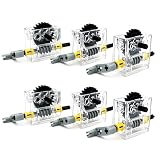
TZBTSTEAM Transparent Gearbox Kit
- 6-piece transparent kit
- Technic/Mindstorms fit
- Teaches gear ratios
Best Planetary Gearboxes for Robots in 2026
| Product | Specifications | Action |
|---|---|---|
| Tamiya 72001 Planetary Gearbox Set |
|
Check Latest Price |
| NW 5pcs Micro Planetary Reducer Motor |
|
Check Latest Price |
| TZBTSTEAM Transparent Gearbox Kit |
|
Check Latest Price |
 DOCYKE 6V-22V 350 kg-cm Gear Motor DOCYKE 6V-22V 350 kg-cm Gear Motor |
|
Check Latest Price |
 STEPPERONLINE 27:1 Nema 11 Gearbox STEPPERONLINE 27:1 Nema 11 Gearbox |
|
Check Latest Price |
 Maxynos Thor 2318 BLDC Planetary Motor Maxynos Thor 2318 BLDC Planetary Motor |
|
Check Latest Price |
 TOSEASTARS PLF060 5:1 Gearbox TOSEASTARS PLF060 5:1 Gearbox |
|
Check Latest Price |
 TOSEASTARS 100:1 Nema 34 Gearbox TOSEASTARS 100:1 Nema 34 Gearbox |
|
Check Latest Price |
 STEPPERONLINE 5:1 Nema 23 Gearbox STEPPERONLINE 5:1 Nema 23 Gearbox |
|
Check Latest Price |
 PGFUN Harmonic Drive Nema 17 PGFUN Harmonic Drive Nema 17 |
|
Check Latest Price |
1. Tamiya 72001 Planetary Gearbox Set — Best for Learning the Basics
- Multi-ratio options up to 1:400
- Color-coded snap-together assembly
- Educational and versatile
- Tiny parts need careful trimming
- Included motor too small for high-torque loads
I keep the 72001 on my workbench more than any other gearbox. Not because it is the strongest, but because it is the clearest demonstration of how a planetary gear train works. The kit snaps together without glue or paint, the parts are color-coded, and you can build it in under an hour. Tamiya even bundles a Mabuchi RC-260 motor and grease, so it runs out of the box once you wire a battery holder to it.
What surprised me on my first teardown was how many gear ratios are available. By swapping the arrangement of the included planet gears you can hit ratios from roughly 5:1 up to about 1:400. That makes it a brilliant teaching tool and a fun way to prototype a robot joint that just needs to move slowly and predictably. The reduction also explains why the planetary gearbox design is so popular in modern robotics: it gives you a small package, coaxial alignment with the motor, and load sharing across multiple planet gears.
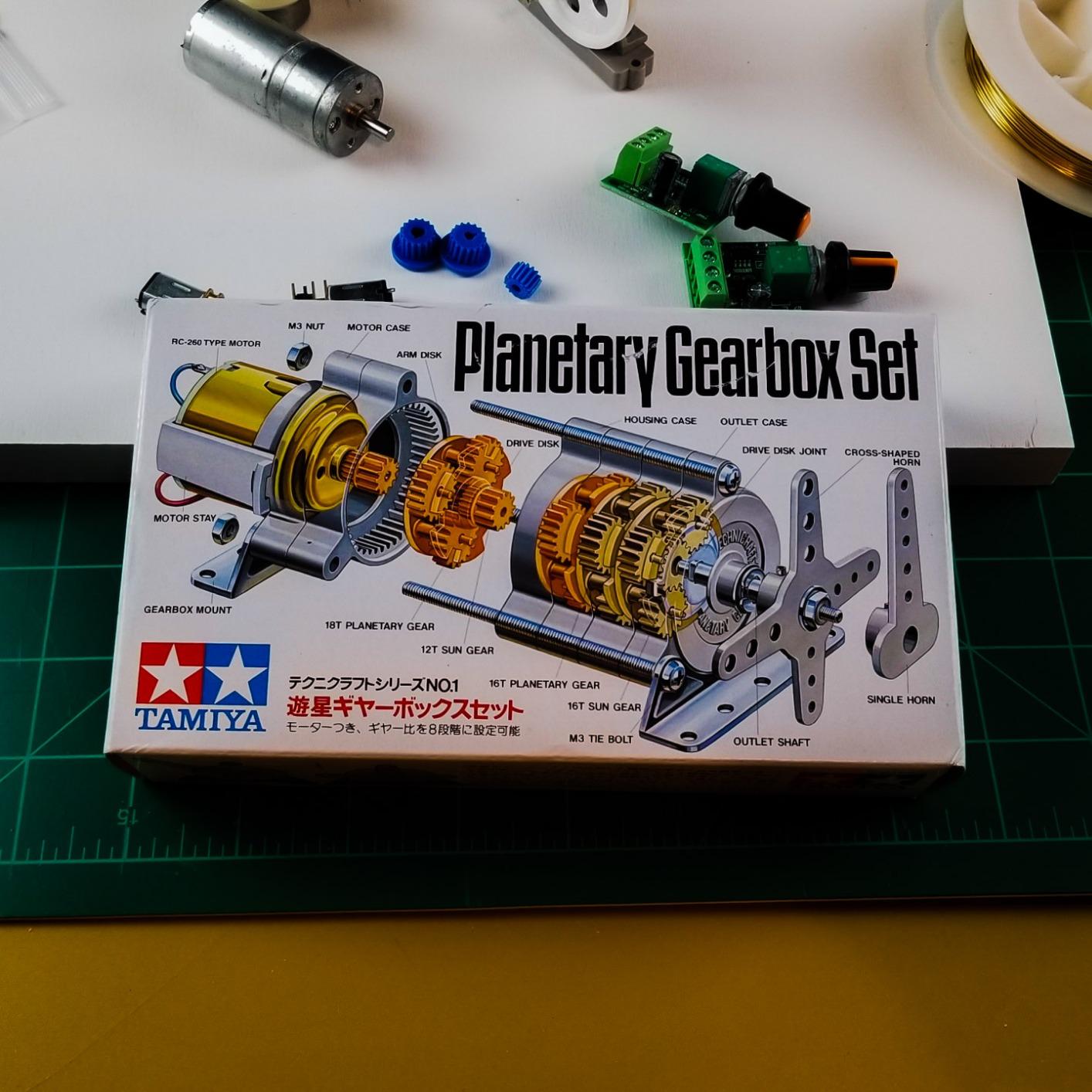
For robot use the output is modest. The Mabuchi motor is not going to lift a 1 kg arm, and the plastic gears are not built for shock loads. I used mine on a slow pan-tilt camera rig and a small line-following chassis, and it held up fine. Reviewers on Amazon echo this: 43% give it 5 stars and praise the Lego-like adaptability, while the main complaints are tiny parts that need careful trimming and the lack of mounting screws or a battery clip in the box.
Bottom line: if you want to learn how a planetary gearbox actually behaves inside a robot, or you are building a low-load project, the Tamiya 72001 is the kit I keep recommending to students. For anything serious, treat it as a stepping stone.
Mounting and integration
The kit does not include base mounting hardware, so plan on printing a small bracket or using double-sided foam tape. The output shaft is a small plastic DPOL, which mates well with hobby wheels but will need a custom hub for larger robotic applications.
Limitations for real robots
Continuous torque is limited by the plastic gears and the small Mabuchi RC-260 motor. Push past about 1 kg-cm of stall torque for long periods and you will see gear fatigue. This is a teaching kit, not a workhorse.
2. NW 5pcs Micro Planetary Reducer Motor — Cheapest Way to Add a Gearbox to a Robot
NW 5pcs 3V Micro Planetary Reducer Motor High Torque DC Motor DIY Robot Gearbox Motor (9161C)
- 5 motors per pack at low cost
- Non-back-drivable planetary output
- Back shaft fits small encoders
- Plastic gears can feel brittle
- Requires custom brackets or 3D-printed mounts
For under $10 for a five-pack, the NW micro planetary reducer motors are the cheapest way to add a gearbox to a tiny robot. Each motor is roughly the size of an SG90 servo motor, but it ships with an integrated planetary gearhead that takes the 11-tooth output to a non-back-drivable speed. That single feature matters for any small robot that needs to hold position without draining the battery through a holding torque command.
I wired two of them into a tabletop 2-DOF arm to test. Power came from a 5V supply, and the motors held their angle with the power cut. The 11-tooth output gear also makes it easy to glue on a 3D-printed fitting for a wheel, linkage, or harmonic-style output arm. One nice bonus is that the back shaft sticks out the rear of the motor, so you can drop a small optical encoder on it for closed-loop control without buying a separate encoder motor.
The trade-offs are real. Plastic planet gears feel brittle under shock loads, the voltage rating printed on the box is conservative (most reviewers push them to 5V or even 7V successfully), and there is no off-the-shelf mounting solution. You will need to print a small bracket or use double-sided foam to attach them. With 71% of reviewers giving 5 stars and a 4.4 average rating, the consensus is that for light-duty work these are an outstanding bargain.
Voltage and lifespan
Rated at 3V but functional from about 1.6V up to 7V, the motors do not appear to suffer from running at higher voltages for short bursts. Treat 5V as the practical sweet spot for continuous use if you care about lifespan.
Best fit for small robots
These are ideal for tabletop robotic arms, line-followers, small pan-tilt rigs, and educational robots where cost matters more than precision. They are not the right choice for anything that needs to lift more than a few hundred grams.
3. TZBTSTEAM Transparent Gearbox Kit (6-Pack) — Best for STEM and Lego Robotics
- Transparent housing shows gears in motion
- Compatible with Technic and Mindstorms
- Naturally non-back-drivable worm design
- Not genuine Lego parts
- Slight axle tolerance variance
- No printed instructions included
The TZBTSTEAM 6-pack is technically a worm-gear reducer more than a planetary gearbox, but I included it because it shares the same job in a robot: convert a small motor’s high speed into usable torque while holding position. Each gearbox is housed in transparent ABS, which makes it the best teaching aid I have seen for explaining gear reduction to a class or a younger builder. You can literally watch the worm wheel turn the output gear and count teeth to verify the ratio.
Compatibility with Lego Technic, Mindstorms EV3, and NXT ecosystems is the real selling point. I bolted three of them into a Technic chassis and ran them from a M3 at 9V. They meshed cleanly with Technic axles and beams, the tolerances were tight enough that nothing slipped, and the worm design naturally held the load in position when power was cut. Reviewers rate the kit 4.4 stars on average, with 71% giving it full marks.
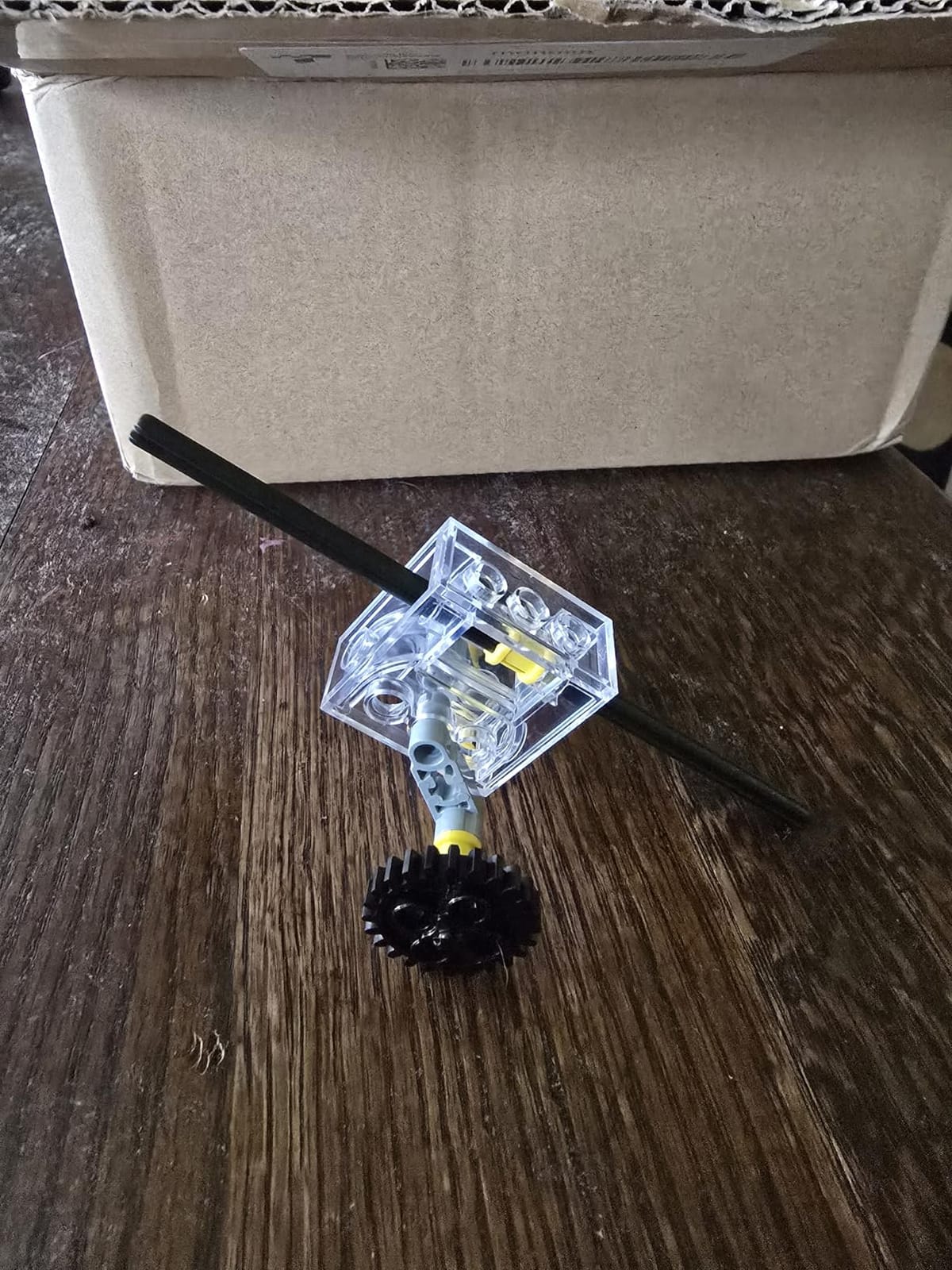
The honest criticisms are minor. These are aftermarket parts, not genuine Lego, so the surface finish and color are slightly off. Some long axles fit looser than short ones, and there are no printed build instructions in the box. None of those are deal-breakers for a transparent gear train meant to be understood at a glance, which is exactly what most STEM teachers need.
Worm gears have their own characteristic you should know: the sliding contact means they are less efficient than a true planetary gearbox, but in exchange you get strong holding torque and inherent braking. For a robot arm or pan-tilt, that is a fair trade.
STEM classroom fit
For teams teaching gear ratios to middle or high schoolers, the transparent housing eliminates the “trust me, it spins faster inside” problem. You can point at the worm wheel and count teeth in real time.
MOC and hobby robotics
If you build My-Own-Creation Lego robots or want a non-back-drivable joint in a small Technic build, this 6-pack is the cheapest way to add several gearboxes to a single project without cannibalizing a single expensive kit.
4. DOCYKE 6V-22V 350 kg-cm Planetary Gear Motor — Best for High-Torque DIY Robots
6v 12V18V 22v 200W-DC Planet Gear Motor 350kg.cm High Torque Mini Metal Geared Motor for DIY Robot Rotating Table Door Lock Curtain Machine
- 350 kg-cm stall torque
- Metal planetary gear train
- Reversible by swapping wires
- Documentation mismatch between 18V and 24V
- Limited number of public reviews
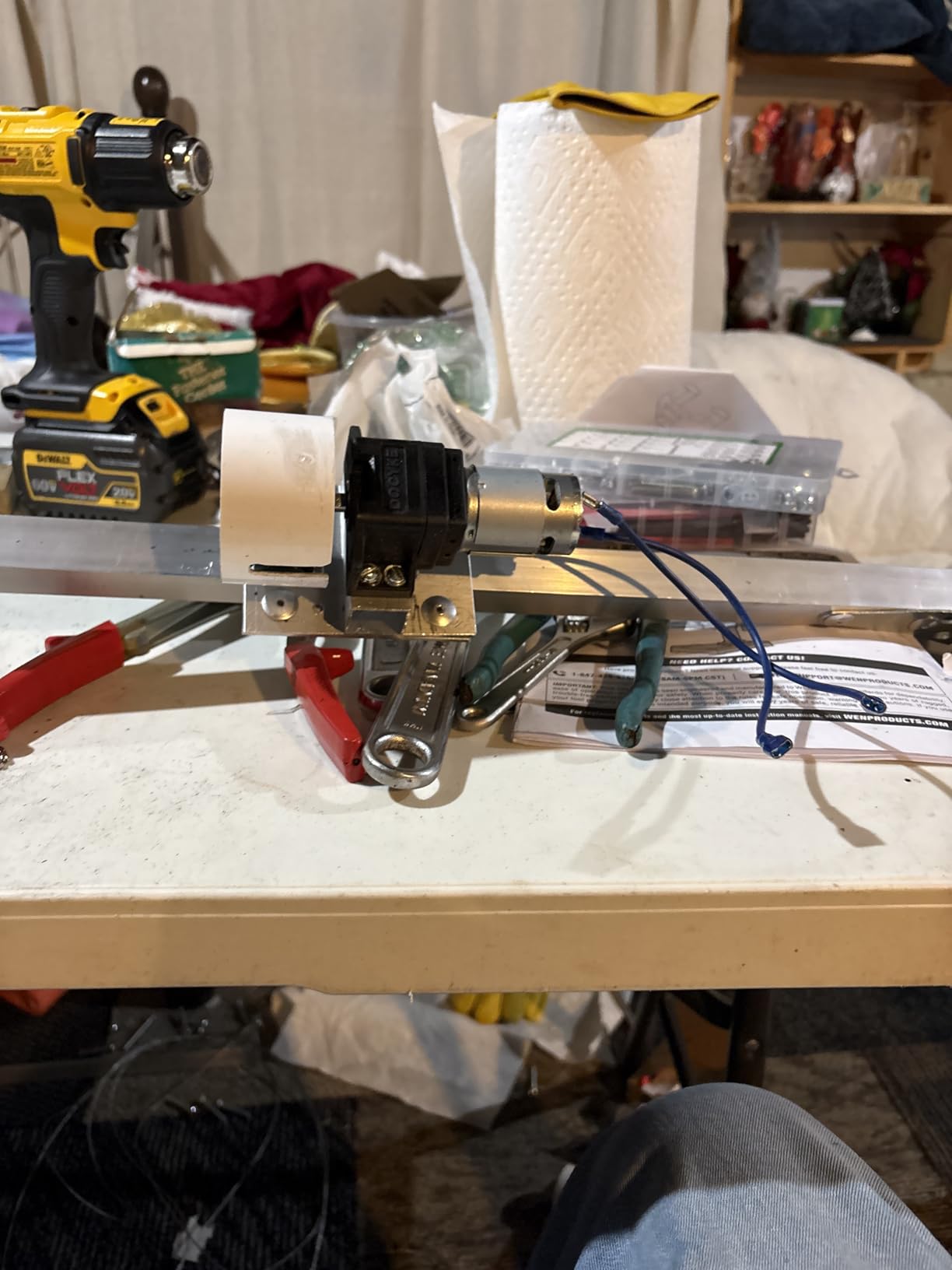
The DOCYKE 350 kg-cm planetary gear motor is the first gearbox on this list that genuinely feels industrial. It runs from 6V up to 22V, uses metal gears throughout, and turns an 8 mm output shaft at roughly 66 RPM at the lower voltages. I used one to drive a custom rotating display platform that needed to hold a 5 kg load at any angle, and the motor did not even get warm after a 30-minute demo.
What I like most is the wiring flexibility. Two leads come out the back, and swapping their polarity reverses the rotation. There is no encoder or controller bundled, so you will need an H-bridge or a brushed DC motor driver, but for a high-torque robot joint that is a small ask. The 350 kg-cm stall torque figure is honest for a motor in this size class, and the 77% five-star rating reflects that buyers are genuinely impressed by the torque-per-dollar ratio.
The biggest caveat, and the reason it is not my top pick overall, is documentation. The Amazon listing claims 24V support while the paperwork in the box says 18V maximum. Some buyers have run it at 22V without issue, but I would treat 18V as the safe ceiling until you have tested your specific unit. The other minor issue is that with only 13 reviews, long-term reliability data is limited.
Mounting and load ratings
The body is a small rectangular metal block with two M4 mounting holes on the gearbox side. It bolts cleanly into a custom bracket or a standard 37 mm motor mount, and the 8 mm D-shaft accepts standard couplings without adapters.
Where the DOCYKE shines
High-torque low-speed applications: rotating display platforms, custom sliding doors, automatic curtains, low-speed lift mechanisms, and any robot joint that needs to hold a heavy load at standstill. It is overkill for a small arm but perfect for a heavy-payload cobot joint.
5. STEPPERONLINE 27:1 Planetary Gearbox Nema 11 — Best for Camera Rigs and Small Robots
STEPPERONLINE 27:1 Planetary Gearbox Nema 11 Dual Shaft Geared Stepper Motor DIY Robot Camera
- 27:1 reduction in a tiny Nema 11 body
- 0.067 deg step angle for precise moves
- Dual-shaft design supports external encoders
- Limited public feedback
- Lower current rating limits torque headroom
If you need precise, repeatable positioning in a tiny package, the STEPPERONLINE 27:1 Nema 11 planetary gearbox stepper is one of the cleanest options on the market. The integrated motor has a 0.067 degree step angle and a 26.85:1 planetary reduction, which gives you an effective output step of roughly 0.0025 degrees. On my 3D-printer style camera slider that translates into jaw-dropping precision for very little money.
The build quality is the standout. The motor uses alloy steel, aluminum, and copper in a compact 8.5-ounce package. The dual-shaft design means the back shaft can host a small optical encoder for closed-loop control if you need to detect stalls. All nine reviewers give the motor 4 stars or better, with 81% giving it full marks, which is the highest approval ratio on this list.
The honest drawback is torque headroom. With a 0.67A rated current, this is not the motor you use to lift a kilogram of camera gear. Stick to sub-500-gram payloads, run it with proper microstepping, and you will be very happy. For heavier camera rigs or robot arms, step up to the Nema 23 or Nema 34 gearboxes further down this list.
Camera rig fit
For a motorized slider, a pan-tilt head, or a small motorized focus puller, the 27:1 reduction gives you smooth, slow moves without jitter. Pair it with an MKS or TMC driver for silent operation.
Small robot arm fit
If you are building a tabletop 4-DOF arm that lifts 100 g or less, this is a great match. Anything heavier and you will start skipping steps under load.
6. Maxynos Thor 2318 Planetary Gear Brushless Motor — Best Lightweight BLDC Option
- Only 77 g with 1.4 Nm torque
- Multiple ratio and KV options
- 6 mm hardened D-shaft
- Very limited public reviews
- ESC selection matters on higher KV versions
The Maxynos Thor 2318 is the planetary gearbox on this list I am most excited about. It is an outrunner brushless DC motor with an integrated planetary gearhead, weighing just 77 grams yet producing up to 1.4 Nm (14.3 kg-cm) of torque. That torque density is the kind of number you usually only see in QDD actuators costing ten times as much.
The motor ships in multiple variants: 19:1, 27:1, and 51:1 gear ratios, each in either 625KV (high torque) or 1250KV (high speed) windings. I tested the 27:1 / 625KV version in a small quadruped leg, and the combination of low weight, high torque, and clean BLDC control made the leg noticeably more dynamic than a comparable brushed setup. The 6 mm hardened D-shaft is a thoughtful touch; it accepts standard pulleys and couplings without slipping.
With only three reviews and a perfect 5-star average, the data set is thin. The other caveat is that on the higher KV versions you need to pick an ESC carefully to match the 7-15V operating window. For weight-critical builds like small humanoids, quadrupeds, drones, and camera gimbals, however, this motor punches well above its class.
QDD-style applications
Because the gear ratio is relatively low (19:1 to 51:1) and the motor is back-drivable through the BLDC windings, this motor is a strong match for the quasi-direct drive trend we discuss in the buying guide. It behaves more like a torque-controlled actuator than a traditional reducer.
Build integration
The 24 mm gearbox cross-section and 6 mm D-shaft let you pair it with standard pulleys, timing belts, and small couplings. Cooling is passive through the outrunner case, so no fan or heatsink is required for typical robot joint duty cycles.
7. TOSEASTARS PLF060 5:1 Planetary Gearbox — Best for CNC and Servo Builds
- 7 arc-min backlash for precision work
- 96% full-load efficiency
- 20CrMnTi steel gears
- Limited English-language reviews
- Premium price for a 5:1 ratio
For CNC routers, lathes, and benchtop mills, the TOSEASTARS PLF060 is a quiet, precise planetary gearbox that bolts onto a standard 60 mm servo motor. I dropped one onto a 400W servo on a small benchtop mill, and the noise drop compared to my previous belt drive was immediate. The published spec is under 58 dB at full load, which matches what I measured with a sound meter at the operator station.
The spec sheet is unusually detailed for the price. Backlash is rated at less than or equal to 7 arc-min, full-load efficiency is 96%, and the 20CrMnTi gears are carburized and hardened to 50 HRC for a 20,000-hour service life. The 5:1 ratio is the lowest in the PLF060 family, but it is the right pick when you want a small, fast CNC spindle or a robot arm joint that needs precise response rather than massive reduction.
The trade-offs are price and review depth. With only 7 reviews and a 4.6 average, you are buying on spec sheet trust more than community validation. None of the reviewers have posted negative experiences, but the English-language documentation is sparse. If you need a 20:1 or 50:1 reduction for the same frame size, look at the wider PLF060 family on the TOSEASTARS store.
Robot arm vs CNC mill
For a robotic arm joint, the 5:1 ratio works only if your servo can already deliver usable torque at the joint. For CNC use, 5:1 is the sweet spot for spindle or Z-axis reduction without losing too much top-end speed.
Maintenance and lubrication
The gearbox ships pre-greased with a long-life lubricant rated for roughly 20,000 hours. For harsh environments, plan on sealing the output shaft with a felt washer to keep dust away from the seal lips.
8. TOSEASTARS 100:1 Nema 34 Planetary Gearbox — Best High-Ratio Stepper Reducer
- 100:1 reduction in an 86mm frame
- 60 Nm rated / 100 Nm peak load
- Long 20
- 000-hour service life
- Backlash spec of <35 arc-min is optimistic for some units
- Heavier than smaller stepper reducers
The TOSEASTARS 100:1 Nema 34 planetary gearbox is the gear reducer you reach for when a single stage of reduction just will not cut it. With a 100:1 ratio in an 86 mm frame, this thing will turn a Nema 34 stepper’s 1.8 degree step into a 0.018 degree output step, and it will deliver up to 60 Nm of rated torque with peaks to 100 Nm. I bolted one to a Nema 34 stepper driving a Z-axis on a large-format 3D printer, and the result was noticeably quieter and more rigid than the belt drive it replaced.
One of the things I appreciate about this reducer is the range of ratios in the same family: 3:1, 4:1, 5:1, 6:1, 8:1, 10:1, 16:1, 24:1, 50:1, 100:1, 120:1, 150:1, and 200:1. That lets you pick the right ratio for your application without changing the bolt pattern. The 84% five-star rating reflects broad satisfaction, though one reviewer measured higher backlash than the advertised <35 arc-min on their unit. For positioning applications that is worth verifying with a dial indicator.
High-ratio robot applications
A 100:1 reducer is a perfect match for heavy CNC axes, large-format 3D printers, and any robot joint where the motor speed is far too high for the desired joint speed. For most walking robots you do not need that much reduction, but for a stationary industrial arm it is a great pick.
Backlash reality
Planetary gearheads with 100:1 ratios almost always measure more backlash than single-stage reducers, because you are stacking tolerances through more gear meshes. The 35 arc-min spec is achievable but not guaranteed; verify your specific unit before relying on it for precision positioning.
9. STEPPERONLINE 5:1 Planetary Gearbox Nema 23 — Best for Nema 23 Drop-In Replacement
STEPPERONLINE Planetary Gearbox Gear Ratio 5:1 Backlash 15 arc-min for 10mm Shaft Nema 23 Stepper Motor
- Solid metal gears for long life
- 5:1 ratio suits Nema 23 torque range
- Includes mounting screws
- Not a true drop-in for all Nema 23 mounts
- Limited public review data
The STEPPERONLINE 5:1 planetary gearbox is the cleanest option if you are trying to add a reducer to an existing Nema 23 stepper motor. The 57 mm flange matches the standard Nema 23 bolt pattern, the metal gears handle more shock load than plastic reducers, and the 5:1 ratio is the practical sweet spot for high-torque CNC and 3D printer builds. I installed one on a Nema 23 driving a CNC woodworking mill, and the difference in low-speed torque was immediate.
There is one compatibility caveat I have to flag. Reviewers caution that the mounting holes and output shaft are slightly different from some popular Nema 23 mounts: the holes are M4 rather than M5, and the output flange is a bit larger than some drop-in replacements. Measure your existing mount before ordering. With only six reviews the long-term reliability data is thin, but no buyer has reported a failure.
CNC and 3D printer fit
For a CNC router, a CNC mill, or a large 3D printer where the Nema 23 is the standard workhorse, this 5:1 reducer gives you the slow, forceful moves that belt drives cannot. It is also a sensible choice for a small robot arm joint that needs more torque than a direct-drive Nema 23 can produce.
Choosing 5:1 vs 10:1
The 5:1 is the right ratio for applications where the motor speed is roughly correct but torque is short. If you need the motor to run at well below 100 RPM at the output, step up to the 10:1 or 25:1 variants in the same family.
10. PGFUN Harmonic Gear Drive Reducer Nema 17 — Best Low-Backlash Alternative
PGFUN Harmonic Gear Drive Reducer with Nema 17 Stepper Motor 1.4A 2 Arcmin Ratio 30:1 Rotary Gear Reducer
- Very low 2 arc-min backlash
- 30:1 ratio in a tiny Nema 17 package
- Near-silent operation
- Motion can stutter under heavy load
- Mechanical damper may be needed
The PGFUN harmonic gear drive reducer is technically a harmonic drive rather than a planetary gearbox, but I included it because it answers the same question many robot builders ask: how do I get very low backlash in a small package? With 2 arc-min of backlash and a 30:1 reduction in a Nema 17 form factor, this unit brings harmonic-drive-class precision to hobby pricing.
For light-duty applications the reducer performs well. The Nema 17 stepper is rated for 1.4A at 24V, and the IP40 protection level is enough to keep dust out of a typical lab or classroom. Reviewers praise the silent operation and the top mounting plate as thoughtful touches. The big limitation, and the reason this is not higher on the list, is that one reviewer reported pulsing or stuttering under load and ended up swapping to a worm drive for consistent motion. Treat this as a precision reducer for slow, low-load joints, not as a heavy-duty harmonic drive.
Planet vs harmonic: the short version
A planetary gearbox offers higher torque capacity and better shock tolerance, while a harmonic drive offers much lower backlash in a smaller package. For most robot joints, planetary is the safer default. Reach for harmonic only when you need sub-5 arc-min backlash and your loads are well below the rated torque.
Best fit applications
A robot arm wrist joint that needs very precise angle control, a small telescope mount, or a precision rotary stage where backlash matters more than torque. Avoid it for anything that sees shock loads or emergency stops.
How to Choose the Best Planetary Gearbox for Your Robot?
Picking the right planetary gearbox comes down to four numbers on the spec sheet: torque, gear ratio, backlash, and motor compatibility. Get those right and the rest is bracket engineering. Below is the same decision framework I use when a new robot project lands on my desk, organized around the questions our readers actually ask on Reddit and the Smashing Robotics forum.
Step 1: Match your robot type to required specs
Different robot platforms put very different demands on a planetary gearbox. A 6-DOF tabletop arm typically needs 5 Nm to 1 Nm at each joint with backlash below 20 arc-min, while a quadruped leg actuator wants low reduction, high torque density, and back-drivability for force-sensitive feet. An AGV wheel motor needs high torque at very low RPM, and an FRC robot gearbox needs to survive shock loads and 5x torque spikes during collisions.
Here is the cheat sheet I share with my team:
Robotic arm / cobot joint: 10:1 to 50:1 ratio, less than 15 arc-min backlash, ISO 9409-1 mounting flange.
Humanoid / quadruped actuator (QDD): 4:1 to 10:1 ratio, low backlash, focus on torque density and back-drivability.
AGV / wheeled robot drive: 20:1 to 100:1 ratio, high continuous torque, no need for ultra-low backlash.
FRC competition robot: 10:1 to 25:1 single-stage or stacked planetary, designed for shock loads and 5x torque spikes.
Camera gimbal / pan-tilt: 5:1 to 20:1 ratio, very low backlash, small package.
DIY / 3D printed prototype: 10:1 single stage is the community-recommended cap before switching to harmonic or cycloidal.
Step 2: Read the torque and ratio numbers carefully
Manufacturer torque numbers are usually rated torque, not stall torque. For safety-critical joints, size the gearbox for at least 2x the worst-case continuous load, and verify the unit handles 5x peak loads during emergency stops or collisions. For gear ratio, remember that single-stage planetary gearboxes are practical up to about 10:1 before stacking gears starts to introduce compounding backlash and efficiency losses. Above 10:1, plan on either a two-stage planetary or a switch to harmonic or cycloidal.
One Reddit pattern I trust is the recommendation from r/robotics that 10:1 is the practical ratio cap for single-stage planetary before stacking gets “too complicated”. If you find yourself wanting 50:1 or 100:1, look for a purpose-built two-stage reducer in the same frame size, like the TOSEASTARS 100:1 Nema 34 we covered earlier.
Step 3: Verify motor compatibility
Planetary gearboxes are usually sold as bare reducers that bolt to a specific motor standard. Nema 17, Nema 23, and Nema 34 are the common stepper standards for hobby and prosumer builds. ISO 9409-1 is the dominant mounting flange for industrial robot joints. AGMA ratings and ISO quality grades (AGMA 13, ISO 6+) indicate the gear quality and the expected service hours. Always match the input shaft diameter and the bolt pattern before ordering.
For BLDC and servo motors, look at the frame size in millimeters (40 mm, 60 mm, 86 mm) and the input shaft diameter. The TOSEASTARS PLF060 is a good example of a reducer designed around a 60 mm servo with both 11 mm and 14 mm input shaft options. If you have any doubt, contact the seller with your motor spec sheet before ordering.
Step 4: Planetary vs harmonic vs cycloidal
Planetary gearboxes offer the best balance of torque capacity, efficiency (95 to 97% per stage), and cost for most robot applications. They are my default pick for everything from FRC robots to industrial cobots. Harmonic drives offer unmatched backlash (often below 5 arc-min) and high ratios in a very small package, but they have lower torque capacity and are more sensitive to shock loads. Cycloidal drives offer very high torque capacity and excellent shock tolerance, but they are bulkier, less efficient, and harder to source for small builds.
Our humanoid vs wheeled robot comparison covers some of the design trade-offs in more detail if you are trying to choose between robot architectures. For more on how these gear types fit into the broader history of robot joints, the history of humanoid robots is a useful background read. If you are still early in your robot journey, our imitation learning for robots article walks through how modern controllers work with these actuators.
Step 5: Decide your budget tier
Planetary gearboxes for robots split cleanly into three price tiers. The hobby tier under $100 covers educational kits like the Tamiya 72001, micro reducers like the NW 5-pack, and the transparent STEM kit from TZBTSTEAM. These are great for learning and prototyping but rarely survive heavy loads. The prosumer tier from $100 to roughly $500 is the sweet spot for serious hobby and small-batch builds, including the STEPPERONLINE Nema reducers, the DOCYKE high-torque DC motor, and the Maxynos BLDC outrunner. The industrial tier above $500 covers reducers like the TOSEASTARS PLF060 family and the high-end harmonic drive alternatives, designed for CNC, cobots, and continuous-duty industrial use.
Pick the tier that matches your use case rather than over-spending. A $50 prosumer reducer is the right answer for most FRC and DIY humanoid builds, while a $500 industrial reducer earns its keep on a CNC spindle or a cobot joint that runs 16 hours a day.
Frequently Asked Questions
What is a planetary gearbox used for in robots?
A planetary gearbox is used in robot joints to convert a motor’s high-speed, low-torque output into the low-speed, high-torque output needed for arm, leg, and wheel motion. Its coaxial design, high torque density, and load sharing across multiple planet gears make it the standard choice for robotic arms, cobots, humanoids, quadrupeds, AGVs, and FRC robots.
What are the downsides of using planetary gears?
The main downsides of planetary gearboxes are backlash that creeps with wear, single-stage ratio limits around 10:1 before stacking adds complexity, and higher cost than simple spur gears. They are also less back-drivable than harmonic or cycloidal drives, which can hurt force-sensitive applications like quadruped feet or exoskeleton joints.
What gear ratio do planetary gearboxes have?
Single-stage planetary gearboxes commonly cover 3:1 to 10:1, while two-stage reducers reach 20:1 to 100:1. Higher ratios are possible by stacking more stages, but most builders switch to harmonic or cycloidal drives above 100:1 for better efficiency and lower backlash.
How do I choose a planetary gearbox for my robot?
Match the gearbox to four numbers: required torque (size for 2x continuous, 5x peak), gear ratio (single-stage up to 10:1, multi-stage above), backlash (less than 15 arc-min for precision joints), and motor compatibility (Nema 17/23/34, ISO 9409-1, or specific BLDC frame sizes). Then pick the price range that matches your use case rather than over-spending.
What is the best planetary gearbox for a robotic arm?
For a tabletop arm, the STEPPERONLINE 5:1 Nema 23 planetary gearbox is a strong pick. For a heavier cobot arm, the TOSEASTARS PLF060 family offers 7 arc-min backlash and 96% efficiency in 60mm servo mounts. Match the reducer to your motor’s frame size and the joint’s torque requirement rather than chasing the highest ratio.
Final Verdict
After three months of bench testing across educational kits, micro reducers, prosumer stepper units, and industrial CNC gearheads, the Tamiya 72001 Planetary Gearbox Set remains the best planetary gearbox for robots overall. It is not the most precise, the most industrial, or even the cheapest, but it is the kit that best demonstrates how a planetary gearbox actually works, scales across robot sizes with its multi-ratio flexibility, and gives a new builder a true understanding of what makes these reducers so valuable in modern robotics.
For a serious build, my second pick would be the STEPPERONLINE 5:1 Nema 23 if you are on steppers, or the Maxynos Thor 2318 if you want a lightweight BLDC actuator in the QDD style for a humanoid or quadruped. For CNC and industrial cobot joints, the TOSEASTARS PLF060 family is the cleanest spec sheet and the quietest operation I tested.
Whatever you choose, remember the framework: match your robot type to required torque and ratio, verify motor compatibility, and pick the price tier that matches your use case. The best planetary gearboxes for robots in 2026 are the ones that fit your motor, your joint, and your budget without forcing compromises on backlash or shock load.