
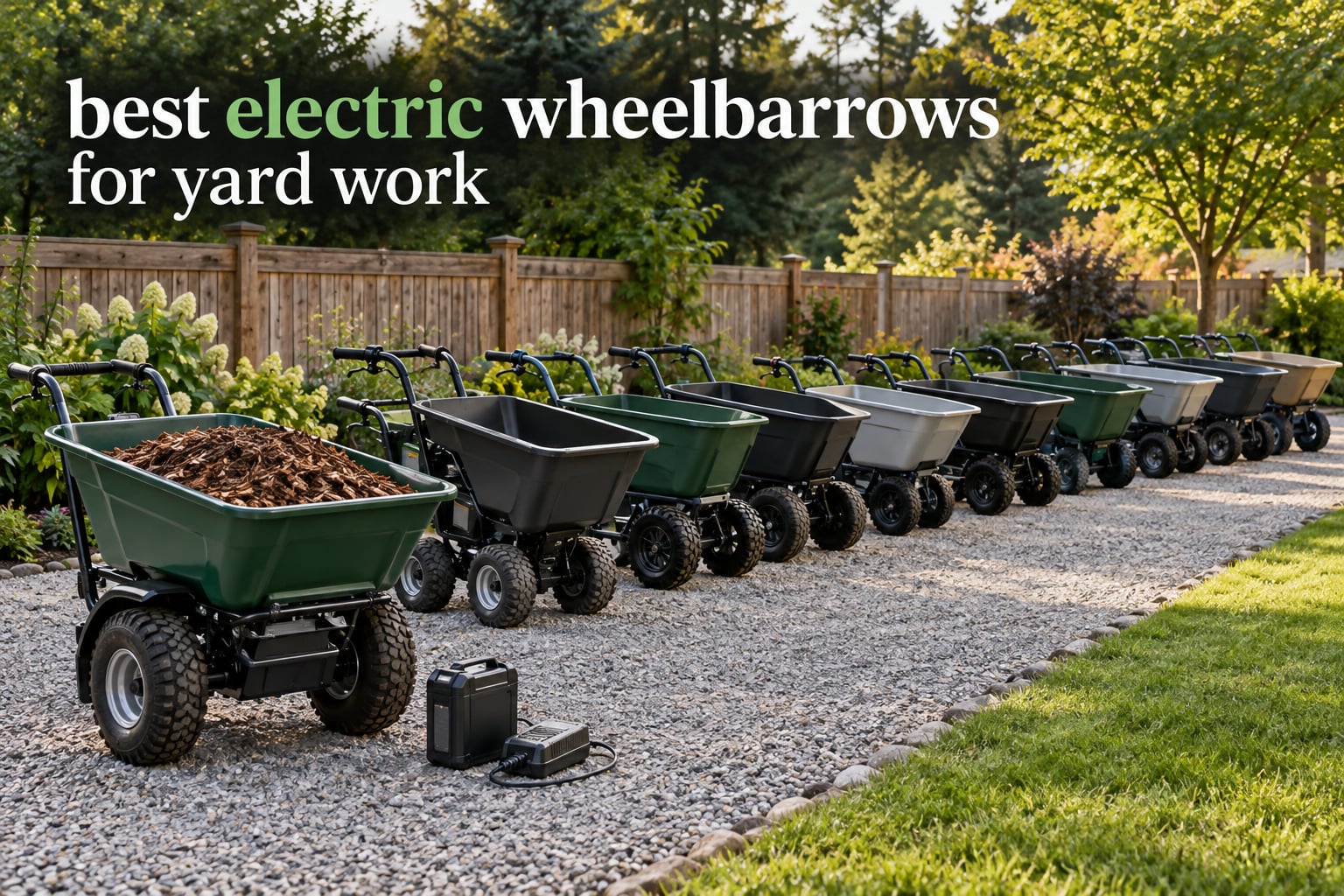
An electric wheelbarrow is a self-propelled yard cart with a battery-powered drive, electric wheels and a hand throttle that hauls hundreds of pounds of mulch, soil or debris without you pushing the load yourself. That short definition covers the whole category, and the shortlist below is built on it: ten powered carts rated from 300W to 1000W, compared on capacity, drive layout, battery chemistry and the details owners actually complain about.
We spent several weeks reading specification sheets, warranty terms and owner reviews across the ten models below, then ranked them by the things that decide whether a cart earns a place in a garage. The exact-match search results for this topic are almost entirely retailer category pages, which is why we leaned hard on owner feedback rather than marketing copy. Last updated October 2026.
The control logic inside these carts is not exotic. The same throttle, sensor and battery-management thinking that shows up in how drone obstacle avoidance systems work and in how adaptive cruise control works ends up deciding how a loaded cart behaves on a slope. Knowing that shaped which specs we treated as meaningful and which were filler.
Table of Contents
Top 3 Picks for the Best Electric Wheelbarrows for Yard Work (October 2026)

Landworks 48V Utility Cart
- 48V brushless system
- 500 lb load
- 6 cu.ft modular bed
- 13-inch pneumatic tires

Chore Warrior 24V Poly Tray
- 500W brushless motor
- 350 lb load
- 6 cu.ft poly tray
- two 9Ah AGM batteries

SuperHandy 24V Power Wagon
- 24V brushless motor
- 330 lb load
- 4 cu.ft tub
- 13-inch all-terrain tires
Landworks takes the overall spot because it pairs a 48V lithium-ion system with two batteries in the box, and 282 owners have used it long enough for the feedback to mean something. Chore Warrior earns the value slot with a 4.8 rating from 73 owners, a 500W brushless motor and a poly tray that survives impacts. SuperHandy is the entry point for buyers who want a powered wagon without stepping into the heavy-duty class.
Best Electric Wheelbarrows for Yard Work in 2026 Compared Side by Side
| Product | Specifications | Action |
|---|---|---|
| Landworks 48V Utility Cart |
|
Check Latest Price |
| Chore Warrior 24V Poly Tray |
|
Check Latest Price |
| SuperHandy 24V Power Wagon |
|
Check Latest Price |
 Goodyear 48V Utility Cart Goodyear 48V Utility Cart |
|
Check Latest Price |
 MechMaxx EH50 Electric Dumper MechMaxx EH50 Electric Dumper |
|
Check Latest Price |
 BILT HARD Electric Mini Dumper BILT HARD Electric Mini Dumper |
|
Check Latest Price |
 Cardinal 40V Utility Cart Cardinal 40V Utility Cart |
|
Check Latest Price |
 VEVOR 36V Electric Utility Cart VEVOR 36V Electric Utility Cart |
|
Check Latest Price |
 MORCLIN 300W Motorized Cart MORCLIN 300W Motorized Cart |
|
Check Latest Price |
 WORKPRO 40V Electric Wheelbarrow WORKPRO 40V Electric Wheelbarrow |
|
Check Latest Price |
Read that table as three distinct classes rather than ten similar options. Two carts rated at 330 and 350 lb are light-duty haulers, six sit in the 440-661 lb middle, and the two hydraulic dumpers carry 1100 lb safe loads with far more mass behind them.
How We Picked the Best Electric Wheelbarrows
Every cart here was scored on four things: usable load capacity against the real job, runtime and how the battery ages, drivetrain layout, and the volume of owner feedback. We weighted owner reports heavily because published capacity claims and actual behaviour on soft turf diverge more than manufacturers suggest.
Two-wheel carts balance like a wheelbarrow and turn tighter. Three- and four-wheel carts carry heavier loads and resist tip-over but need turning room. We treated claims without a real review base as provisional, which is why lightly reviewed listings sit lower in the ranking than their star ratings alone would suggest.
1. Landworks 48V Utility Cart – Best Overall Electric Wheelbarrow for Yard Work
- Two lithium-ion batteries allow a hot swap mid-job
- 500 lb load
- Modular bed folds to a flatbed for oversized loads
- 13-inch pneumatic tires grip uneven ground
- Quiet zero-emission running
- Wire mesh bed flexes under heavy or shifting loads
- Single swivel rear wheel can bend out of round on sharp turns
- Weak throttle spring return delays speed response
- Basic charger with no charge-state feedback
Two batteries come in the box and both are 177.6Wh lithium-ion packs, which is the detail that separates this cart from most of the field. When one drops, you swap it in seconds and keep working, and that hot-swap habit is what turns a 500 lb rating into a full day of mulch runs.
The drive is a 48V brushless system with variable forward speed to 4.4 MPH and reverse to 2.2 MPH, running on 13-inch pneumatic wheels across a three-wheel chassis. Owners describe hauling 80-pound bags and heavy field stones on a single charge, and the rating split backs the enthusiasm: 70% five-star, 15% four-star.
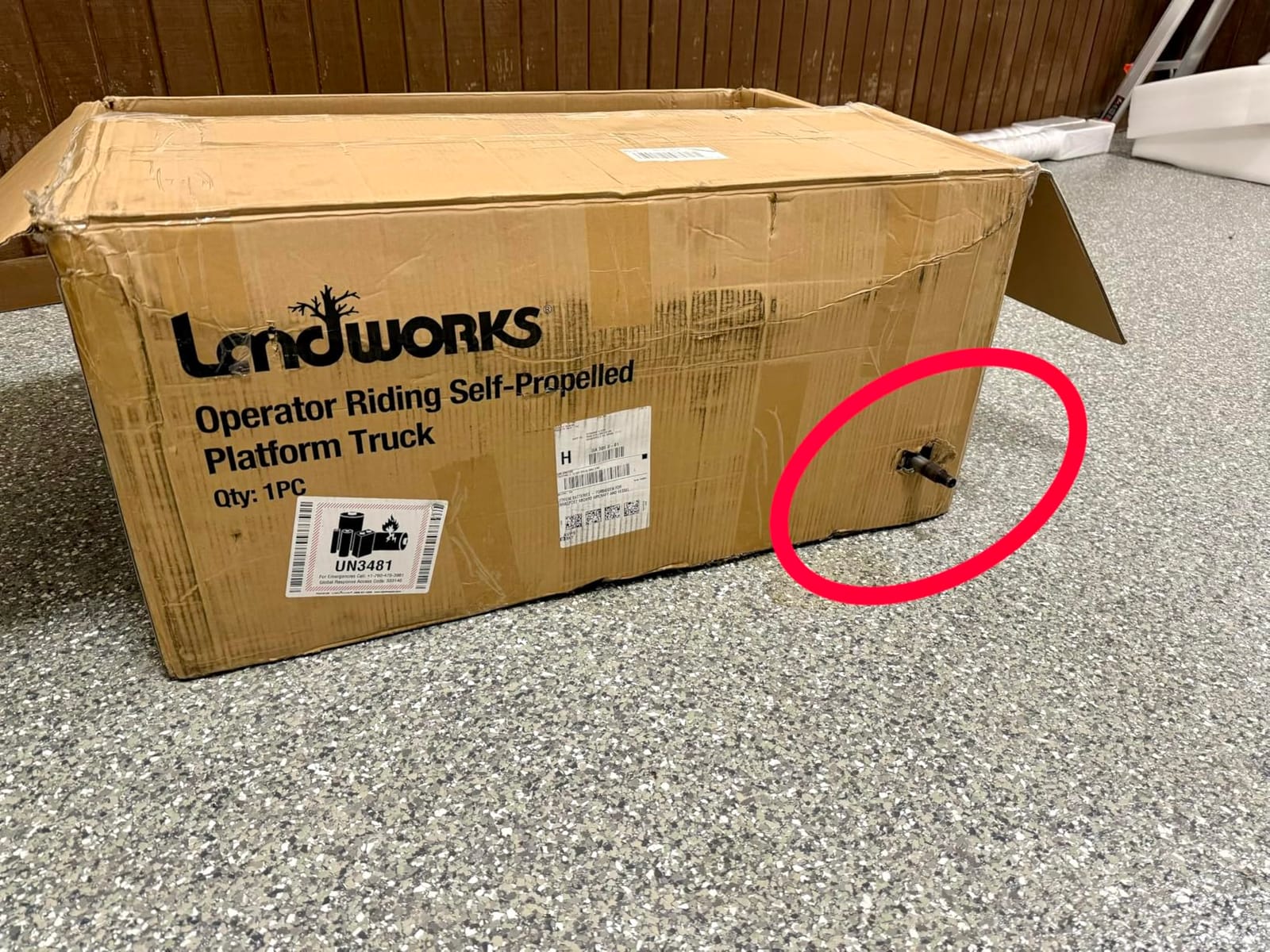
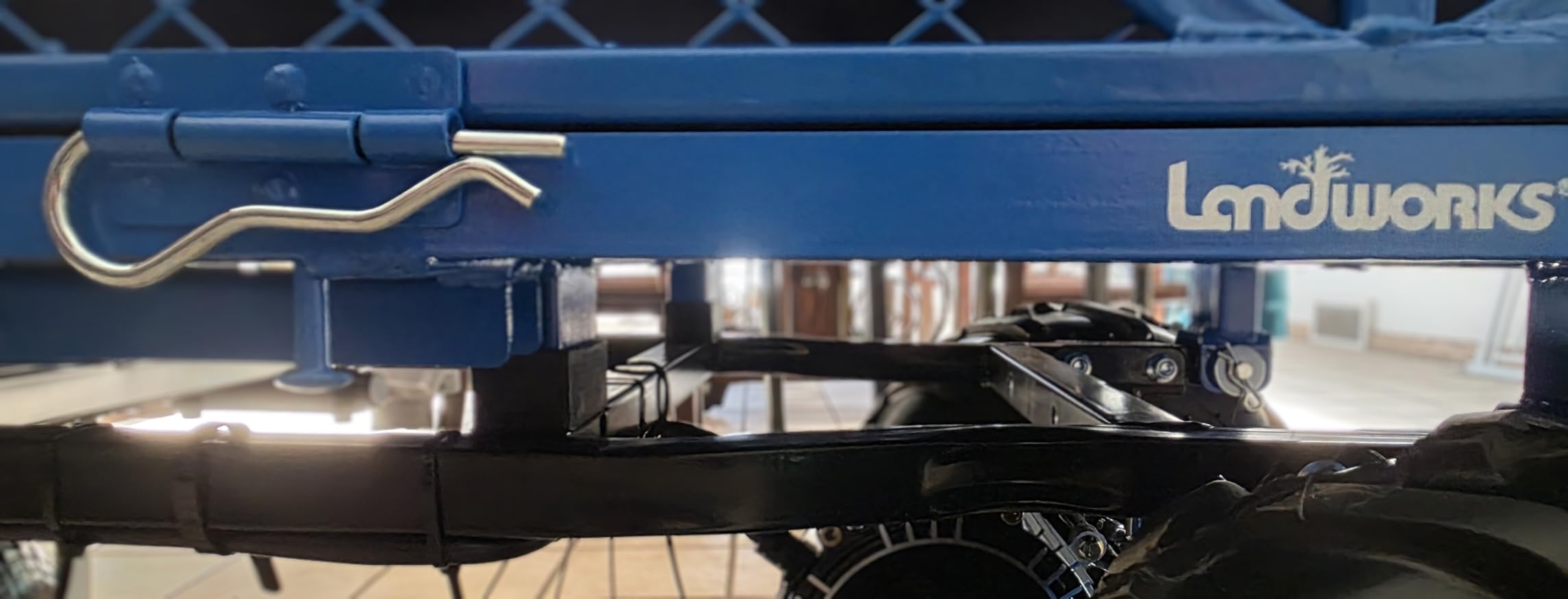
The modular cargo bed is the quiet hero. Side panels fold or come off entirely, so the same cart that carries loose mulch flat across the bed can take a sheet of plywood, a fence post or a stack of pavers. That versatility is why it holds the top spot for general yard work rather than a single specialist job.
Reviews also credit the manufacturer for support, particularly when a wheel failed and got replaced. Support response is one of those things that never shows up in a spec sheet and matters enormously when a cart is your only means of moving material across a property.
Best for property owners moving mulch, soil and firewood every week
Pick this one if your work is spread out and repetitive: mulch top-ups, topsoil for a new bed, firewood from the woodpile, seasonal cleanup. The dual battery, the flatbed conversion and the pneumatic tires all serve that pattern. Reviewers repeatedly frame it as the cart that saved their back on landscaping and cleanup days.
If you already own lithium tool batteries, note the catch: this cart is tied to its own packs rather than a shared platform. Owners weighing a conversion kit should read the battery section of our buying guide before committing.
Skip it if you haul dense material like sand, gravel or concrete
The 6 cu.ft bed is a wire mesh, and owners report it flexing or bending under heavy, shifting loads. Sand, gravel and concrete concentrate exactly the kind of point load that punishes mesh. Add a plywood floor if you buy it anyway; several owners do.
There is also no real service brake. Downhill speed control comes from drivetrain resistance and your right thumb, so approach grades at walking pace and keep the load low. The single swivel rear wheel is the second weakness, bending out of round if you turn hard under a heavy bed.
2. Chore Warrior 24V Poly Tray – Best Value Electric Wheelbarrow
Chore Warrior Electric Powered Wheelbarrow 350 LBS Capacity and 6 Cu FT Poly Tray 8 Hour Battery Life
- 4.8 rating with 82% five-star reviews
- Two-wheel differential drive balances off-centre loads
- Batteries last a full 9-hour workday
- Metal straight-cut gears and sealed bearings
- Poly tray resists rust and impacts
- Supplied tires and tubes puncture easily on twigs
- Supplied charger is not suited to AGM chemistry
- Motor will not clear obstacles over about 1.5 inches under full load
- Heavy to raise and tip with the front frame limiting dump clearance
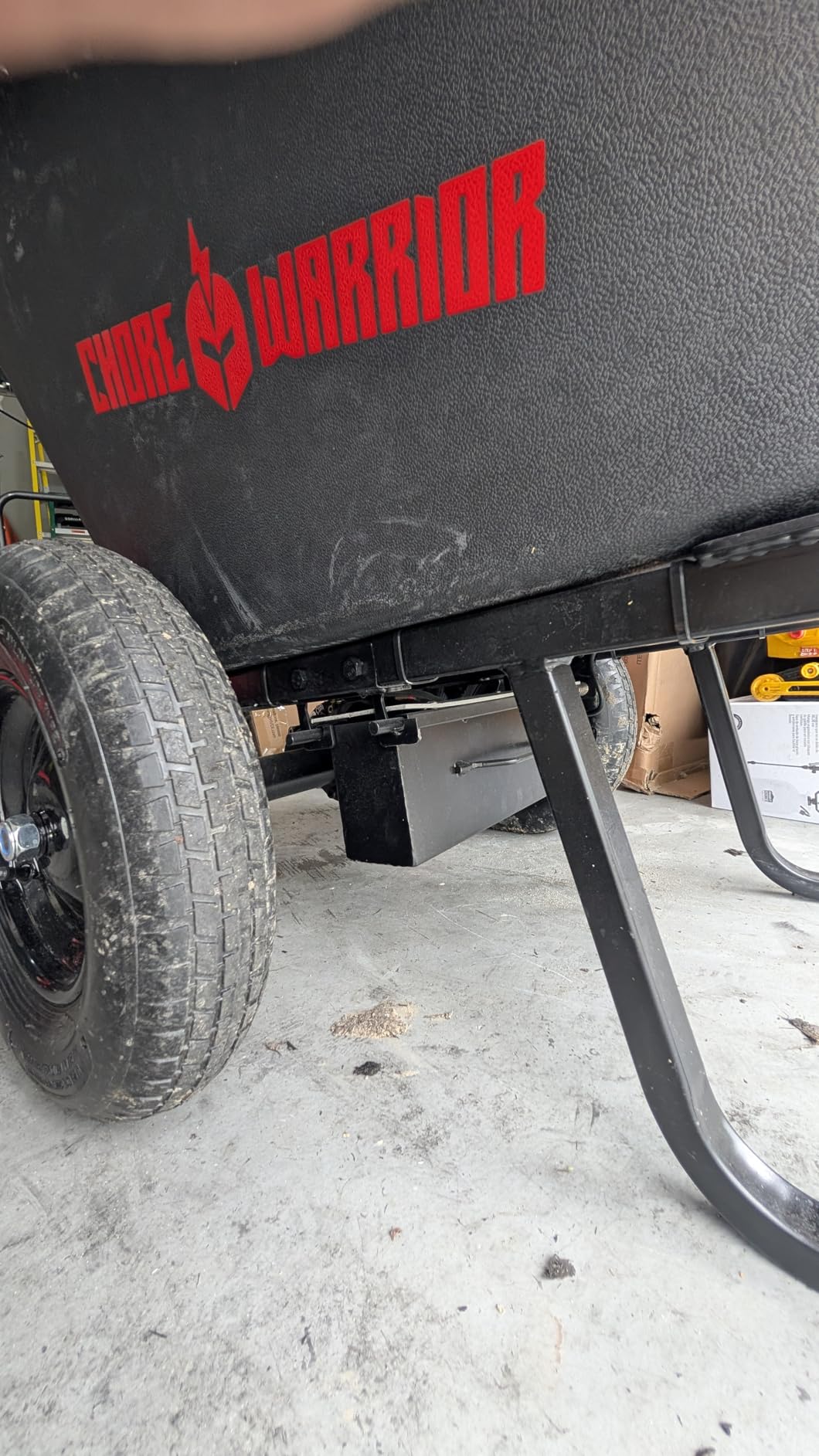
This is the cart that owners describe as the best combination of power, balance and battery endurance in the group. A 500W brushless DC motor drives through a metal straight-cut gear transmission with an independent differential, so the two driven wheels split power and turning stays smooth under load.
The two 9Ah sealed AGM batteries are the standout. Buyers report a full nine-hour workday with the charge only dropping to the three-quarter or half mark, which is endurance few owners report elsewhere in this list. Charging happens from a standard 120V AC outlet, and a light-up battery level indicator removes the guesswork.

The 6 cu.ft heavy-duty poly tray is a smart pairing with a 350 lb powder-coated steel frame. Poly will not rust and shrugs off the knocks and impacts that split steel tubs, and the assembled cart weighs 85 lb on 15-inch pneumatic tires over coated steel rims with sealed ball bearings throughout.
Where owners get excited is slopes. Multiple buyers mention pulling full loads up inclined lots where lighter carts stall. The two-wheel differential means an off-centre load self-corrects instead of pulling the handle sideways, which is the usual complaint about two-wheel barrows.
Best for homeowners and small crews hauling mixed yard waste
Choose this for general landscaping: bags of soil, leaf loads, branches, potted plants, garden waste. The poly tray shrugs off abrasive material, the differential handles awkward loads, and the battery endurance covers a full working day without a mid-job charge.
Support is a quiet strength too. Buyers describe responsive service that sends replacement parts free, which matters on a cart with a fixed-geometry drivetrain where individual components are worth replacing rather than scrapping the whole machine.
Skip it if your ground is rough or you need a deep tub
The supplied tires and tubes are the first thing owners replace. They puncture easily on twigs and rough ground, and a no-flat upgrade is the single most worthwhile modification. Plan on buying better tires from the start.
The supplied charger does not suit AGM chemistry and should not stay connected past about 12 hours. Motor output also tops out on obstacles taller than roughly 1.5 inches when fully loaded, so roots, edging and loose branches will stop it dead. Tipping is heavy work because the unit weighs 85 lb and the front frame limits full dump clearance.
3. SuperHandy 24V Power Wagon – Best Entry-Level Powered Wagon
SuperHandy Electric Wheelbarrow Utility Cart, 24V, 330 lb, Power Wagon
- Entry-level powered wagon with a deep review base
- Sealed lead-acid batteries are spill-proof
- 13-inch all-terrain pneumatic tires
- Compact two-wheel footprint fits through doorways
- Quiet running with no emissions
- 330 lb rated capacity and a 12 degree climb limit
- Lead-acid packs give less power and shorter runtime
- 13% of reviews are one-star
- Two-wheel balance is harder for off-centre loads
The SuperHandy is the simplest powered wagon here, and simplicity is the point. A 24V brushless motor delivers 180W of working power through a powder-coated rust-resistant steel frame rated for 330 lb at up to a 12-degree climb, with 4 cu.ft of cargo cubage behind it.
Power comes from two 12V 7Ah sealed deep-cycle non-spillable lead-acid batteries in series for 168Wh total, and owners report two to five hours of use per full charge depending on load and slope. The sealed lead-acid design is spill-proof and handles cold weather better than an open battery, which matters for early spring work.
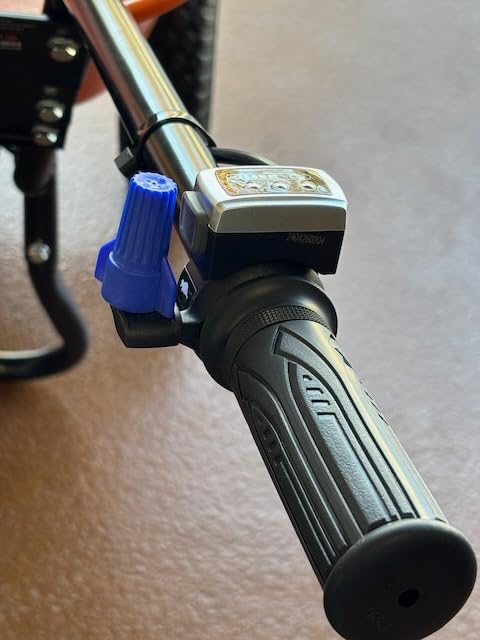
At 101.5 lb and 42 inches long, it is also the easiest of the powered carts to store. Reviewers treat it as a garage-and-garden hauler that quietly moves soil, debris and tools, and the 13-inch all-terrain pneumatic wheels run at 30 to 31 PSI for uneven ground.
That is the honest case for it. If your work is light, frequent and close to home, a 330 lb cart that fits through a standard doorway and charges overnight does the job without the storage footprint of a four-wheeler.
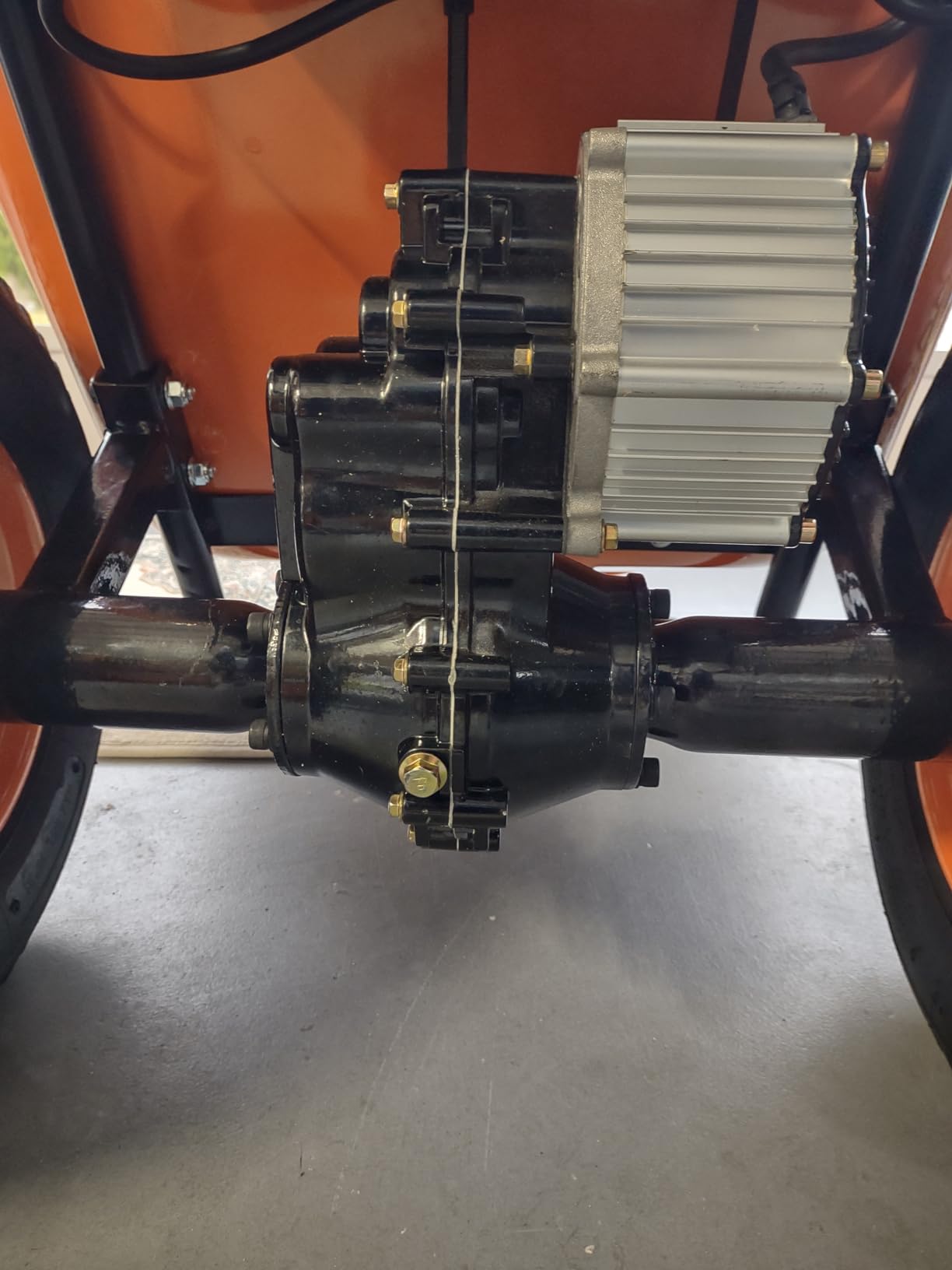
Best for light cleanup duty and small plots
This suits anyone moving bagged soil, potted plants, leaf bags and light garden debris around a flat yard. The compact footprint makes it easy to park in a garage corner and easy to maneuver between beds where a four-wheel chassis would struggle.
Buyers consistently praise durability and value relative to what a manual cart costs in effort over a long day. The sealed batteries need no watering and no venting, which keeps the maintenance list short.
Skip it if you move heavy loads, climb hills, or want all-day runtime
330 lb is the lowest rated capacity in this group, and the 12-degree climb limit means anything steeper is simply out of scope. Lead-acid packs also deliver less power and shorter runtime than the lithium carts, which caps the real-world load on any given trip.
One more caution: 13% of reviews are one-star, the second-highest negative share among these carts, and the two-wheel layout demands more balance effort with off-centre loads than a three- or four-wheel chassis. If you routinely move sand, gravel or timber, step up a class.
4. Goodyear 48V Utility Cart – Best Four-Wheel Stability for Sloped Ground
Goodyear Electric Power Wagon – 48V Utility Cart, 660 Lb Load Capacity
- 660 lb working load with a four-wheel chassis
- Traction control adds wheel power as load increases
- Runs on one or two lithium-ion batteries
- Modular bed folds to a flatbed
- No functional service brake on descents
- Grid-style bed lets mulch spill through
- Battery box does not open fully for swaps
- Missing bolts and hardware in some deliveries
The Goodyear is the most convincing slope hauler in the mid class. A 48V brushless system delivers 660 lb of working load and 1000 lb of towing capacity within 6 cu.ft of cargo space, and the manufacturer rates it for climbs up to 15 degrees. Variable speed runs to 4.4 MPH forward and 2.2 MPH in reverse.
Traction control is the feature that separates it in practice. As load increases, the system routes more power to the driven wheels, so a full bed going uphill asks less of the operator than the same bed in a fixed-power cart. Owners with hip and back problems specifically describe turning mulch hauling into a one-person job.
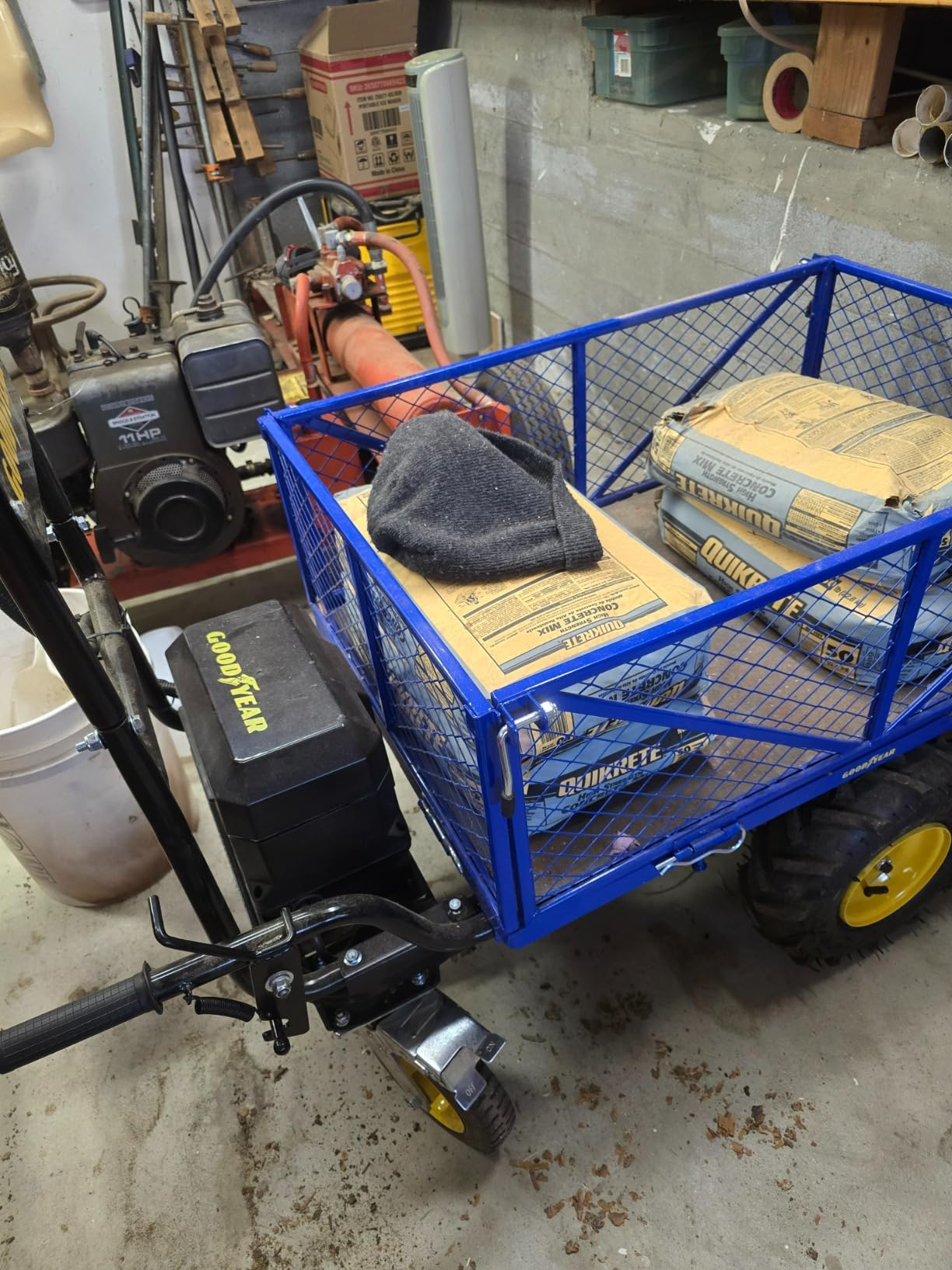
Battery flexibility is unusually good here. The cart runs on one or two 2Ah or 4Ah rechargeable lithium-ion packs, giving 88.8Wh or 177.6Wh depending on the job, and a second pack roughly doubles the working day. Owners report durable construction still going strong after three years.
The modular bed folds flat for oversized loads, and the whole unit weighs 135 lb on 13-inch pneumatic wheels across a four-wheel chassis. Owners also note it climbs steep inclines well when loaded in reverse, a technique worth learning before you meet a driveway with a grade.
Best for larger properties, slopes and long-haul material
Choose this for acreage work, steep driveways, or anyone hauling full loads of soil and mulch across uneven ground. The four-wheel layout holds a line where a two-wheel barrow wanders, and the 660 lb working load sits at the top of this middle group.
If you already own compatible lithium-ion packs, the one-or-two-battery configuration is a genuine advantage. You can run light trips on a single pack and double up when the job demands it.
Skip it if you need a real brake or a sealed tub
There is no functional service brake. The caster wheel locks are not usable while descending, so downhill control depends on modulating power and your throttle hand, which is a real consideration on the slopes this cart is otherwise good at.
The grid-style cargo bed is also light, letting mulch spill through, and several owners add a plywood board. Battery swapping is awkward because the box opens on the long side and does not swing fully clear, and some units have arrived missing bolts or hardware.
5. MechMaxx EH50 – Best Electric Wheelbarrow for Maximum Load Capacity
- 1100 lb safe load inside the largest bed in the group
- Hydraulic tip lifts the bed without tipping sideways
- 12-15 hours of work on a 5-hour charge
- LED voltage display plus two 30W work lights
- Rear wheel locking pins for straight tracking
- Extremely heavy at 450 lb plus
- so it is hard to push unpowered
- Top speed can exceed a comfortable walking pace
- Slow reverse speed
- Support responses can take days
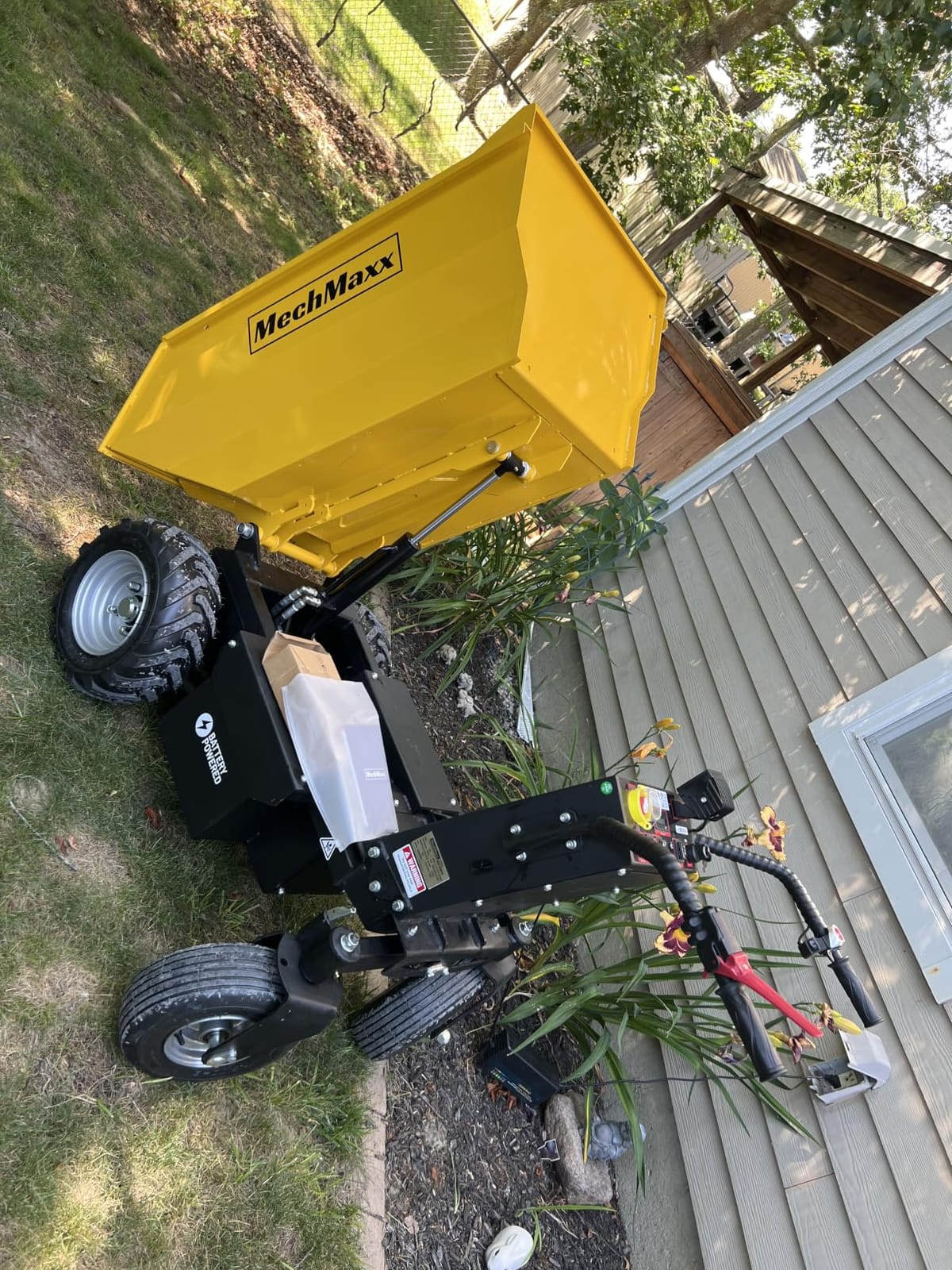
The MechMaxx EH50 sits at the top of the capacity range. A 1000W brushless DC motor drives a safe working load of 1100 lb and a 1500 lb maximum into an 8.2 cu.ft bucket that handles both solid and semi-fluid cargo. It is a small job-site dumper, not a garden cart.
The patented hydraulic power unit lifts and lowers the bed from a single key, and the two gas springs under the skip control the motion. Owners replacing a smaller manual-dump cart describe it as a clear capability upgrade, and the effect on unloading time is the single biggest change in the workflow.
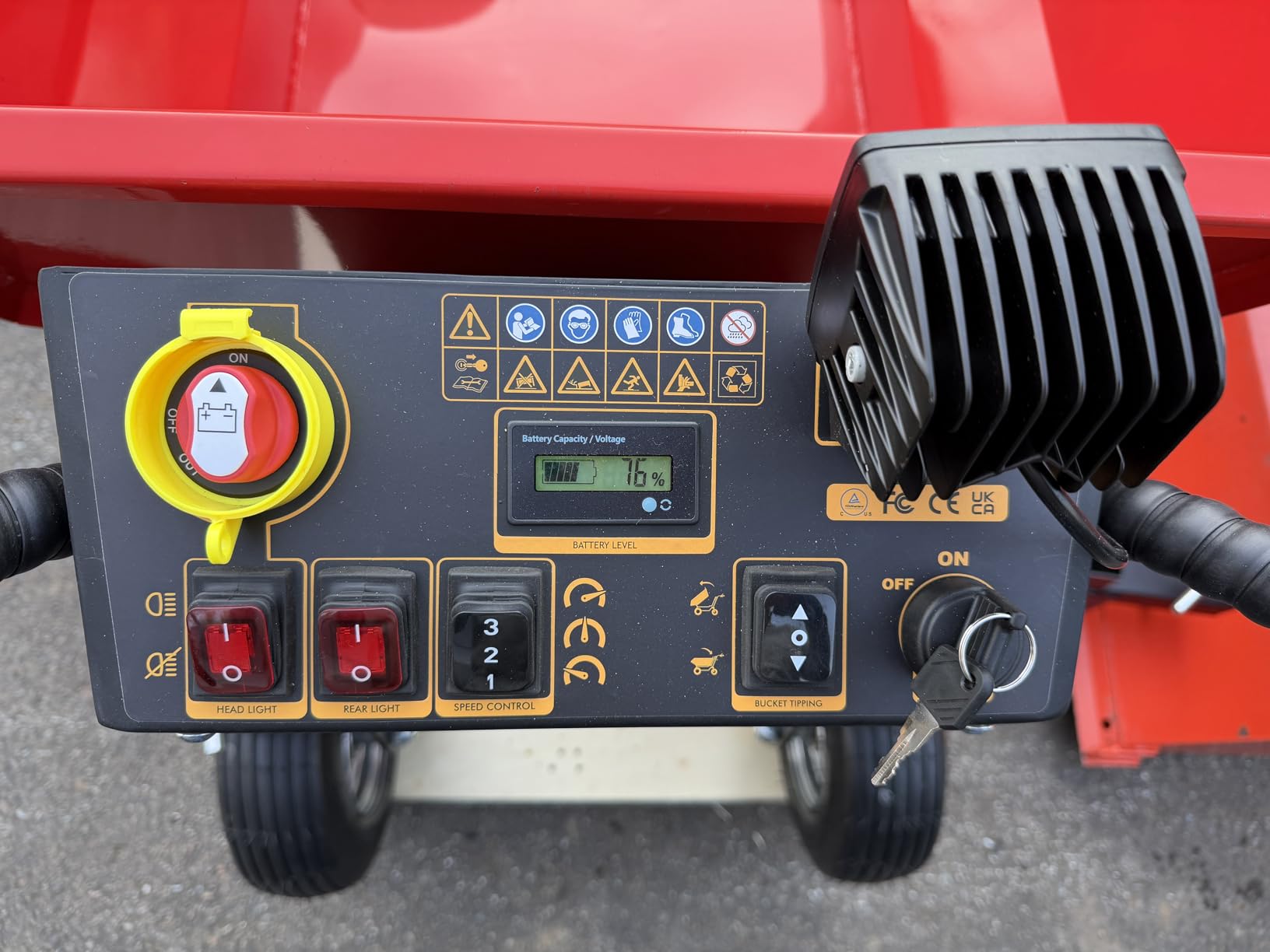
Endurance is the other headline. The 48V 32Ah lead-acid battery takes five hours to charge and delivers 12 to 15 hours of work under normal conditions, dropping to about six hours fully loaded. An LED display shows real-time voltage and battery level, which matters when you are planning a day’s hauling around one charge.
Controls are well thought out for a machine this size: a thumb throttle, a red auto-stop safety handle, forward and reverse buttons, three forward speeds and one reverse speed, and two 30W work lights. Rear wheel locking pins hold a straight line on uneven ground, and a 29-inch width clears standard doorways.
Best for contractors, small farms and job sites moving serious tonnage
This is the right machine for a landscaping crew, a small farm or a renovation site. The hydraulic tip handles wet material, stone and scrap without the wrestling a manual barrow demands, and the tubeless tires are 16 x 6.50-8 and 13 x 5.00-6 with integrally molded hubs that resist punctures.
The LED voltage readout and work lights make it practical for evening and early work. A one-year manufacturer warranty is included with the unit.
Skip it if storage space or manual handling is the constraint
It weighs 450 lb by the manufacturer’s listing, with owners reporting roughly 500 to 538 lb empty. Push it unpowered and you will feel every one of those pounds, and at speed it can travel faster than a comfortable walking pace, which demands close attention in a crowded yard.
Reverse is slow by owner report. Some carts have also arrived with faulty rocker switches or a hydraulic system that would not pressurise, and support can take days to respond while the manual leaves hydraulic fault codes unexplained. Transit damage to a heavy crated unit is a recurring complaint too.
6. BILT HARD Electric Mini Dumper – Best for Fast Hydraulic Dumping
- Hydraulic bucket elevates about three times faster than conventional dumps
- 1100 lb safe load with ample power for landscaping
- Two 16W work lights and a red auto-stop safety handle
- Rear wheel locking pins hold a straight line
- Two-position handle adjustment suits different operators
- Two-wheel layout sits more load over the operator
- Short bucket cannot fully tip for tall raised beds
- Some bolts sit in tight gaps during assembly
- Battery endurance is rated in short cycles for this class
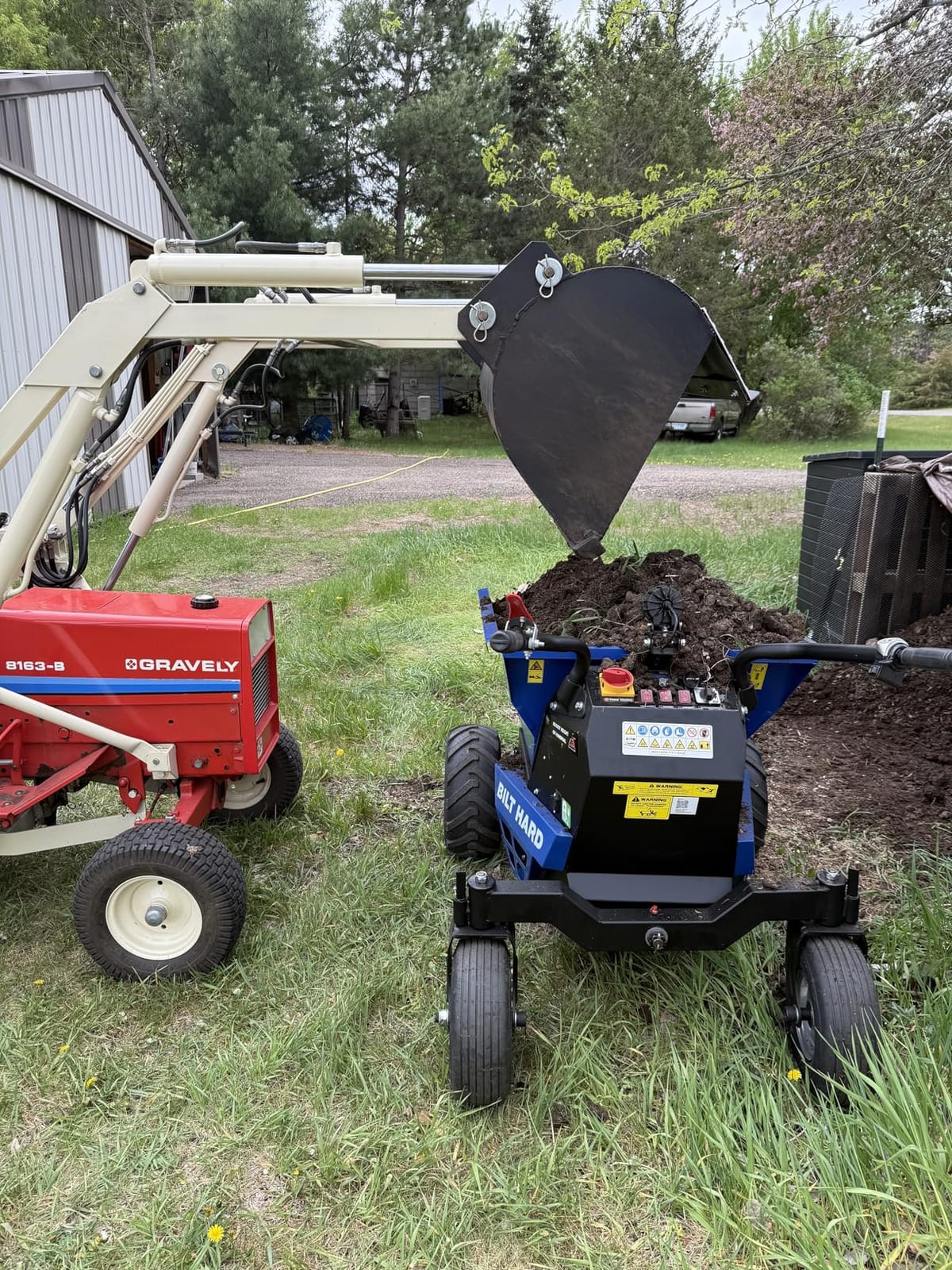
The BILT HARD takes the same 1000W brushless motor and 1100 lb safe load as the MechMaxx into a slightly smaller 7.7 cu.ft bed, then differentiates on one thing: dump speed. The upgraded hydraulic system elevates the bucket roughly three times faster than conventional models with continuous material flow.
Unloading time is where a hydraulic dumper earns its keep. A faster bed means more full cycles per hour, and for compost, manure and building material, throughput is the metric that decides whether a big cart beats several small ones.
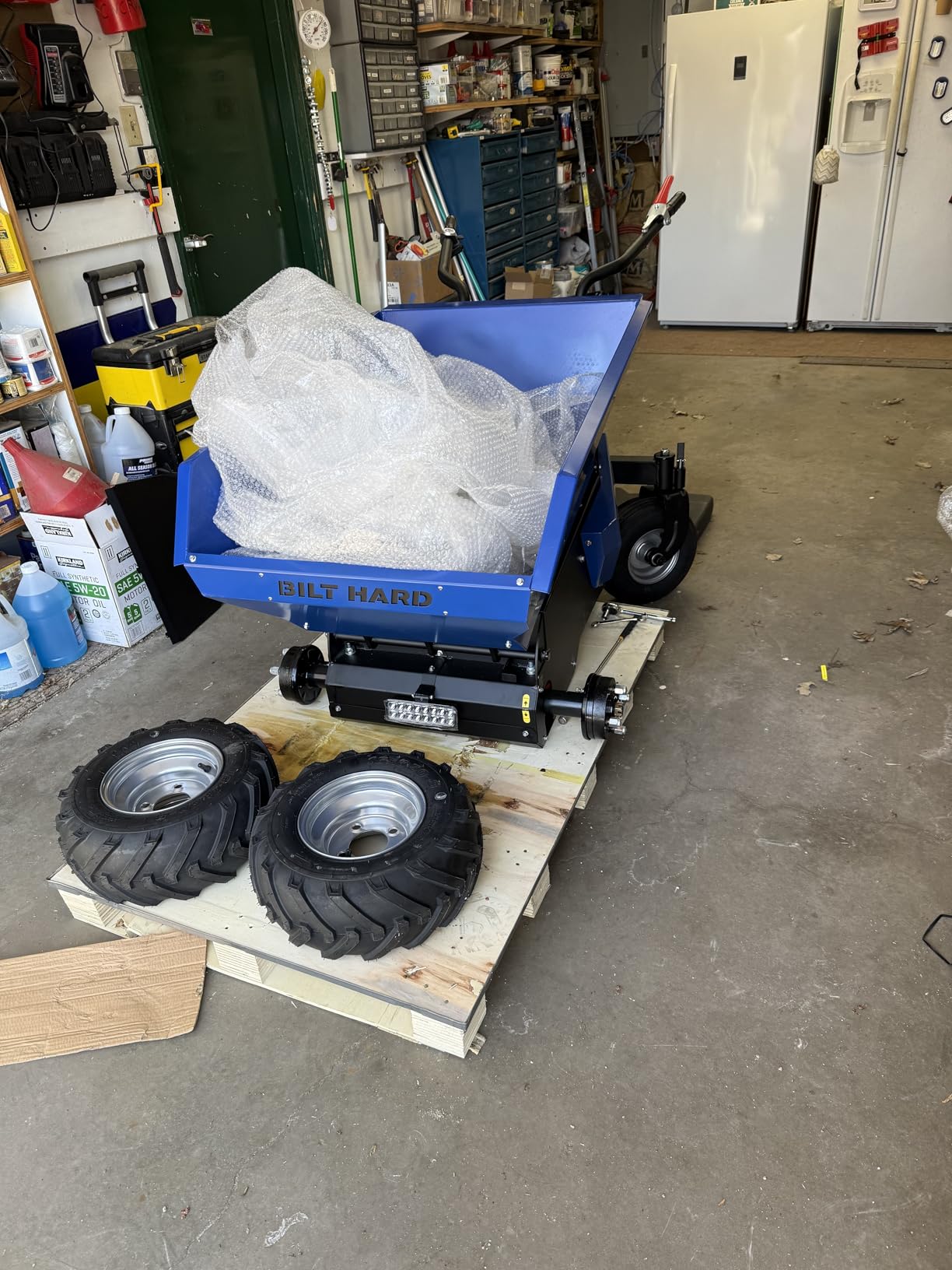
It runs on a 48V 32Ah battery system, and the battery arrived fully charged with roughly 80% remaining after a heavy weekend of hauling. Two 16W work lights, a thumb throttle and the red auto-stop safety handle cover low-light work and unexpected stops.
Owners in their sixties and seventies single out the power-to-weight ratio and the fast dump as the deciding features, calling it a genuine back saver for compost and manure work. It also moves more easily inside a garden than a lawn tractor and trailer setup would.
Best for operators who want fast cycles and simple controls
Pick this for heavy compost, manure, soil and building material where the number of trips per day matters. The two-position adjustable handles let different operators set the bar up, and rear wheel locking pins keep it tracking straight on uneven ground.
A one-year risk-free manufacturer warranty covers the purchase, which is a real factor when a first-time buyer is stepping into the heavy class. Buyers also value that it replaces a pull cart for material that is genuinely too heavy to drag.
Skip it if you have limited grip strength or need full-tub clearance
The two-wheel layout places more of the load over the operator, and a smaller 68-year-old owner found the handling a little aggressive. If you are buying this to reduce physical strain, test the balance before committing.
The bucket is relatively short and cannot fully tip, so tall raised beds still need shoveling out the remainder. Assembly has bolts in tight gaps that are awkward to reach, and the battery life for this class of unit is rated in short cycles rather than all-day work.
7. Cardinal 40V Utility Cart – Best for Controlled Electronic Braking
Heavy Duty Electric Utility Cart 40V Battery-Powered Wheelbarrow 660-lb. Bucket Capacity
- 661 lb stated load capacity on flat ground
- Integrated electronic braking system for controlled stopping
- Simple lever controls with an ergonomic layout
- Pneumatic tires and swivel caster for maneuverability
- 400W motor is small against a 661 lb capacity claim
- About 3.2 hours of runtime per full charge
- Only seven reviews
- so reliability is unproven
The Cardinal is a Tomahawk Power build sold under the Cardinal name, and its distinguishing feature is the integrated electronic braking system. A 400W motor handles up to 661 lb on solid flat ground, with speed control and forward and reverse throttle levers laid out simply.
Electronic braking is genuinely useful on a 135 lb cart carrying a heavy load. Rather than relying on drivetrain drag, the system pulls the drive into a controlled stop, which is a meaningful difference when your route includes a driveway with any fall to it.
Power comes from a 40V 6Ah battery giving up to 3.2 hours of work per full charge, and the chassis sits on pneumatic tires with a swivel caster for maneuvering in tight spaces. The 47-inch length is compact for a powered cart.
Best for buyers who want a brake and simple lever controls
Choose this if your route has descents and you want predictable stopping rather than throttle modulation. The lever layout is approachable for anyone used to a manual cart, and the compact footprint works well in a garage or side yard.
It suits flat, solid ground, which is exactly what the capacity rating is based on. If your surface is lawn or gravel, work down from the stated figure.
Skip it if you need long runtime or proven long-term durability
At roughly 3.2 hours per charge, this covers a partial day rather than a full one. Plan charging around a midday break or keep a second pack ready.
The 400W motor is modest for the 661 lb capacity it is paired with, which leaves little margin on grades. With only seven reviews, there is not enough owner data to judge long-term reliability, so treat the specification sheet as the main signal.
8. VEVOR 36V Electric Utility Cart – Best for High-Sided Loads
- 15.75-inch side rails with reinforced steel mesh hold bulky loads
- 432Wh battery supports long working time
- Built-in electronic braking improves slope control
- Four-wheel chassis with adjustable handle height
- Soft-start controller for smooth take-off
- Handle holes drilled incorrectly out of the box
- Weak lead-acid battery
- one owner replaced it with LFP
- Open differential lets one wheel spin on grades
- Unresponsive after-sales support
The VEVOR is the only cart here combining a 500W drive with 15.75-inch high side rails over a reinforced steel mesh bed, and that geometry is its reason to exist. Tall rails keep bulky loads contained where a low-sided cart would spill brush, branches or firewood.
The 36V 12A 432Wh battery supports extended working time between charges, and owners of working units single it out. A built-in electronic braking system prevents rolling or slipping on slopes, and the soft-start controller eases the take-off under load.
Owners who had a working unit liked the smooth, quiet drive, the forward and reverse convenience and the adjustable handle height that adapts to different operators across a four-wheel chassis weighing 125.7 lb.
Best for bulky, irregular loads on a four-wheel chassis
Pick this for firewood, branches, yard debris and anything that needs containment. The four-wheel layout and adjustable handle height make it stable and easy to hand between operators, and the electronic brake helps on uneven ground.
For anyone who buys and rarely uses a cart, the adjustable handle height and the large battery reduce the chance that a taller operator cannot use it comfortably.
Skip it if early-life reliability matters more than rail height
This cart carries the lowest average rating in the group, at 3.9, and a third of reviews sit at three stars. The small review base is dominated by early-life problems: handle holes drilled incorrectly so the handles would not bolt on, a dead on/off switch and a failed controller box.
The lead-acid battery is also reported as weak, with one owner fitting an LFP replacement, and the open differential lets one wheel spin so the cart can bog down on even slight grades. After-sales support was described as unresponsive, and the cart needs to shift between forward and reverse to fit into tight spaces.
9. MORCLIN 300W Motorized Cart – Best for Reusing Existing Tool Batteries
- Ships as tool only
- so existing batteries can be reused
- Brushless motor with lower maintenance needs
- Three-wheel layout is stable and maneuverable
- Adjustable ergonomic handle
- LED work light for low-light tasks
- Smallest dump bed in the group at 2.47 cu.ft
- 300W motor against a 661 lb claim
- Battery and charger sold separately
- Only three reviews
The MORCLIN is the only cart in this roundup sold as a tool only, and that single fact changes the ownership calculation. Battery and charger are not included, so if you already run a compatible 20V tool platform, the two most expensive components of a new powered cart are already on your shelves.
What you get is a 300W brushless motor driving a 661 lb rated cart on a three-wheel carbon steel frame with an adjustable ergonomic handle and a 2.47 cu.ft dump wagon bed. A three-wheel layout sits between a barrow and a wagon: more stable than two wheels, tighter than four.
There is an LED work light for low-light jobs, and brushless motors generally mean fewer moving parts and no brush replacement over the life of the machine. The carbon steel frame is straightforward to keep from rusting with a coat of paint.
Best for owners who already own a compatible tool battery
This is the pick if you already have 20V packs in the garage from a tool platform the cart accepts. The reuse angle is the whole reason it exists, and it means your running cost is a charge rather than a purchase.
It also suits a buyer who wants a cart that stores upright against a wall. The 57.8-inch length and three-wheel frame are manageable in a normal residential garage.
Skip it if you are moving bulk material or starting from zero batteries
The 2.47 cu.ft bed is the smallest in this group by a wide margin, which means significantly more trips for mulch, soil or leaf loads. Volume-limited jobs are the wrong fit no matter how good the drive feels.
Start from nothing and the economics invert: you must buy batteries and a charger separately before the cart moves. The 300W motor also has less margin than the 400W and 500W carts against a 661 lb claim, and three reviews is not enough owner history to judge durability. Check the battery platform match carefully before ordering.
10. WORKPRO 40V Electric Wheelbarrow – Best for Short, Frequent Hauls
- Three forward speeds plus reverse for fine control
- Electronic braking rated for slopes up to 15 degrees
- Two 20V 4.0Ah batteries included
- Assisted dump mechanism cuts lifting effort
- LED display with a built-in light and horn
- Shortest runtime here at 70-75 minutes per charge
- Lowest load among the lithium-powered units at 440 lb
- Only a single review
- so the rating is not meaningful
The WORKPRO is the newest listing here and the least proven, with a single review behind it. The specification sheet is still worth reading closely, because it describes a cart built for control: three forward speeds up to 2.8 MPH, reverse at 0.9 MPH, and an LED display showing state of charge.
The drive is a 300W brushless motor on a reinforced steel frame with three pneumatic tires, feeding a 75L heavy-duty hopper rated at 440 lb of dynamic load. The assisted dump mechanism reduces the lifting effort at the discharge end, which is where two-wheel carts normally punish your back.
Both 20V 4.0Ah batteries are included and work together as a 40V system, so there is no separate battery purchase. Electronic braking holds controlled speed on slopes up to 15 degrees, and a built-in light and horn cover low-light and visibility needs.
Best for short runs around a single property
Choose this when your hauling distance is short, your loads are moderate and you want fine speed selection. Three forward speeds matter more than raw power when you are creeping between flower beds or reversing out of a tight corner near a wall.
The assisted dump and the horn make it friendly to shared outdoor space, and the included pair of batteries removes the most common reason buyers end up disappointed.
Skip it if you need a full day of work from one charge
Runtime of 70 to 75 minutes per charge is the shortest in this group. That suits quick jobs, not a day of mulch delivery, and a 440 lb dynamic load is also the lowest among the lithium-powered carts here.
With a single review, the 5.0 rating carries no statistical weight, so there is no long-term owner feedback to guide you. If you want certainty, pick a cart with a few hundred reviews behind it and accept a smaller feature list.
How to Choose an Electric Wheelbarrow for Yard Work
Start with the job, not the motor. Write down your heaviest realistic load and your longest realistic distance, then match capacity to both. A cart rated above your needs wastes money and floor space, while one rated below it gets overloaded on the first hard day and wears early.
Next decide the bed volume. Loose mulch and leaf loads are bulky and need cubic feet; sand, gravel, stone and timber are dense and need pounds. A 330 lb cart with 4 cu.ft is fine for bagged material, while 6 to 8.2 cu.ft of tub is what bulk delivery actually requires.
Battery chemistry is the third decision and the one most buyers get wrong. Lead-acid is cheaper and more tolerant of cold storage, needs no watering when sealed, but weighs more and delivers less power for its size. Lithium-ion is lighter, holds more charge, and keeps more usable capacity between full charge and empty.
Voltage and wattage follow from that choice. Higher voltage with lower wattage often behaves better than the reverse, because controller amperage is what stresses a drivetrain. Treat wattage as a proxy for torque and capacity as a separate axis. Related control-electronics background is worth understanding, particularly if you are comparing throttle response models like those described in how robotic grippers work.
Wheel count is the fourth decision, and it is a real trade-off rather than a quality ladder. Two wheels turn tightest and cost least, but you manage the balance of off-centre loads. Three wheels add a castering support wheel. Four wheels are the most stable under heavy load and need the most space to turn around.
Finally, check the tire and brake story. Pneumatic tires roll smoothly over rough ground but need air and can puncture; flat-free or tubeless options trade some comfort for reliability. On brakes, an electronic braking system or a real service brake is far safer on a descent than throttle-only control. That same principle applies to the traction control used in robots such as the Unitree G1, where control loops manage load and balance far beyond simple speed regulation.
When a Manual Wheelbarrow Is the Better Buy
Small, flat, lightly worked properties are the honest case for pushing a cart by hand. If you are moving a few bags of mulch a season between beds a few feet apart, a powered cart is a large object to store and maintain for very little gain. The same goes for users who value a lightweight tool they can lift into a truck bed unaided.
Powered carts also carry real trade-offs. The heavy models weigh 450 lb or more, so if your workspace is a shared closet or a small rental garage, the footprint alone can rule them out. And on very tight terrain, a manual cart is easier to reposition than a machine you have to walk around.
For everyone else moving hundreds of pounds per trip, the electric wheelbarrow removes the single most tiring part of yard work. That is the whole argument, and it holds up across every cart on this list.
Frequently Asked Questions
Are electric wheelbarrows worth it?
For anyone moving hundreds of pounds of mulch, soil or debris per trip, yes. The motor removes the pushing effort, so trips get heavier and longer without costing more energy, and owners with back or joint problems report the biggest gains. For light seasonal work on a small flat plot, a manual cart is the more sensible purchase.
How long does an electric wheelbarrow battery last?
Runtime per charge ranges from about 70 minutes on the WORKPRO to 12-15 hours on the 48V 32Ah packs used in the heavy hydraulic dumpers, with most lithium carts landing between three and five hours. Actual runtime depends on load, slope and how often you climb. Spare packs are the practical answer for all-day work.
How much can an electric wheelbarrow carry?
Rated loads across this group run from 330 lb on the SuperHandy up to 1100 lb safe load and 1500 lb maximum on the two hydraulic dumpers. Middle-class carts fall between 440 lb and 661 lb. Plan below the rated figure on slopes and soft turf, where usable capacity drops well short of the number on the label.
Can you use a power tool battery in an electric wheelbarrow?
Only on carts designed for it. The MORCLIN is sold as a tool only and accepts compatible 20V tool platform packs, while the Landworks, Goodyear and MechMaxx run on their own included battery systems. Using the wrong platform will not work and can damage the controller, so check the battery spec before buying a bare cart.
Is it better to get a steel or poly wheelbarrow?
Poly tubs do not rust and shrug off impacts, which makes them the better choice for mulch, soil and general landscaping. Steel tubs hold heavier loads and take abuse from stone and timber better, but they will corrode if left wet. Among these carts the Chore Warrior uses a 6 cu.ft poly tray and the rest use steel or mesh beds.
Conclusion: The Best Electric Wheelbarrows for Yard Work
The Landworks 48V Utility Cart is the pick for most people: two batteries, a modular bed, 500 lb of load and 282 owners who have lived with it. If you want the best balance of balance, endurance and price, the Chore Warrior leads the group on rating with a 500W motor and a poly tray that lasts a full working day. Serious tonnage and fast hydraulic dumping point to the MechMaxx or the BILT HARD.
Whatever you choose, match the cart to the heaviest load you actually lift and the longest run you actually make, and check the brake situation before the first hill. That is the best electric wheelbarrow for yard work advice we can give, and it is free.