
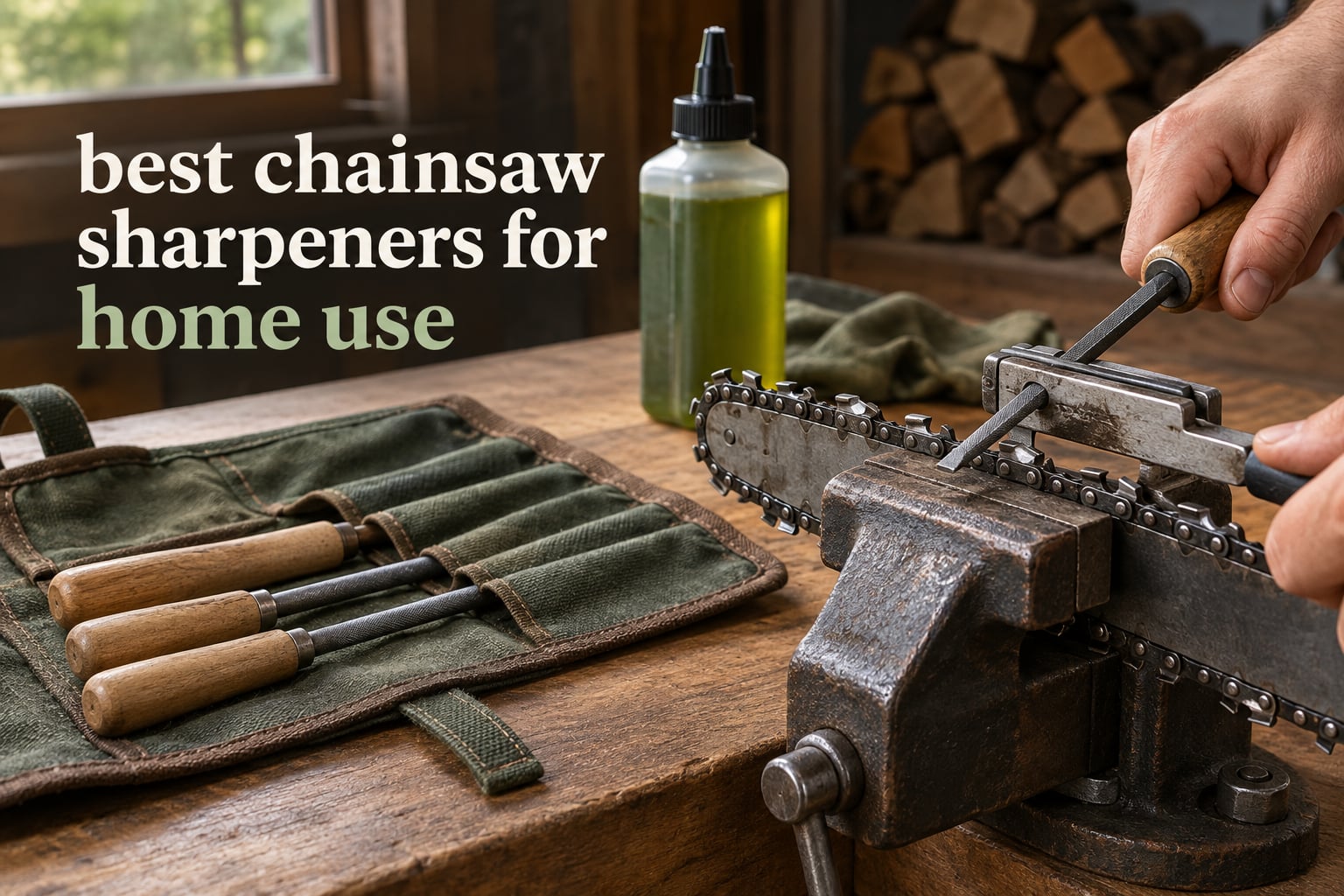
A dull chainsaw chain is not just slow. It throws fine sawdust instead of clean chips, which means you are leaning on the throttle and on the bar, burning more fuel for less wood, and loading the chain drive far harder than it is designed to take. It is also one of the most common reasons a saw kicks back, and kickback is what actually sends people to the emergency room.
That is why the best chainsaw sharpeners for home use matter more than the price tag suggests. A sharpener is not a luxury accessory; it is the cheapest way to make an existing saw safer, cheaper to run and easier to control. And for the typical homeowner cutting a few loads of firewood or clearing storm debris once a year, the right answer is usually a file and an angle guide rather than an expensive bench machine.
We pulled together ten sharpeners that make sense for a garage, a truck bed or a small workshop for 2026, from a basic three-file manual set up to a bench-mounted electric grinder. The rounds are organised by how much wood you actually cut, and the technical details that decide whether a chain gets sharpened correctly are called out for each one.
One practical note before you buy anything. A lot of the cleanup work that motivates a sharpener happens right after a storm, and if the power is out while you are cutting, that is a different problem. Our [home generator guide for storm cleanup](https://www.smashingrobotics.com/best-generators-for-home-use/) covers that half of the job.
Table of Contents
Top 3 Chainsaw Sharpeners for Home Use (October 2026)
Three picks cover almost every home use case. Our editor’s choice is the manual field kit, the best electric option is a handheld 120V unit, and the best workshop option is a bench-mounted grinder for owners who cut often.
Oregon Universal Field Kit
- Covers 5/32
- 3/16 and 7/32 inch files
- Angle guide for depth gauges
- Rolled canvas pouch

Sharp Pebble 120V Electric Kit
- 4 grinding wheel bit sizes
- Angle guide attachment
- Adjustable speed settings

Oregon 120V Bench Grinder
- Covers chains to .404 inch pitch
- One-way motor rotation
- Vice clamp with 3 wheels
Quick Comparison of All 10 Chainsaw Sharpeners in 2026
Every pick below is written for home use rather than forestry work. Prices change constantly, so use the product names and types to compare, then check the current listing for figures.
| Product | Specifications | Action |
|---|---|---|
| Oregon Universal Chainsaw Field 7 Piece Sharpening Kit |
|
Check Latest Price |
 EzzDoo Electric Chainsaw Sharpener Kit with Diamond Bits EzzDoo Electric Chainsaw Sharpener Kit with Diamond Bits |
|
Check Latest Price |
| Sharp Pebble Electric Chainsaw Sharpener Kit |
|
Check Latest Price |
| Oregon Professional Compact 120 Volt Bench Chain Grinder |
|
Check Latest Price |
 Stihl 2 in 1 Easy File for 3/8 Inch Chains Stihl 2 in 1 Easy File for 3/8 Inch Chains |
|
Check Latest Price |
 Oregon 12V Sure Sharp Electric Chain Sharpener Oregon 12V Sure Sharp Electric Chain Sharpener |
|
Check Latest Price |
 Hipa 12 Pack Chainsaw File and Sharpener Kit Hipa 12 Pack Chainsaw File and Sharpener Kit |
|
Check Latest Price |
 Honoson 3 Piece Chainsaw File Set Honoson 3 Piece Chainsaw File Set |
|
Check Latest Price |
 F WPKID Portable Chainsaw Sharpener with Diamond Bits F WPKID Portable Chainsaw Sharpener with Diamond Bits |
|
Check Latest Price |
 Chicago Electric Sharpener Wall Bench or Vise Mount Chicago Electric Sharpener Wall Bench or Vise Mount |
|
Check Latest Price |
1. Oregon Universal Chainsaw Field Kit – Best Chainsaw Sharpener Overall for Home Use
- Covers the three most common chain pitches plus a flat file
- Filing guide keeps angle and depth gauge setting consistent
- Files are straight and fast
- needing only 3-4 passes per tooth
- Sturdy handle and roll-up canvas pouch
- Instructions are not explicit about some filing details
- Canvas roll is not water resistant
- No second handle for the flat raker file
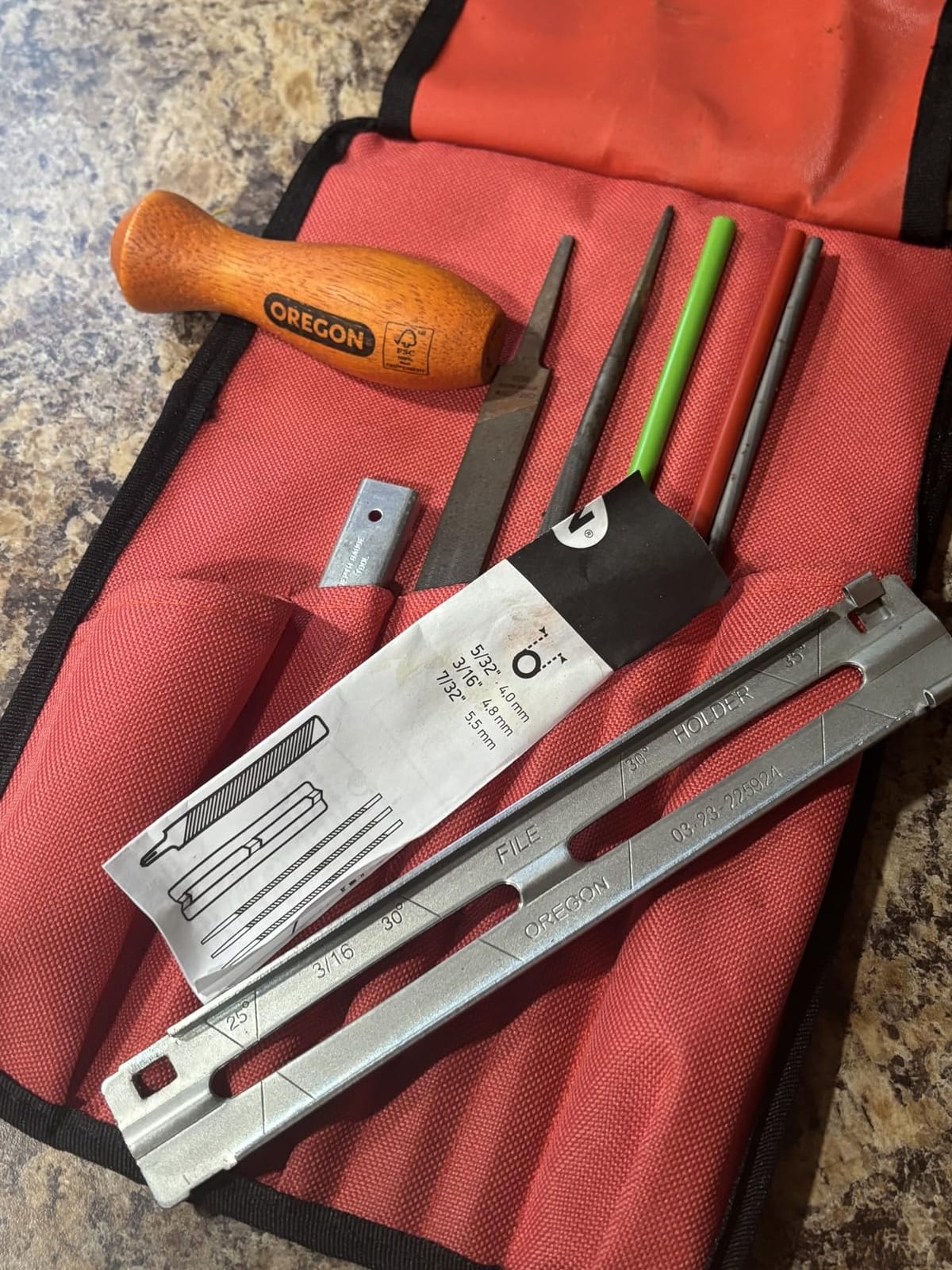
This is the kit we keep handing to people who ask us what to buy first. It packs three round files at 5/32 inch, 3/16 inch and 7/32 inch, which covers virtually every chain a homeowner will own, plus a 6 inch flat file for depth gauges, a universal file handle, a filing guide and a roll-up canvas pouch. Nothing needs power.
The filing guide is the reason it earns the top spot. Without one, hand sharpening is guesswork on both the angle and how far you drop the raker. With it, you sweep the file across the cutter at a repeatable angle and let the guide set the depth gauge height in the same motion. Reviewers report the files are straight and remove material quickly, and one long-running hands-on test thread on the Arborist Site forum settles on this Oregon universal kit as the best choice for most people, with the Granberg File-N-Joint as the classic benchmark.
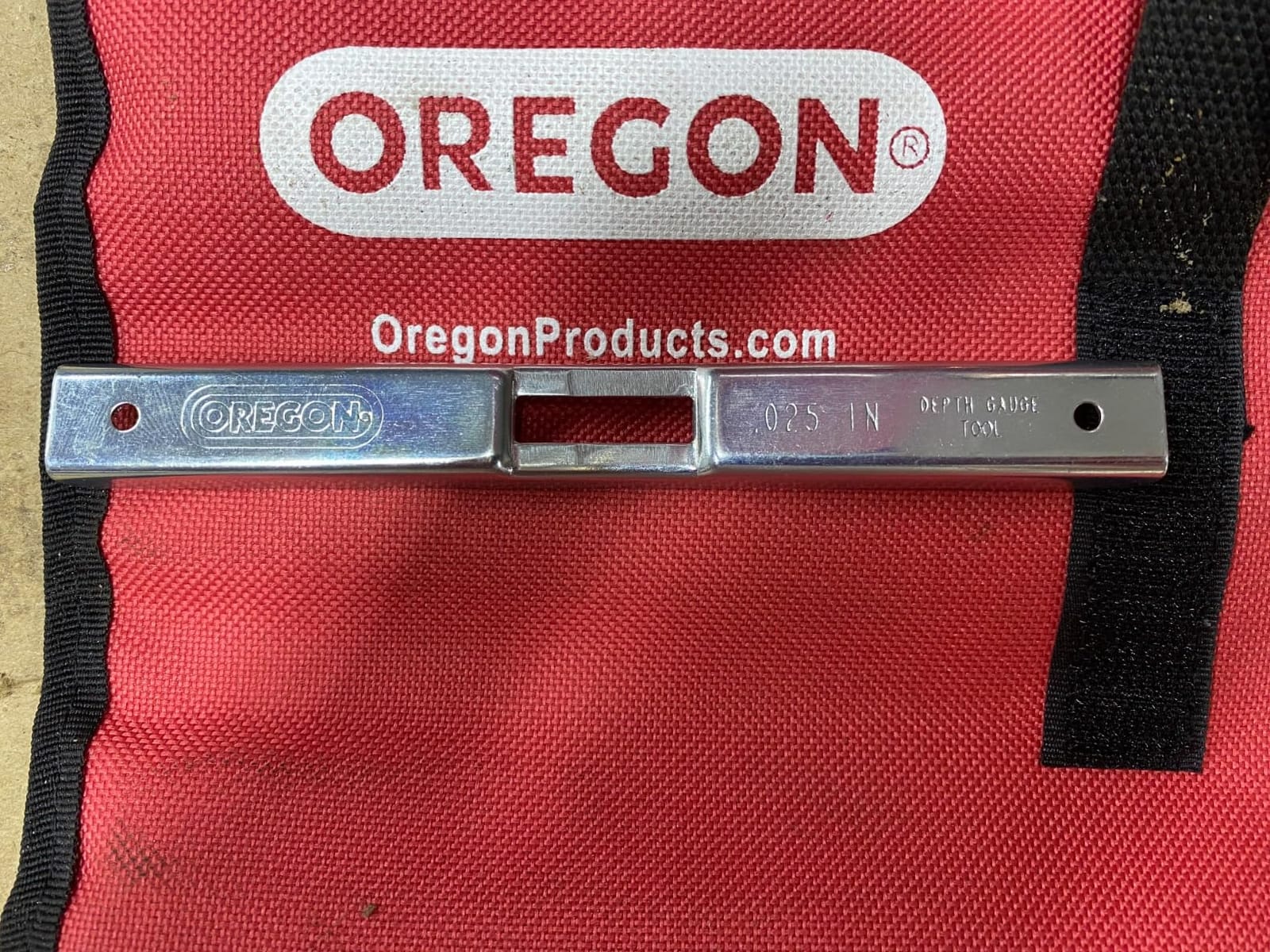
Build quality is the quiet strength here. The handle and guide are sturdy enough to survive years in a truck bed, and the pouch rolls up small enough to sit in a saw sling. Owners who moved up from a single-file approach say the results beat what they were getting from a competing Stihl sharpening tool, which is not a small claim given how many of them own Stihl saws.
The honest downsides are minor. The instruction sheet is not explicit about every filing detail, so a first-timer may need a short walkthrough on raker height. The canvas roll is not water resistant, which matters in the woods. And there is no second handle for the flat file, so raker work is a one-handed job.
Is this the right sharpener if you own more than one saw?
Yes, if the chain is a standard round-ground type. Three file sizes plus a flat file covers everything from a 1/4 inch mini saw up through a full-size bar, and the pouch means the whole set lives together rather than rattling loose in a drawer.
One caveat worth naming: standard files are for standard chain. If you have moved to carbide chain, none of these round files will touch it, and you need a diamond or carbide-specific wheel instead.
Where this kit disappoints
It does nothing for you if you cut several loads a week and want a chain back in an afternoon rather than an evening of filing. There is no motor here, by design, so grinding speed simply is not on the table.
It also does not fix a chain that has already been run badly out of shape. A chain that has been digging in for a season needs reshaping work, not a touch-up, and that is a bigger job than this kit is built for.
2. EzzDoo Electric Chainsaw Sharpener Kit – Best for Sharpening Without Removing the Chain
- Sharpens the chain while it is still on the bar
- Roughly three times faster than hand filing
- Angle guide gives equal sharpening on every tooth
- One diamond bit can sharpen 5 or more chains
- Useful when hand or wrist issues rule out filing
- Motor runs warm during extended use
- Angle guide gets in the way for some users
- Diamond bits can wear mid-chain
- Angle adapter quality is only fair
The defining feature here is that the chain stays on the bar. You clamp the guide bar, rest the tool on the cutter and go tooth by tooth, which means no bar removal, no chain tension changes and no loose chain across the bench. For anyone who has fumbled a chain back onto a bar in the cold, that convenience alone is worth a lot.
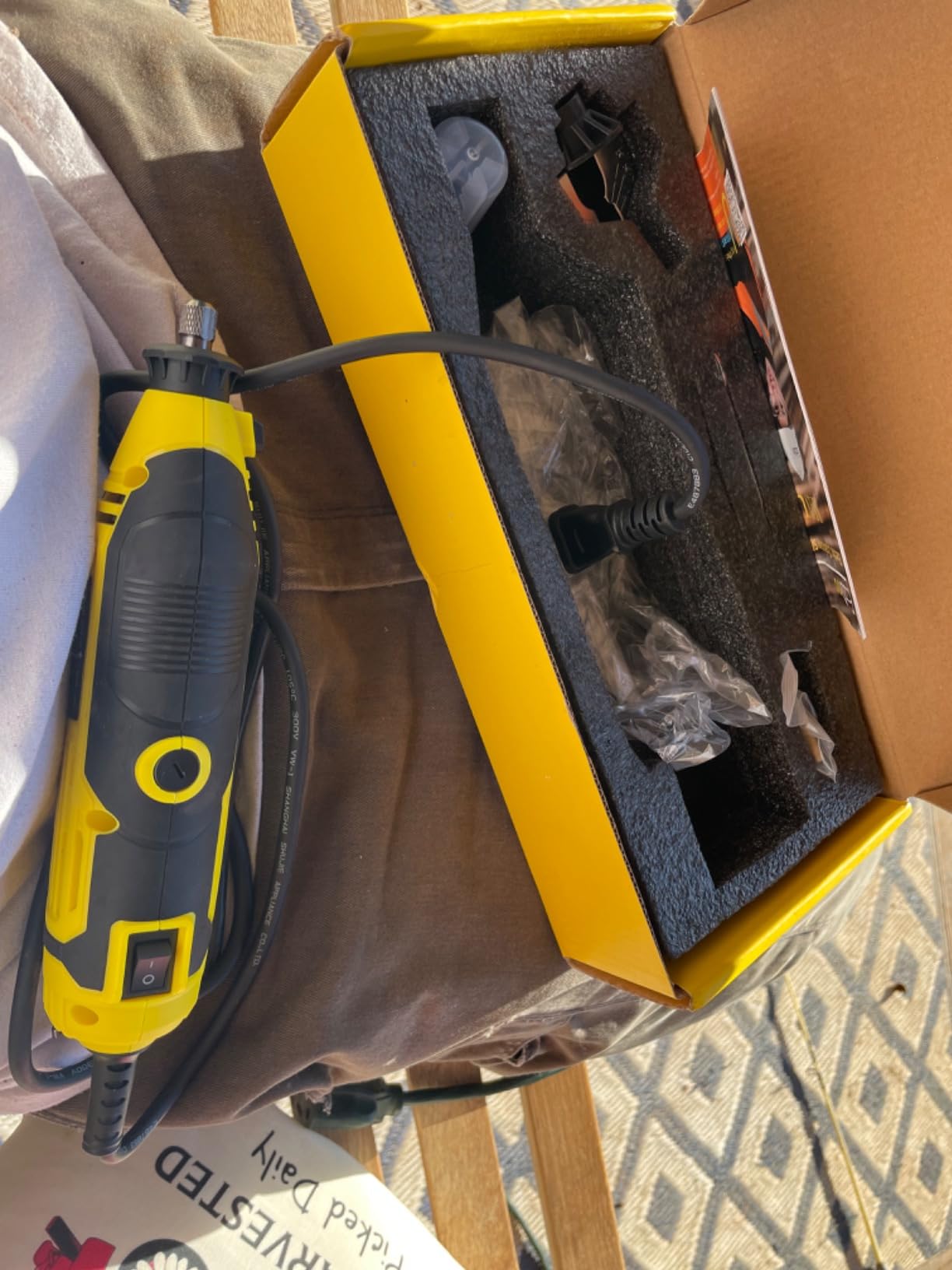
The kit ships six titanium-coated diamond bits across three common sizes, plus an angle guide attachment, both a pro and a normal wrench, a sharpening tool, two spare carbon brushes and a backup collet. Those spares matter, because carbon brushes are the part that wears out first on a tool like this.
Reviewers consistently report a large gain in speed and consistency over hand filing, and clean fast cutting afterward. One common positive theme is accessibility: several owners with hand or wrist problems specifically bought this because filing a full chain by hand had become painful.
The recurring caveats are honest ones. The motor runs warm on heavy workloads, so this is a seasonal sharpener rather than something for continuous daily shop use. The angle guide is awkward for some setups, one adapter arrived bent, and a diamond bit can wear down partway through a chain, which leaves you finishing with an inconsistent tooth.
How much faster is this than a hand file?
Owners put it at roughly three times faster than filing by hand, and the difference grows on a badly dull chain. A full bar that would take a long evening of sweeps comes back in a fraction of that time, which matters most when you are sharpening between cordwood rounds rather than sitting down for a planned maintenance session.
The speed comes from diamond bits rather than rotary stones, and reviewers note they hold up well, with a single bit reported to be good for five or more chains. That is a real consumable cost advantage over stone wheels.
When to pick something else
Pick a manual kit if you cut a few loads a year. An electric sharpener earns its keep on volume, and a warm motor during long sessions is a poor trade when you are only doing two sharpenings a year.
Also consider the burn risk. A rotating abrasive wheel removes metal faster than a file and will over-grind if you dwell on a tooth, which shortens chain and bar life. Short passes, one tooth at a time.
3. Sharp Pebble Electric Chainsaw Sharpener Kit – Best Electric Sharpener for Consistent Angles
Sharp Pebble Electric Chainsaw Sharpener Kit – Chain Saw Sharpening Tool
- Sets the angle once so every tooth matches
- Sharpens even the bluntest chains in minutes
- Works comfortably for either hand
- Lightweight at 16 ounces
- Reduces saw effort and extends chain life
- Wheel bits are consumables that wear over time
- 4.4 average is below the top-rated manual kits
- No case or pouch included
This kit ranks at the top of the chain saw sharpener category, and the reason owners cite is angle repeatability. You set the grinding angle once, and every subsequent tooth is cut to that same setting, which removes the single hardest part of hand sharpening: keeping your wrist consistent for several dozen strokes.
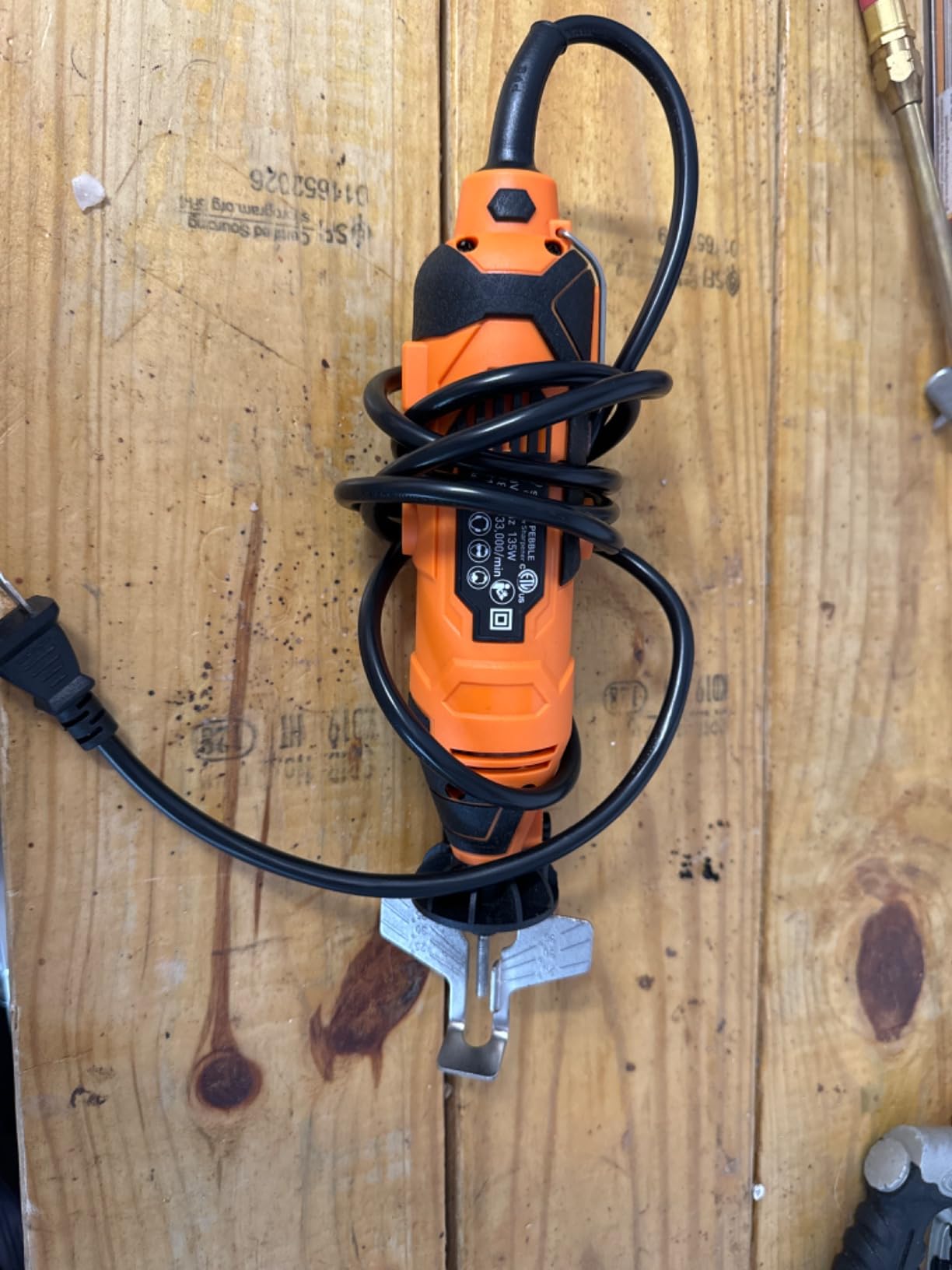
It is a 120V corded tool with four wheel bits at 5/32 inch, 3/16 inch and two 7/32 inch sizes, an angle guide attachment, a wrench and an eBook. That duplicated 7/32 inch wheel is a genuine oddity in the box, and no one has convincingly explained it, so treat it as spare rather than a special feature.
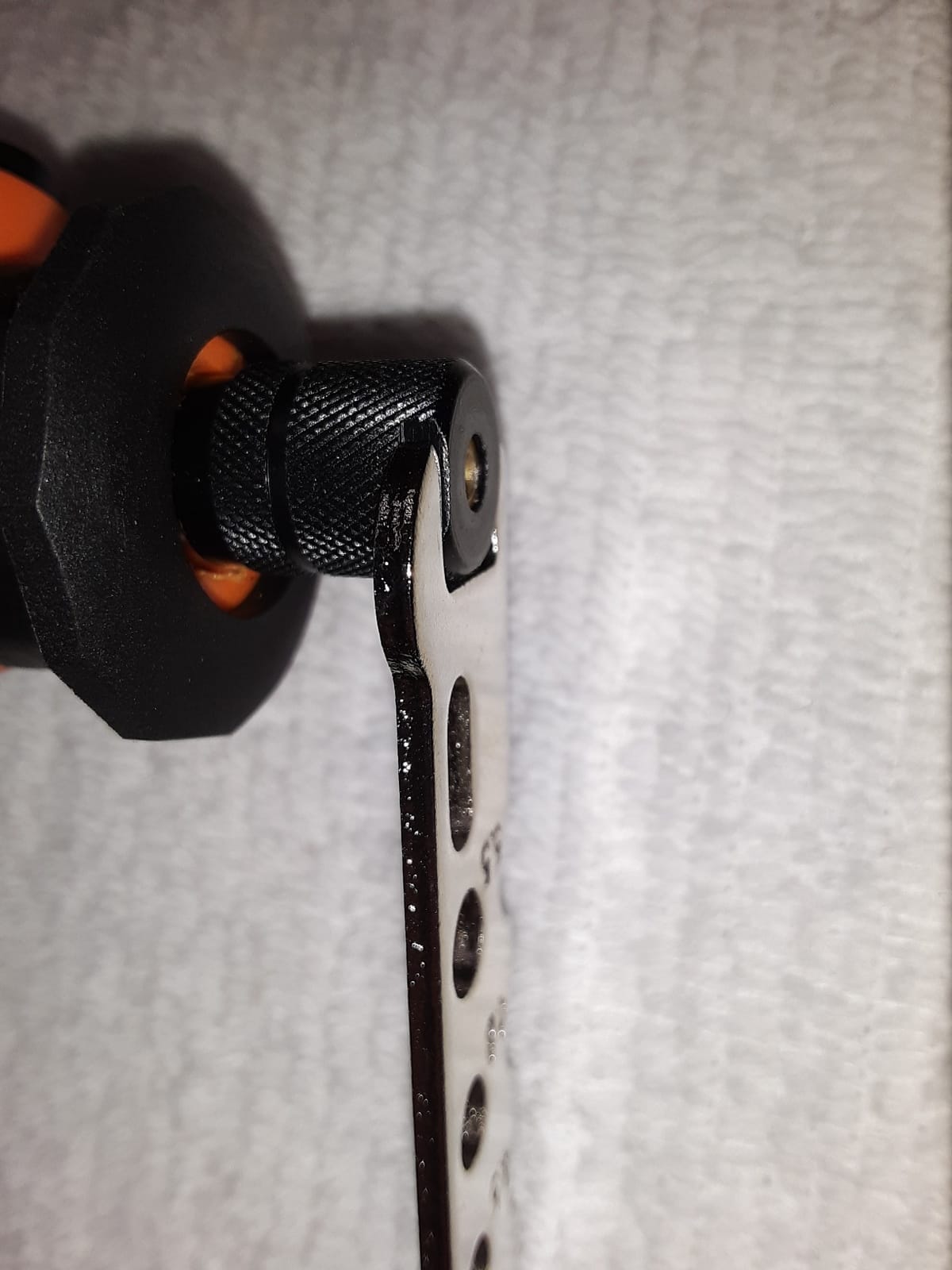
At 16 ounces it is one of the lighter electric options, and reviewers like the combination of a ball-bearing motor for stable disc rotation with adjustable speed settings for a cleaner finish. It handles both handedness comfortably, which some competing guides do not. Owners also report that a sharp chain visibly reduces the effort the saw needs, extending chain and engine life.
Be clear-eyed about the trade. The 4.4 average sits below the highest-rated manual kits, the wheel bits are consumables that dull with use, and there is no carrying case, so the loose parts tend to migrate in a toolbox.
Is a 120V corded tool restrictive compared with battery or 12V models?
For garage work, not really. You need an outlet within reach of where you clamp the saw, and the cable is the thing that decides whether a bench or a driveway. If you are sharpening where there is no outlet, the 12V car-powered unit further down handles that case better.
There is no battery to charge, no battery to age out over a decade, and no runtime ceiling. For a fixed setup this is the more reliable choice.
What about the over-grinding problem?
It is the main risk with any rotary sharpener and the most common complaint forum owners raise. A rotating wheel strips metal far faster than a file, and holding it on one tooth will heat and burn the steel blue.
Use the angle guide, keep the wheel moving, and take two or three short passes per tooth rather than one long one. Pull the tool back to check after the first tooth rather than after the whole bar.
4. Oregon Professional Compact Bench Chain Grinder – Best for Owners Who Cut Every Week
- Permanent hands-free sharpening station
- Covers chains up to .404 inch pitch
- One-way motor rotation improves safety
- Sharpens chains in-house and saves replacement costs
- Includes dressing brick
- profile guide and depth gauge disc
- Weighs 17 pounds so it needs a solid bench or wall
- A step up in cost and complexity versus handheld units
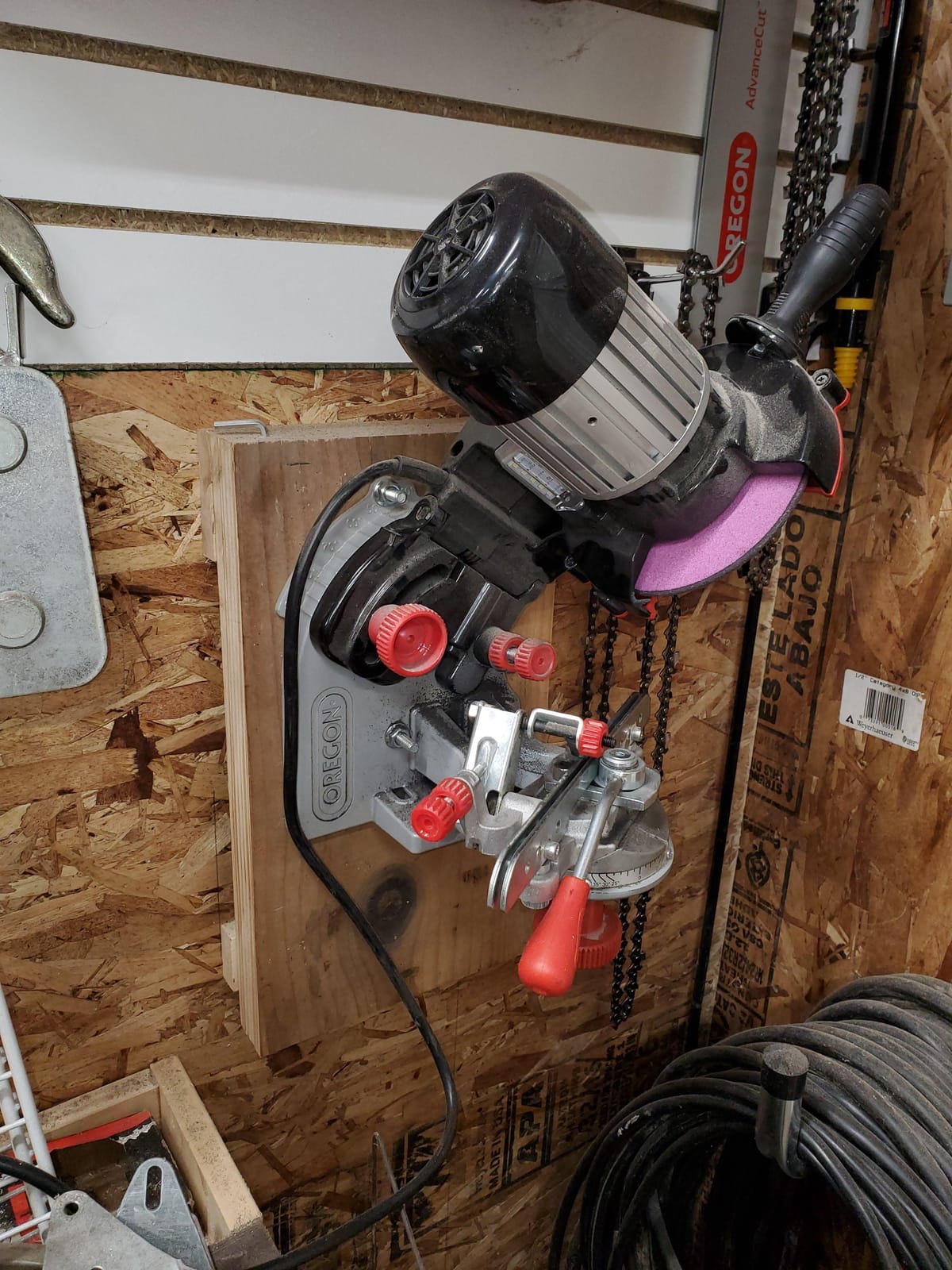
This is the pick for someone who has already outgrown a handheld. It mounts to a bench or a wall with two included bolts and becomes a permanent station with a manual chain clamping vice, so the bar sits still while the wheel does the work. For a weekly firewood habit, that difference in convenience is substantial.
The grinder runs 220 watts at 120 volts, spins to 3150 rpm in one direction only, and sharpens chains up to .404 inch pitch from Oregon, Stihl, Husqvarna and others. That coverage means nearly every consumer chain you will meet. The box includes a dressing brick, a profile guide, 3.2 mm and 4.7 mm grinding wheels and a 6.0 mm flat profile disc for depth gauges.
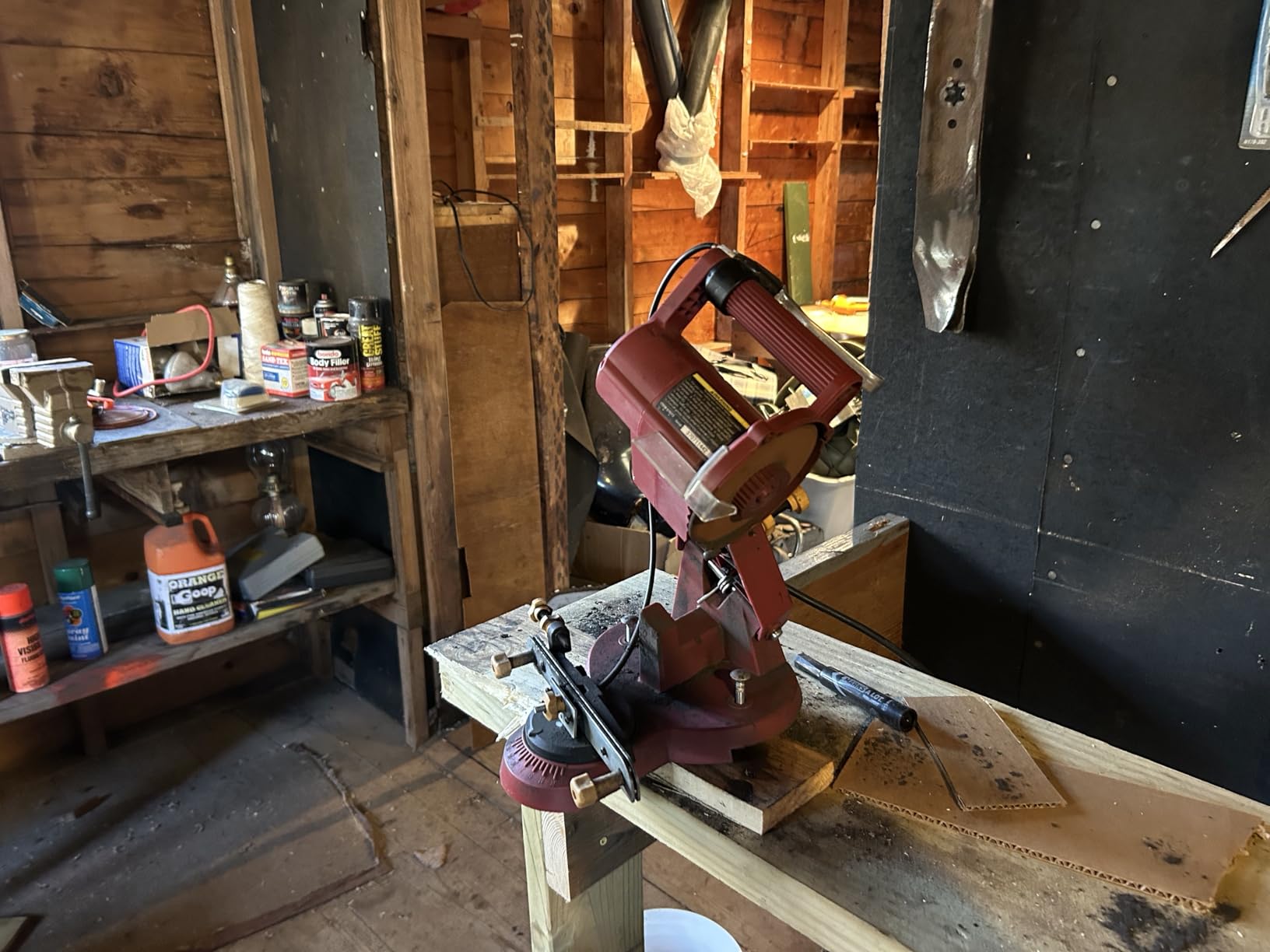
Owners cite durability, broad chain coverage and the long-term math: sharpening in-house beats buying a new chain every few months. With more than 3,000 reviews and a high share of five-star ratings, the complaint pattern is thin, which is unusual for a powered tool in this category.
One-way rotation and a manual vice are the safety story as much as the convenience story. A wheel that only turns one way cannot pull itself into the chain, and a clamped bar cannot jump while you work. That is worth more than it sounds.
Is a bench grinder overkill for a homeowner?
For most homeowners, yes, and we would not put it on a list of five sharpeners. Buy it when you are sharpening weekly or maintaining several saws, because at that volume the time saving and the avoided chain replacements start to matter.
It is a genuine step up in cost and complexity compared with a handheld electric unit. If you cut a few loads a year, a file kit does the same job and takes a fraction of the setup.
What should you avoid at this price level?
Skip anything in the several-hundred-dollar-and-up range aimed at tree services and forestry contractors. Those machines assume chains coming off professional saws every hour of the day, and a homeowner would be paying for duty cycles never reached.
The 500 dollar-plus hydraulic and commercial grinders that dominate shopping carousels for this keyword are built for a business case, not a garage. Judge a bench grinder on whether you will mount it and use it weekly.
5. Stihl 2 in 1 Easy File – Best for Owners of Stihl 3/8 Inch Chains
Stihl 2 in 1 Easy File Chainsaw Chain Sharpener 3/8″ 5605 750 4305
- Resharpens the cutter and lowers the depth gauge in one pass
- Built-in holder keeps the angle consistent
- Very high share of five-star ratings
- No power needed
- works anywhere
- Sized only for Stihl 3/8 inch chains 5605
- 750 and 4305
- Not a general purpose sharpener for other pitches
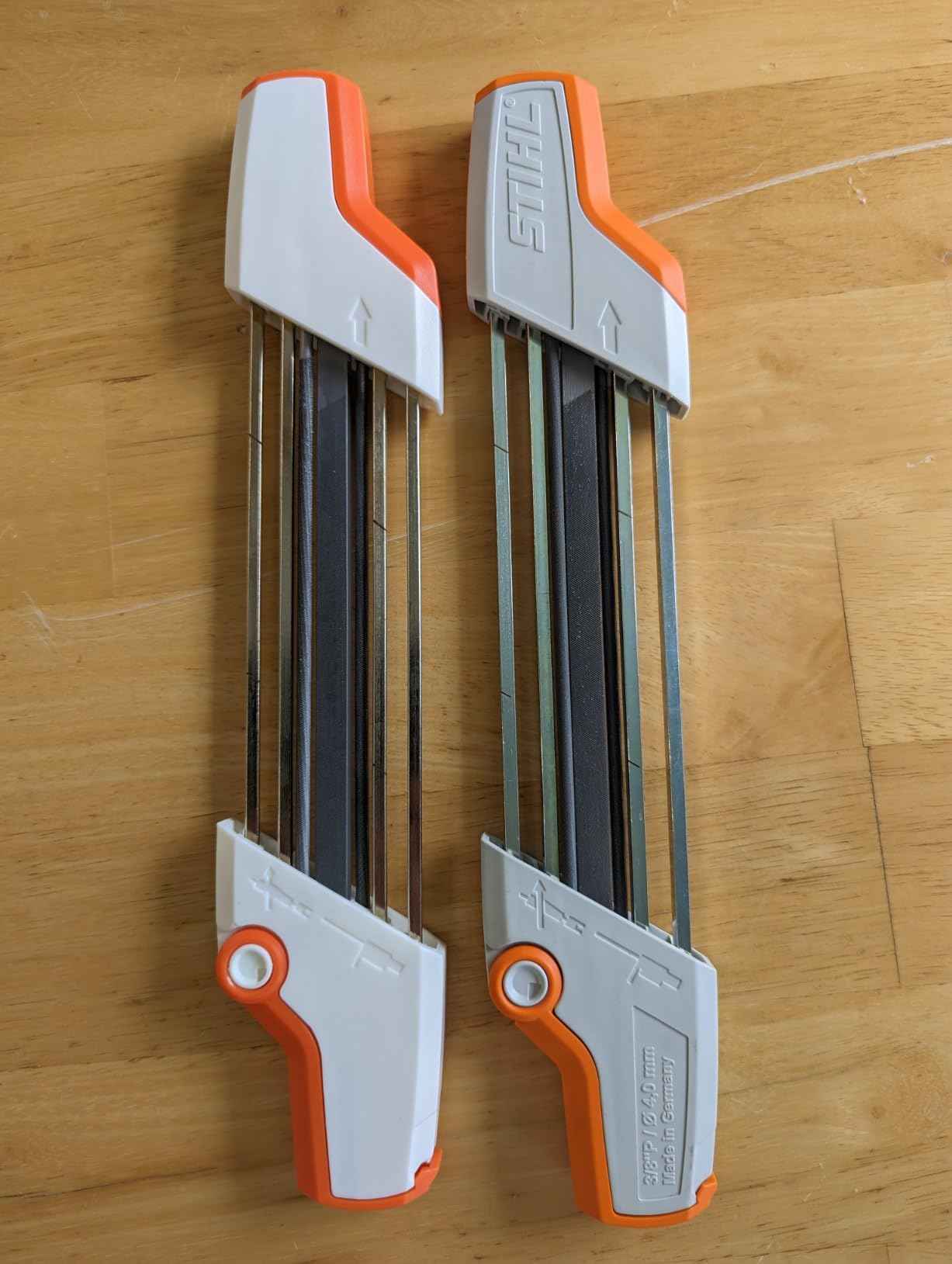
If your saw is a Stihl running a 3/8 inch chain from the 5605, 750 or 4305 families, this holder is the most elegant manual tool on the market. The 2 in 1 design reshapes the cutter and lowers the depth gauge in a single pass, which removes the most tedious part of hand sharpening: filing teeth, then switching tools for every raker.
That is the whole trick. A separate 2 in 1 holder is usually clunky, but this one keeps the file at a fixed, repeatable angle while the guide handles raker height, so consistency comes from the tool rather than from your wrist.
With a 4.7 average and an unusually high share of five-star ratings, owner satisfaction is about as concentrated as it gets in this category. Owners of the matching chains describe the one-step workflow as the reason they stopped dreading chain maintenance. There is no power source, no consumables beyond the file, and nothing to break electronically.
The limitation is scope, and it is a hard one. This is not a universal sharpener. It is built for 3/8 inch pitch Stihl chains, and for full chisel chain types. Buy it as a second tool, not as a replacement for a general kit.
Is this a good first sharpening tool for a beginner?
It is, provided your saw matches. A first-timer benefits far more from a tool that fixes the angle and the raker height for them than from a bare round file, and this holder does both. The learning curve is close to zero because the tool enforces the two hardest things to learn.
If your saw does not match, skip it. A holder sized for the wrong chain will fight you rather than help, and a mismatched file diameter will not cut correctly.
Should this be your only sharpener?
Only if you own one Stihl saw on that chain. Anyone with a second saw, a pole saw or a neighbor’s saw to help will find the narrower scope limiting fast, and the general kit is the better single purchase.
Verify the chain code stamped on the drive link before ordering. The model list is short and specific, and there is no substitute for checking it.
6. Oregon 12V Sure Sharp Electric Sharpener – Best for Sharpening in the Field
- Covers 1/4 inch
- 3/8 LP
- .325
- 3/8 and .404 inch chains
- Runs away from a wall outlet
- Simple sharpening angle guide
- Angled body reaches the chain easier
- Replacement stones widely available
- Sharpening stones wear and need periodic replacement
- Needs a vehicle or battery nearby
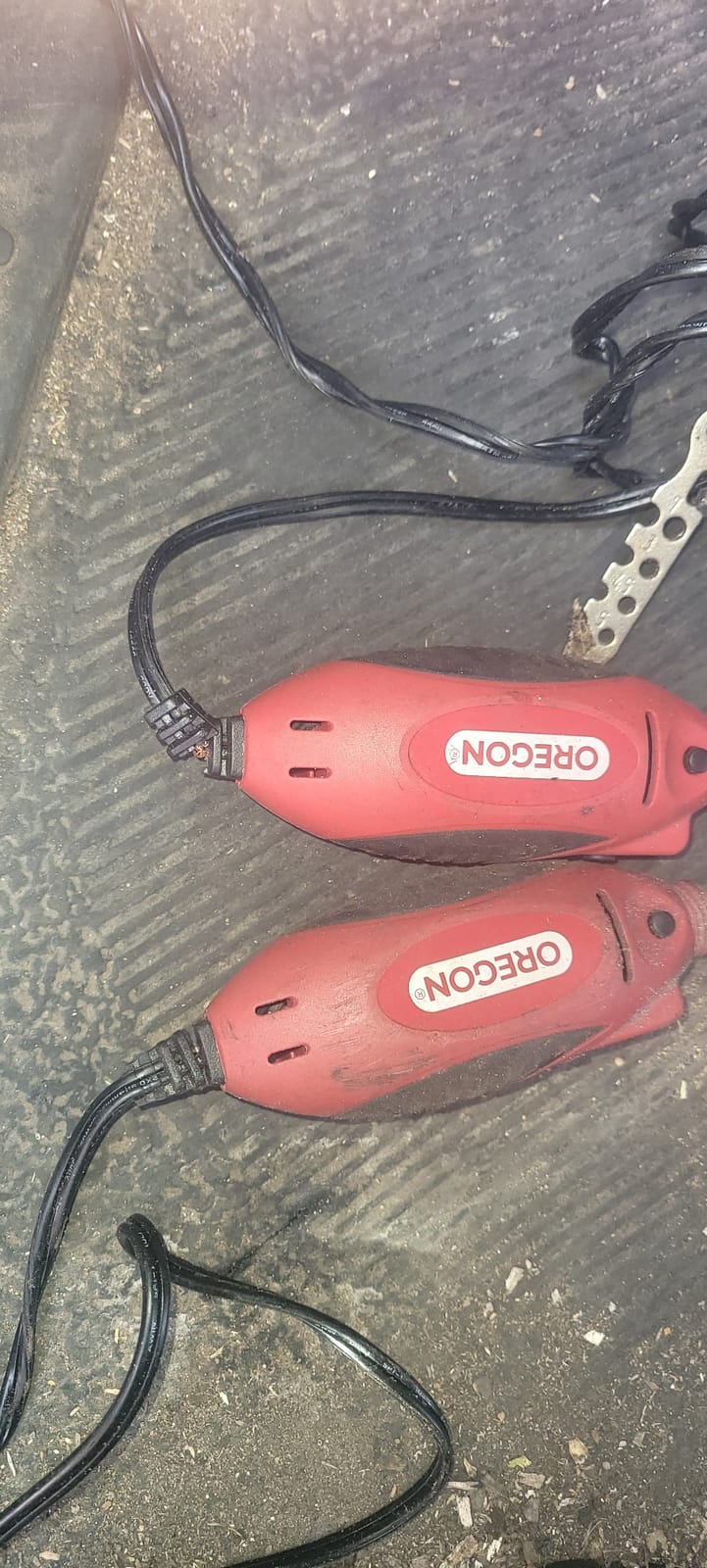
Most electric sharpeners assume a garage with a wall outlet. This one is built for the opposite case. It runs from a 12 volt car adapter or straight off battery clips, on a 16 foot cable, so you can sharpen a dull chain in the driveway or at the far end of a downed tree instead of walking it back to the bench.
The chain coverage is the quiet strength: 1/4 inch, 3/8 inch low profile, .325 inch, 3/8 inch and .404 inch round-ground chain, which is close to everything a homeowner owns. Three stones at 5/32 inch, 3/16 inch and 7/32 inch and a collet wrench are included, and replacement stones are easy to find.
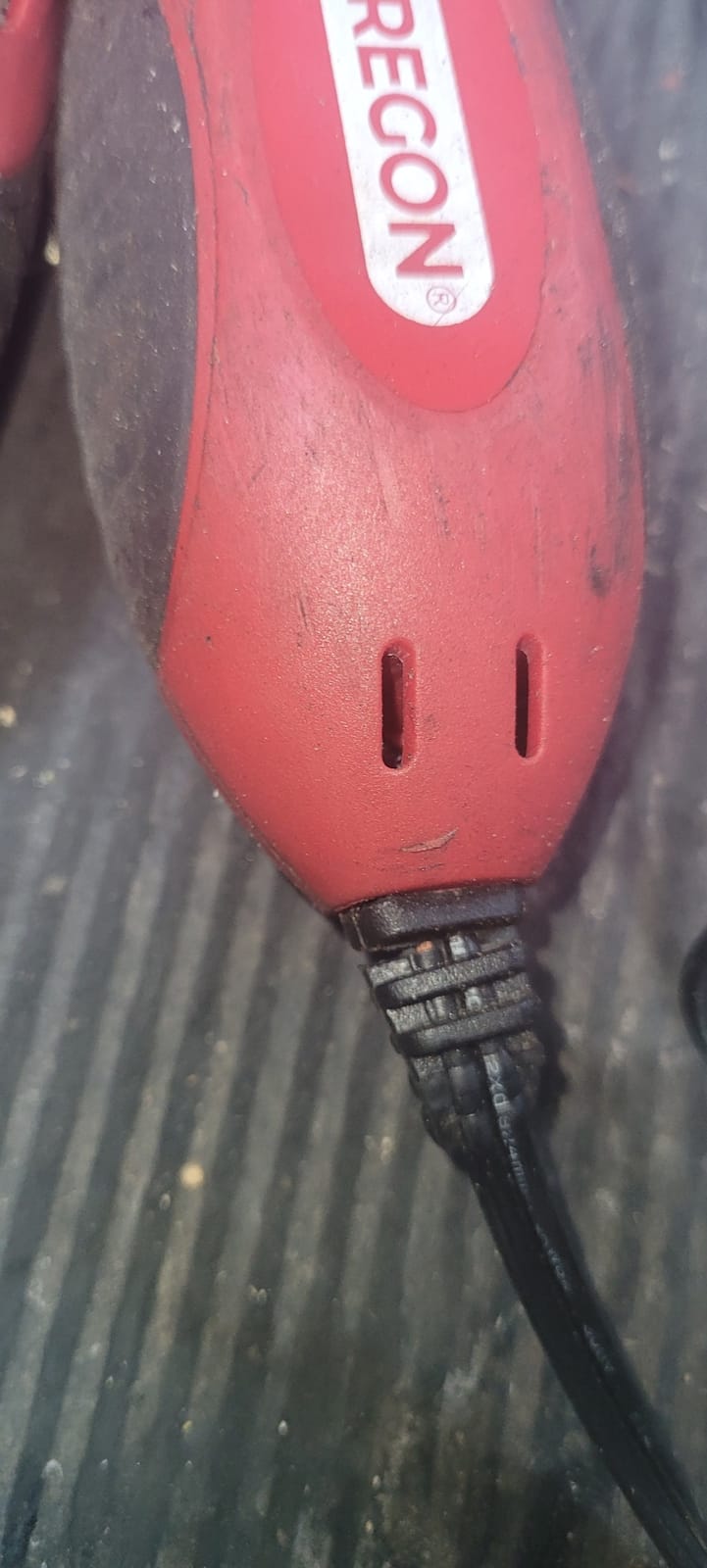
The angled body is a small design decision that pays off in practice, because it lets you get at the chain without contorting your wrist. The simple angle adjustment guide is what keeps results repeatable, and at 16 ounces the whole tool is easy to hold one-handed with the other hand on the bar.
Two limits are worth planning around. The stones wear and need replacing, and a 12V source means the tool is useless if you are far from a vehicle. Neither is a dealbreaker for the owner this product suits.
Is a 12V car-powered sharpener better than a corded 120V unit?
Only if you sharpen away from an outlet. For a garage, a 120V tool with a ball-bearing motor is more consistent and has no cable to snag. For a woodlot or a property where you cut away from the truck, the 12V approach is the only one that works at all.
Battery clips add flexibility, since you can connect to a battery rather than relying on a running vehicle.
What does low profile chain change?
It changes the file and stone you need. Low profile chains run a shallower gullet, which means the top plate angle and the raker geometry are tighter than standard profile. Using the wrong stone or a standard-angle setting on a low profile chain is how people end up with a chain that cuts roughly after a fresh sharpening.
This tool lists 3/8 inch low profile support explicitly, which is more than most competitors state.
7. Hipa 12 Pack Chainsaw File and Sharpener Kit – Best for Owners of Many Different Saws
- Widest file coverage with 6 round sizes including 1/8 and 13/64 inch
- Size markings carved into each file
- Quick gauge checks pitch angle tooth length and depth gauge
- Bar groove cleaner for bar channels and oil holes
- High visibility orange pouch
- At 12 pieces the kit is bulkier than a three-file set
- No powered option
- fully manual
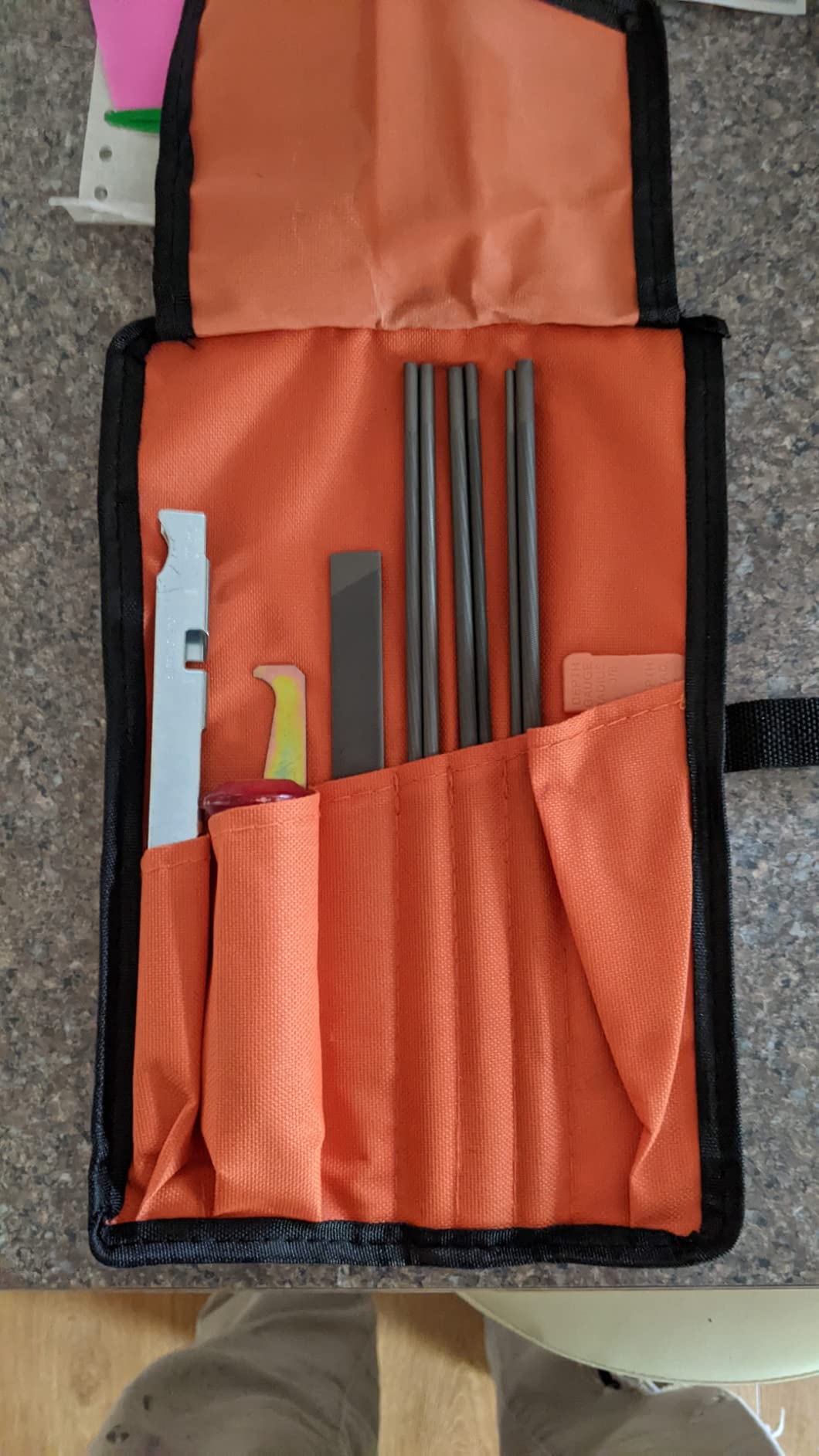
Where most three-file kits stop at the common pitches, this one keeps going. It carries six round files at 5/32 inch, 7/32 inch, 3/16 inch, 11/64 inch, 1/8 inch and 13/64 inch, and the maker lists compatibility across 1/4 inch, .325 inch, 3/8 inch, 3/8 inch low profile, .404 inch, 7/16 inch, .354 inch and 1/2 inch pitch chains.
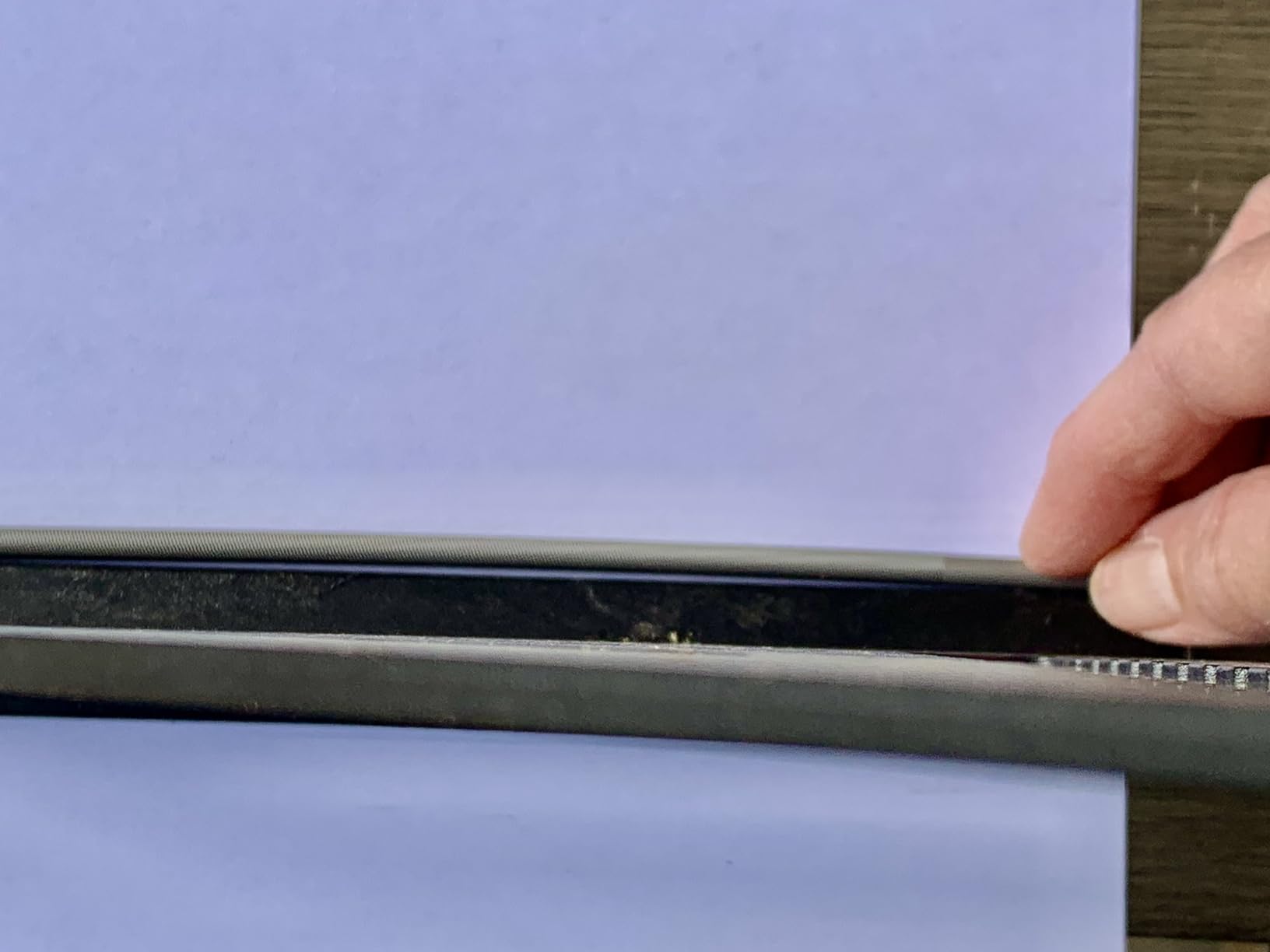
The supporting tools are what separate it from a plain file bundle. There is a 6 inch flat file, a 2 in 1 depth gauge tool covering .025 inch and .030 inch, a multi-function quick gauge that checks pitch, filing angle, cutter tooth length, depth gauge size and bench grinding wheel thickness, and a bar groove cleaner for the bar channels and oil holes.
For a household with two or three saws, or a pole saw and a chainsaw, that coverage removes the guesswork entirely. File sizes are carved into each handle, so you are not reading tiny stamped marks, and the wooden handle is comfortable across a long session. Reviewers point to exactly this: easy identification and beginner friendliness at a strong value.
The bar groove cleaner is an underrated addition. A blocked oil hole and a packed bar groove are real causes of poor cutting, and almost no competing kit includes a tool for them.
Is 12 pieces too much for one saw?
If you own one standard 3/8 inch saw, yes, and you will use three of the twelve pieces. The set is bulkier in a drawer or a truck bed, and the extra files are dead weight for a single-chain household.
For anyone maintaining a small fleet of saws, the ratio flips immediately. Rare pitches that would otherwise need a special order are simply in the pouch.
What does the quick gauge actually tell you?
It consolidates five separate measurements into one tool: chain pitch, filing angle, cutter tooth length, depth gauge size and grinding wheel thickness. For a beginner, that removes the guesswork from the two settings that matter most, the angle and the raker height.
It does not sharpen anything by itself. It tells you whether the settings you are about to use are correct for the chain in front of you, which is a different and more useful job.
8. Honoson 3 Piece Chainsaw File Set – Best Budget Pick for Occasional Cutting
- Covers the three most common chain pitches
- Quenched steel resists abrasion and holds its edge
- Handles reduce hand fatigue over long sessions
- Hanging hole in each handle for storage
- Also works for general metalwork and carpentry
- No filing guide or depth gauge tool included
- No carry pouch
- Angle consistency is entirely on you
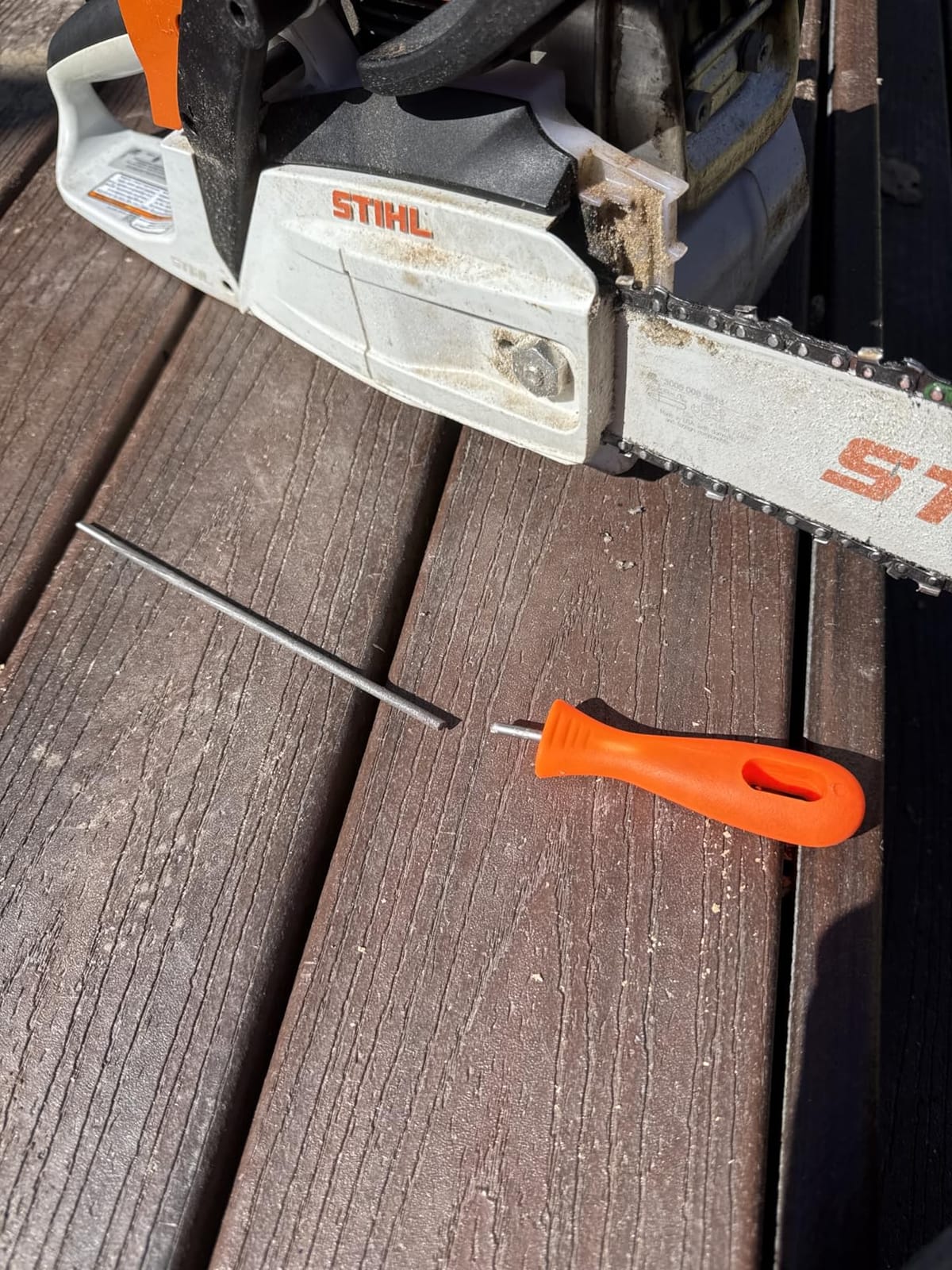
Three files, 5/32 inch, 7/32 inch and 3/16 inch, in high-strength steel with a high-temperature quenched surface treatment, each with a plastic handle. That is the entire product, and for a homeowner cutting a couple of loads of firewood a season it does the job properly.
The quenched surface is the detail that matters. File steel that has not been treated wears and rounds off quickly, and a rounded file leaves a chain looking sharpened without actually cutting. Reviewers consistently single out the steel as durable and edge-holding, which is the main quality risk in a kit this simple.
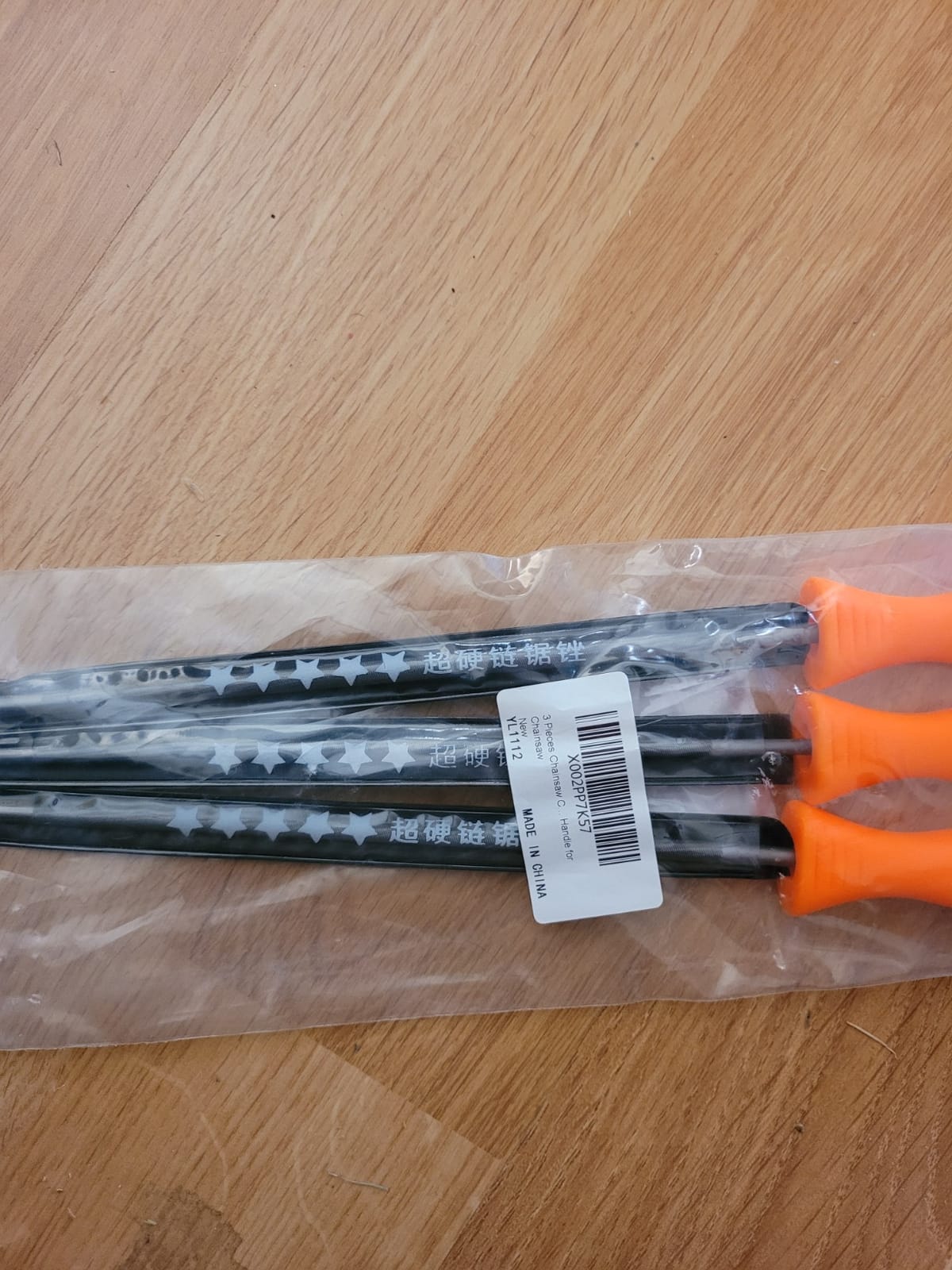
Handles matter more than buyers expect. A bare file rolls in your hand and wears a blister; a moulded handle with a hanging hole gives you a consistent grip and a place to store it. Reviewers also note the files double for ordinary metalwork and carpentry, so they are not sitting idle eleven months of the year.
What you give up is everything that makes hand sharpening hard. There is no guide, so the angle depends on your wrist, and there is no depth gauge tool, so setting the raker height is guesswork. Neither matters much on a chain used lightly.
Do I need a filing guide with a set this simple?
For light duty, no. If you cut a few loads a year and touch the chain up before it gets away from you, the angle you hold by hand is close enough and the chain will cut fine.
Once you start cutting weekly, or once the chain has been neglected, a guide changes the outcome. At that point the money saved here is spent re-buying chain.
How do you keep three files organized?
The hanging hole in each handle is the storage system. Keep them on a hook or a ring near the saw rather than loose in a drawer, and note the size on the handle with a marker so you grab the right one in the dark.
There is no pouch, so this is a kit for one shed and one saw. Anyone running a woodlot will want the field kit or the 12 piece set instead.
9. F WPKID Portable Chainsaw Sharpener – Best for Small Electric and Gas Saws
- Lightweight at 12.3 ounces and easy to carry
- Fits a 4 inch to 22 inch range of saw sizes
- Five grinding stones bundled with the tool
- Compact 4 x 3 x 2.5 inch body
- Only 164 reviews so long term durability is not well established
- Marketing copy does not detail specific chain pitch coverage
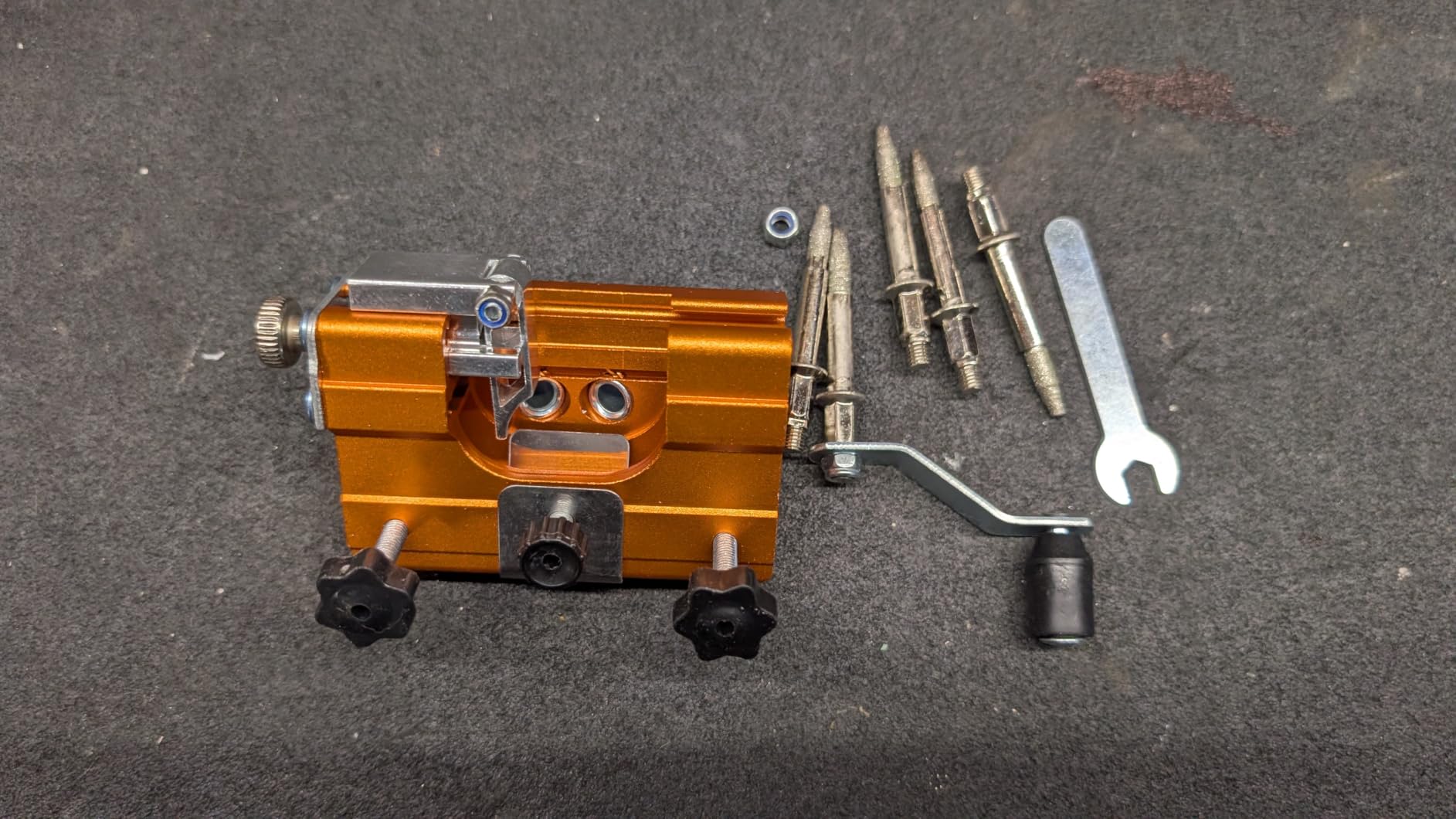
At 12.3 ounces and about the size of a paperback, this is the smallest tool in the lineup, and the pitch is obvious: sharpening a small 4 inch electric or pole saw without dragging the whole thing to a bench. Five diamond drill bits come bundled, and the stated fit covers 4 inch to 22 inch electric and gas powered saws.
For a homeowner with a battery trimmer or a small electric chainsaw and a gas saw on the same property, having one small powered tool that covers the range is genuinely convenient. Diamond bits cut aggressively and hold longer than rotary stones, which is the same advantage reviewers credit on other diamond-bit sharpeners.
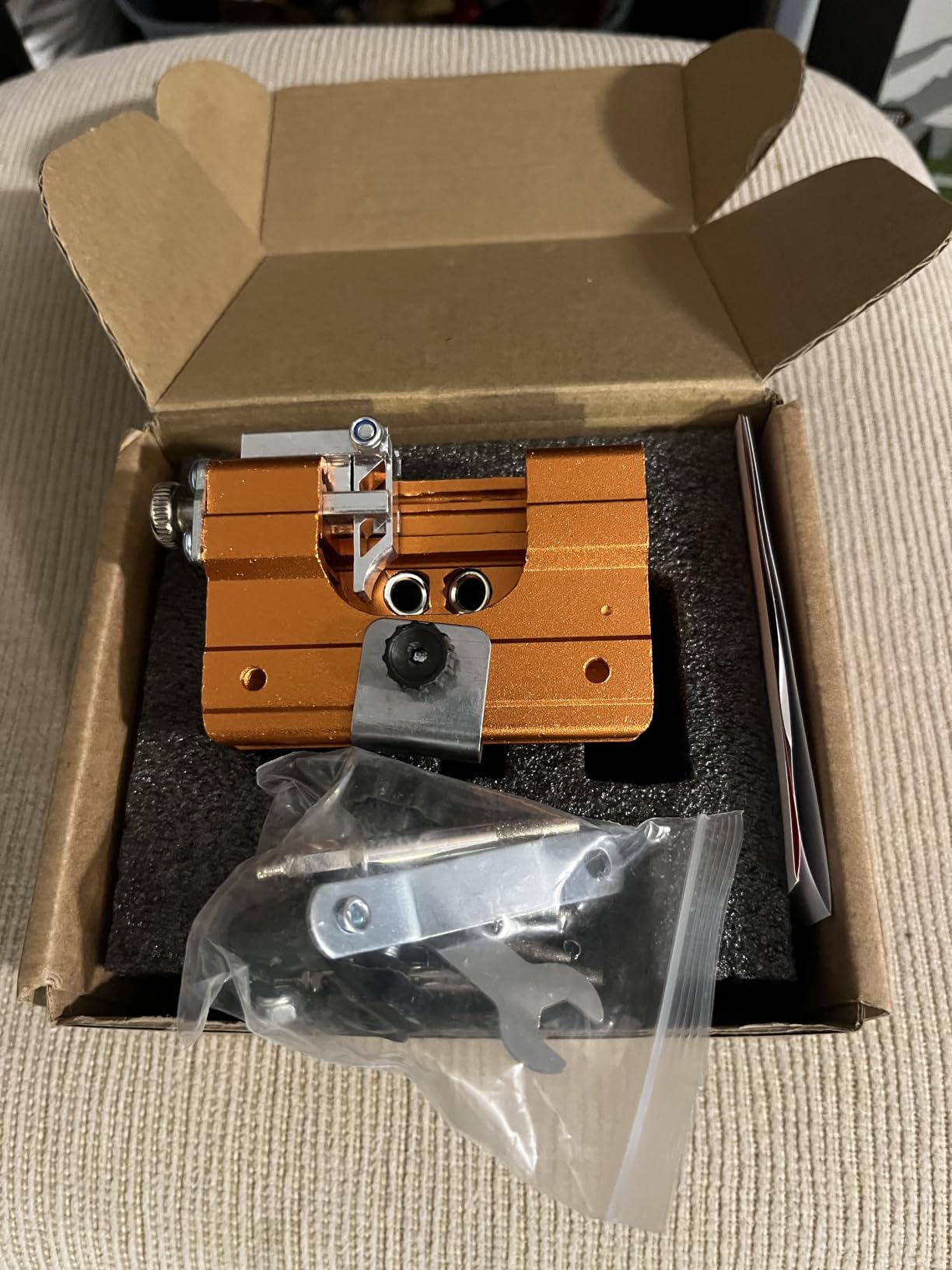
Here is the honesty note on this one. The catalog shows a 4.6 rating across 164 reviews, which is thin evidence compared with the multi-thousand review counts elsewhere in this list. Long term durability is not established, and the listing copy does not spell out which chain pitches the bits fit, so you are trusting the general fit range rather than a specific pitch specification.
It is also worth knowing the review text attached to this listing does not describe a chainsaw sharpener at all. That does not tell you the product is bad, but it does mean you should treat the review average as unverified and decide on the specifications alone.
When is a tool this small the right answer?
When the saw is small and the sharpening is occasional. A 4 inch electric chainsaw dulls quickly because its chain has fewer cutters, and taking it apart to file it is fussy. A compact powered tool handles that in a couple of minutes.
It is not a substitute for a proper setup on a full-size bar. At 12.3 ounces there is no stability for long passes, and a light tool makes a steady angle harder to hold.
Does it cover carbide chain?
Diamond bits are the right tool family for carbide, unlike the standard round files in the manual kits. But this listing does not state pitch coverage, so confirm what you actually have before you commit.
Check the chain code and confirm the fit with the seller rather than assuming. It is a cheap question to ask and an expensive one to get wrong.
10. Chicago Electric Sharpener with Wall Bench or Vise Mount – Best Starter Bench Unit
- Sharpens a chain in a fraction of the time of manual work
- Mounts to a wall
- a bench or a vise
- Owners report the motor lasting 15 or more chain sets
- Quick to set up and easy to learn
- High speed steel blade at a 35 degree cutting angle
- Plastic body
- chain track and lock feel cheap
- Weakest point is the chain track and locking brake
- Best suited to occasional rather than daily use
This is the entry point into mounted electric sharpening. It clamps to a wall, a bench or a table vise, comes with a chain clamp handle and a table vise, and runs a 90 watt 120 volt corded motor at 5000 rpm with capacity for an 18 tooth chain.
The mounting options are the point. A vise mount means you can take the whole thing to a workbench, while wall mounting keeps it out of the way until you need it. Owners who sharpen occasionally say it pays for itself quickly and is dramatically faster than manual work, and several report the motor has sharpened 15 or more sets of chains.
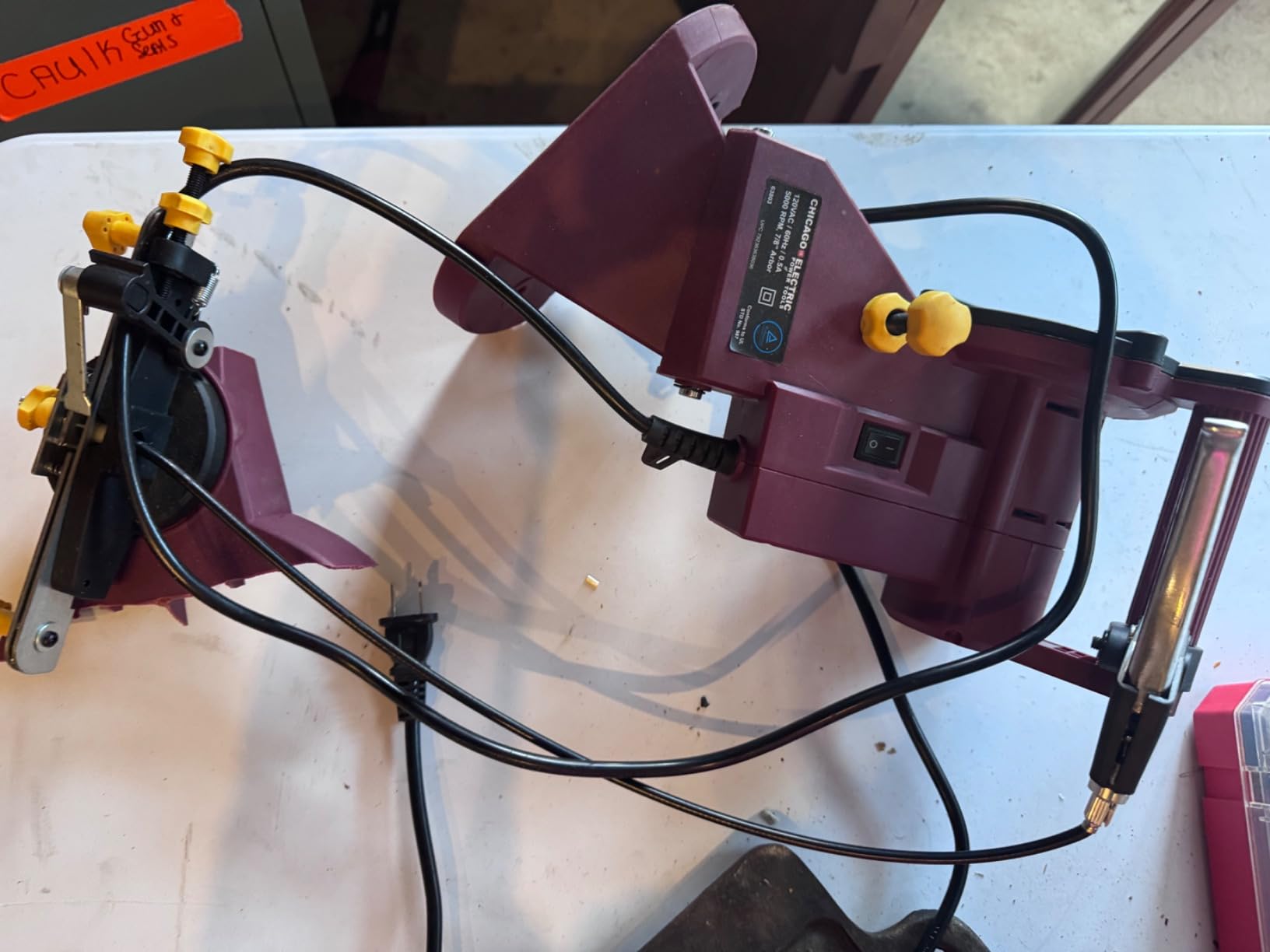
The blade is high speed steel at a 35 degree cutting angle, which is a steeper, more aggressive geometry than a typical filing angle. It cuts quickly, which is the upside, and takes more metal than a file, which is the catch.
This is the lowest-rated product in the lineup at 4.3, and the reason is consistent: the motor works, but the plastic body, the chain track and the locking brake feel cheap. One reviewer received a unit with the handle broken in two. It is a tool for occasional sharpening, not a daily shop machine.
How good is a 35 degree cutting angle for a chainsaw?
It works and it is fast, but it is a compromise. Most hand filing is done around 25 degrees, and a steeper angle leaves a sharper, more brittle edge that dulls sooner. If you are only sharpening occasionally you will not notice much difference.
If you cut heavily, the slower-dulling geometry of a file guide is the better long-term answer even though it takes longer per tooth.
Is this sharpener worth buying over a manual kit?
Only if you want speed more than durability. A manual kit costs less, needs no mounting, cannot have a plastic chain track wear out, and gives you better control over raker height. The case for this unit is that you can restore a chain in minutes.
It is worth noting that budget-brand sharpeners attract real scepticism from experienced owners. A long-running forum thread on chainsaw sharpening tools includes a blunt dismissal of a comparable budget unit, and the lesson is that a familiar brand name does not buy forgiveness for flimsy hardware.
How to Match File and Wheel Size to Your Chain Pitch
Matching file diameter to chain pitch is the one decision that can make an expensive sharpener useless. A file that is too small will not follow the gullet, and one that is too large will not seat properly, so neither produces a correct edge. The standard home mappings are simple.
1/4 inch and 3/16 inch pitch chains take a 5/32 inch round file or wheel.
.325 inch, 3/8 inch low profile and 3/8 inch chains take a 3/16 inch round file or wheel.
.404 inch pitch chains take a 7/32 inch round file or wheel, and this is the size most home bench grinders include.
Rarer pitches such as 1/8 inch, 11/64 inch and 13/64 inch need their own file, which is why a 12 piece kit is worth it if you own more than one saw.
To check your pitch before buying anything, look at the chain while it is still mounted and count three of the small drive links. Divide the total length of those three links in inches by eight, and the result is your chain pitch in inches. The Stihl Easy File holder and the Hipa quick gauge both let you confirm the match without arithmetic.
Carbide chain is the exception that catches people out. Standard round files will not touch a carbide chain at all, and using one wastes the file. If your chain has carbide-tipped cutters, you need a diamond or carbide-specific wheel, and a manual file kit is the wrong purchase.
Manual vs Electric: Which One a Home Owner Actually Needs
For a typical homeowner, the manual file with a guide is the correct answer, and most of the search volume on this keyword is wasted on people buying power tools they will use twice a year. The tier framework is simple.
A few loads a year, one saw: a file kit with a guide. It handles every pitch you will meet, needs no outlet, and has nothing to break. This is where most home use belongs.
Weekly firewood or storm cleanup: a handheld electric sharpener. The time saving across several loads a month is where the money comes back, and the speed gap versus a file is large enough to notice.
Multiple saws or weekly professional-level cutting: a bench or wall-mounted grinder. This is the Oregon Professional Compact tier and the last step that makes sense for a property owner.
Above that, stop. Commercial and hydraulic grinders in the several-hundred to thousand-dollar range are built for tree services running saws all day. They are not a home use upgrade, and the search results that surface them for this keyword are misleading.
The most common owner complaint about electric sharpeners is over-grinding, and it is a real risk: a rotating wheel strips metal far faster than a file, and dwelling on a tooth shortens chain and bar life. A frequent forum objection, repeated in tools groups, is that electric units burn out motors and strip gears. The counter-argument is that a manual file cannot do either of those things and costs a fraction of the outlay. The honest middle ground is a progression: learn on a manual file with a guide, add a handheld electric once your volume justifies it, and use a mounted grinder only to true up teeth rather than reshape chains.
How to Sharpen a Chainsaw Chain in 5 Steps
This sequence works for both manual and electric sharpeners. The diagnosis step matters more than the technique, because a chain that only needs touching up and one that needs reshaping are different jobs.
1. Diagnose the cut. A sharp chain throws chips that break cleanly and land on the side. A dull chain throws fine sawdust and forces you to push. A chain that has been digging in for weeks may need reshaping, which is a bigger job than a touch-up.
2. Check tension and clean the bar. A loose chain will not sit steady for filing. Flip the brake off, tension the chain properly, and clear the bar groove and oil holes as you go.
3. File the cutters on one side only. Mark the chain with a marker or a paint pen, then file every cutter on the marked side to the same length. Advancing around the bar as you work keeps the angles consistent. Never file alternately, and never skip a tooth.
4. Set the depth gauges, then even them up. Set every raker to the same height with your depth gauge tool or file gauge, then file them level with a flat file. If a raker is too low, the chain will not cut properly no matter how good the cutters look. If a raker is too high, the chain will not cut at all.
5. Repeat on the opposite side, then reset the chain. Turn the chain over and do the same work, matching the angle you used on the first side. Reset the tension, clear the bar, and check that the chain cuts chips before you put the saw away.
Sharpening Safety Basics for Home Chainsaw Owners
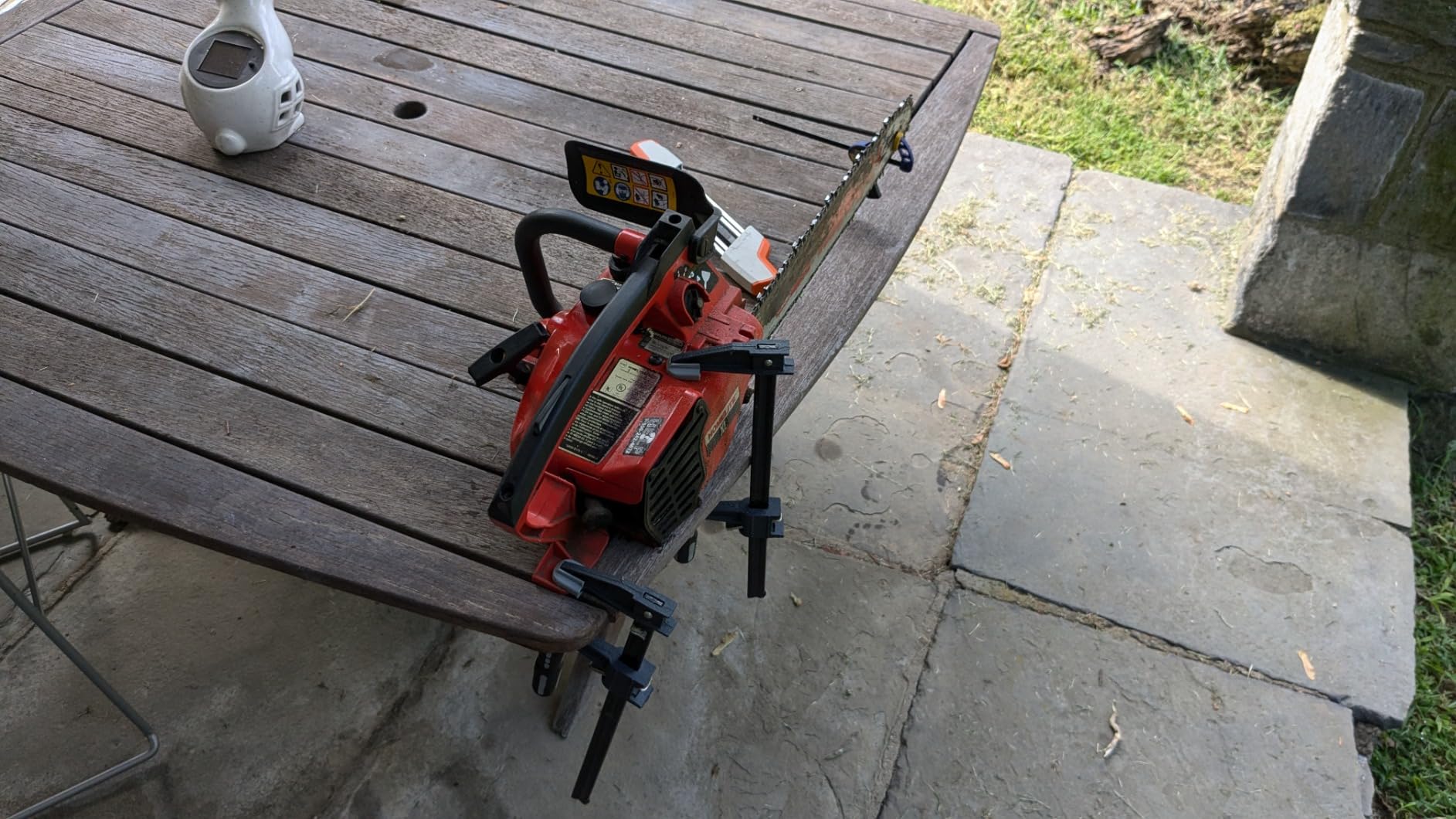
Sharpening a chain is one of the safer chainsaw tasks, but the chain is still sharp and still under tension. Clear the area, clamp the saw or wedge the bar so it cannot move, and keep both hands out of the chain line.
Do not wear loose gloves near a running chain or grinder. A glove is the single most common way a sharpening session turns into a chain-caught hand injury. If you are filing by hand, wear fitted, close-fitting gloves at most, and keep them well away from the bar while the saw is running.
Never test a freshly sharpened chain with your hand. Run it at low speed, cut into a scrap block, and confirm it is producing chips. If the chain is not cutting and you force it, the rakers are too high and the chain will grab, which is how kickback injuries start.
One electrical note for the corded sharpeners in this list. If an outlet trips when you plug a bench unit in, the problem is usually the extension lead rather than the sharpener. Our [guide to picking wire gauge for your build](https://www.smashingrobotics.com/what-gauge-wire-should-you-use-in-a-robot/) explains why undersized cable voltage-drops under load, and testing the suspect circuit first is easier with the multimeters ranked in [our automotive multimeter picks](https://www.smashingrobotics.com/best-multimeters-for-automotive-use/). Both take less time than a new chain does.
Frequently Asked Questions
Do chainsaw sharpeners actually work?
Yes, when the tool matches the chain pitch. A file or wheel of the wrong diameter will not cut a correct edge no matter how well you use it. A sharpener also has to handle the depth gauge, not just the cutters, because a chain with low rakers will not cut properly. Used correctly, a sharpener restores a chain to cut chips instead of sawdust, which makes the saw safer and easier to run.
Is an electric chainsaw sharpener worth it?
It is worth it if you sharpen several times a year or cut weekly. A handheld electric sharpener is roughly three times faster than hand filing, and the time saving across multiple loads of firewood is where the money comes back. For one or two sharpenings a year, a manual file kit with a guide is the better buy because it has nothing to break and costs far less.
What file size do I need for my chainsaw?
Match the file to chain pitch. Chains at 1/4 inch and 3/16 inch pitch take a 5/32 inch round file. Chains at .325 inch, 3/8 inch low profile and 3/8 inch pitch take a 3/16 inch file. Chains at .404 inch pitch take a 7/32 inch file. To check your pitch, count three drive links, measure them in inches, and divide by eight. Carbide chain requires a diamond or carbide wheel, not a standard file.
What is the best method to sharpen a chainsaw chain?
File the cutters on one side only, mark the chain first so you do not skip teeth, and keep the same angle on every tooth. Then set every depth gauge to the same height and level them with a flat file, before repeating the same work on the opposite side. Diagnose first: chips mean the chain only needs a touch-up, while fine sawdust means it needs real sharpening, and a chain that has been digging in may need reshaping.
How often should I sharpen my chainsaw chain?
Check it before every session and sharpen when the saw starts throwing sawdust instead of chips, which is usually every few loads of firewood. A chain that cuts cleanly and pulls itself into the wood does not need attention yet. Rotate between two chains if you cut regularly, since it roughly doubles the time before either one needs filing and halves how much filing you do in a single session.
The Best Chainsaw Sharpeners for Home Use: Final Verdict
The best chainsaw sharpeners for home use resolve around how much wood you actually cut. The Oregon Universal Field Kit is our editor’s choice because it covers the three file sizes nearly every home saw needs, and its filing guide fixes the angle and the raker height that hand sharpening usually gets wrong.
Move up to a handheld electric sharpener only when your volume justifies the speed, and to a bench grinder only when you are sharpening weekly or maintaining several saws. Whatever you choose, match the file or wheel to your chain pitch first, and leave the commercial machines priced for tree services alone.