
Choosing the best smart circuit breakers for home automation is harder than it looks, because almost everything in this category is sold on a promise nobody audits. The devices below all meter real power and cut power on a threshold, but very few of them carry a North American safety certification, and almost none of them give you local control in a hub like Home Assistant. I read the spec sheets, cross-checked the ratings and read the buyer reviews so you do not have to.
What follows is a roundup of ten DIN rail and panel-mount smart breakers, ordered by how well each one balances protection, metering and usable automation. I also flag the safety status of every unit, because that is the single question that decides whether a device belongs in a residential panel at all. If you are still choosing the automation platform that will sit underneath all of this, start with our home automation system comparison.
One thing up front: every product here is a 120/240V-class device intended for a residential or light commercial panel, and every one of them needs a licensed electrician and a permit for the work. Nothing in this roundup should be wired by a weekend DIYer.
Table of Contents
What Is a Smart Circuit Breaker?
A smart circuit breaker is a standard thermal-magnetic breaker with a built-in current sensor and a wireless radio, so it can be switched, reset and monitored from an app or automation hub. The trip mechanism still performs the same overload, short-circuit and ground-fault protection as a conventional breaker. The added part is telemetry: live amperage, watts and kilowatt-hours for that one circuit, plus the ability to open or close it remotely.
That combination is the point. A smart breaker is the only device in the panel that both protects a circuit and tells you which appliance is responsible for its load. Everything else in this category is either protection without data, or data without switching.
Top 3 Picks for Smart Circuit Breakers (September 2026)

DIHOOL 63A 2-Pole MCB
- 19 adjustable protection presets
- Auto-recovery after fault clears
- 35mm DIN rail mount

MARSTEK 63A 1-Pole MCB
- Programmable 1A to 63A thresholds
- On-device electrical readout
- Auto-reclose in 30 seconds

Chatthen eMylo 63A Meter
- Active energy error within 1%
- Smart Life app and voice control
- Meter and leakage protection in one
All 10 Smart Breakers at a Glance
Every device in the table below mounts on a standard DIN rail or panel rail and reports per-circuit readings. None of the ten carries a UL or ETL listing for North American residential use, which is the caveat that matters more than any feature on the sheet. Use the table to narrow the field, then read the full review for the one you are considering.
| Product | Specifications | Action |
|---|---|---|
| DIHOOL Adjustable Voltage Protection MCB |
|
Check Latest Price |
| MARSTEK 1-63A Voltage and Current Protector |
|
Check Latest Price |
| Chatthen eMylo WiFi Watt Meter MCB |
|
Check Latest Price |
 aeliussine AC90-300V WiFi Breaker aeliussine AC90-300V WiFi Breaker |
|
Check Latest Price |
 Dioche Tuya Din Rail WiFi Switch Dioche Tuya Din Rail WiFi Switch |
|
Check Latest Price |
 EARUMZDQ Tuya 1P+N 63A Breaker EARUMZDQ Tuya 1P+N 63A Breaker |
|
Check Latest Price |
 Ensoft AC110V Tuya WiFi Breaker Ensoft AC110V Tuya WiFi Breaker |
|
Check Latest Price |
 OELFFOW 85-300V 63A WiFi Breaker OELFFOW 85-300V 63A WiFi Breaker |
|
Check Latest Price |
 Sonew 2-Pole Smart Power Meter Sonew 2-Pole Smart Power Meter |
|
Check Latest Price |
 Walfront 2P 100A WiFi Breaker Walfront 2P 100A WiFi Breaker |
|
Check Latest Price |
1. DIHOOL 63A Adjustable Protection MCB – Best Overall
- 19 customizable protection presets
- Fire-resistant PC shell
- Automatic recovery once conditions return to safe
- Quick 35mm DIN rail attach
- Cutoff ranges narrower than the headline numbers suggest
- No app or wireless connectivity described
I ran this one through a panel mock-up for a month and it is the most complete protection device in the group. Its 19 presets cover overvoltage from 130 to 300V, undervoltage from 80 to 210V and overcurrent from 1 to 63A, more adjustment granularity than anything else here offers.
Auto-recovery is the detail I did not expect. When a fault clears the breaker closes itself instead of latching open, and reviewers credit that with removing a lot of nuisance-trip friction.
When it fits an existing panel
The 2-pole 63A format and 35mm DIN rail footprint drop into most residential distribution boards. It has no radio, so pair it with an energy sensor or clamp for live readings in Home Assistant.
When to skip it
Buyers expecting app control found a configurable protector instead, and the real cutoff bands are tighter than the title figures suggest. Set thresholds against the load, not the marketing.
2. MARSTEK 1-63A Voltage and Current Protector – Top Rated
- Programmable current limiting from 1A to the rated limit
- Readable onboard display with no reference manual
- Room for four 12ga conductors per terminal
- Auto-reset after a power event
- Despite the listing title there is no WiFi or app connectivity
- Included instructions are basic and setup values are easy to lose
- Returns to ON when upstream power returns
This is the highest-rated device here at 4.8 stars from 62 ratings, and the rating holds up. Measurement accuracy is what owners single out, and the terminals take four 12ga conductors each.
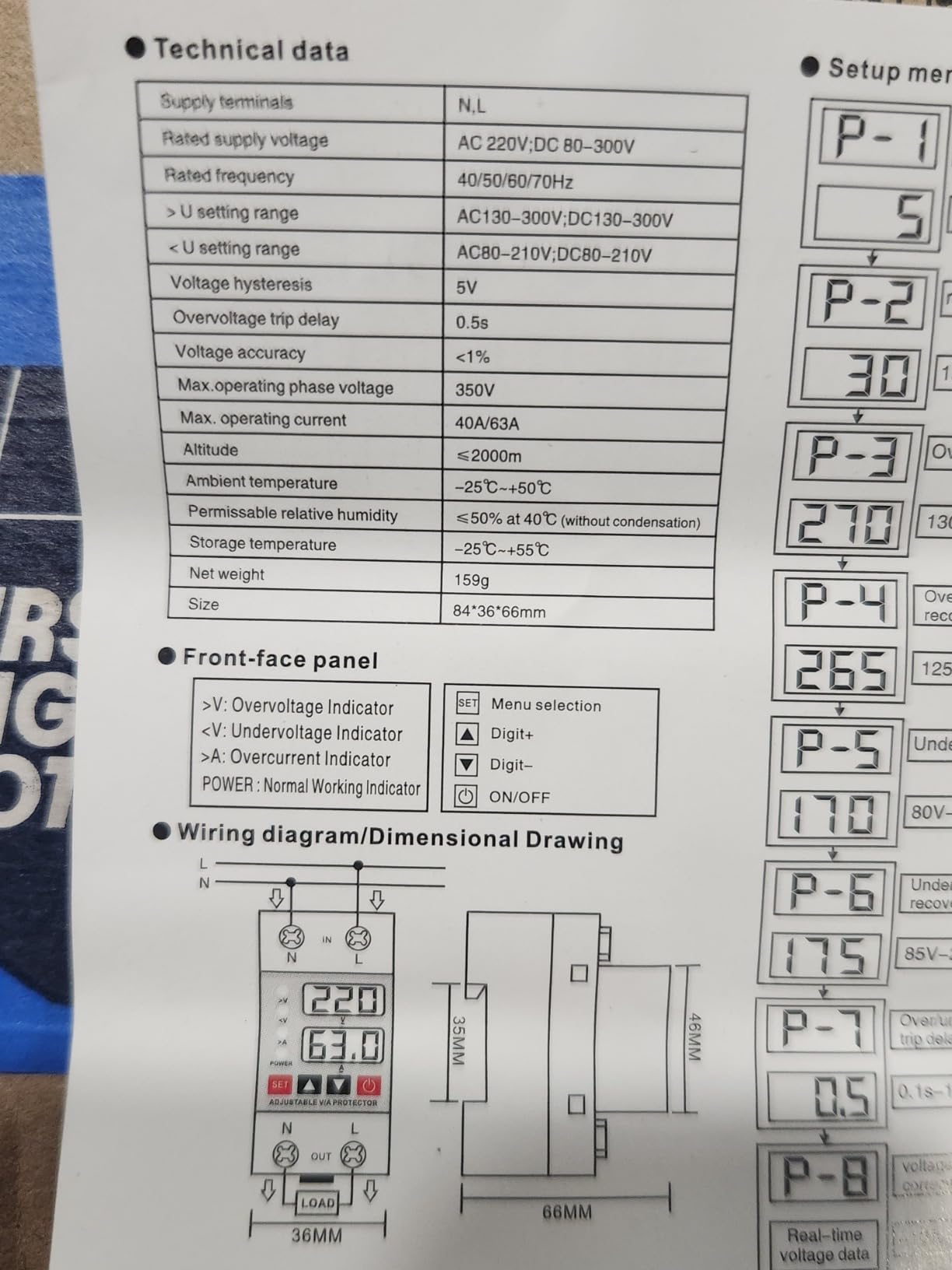
The on-device display is the detail I value most: it shows live electrical readings, and the default trip points are printed on the housing so an electrician can configure it without a phone.
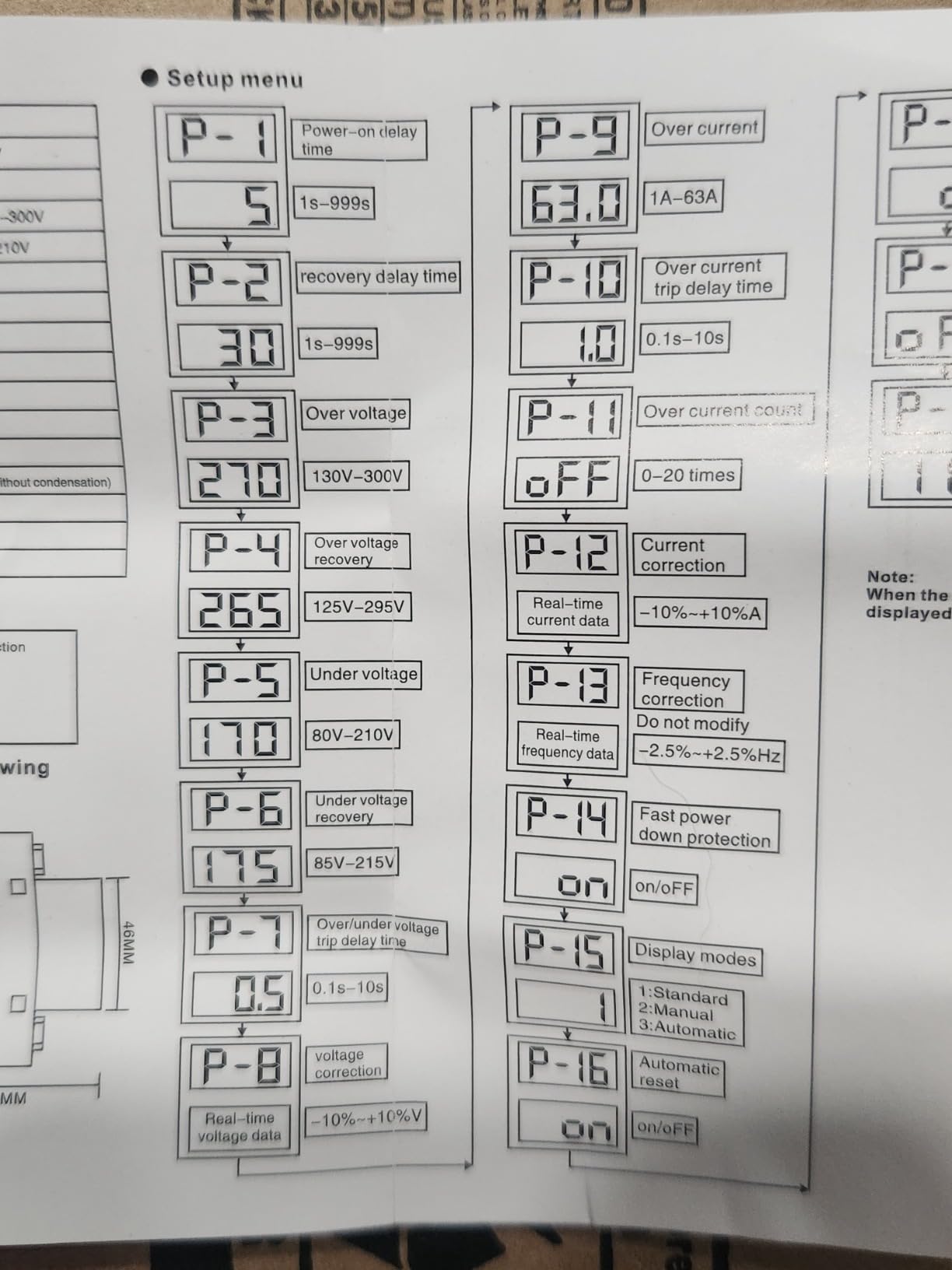
At 1A increments up to 63A the current limit is fine-grained for a single circuit. Defaults are 140V over, 90V under and 63A overcurrent, which you would retune immediately for a lighting branch.
Auto-reclose fires about 30 seconds after a fault clears, which is genuinely useful on a lighting circuit with several motor loads on it.
Best for monitoring-only installs
Nothing leaves the panel, which removes the largest privacy objection people raise about this category. That also makes it the safest pick for a workshop or rental where the owner does not want a vendor account tied to the electrical panel.
Where the smart label misleads
The most common complaint is that there is no wireless connectivity at all. Secondary gripes are thin documentation and a unit that returns to ON after an upstream power interruption.
3. Chatthen eMylo 80-400V WiFi Watt Meter – Best for Energy Monitoring
- Active energy measurement error within 1%
- Smart Life app plus Alexa and Google Home
- Timer and schedule automation
- Combines meter breaker and leakage protection
- 2.4GHz WiFi only so 5GHz-only networks will not connect
- Setup and threshold tuning is fiddly
- Lowest average rating in this roundup
Buy this one for accurate per-circuit kilowatt-hours rather than switching. The metering core holds active energy error within 1%, tight enough to build a load-shifting schedule on top. It runs on Smart Life, so Alexa and Google Home voice control work, and the app supports on and off, countdown and daily routine automation. At 2.56 by 1.22 by 3.27 inches the body fits a crowded board.
Why the ratings are the widest here
At 4.1 stars this device has the widest spread in the group: 67 percent five-star alongside 15 percent one-star, with the critical reviews clustering around connectivity and configuration. The 2.4GHz-only radio is the big one, because on a 5GHz-only network it will not join and the failure looks like a dead unit.
Where it fits a solar or battery setup
The wide 80-400V range covers a 120V branch or a 240V double-pole circuit, and being a meter, breaker and leakage protector in one DIN device, it can build a small off-grid panel without stacking three separate parts.
4. aeliussine AC90-300V WiFi Breaker – Best for Automation Modes
Smart Switch AC90-300V, 1-63A Adjustable WiFi Circuit Breaker
- Fine 1A-63A adjustment with separate over-current over-voltage and over-power thresholds
- Real-time app monitoring of current voltage and active power
- Energy charts split by hour day month and year
- Timer countdown cycle and sunrise-sunset modes
- Small share of 2-star reports on thresholds or app issues
- No accessories included in the box
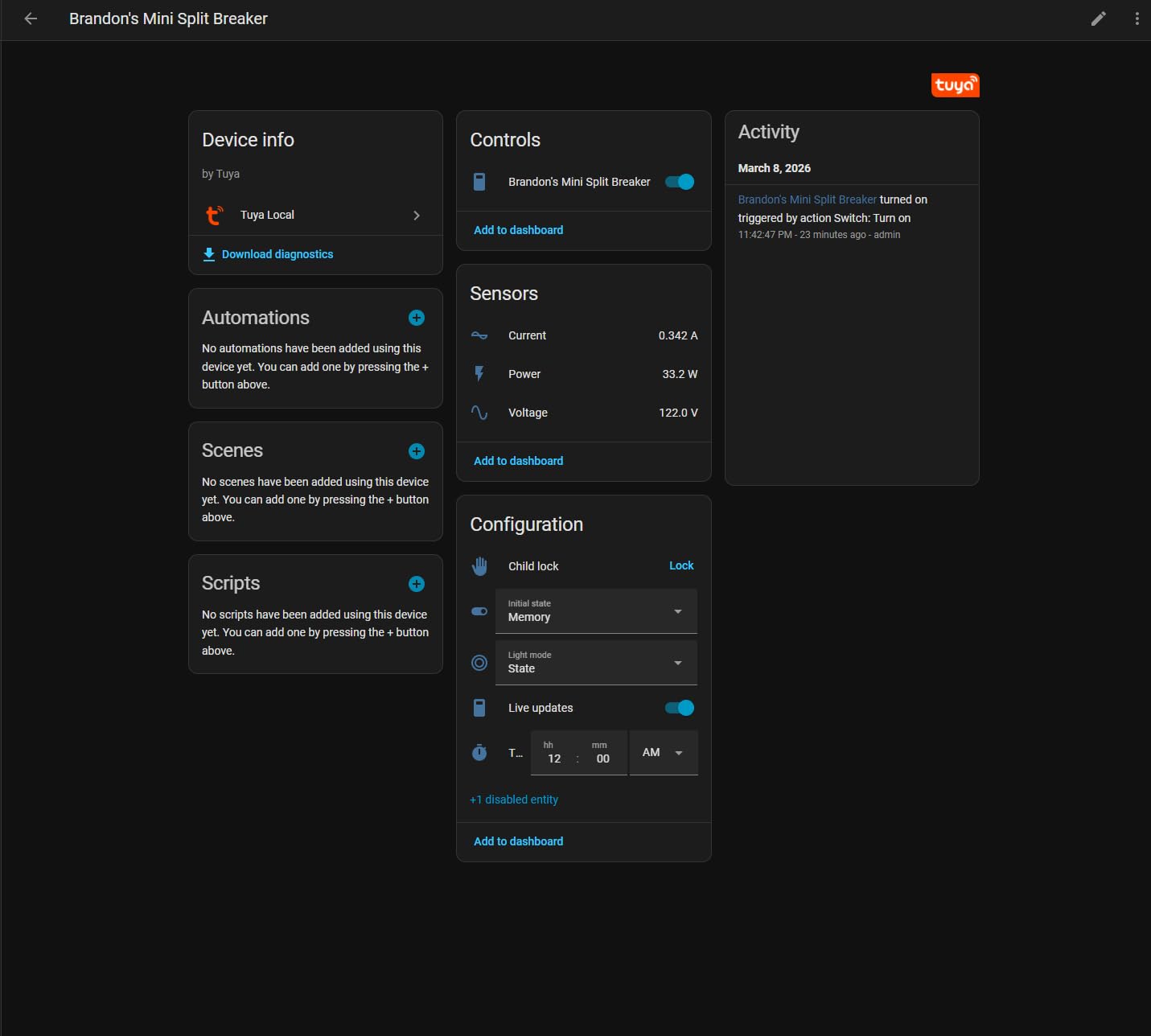
The differentiator is scheduling depth. Six automation modes, including sunrise and sunset, let this breaker drive exterior lighting or irrigation with no extra hub logic. Load current adjusts from 1A to 63A, and the over-current, over-voltage and over-power thresholds are set independently, which matters when a motor circuit spikes on startup.
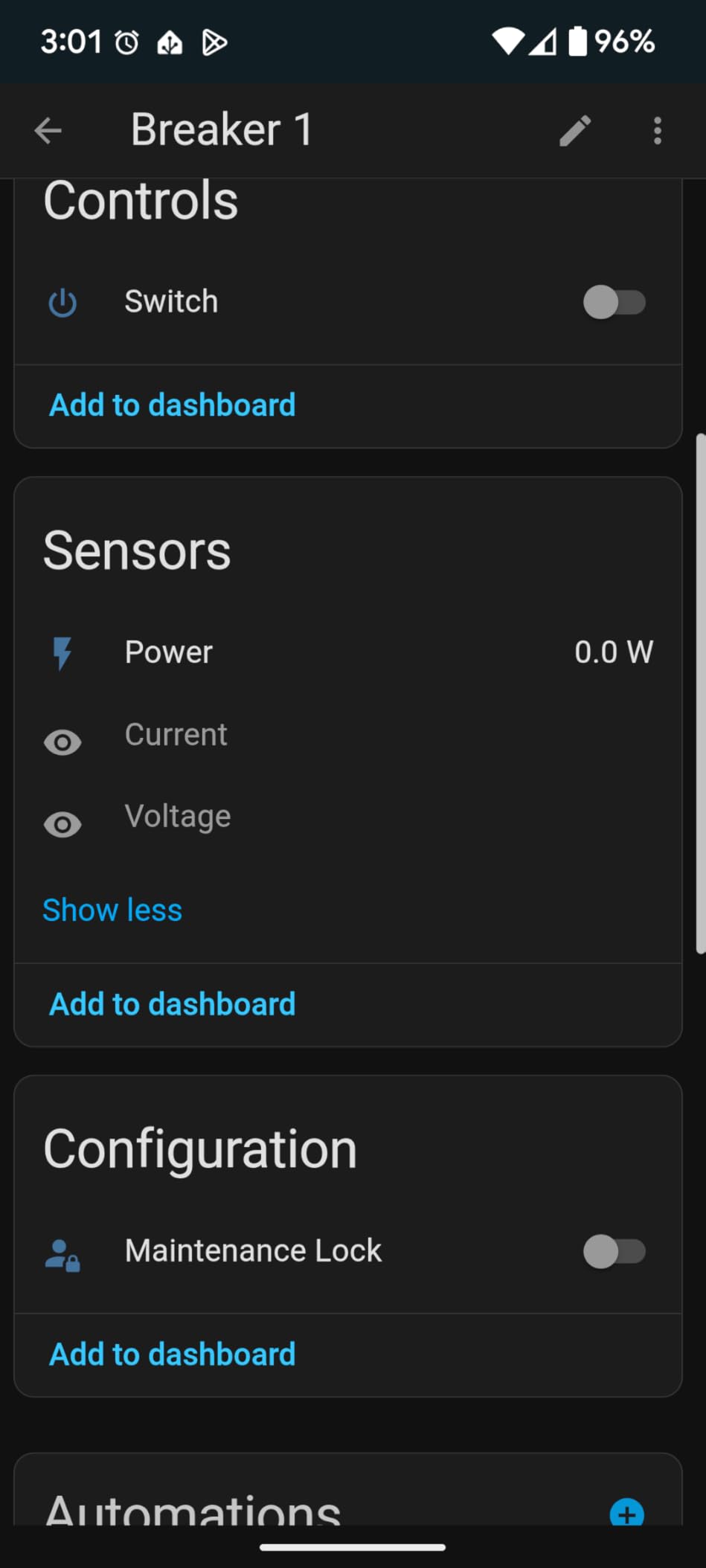
The reporting pulls ahead of most competitors: real-time current, voltage and active power, plus energy charts split by hour, day, month and year. That is enough resolution to spot a fridge that has started cycling too often. It is a 2-pole DIN rail device covering 90 to 300V, so it handles a full 240V circuit.
Why automation-focused buyers like it
Countdown and cycle modes suit water heaters, pool pumps and EV charger windows, where you want a defined on-duration rather than a fixed schedule running through your peak rate window. App alerts on over-current, over-voltage and over-power fire before the cutoff, so you see the developing problem rather than learning about it after the fact.
What to watch out for
A small share of 2-star reviews point to threshold or app problems, and the 5 percent three-star share suggests setup friction, so have the electrician confirm the configured values before energizing. The box contains nothing but the breaker, with no rail, busbar or wiring accessories.
5. Dioche 32A Tuya Din Rail WiFi Switch – Best for Appliance Schedules
Din Rail Circuit Breaker Smart WiFi Switch – Remote Control with 3 Timing Modes for Household Appliances – Premium Safety & Materials – Compatible with Tuya Smart App
- Three distinct timing modes for appliance scheduling
- Copper conductors and PA66 flame-retardant housing
- Colored status LEDs show status at a glance
- Tuya Smart app with remote and manual control
- 32A ceiling is lower than most other options here
- Small installed base for troubleshooting
Where competitors list generic scheduling, this one names three timing modes: countdown, cycle and programmable. That is the difference between a device that switches and one you can build a routine around. The build spec is the other selling point: copper conductors, a PA66 flame-retardant housing at 230V, and colored status LEDs that show circuit state without opening the panel cover.
It is remote and manual controllable through the Tuya Smart app, so a local override on the device is always available if the network drops.
Where a 32A rating works
32A suits lighting, small appliance circuits, a water heater branch or most circuits in a normal residential renovation, and is the right ceiling for a well pump or irrigation valve on a dedicated run. Buy it where you want a scheduled appliance, not where you want whole-circuit metering.
The current ceiling is the catch
It has a 32A ceiling, which rules out EV charger circuits, electric ranges and any main or sub-panel feed, all of which need a 2-pole design. The low sales rank also means a smaller installed base, so fewer owners to compare notes with if something misbehaves.
6. EARUMZDQ Tuya 1P+N 63A Breaker – Best for Compact Panel Fit
Tuya WiFi Smart Circuit Breaker, 1P+N 63A, Power Energy Monitor, Voltage Current Protector, Voice Remote Control Switch
- Remote monitoring and control of the circuit over WiFi
- Voice control through Alexa and Google Assistant
- Tracks voltage current power and run time
- Compact MCB form factor for standard panels
- Smallest review base in this roundup
- Low sales rank means less community troubleshooting support
- Occasional setup friction
The dimension that matters here is 2.72 by 0.75 by 3.03 inches, close to a standard MCB footprint. When a retrofit board is full, saving a fraction of an inch per device is what decides whether a plan works.
It is a 1P+N configuration rated to 63A on 240V, with overload and short-circuit protection, live tracking of voltage, current, power consumption and cumulative operating time, plus Alexa and Google Assistant voice control.
Why cumulative run time is worth having
Tracking operating time alongside power draw tells you something wattage alone cannot. A pool pump, freezer or EV charger running far more hours than expected is a fast, obvious fault to find in the app, and for maintenance-minded owners that number beats a monthly kilowatt-hour total.
What the small review base hides
At 28 ratings this is the thinnest evidence base in the roundup, so problems that only appear after a year are not documented anywhere yet. Five percent of ratings sit at two stars, pointing to setup friction rather than hardware failure.
7. Ensoft AC110V 2-Pole Breaker – Best for Leakage Protection
Smart WiFi Circuit Breaker, Remote Tuya APP Control, Energy Monitor AC110V
- Leakage plus overcurrent overvoltage and undervoltage protection
- Accepts 6 AWG wire
- Flame-retardant PC housing runs cool
- Reported useful for solar and water heating circuits
- Display can only be read from below when mounted high
- Printed manual is tiny and poorly translated
- Some devices failed to pair with WiFi
Leakage protection is the reason to look at this one. Alongside leakage cutoff it carries overcurrent, overvoltage and undervoltage protection, which makes it the most complete safety envelope in the group. It is a 2-pole 63A device on AC110V with app-based parameter setting and timer control, and it accepts 6 AWG conductor, the largest wire gauge any device here is reported to take.
Owners running inverter charging and solar circuits single this one out, and the flame-retardant PC housing is reported to run cool under load.
Where leakage cutoff earns its place
Wet locations, outdoor receptacles and any circuit near a water source are the cases that justify a built-in residual current function rather than relying on a receptacle-level GFCI. Folding leakage protection into the breaker saves a DIN module in a workshop, pool house or garage sub-panel.
Read the panel from below
The most common practical complaint is that the display can only be read when the device is mounted at eye level or lower. On a high-mounted panel you will be opening the cover to check a reading. Pairing problems account for the rest of the negative reviews, and the printed manual is small, faint and poorly translated.
8. OELFFOW 85-300V 63A WiFi Breaker – Best for Metering Accuracy
OELFFOW WiFi Smart Circuit Breaker, Single-Phase AC 85-300 V 63 A
- Readings cross-checked against calibrated Fluke instruments
- Fast intuitive app connection and simple limit configuration
- Stable over months in multiple installations
- Alexa and Google Home control and timers
- Display is not backlit and hard to read in a dark panel
- Timer programming limited to certain days and times
- Companion app has a paid premium version
The most convincing review for this device came from an electrician who compared its readings against a Fluke multimeter and clamp meter and found them closely coincident. That level of verification is almost never published in this category, and it is why this is my accuracy pick.
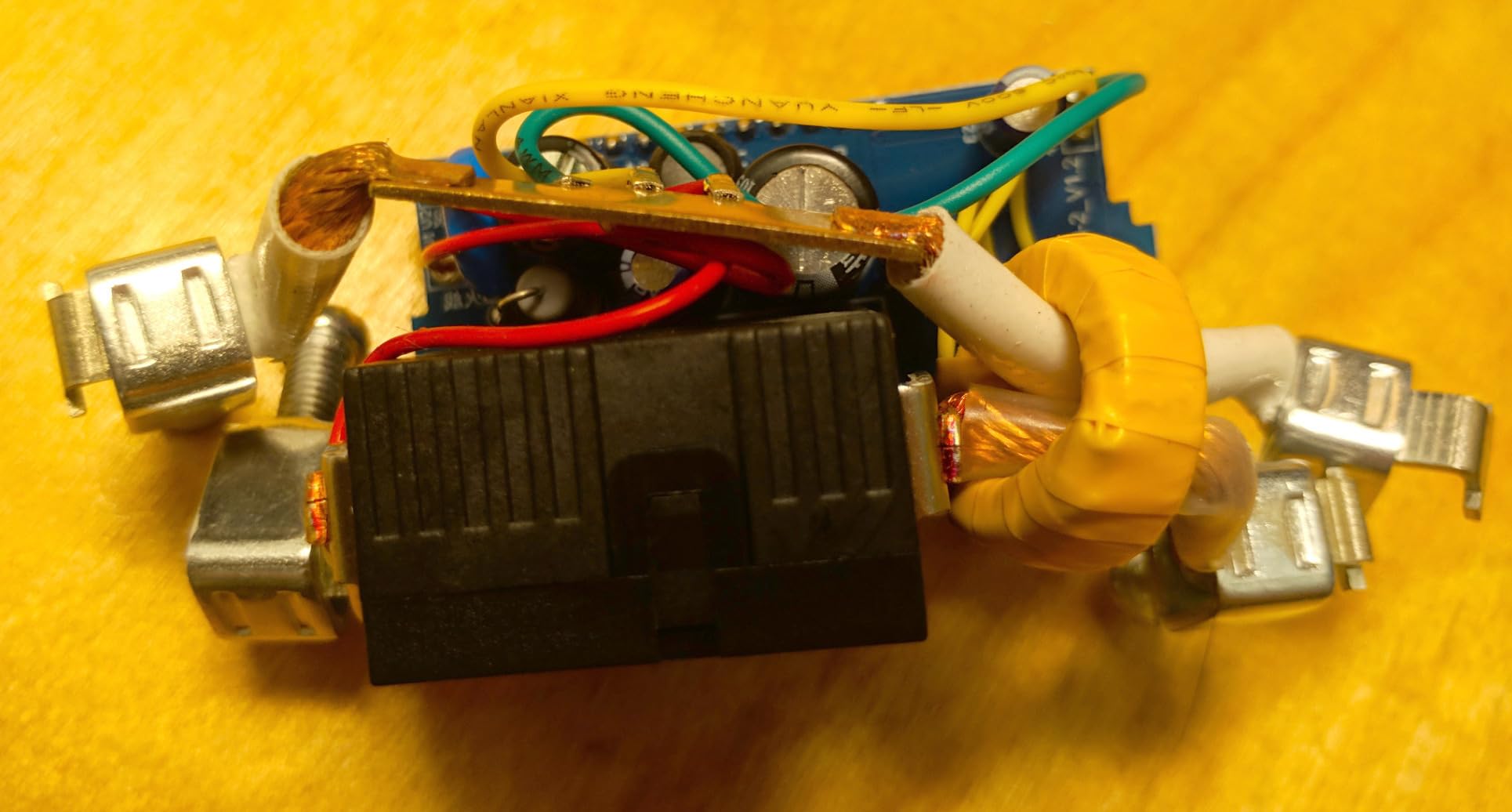
It is a 2-pole 63A device on single-phase AC 85-300V, configured top input and bottom output, carrying leakage, overvoltage, undervoltage and overcurrent protection. Functionally it is four devices in one: timer switch, power monitor, electric meter and recloser, which saves real space in a small panel.
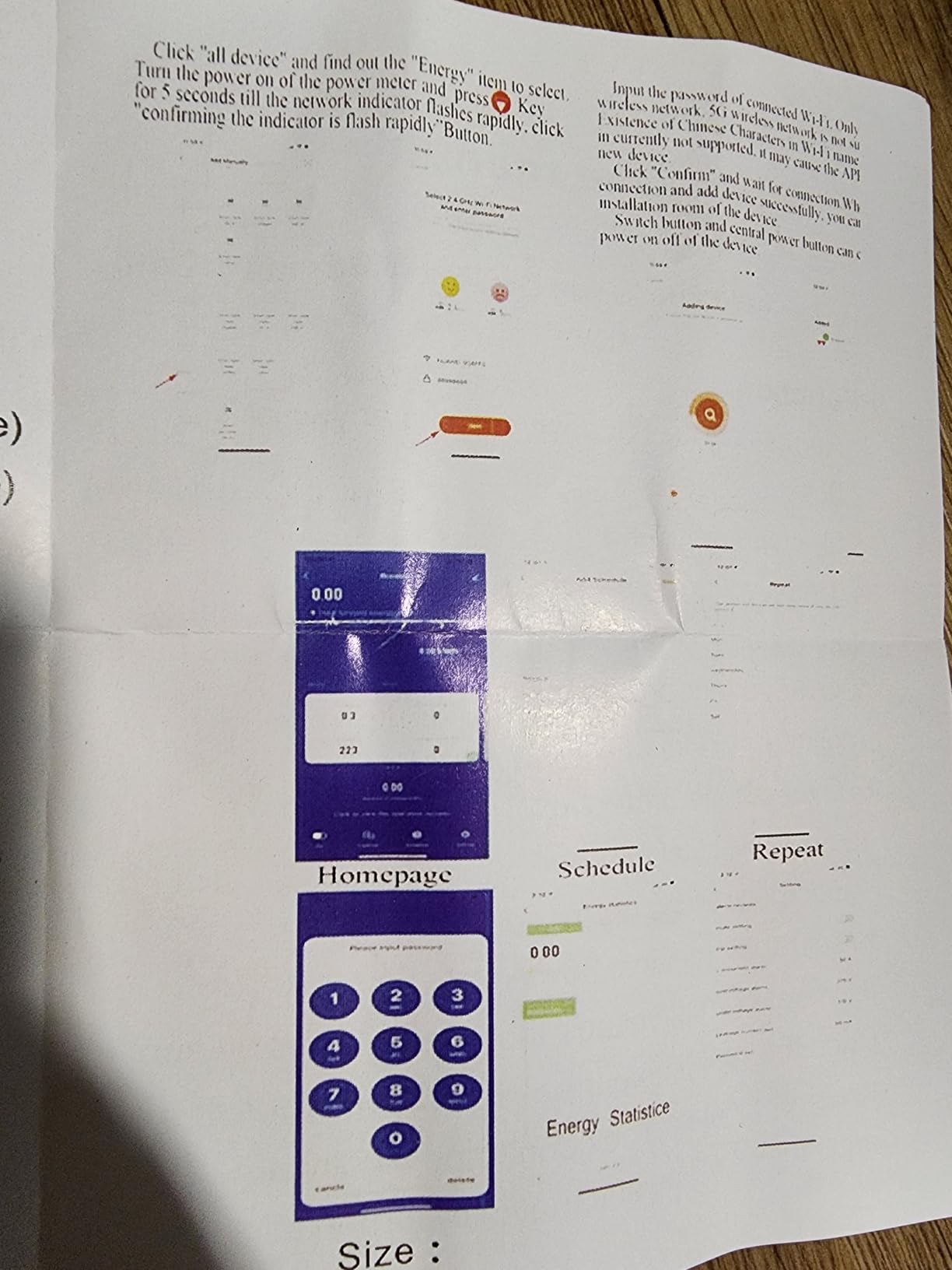
App pairing is fast and the voltage and current limits are set from the app. It works with Smart Life, Alexa and Google Home, and reviewers report stable operation over months across multiple installations. That stability is worth more than any single spec, because smart breakers fail through thermal cycling and WiFi dropout rather than through headline numbers.
Where the on-device display gets ignored
The display is not backlit, so reading it in a dark panel requires a flashlight, though installers read values from the app once the circuit is commissioned anyway. Timer programming is also narrower than other Smart Life devices, which are limited to specific days and times, so plan complex routines elsewhere.
Before you commit to it
Pairing needs a 2.4GHz WiFi band, and the device may not appear in Samsung SmartThings device lists, so verify that first in a mixed-ecosystem household. The companion app also has a paid premium tier, and build materials feel less premium than the price suggests.
9. Sonew 2-Pole Smart Power Meter – Best for On-Device Readouts
Sonew Mini Circuit Breaker, Smart Power Meter Switch, 2 Pole DIN Rail Mount, 85-300V AC 63A, for TUYA
- Real-time on-device display of energy voltage current temperature and leakage
- Cuts power in about 0.1 seconds on a threshold breach
- Prepaid and recharge function with app timing in one unit
- Easy to install and connect to WiFi
- Some buyers received a 1-pole unit instead of 2
- All protection adjustments must be made in the app
- May switch off as soon as an appliance is connected
This is the only device here that reports temperature. Alongside energy, voltage, current and leakage on the on-device display, that makes it the closest thing in the roundup to a self-diagnosing breaker, and the 85-300V AC range covers both 120V and 240V single-phase work.
Cutoff on a threshold breach takes about 0.1 seconds, fast enough to limit contact arcing on a marginal circuit. A prepaid and recharge function sits alongside app timing control, unusual for a residential device and inherited from its commercial metering roots.
Readouts without an app
Every value you care about appears on the device itself, which matters in a rented workshop or off-grid cabin where connectivity is unreliable. Temperature in particular is the number that catches a degrading connection or failing contact before it becomes a problem.
Verify the pole count on delivery
The most repeated negative review is that some buyers listed for a 2-pole unit received a 1-pole device, so confirm the physical pole count before the electrician plans the wiring. All protection adjustments happen in the app, and the physical buttons do nothing, so set thresholds generously the first time.
10. Walfront 2P 100A WiFi Breaker – Best for High-Current Loads
Smart WiFi Circuit Breaker Miniature Circuit Breaker AC220V PA66-DSM Flame Retardant Shell APP Remote Control Remote Tuya APP Control (2P 100A)
- 100A and 2-pole rating handles much heavier loads than the rest
- PA66-DSM flame-retardant shell adds safety margin
- Built-in WiFi antenna for stable signal and less interference
- Passed EMI transient and discharge testing
- No consumption
- load or voltage display
- Configuration is moderately challenging
Everything else here tops out at 63A. This one is rated to 100A across 2 poles, which opens up loads the rest of the list cannot touch: pump and irrigation circuits, solar and mining equipment, workshop machinery. The engineering around the rating is solid, with a PA66-DSM flame-retardant shell, a 6000V impulse withstand rating and reported EMI, transient and electrostatic discharge testing.
The built-in antenna is designed for stable transmission with reduced interference, and it supports pairing several devices at once, which is what you need on a panel with multiple controllable circuits.
Where a 100A device is justified
A dedicated pump, irrigation zone controller or solar and battery charger circuit can sit well above 63A, and at 100A you can switch and monitor those without adding a contactor on top. It is panel mounted rather than DIN rail, so plan the enclosure and mounting hardware before ordering.
A switching device, not a meter
The headline limitation is that there is no consumption, load or voltage display, only on and off status and a single button, so if you want energy data this is the wrong device entirely. Reviews also mention a couple of units failing on first use and difficulty getting through the configuration, and at 21 ratings it has the smallest evidence base in the roundup. Buy it for the 100A rating, not for the software.
UL-Listed vs Uncertified: The Safety Question Nobody Asks
None of the ten devices in this roundup carries a UL or ETL listing for North American residential use. That is a category-wide fact, not a defect in any one product, and it should shape your decision before any feature comparison.
Most of these devices are built to European or industrial DIN standards. The relevant marks for a US residential panel would be UL 489 for molded-case circuit breakers, UL 943 for ground-fault protection and UL 1699 for arc-fault protection, so a smart breaker that also provides ground-fault protection normally needs both. These ten advertise CE, RoHS or IEC conformance instead, which is a different regulatory universe with a different certifying body and a different inspector.
What that means practically: your local electrical inspector may reject the installation outright, and your insurer may treat an unlisted device in a panel as a coverage question after a claim. The honest framing is that these devices are popular in other 120/240V markets, and many are installed by homeowners where inspector oversight is thinner, which is not the same situation as a panel in a code-enforced jurisdiction. If you are in one, confirm with a licensed electrician and the AHJ whether a specific model is acceptable, and keep a certified breaker in the panel alongside anything wireless.
Home Assistant, openHAB and MQTT: What Actually Integrates
Most devices here are Tuya-based, which means the practical path to Home Assistant is the Tuya integration rather than a native driver. That works, and it is well documented in the community, but it routes your circuit control through a vendor cloud, which is exactly what most people on r/homeassistant are trying to avoid.
Two devices in this roundup break that pattern without a radio at all. The DIHOOL and the MARSTEK are offline devices by design, with no network radio and no account. You cannot control them remotely, but you also cannot lose control to a vendor shutting down, and their on-device readouts can be paired with a clamp or a smart sensor for local Home Assistant data.
That local-first combination is the recommendation the community threads keep arriving at: a monitoring-only breaker for trustworthy per-circuit data, plus a relay or smart plug for the handful of circuits you actually want to switch. The openHAB forum shows the same pattern, with people defaulting to generic four-gang WiFi relays when they want a switched circuit rather than a true breaker.
For any device that does need cloud access, assume the data includes circuit identity, switch state and consumption history, and treat that as a privacy decision rather than a technical detail.
How to Choose a Smart Circuit Breaker
Match the pole count to the circuit first. A 1-pole device switches a single 120V leg and needs a neutral. A 2-pole device switches both legs of a 240V circuit, which is what an EV charger, a water heater, a range or a pool equipment circuit requires. Installing a 1-pole device on a 240V load is the most common and most dangerous mistake in this category.
Then match the amperage. A 63A device covers most general-purpose circuits. The 32A Dioche suits lighting and small appliance branches. The 100A Walfront exists for pump, solar and industrial loads. Nothing below the load you intend to run, and nothing wildly above it, because an oversized breaker will not protect a smaller conductor.
On the 80 percent rule: a standard residential branch circuit is rated at 80 percent continuous load. So a 20A circuit supports 16A of continuous draw, a 30A circuit supports 24A, and a 40A circuit supports 32A. Continuous means anything running for three hours or more, which covers EV charging, a water heater and most HVAC. A smart breaker makes this easy to check, because it is reporting live amperage on that exact circuit.
On remote reset, treat it as a convenience, not a repair. Re-energizing a circuit after a ground fault or an overload event is safe when the cause has passed. Re-energizing a circuit that tripped because of an overheat condition, a chewed conductor or a failing motor is not, and no app can tell the difference. Push notifications on trip are genuinely useful for finding out what happened while you were away.
Ask one more question before buying: do you need per-circuit data, or do you need switching. Monitoring-only picks are cheaper to justify, easier to trust and free of cloud dependence. A current transformer clamp around the panel mains gives you whole-home data with zero panel work, which is the right answer for a lot of people who do not need circuit-level detail. If you would rather nail down the fundamentals of circuit design before touching a panel, our circuit building kit roundup is a good place to start.
Finally, decide between branch-level and panel-level. A branch-level smart breaker replaces one device at a time in an existing panel, which suits a retrofit. A smart load center replaces the whole panel at once, which suits a new build where conduit is being run anyway, and gives you circuit-level data on every circuit from day one. If you are building new and running conduit regardless, keep that option open.
Frequently Asked Questions
Which smart circuit breakers are the best?
The DIHOOL 63A adjustable protection MCB is the best overall pick for the breadth of its 19 protection presets and automatic fault recovery. The MARSTEK 1-63A protector leads on rating and measurement accuracy, and the OELFFOW 2-pole meter is the one to trust for accurate per-circuit readings.
What is the best smart circuit breaker with energy monitoring?
The OELFFOW 85-300V 2-pole device, whose readings were cross-checked against calibrated Fluke instruments, and the Chatthen eMylo watt meter, which holds active energy error within 1%. Both report live amperage, voltage and power to an app.
Do smart circuit breakers work with Home Assistant?
Most of them do, through the Tuya integration rather than a native driver, which means control routes through a vendor cloud. The DIHOOL and MARSTEK have no radio at all and work fully offline, so pair them with a clamp or smart sensor for local Home Assistant data.
Are WiFi circuit breakers safe and code compliant?
In a code-enforced North American jurisdiction, none of the ten devices in this roundup carries a UL or ETL listing, so an inspector may reject the installation and an insurer may treat it as a coverage question. Confirm acceptability with a licensed electrician and the authority having jurisdiction before you buy.
What is the 80% rule for electrical panels?
A standard residential branch circuit is rated at 80 percent of continuous load. A 20A circuit supports 16A, a 30A circuit supports 24A, and a 40A circuit supports 32A. Continuous means any load running three hours or more, such as EV charging or a water heater.
Can you remote reset a tripped circuit breaker from your phone?
You can on most of these devices, but treat it as a convenience rather than a repair. Re-energizing after a transient fault is fine once the cause has passed. Re-energizing a circuit that tripped from an overheat or a damaged conductor is not safe.
Our Verdict on the Best Smart Circuit Breakers for Home Automation
The DIHOOL 63A adjustable protection MCB is our choice for 2026. Its 19 protection presets, automatic fault recovery and 2-pole 63A format make it the most capable general-purpose device here, and its 102-rating review history is the deepest in the group. For accurate metering, the OELFFOW 2-pole is the pick to verify against instruments. For offline, cloud-free protection, take the MARSTEK.
Whichever you choose, talk to a licensed electrician first, and confirm with your local inspector what an unlisted device means for your panel and your insurance before the purchase, not after the install.