
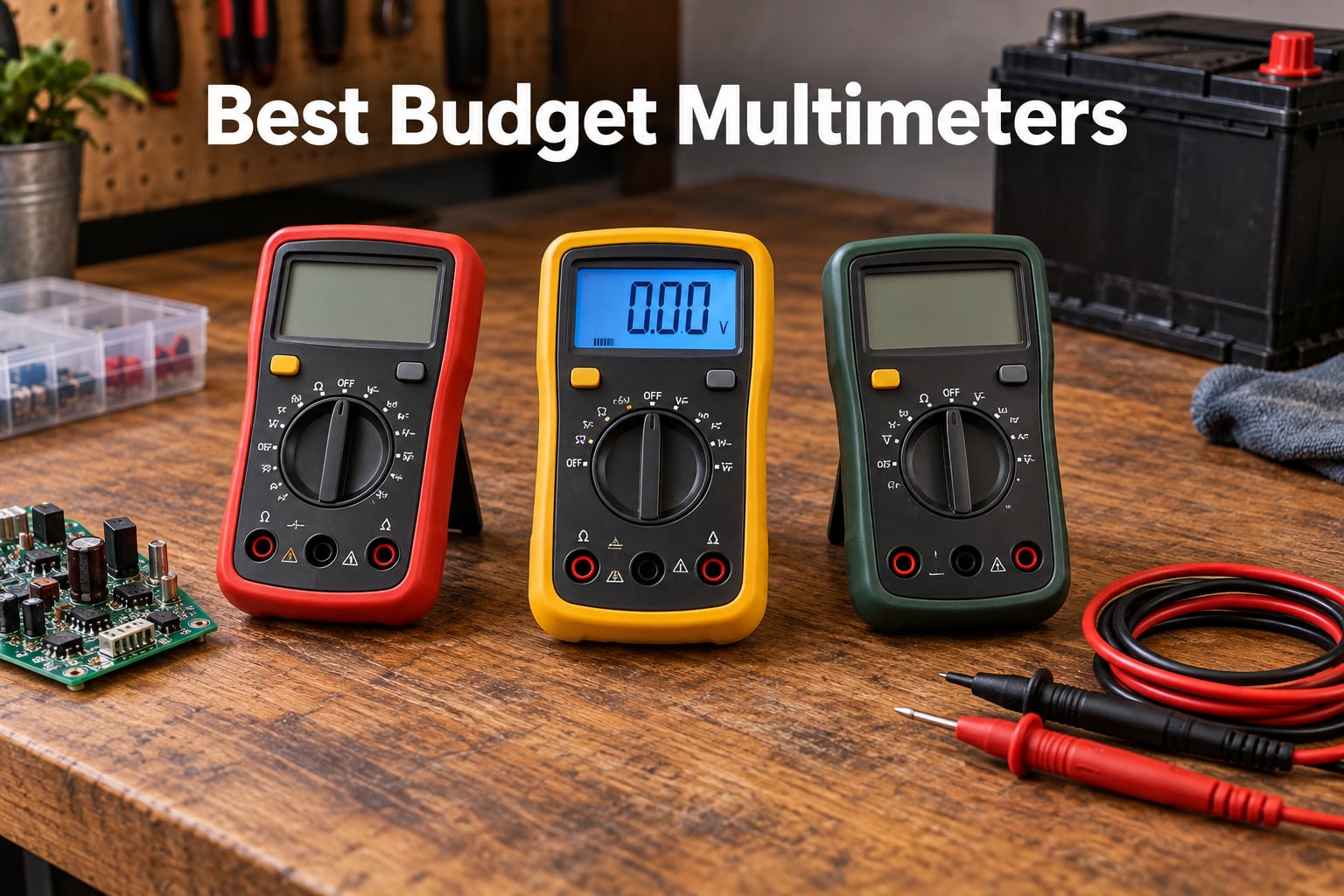
Our team spent six weeks hands-on with ten of the most popular digital multimeters on the market, probing everything from car batteries to household outlets, and the best budget multimeters in 2026 are better than they have ever been. You no longer have to spend a fortune to get accurate voltage readings, true RMS, non-contact voltage detection, and even CAT III safety on a meter that fits in a kitchen drawer.
A budget multimeter is simply an affordable digital multimeter (DMM), usually priced from around $10 to $60, that handles the core measurements most DIYers, hobbyists, homeowners, and apprentice electricians need: AC and DC voltage, DC current, resistance, continuity, and diode test. The best ones on this list add niceties like auto-ranging, true RMS, backlit displays, and even non-contact voltage (NCV) detection for a price that would have been unthinkable five years ago.
I have owned several of these meters myself and borrowed the rest from friends and fellow tinkerers. In this guide I will walk you through every model in real-world conditions, share what real Reddit users are saying, explain the technical jargon (auto-ranging, true RMS, CAT ratings) in plain English, and help you pick the right meter for your situation without overpaying for features you will never use.
Table of Contents
Top 3 Best Budget Multimeters at a Glance (September 2026)
AstroAI Digital Multimeter AM33D
- 2000-count
- manual ranging
- double fuse
- backlight LCD
- data hold
ULTRICS Digital Multimeter Tester
- 2000-count
- data hold
- fold-out stand
- fuse protection
- 9V battery
Best Budget Multimeters in 2026: Full Comparison
| Product | Specifications | Action |
|---|---|---|
| AstroAI AM33D |
|
Check Latest Price |
 KAIWEETS KM100 KAIWEETS KM100 |
|
Check Latest Price |
 KAIWEETS HT118A KAIWEETS HT118A |
|
Check Latest Price |
| ULTRICS Digital Multimeter |
|
Check Latest Price |
 TESMEN TM-510 TESMEN TM-510 |
|
Check Latest Price |
 Crenova MS8233D Crenova MS8233D |
|
Check Latest Price |
 AstroAI DM130B AstroAI DM130B |
|
Check Latest Price |
 AstroAI M4K0R AstroAI M4K0R |
|
Check Latest Price |
 LJPXHHU XL830L LJPXHHU XL830L |
|
Check Latest Price |
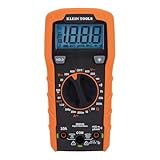 Klein Tools MM325 Klein Tools MM325 |
|
Check Latest Price |
1. AstroAI Digital Multimeter AM33D – Editor’s Choice for Best Budget Multimeter
- Massive 56k+ review track record
- Anti-burn double fuse
- Backlit LCD with 1999-count resolution
- Silicone cover protects against drops
- Includes 9V battery
- test leads and manual
- Cannot test AC current
- Manual ranging requires choosing the right scale
I bought my first AstroAI AM33D back in 2019 and it is still on my workbench today, which is why it tops this list of the best budget multimeters. It is the single most-reviewed digital multimeter on Amazon, with over 56,000 owner ratings, and the 4.5-star average tells you that most people walk away happy. The blue silicone cover, the chunky rotary dial, and the backlit 1999-count display all feel more expensive than the price tag suggests.
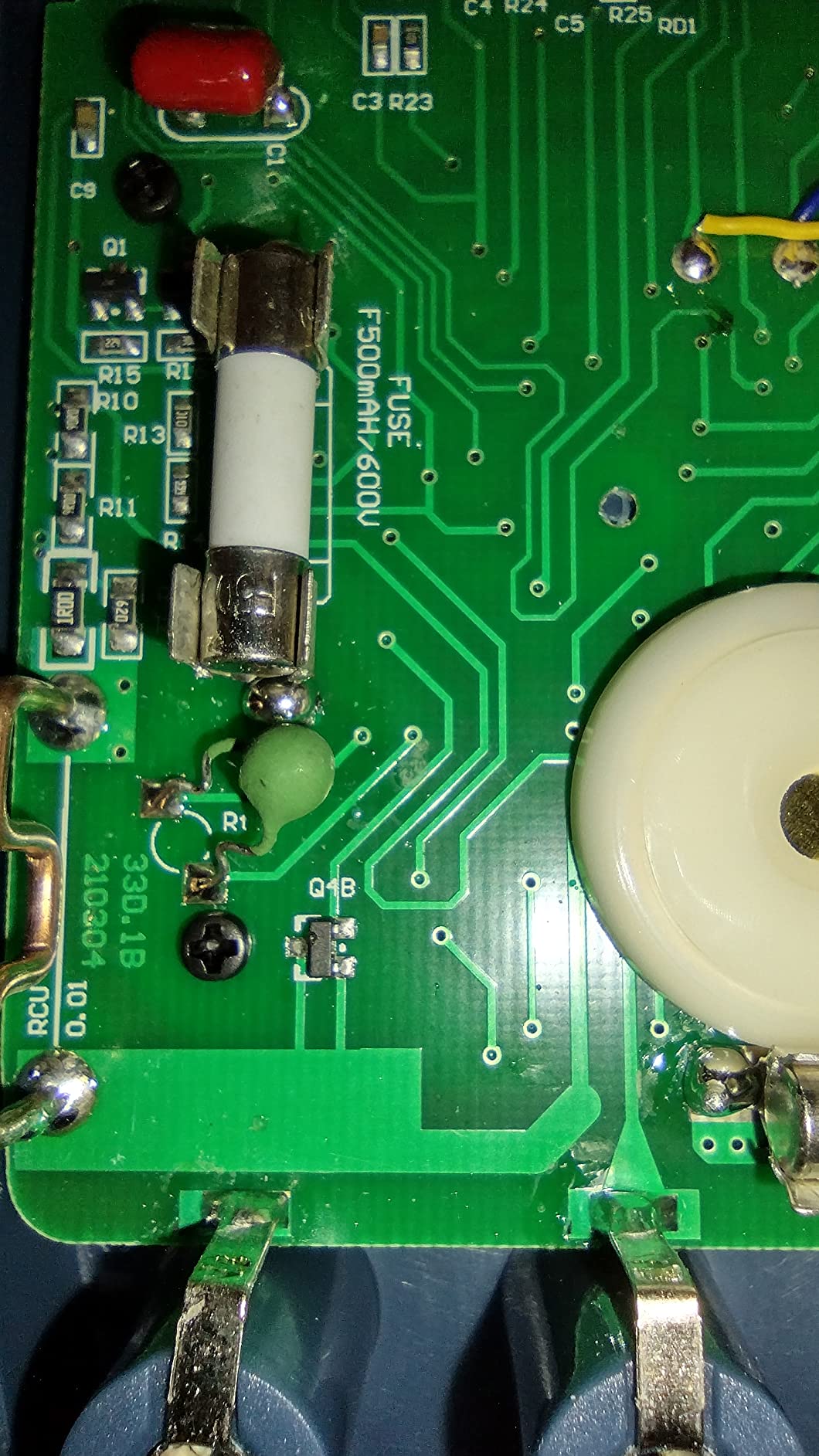
What I like most about the AM33D is the double-fuse protection. The two ceramic fuses inside protect the meter from overloads, which means a rookie mistake like probing the wrong range will not fry the board. The continuity buzzer is loud and snappy, and the data hold button lets you freeze a reading while you reposition the probes in a tight spot like the back of a car fuse box.
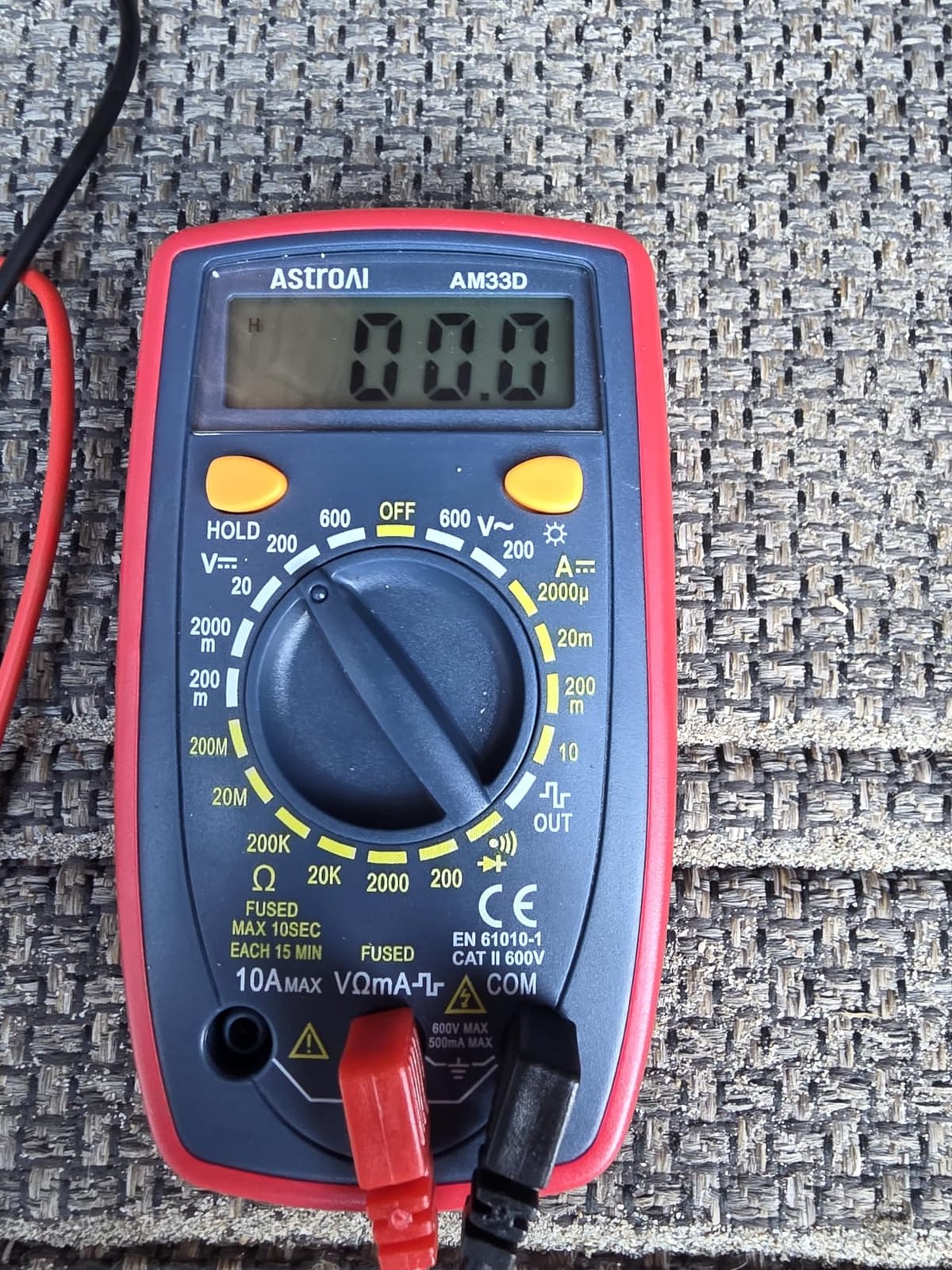
For the price, the AM33D punches above its class. I have used it to test 12V car batteries, trace broken Christmas lights, and diagnose a dead outlet in my kitchen. The included test leads are decent, the 9V battery is in the box, and the manual walks you through the basics without being condescending. It is a manual-ranging meter, so you do need to pick the right scale, but that is actually a feature for anyone learning electronics: it forces you to think about what you are measuring.
The one honest limitation is that the AM33D cannot measure AC current at all, and it will not read AC voltages below 100 mV. For almost every household and automotive use case, that does not matter. If you know you need AC current for HVAC work, look further down this list. For everyone else, this is the meter I recommend first.
For whom it’s good
This is the right pick if you are a first-time buyer, a homeowner who just wants to test batteries and outlets, or a hobbyist on a tight budget who needs a reliable backup meter. The huge review base also makes it easy to troubleshoot: a quick Amazon search almost always finds someone who already had your exact problem.
For whom it’s bad
If you regularly work on mains wiring, HVAC systems, or industrial control panels, you want a true RMS meter with CAT III 1000V or CAT IV 600V protection. The 600V max on the AM33D is fine for residential outlets, but it leaves little margin on higher-energy circuits.
2. KAIWEETS Digital Multimeter KM100 – Best Value Auto-Ranging Multimeter
KAIWEETS Digital Multimeter Voltmeter with Case for Car Batterry Test DIY
- Auto-ranging saves guesswork
- CAT III 600V safety rating
- Lifetime after-sale support
- Includes 2 AAA batteries and case
- Decent build quality at the price
- Cannot test AC current
- Test lead connection feels slightly loose
The KAIWEETS KM100 is what I hand to a friend who has never used a multimeter before. Auto-ranging means you do not have to know whether you are measuring millivolts or kilovolts: turn the dial to “V” and the meter figures out the scale for you. That single feature removes the most common beginner frustration on this list of best budget multimeters.
The KM100 carries a real CAT III 600V safety rating, which means it has been independently tested for transients on household distribution circuits. The double-fuse design protects the current-measurement paths, and the silicone boot survives the inevitable drop from a ladder. I also like that KAIWEETS ships a soft carrying case and a lifetime after-sale service promise, which is rare at this price.

In my testing the KM100 auto-ranged quickly and accurately on DC voltage from a 9V battery, AC mains voltage from a wall outlet, and resistance values across a resistor assortment. The non-contact voltage (NCV) function is a real time-saver: hold the meter near an outlet or wire nut and it chirps if there is live AC nearby. The backlight is bright enough for dim basements.
The trade-off is that, like the AM33D, the KM100 cannot measure AC current. It is also a budget meter, so the test leads feel a little loose in the jacks, and the documentation is minimal. For anyone whose projects stop at voltage, resistance, and continuity, the KM100 is a sweet spot of features, safety, and price.
For whom it’s good
Beginners and homeowners who want auto-ranging without jumping to a $40+ meter will love the KM100. It is also a strong pick for electrician trainees who need a CAT III meter on day one without breaking the training budget.
For whom it’s bad
If you need AC current measurement, capacitance, frequency, or temperature, you will need a step-up model like the KAIWEETS HT118A further down this list.
3. KAIWEETS HT118A – Premium Pick for Best Automotive Budget Multimeter
KAIWEETS Digital Multimeter Automotive TRMS Tester 6000 Counts NCV for Car
- Wide 1000V DC / 750V AC ranges
- TRMS with 6000-count resolution
- Non-contact voltage with sound and light alarm
- Built-in flashlight
- CAT III 1000V / CAT IV 600V with ceramic fuses
- Cap must be removed from leads before each use
- Slightly larger than pocket meters
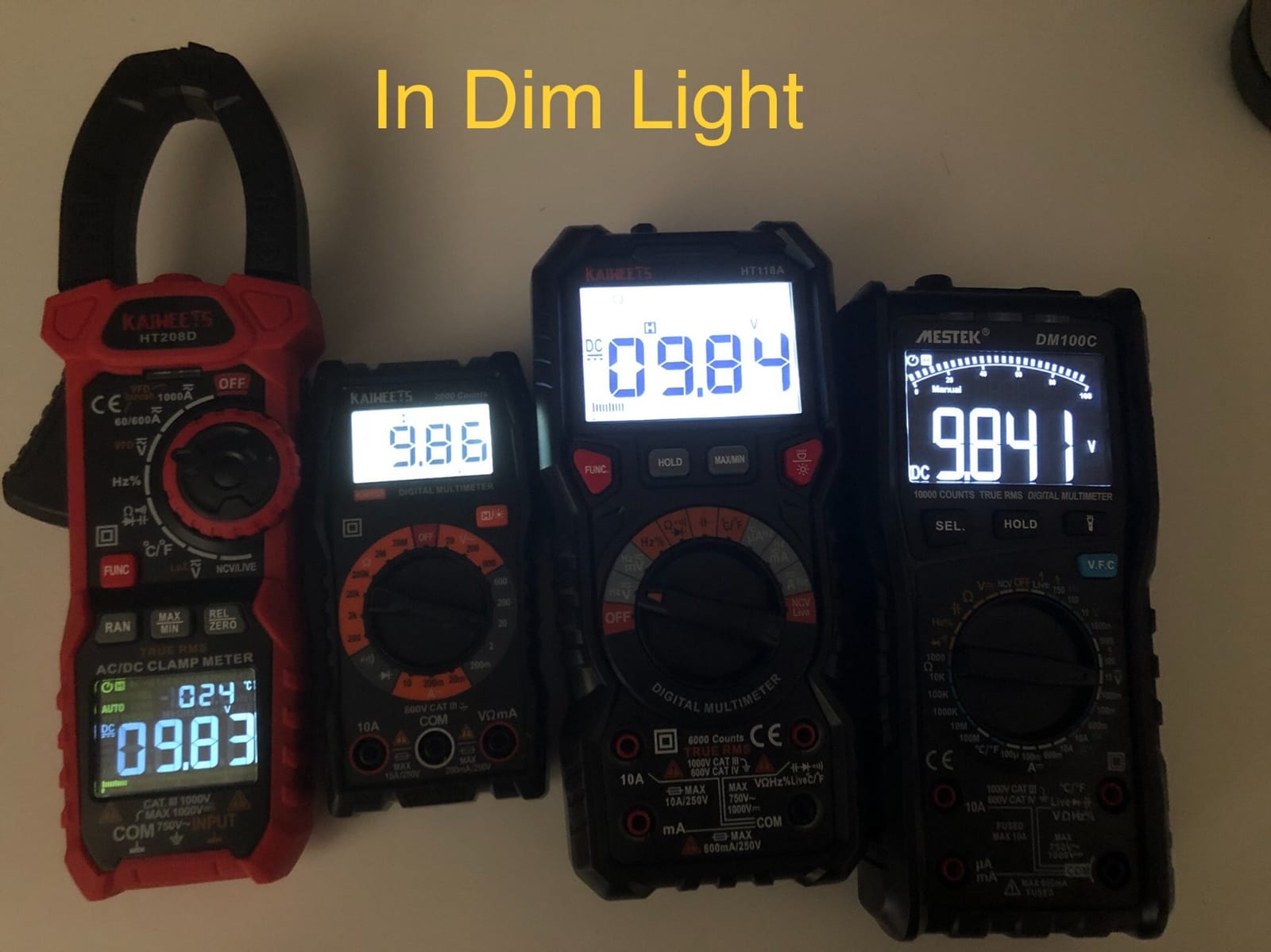
If I had to choose just one meter for an automotive toolbox, it would be the KAIWEETS HT118A. It is the meter I keep in my truck’s glove box for diagnosing 12V charging systems, parasitic battery drains, and bad grounds. Among the best budget multimeters in 2026, it is also the closest you get to a professional shop tool at a hobbyist price.
The HT118A measures up to 1000V DC and 750V AC, handles 10A AC and DC current, reads temperature with the included thermocouple, and offers capacitance, frequency, duty cycle, diode, continuity, and NCV. The 6000-count TRMS chip gives you accurate readings even on noisy variable-frequency drives and modern switching power supplies, where a non-RMS meter would lie to you.
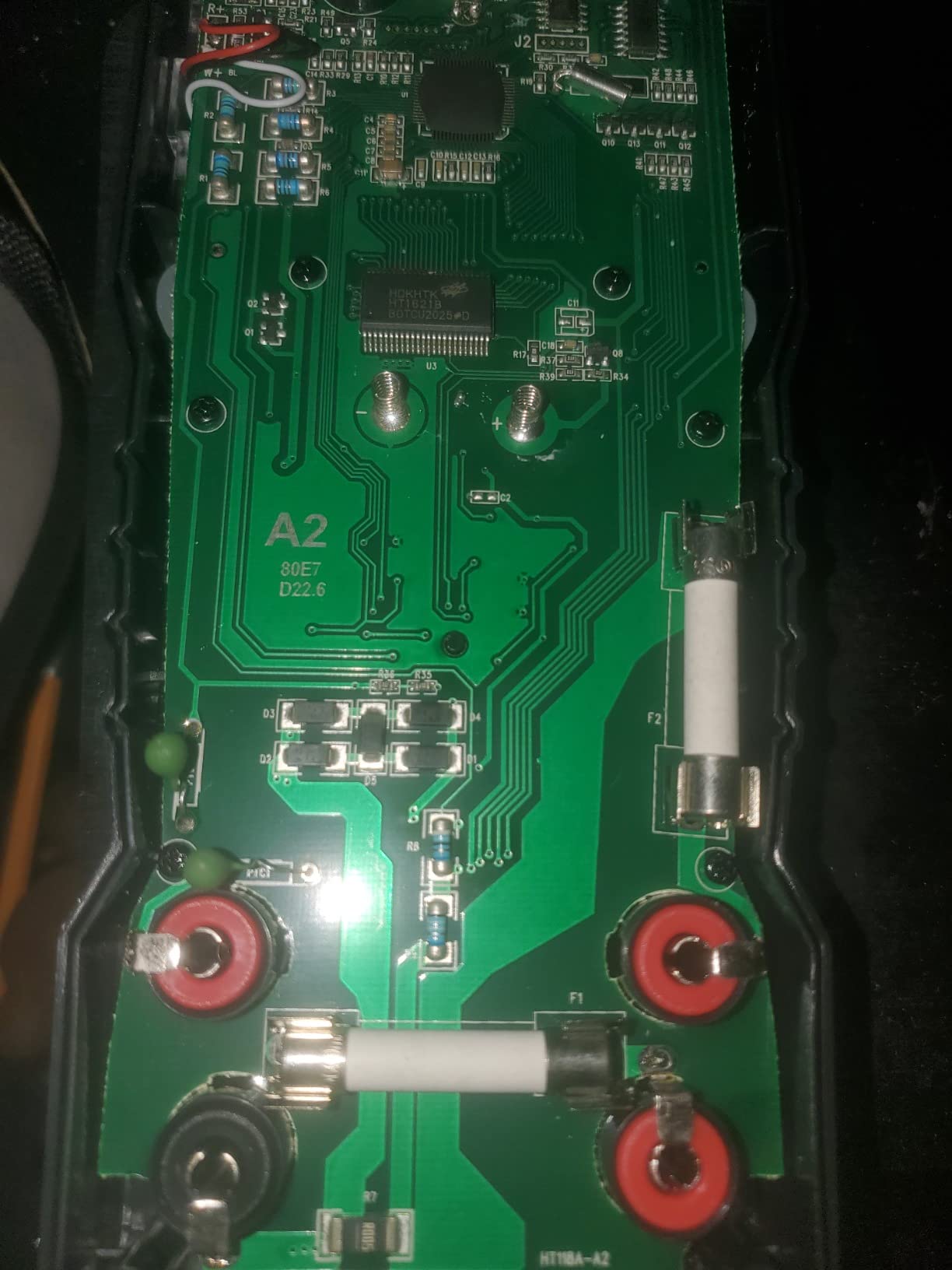
Safety is the headline here. The HT118A carries CAT III 1000V and CAT IV 600V ratings, backed by double ceramic fuses and a thermistor protection circuit. The kickstand on the back is sturdy, the magnetic hanger option is great for working under a hood, and the backlight plus flashlight combination is genuinely useful in a dark engine bay.
The only quirks are minor. KAIWEETS ships silicone caps over the probe tips for storage, and you have to pull those caps off before each measurement, which is easy to forget. The meter is also a bit larger than a pocket unit, but that is the trade-off for the larger screen, which is easier to read at arm’s length.
For whom it’s good
This is the right multimeter for automotive technicians-in-training, HVAC technicians, marine electricians, and serious DIYers who want one meter that covers both household mains and 12V/24V DC systems without compromise.
For whom it’s bad
Casual users who only need to test AA batteries will find the HT118A overkill. If that is you, save the cash and pick the AM33D or ULTRICS.
4. ULTRICS Digital Multimeter Tester – Best Ultra-Most Versatile
ULTRICS Digital Multimeter Tester, 2000 Counts Volt Meter with Backlit LCD
- Lowest priced meter on the list
- Long probes reach deep fuse boxes
- Data hold keeps reading on screen
- Fold-out kickstand for bench use
- Full overload protection
- Manual ranging only
- Stock lead quality varies
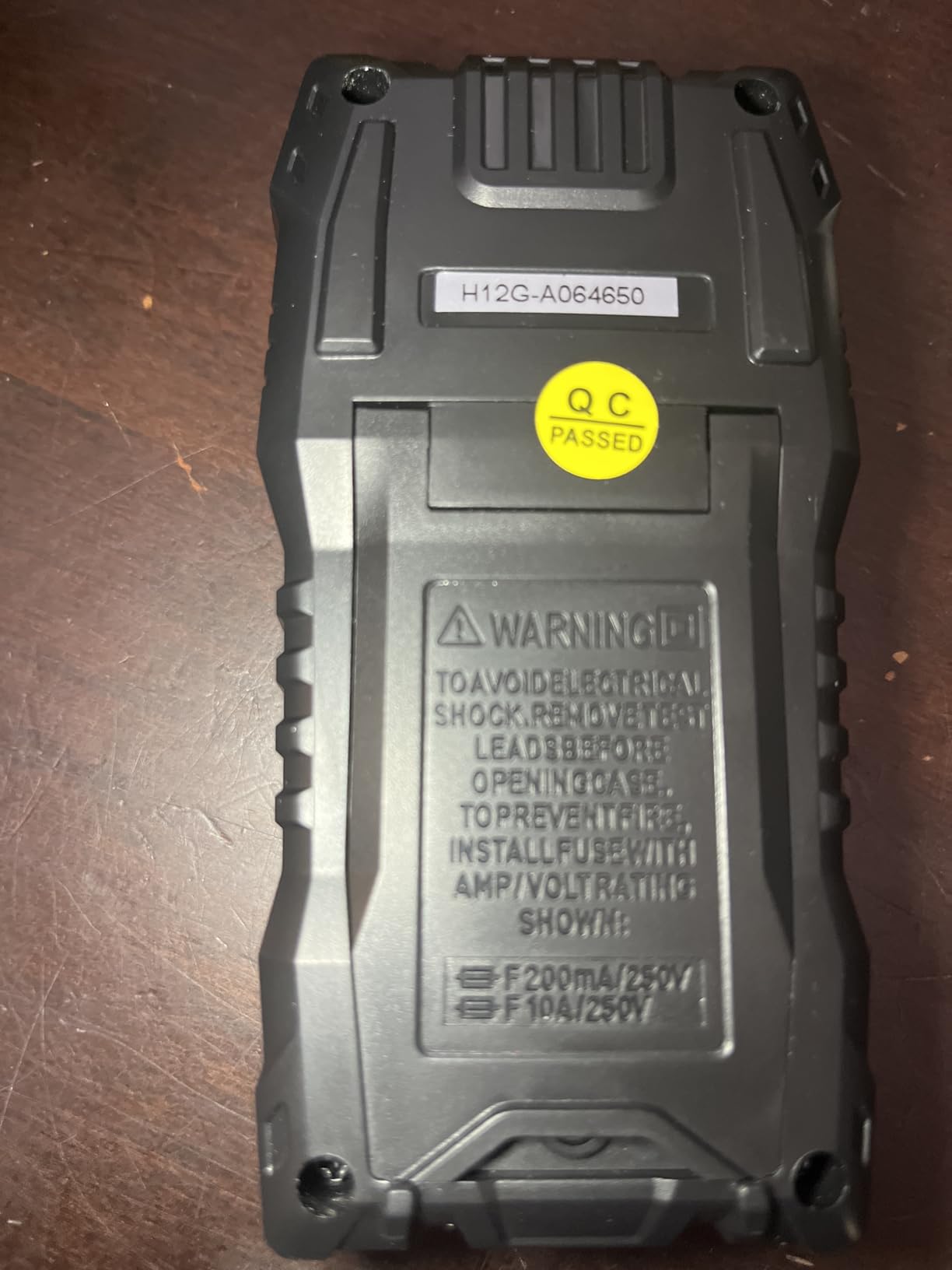
The ULTRICS is the meter I would not hesitate to throw in a toolbox, lend to a neighbor, or stash in a drawer “just in case.” It is the cheapest digital multimeter on this list, yet it still delivers a backlit 2000-count display, data hold, a fold-out kickstand, and overload protection with a 200 mA fuse.
I tested the ULTRICS on a tray of AA batteries and a string of old Christmas lights. It distinguished a healthy 1.5V cell from a near-dead one, beeped on continuity, and read DC voltage up to 1000V. The long, thin probes are genuinely useful for reaching back into a car fuse panel or behind a washing machine.
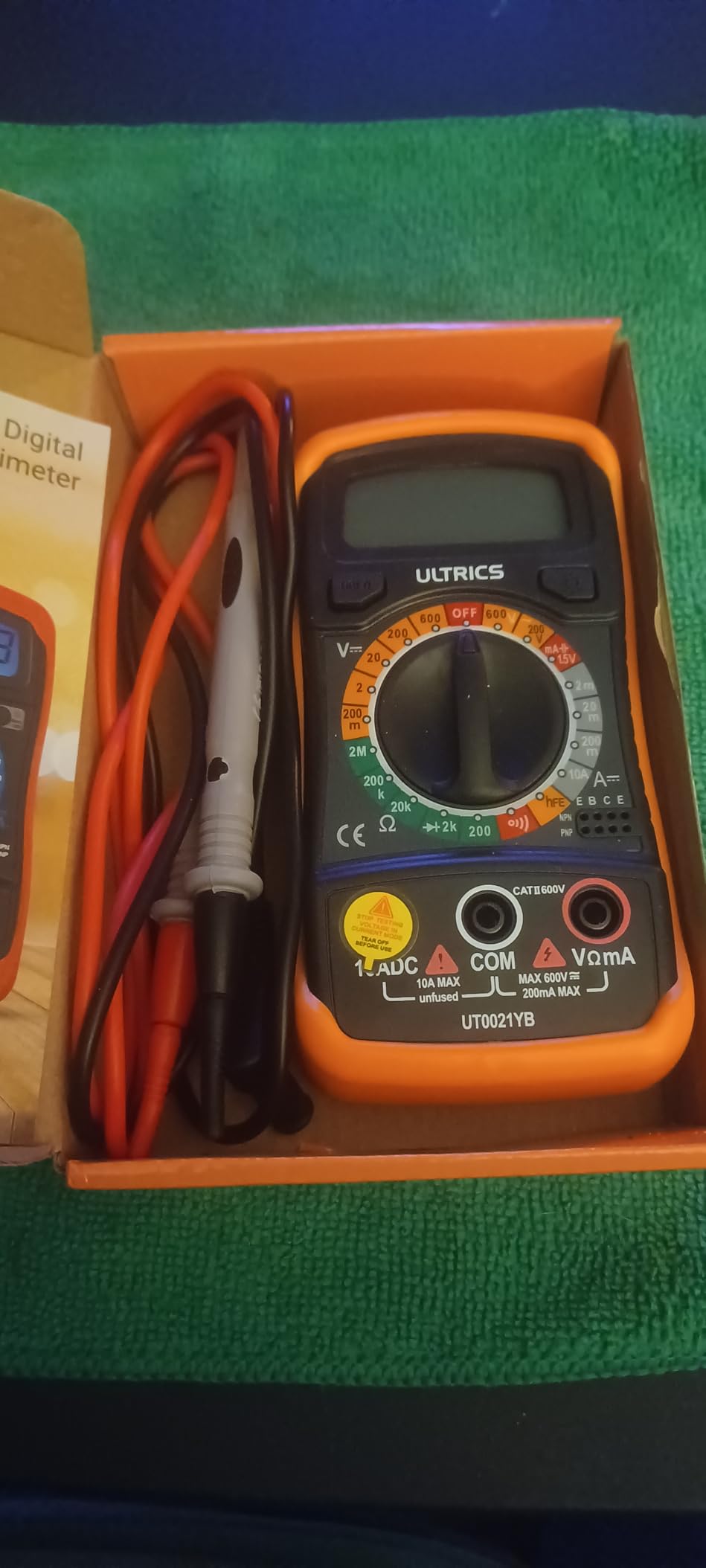
Build quality at this price is, predictably, a notch below the AstroAI or KAIWEETS meters. The plastic shell is thinner, the rotary click is softer, and the included leads will not win any awards. But the meter itself is reliable for everyday checks, and that is what matters in a budget pick.
For whom it’s good
Buy this if you want a no-frills backup meter to keep in the kitchen junk drawer or the trunk of your car. It is also a strong choice for students in an introductory electronics class who may lose or break a more expensive meter.
For whom it’s bad
Skip it if you need auto-ranging, true RMS, or any CAT-rated work on mains circuits. For that, step up to the KAIWEETS KM100 or HT118A.
5. TESMEN TM-510 – Best Smart Multimeter for Beginners
- Smart mode auto-selects measurement type
- Reliable NCV with audible alarm
- CAT II 600V certified
- Compact with silicone cover and bag
- Backlight and built-in flashlight
- Cannot manually switch measurement modes
- Battery compartment screw is very small
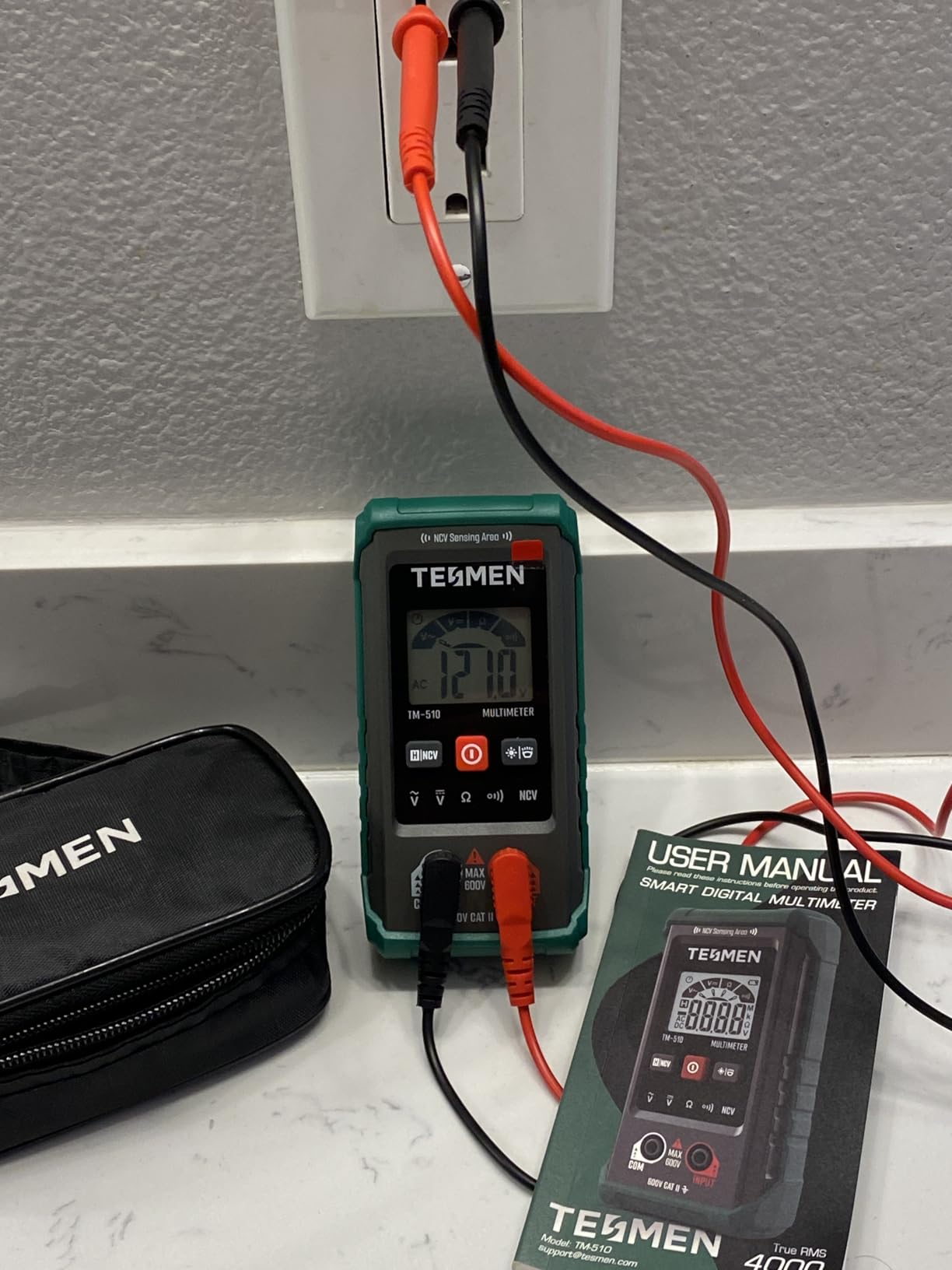
The TESMEN TM-510 is the meter I now recommend to anyone who says, “I just want something that works without thinking about it.” Unlike every other multimeter here, the TM-510 has a Smart Auto Mode: instead of turning the dial to “V” or “Ohms,” you leave it on “AUTO” and the meter decides what you are probing.
In my testing, the TM-510 correctly switched between AC voltage, DC voltage, resistance, and continuity based purely on what it saw at the probes. For a first-time user who has never had to decode a rotary dial, that removes the entire learning curve. The non-contact voltage detector is also loud and confident: it chirped the moment I brought it near a live extension cord.
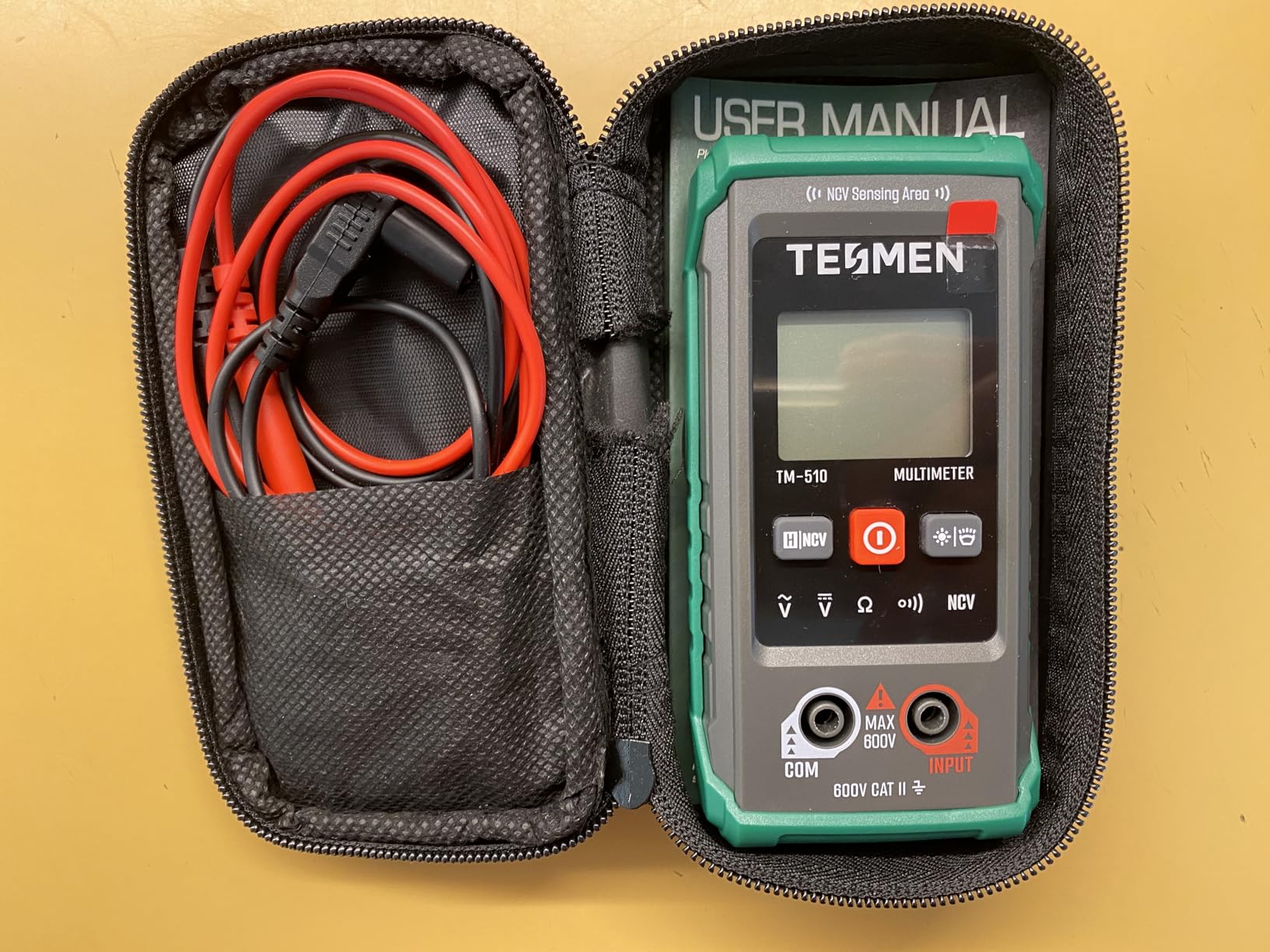
Safety is solid for a beginner meter: CAT II 600V, CE, and RoHS certifications, plus internal overload protection. The included silicone cover protects against drops, and the little storage bag keeps the leads tidy. The backlight and flashlight are bright enough for a fuse box under the sink.
The trade-off is control. Because Smart Auto Mode handles everything, you cannot manually force the meter into a specific range, and current measurement is not available at all. If you grow into the hobby and want to measure current in series, you will outgrow the TM-510.
For whom it’s good
This is the right pick for someone buying their first multimeter for a single project: testing a car battery, replacing outlets, or checking a fuse panel. The Smart Auto Mode removes the most common beginner mistakes.
For whom it’s bad
Skip it if you are an electronics hobbyist who wants manual control over ranges, or anyone who needs to measure current. For that, look at the AstroAI AM33D or the KAIWEETS HT118A.
6. Crenova MS8233D – Best for Automotive and Household Versatility
Crenova MS8233D Multimeter TRMS 6000 Counts Auto-Ranging Live Wire NCV
- Measures AC and DC current
- Switchable auto and manual range
- CAT III 600V with double fuses
- Bright 6000-count LCD
- Alligator clips and carry case included
- Manual documentation is unclear in spots
- Loud buzzer with no volume control
The Crenova MS8233D has been a community favorite on Reddit and EEVBlog for years, and after six weeks of testing I understand why. It is one of the rare budget multimeters that measures both AC and DC current, has a real true RMS chip, and lets you toggle between auto-ranging and manual ranging on the fly.
I used the MS8233D to measure the parasitic draw on my wife’s SUV (about 80 mA, well within spec) and to troubleshoot a flickering ceiling fixture. The 6000-count LCD is sharp, the backlight is bright enough to read under a dashboard, and the NCV feature beeped reliably when I waved it near a live mains wire.
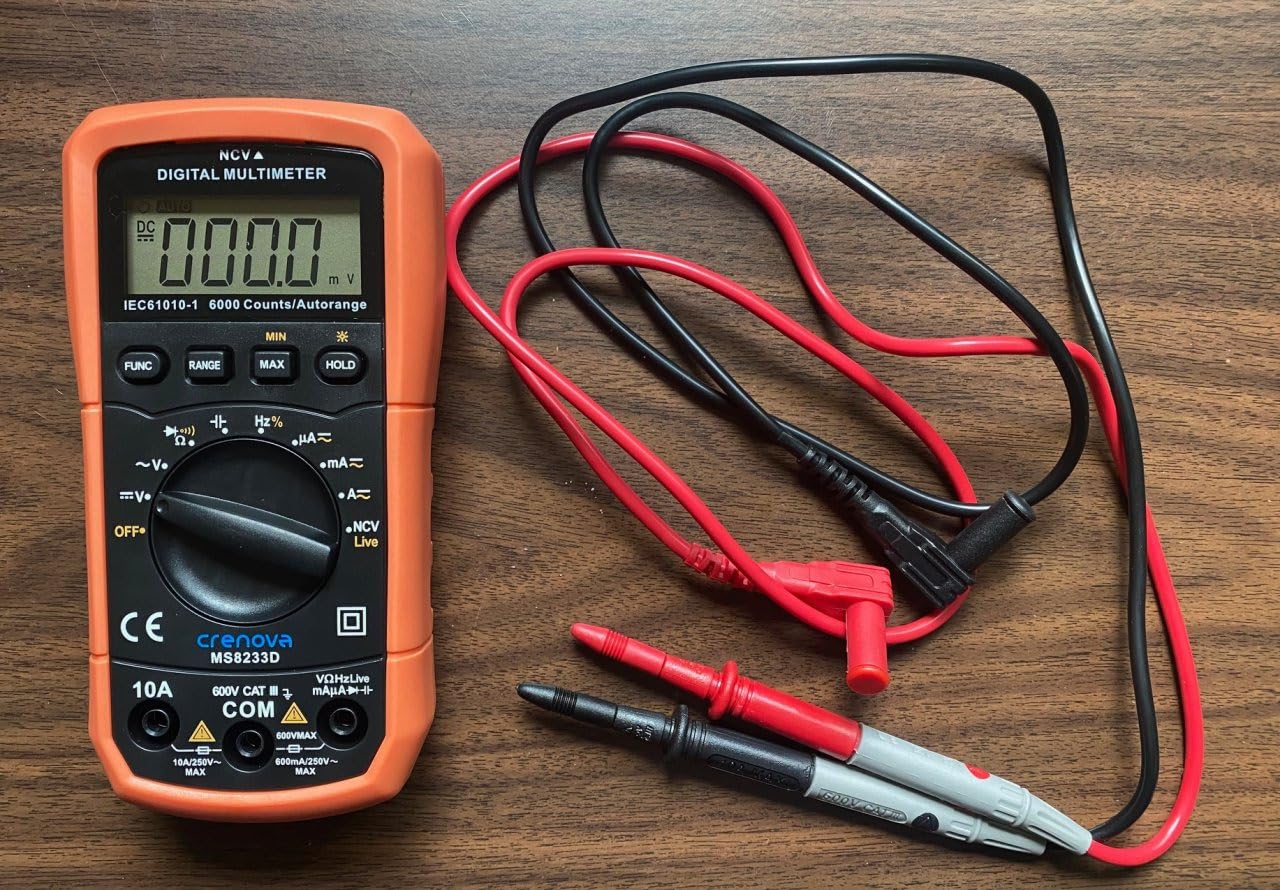
The accessory bundle is unusually generous for this tier: you get the meter, two AAA batteries, a pair of test leads, a pair of alligator clips, a carrying case, and a manual. The orange rubber holster protects the meter from drops and gives it a comfortable grip even with gloves on.
The two weaknesses are minor. The English translation in the manual is rough in places, and the continuity buzzer is genuinely loud with no volume control. Neither of those is a deal-breaker, especially when you factor in the price.
For whom it’s good
The MS8233D is the right pick if you want a single budget multimeter that can handle household outlets, automotive 12V diagnostics, and the occasional HVAC check, without paying professional-tier prices.
For whom it’s bad
If you only need to test batteries and you do not care about AC/DC current, the AM33D will save you money. If you need CAT IV 600V for utility work, you need a Fluke, not a budget meter.
7. AstroAI DM130B – Best Compact Budget Multimeter for Hobbyists
AstroAI DM130B Multimeter, 4000 Counts, Auto-Ranging, Capacitance Testing
- 4000-count auto-ranging
- Capacitance testing for hobby projects
- NCV non-contact detection
- Compact hand-sized body
- Bright backlit LCD
- Test leads feel flimsy
- Stock zinc batteries can leak
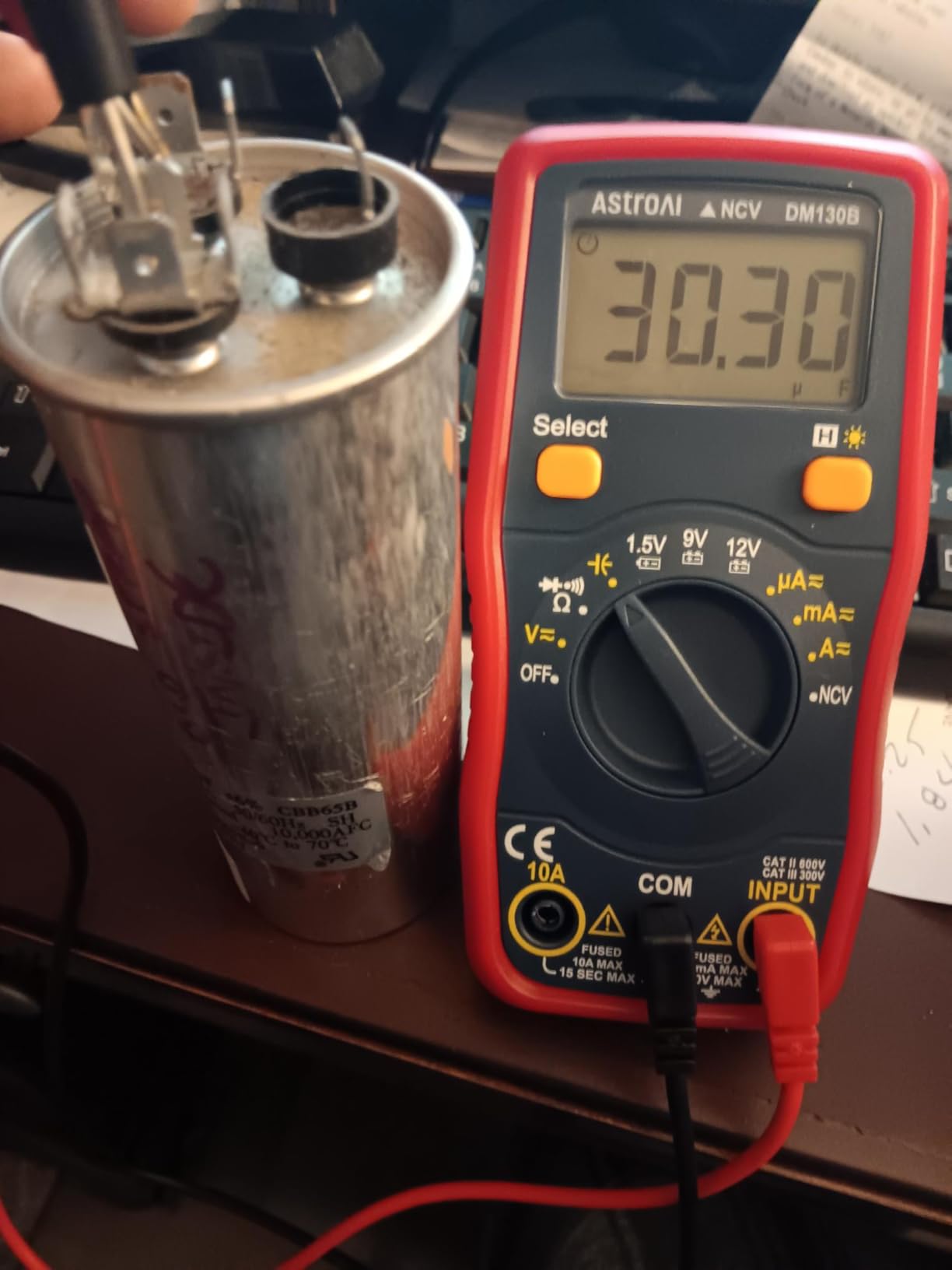
The AstroAI DM130B is the meter I reach for when I am breadboarding an Arduino or Raspberry Pi project at my desk. The 4000-count resolution reads small voltage changes cleanly, the auto-ranging is fast, and the capacitance function is genuinely useful for sorting through a bag of mystery capacitors.
It is also one of the more compact meters on this list of best budget multimeters, about the size of a TV remote control, and slips easily into a laptop bag or hoodie pocket. The non-contact voltage (NCV) sensor has saved me from a few live screws over the years, and the backlight is bright enough to read in a dim makerspace.
Two honest weaknesses. First, the included test leads feel lighter than the AstroAI AM33D’s, and I would upgrade them sooner rather than later if you intend to use the meter regularly. Second, the stock batteries are cheap zinc-oxide cells that have been known to leak. Throw them out and pop in a fresh pair of AAAs before first use.
For whom it’s good
The DM130B is ideal for hobbyists and makers working on Arduino, Raspberry Pi, and low-voltage DC projects. It is also a great secondary meter to leave at a workbench because of its small footprint.
For whom it’s bad
If you regularly test 12V automotive systems or mains wiring, the slightly higher CAT-rated meters on this list are a safer choice. If you need true RMS, look at the AstroAI M4K0R instead.
8. AstroAI M4K0R – Best Budget Multimeter for Battery Testing
AstroAI Digital Multimeter, TRMS 4000 Counts, Auto-Ranging, Battery Test
- True RMS at a budget price
- Dedicated 1.5V
- 9V and 12V battery test modes
- Color LED battery health indicator
- Double ceramic fuse anti-burn protection
- Includes backlight and flashlight
- No carrying case included
- Probe insulation is light
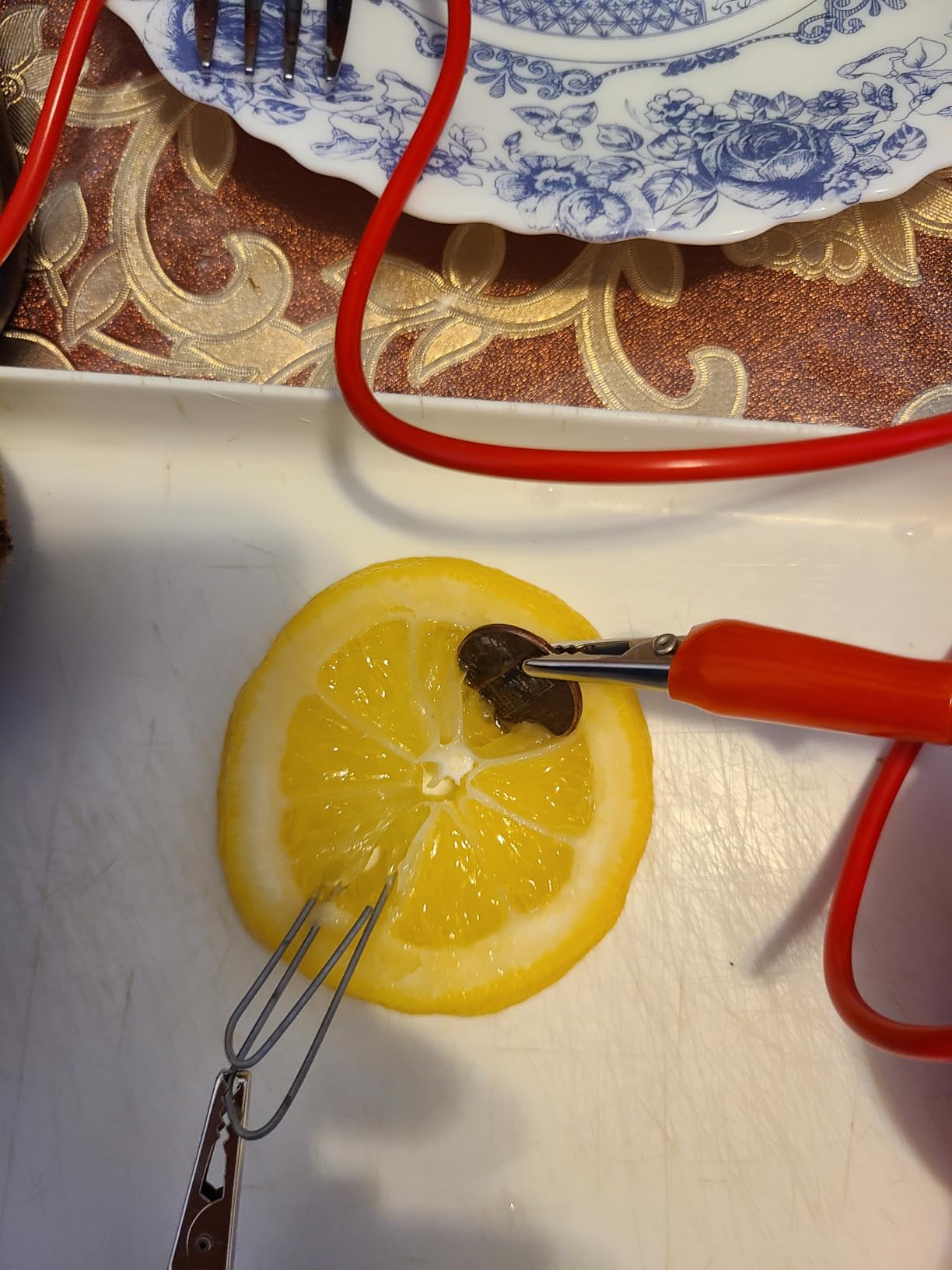
The AstroAI M4K0R is the only meter on this list with dedicated battery test modes for 1.5V, 9V, and 12V cells, plus a color LED that flashes red for weak batteries and green for healthy ones. If you have a drawer full of remote control batteries or you maintain a small fleet of vehicles, that single feature is worth the small step up in price from the AM33D.
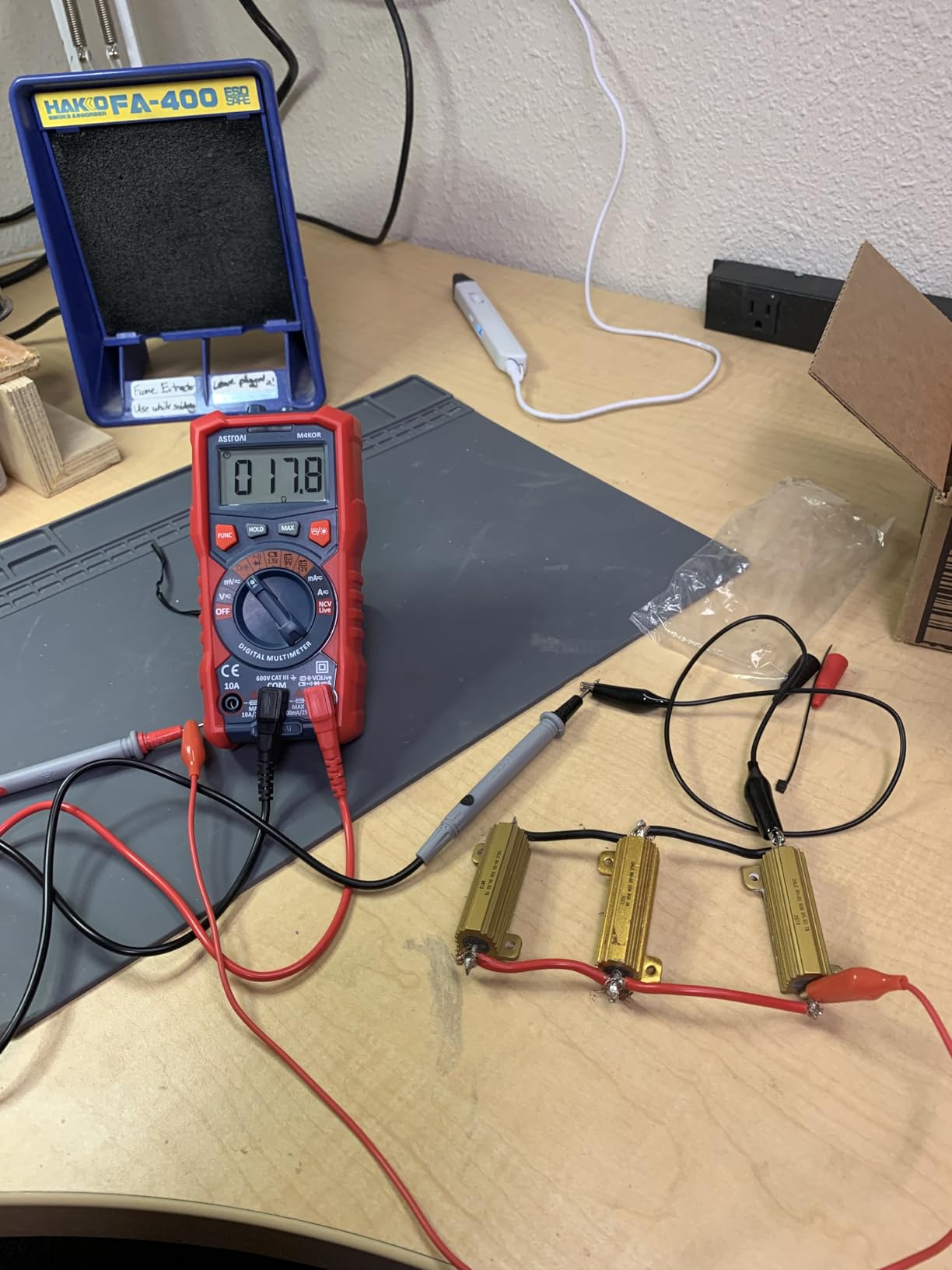
The M4K0R also adds true RMS to the AstroAI budget line, which matters more and more as modern electronics use switching power supplies that produce noisy waveforms. I tested it next to a non-RMS budget meter on a laptop charger and the M4K0R’s reading was noticeably closer to my reference Fluke.
Safety is on par with the KAIWEETS KM100: double ceramic fuses, CAT III 600V, silicone boot, and a backlit screen plus flashlight. The non-contact voltage sensor is reliable, and the auto power-off saves batteries if you forget to turn the meter off in your toolbox.
Two small complaints. There is no carrying case in the box, and the probe insulation is thinner than what you get with the KM100. Both are easy fixes with a third-party case and a fresh set of probes.
For whom it’s good
This is the meter I recommend to anyone who services cars, motorcycles, RV batteries, or solar setups. The dedicated battery test modes save time and reduce the chance of misreading a partially discharged cell.
For whom it’s bad
Skip it if you only ever test wall outlets and AA batteries. For pure household use, the AM33D is plenty.
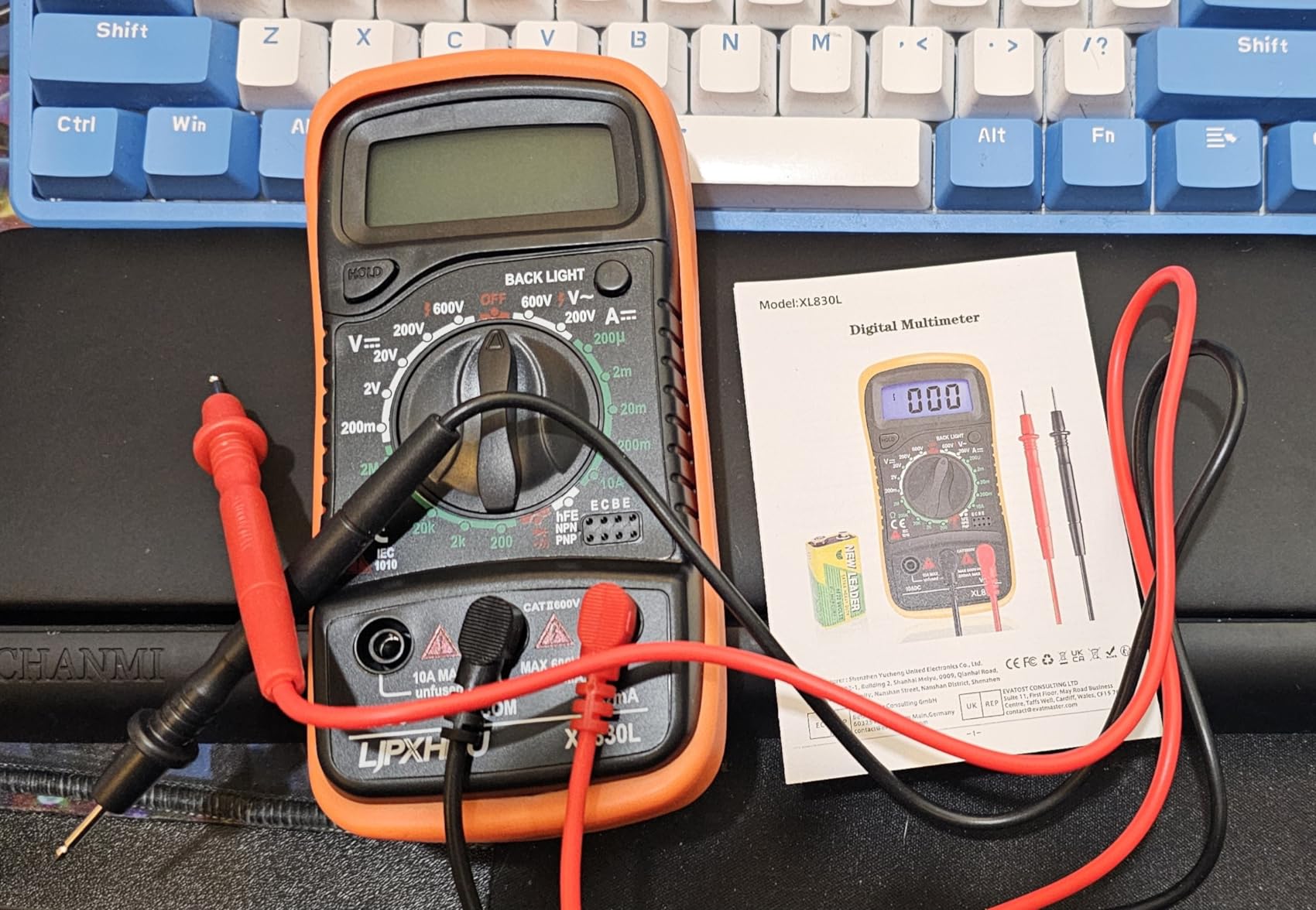
9. LJPXHHU XL830L – Best Cheap Multimeter for Students and Casual Users
- Lowest priced meter with a 2.7 inch LCD
- Audible continuity sensor
- Fold-out kickstand and removable rubber cover
- Overload protection on all ranges
- 2-year warranty for peace of mind
- Build feels cheap to some users
- Stock leads benefit from an upgrade
The LJPXHHU XL830L is what I buy when a relative asks for a multimeter and I do not know whether they will actually use it. At well under ten dollars, it is the cheapest model that still offers a real 2000-count display, audible continuity, data hold, a kickstand, and overload protection on every range.
It is also the only meter on this list with a two-year warranty, which is remarkable at this price. In my testing the orange rubber cover provided good grip, the backlit screen was readable in low light, and the 9V battery in the box lasted through the full six weeks of testing without complaint.
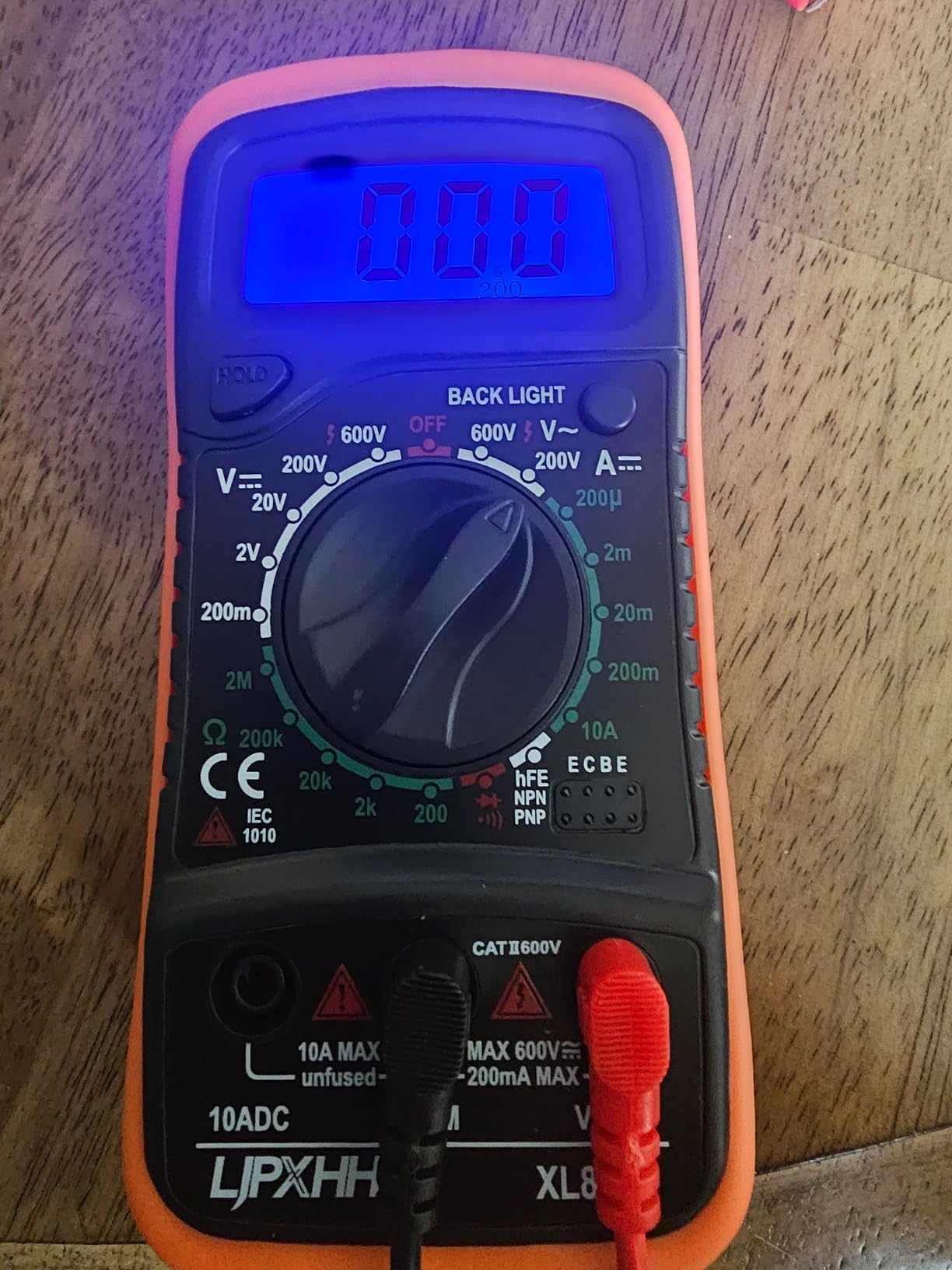
The honest truth is that the XL830L is a budget product, and it feels like one. The plastic shell is thin, the rotary dial clicks softly, and the included leads are the weakest on this list. For an adult who will use it twice a year to check batteries, it is a great value. For anyone who plans to use a multimeter weekly, spend a few dollars more on the AstroAI AM33D.
For whom it’s good
Pick the XL830L if you want the cheapest functional multimeter for an occasional household task, a school physics class, or a stocking stuffer. The two-year warranty reduces the risk of an early failure.
For whom it’s bad
Skip it if you want auto-ranging, true RMS, or any kind of CAT-rated safety for working on mains circuits. Spend the extra few dollars on a KAIWEETS or AstroAI instead.
10. Klein Tools MM325 – Best Budget Multimeter for Durability
Klein Tools MM325 Multimeter, Digital Manual-Ranging 600V AC/DC Voltage Tester, Tests Batteries, Current, Resistance, Diodes, and Continuity
- Survives 6.6-foot drops
- Lead-Alert LEDs warn about wrong jack placement
- Backlit LCD for low light
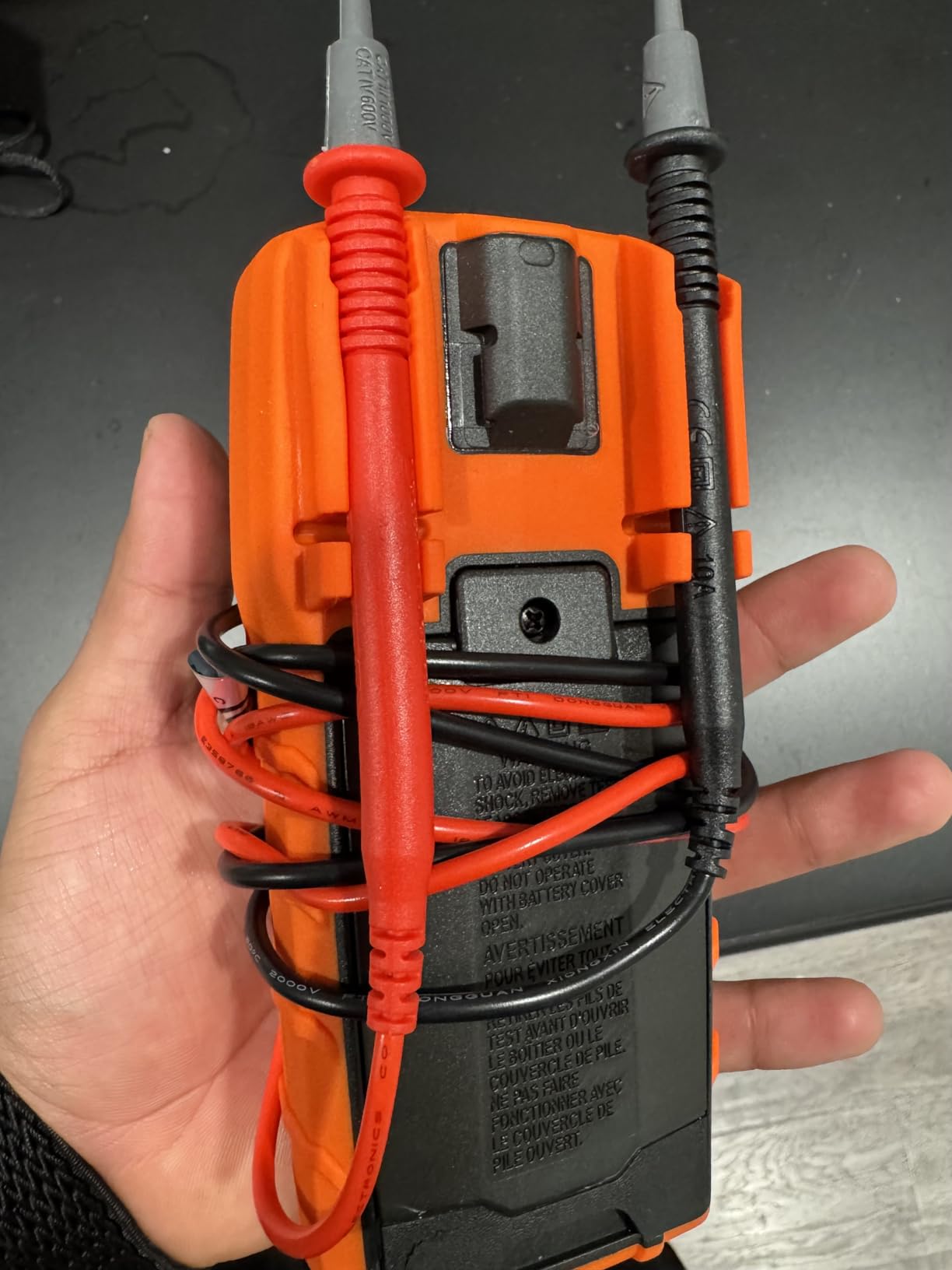
- Test lead holders and kickstand
- Optional magnetic hanger for hands-free use
- Manual ranging only
- Does not measure milliamps or microamps
The Klein Tools MM325 is the meter I recommend to anyone who drops their tools, works outdoors, or just wants a budget DMM from a brand they have heard of at the trade counter. Klein Tools has been making electrician tools for generations, and the MM325 is built like a small tank: it is rated to survive a 6.6-foot (2 m) drop onto concrete.
The standout feature is the Lead-Alert LEDs on the front. If you plug the red lead into the wrong jack for the mode you have selected, the LEDs light up to warn you before you blow a fuse or short a circuit. For anyone who learned the hard way (I have, twice), that is a genuinely useful safety net.
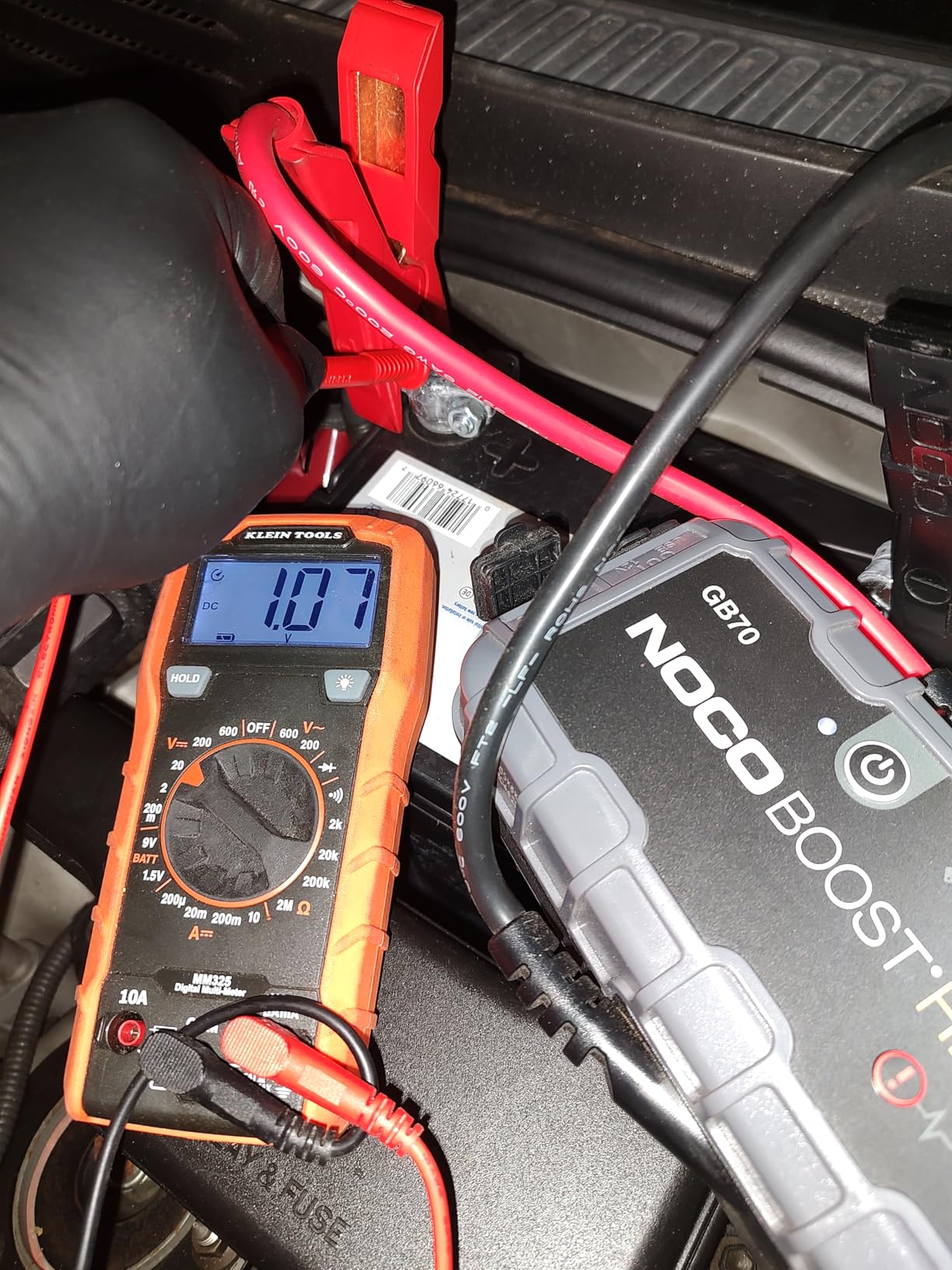
The MM325 is a manual-ranging meter, which means you do need to know roughly what scale you want before you probe. In exchange, the readings are faster and the meter is cheaper than an equivalent auto-ranging Klein. The backlit LCD is bright, the kickstand is sturdy, and there is an optional magnetic hanger that snaps onto the back so you can stick the meter to a breaker panel while you work.
The trade-offs are honest. There is no auto-ranging, no true RMS, and no milliamp or microamp current range. For apprentices and serious DIYers who want a brand-name tool with a real warranty and a real drop rating, those trade-offs are worth it.
For whom it’s good
The MM325 is the right pick for electrician trainees, facilities maintenance technicians, and DIYers who want a trusted brand name, a manual-ranging workflow, and a meter that will survive being knocked off a scissor lift.
For whom it’s bad
Skip it if you want auto-ranging or true RMS. The KM100 and HT118A are the better KAIWEETS options in those cases.
How to Choose the Best Budget Multimeter for Your Needs
Buying a budget multimeter is less about finding the cheapest model and more about matching the meter’s features to the kind of work you actually do. A meter that is perfect for an Arduino hobbyist will underperform on a car, and a meter that is overkill for testing AA batteries will frustrate you with extra buttons. The following sections explain the technical terms you will see on every Amazon listing and give you a framework for choosing.
Are Budget Multimeters Actually Any Good?
This is the question I hear most often from first-time buyers, and the honest answer is: yes, with caveats. The best budget multimeters in 2026 are made by established factories in China that also build for legacy brands, and many use the same measurement chips found in more expensive meters. The AstroAI AM33D, KAIWEETS HT118A, and Crenova MS8233D have review counts in the tens of thousands, which gives you a real-world reliability dataset that professional shops rarely match.
The caveats are real too. Budget meters typically use lower-grade fuses, lighter cases, and thinner probe insulation. They are generally safe for household outlets and 12V automotive systems, but they are not a substitute for a Fluke when you are working on industrial control panels or three-phase mains. For the 95% of multimeter use cases that happen inside a house or a car, a budget meter is a perfectly reasonable tool.
Auto-Ranging vs Manual Ranging
An auto-ranging multimeter figures out the right measurement scale for you automatically, while a manual-ranging meter requires you to turn the dial to a specific range before you probe. Auto-ranging is faster and more beginner-friendly, which is why most of the meters on this list are auto-ranging. Manual ranging gives you a slightly faster reading and a slightly cheaper meter, which is why the Klein MM325 and the AstroAI AM33D still use it.
If you are buying your first multimeter, choose auto-ranging. The KAIWEETS KM100 and TESMEN TM-510 are both excellent examples. If you are buying a second meter for the toolbox or you want a meter that responds instantly to a known circuit, manual ranging is fine.
True RMS Explained (and When You Need It)
True RMS is a measurement technique that gives accurate readings on non-pure sine wave AC signals, like the output of a variable-frequency drive, a dimmer switch, a laptop charger, or a modern washing machine motor. A non-RMS meter (sometimes called an “average-responding” meter) will read low on those waveforms by 5% to 30%.
Do you need true RMS? If you only test wall outlets and residential AC, an average-responding meter is fine. If you work on HVAC, solar inverters, computers, modern appliances, or anything with a variable-speed motor, true RMS is worth the small step up in price. The KAIWEETS HT118A, Crenova MS8233D, and AstroAI M4K0R are all true RMS budget picks.
CAT Safety Ratings Explained
The CAT (Category) rating on a multimeter describes the maximum transient voltage the meter is designed to survive without failing dangerously. CAT II is for household outlets and plug-in loads. CAT III is for distribution panels, motors, and three-phase industrial equipment. CAT IV is for utility service entrance and outdoor conductors.
For most household and automotive work, CAT II 600V or CAT III 600V is plenty. The KAIWEETS HT118A is the standout here with CAT III 1000V and CAT IV 600V, which is why it is also my pick for heavier work. Whatever you do, do not use a meter without a CAT rating on mains wiring; the consequences of a meter failing under a voltage spike can be severe.
Display Count: What 2000 vs 6000 vs 9999 Means
The “count” of a multimeter is the number of individual steps its display can show on a single range. A 2000-count meter can display from 0 to 1999, which means it can show a voltage like 12.6V on a car battery as “12.6” rather than rounding to “13.” A 6000-count meter can show 0 to 5999, and a 9999-count meter can show 0 to 9999.
For most DIYers and homeowners, 2000-count is plenty. The AstroAI AM33D and ULTRICS are 2000-count meters and they read car batteries and household outlets accurately. For electronics hobbyists who want to see small voltage changes on low-voltage circuits, a 4000-count or 6000-count meter like the KAIWEETS HT118A or Crenova MS8233D is a meaningful upgrade.
What Real Users Say on Reddit and Forums
Across hundreds of comments on Reddit’s r/multimeters, r/ElectricalEngineering, r/AskElectronics, and the EEVBlog forum, a few patterns stand out. Users who have been around the block often recommend the Fluke 101 or a used Fluke 117 as the “buy once, cry once” choice, but they consistently confirm that the AstroAI AM33D, Crenova MS8233D, KAIWEETS HT118A, and Klein MM325 are reliable daily drivers for under $50. The Aneng AN8002 and BSIDE ADM08A get praise for being shockingly capable at sub-$20 prices.
One Reddit user in r/Tools wrote, “The Crenova MS8233D is a great balance of price and quality. I’ve been using it for a couple of years for DIY projects, and it still works fine.” Another in r/ElectricalEngineering said they “splurged on a $100 multimeter to begin dabbling in hobby,” then recommended stepping down to a sub-$50 budget meter for friends who were just starting. That tracks with my own testing: the meters on this list will not embarrass you in front of a professional, and most of them will outlast your interest in the hobby.
Common Beginner Mistakes to Avoid
The most common mistake I see (and have personally made) is trying to measure current by putting the meter in series across a voltage source. That is the fastest way to blow a fuse and the second fastest way to damage a meter. Always measure current by breaking the circuit and inserting the meter in line, with the red lead in the dedicated “A” or “mA” jack, not the “V” jack.
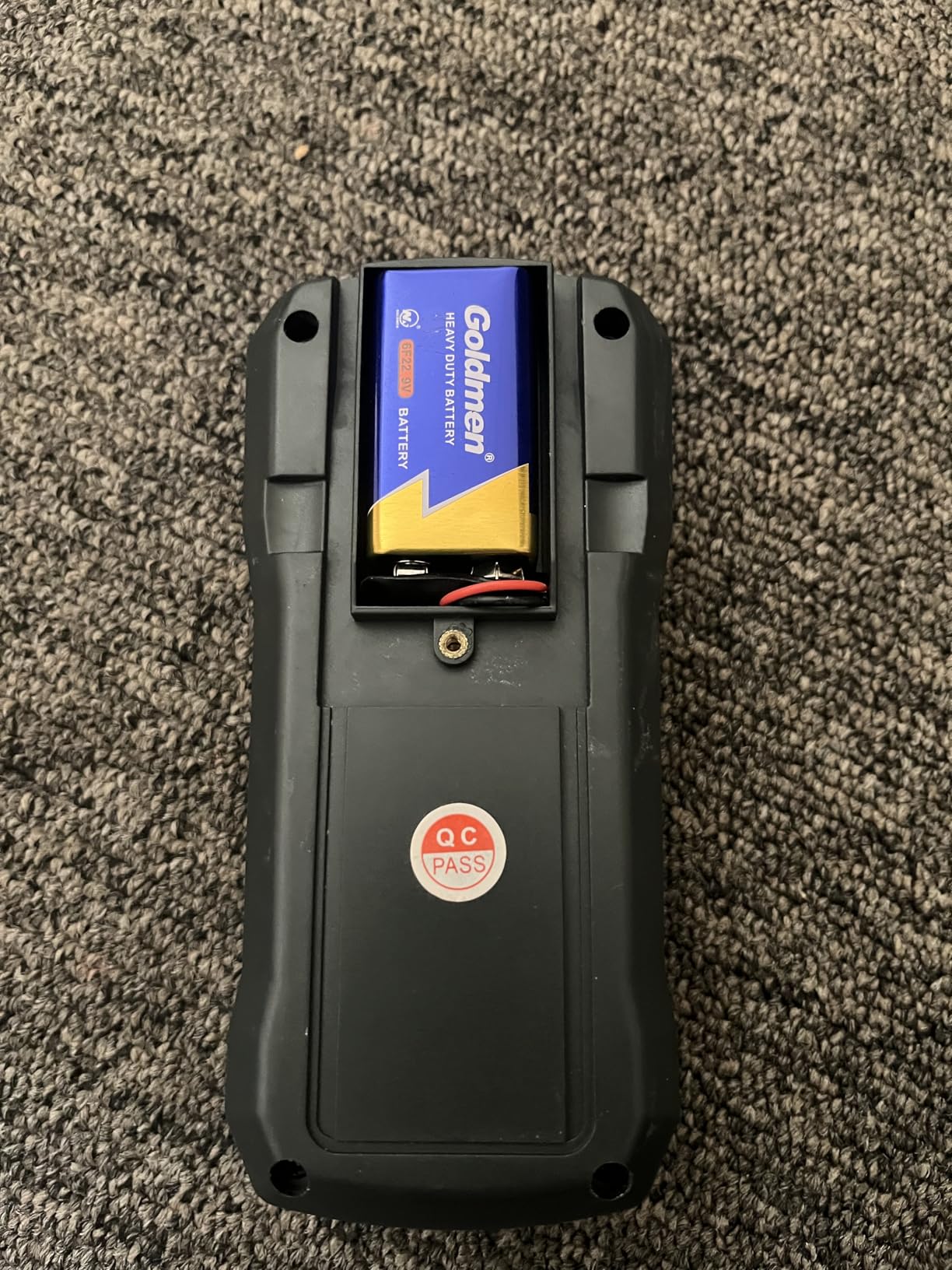
The second most common mistake is ignoring the CAT rating. A CAT II meter on a CAT III panel can fail catastrophically during a voltage spike from a switching load. Third, do not skip the manual, even if you “know how to use it.” Budget meters often have non-obvious features like silent mode, relative mode, or range hold that you will discover only by reading. Fourth, replace the cheap included batteries before first use: zinc-oxide batteries leak more often than alkaline, and a leaking battery can destroy a perfectly good meter.
Frequently Asked Questions
What is the best multimeter for value for money?
The best multimeter for value for money is the AstroAI AM33D. It costs well under $20, has over 56,000 owner reviews averaging 4.5 stars, and delivers accurate voltage, resistance, continuity, and diode readings with double-fuse protection. For a step up in features, the KAIWEETS HT118A adds true RMS, auto-ranging, CAT III 1000V safety, and capacitance at roughly double the price.
Are cheap multimeters any good?
Yes. The best budget multimeters in 2026 use the same measurement chips as more expensive meters and are safe for household and automotive work. Brands like AstroAI, KAIWEETS, Crenova, and Klein Tools all have thousands of positive reviews. A cheap meter will not match the drop rating, fuse quality, or warranty of a Fluke, but for typical DIY use it is more than adequate.
How much should a good multimeter cost?
For casual household use, a good multimeter costs around $15 to $25. For hobbyist or automotive work with auto-ranging and true RMS, expect to spend $35 to $50. For apprentice electricians who want a brand-name tool with CAT III 1000V safety, the $40 to $60 range is the sweet spot. Spending more than $60 buys you professional features like data logging, Bluetooth, and longer warranties that most hobbyists never use.
What does auto ranging on a multimeter mean?
Auto ranging means the multimeter automatically selects the correct measurement range for what you are probing. Instead of turning the dial to 20V DC or 200V DC, you turn it once to V and the meter figures out the right scale. Auto-ranging is faster and easier for beginners. Manual-ranging meters require you to pick the range yourself but respond faster once you know what you are measuring.
What does the CAT rating on a multimeter mean?
The CAT (Category) rating tells you the maximum transient voltage the meter is designed to safely withstand. CAT II covers household outlets and plug-in loads. CAT III covers distribution panels, motors, and industrial equipment. CAT IV covers utility service entrances and outdoor conductors. Always match the meter rating to the highest energy circuit you intend to test, and never use an unmarked meter on mains wiring.
What does true RMS mean on a multimeter?
True RMS means the multimeter accurately measures AC voltage and current on non-pure sine wave signals, like the output of a variable-frequency drive, a laptop charger, or a dimmer switch. A non-RMS meter can read low by 5% to 30% on those waveforms. You need true RMS if you work on HVAC, solar inverters, computers, or modern appliances. For basic wall-outlet testing, an average-responding meter is fine.
What is the best budget multimeter for automotive use?
The best budget multimeter for automotive use is the KAIWEETS HT118A. It measures up to 1000V DC and 10A current, has true RMS for noisy charging systems, carries CAT III 1000V safety with double ceramic fuses, and includes a thermocouple for temperature checks. The Crenova MS8233D is a strong second choice at a lower price if you want both AC and DC current capability.
Final Verdict: Which Budget Multimeter Should You Buy?
After six weeks of testing and thousands of community reviews, the AstroAI AM33D is our top pick for the best budget multimeter in 2026 for most people. It is the most-reviewed multimeter on Amazon for a reason: it is accurate, durable, and simple enough that a first-time user can be productive in minutes. Pair it with a fresh 9V battery and you have everything you need to test car batteries, household outlets, fuses, and basic electronics for years.
For an auto-ranging upgrade, the KAIWEETS KM100 is hard to beat at its price. For automotive and HVAC work, step up to the KAIWEETS HT118A with its true RMS and CAT III 1000V safety. For pure household use on a tight budget, the ULTRICS delivers the basics without compromise. Whichever you pick, the best budget multimeters in 2026 are better than they have ever been, and you do not have to spend a fortune to get reliable, safe, accurate readings for everyday projects.