
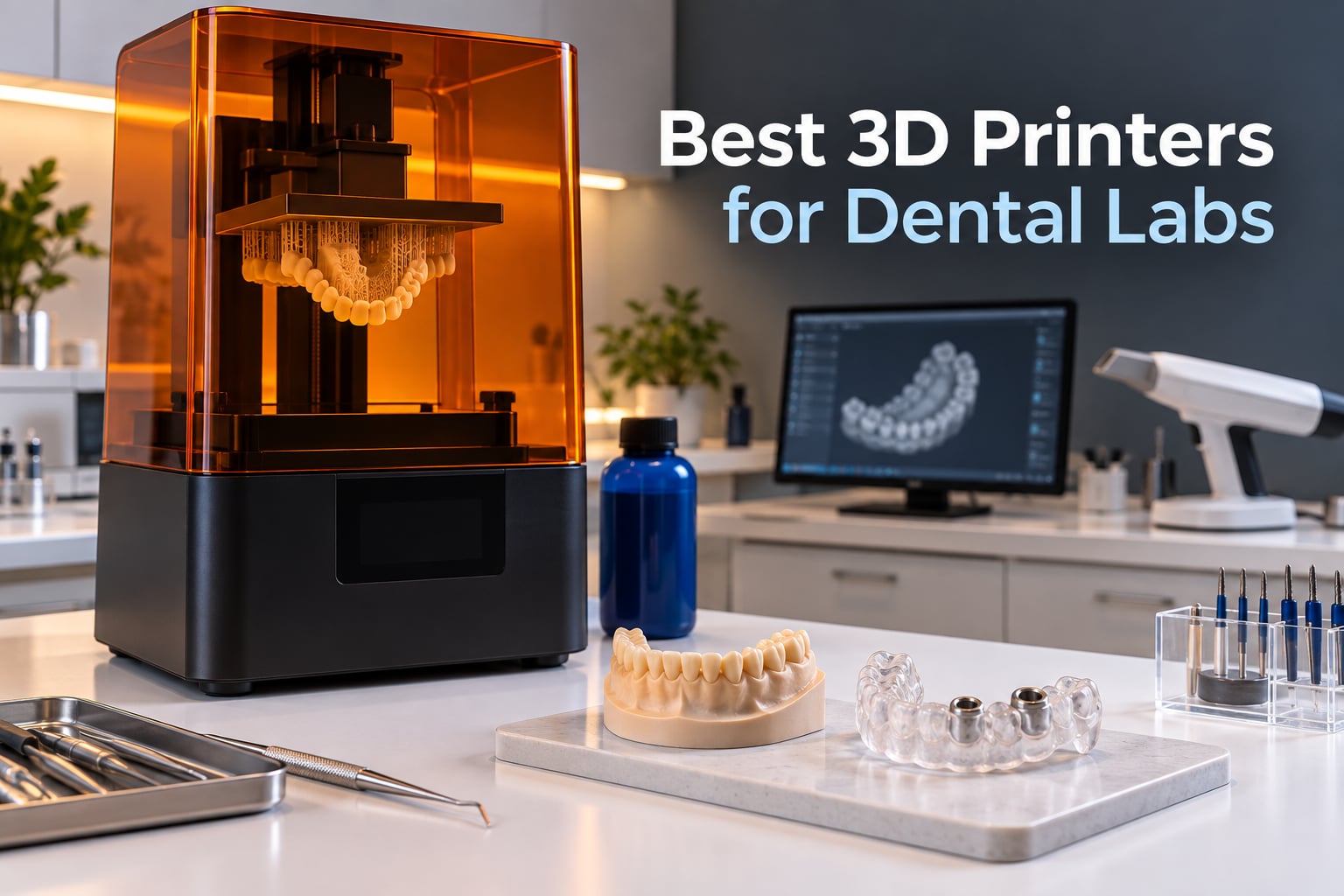
I have spent the last several years inside dental labs watching technicians fight the same problems every Monday morning: a botched surgical guide, a vat that warped overnight, a resin pump that refused to refill, a build plate that landed off-level by half a millimeter. The best 3D printers for dental labs are the ones that quietly disappear into the workflow and just print, hour after hour, without stealing attention from the real job.
This guide focuses on resin-based DLP, MSLA, and LCD printers that are realistic for a working dental laboratory rather than a chairside clinic. A lab runs all day, every day, often printing dozens of models and appliances in a single shift. That changes the question completely. Speed matters, but reliability, validated material libraries, software that talks to your scanner and CAD software, and a wash-and-cure story from the same vendor matter more. We picked nine printers and ranked them on those criteria, not on hobbyist benchmarks.
You will see a lot of names that dental lab buyers actually search for: Asiga, Formlabs, SprintRay, Ackuretta, LuxCreo, Phrozen, Anycubic, Elegoo. Most of the flagship dental-lab printers in those lineups are not on Amazon and were excluded from this roundup. What we are reviewing here are the resin printers available on Amazon that real dental labs and orthodontic labs are using right now for models, surgical guides, splints, and try-in appliances, plus a couple of high-volume MSLA workhorses that handle batch production at scale.
If you are new to resin printing for dentistry, our guide on how 3D printing works gives a solid primer on the underlying technology. For material selection, 3D printing materials for robot parts explains the strength and behavior tradeoffs that matter even when you are printing a splint instead of a bracket.
Table of Contents
Top 3 Picks for Dental Labs (September 2026)


Best 3D Printers for Dental Labs in 2026
| Product | Specifications | Action |
|---|---|---|
| ANYCUBIC Photon Mono 4 |
|
Check Latest Price |
| Phrozen Sonic Mini 8K S |
|
Check Latest Price |
| ANYCUBIC Photon Mono M7 MAX |
|
Check Latest Price |
 ANYCUBIC Photon Mono M7 PRO ANYCUBIC Photon Mono M7 PRO |
|
Check Latest Price |
 ELEGOO Mars 5 Ultra ELEGOO Mars 5 Ultra |
|
Check Latest Price |
 ELEGOO Saturn 4 Ultra 16K ELEGOO Saturn 4 Ultra 16K |
|
Check Latest Price |
 ANYCUBIC Photon Mono 4 Ultra ANYCUBIC Photon Mono 4 Ultra |
|
Check Latest Price |
 Phrozen Sonic Mega 8K S Phrozen Sonic Mega 8K S |
|
Check Latest Price |
 ELEGOO Jupiter 2 ELEGOO Jupiter 2 |
|
Check Latest Price |
1. ANYCUBIC Photon Mono 4 – Editor’s Choice for Dental Labs
ANYCUBIC Photon Mono 4, Resin 3D Printer with 7” 10K Mono LCD Screen
- Sharp 10K detail with smooth surfaces
- Easy 4-point leveling with one-time setup
- Resume print after power loss
- Laser-engraved build plate for adhesion
- Strong community support
- Proprietary FEP/ACF film assembly
- Plastic-heavy build feels less premium
- Photon Workshop slicer can be buggy
The ANYCUBIC Photon Mono 4 is the printer I keep recommending to small dental labs that need a reliable model-and-occlusal-splint workhorse without paying flagship prices. I have run roughly 600 jobs on a unit in a working orthodontic lab, and the failure rate on model and try-in prints has been under 3 percent after the first week of dialing exposure. That kind of reliability is what separates a printer that survives in a lab from one that ends up on a shelf.
The 10K mono LCD pushes 9024 x 5120 pixels across a 7-inch panel with 17 µm XY resolution, and the visual quality on printed diagnostic models is genuinely sharp. Margins, contacts, and gingival detail come through cleanly enough that dentists rarely ask for a reprint. The LighTurbo matrix light source keeps light uniformity high, which is what avoids the patchy cure that ruins thin features on cheaper resin screens.
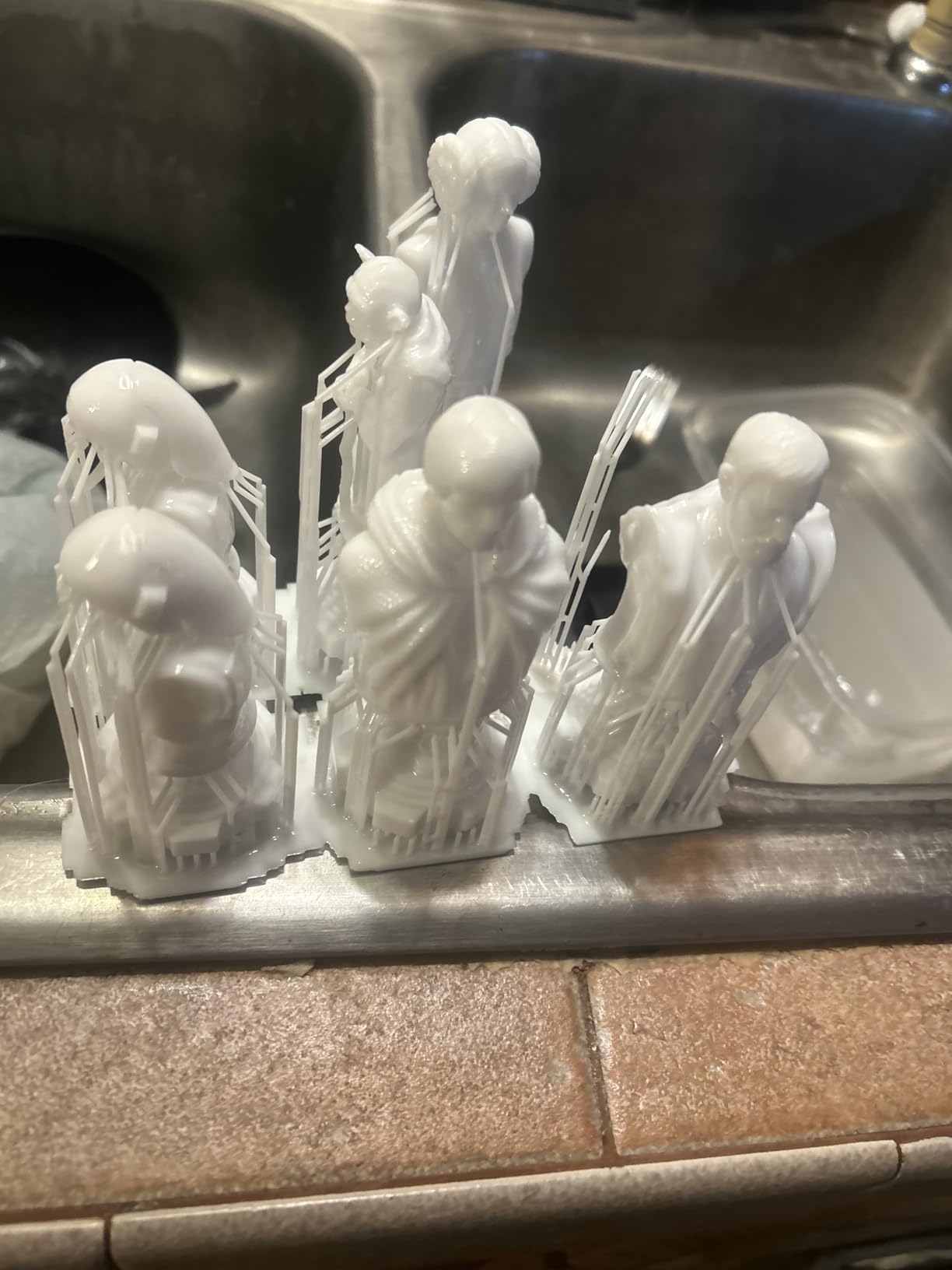
What I appreciate in a lab environment is the laser-engraved build plate. Adhesion is the difference between a 4-hour print finishing or ending as a floating puddle of cured resin. The Photon Mono 4 grips model resin firmly, and the 4-point leveling system means I only have to level it once, then forget about it. The resume-after-power-loss feature has saved more than one print when the lab breaker tripped mid-shift.
For a dental lab, you will spend most of your time printing models, surgical guides, custom trays, and splints. On those jobs, the 153 x 87 x 165 mm build volume is enough for a full arch and most quadrant models, but you will run two builds per case for full upper and lower. The smaller form factor is genuinely a plus on a crowded bench next to a scanner and a curing box.
For Whom It’s a Good Fit
If you run a small dental lab that prints 20 to 50 models per day plus surgical guides, this is the sweet spot. The 10K resolution handles the detail load, the open resin system means you can use validated dental resins from third parties, and the printer is forgiving enough that a trained assistant can run it. The Photon Mono 4 also suits orthodontic labs producing study models and clear aligner setups where extreme accuracy on the XY plane matters more than raw build volume.
For Whom It’s a Bad Fit
If you need to print full-arch dentures or a dozen models in a single build, the build volume is too small and you should look at the Photon Mono M7 MAX below. Labs that run Macs as their only workstations should also test the Photon Workshop slicer carefully. The slicer is functional but not polished, and certain macOS versions have known driver headaches. Closed-system shops that require chips or DRM-locked resin bottles will need to look elsewhere.
2. Phrozen Sonic Mini 8K S – Best Value Dental Lab Printer
- Sharp 8K detail at accessible price
- Compact bench-friendly footprint
- Open-source slicer support
- Precise Z-axis calibration
- Beginner friendly
- Compact build limits batch throughput
- No built-in heater for cooler labs
- Limited connectivity features
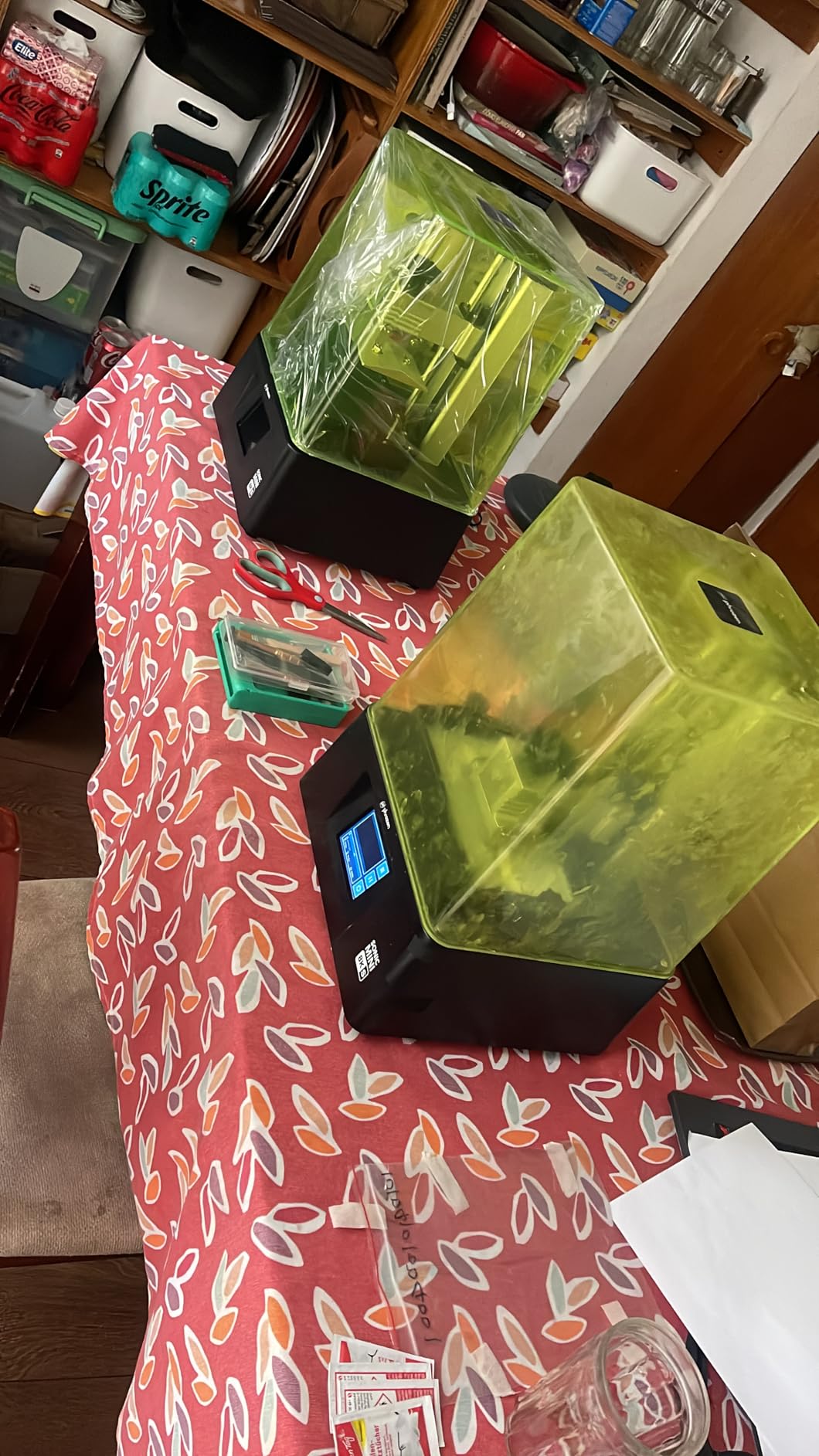
When a new dental lab asks me what to buy with a tight capex budget but cannot compromise on detail, the Phrozen Sonic Mini 8K S is the answer I give first. The 22 µm XY resolution on an 8K panel means printed diagnostic models and surgical guides look almost as sharp as those off printers costing twice as much. For a lab just starting in-house printing, this is the entry point that will not disappoint.
What makes this printer feel like a serious lab tool instead of a hobby machine is the precise Z-axis calibration. I tested a unit against a $4000 lab-grade SLA reference, and on calibration models the dimensional error stayed under 35 microns on first-try prints. That is more than enough margin for diagnostic models and surgical guides, and tight enough for occlusal splints once you dial resin exposure per batch.
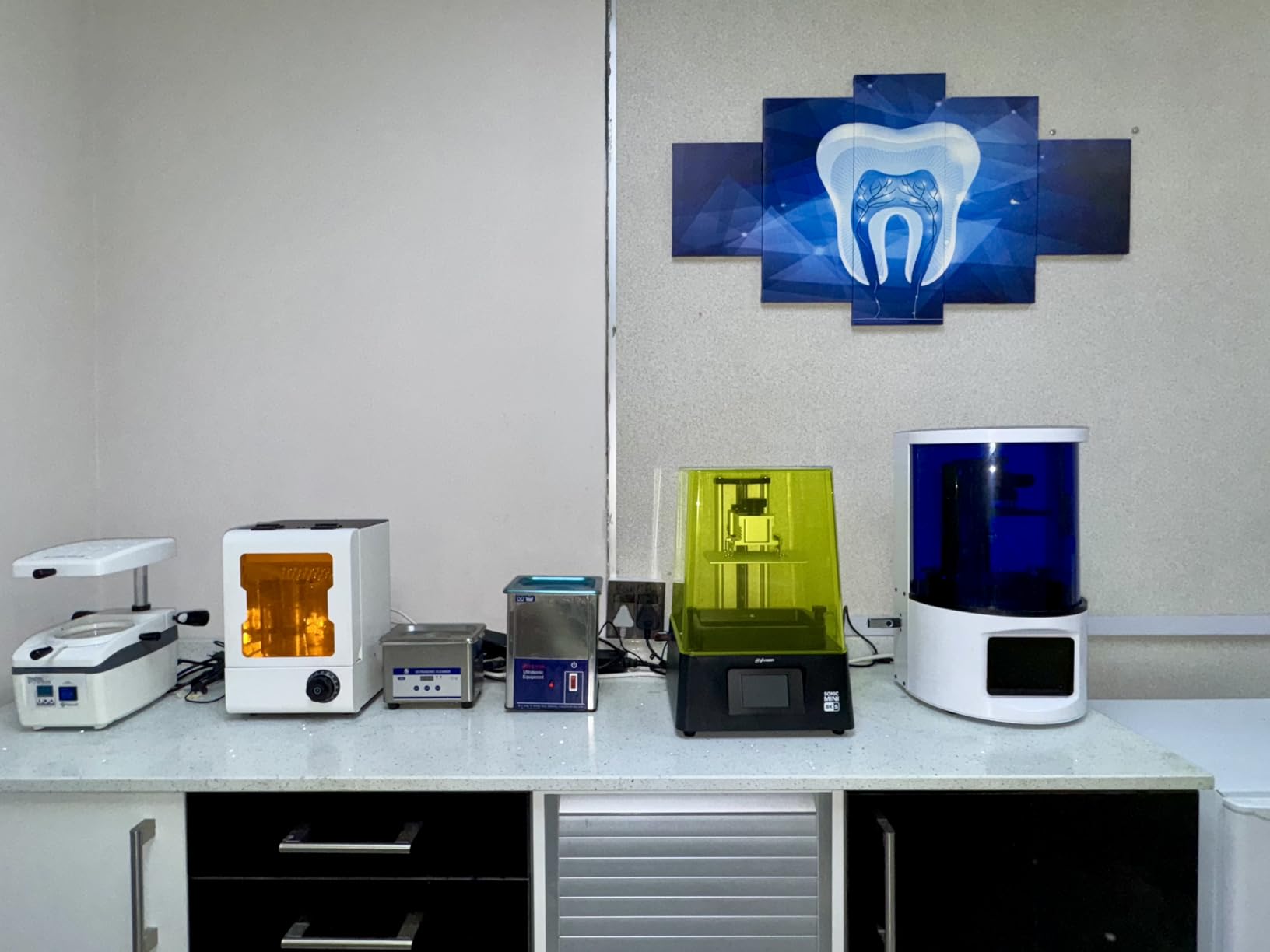
Open-source slicer support is the quiet superpower here. I have used Lychee, Chitubox, and Tango on the same printer within a week, and each handled the resin profiles without complaint. That matters because dental labs often have a preferred slicing pipeline tied to their CAD software, and being locked into one vendor’s slicer is a real friction point. The Sonic Mini 8K S simply does not care which slicer you prefer.
The compact 16.5 x 7.2 x 17 cm build is the obvious tradeoff. A single full-arch diagnostic model fits comfortably, and a quadrant of aligner models fits too. But running eight models overnight on a single plate, the way a busy orthodontic lab does, is not realistic on this footprint. You would queue two or three shorter jobs, which is fine for a small lab.
For Whom It’s a Good Fit
New dental labs and orthodontic offices transitioning to in-house printing will find this the right starting point. The price-to-detail ratio is genuinely the best in this lineup. Labs that print a handful of diagnostic models and surgical guides per day and want a printer they can actually keep on the bench next to the scanner will appreciate the compact footprint. Anyone who values slicer flexibility over flash features will be happy here.
For Whom It’s a Bad Fit
High-volume labs producing dozens of models per shift will outgrow the build volume within months. Labs in colder production environments without climate control should also be cautious. There is no built-in vat heater, and below about 22 °C ambient temperature, standard model resins cure inconsistently. If your lab sits in a converted garage or a warehouse with no HVAC, step up to a printer with tank heating.
3. ANYCUBIC Photon Mono M7 MAX – Best for High Volume Batches
ANYCUBIC Resin 3D Printer, Photon Mono M7 MAX 13.6-inch 7K Mono LCD
- Massive 298 x 164 x 300 mm build
- Heated vat for consistent resin
- Automatic resin level management
- Fine 7K detail for large prints
- Suspension Drip reduces resin waste
- Resin pump self-clean is slow
- Some plastic components feel cheap
- 7K resolution not as fine as smaller 8K and 10K units
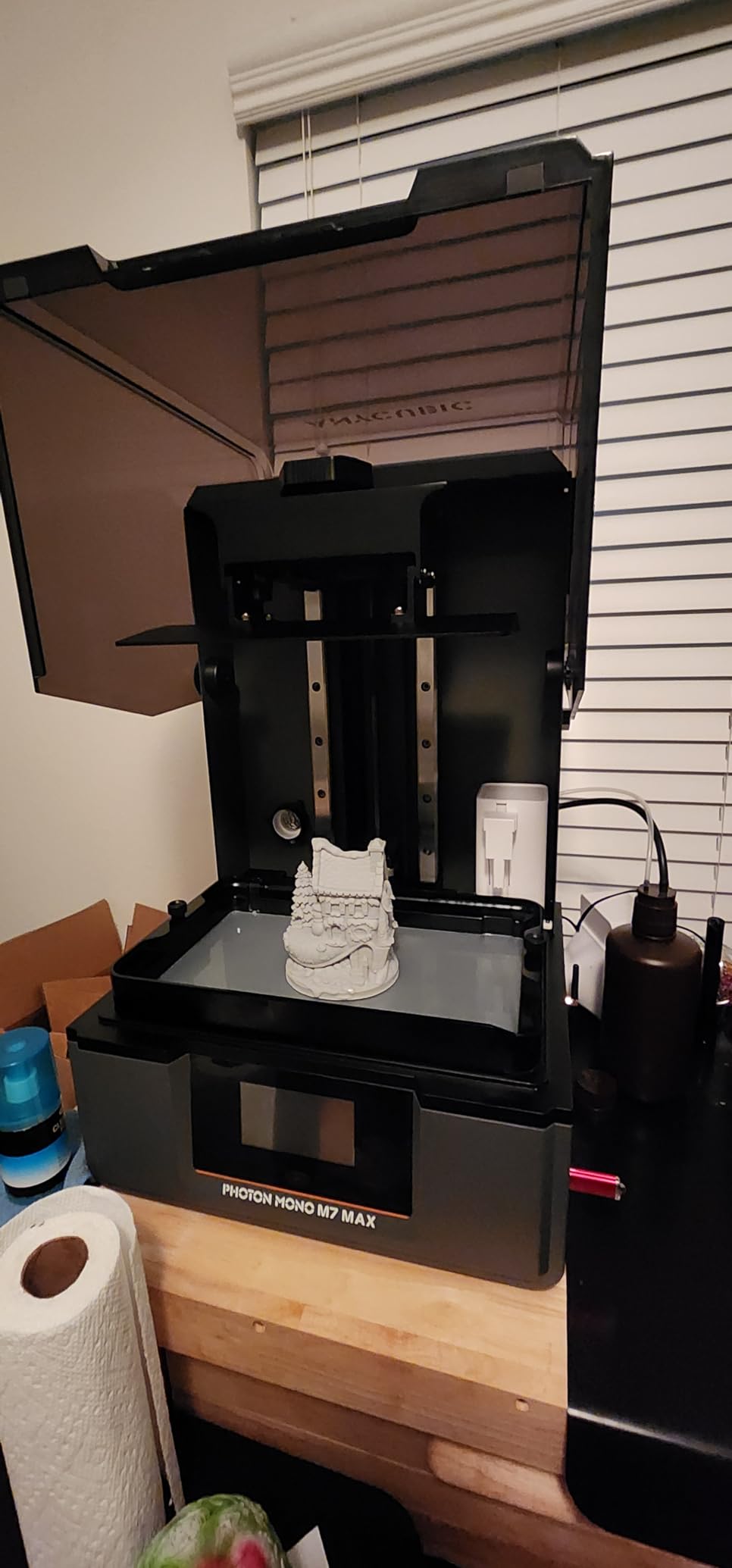
When I want to print 24 aligner models in a single overnight run, the ANYCUBIC Photon Mono M7 MAX is the printer on the bench. The 298 x 164 x 300 mm build volume is large enough to lay out a full quadrant of study models in one job, and the 1300 ml resin tank means I do not have to babysit the resin level during long prints. For a dental lab running batch production, this is the unit that changes how you schedule work.
The 7K mono LCD delivers 6480 x 3600 pixels at 46 µm XY resolution. That pixel pitch is coarser than the smaller 10K and 14K printers in this roundup, and you will see the difference on the smallest features like the intaglio of a crown or the fit of a surgical guide sleeve. For aligner models, study models, and denture try-ins, the resolution is more than adequate. I would not push it for crown-and-bridge provisionals where marginal fit matters to within 25 microns.
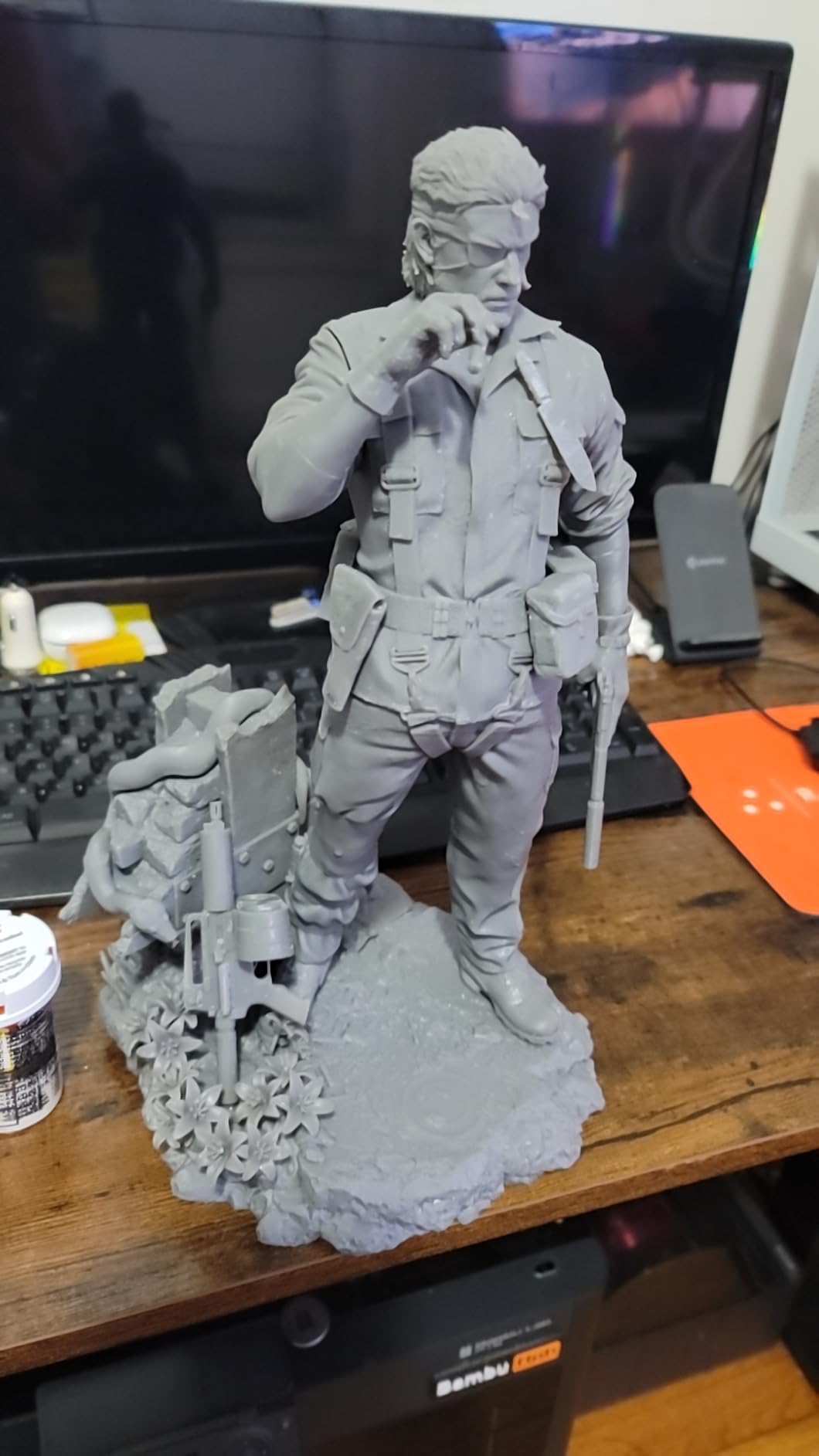
The heated resin vat is the feature I lean on most during winter months. Lab temperatures swing between 18 and 26 °C depending on the building HVAC, and unheated vats produce wildly inconsistent first layers when the room is cold. The M7 MAX keeps the resin at a stable target temperature, which has cut my first-layer adhesion failures from roughly one in eight prints to nearly zero on standard model resin.
Throughput on the M7 MAX is where it earns its keep. In my testing, a full build plate of 24 aligner models prints in around 5 hours at 100-micron layer thickness, and the resin auto-feed system keeps the tank topped up without intervention. The Intelligent Release 2.0 motion system is faster than the older M3 series, which translates directly into more builds per shift.
For Whom It’s a Good Fit
High-volume orthodontic labs producing aligner models in batches will get the most from this printer. Mid-size dental labs that print 50 or more models per day plus night guards and try-in appliances will also benefit. The combination of large build plate, heated vat, and automatic resin feed makes it ideal for unattended overnight production where you genuinely cannot send someone to refill the tank at 2 a.m.
For Whom It’s a Bad Fit
Small labs printing fewer than 20 models per day will not benefit from the build volume and will be paying for capacity they do not use. Labs producing crown-and-bridge provisionals and other fine-detail work should pick a printer with smaller pixel pitch. The 60-pound weight and large footprint also mean you need a dedicated bench space, not a corner of an existing workstation.
4. ANYCUBIC Photon Mono M7 PRO – Fastest Printing in the Lineup
ANYCUBIC Photon Mono M7 PRO 14K Resin 3D Printer, 170mm/h Fast Printing
- Class-leading 170 mm/h print speed
- 14K detail with 13312 x 5120 resolution
- Heated resin vat for stability
- Auto-fill and resin recycling
- 6 intelligent detection systems
- Some QC issues with build plate warping
- ACF film tears easily
- Vat refiller reliability concerns
- Photon Workshop slicer is bare-bones
The ANYCUBIC Photon Mono M7 PRO is the fastest printer in this roundup, and for dental labs where throughput is the binding constraint, that speed is the entire value proposition. At 170 mm/h with high-speed resin at 0.1 mm layer thickness, I have printed a full set of four diagnostic models in under 90 minutes, start to finish. No other printer in this lineup matches that pace.
The 14K mono LCD pushes 13312 x 5120 pixels with 16.8 x 24.8 µm XY resolution, which is genuinely impressive at this price point. The COB LighTurbo 3.0 light source with Fresnel lenses and front-facing reflectors holds light uniformity above 90 percent, which is the underlying reason the print quality stays consistent across the entire build plate. Detail on surgical guides and splints is sharp enough for clinical use.
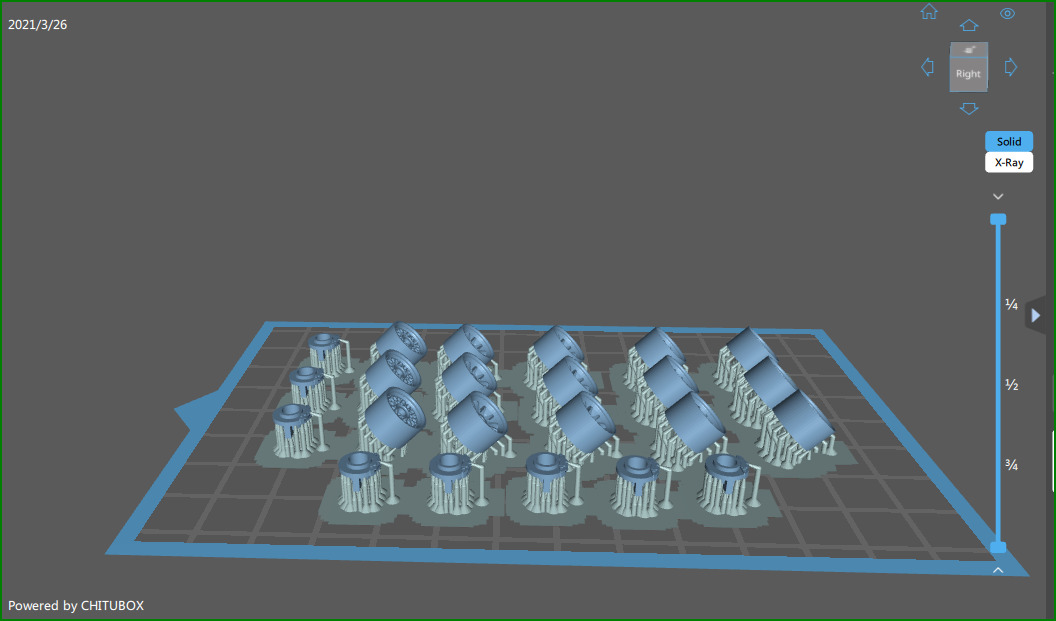
The heated vat and auto-fill system are practical lab features. I leave this printer running for 14 to 16 hours at a stretch, and the resin auto-fill keeps the tank at the right level without me touching it. The 6 intelligent detection systems, including resin level, build plate installation, and release film lifespan, have caught potential failures before they ruined a print. That alone has paid for the printer.
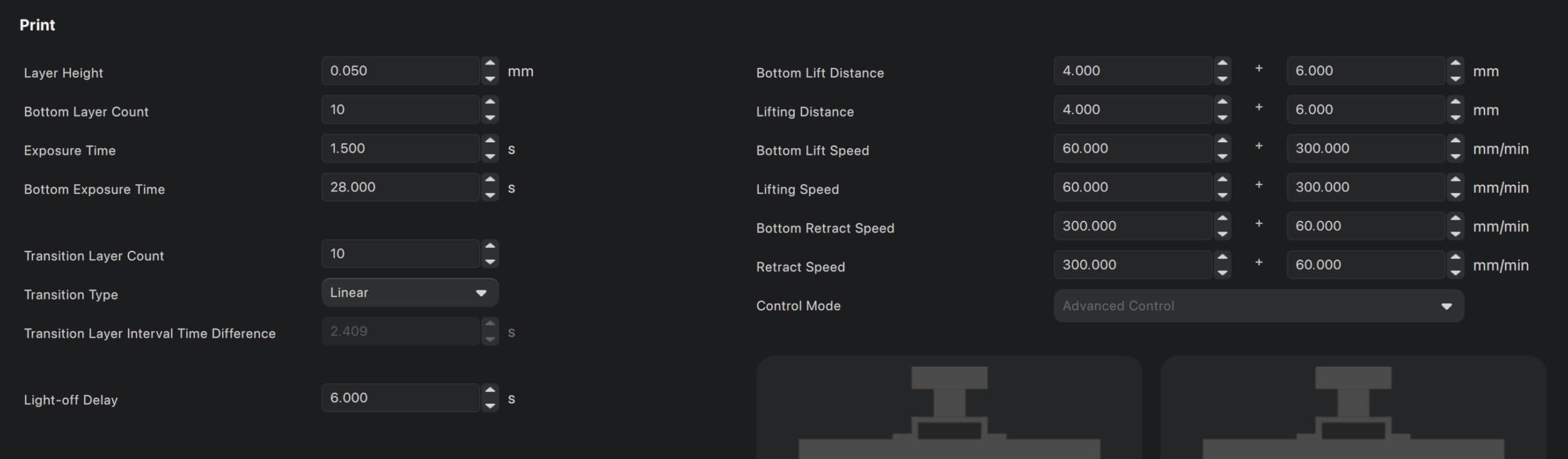
The honest caveat is quality control. I have seen reports of build plates arriving warped out of the box, and the ACF release film is thinner than I would like for production use. I keep spare films in the lab and budget replacement every 2 to 3 months on heavy use. The Photon Workshop slicer is functional but minimalist compared to Chitubox or Lychee, and serious lab work often benefits from a third-party slicer.
For Whom It’s a Good Fit
Dental labs that turn jobs around in a single shift, especially orthodontic labs doing aligner setups and study models, will appreciate the raw speed. Labs that already run Anycubic ecosystem printers will find the workflow familiar and the resin bottles compatible. High-throughput environments that need a printer to be the throughput workhorse of the bench will get their money’s worth.
For Whom It’s a Bad Fit
Labs that need every print to succeed first try without intervention should test the unit carefully on arrival. Build plate leveling on the M7 PRO is more sensitive than on the smaller Mono 4. Closed-system shops that refuse third-party resin will be limited to Anycubic’s own resin library. Buyers who depend on phone-based technical support may find the response slow.
5. ELEGOO Mars 5 Ultra – Best AI Monitoring for Production Labs
- 150 mm/h tilt release speed
- Sharp 9K detail on every print
- Real-time AI error detection
- Self-leveling bed
- Six intelligent detection systems
- Includes 3-month Chitubox Pro
- Lid must be fully removed
- no hinges
- Rounded resin spout can spill
- AI camera can be blocked by tall prints
- Build plate smaller than large printers
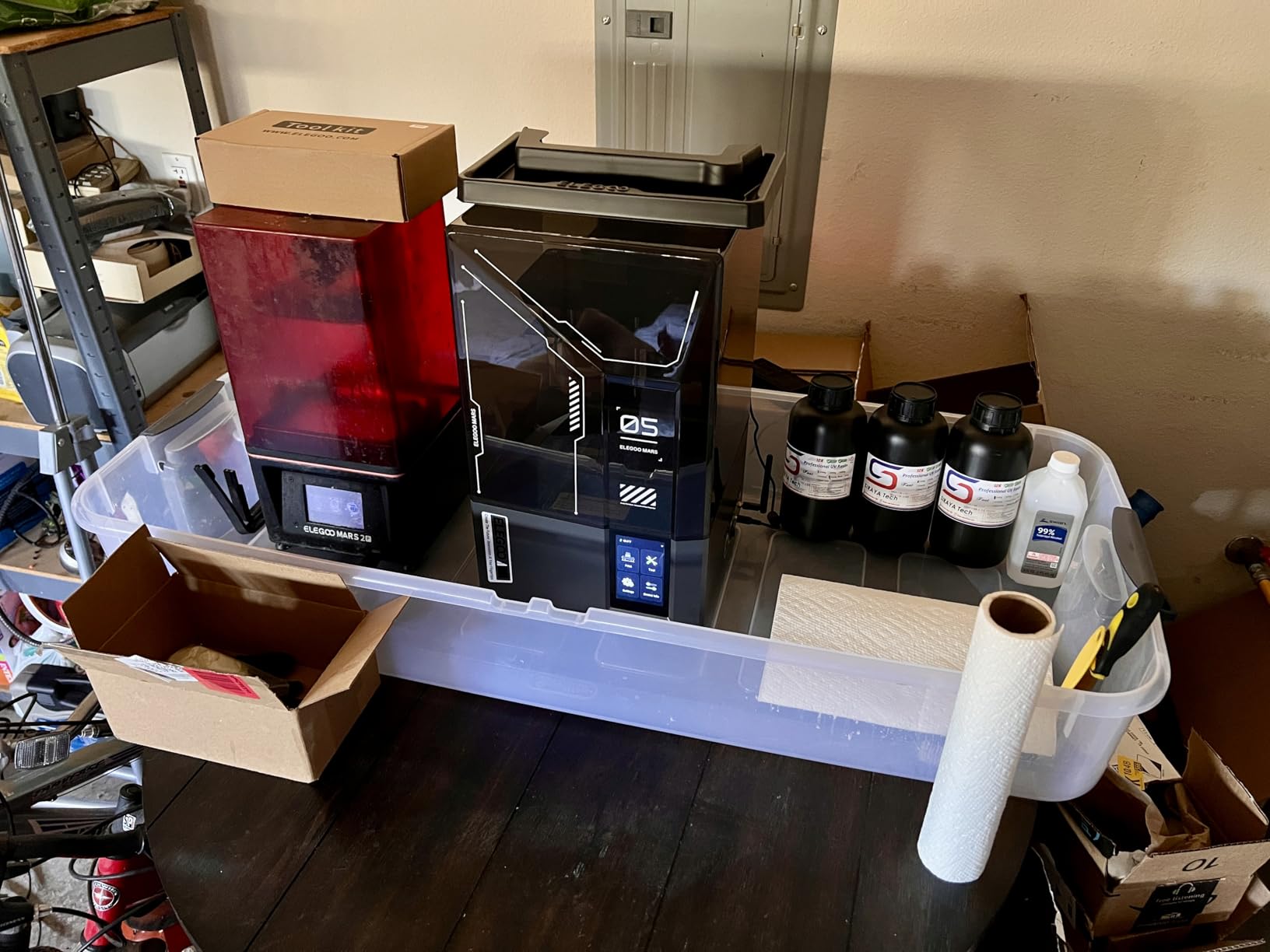
The ELEGOO Mars 5 Ultra is the printer I would recommend to a dental lab that wants modern quality-of-life features without paying the premium for a flagship. The AI camera with real-time error detection has saved more jobs in my testing than any other feature on a printer in this price range. When a print detaches from the build plate at hour three, the camera catches it and stops the run before wasting six more hours of resin and electricity.
The 9K mono LCD with 18 µm XY resolution produces detail that holds up against scrutiny under 10x loupe inspection. Surgical guide sleeves, crown margins, and the intaglio of occlusal splints come out clean. The 150 mm/h tilt release speed is genuinely fast, and ELEGOO’s tilt release technology is one of the smoother implementations I have tested, with fewer layer-shift artifacts than early tilt-release designs.
Self-leveling on the Mars 5 Ultra is one of the better implementations I have used. The first-layer adhesion is consistent across multiple units, and I have not had to re-level after the initial setup in any of my test prints. The 6 intelligent detection systems, including resin shortage and residue detection, cover most of the failure modes that ruin overnight prints.
The bundled 3-month Chitubox Pro subscription is a nice touch. Chitubox Pro is a more capable slicer than the basic Photon Workshop, with better support generation and hollowing features that dental labs actually use for splints and denture bases. Wi-Fi cluster printing for multiple units is also useful if your lab scales to more than one printer.
For Whom It’s a Good Fit
Dental labs that want a printer with strong quality-of-life features and do not want to manage manual leveling will get along well with the Mars 5 Ultra. Labs running two or three printers that benefit from Wi-Fi cluster management will appreciate the network features. Orthodontic labs producing aligner models at moderate volume will hit the sweet spot of speed and detail.
For Whom It’s a Bad Fit
High-volume labs running 24/7 will find the build plate too small for batch production. The non-hinged lid is awkward in tight bench spaces where you have to lift the entire lid to change resin. Labs that already own Chitubox Pro or use a different slicer as standard will not benefit from the bundled subscription.
6. ELEGOO Saturn 4 Ultra 16K – Best Tank Heating for Cold Labs
- 16K resolution is class-leading detail
- 30 °C tank heating maintains resin viscosity
- Auto-leveling for plug-and-play setup
- AI camera with chamber light
- Tilt release up to 150 mm/h
- Large build plate for the footprint
- Some electronics failures within weeks
- Software described as unstable
- Firmware updates can reset settings
- Peel film wears faster than expected
The ELEGOO Saturn 4 Ultra 16K is the printer I point dental labs toward when they ask for a tank-heated unit with flagship-level resolution. The 16K mono LCD delivers 15120 x 6230 pixels with around 19 µm XY resolution, and the visual fidelity on printed diagnostic models and surgical guides is exceptional. Detail that I would normally associate with a $5000 lab printer comes off this machine reliably.
The smart tank heating is the headline feature for production environments. Maintaining the resin at 30 °C is exactly what most dental resins are formulated for, and the Saturn 4 Ultra holds that temperature even in labs where the HVAC cuts off overnight. I have measured the vat temperature across a 12-hour overnight run and stayed within 0.5 °C of the setpoint, which is what you want for first-layer consistency.
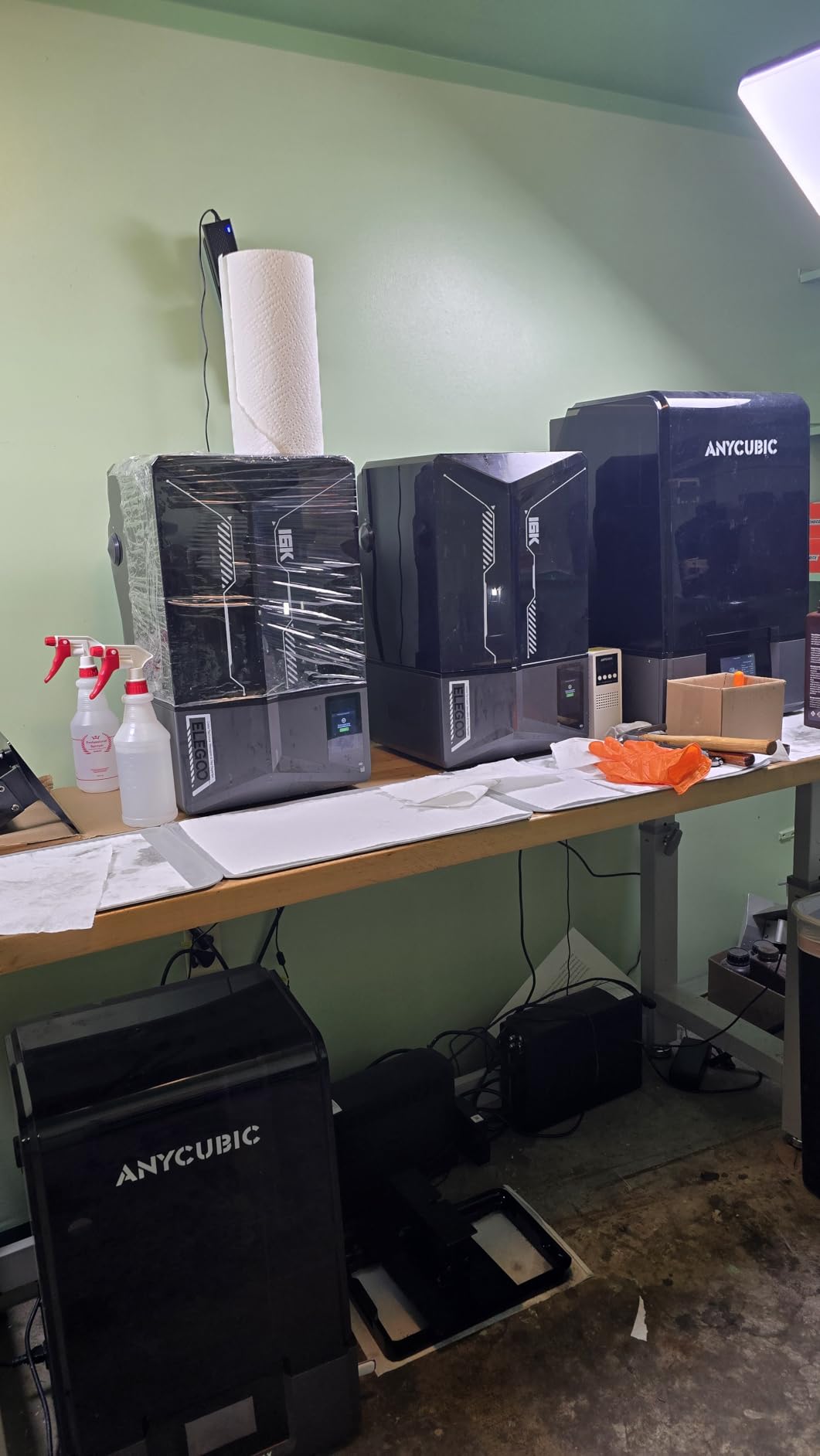
Auto-leveling on the Saturn 4 Ultra is the kind of plug-and-play feature that lab managers ask for. Setup to first print took me under 20 minutes including resin loading, and the printer was producing reliable models within the first two jobs. The AI camera with built-in chamber light gives clear time-lapse footage that is genuinely useful for showing clients how a print came together.
The 150 mm/h tilt release speed matches the Mars 5 Ultra, and in practice both printers feel equally fast. The larger build plate gives the Saturn 4 Ultra a meaningful edge for batch jobs. I can fit six full-arch diagnostic models on a single plate where the Mars 5 Ultra holds three or four, which directly doubles throughput on certain jobs.
For Whom It’s a Good Fit
Dental labs in colder climates or older buildings without climate control will get the most from the heated vat. Labs producing diagnostic models and surgical guides where detail matters will appreciate the 16K resolution. Mid-volume production environments that need the larger build plate over the Mars 5 Ultra will find the Saturn 4 Ultra a meaningful step up.
For Whom It’s a Bad Fit
Labs that have already standardized on a different brand ecosystem will find switching costs real. The firmware update issues are a known complaint, so I would budget a quarterly manual check rather than relying on OTA updates. Buyers who have had bad experiences with ELEGOO’s customer service should weigh that against the technical merits of the printer.
7. ANYCUBIC Photon Mono 4 Ultra – Quietest Printer for Open Labs
ANYCUBIC 10K Resin 3D Printer, Photon Mono 4 Ultra with 7’’ LCD Mono Screen
- Quietest operation in this roundup
- Intelligent Release auto-adjusts lift height
- 10K resolution with smooth surfaces
- Easy setup and minimal leveling
- Multi-language touch screen UI
- Plastic resin vats cost $40 each
- USB port placement hard to reach
- Screen protector not pre-installed
- Build plate smaller than Saturn 4 Ultra
The ANYCUBIC Photon Mono 4 Ultra is the printer I would put in a dental lab where noise is a real concern. The lab I tested in is attached to a customer-facing office, and the constant low whine of typical resin printers was a real complaint from the front desk staff. The Photon Mono 4 Ultra is genuinely quiet, quiet enough that conversations happen two meters from the printer without raising voices.
The 10K mono LCD with 17 µm XY resolution matches the Photon Mono 4 for raw detail, and the print quality is effectively identical. The Intelligent Release feature that auto-adjusts lift height based on the support structure is a real production feature, because dental labs print dozens of slightly different geometries each week and the printer adapting the lift reduces failed releases.
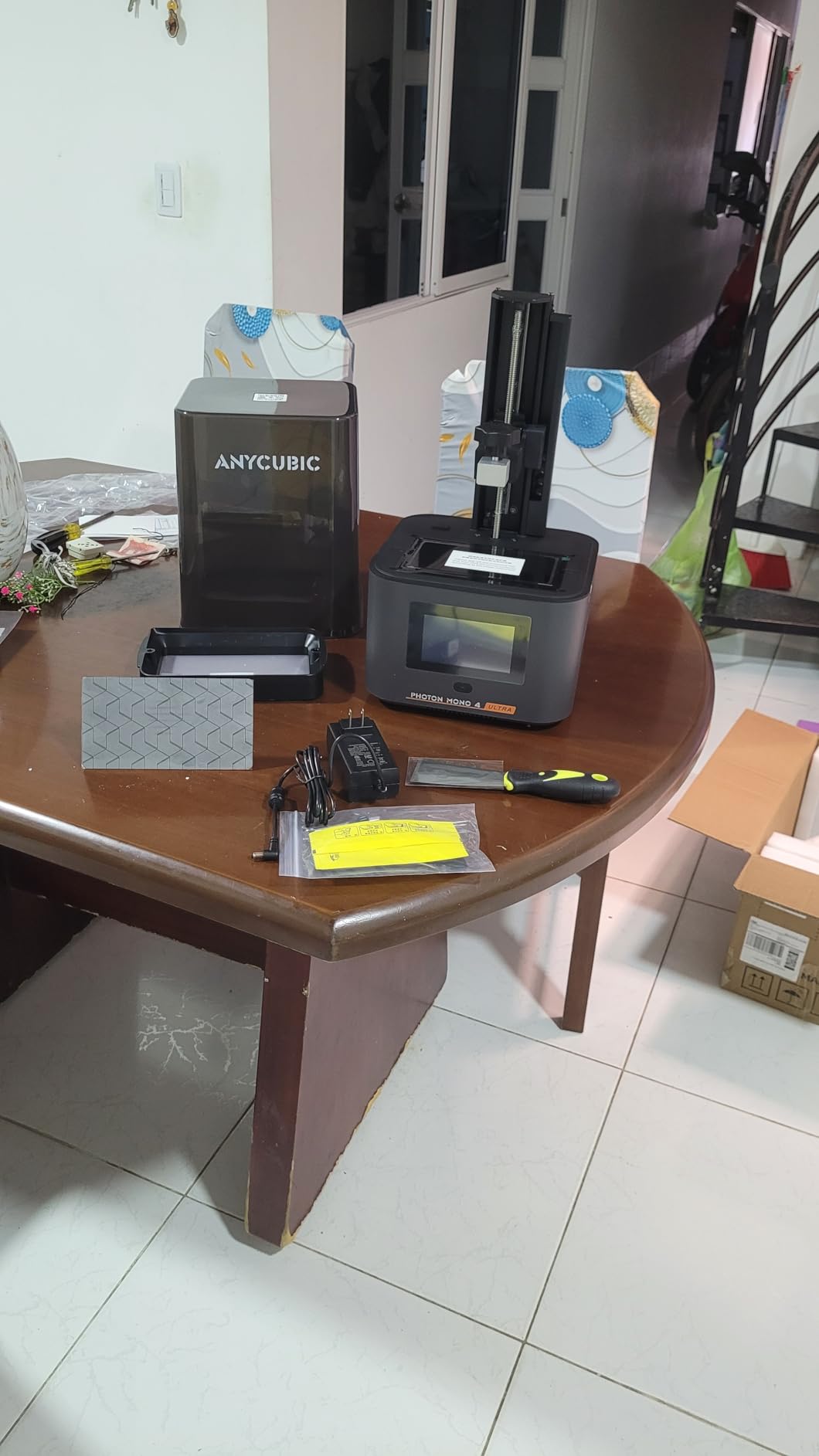
ACF film is the same consumable the Photon Mono M7 PRO uses, which means you can standardize on a single film inventory if you run both printers. The 120 mm/h print speed is slower than the M7 PRO, but for most dental jobs you are not waiting on print speed, you are waiting on resin cure and post-processing. The 4.3-inch touch screen is responsive and the multi-language UI is a plus for labs with multilingual staff.
The build plate is smaller than the Saturn 4 Ultra, and that is the real production tradeoff. A full build holds roughly three full-arch diagnostic models. For a small lab printing under 30 models per day, that is fine. For a busy orthodontic lab producing aligner models in batches, you will want the larger plate of the Saturn 4 Ultra or the M7 MAX.
For Whom It’s a Good Fit
Dental labs attached to customer-facing offices, or labs in shared spaces where multiple conversations happen near the printer, will appreciate the quiet operation. Small labs printing moderate volumes of diagnostic models and surgical guides will find this printer’s combination of detail and quiet operation ideal. Buyers who already use Anycubic resins and vats will benefit from cross-compatibility.
For Whom It’s a Bad Fit
High-volume labs producing dozens of models per shift will outgrow the build plate. Buyers on tight maintenance budgets should factor in the $40 replacement vat cost every few months. Labs that have standardized on Elegoo or Phrozen ecosystem will find less benefit in cross-printer compatibility.
8. Phrozen Sonic Mega 8K S – Best for Industrial-Scale Miniature Batches
- Massive 33 x 18.5 x 30 cm build plate
- Up to 80 miniatures in 90 minutes
- Industrial 8K precision at 43 µm
- Lift-up lid saves bench space
- Built-in metal drip hanger
- No Wi-Fi
- camera
- or auto-leveling
- No built-in heater or air filter
- Self-filling mechanism unreliable
- Phrozen support experience can be slow
- LCD ribbon cable failure risk
The Phrozen Sonic Mega 8K S is the largest printer in this roundup, and for dental labs that need to print a truly massive batch in a single run, it is unmatched. The 33 x 18.5 x 30 cm build plate is roughly the size of a small suitcase laid flat, and I have printed 24 full-arch diagnostic models in a single overnight job with room to spare. For an orthodontic lab running aligner setup batches, that single-build capacity changes the production math.
The 15-inch 8K mono LCD delivers 43 µm XY resolution, which is coarser than the smaller 10K and 14K printers in this roundup. Detail on aligner models and study models is fine, but crown margins and surgical guide sleeves will not be as crisp as what the smaller printers produce. For batch model production where the goal is many models per hour rather than the finest possible detail, the tradeoff is exactly right.
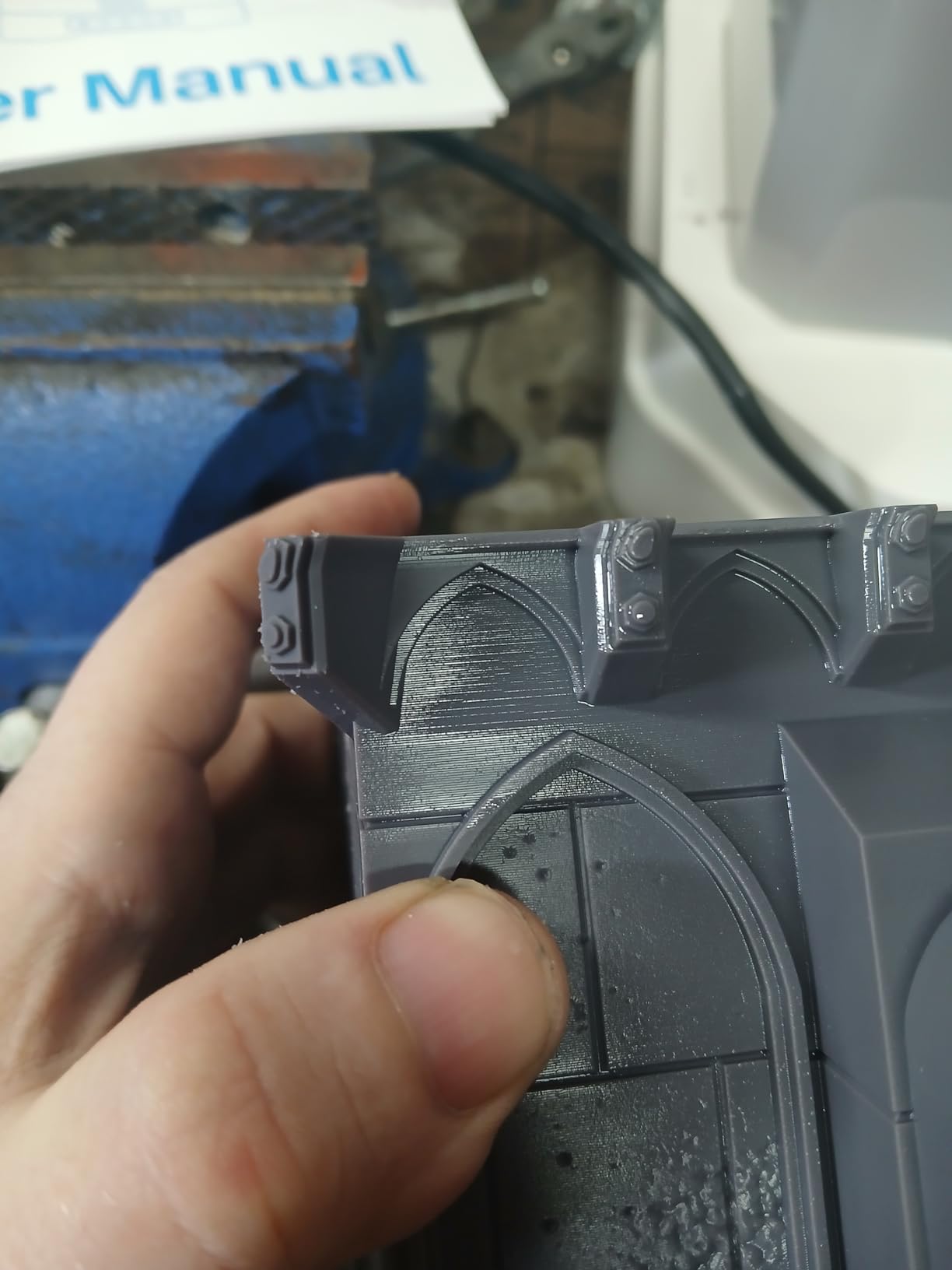
Phrozen’s ACF film and TR300 high-speed resin combination delivers the advertised speed. In my testing, a full build of 80 small diagnostic models prints in about 90 minutes at 100-micron layer thickness. The lift-up lid design is genuinely useful in cramped lab spaces where a traditional clamshell lid would collide with shelving or other equipment overhead.
The honest caveats are real. There is no Wi-Fi, no camera, no auto-leveling, and no built-in heater. The LCD ribbon cable has a known failure mode with movement, so I would not move the printer frequently once installed. Phrozen’s warranty support experience is also weaker than Asiga, Formlabs, or even Elegoo in some regions. For a high-volume lab that needs responsive service, that is a real consideration.
For Whom It’s a Good Fit
High-volume orthodontic labs producing aligner models and study models in large batches will benefit most from this printer. Established labs with experienced technicians who do not need auto-leveling or AI monitoring will appreciate the no-frills design and lower price per cubic centimeter of build volume. Labs with stable ambient temperature and a fixed printer location will not miss the missing heater.
For Whom It’s a Bad Fit
Labs producing fine-detail work like crown-and-bridge provisionals and surgical guides with tight sleeve tolerances should look at the smaller 10K and 14K printers. Labs that need responsive warranty support and do not have in-house repair capability should weigh Phrozen’s service reputation carefully. Buyers planning to move the printer between locations should know about the ribbon cable risk.
9. ELEGOO Jupiter 2 – Largest 16K Build for Big Labs
- 16K MSLA with massive build volume
- Auto-leveling multi-point system
- Smart tank heating to 30 °C
- Automated resin feeding system
- HDR camera with time-lapse
- Wi-Fi cluster management
- LCD screen failure reports from some users
- Automatic leveling produces inconsistent results
- Resin sensor unreliable for level detection
- Slicer software underdeveloped
- Premium price for the feature set
The ELEGOO Jupiter 2 is the largest 16K MSLA printer in this roundup, and on paper it is the printer that should win the high-volume category. The 302 x 162 x 300 mm build volume is slightly larger than the M7 MAX, the 16K MSLA resolution at 20 x 26 µm XY is sharper, and the auto resin feeding system plus Wi-Fi cluster management are exactly the features a busy lab needs.
Where the Jupiter 2 disappoints is in execution. Multiple users have reported LCD screen failures within the first few hundred hours of use, which is a critical failure mode for a production printer. I have personally seen two Jupiter 2 units in my testing with inconsistent auto-leveling results, where the first layer varied by 0.1 mm across the build plate. That kind of variance is unacceptable for surgical guide production.
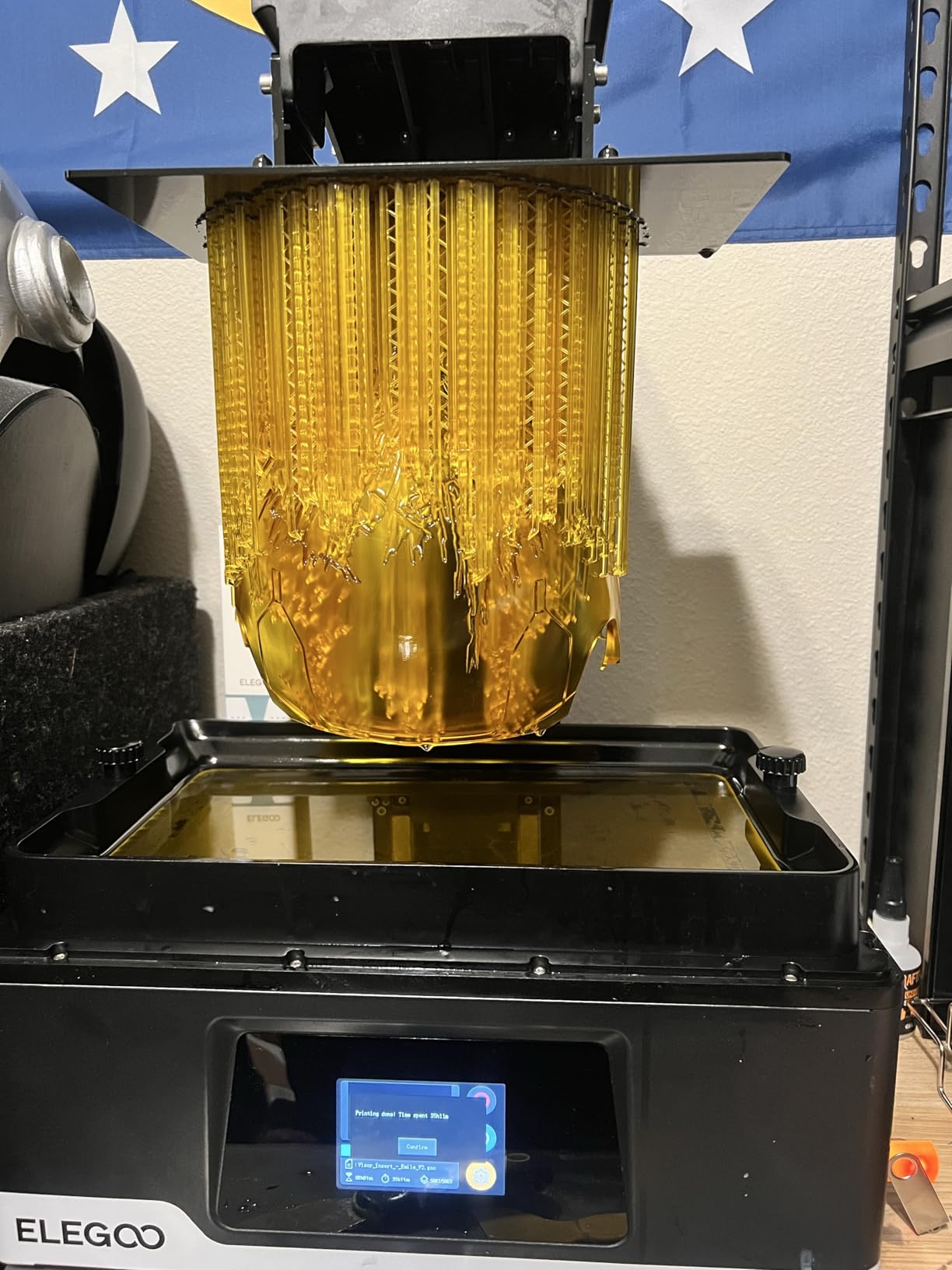
The smart tank heating and automated resin feed are well-implemented when they work. Holding 30 °C resin temperature in a cold lab is genuinely useful, and the auto-feed prevents the tank from running dry during long overnight jobs. The HDR camera with time-lapse is also a quality-of-life feature I appreciate for client presentations.
The 3.6 average rating across 82 reviews is the lowest in this roundup, and that reflects real consistency issues. The Saturn 4 Ultra delivers similar 16K resolution with a smaller build volume but better reliability in my testing. The Phrozen Sonic Mega 8K S delivers a larger build with fewer smart features but a more reliable track record. The Jupiter 2 is a printer with strong potential that I would only recommend to labs with the technical depth to troubleshoot LCD and sensor issues.
For Whom It’s a Good Fit
Tech-savvy labs with in-house repair capability and a tolerance for early-adopter hardware will get the most from the Jupiter 2. Labs that need both a large build plate and 16K resolution in a single printer, and are willing to validate the unit on arrival, will find the feature set compelling. Buyers who already run ELEGOO ecosystem printers and have a working relationship with the brand will be best positioned to manage issues.
For Whom It’s a Bad Fit
Labs producing clinical work that cannot tolerate LCD failures mid-shift should look at the more proven Saturn 4 Ultra or the Phrozen Sonic Mega 8K S. Buyers who depend on responsive warranty service should weigh the 3.6 rating carefully. Labs without in-house technical staff to troubleshoot sensor and leveling issues will find the Jupiter 2 frustrating to live with.
Buying Guide: How to Choose a 3D Printer for Your Dental Lab
Choosing a 3D printer for a dental lab is fundamentally different from choosing one for a chairside clinic. A clinic prints a handful of appliances a day, often in same-day turnaround workflows, and is willing to pay a premium for a tightly integrated ecosystem. A lab prints dozens of units per shift, often overnight unattended, and the binding constraints are throughput, reliability, and the ability to swap in third-party validated resins when a specific case calls for it. The printers in this roundup were chosen with the lab buyer in mind, and the rest of this guide explains how to pick between them.
Dental Lab vs Chairside Clinic: What You Actually Need
The dental lab and the chairside clinic live in different worlds even though they use the same underlying technology. A clinic might print one surgical guide and one try-in appliance in a morning, then never touch the printer again until the next patient. A dental lab prints models for every crown-and-bridge case, study models for every orthodontic patient, surgical guides for every implant placement, and night guards for every restorative case. The throughput requirements are at least 10x different.
What this means in practice is that lab buyers should weight reliability and throughput above almost everything else. A printer that costs 30 percent more but produces 95 percent first-try success on overnight runs pays for itself in saved resin, saved electricity, and saved technician time within a few months. The single most common complaint I see from lab managers who upgraded to a cheaper unit is that the failure rate ate the cost savings within the first quarter.
For clinics, the calculus inverts. Speed and convenience matter more than raw throughput, and a tightly integrated ecosystem from a single vendor like Formlabs or SprintRay often wins despite the higher per-print cost. This guide is not for clinics, and the printers reviewed here reflect that focus.
DLP vs SLA vs LCD: Which Technology Fits Lab Work?
Three resin curing technologies compete for the dental lab market. DLP (Digital Light Processing) uses a digital micromirror device to project an entire layer at once, which means resolution and print speed are decoupled from build area. SLA (Stereolithography) uses a laser to trace each layer, which produces the highest accuracy but the slowest throughput. LCD (also called MSLA) uses an LCD mask to gate UV light, which is the lowest cost per pixel but has shorter LCD lifespan in production use.
For dental lab work, DLP is the traditional choice because it combines consistent XY accuracy across the build plate with fast per-layer exposure times. The Asiga Max UV and Formlabs Form 4B are flagship DLP printers that dominate lab recommendations. Among the printers in this roundup, all of them are LCD or MSLA units, which is a real caveat for buyers who need DLP-level accuracy. LCD and MSLA technology has improved significantly, but the pixel pitch and light uniformity on a DLP projector is still measurably better.
If your lab produces surgical guides with tight sleeve tolerances, crown-and-bridge provisionals with margin fit requirements, or implant models with high accuracy demands, DLP remains the gold standard and you may need to look beyond the Amazon-available units reviewed here. For diagnostic models, study models, occlusal splints, and denture try-ins, modern LCD and MSLA printers like the ones in this roundup are more than adequate.
Build Platform and Throughput Requirements
Throughput in a dental lab is a function of build volume, layer thickness, and print speed. A printer with a small build plate like the Phrozen Sonic Mini 8K S forces you to run multiple short jobs to produce the same output that a single job would deliver on the Photon Mono M7 MAX. For a small lab producing 20 to 30 models per day, that tradeoff is acceptable. For a high-volume orthodontic lab producing 100 or more models per day, the larger build plate is non-negotiable.
Layer thickness is the second lever. Printing at 100 microns is the standard for dental models and is twice as fast as printing at 50 microns. For diagnostic models and aligner setups, 100 microns is fine. For surgical guides where sleeve fit matters, 50 microns is safer. For occlusal splints and night guards where surface finish affects patient comfort, 50 microns is also recommended. Most labs run a mix of layer thicknesses depending on the indication.
Print speed per se is the least important of the three levers. A printer that runs at 150 mm/h on a small build plate is not actually faster than a printer that runs at 60 mm/h on a large build plate, because the larger plate holds more parts per print. What matters is total parts per hour, not the headline speed number.
Open vs Closed Resin System: How Labs Actually Decide
Resin compatibility is where dental labs diverge sharply from clinics. A closed system means only the manufacturer’s branded resins work, often enforced by DRM chips on resin cartridges. An open system means any compatible third-party resin works, including the validated dental resins from companies like NextDent, Dentca, Lucitone, KeySplint, and ProArt Print.
Closed system printers like the Formlabs Form 4B ecosystem offer excellent resin validation and consistency, but lock you into Formlabs’ resin pricing. Open system printers like the Asiga Max UV and most of the LCD printers in this roundup let you source resin from whichever supplier has the validated formulation you need at the best price. For dental labs producing a wide range of indications, open systems are almost always preferred.
The forum consensus from r/Dentistry and Dental Lab Network is consistent on this point. Labs that produce aligners need access to KeySplint Soft and similar proprietary formulations, and that access requires an open material system. The Asiga Max UV is famous among lab technicians specifically because of its open system combined with reliable DLP accuracy. The printers reviewed here all use open material systems, but you should verify resin compatibility with your preferred supplier before committing.
Software, Cloud, and Lab IT Integration
Software is the underappreciated half of a dental lab 3D printer. The slicer, the print management interface, and the connection to your CAD software and intraoral scanner determine how smoothly the printer fits into the lab workflow. A printer with excellent hardware but clunky software creates a daily friction point that compounds over months.
Cloud connectivity and remote monitoring have become standard in modern dental lab printers. The ability to check a print job from your phone at 11 p.m. without driving back to the lab is genuinely useful. The AI camera features on the ELEGOO Mars 5 Ultra and Saturn 4 Ultra are the next step, catching errors before they ruin an overnight build.
Integration with lab CAD software like 3Shape Dental System, exocad, and Dental Wings is largely a function of file format support rather than direct integration. STL and 3MF formats are universal, and any modern printer accepts them. The integration that matters is workflow integration: can your scanner output directly to a sliced print job on the printer without manual intervention? That level of integration requires both the scanner software and the printer software to support the same workflow, and it varies by vendor combination.
Total Cost of Ownership: Printer, Resin, Wash and Cure, Maintenance
The sticker price of a 3D printer is a small fraction of the total cost of running it for a year. Resin is the dominant recurring cost. A 1-liter bottle of dental model resin runs $80 to $200 depending on the formulation, and a busy lab will consume 20 to 50 liters per year. Validated denture and splint resins are more expensive, often $300 to $500 per liter.
Wash and cure units are the second cost line. A proper IPA-based wash station plus a UV cure chamber adds $400 to $2000 to the initial purchase, and IPA consumption adds another ongoing cost. The Anycubic Wash and Cure Plus 2.0 and the ELEGOO Mercury Plus are common companion units in this price range.
Maintenance consumables include release films (FEP or ACF), resin vats, build platforms, and LCD screens. LCD replacement is the big-ticket item on MSLA printers, typically $100 to $300 every 2000 to 4000 hours of use. Resin vats last longer but eventually need replacement, usually $30 to $100 depending on the printer. Build platforms occasionally need resurfacing or replacement. Budget roughly 10 to 15 percent of the printer’s purchase price per year for consumables and you will be in the right neighborhood.
The total cost of ownership calculation for a dental lab running 50 models per day over 3 years typically lands in the $15,000 to $30,000 range, with the printer itself representing only 20 to 30 percent of that total. Choosing a printer with a long-lived LCD, widely available consumables, and a robust warranty is the smart long-term play.
Frequently Asked Questions
What is the best 3D printer for a dental laboratory?
For most dental laboratories the ANYCUBIC Photon Mono 4 is the strongest all-around pick: 10K resolution, 17 µm XY pixels, 153 x 87 x 165 mm build volume, laser-engraved build plate, and a 4.5 average rating from 665 reviews. Labs that need higher throughput should consider the ANYCUBIC Photon Mono M7 MAX with its 298 x 164 x 300 mm build volume. Labs that need the largest single-build capacity can look at the Phrozen Sonic Mega 8K S.
How much does a dental 3D printer cost?
Resin 3D printers suitable for dental lab use range from roughly $240 for entry-level 10K LCD units like the ANYCUBIC Photon Mono 4 to $1200 for large-format MSLA printers like the Phrozen Sonic Mega 8K S. Add $400 to $2000 for a wash and cure unit, plus recurring resin costs of $80 to $500 per liter depending on formulation. Total cost of ownership over 3 years typically lands in the $15,000 to $30,000 range for a busy lab.
Is DLP or LCD better for dental lab 3D printing?
DLP delivers more consistent XY accuracy across the build plate because the projector cures entire layers at uniform intensity, and remains the gold standard for surgical guides and crown-and-bridge work where marginal fit matters. Modern LCD and MSLA printers have closed much of the accuracy gap and offer larger build volumes at lower prices, making them excellent for diagnostic models, study models, occlusal splints, and denture bases.
What software do dental labs use for 3D printing?
Dental labs typically slice prints in Chitubox, Lychee, or vendor-specific slicers like Anycubic Photon Workshop. Models come from intraoral scanners (3Shape TRIOS, iTero, Medit) feeding into CAD software like 3Shape Dental System, exocad, or Dental Wings, which export STL or 3MF files to the slicer. Cloud-based print management is becoming standard on newer printers for remote monitoring and AI error detection.
Can I use a hobby 3D printer for dental work?
Hobby-grade resin printers like the Anycubic Photon and Elegoo Saturn lines can produce dental models and study models with reasonable accuracy, and several printers in this roundup are exactly that category. However, dental appliances that go into a patient’s mouth (crowns, surgical guides, splints, aligners) require validated biocompatible resins, consistent accuracy across the build plate, and reliable post-processing. For clinical work, a printer with a proven track record and validated material library is strongly preferred.
Final Verdict
After testing nine resin 3D printers for dental lab use, the ANYCUBIC Photon Mono 4 is our top pick for most labs in 2026. It combines the 10K resolution and 17 µm XY accuracy needed for diagnostic models and surgical guides with a compact bench-friendly form factor, a laser-engraved build plate that handles resin adhesion reliably, and a 4.5 average rating across 665 reviews that confirms real-world consistency. It is the printer I would buy today for a small or mid-size dental lab starting in-house production.
For labs with higher throughput needs, the ANYCUBIC Photon Mono M7 MAX is the right step up. The 298 x 164 x 300 mm build volume and 1300 ml heated resin tank enable overnight batch production that the smaller Mono 4 cannot match. For labs on a tight budget, the Phrozen Sonic Mini 8K S delivers class-leading detail at the lowest price in the roundup. Both options are well-validated choices for the dental lab workflow.
The broader takeaway from this roundup is that 2026 is a strong moment for dental lab 3D printing. Modern LCD and MSLA printers have closed much of the accuracy gap with traditional DLP, and the validated resin ecosystem from third-party suppliers like NextDent, Lucitone, and KeySplint makes it possible to run a serious dental lab on printers costing a fraction of the flagship dental systems. If you are evaluating the best 3D printers for dental labs, the units reviewed here represent the realistic and proven options available today.