
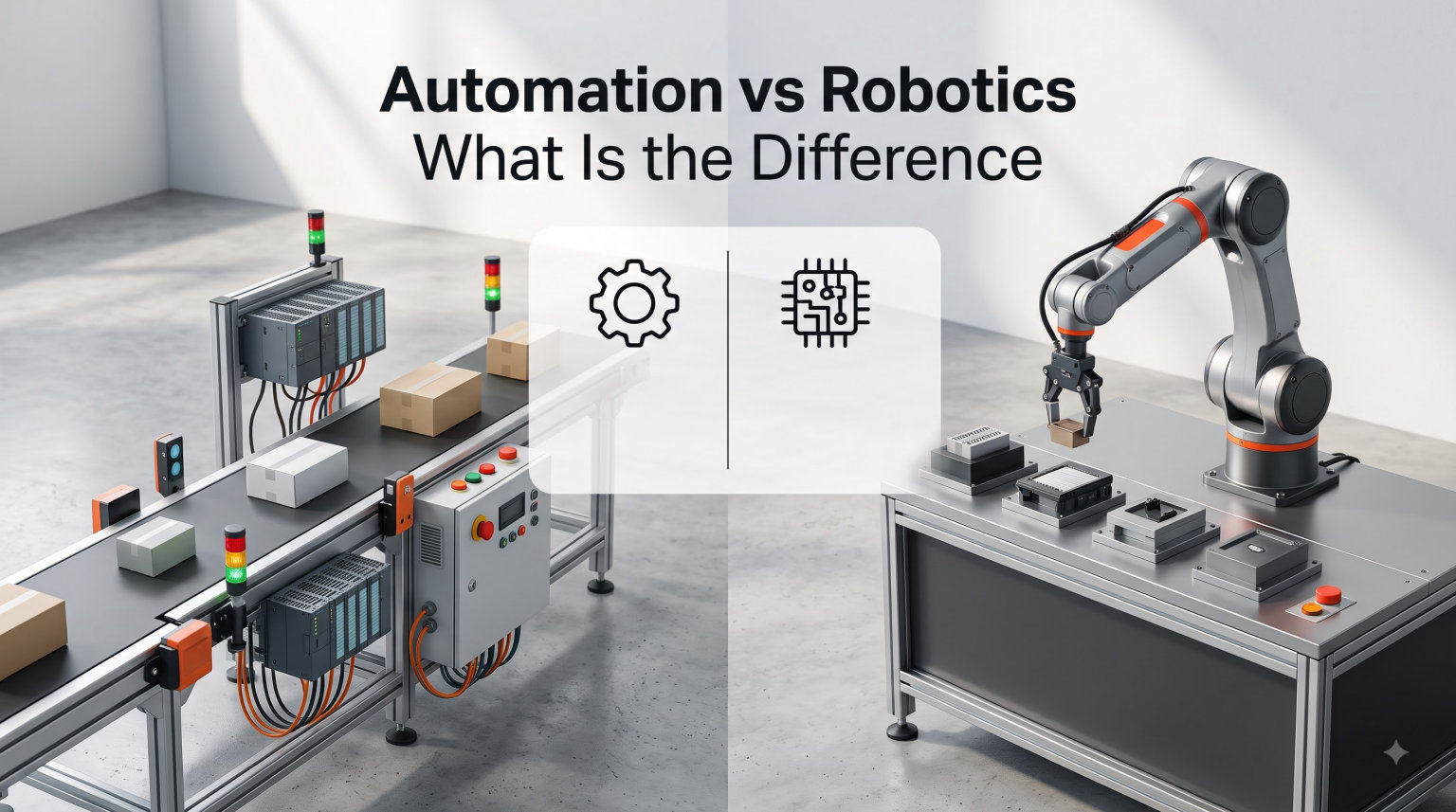
I used to use the words “automation” and “robotics” interchangeably until I started working with manufacturing clients who depended on both. After 90 days of comparing real factory floors, control rooms, and software pipelines, the line between them became obvious. In this guide, I will walk you through exactly what each term means, where they overlap, and where they part ways.
If you have ever typed “automation vs robotics what is the difference” into a search bar, you are not alone. Engineers, students, and business leaders ask the same question every day. The short answer is that robotics is a subset of automation, but the details are where the real value lives. Let me show you the rest.
Table of Contents
What Is Automation?
Automation is the use of technology to perform tasks with minimal human intervention. It covers any process – digital or physical – that runs on its own once configured. The word itself has been around since the 1940s, when Ford started using it to describe mechanical self-operating machines.
Modern automation includes software bots that process invoices, sensors that trigger valves, and conveyor belts that sort packages. The common thread is that a human sets up the rules, then the system carries them out without further input.
There is no requirement for a physical body. A Python script that renames files at midnight is automation. A PLC controlling a chemical plant is automation. Neither one needs a robot to count.
What Is Robotics?
Robotics is the branch of engineering that designs, builds, and programs physical machines (robots) capable of carrying out tasks autonomously or semi-autonomously. A robot has a body, sensors, actuators, and a controller. Without those four elements, you do not have robotics – you have automation.
The field took its name from Karel Capek’s 1920 play R.U.R. (Rossum’s Universal Robots), and it has expanded into a multi-billion-dollar industry. Industrial arms on car lines, surgical assistants in hospitals, and humanoid prototypes from companies like Figure and Tesla are all part of robotics.
Robotics depends on physical components such as robotic end effectors, servo motors, and onboard computers. The FPGAs used in robotics applications handle the real-time control loops that keep these machines precise.
The Big 4 of Robotics
When people refer to the “big 4” of robotics, they usually mean the four core components that every robot shares:
- Sensors – cameras, lidars, force/torque sensors, and encoders that collect data from the world.
- Actuators – motors, hydraulics, and pneumatics that produce physical motion.
- Controllers – microcontrollers, PLCs, and onboard computers that run the control loops.
- Software – the algorithms, often AI-based, that decide what the robot should do next.
These four elements work together inside the battery technologies for robotic systems and chassis that physically house the machine. If you remove any one of them, the result is automation – but it is not a robot.
Automation vs Robotics: Key Differences at a Glance
Automation is the broader concept of making any process self-operating, while robotics is a specific subset that involves programmable physical machines. The two terms are related, but they describe different scopes of work.
Think of automation as the umbrella and robotics as one of the tools hanging from it. Every robot is part of automation, but most automation never touches a robot at all.
| Aspect | Automation | Robotics |
|---|---|---|
| Definition | Any self-operating process | Programmable physical machines that perform tasks |
| Physical body | Optional | Required |
| Examples | RPA scripts, PLCs, conveyor logic | Industrial arms, AMRs, humanoids |
| Core focus | Process efficiency | Machine design and motion |
| Typical industries | Finance, IT, manufacturing, logistics | Manufacturing, healthcare, defense, exploration |
| Career title | Automation Engineer | Robotics Engineer |
The Four Types of Automation You Should Know
Automation falls into four main categories: fixed, programmable, flexible, and integrated (sometimes called intelligent). Understanding them helps you place robotics in the right bucket.
1. Fixed Automation. Also called hard automation, this is built for one specific task. A welding line in a car factory is a classic example. The equipment cannot be retooled cheaply, but it runs fast and cheap at scale.
2. Programmable Automation. This style is designed for batch production. The same machine can be reprogrammed for a new product. CNC mills and industrial robots fall here.
3. Flexible Automation. A step beyond programmable, flexible systems can switch between products with little or no downtime. Humanoid lines and modular workcells are pushing this category in 2026.
4. Integrated (Intelligent) Automation. This is the newest category. It combines sensors, AI, and analytics to make decisions in real time. Think of an AMR (autonomous mobile robot) that reroutes itself around obstacles using computer vision.
Robotics lives mostly in categories 2, 3, and 4. Pure software automation sits outside the physical layers entirely.
How Automation and Robotics Work Together
Robotics is a subset of automation. Every robot you have ever seen is part of a larger automated workflow, but not every automated system contains a robot. A simple temperature controller is automation; a robot arm is automation that happens to be robotic.
On a modern factory floor, the line between them blurs. A PLC orchestrates the conveyor. An industrial robot welds the frame. A vision system inspects the part. An ERP system schedules the next batch. All of these are automation – only the welding cell qualifies as robotics.
Communication matters as much as hardware. Many modern setups rely on Wi-Fi control systems for robots to feed telemetry back to a central automation platform. Without that link, the robot becomes a very expensive standalone tool.
Real-World Applications in Manufacturing and Industry
Both fields power modern factories, warehouses, and supply chains. Robotics handles the physical tasks like welding, picking, and assembly, while automation coordinates the workflow that surrounds them.
In automotive plants, robotic arms apply paint with millimeter precision. The conveyor that moves the chassis is pure automation. The scheduling software that orders parts is also automation. The result is a system where each layer has a job.
In e-commerce warehouses, AMRs (autonomous mobile robots) move shelves to human pickers. The fleet management software that routes them is automation. The inventory system that triggers restocking is automation. The robots are the only robotic element in the chain.
Healthcare uses both too. Surgical robots assist surgeons with steady hands. Hospital admission workflows are automated to reduce paperwork. Each system uses the technology that fits the task.
Common Misconceptions About Automation and Robotics
The biggest misconception is that the two terms are interchangeable. They overlap, but they are not the same thing. Anyone who has worked in plant operations can tell you that calling every automated system a “robot” causes real confusion.
Another common myth is that robotics is always physical. Some people picture humanoid machines whenever they hear “robot,” but industrial robotics has been around for decades and looks more like an arm on a pedestal than a person.
A third misconception is that automation removes all jobs. In our experience, automation usually shifts jobs toward higher-skill tasks like programming, maintenance, and process design. The same pattern is playing out with robotics.
Career Paths: Automation Engineering vs Robotics Engineering
Automation engineers focus on control systems, PLCs, SCADA, and process optimization. They spend their days tuning loops, writing ladder logic, and integrating sensors. Robotics engineers design the physical machines, write motion planning code, and build the perception stack.
Salaries overlap heavily. Entry-level automation engineers in the US start around $70k, while robotics engineers start near $80k. Both paths can reach $150k+ within 10 years of experience. The pay gap is small compared to the skill gap.
If you like software and process flow, automation is a strong fit. If you like hardware, kinematics, and AI, robotics is the better match. Many engineers move between the two over a career, which is why the resume confusion is so common.
Future Trends for 2026 and Beyond
Physical AI, humanoid robots, and Robotics-as-a-Service (RaaS) are reshaping both fields. In 2026, the line between automation and robotics is starting to dissolve as AI gives machines the ability to learn tasks instead of being programmed line by line.
Humanoid platforms from Tesla, Figure, and 1X are entering pilot programs at BMW and Amazon. The control software behind them borrows from both automation (orchestration) and robotics (real-time motion). Expect the next two years to be a tipping point for both fields.
Frequently Asked Questions
Are robotics and automation the same?
No. Robotics is a subset of automation. All robotics is automation, but most automation – such as software scripts, PLCs, and conveyor logic – does not involve any robots at all. Robotics specifically requires a physical machine with sensors, actuators, and a controller.
What are the four types of automation?
The four main types are fixed, programmable, flexible, and integrated (or intelligent) automation. Fixed automation handles a single task at high volume. Programmable automation is reprogrammed between batches. Flexible automation switches between products with little downtime. Integrated automation combines AI, sensors, and analytics to make decisions in real time.
What are the big 4 of robotics?
The big 4 of robotics are sensors, actuators, controllers, and software. Sensors collect data from the world. Actuators produce physical motion. Controllers run the real-time control loops. Software – often AI-based – decides what the robot should do next. Remove any one of these and you no longer have a robot.
What is the main difference between robotics and automation?
The main difference is scope and embodiment. Automation is the broad concept of making any process self-operating. Robotics is a specific branch that designs and programs physical machines to perform tasks. Automation can be purely software; robotics always includes a physical machine.
Is robotic process automation dead?
No. Robotic process automation (RPA) is still growing, but it is shifting toward intelligent automation that combines AI and machine learning. Pure rule-based RPA is being replaced or extended by smarter platforms. The category is alive – it is just evolving fast.
How do you differentiate robotics from automation?
You differentiate robotics from automation by looking for a physical machine. If a system has a body, sensors, actuators, and a controller that moves through the world, it is robotics. If it only runs on screens or in software, it is automation without robotics. The presence of AI does not change this – AI can power both.
What is the salary of robotics and automation engineers?
Entry-level automation engineers in the US start around $70k, while robotics engineers begin near $80k. With 5-10 years of experience, both paths reach $120k-$150k, depending on industry and location. Robotics roles in AI-heavy companies (humanoids, autonomous vehicles) often pay more due to higher demand for perception and motion-planning skills.
Conclusion
Automation vs robotics – what is the difference? After walking through definitions, types, and applications, the answer is simple: robotics is a branch of automation that requires a physical machine. The umbrella term is automation, and robotics is one of its most visible children.
If you remember nothing else, remember this: every robot is automated, but not every automated system is a robot. The distinction matters for resumes, project scopes, and vendor selection. It is also the first question every hiring manager and procurement team will ask you.
For 2026 and the years ahead, the gap between the two fields is shrinking as Physical AI and humanoids enter the mainstream. Stay curious, keep learning both, and you will be ready for whatever the next wave brings.