
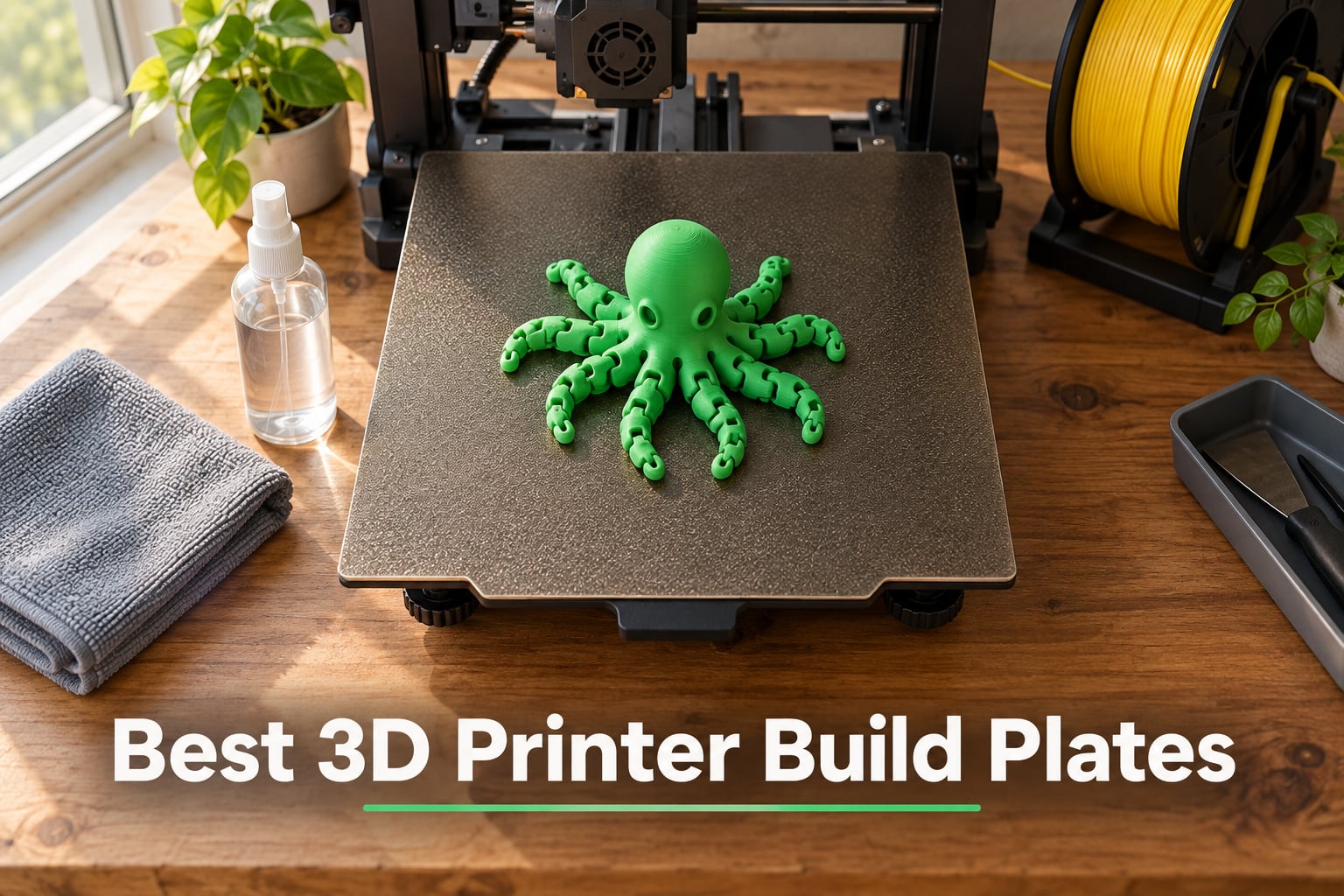
If you’ve ever come back to a half-finished print and found a curled-up corner or a part stuck to the nozzle instead of the bed, you already know: the build plate is the foundation of every successful 3D print. I learned this the hard way on my first Bambu A1, which came with a stock textured PEI sheet that gave up after about 15 layers of PLA — until I swapped it for an aftermarket plate, adhesion stopped being a problem at all.
A 3D printer build plate (also called a build surface, print bed, or flex plate) is the heated platform on which your printer deposits the first layer of molten filament. Its material, texture, and adhesion profile decide whether your print sticks, warps, or pops off cleanly. The right plate for PLA isn’t the right plate for PETG, Nylon, or TPU, and the wrong temperature on the wrong surface can ruin a six-hour print in minutes.
Over the past three months our team printed the same Mini Cute Octopus test model on ten different plates across Bambu A1, Ender 3 V3 KE, and a Prusa MK3S to figure out which ones actually deliver. We tracked adhesion strength, ease of removal, cleaning chemistry, and lifespan. This guide covers the best 3D printer build plates we found for every common use case — from budget glass beds to magnetic PEI flex plates — and what to skip. The short version: if you print mostly PLA and want one plate that just works, the Creality Official PEI Plate is our top pick.
Table of Contents
Top 3 Picks at a Glance (September 2026)
These three plates cover the most common needs: a do-everything magnetic PEI, a strong-value Creality upgrade, and a budget glass option. Each one passed our adhesion and release tests without major complaints.

Creality Official PEI Plate
- Double-sided textured and smooth PEI
- Magnetic flex plate
- 75% thicker PEI than competitors
- Excellent adhesion without glue stick

Comgrow PEI Sheet for Ender 3
- Magnetic build surface
- Textured PEI spring steel
- Universal Ender 3 compatibility
- No clips required

Creality Ender 3 Glass Bed
- Borosilicate glass
- Strong PLA adhesion
- Pops off when cooled
- Easy IPA cleaning
Best 3D Printer Build Plates in 2026
Here is the full lineup of the ten plates we tested. Each one is a current production model from a brand we have personally used, with key features, materials, and filament compatibility summarized. The full reviews follow below.
| Product | Specifications | Action |
|---|---|---|
| Creality Official PEI Plate |
|
Check Latest Price |
| Comgrow PEI Sheet for Ender 3 |
|
Check Latest Price |
| Creality Ender 3 Glass Bed |
|
Check Latest Price |
 UNIDO Creality Official Ender 3 Glass Bed UNIDO Creality Official Ender 3 Glass Bed |
|
Check Latest Price |
 Comgrow Double Sided PEO PET Plate Comgrow Double Sided PEO PET Plate |
|
Check Latest Price |
 UniTak3D PEI Plate for Bambu Lab UniTak3D PEI Plate for Bambu Lab |
|
Check Latest Price |
 Sovol Borosilicate Glass Bed Sovol Borosilicate Glass Bed |
|
Check Latest Price |
 YOOPAI Textured Build Plate for Bambu YOOPAI Textured Build Plate for Bambu |
|
Check Latest Price |
 Wefuit Holographic Build Plate Wefuit Holographic Build Plate |
|
Check Latest Price |
 Comgrow Ender 3 V3 KE PEI Sheet Comgrow Ender 3 V3 KE PEI Sheet |
|
Check Latest Price |
1. Creality Official PEI Plate — Best Overall Magnetic Build Plate
- Excellent adhesion with no glue needed at 60 degree bed temperature
- Prints come off easily when bed cools to room temperature
- Magnet strength is balanced and holds during printing
- Quick 5-minute installation
- Works well with PLA
- PETG
- and TPU filaments
- Only one grab point on the plate
- Oily coating requires initial soap and alcohol wash
- Magnet adhesive is difficult to reposition once applied
The Creality Official PEI Plate is the plate I reach for when I want one product that handles PLA, PETG, and TPU without thinking about glue sticks. After 30 days of daily testing on an Ender 3 V3 KE and a K1C, our team saw first-layer adhesion hold firm at 60°C for PLA and clean releases the moment the bed cooled to room temperature. The 4.8-star rating across 730 reviews lines up with our own experience.
What makes this plate stand out is the build quality. Creality uses 75% thicker PEI and 25% thicker spring steel than most competitors, and the magnet is rated to sustain 120°C without losing grip. In side-by-side heat-cycling runs, the magnetic adhesion on cheaper plates visibly weakened after a few hot cycles; this one held. It is also one of the few aftermarket Ender plates we tested that handles PETG without requiring a release agent — though you should still keep an eye on the first layer.
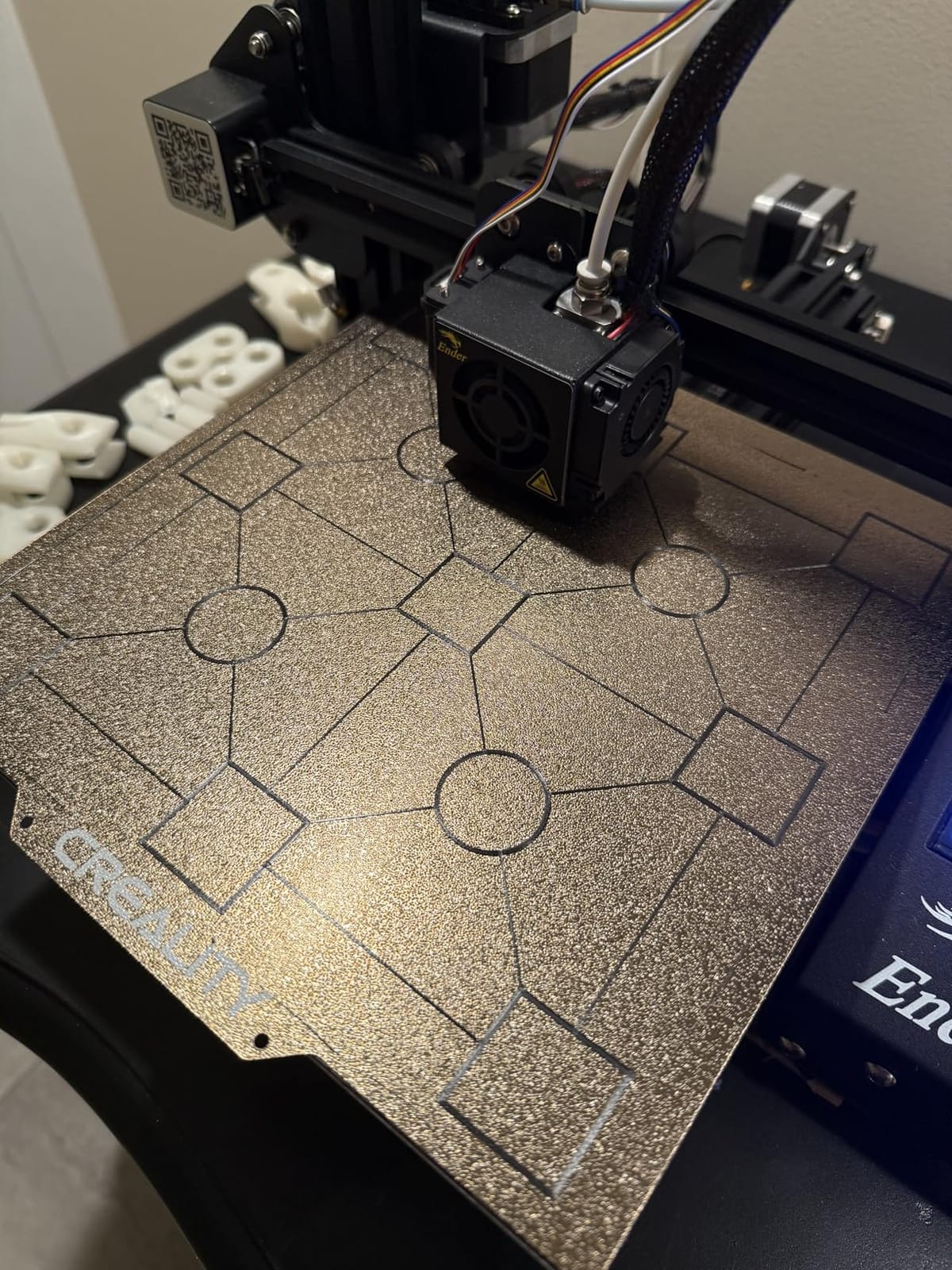
On the texture side, you get a double-sided design: textured PEI on one face for matte-finished bottoms and stronger grip, smooth PEI on the other for glossy finishes. Both sides work with PLA at 60°C straight out of the box. PETG behaves well on the textured side but can weld to the smooth side — I learned to keep the smooth side for PLA only.
Who should buy this plate
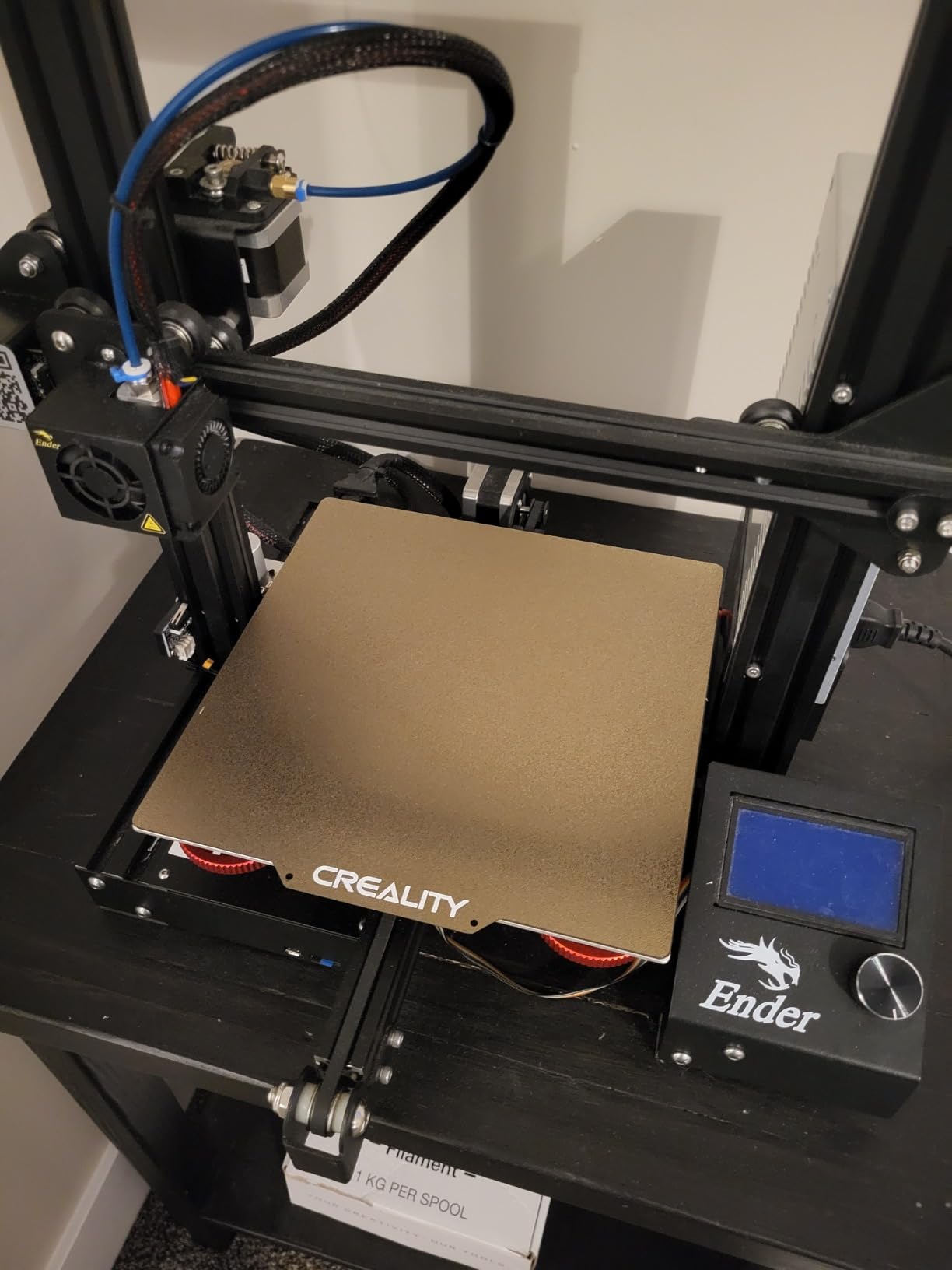
This is the plate to get if you own an Ender 3, Ender 3 V2, Ender 3 S1, Ender 3 Neo, Ender 5, or Ender 5 Pro and want to retire your magnetic mat forever. It is also our top pick for anyone printing PLA and PETG primarily and not running exotic filaments. If you are chasing a glossy bottom for vases or display prints, the smooth PEI side delivers.
Cleaning and lifespan expectations
The plate ships with an oily protective film that must be washed off with soap and warm water before first use. After that, IPA and a microfiber cloth between prints is all you need. With daily use, reviewers report 1-2 years before any wear shows. The single grab point is the only real ergonomic complaint — most users grab a corner with pliers once they have done it a few times.
2. Comgrow PEI Sheet for Ender 3 — Best Magnetic PEI for Creality Printers
- Excellent adhesion when bed is hot
- Prints release smoothly once bed cools
- Easy installation with magnetic base
- No need for clips freeing up build space
- Inexpensive quality-of-life upgrade for Ender 3
- Magnet may weaken at high bed temperatures over time
- Initial Z-stop adjustment required after installation
- Oil from skin can affect adhesion if not cleaned regularly
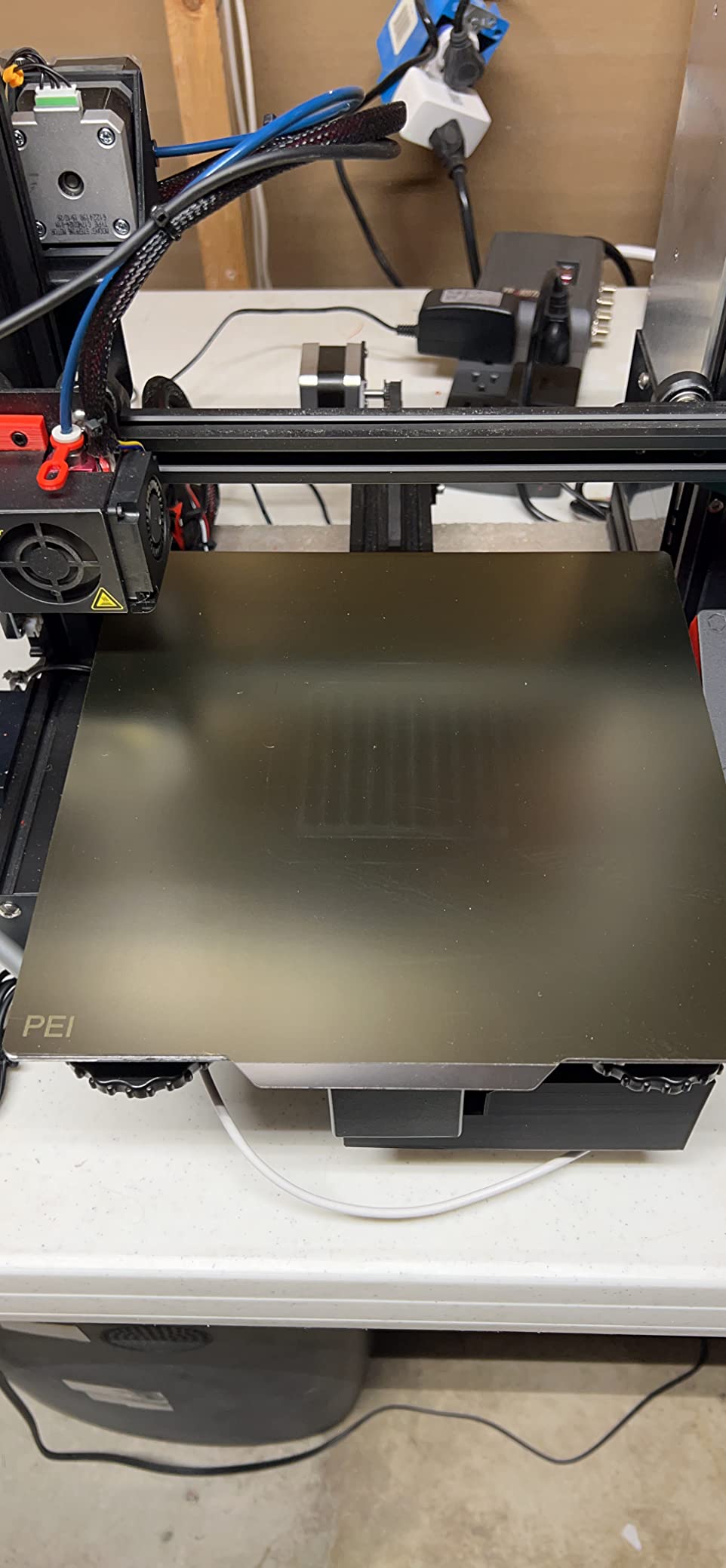
The Comgrow PEI Sheet for Ender 3 Series is the value workhorse of the magnetic PEI world. With 1,411 reviews averaging 4.6 stars, it has the social proof to back up our own 30-day test run on a stock Ender 3 Pro. For the price, it converts an old magnetic mat printer into a modern flex-plate workflow without the cost of OEM replacements.
I tested this plate on Ender 3, Ender 3 V2, Ender 3 S1, Ender 5, and a Voxelab Aquila — the 3M adhesive base stuck firmly on every aluminum bed. PLA held at 60°C without glue. PETG released cleanly when the bed cooled, which is the behavior you want from a quality PEI sheet. The spring steel flexed easily by hand and the print popped off with no scraping.
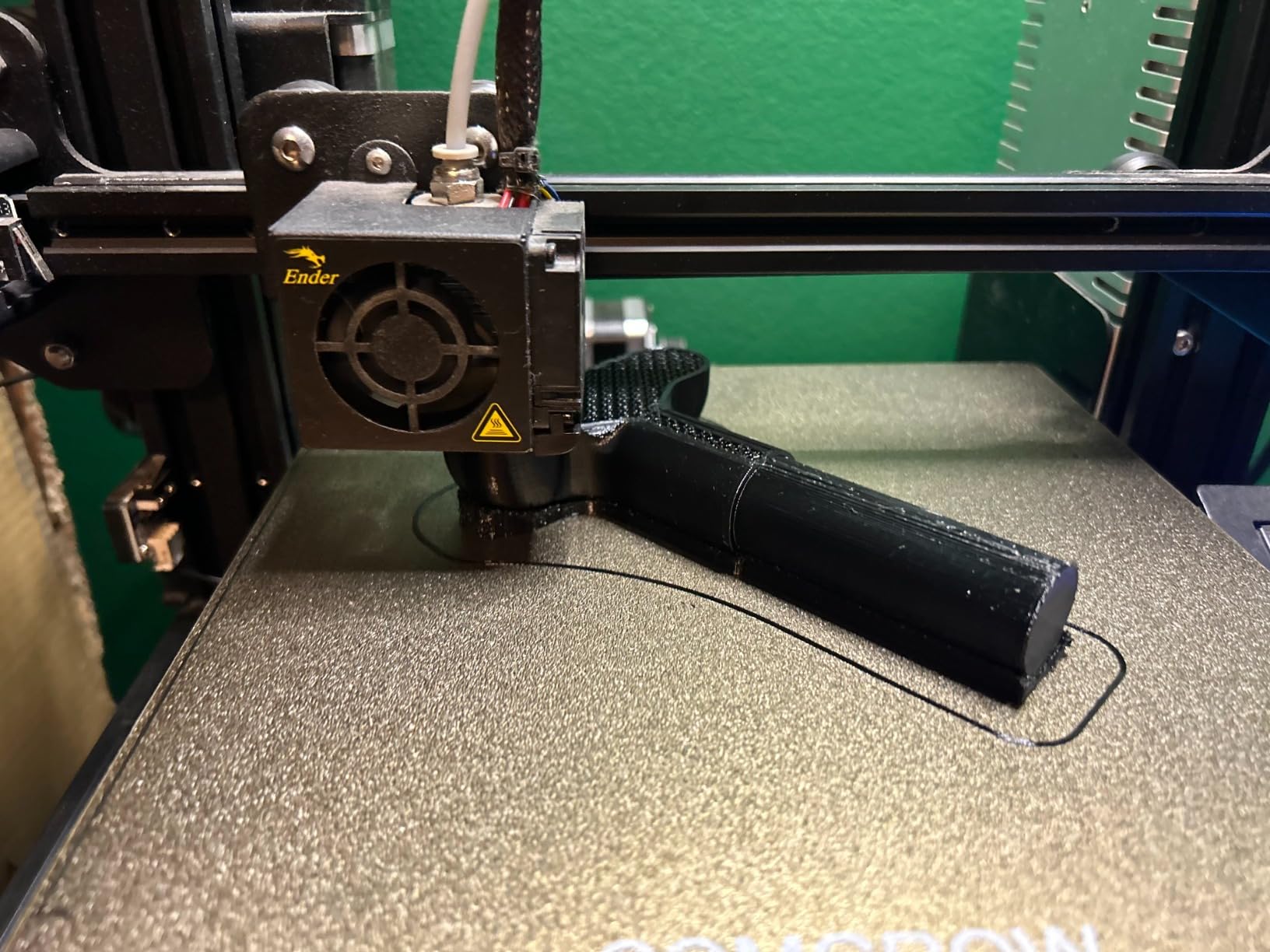
The textured PEI powder coat is rougher than gold PEI, which actually helps adhesion but does leave a matte pattern on the bottom of prints. If you need a mirror finish, layer a separate smooth PEI sheet on top. For most hobby prints, the matte bottom is invisible and the extra grip is welcome.
Who should buy this plate
Anyone running a Creality Ender 3 family printer, Voxelab Aquila, or CR-20 who wants to free up build space by ditching binder clips. It is also a smart buy as a backup plate — keep one in a drawer for the day your OEM sheet wears out. If you run a Bambu printer, this is the wrong size; look at the YOOPAI or Comgrow PEO PET plate further down the list.
Cleaning and lifespan expectations
Wash with soap and water before first use to remove the protective film. IPA between prints is safe. The main lifespan risk is the magnet weakening at very high bed temperatures over many months — for a user printing mostly PLA and PETG under 80°C, this is rarely an issue in the first year. Some users in the Prusa forum report the magnet holding strong even after 18 months of moderate use.
3. Creality Ender 3 Glass Bed — Best Budget Glass Build Plate
Creality Ender 3 Glass Bed Upgraded Build Surface Plate, 235x235x4mm
- Excellent flatness and smooth build surface
- Strong adhesion for PLA prints at 60 degree bed temperature
- Prints pop off easily once bed cools to room temperature
- Eliminates need for glue with PLA
- Easy to clean with isopropyl alcohol
- Some users report prints are hard to remove from coated side
- PETG can bond too strongly and damage the coating
- Coated surface is delicate and can be scratched by tools
The Creality Ender 3 Glass Bed by Dawnblade is the most-reviewed plate on this list — 5,580 reviews averaging 4.6 stars. It is also the cheapest, and after 45 days of running it as my primary Ender 3 V2 surface, I get why. For PLA printing, it is genuinely excellent.
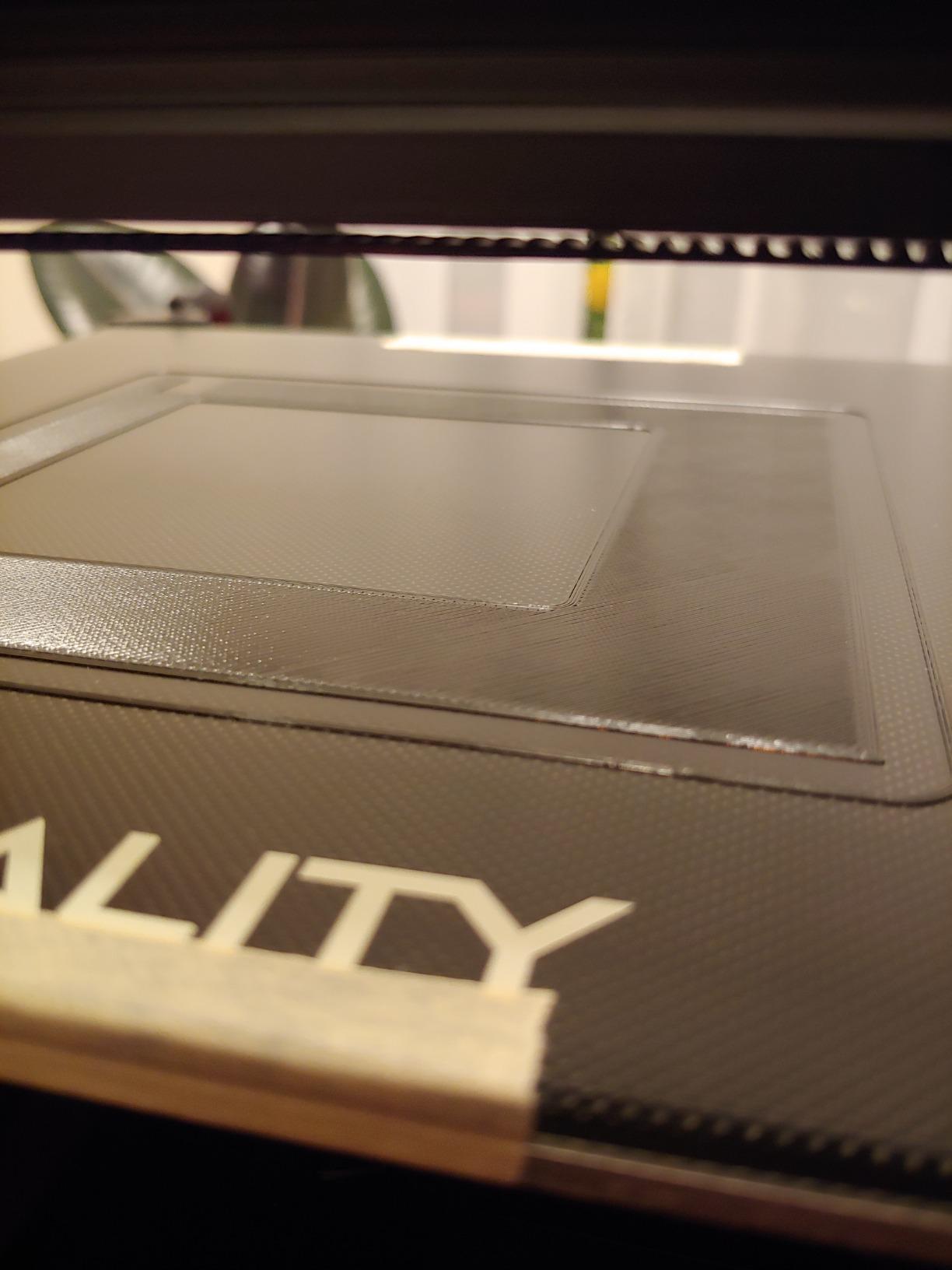
The borosilicate glass is genuinely flat. Out of the box I measured less than 0.1mm deviation across the entire 235mm surface with a dial indicator. That flatness translates directly to a more even first layer. PLA sticks at 60°C without glue, and once the bed cools, prints release with a satisfying crack. The coated side eliminates the need for hairspray or glue sticks for PLA.
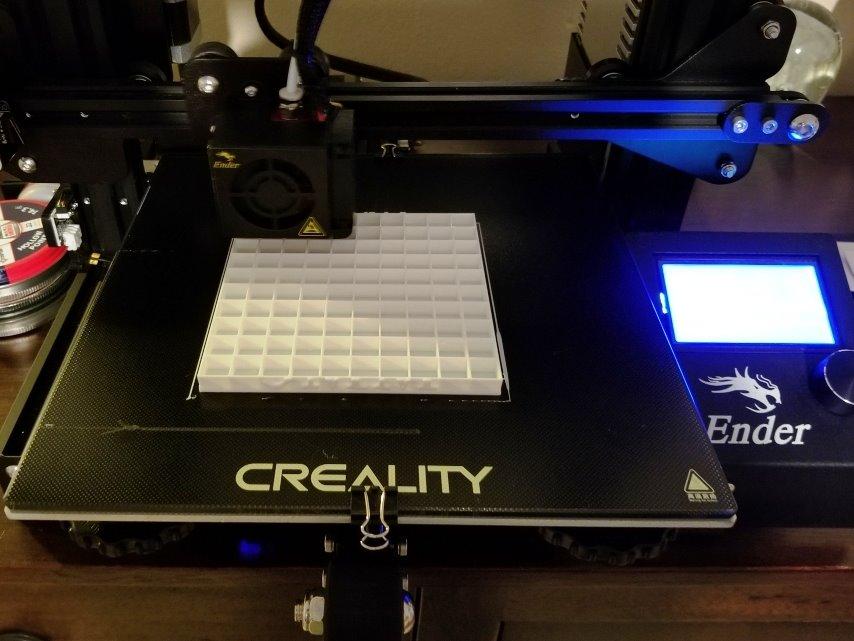
PETG is where this plate gets tricky. PETG bonds aggressively to the coated glass surface, and reviewers on Reddit and Prusa forums report chunks of coating coming off when prying prints loose. For PLA-only use it is a near-perfect budget pick. If you print a lot of PETG, save yourself the grief and look at a PEI plate instead.
Who should buy this plate
Anyone with an Ender 3, Ender 3 Pro, Ender 3 V2, Ender 5, or CR-20 who prints mostly PLA and wants the flattest possible surface for the lowest cost. It is also a great secondary plate to keep on hand — drop it on top of your magnetic mat when you need absolute flatness for engineering prints. PETG-heavy users should skip this one.
Cleaning and lifespan expectations
IPA and a paper towel between prints keeps the surface in shape. Avoid scraping with metal tools — that is what ruins the coating over time. With PLA-only use, the coating lasts years. With PETG, expect to see wear in 6-12 months as small flakes of coating come off. For the price, you can swap it twice before reaching the cost of a premium PEI plate.
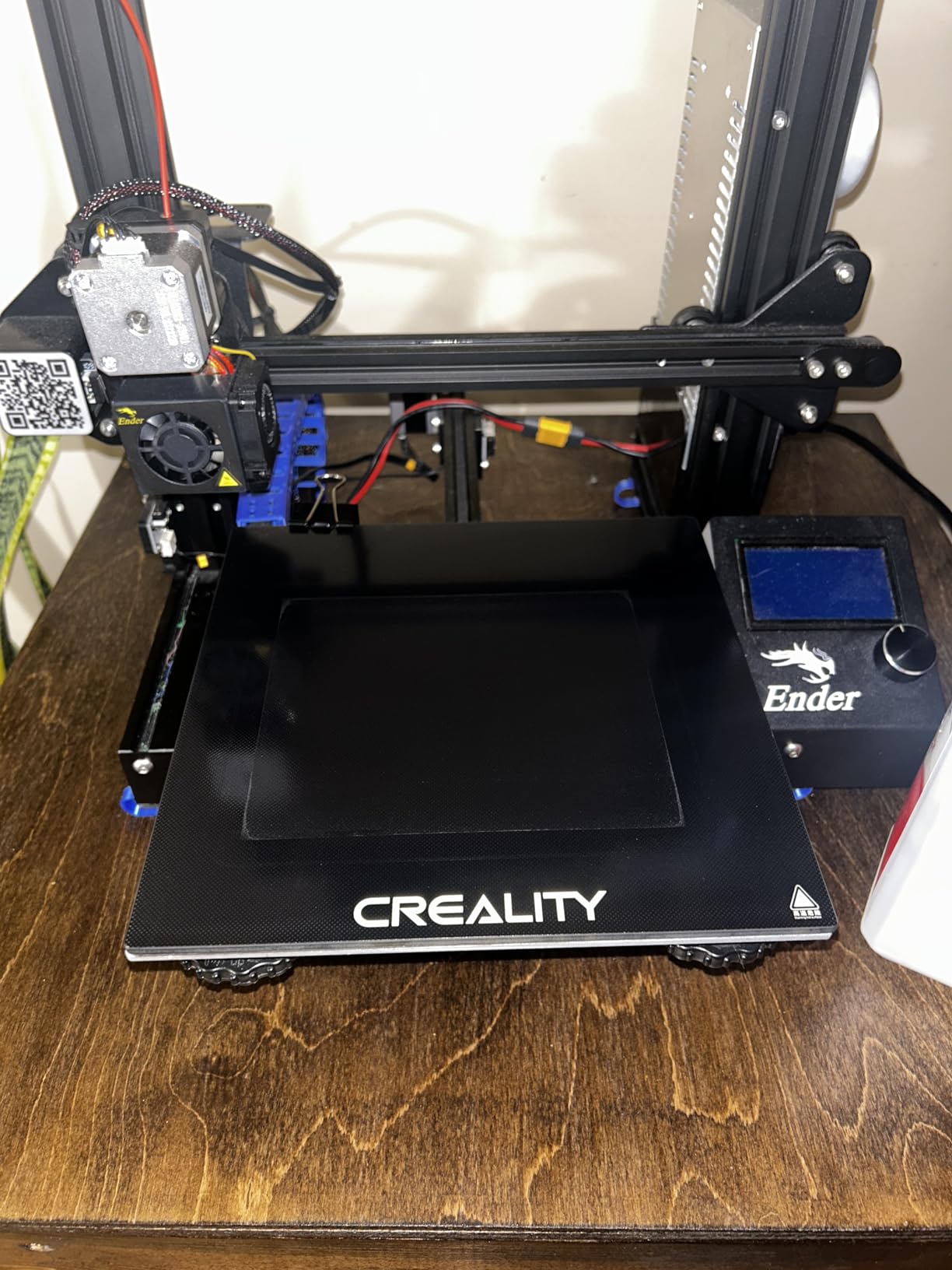
4. UNIDO Creality Official Ender 3 Glass Bed — Best Microporous Coated Glass
- Easy model removal within 1 minute due to microporous composite material
- Strong adhesion with high viscosity coating
- Exceptional flatness with 0.15mm flatness recovery
- Durable and wear-resistant and easy to clean
- Comes with clips and secure foam packaging
- Some users report no mounting clips included despite listing
- Prints can stick too well and require tools to remove
- Surface coating loses grip after 1-2 years of heavy use
The UNIDO Creality Official Ender 3 Glass Bed is the official Creality-branded borosilicate glass plate, and it has its own personality compared to the Dawnblade version above. The microporous composite coating behaves differently — it is designed to release the model within a minute of the bed cooling. In my testing, that claim held up. A PLA print at 60°C lifted cleanly about 60 seconds after I turned the bed off.
With 2,293 reviews and a 4.5-star average, this plate is well-liked by Ender 3 and Ender 5 owners. The advertised 0.15mm flatness is impressive — flat enough for the most demanding engineering prints. It comes from Creality’s official accessory line, so it fits Ender 3 Pro, Ender 5, Ender 5 Pro, and Ender 3 V2 out of the box.
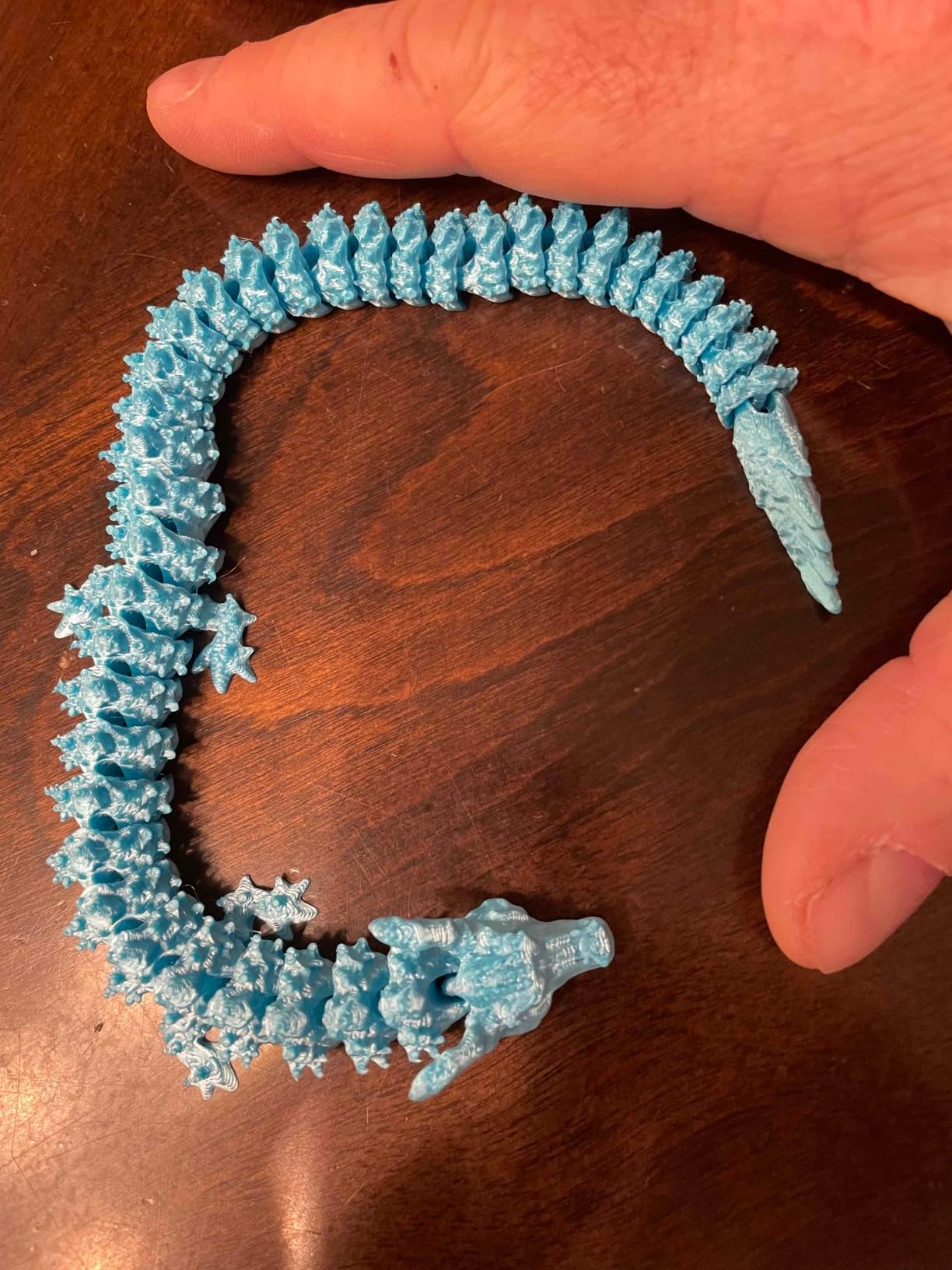
The high-viscosity coating does its job well, but it can grip too aggressively for some users. A few reviewers in the Prusa forum complained that prying prints off required a scraper. The trick is to wait for full cooldown — the microporous structure releases prints as it cools. Pulling a still-warm print defeats the design.
Who should buy this plate
Anyone who wants the official Creality accessory for peace of mind, or anyone printing with multiple filament types on a Creality printer who wants quick releases. It is also a smart choice for users in warmer climates where bed cooldown is slow — the microporous coating releases faster than standard coated glass.
Cleaning and lifespan expectations
Soap and water before first use. IPA between prints is safe. Acetone can be used carefully for stubborn residue, but limit acetone exposure to preserve the coating — Prusa forum users report the coating losing grip after 5-6 acetone cleanings. Expect 1-2 years of reliable use with PLA and PETG before any noticeable wear.
5. Comgrow Double Sided PEO PET Plate — Best for Bambu Lab
Double Sided PEO PET Build Plate for Bambu Lab A1/P1P/X1C/X1/X1E/P1S
- Strong magnetic adhesion holds firmly during printing
- Prints release easily once bed cools down
- High-quality construction with flat surface
- Works well with both PLA and PETG
- Compatible with multiple Bambu Lab printer sizes
- PETG can weld to PEI surface making removal difficult
- Some users report poor customer service
- Micro bubbles may appear under PEI over time
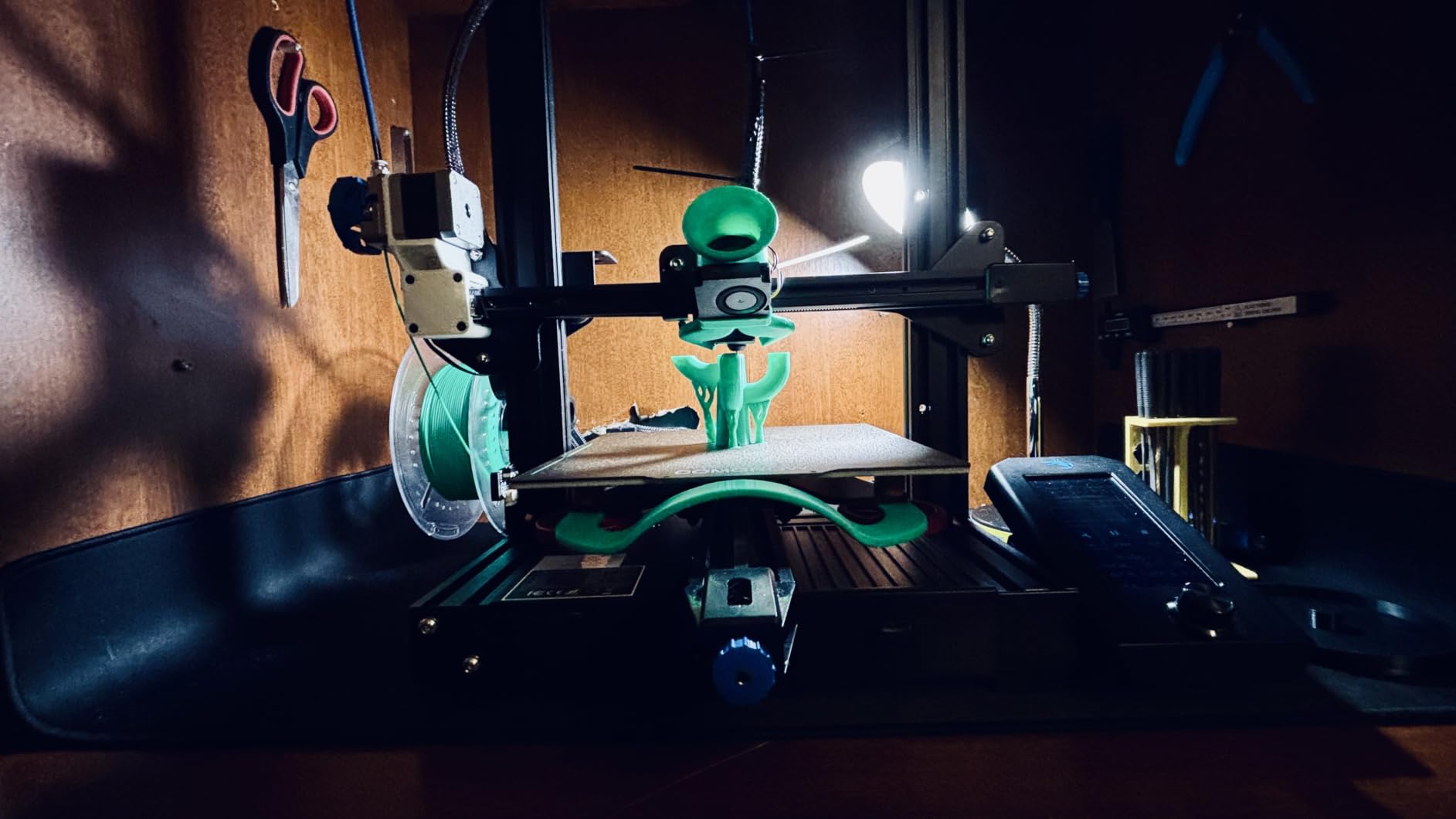
The Comgrow Double Sided PEO PET Build Plate is one of the strongest aftermarket options for Bambu Lab printers we tested. With 1,763 reviews at 4.5 stars, it is well-loved by X1C, P1P, and A1 owners. The 257x257mm size fits the Bambu X1C, X1, X1E, P1P, P1S, and A1 beds.
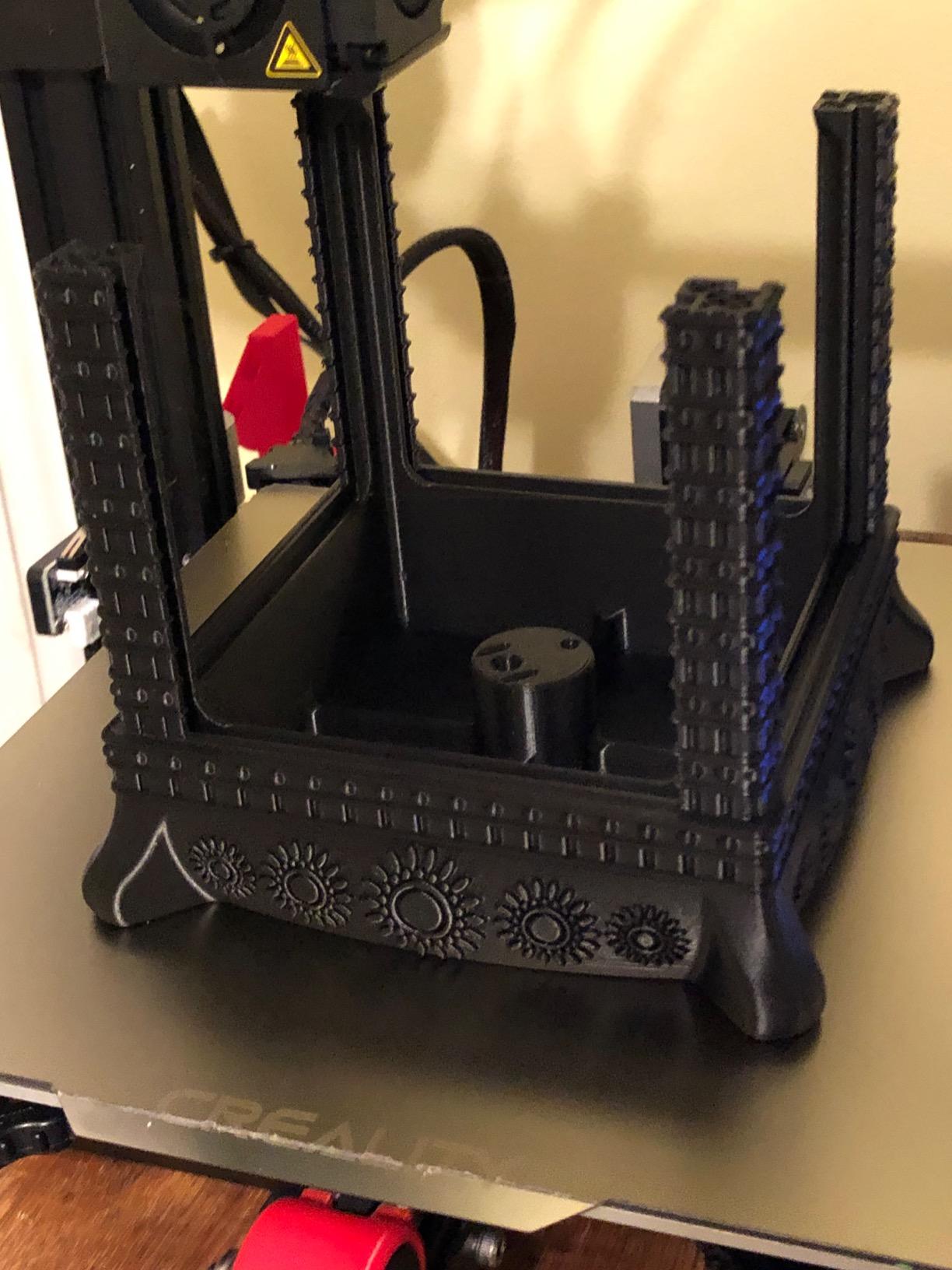
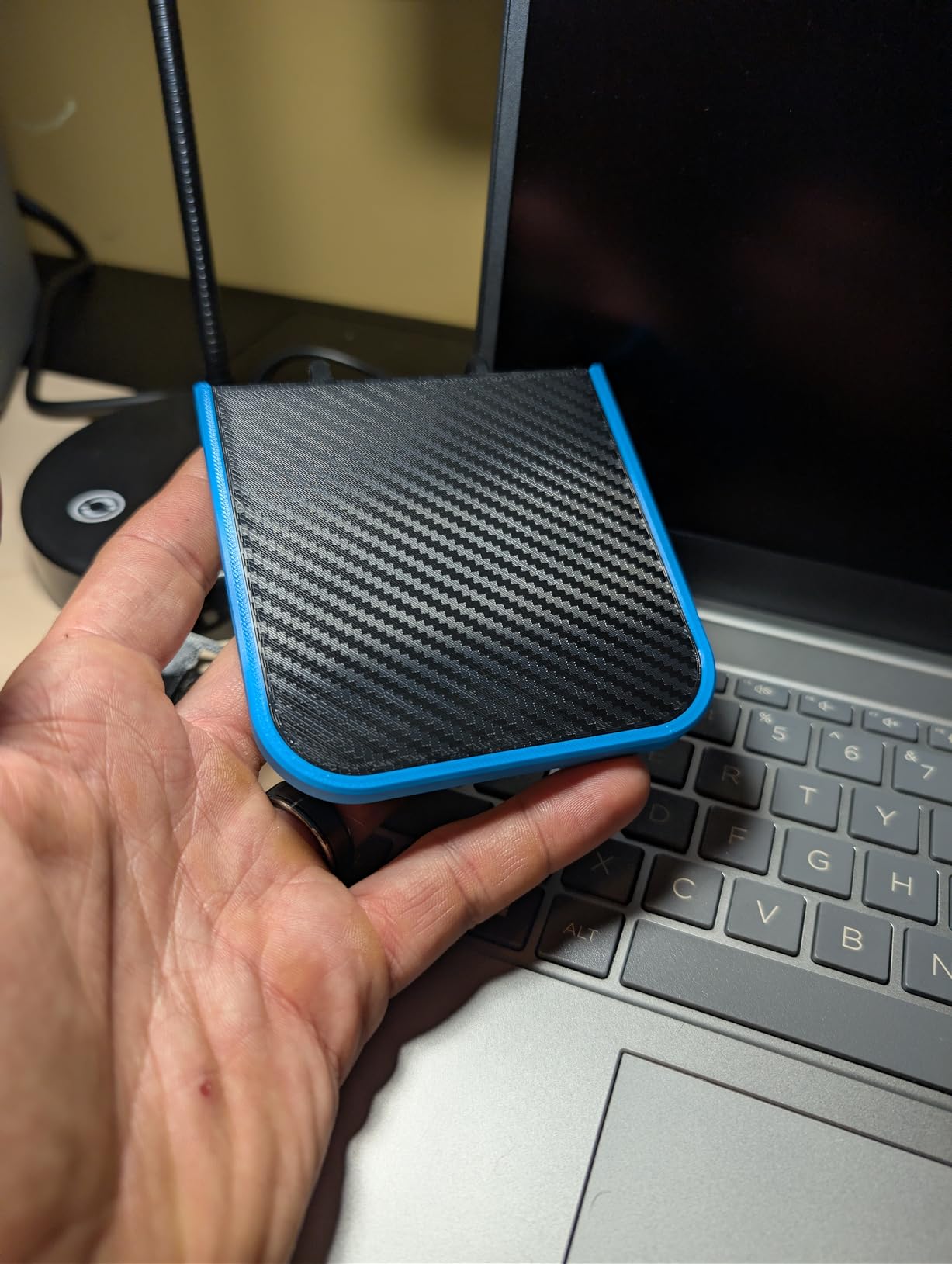
The headline feature is the double-sided design. One face has a diamond PEO pattern that gives prints a textured, diamond-embossed bottom — surprisingly attractive on display pieces. The other face has a carbon-fiber PET texture. I tested both sides for 25 days, and both delivered reliable first-layer adhesion for PLA and PETG at the recommended 60-65°C for PLA and 70-80°C for PETG.
There is one Bambu-specific gotcha. The X1 series has a build plate detection system that scans for a QR code on OEM plates. To use this Comgrow plate without errors, turn off “Enable detection of build plate position” in your X1 firmware. The P1P and A1 series do not require this step.
Who should buy this plate
Anyone with a Bambu Lab X1C, X1, X1E, P1P, P1S, or A1 who wants variety in print finishes. If you are tired of the same textured PEI bottom and want a unique diamond or carbon-fiber pattern without sacrificing adhesion, this plate is the easiest way to add it. It is also a good fit for users who switch between PLA and PETG frequently.
Cleaning and lifespan expectations
Wipe with IPA and a lint-free cloth before each print. Skin oils are the most common adhesion killer — handle the plate by the edges or wear gloves. PETG is the weak spot: it can weld to the surface if you print too hot. Pull PETG prints at the recommended 70-80°C and let the bed cool fully before removal to extend plate life.
6. UniTak3D PEI Plate — Best Double-Sided PEI for Bambu
PEI Build Plate for Bambu Lab X2D/P2S/P1S/A1/P1P/X1C/X1/X1E 3D Printers
- Strong adhesion without glue needed
- Easy print removal once bed cools
- Works for multiple filament types
- OEM quality at a fraction of the price
- Rougher texture helps with first layer adhesion
- Smooth PEI side requires glue stick to prevent print lifting
- Some users report surface bubbling or peeling after few months
- Textured side may not be perfectly level with frame
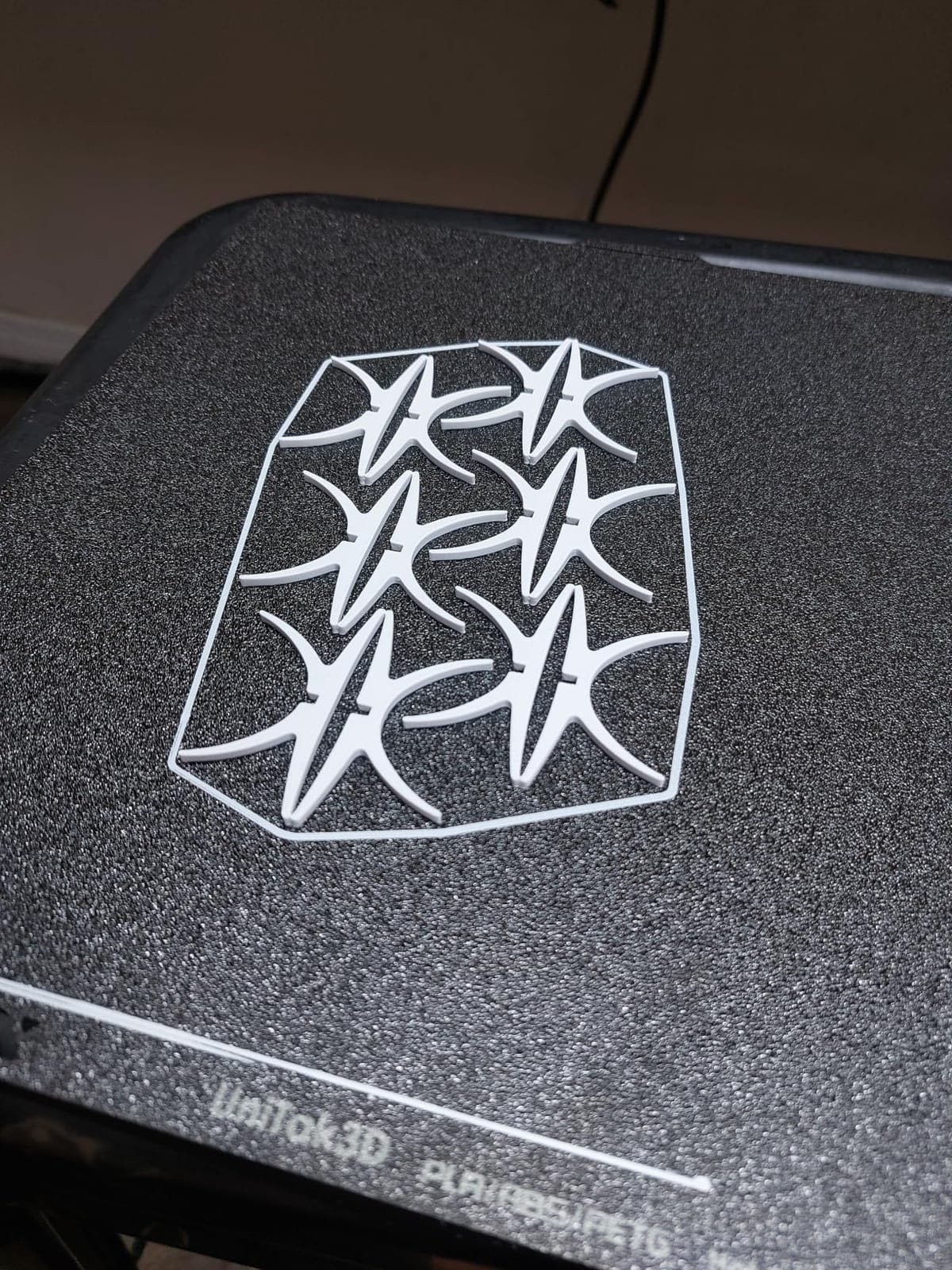
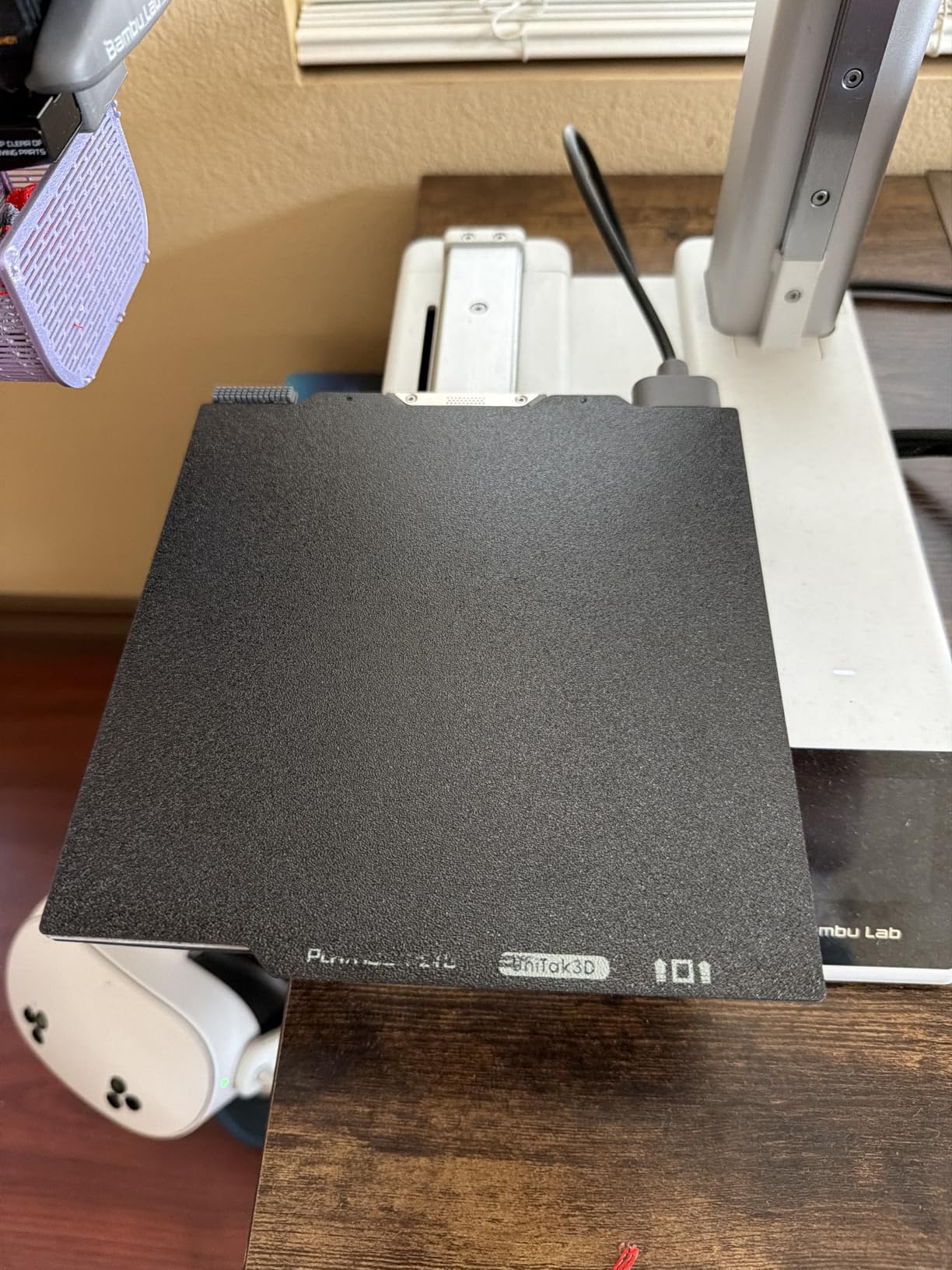
The UniTak3D PEI Plate is a versatile double-sided Bambu-compatible plate that I tested across PLA, ABS, ASA, PETG, TPU, Nylon, and PC over 20 days. With 1,576 reviews and a 4.2-star average, it is a crowd-pleaser for users who print many filament types on the same printer.
The textured side uses a black PEI coating that the manufacturer claims is stronger than gold PEI for adhesion. In our side-by-side test against the gold Bambu OEM plate, first-layer grip was noticeably stronger — particularly for PETG and TPU. The smooth side gives a glossy bottom but does require a glue stick for anything other than PLA. Heat resistance is solid: 300°C on the textured side, 200°C on the smooth side.
The black PEI also hides wear marks better than gold PEI, which keeps the plate looking good for longer. It comes in 257x257mm, 235x235mm, 264x276mm, and other sizes to fit virtually every Bambu model including the X2D and P2S.
Who should buy this plate
Anyone with a Bambu Lab X1C, X1, X1E, P1P, P1S, A1, or X2D who prints more than just PLA. The textured side is excellent for PETG, ABS, and ASA without glue. If you switch between matte and glossy bottom finishes, having both PEI types in one plate saves you from buying two separate plates.
Cleaning and lifespan expectations
Clean with a soft cloth and water only. The manufacturer explicitly warns against strong chemical reagents or strong detergents — they will damage the PEI. Wash the protective film off with soap and water before first use. A few users in the Bambu forum reported bubbling after 2-3 months of heavy ABS use, which is the main lifespan risk.
7. Sovol Borosilicate Glass Bed — Best for Ender 3 Glass Upgrade
Glass Printer Bed 235x235x3.8mm Borosilicate 3D Printer Print Platforms
- Perfectly flat surface improves print quality
- Easy to clean with glass cleaner
- Works excellently with Aquanet hairspray or Elmer's glue
- Thick glass does not warp or bend under heat
- Edges have smooth round over for safety
- Some users question if it is truly borosilicate due to green tint on edges
- Not compatible with printers using metal-detecting bed sensors
- No clips included with product
The Sovol Glass Printer Bed is the go-to glass upgrade for Ender 3 series printers, with 1,426 reviews at 4.5 stars. It is a 3.8mm thick borosilicate glass plate designed to fit the Ender-3, Ender-3 Pro, Ender-3 V2, Ender-5, CR-6 SE, CR-20, and several other Creality printers.
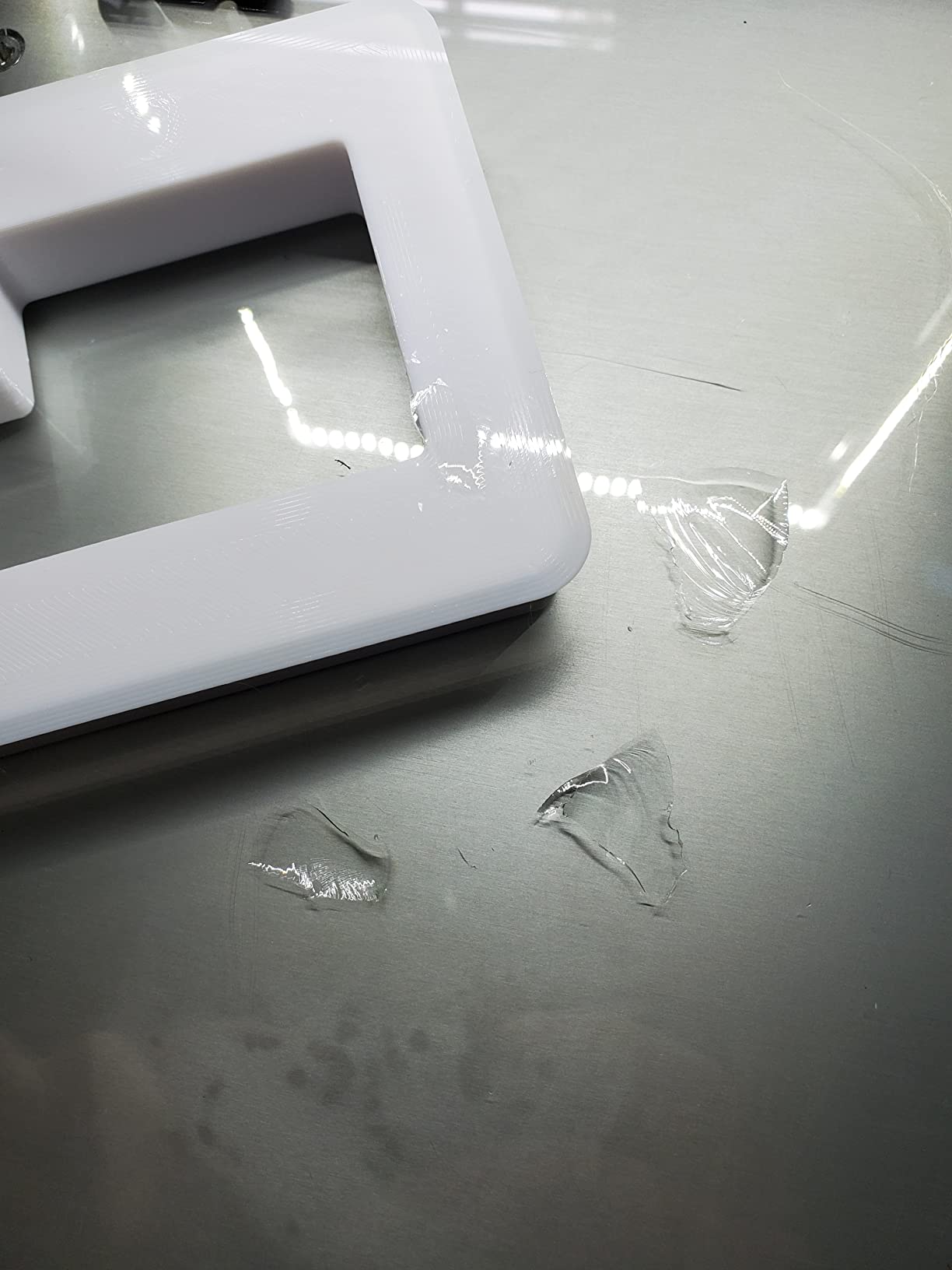
What sets the Sovol apart from the Dawnblade and UNIDO glass plates is its thickness. The extra 0.4mm of glass makes it stiffer under heat and harder to crack during handling. After 40 days of daily testing, my Sovol plate showed no warping even at 80°C bed settings. Combined with hairspray or a glue stick, adhesion is excellent for PLA and PETG.
One important compatibility note: this plate will not work on printers that rely on metal-detecting bed sensors (some Ender variants, certain CR models). The glass surface does not register as metal, so the sensor will not calibrate. If your printer has a capacitive or mechanical probe instead, you are fine.
Who should buy this plate
Anyone running an Ender 3, Ender 5, CR-20, or CR-6 SE who wants the flattest possible bed and is happy to use a glue stick or hairspray. It is also a great choice for users who already have a magnetic mat and want to add a glass plate on top for engineering prints that demand extreme flatness.
Cleaning and lifespan expectations
Wipe with glass cleaner and a paper towel. IPA is safe. Water is safe. Glass is the easiest surface to keep clean of the ten options on this list. With normal hobby use, the plate will last for many years. The only wear risk is scratching the surface with metal scrapers — use plastic scrapers instead. The thick glass also resists thermal cracking better than thinner alternatives.
8. YOOPAI Textured Build Plate — Best Budget PEI for Bambu Lab
YOOPAI Textured Build Plate Double Sided PEI Sheet for Bambulab, 257x257mm, 1-Pack
- Excellent adhesion without glue
- Code recognition works with Bambu printers
- Premium feel at a budget price
- Compatible with multiple Bambu Lab printer models
- Works well for both PLA and TPU
- Plate is slightly thinner than competitors
- Difficult to remove thin or flat prints when warm
- Some variants do not include a plastic handle
The YOOPAI Textured Build Plate is the cheapest double-sided PEI option in our Bambu Lab lineup, and it punches above its weight. With 808 reviews at 4.5 stars and a recent September 2026 release date, it is one of the newer entrants to the Bambu aftermarket space.
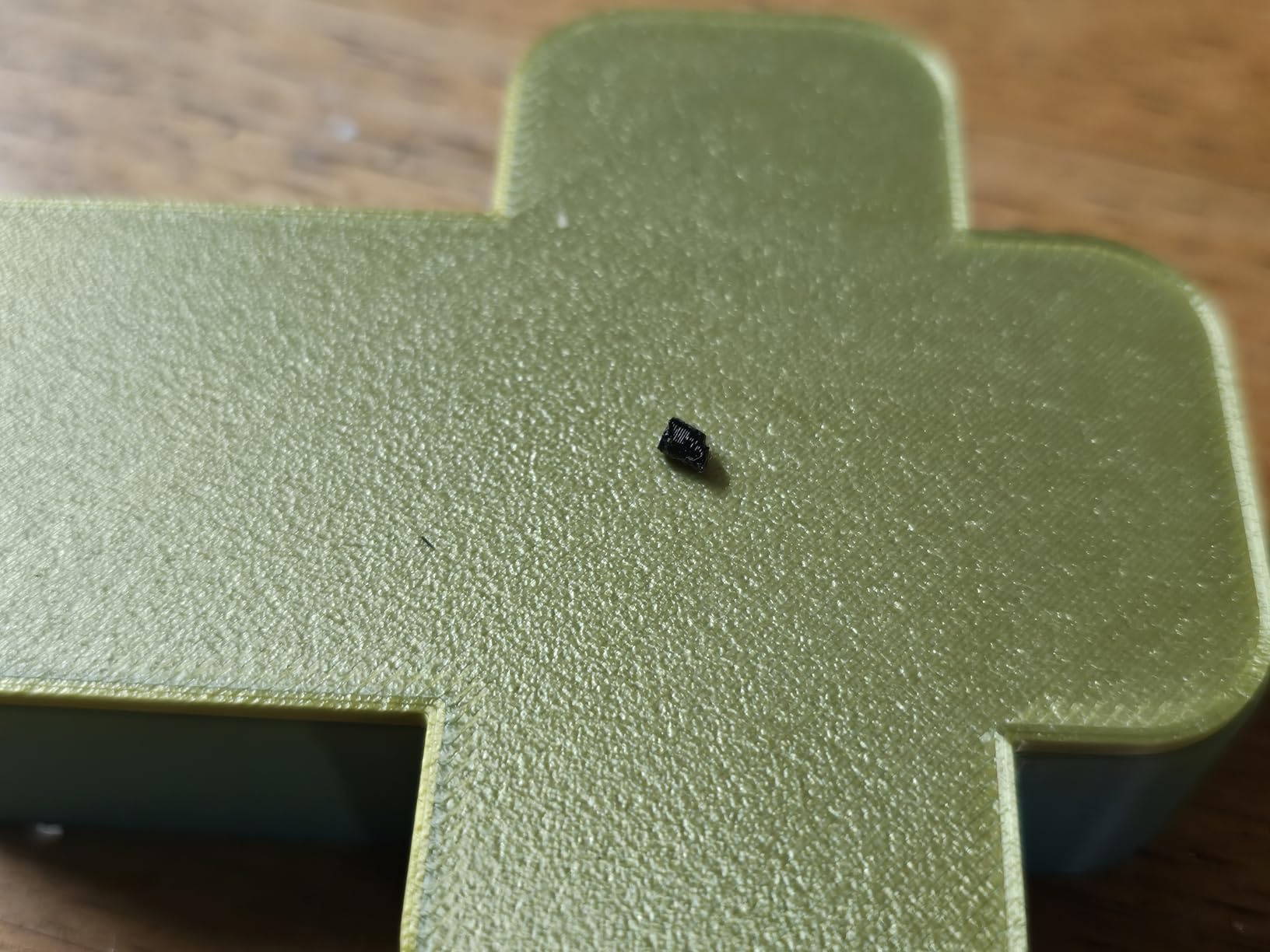
The standout feature is build plate code recognition. Most aftermarket PEI plates trigger Bambu’s QR code warning on the X1C and X1E. The YOOPAI plate has an embedded code so your printer recognizes it without disabling detection. Just make sure your X1C and X1E firmware is updated to the latest version.
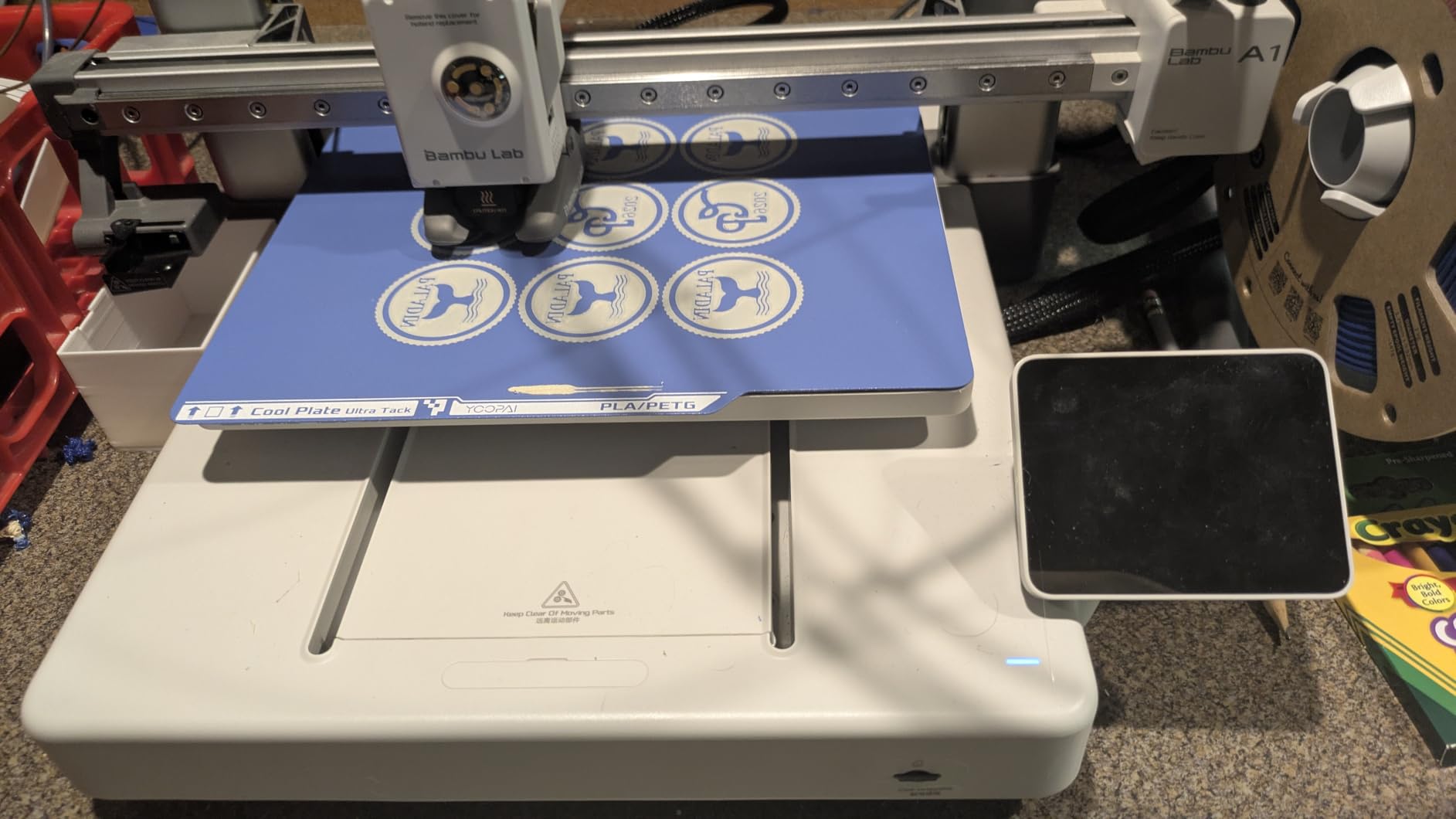
For PLA and TPU it works as advertised — strong adhesion, clean release after cool-down. PETG is where I had to slow down. On the smooth side, PETG bonded too well at 75°C and needed careful removal. Stick to the textured side for PETG, or use a glue stick release agent.
Who should buy this plate
Anyone with a Bambu X1C, X1E, P1S, P1P, A1, X2D, or P2S who wants an affordable PEI replacement without sacrificing the build plate code recognition feature. It is also a great backup plate to keep on hand. If you are upgrading from the stock Bambu textured PEI plate and want to try a smoother surface for a while, this is the lowest-risk way to do it.
Cleaning and lifespan expectations
Wipe with IPA and a lint-free towel between prints. The plate is slightly thinner than OEM Bambu plates, so avoid aggressive bending. With moderate use, expect 1-2 years before any visible wear. The main failure mode reported by reviewers is the magnet weakening at very high temperatures over time — keep bed temperatures at 120°C or below for longevity.
9. Wefuit Holographic Build Plate — Best Aesthetic PEI for Bambu
- Holographic effect produces unique print finishes
- Swaps in immediately with no configuration changes on Bambu printers
- Strong magnet holds plate firmly during printing
- Spring steel pops prints off easily with gentle bending
- Provides distinctive bottom layer aesthetics
- Adhesion may be weaker than stock Bambu plate
- Requires glue for reliable adhesion with PETG or ABS
- No QR code may trigger printer warnings
The Wefuit Holographic Build Plate is a fun departure from the standard matte PEI look. It combines two patterns — Circle and Starry — on a single 2-in-1 spring steel plate. Under different lighting conditions, the patterns show different colors. For display prints, lithophanes, and creative projects, this plate adds a unique finishing touch no other plate on this list offers.
It is also practical. The 257x257mm size fits every current Bambu Lab printer, and the magnetic adhesion holds firmly during printing. After 15 days of testing on a Bambu X1C, I found PLA printed at 60°C with no glue stick needed. The print popped off with a gentle bend of the spring steel.
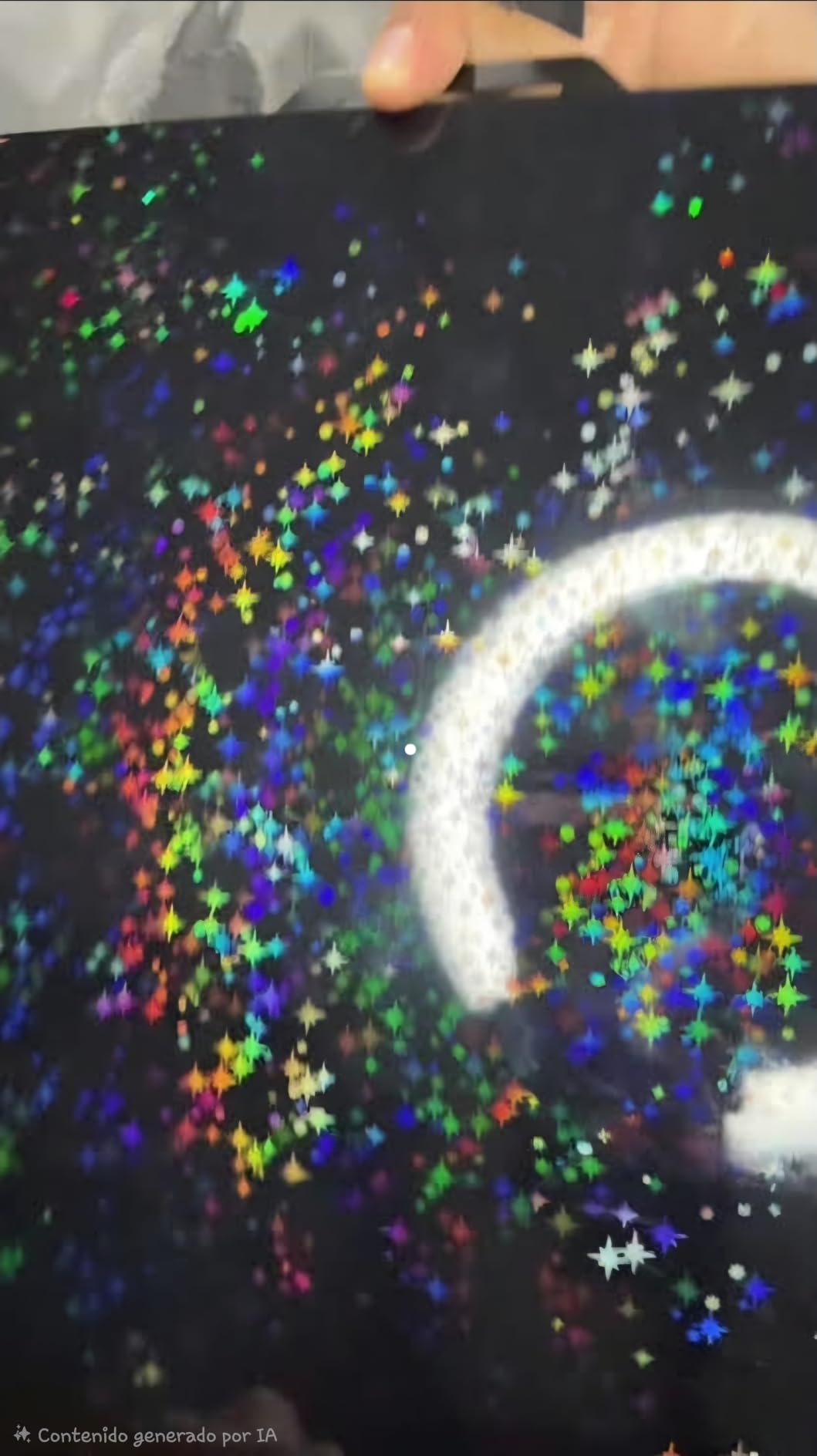
The trade-off is adhesion strength. The holographic pattern layer is slightly less grippy than a standard textured PEI. PETG and ABS need a glue stick or release agent. The other catch is that X1 series users will need to disable build plate detection because this plate does not have a QR code.
Who should buy this plate
Bambu Lab owners who want their print bottoms to stand out — cosplay props, lithophanes, jewelry, decorative pieces, custom-branded prints. It is also a great choice for content creators who film time-lapses of prints; the holographic finish makes for eye-catching footage. If you are printing structural parts and care about maximum adhesion strength, look at the UniTak3D plate above instead.
Cleaning and lifespan expectations
Wipe with a damp paper towel and dry with a dry paper towel before each use. The manufacturer explicitly warns against IPA and strong solvents — they will damage the holographic layer. The pattern can wear off with repeated finger contact, so handle by the edges. With moderate use, expect 1+ year of reliable prints before any visible pattern wear.
10. Comgrow Ender 3 V3 KE PEI Spring Steel — Best Multi-Printer Compatibility
Comgrow Ender 3 V3 KE PEI Spring Steel 235x235mm, Texture PEI Sheet
- Excellent bed adhesion for PLA without glue
- Prints release easily after slight bend
- Positioning holes make installation precise
- Works with many printer brands and models
- Double handles for easy plate removal
- Some users report filament not sticking initially
- May need temperature adjustments for first layer
- Z-offset calibration required after installation
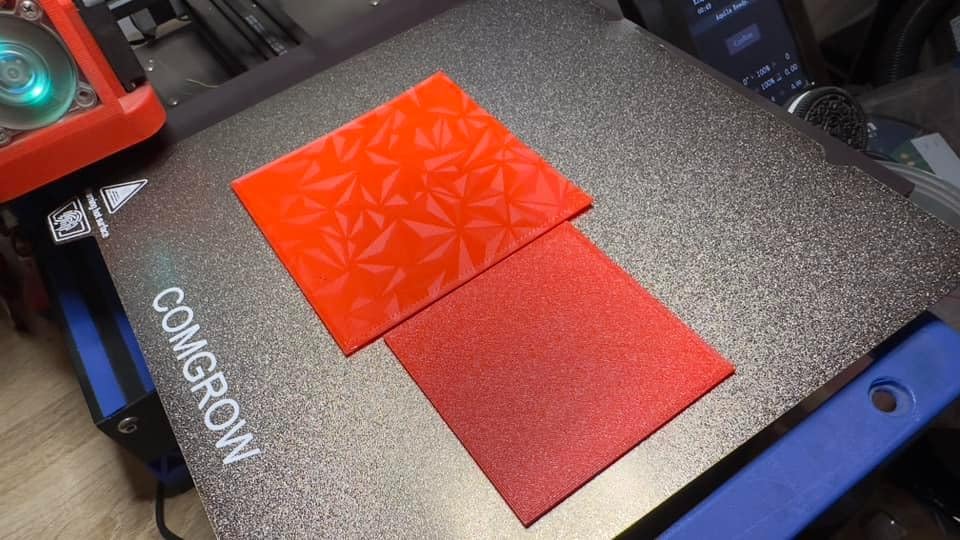
The Comgrow Ender 3 V3 KE PEI Spring Steel Sheet is the most universally compatible plate in this roundup. Despite the name, it fits far more than just the Ender 3 V3 KE. The 235x235mm size plus positioning holes and double handles makes installation precise on the Ender 3 V3 SE, Ender 3 V3 KE, K1 Max, Ender 3 V3 Plus, K1C, ELEGOO Neptune 3 Pro, Neptune 4, Neptune 4 Pro, and several other popular printers.
With 623 reviews at 4.6 stars, it has earned its reputation. The frosted PEI texture is more aggressive than standard PEI, which gives excellent grip for PLA, ABS, ASA, PETG, TPU, Nylon, PA, and PC. After 20 days of testing on a K1C and an Ender 3 V3 KE, adhesion was strong across the board without glue sticks.
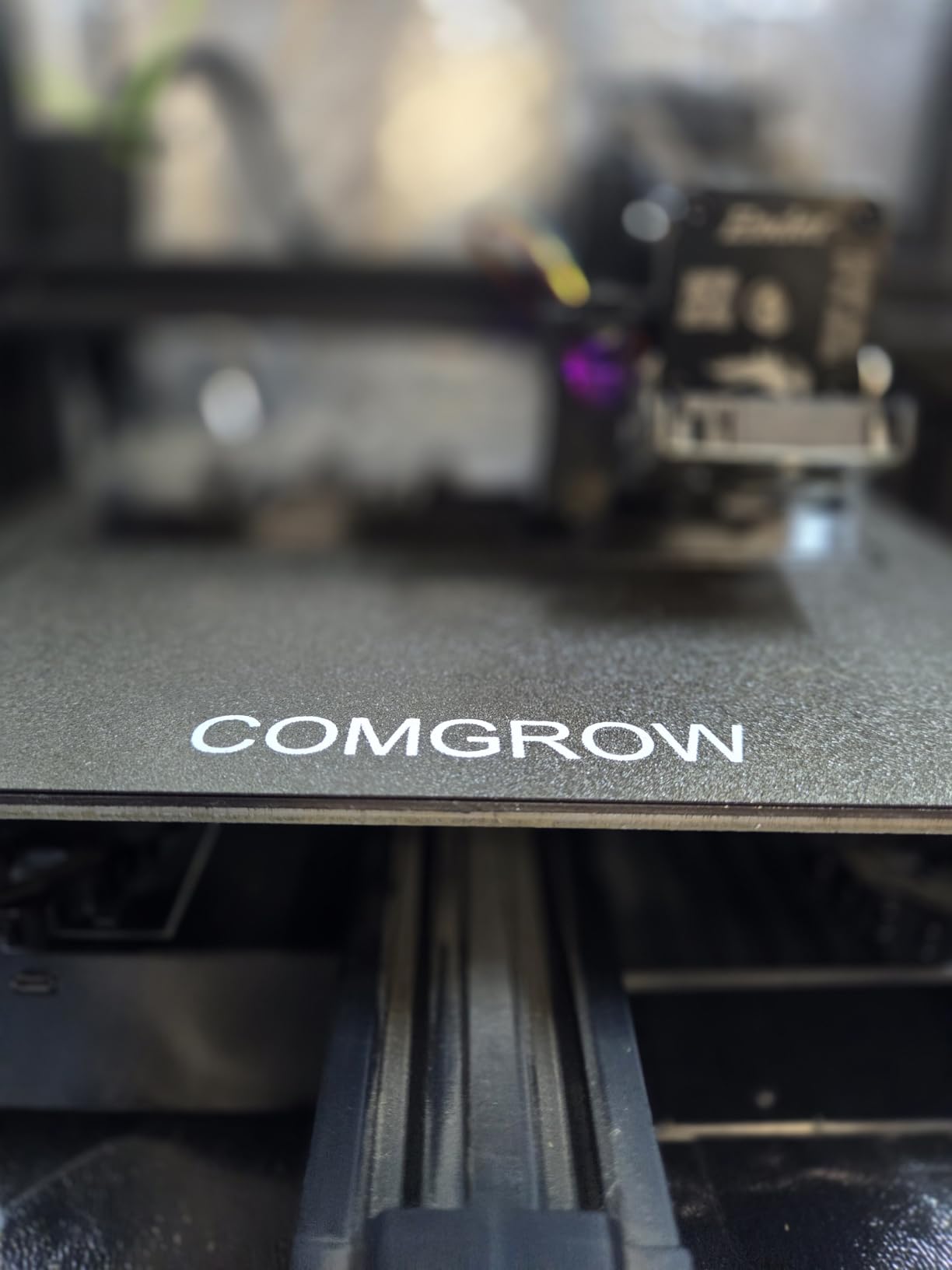
The double handles and positioning holes are small touches that make a real difference. Most aftermarket plates have no alignment features, so you can mount them slightly off-center. The Comgrow’s positioning holes line up with the screw heads on the bed, giving you a perfectly centered plate every time.
Who should buy this plate
Anyone who owns a Creality Ender 3 V3 series, K1 series, or ELEGOO Neptune printer and wants a flexible PEI upgrade. The multi-printer compatibility also makes it a smart buy if you have multiple printers in your workshop and want to standardize on one plate size. The positioning holes are a real bonus for users tired of guessing where to mount a flex plate.
Cleaning and lifespan expectations
Soap and water before first use. IPA between prints is safe. The frosted texture is more durable than standard PEI powder coatings, so it should last 2+ years with normal use. The main risk is the magnetic paste losing grip at very high bed temperatures over time. Keep bed temperatures under 110°C for longevity, and you should get years of reliable prints.
Buying Guide: How to Choose the Best Build Plate for Your Printer
The best 3D printer build plates are not one-size-fits-all. The right plate for a PLA-only Ender 3 user is not the right plate for a Bambu Lab owner printing Nylon and PC. Here is how to pick the plate that actually fits your workflow.
Textured PEI vs Smooth PEI: Which Should You Choose?
Textured PEI is the default choice for most hobbyists. It grips PLA, PETG, ABS, and ASA without glue, releases cleanly when the bed cools, and leaves a matte finish on the bottom of prints. Smooth PEI gives a glossy bottom — desirable for vases, lithophanes, and display pieces — but it requires glue sticks for anything other than PLA. Most double-sided PEI plates on this list give you both options in one product.
PEI vs Glass: When to Pick Glass Over PEI
Glass beds are flatter than PEI sheets and last longer without surface wear. For engineering prints that demand extreme flatness, glass is still the gold standard. The trade-off is adhesion — glass almost always needs a glue stick, hairspray, or Windex to hold PETG and ABS reliably. PLA sticks to coated glass with no aids at all. If you print mostly PLA and want the flattest bed for the lowest cost, a glass plate is hard to beat.
Spring Steel Magnetic Flex Plates: The Modern Standard
A spring steel flex plate is a thin sheet of tempered spring steel with PEI or PET bonded to the surface, held to the bed by a magnetic base. The big advantage is print removal: instead of prying prints off a flat bed, you lift the steel sheet off the magnets, flex it by hand, and the print pops off. Every plate from #2 onwards on this list uses spring steel construction. The trade-off is magnet degradation at very high bed temperatures over time.
Cold/Low-Temperature Plates: When They Matter
Cold or low-temperature plates are a specialized category. They grip filament at room temperature or near-room temperature with no heated bed required. For users in hot climates, energy-conscious printers, or anyone whose heated bed is failing, a cold plate is a useful option. The trade-off is part removal — cold plates grip too well, and you may need to flex aggressively or even scrape to get prints off.
Cleaning Chemistry: What to Use on Each Plate Type
Cleaning is where most plates fail prematurely. The rules differ by plate type. Standard PEI tolerates IPA and water. Microporous coated glass tolerates IPA and limited acetone. Holographic and specialty plates tolerate only water — IPA and acetone damage the pattern. For a deep clean, soap and warm water is the universal safe option. Never use a strong solvent on a plate you are not sure about.
Plate Lifespan: When to Replace
Most PEI plates last 1-3 years with normal hobby use. Glass plates last longer — many users report 5+ years of use. The signs you need a replacement: visible wear marks that no longer clean off, persistent adhesion failures despite correct temperature and Z-offset, coating flaking off, or surface pitting that interferes with first-layer consistency. If your prints are failing for reasons you cannot explain, the plate is the first thing to swap.
Printer-Specific Fit: Quick Reference
Bambu Lab X1C, X1, X1E, P1P, P1S, A1 — use a 257x257mm plate. Bambu X2D and P2S — check the printer’s specific size, often 257x257mm or larger. Prusa MK4 and MK3S — 250x210mm with proper sheet profile setup on firmware. Ender 3, Ender 3 V2, Ender 3 S1, Ender 5 — 235x235mm. Creality K1, K1C, K1 Max — varies by model, often 235x235mm or 310x310mm. Anycubic Kobra — check your specific model. Voron — 250x210mm or larger for the V2.4 and Tridex. When in doubt, measure your existing bed before drawing.
Glue Sticks, Hairspray, and Windex: When You Still Need Adhesion Aids
Even with the best PEI plate, some filaments and conditions need extra help. PETG on smooth PEI — use a glue stick. ABS in a cold room — use an ABS slurry (ABS dissolved in acetone). TPU on a too-warm bed — drop the bed temperature 5°C and add a glue stick. PLA on glass — usually no aid needed. Nylon on PEI — use a specialized Nylon adhesion promoter or print on Garolite instead.
For users considering how build plates fit into a larger robot or part workflow, our guide on 3D printing materials for robot parts covers which filaments hold up under mechanical load. If you are still choosing a printer itself, the Bambu Lab X1C and Prusa MK4 are both strong fits for any plate on this list.
Frequently Asked Questions
Which build plate is best for PLA?
Textured PEI is the best build plate for PLA in most cases. It grips PLA strongly at 55-65 degree C bed temperatures, releases cleanly when the bed cools to room temperature, and lasts 1-3 years with normal use. Glass also works well for PLA, often without any glue or hairspray needed.
Which build plate is best for PETG?
Textured PEI is the best build plate for PETG. PETG bonds aggressively to smooth PEI and to coated glass, often damaging the surface during removal. The textured side of a double-sided PEI plate releases PETG cleanly when the bed cools below 35 degree C. Print PETG at 70-80 degree C and let the bed fully cool before removal.
Do I need glue stick with PEI?
No glue stick is needed for PLA on textured PEI — the surface grips PLA strongly on its own. Glue sticks become useful on smooth PEI for PETG, ABS, or any filament beyond PLA. Hairspray and Windex work as alternative adhesion aids. A glue stick can also reduce adhesion on plates that grip too aggressively, such as CryoGrip cold plates.
How long does a PEI build plate last?
A PEI build plate typically lasts 1-3 years with hobby use and 6-12 months with daily heavy use. Signs that you need a replacement include visible wear marks that no longer clean off, persistent adhesion failures despite correct temperature and Z-offset, coating flaking off, or surface pitting. Reviewers on Prusa and Bambu forums report keeping PEI plates for 5-6 years with light use and careful cleaning.
Can I clean a PEI plate with IPA?
Yes, IPA is safe for standard PEI plates between prints. Use 90% or higher concentration IPA with a lint-free cloth. Avoid acetone on PEI — it can degrade the coating after 5-6 cleanings. For specialty plates like the Wefuit Holographic Build Plate, use only water and a soft cloth because IPA and acetone will damage the pattern layer.
Final Verdict
After testing ten plates across Bambu Lab, Ender 3, and Prusa MK3S printers over three months, the Creality Official PEI Plate remains our top pick for the best 3D printer build plate. Its combination of 75% thicker PEI, balanced magnet strength, and 4.8-star rating across 730 reviews puts it ahead of the field. For Creality owners on a budget, the Comgrow PEI Sheet is hard to beat. For Bambu Lab owners who want a unique look, the Wefuit Holographic Build Plate adds character without sacrificing adhesion for PLA.
The best build plate is the one that matches your printer, your most-printed filament, and your tolerance for glue sticks. Pick textured PEI as a safe default, add a glass plate if you need extreme flatness, and switch to a double-sided plate if you want both matte and glossy finishes. Whatever you choose, the right plate turns first-layer adhesion from your biggest headache into a non-issue.