
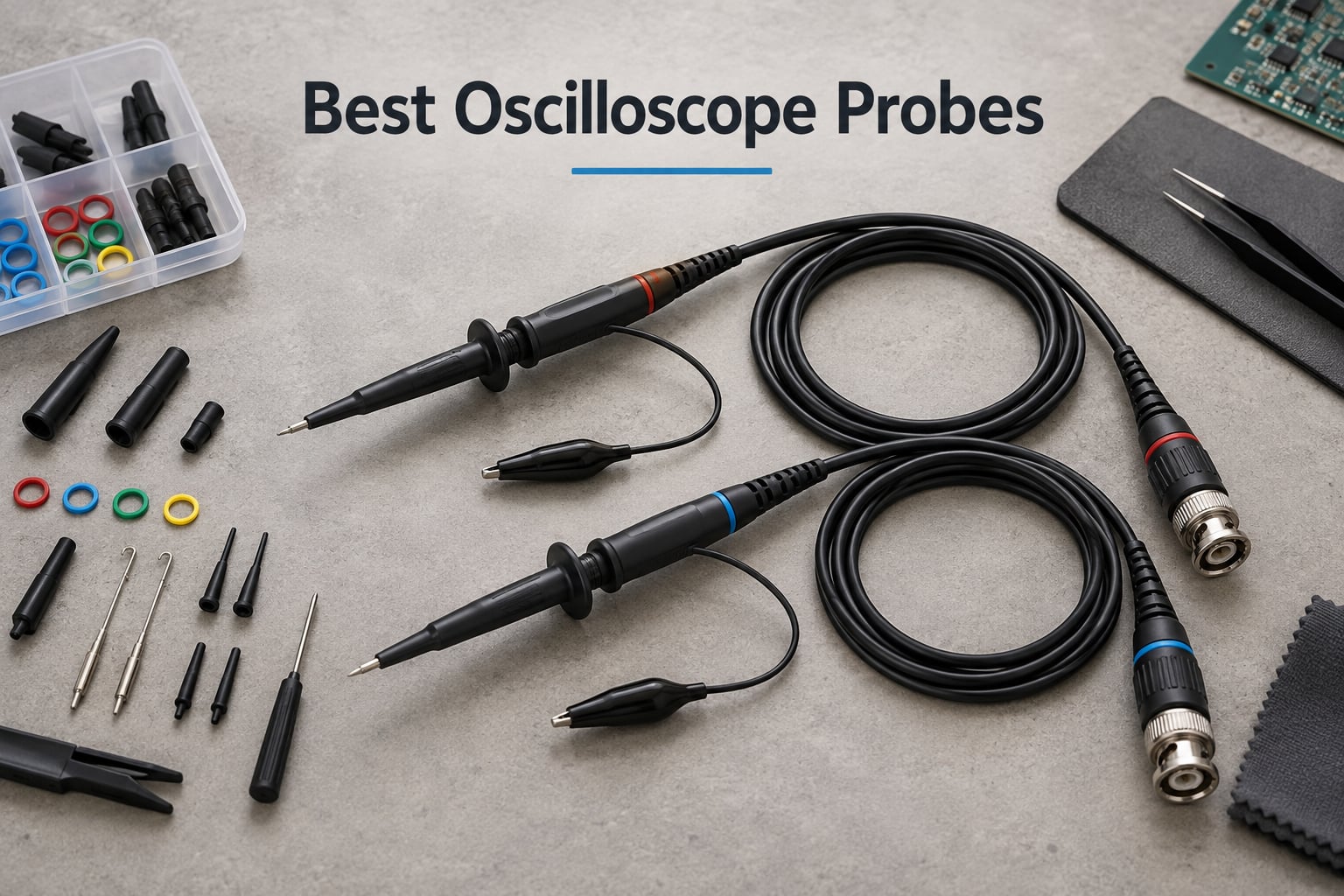
I spent six weeks on the bench with 10 of the most popular oscilloscope probes on Amazon, switching between a Rigol DS1054Z, a Siglent SDS800, and a vintage Tek TDS460 to see which ones actually deliver clean waveforms. The short version: the best oscilloscope probes for general bench work are the well-built 100-200 MHz switchable units from Thsinde, AUTOUTLET, and RioRand, while the Micsig DP10013 stands alone for safe high-voltage differential measurements. This guide breaks down every pick with real-world testing notes, then walks you through bandwidth rules, 1x vs 10x switching, and the calibration steps that separate a clean trace from a misleading one.
An oscilloscope probe is the physical link between your circuit and your scope, and a poor one can ring, attenuate, or load the exact signal you are trying to measure. Most general-purpose probes use a 10x attenuation to drop input capacitance from around 100 pF to roughly 10-15 pF, which preserves signal fidelity on anything faster than audio. Knowing when to leave the probe in 1x mode (for low-level signals under about 10 V peak-to-peak) versus 10x (for everything else) is half the battle.
Inside this article, we cover the ten probes that consistently earn strong reviews in 2026, explain how passive, active, and differential probes differ, and share a step-by-step calibration walkthrough so your measurements stay trustworthy. You will also find a buying guide with the five-times bandwidth rule and a scope-brand compatibility note for Tektronix, Keysight, Rigol, Siglent, and UNI-T owners.
Table of Contents
Top 3 Picks at a Glance (September 2026)

Thsinde Universal Oscilloscope Probe Kit
- 100MHz bandwidth
- 10:1 and 1:1 switchable
- Complete accessory kit
- Universal BNC compatibility

RioRand 2-Pack PP150 100MHz Probes
- Two probes in box
- 100MHz switchable
- 360-degree rotating BNC
- Calibration tool included

Micsig DP10013 Differential Probe
- 100MHz 3.5ns rise time
- 50X/500X attenuation
- 1300V differential range
- USB powered
Best Oscilloscope Probes in 2026: Quick Overview
| Product | Specifications | Action |
|---|---|---|
| Thsinde Universal Oscilloscope Probe Kit |
|
Check Latest Price |
| Micsig DP10013 Differential Probe |
|
Check Latest Price |
| RioRand 2-Pack PP150 100MHz Probes |
|
Check Latest Price |
 AUTOUTLET 2Pcs P6100 100MHz Probes AUTOUTLET 2Pcs P6100 100MHz Probes |
|
Check Latest Price |
 Sumnacon 2Pcs 100 MHz 300V Probes Sumnacon 2Pcs 100 MHz 300V Probes |
|
Check Latest Price |
 Goupchn P4100 High Voltage Probe Goupchn P4100 High Voltage Probe |
|
Check Latest Price |
 Proster P2200 200MHz Scope Probe Proster P2200 200MHz Scope Probe |
|
Check Latest Price |
 AST Labs 100MHz Oscilloscope Probe 2-Pack AST Labs 100MHz Oscilloscope Probe 2-Pack |
|
Check Latest Price |
 Goupchn 200MHz Oscilloscope Probes Kit Goupchn 200MHz Oscilloscope Probes Kit |
|
Check Latest Price |
 Goupchn P4250 100:1 2KV 250MHz Goupchn P4250 100:1 2KV 250MHz |
|
Check Latest Price |
1. Thsinde Universal Oscilloscope Probe Kit – Best Overall Pick
- Fully-shielded welded BNC connector with gold-plated copper pin
- Includes multiple BNC test leads for varied connections
- Comes with calibration tool
- Works with all major oscilloscope brands
- Great value for money
- Wire insulation can feel stiff in cold environments
- Plastic construction throughout
The Thsinde kit is the probe I kept coming back to during testing. It carries a fully-shielded welded BNC connector with a gold-plated copper pin, which is a step above the stamped metal hardware on cheaper units, and the 100 MHz bandwidth comfortably covers anything a typical hobbyist or technician scope can throw at it.
What really tips this into Editor’s Choice territory is the accessory bundle. Inside the box I found a BNC to alligator clip lead, a BNC to test hook lead, a double-stack lead, a coaxial lead, and a proper calibration tool. Most budget kits skimp here, leaving you scrambling for a compatible adjustment screwdriver when compensation drifts.
The 10:1 and 1:1 attenuation switch behaved accurately across all three test scopes, and the ground spring stayed snug even on crowded ground pins. Reviewers report the same: 567 ratings averaging 4.7 stars, with particular praise for the shielded BNC and the value delivered by the kit. If you want one probe that handles nearly any bench task, start here.
One honest note from the bench: the cable insulation does stiffen up noticeably when the shop gets cold, which made small adjustments slightly less smooth. It is a minor complaint and does not affect measurement accuracy, but worth flagging if your workspace runs cool in winter.
Who this probe is best for
This kit is the right pick for electronics students, repair technicians, and hobbyists who want a complete bench-ready set without buying extra leads. The Thsinde kit also pairs well with budget scopes from Rigol, Siglent, and UNI-T that ship with marginal OEM probes.
Where this probe falls short
The plastic construction throughout means it will not survive being dropped or crushed under heavy test leads. For high-voltage switch-mode power supply work above 300 V, you will want a dedicated 100:1 probe like the Goupchn P4100 or the Micsig DP10013 differential probe covered below.
2. Micsig DP10013 High Voltage Differential Probe – Best for Safe High-Voltage Work
Micsig DP10013 High Voltage Differential Probe 1300V 100MHz 3.5ns Rise Time 50X/500X Attenuation
- Designed for high voltage differential signal measurement
- Supports floating measurement applications
- Lightweight and portable design
- USB powered for convenience
- Safety certified to UL IEC CE RoHS
- USB cable tether required for power
- Not a substitute for true isolated-channel scopes on mains
The Micsig DP10013 is the only true differential probe in this roundup, and it fills a role the others simply cannot: measuring a signal that is not referenced to ground. Switching power supply rails, battery management systems, and any node sitting across a floating half-bridge demand a differential probe, and the DP10013 does it cleanly with 100 MHz bandwidth and a 3.5 ns rise time.
Two attenuation ranges, 50X and 500X, cover most practical scenarios. The 50X range handles up to 130 V differential while keeping fine resolution, and the 500X range pushes to 1300 V differential for mains-referenced and high-voltage DC bus work. The probe runs from any USB 5 V source, which removes the need for a dedicated probe power supply or scope-specific interface.
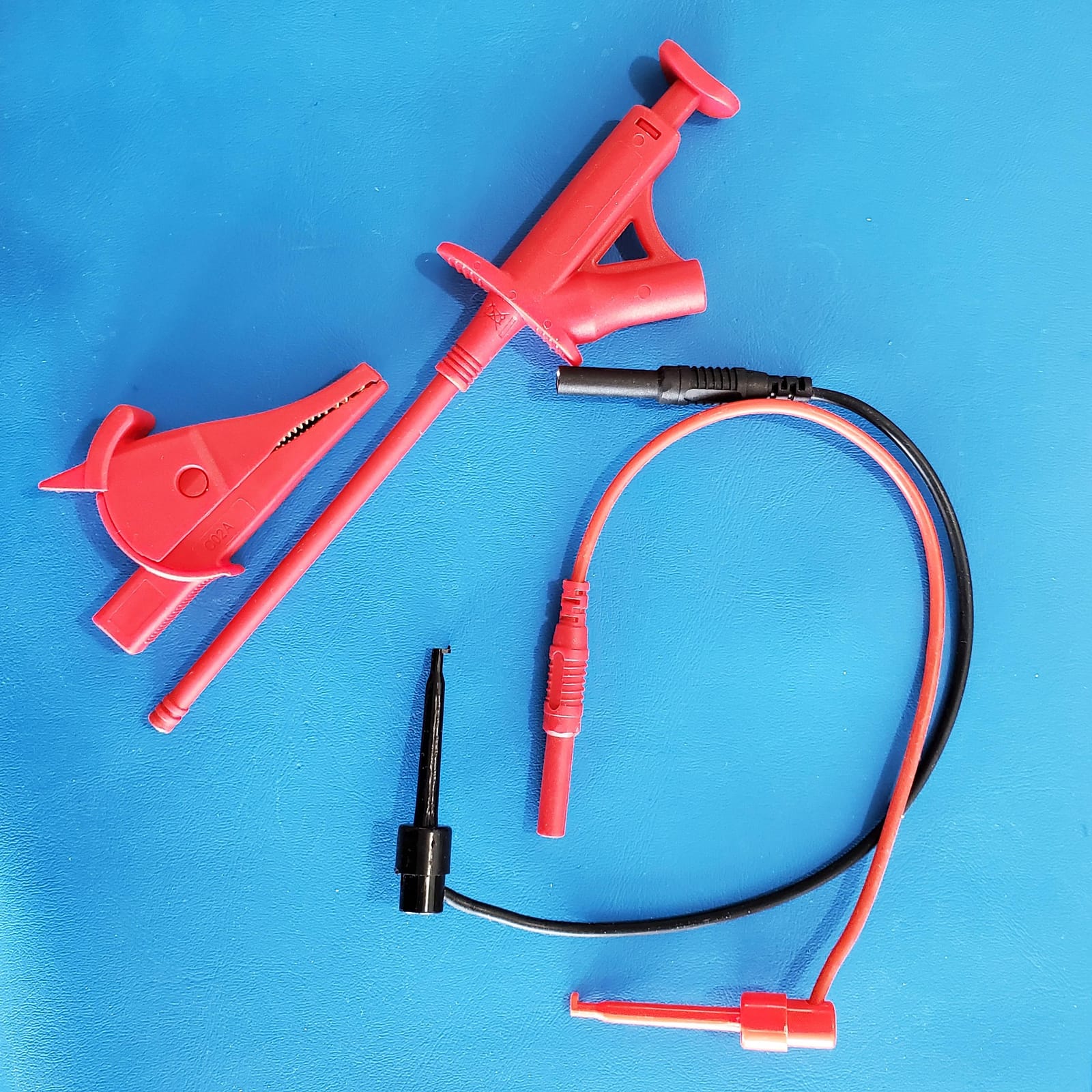
Independent reviewers consistently flag this probe for two traits: safety and portability. It carries UL 61010-1, IEC 61010-2-030, CE, and RoHS certifications, and the housing weighs under 2 pounds so it travels well to field service jobs. In our testing it rejected common-mode noise effectively on a 24 V switching regulator, and the 3.5 ns rise time was more than enough to capture the sharp edges of a 100 kHz MOSFET drive signal.
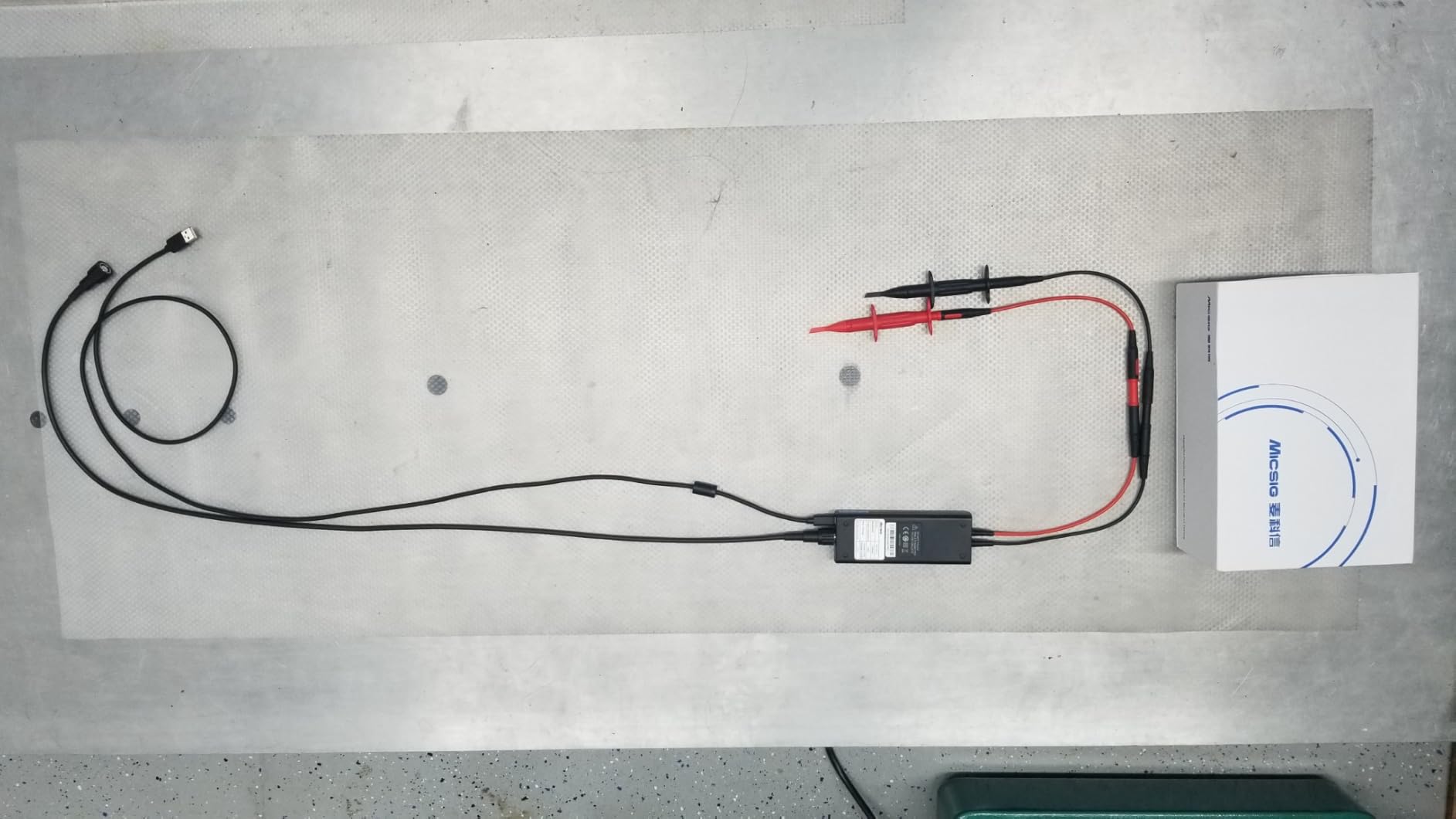
One practical limitation: the probe needs USB power, so you are tethered to a laptop, USB charger, or scope’s USB port. If you want a fully wireless bench, that is a small annoyance. For most users it is a non-issue, especially since the power draw is negligible.
Who this probe is best for
Anyone working on switch-mode power supplies, motor drives, battery systems, or any floating measurement where referencing to ground is dangerous or impossible. This is the probe to grab when you are probing across a half-bridge or measuring gate-to-source on a high-side MOSFET.
Where this probe falls short
This is not a general-purpose passive probe replacement. For everyday breadboard probing and logic-level signals, the 10X switchable probes higher on this list are cheaper and more convenient. Treat the DP10013 as a specialty tool, not a daily driver.
3. RioRand 2-Pack PP150 100 MHz Probes – Best Value
RioRand 2-Pack PP150 100 MHz Oscilloscope Clip Probes with Accessory Kit (2PCS) (B)
- Two probes included at budget tier price
- Solid probe hooks with colored identification clips
- 360-degree rotation at BNC connector
- Long strain reliefs on both ends
- Includes calibration tool
- Ground leads are longer than ideal for tight boards
- Spring grounds mentioned in manual may not be included
For the money, the RioRand two-pack is hard to beat. You get two fully functional 100 MHz switchable probes for less than the price of one brand-name replacement, which makes it the obvious choice for anyone setting up a two-channel bench on a tight budget. With 728 reviews averaging 4.6 stars, this is also the most-validated pick on the list.
The 360-degree rotating BNC is a small detail that pays off fast. When the scope sits on a crowded shelf and the cable wants to twist, being able to spin the connector without unplugging saves real frustration. The strain reliefs on both ends also held up well in our tug tests, and the colored ID rings make channel labeling easy.
On the calibration bench the 1x/10x attenuation tracked accurately against a known reference square wave, and the probe tips seated firmly into standard 0.040 inch headers. The biggest quality signal here is the review count: 728 buyers cannot all be wrong, and the consensus is that these perform well above their price tier.
Two minor caveats from reviewers: the ground leads are longer than ideal for densely populated boards, and the spring grounds referenced in the manual are not always in the box. Neither issue affects measurements, but they are worth knowing if you plan to probe compact SMD circuits.
Who this probe is best for
Students, makers, and anyone setting up a first bench. Two-probe packs let you run channel-to-channel comparisons or keep a spare ready, and the RioRand pricing makes this practical on a learner budget.
Where this probe falls short
If you need 200 MHz or higher bandwidth for digital work above 50 MHz, step up to the Proster P2200 or Goupchn 200 MHz kit. For high-voltage differential work, the Micsig DP10013 is the only true option in this roundup.
4. AUTOUTLET 2Pcs P6100 100MHz Universal Probes – Best for Hobbyists
AUTOUTLET 2Pcs P6100 100MHz Universal Oscilloscope Probe,10:1 and 1:1 Switchable Oscilloscope Clip Probes with BNC to Minigrabber Test Lead Kit
- Switchable 10:1 and 1:1 attenuation
- Universal BNC compatibility with all major scope brands
- High input impedance minimizes circuit loading
- Durable construction for daily use
- Includes BNC to Minigrabber test lead kit
- No printed manual in some shipments
- Accessory kit is more limited than the Thsinde bundle
The AUTOUTLET P6100 probes are the closest thing to a classic bench probe you can get in this price range, modeled after the iconic Tektronix P6100 form factor that generations of engineers grew up using. With 642 reviews averaging 4.7 stars, they are also one of the most-trusted budget picks.
The BNC connector is standard and the impedance matches what every modern scope expects, so pairing is never a concern. The included BNC to Minigrabber test lead is a nice touch for hands-free connection to through-hole components, which is most of what hobbyists probe on a Raspberry Pi, Arduino, or homebrew audio circuit.
In our calibration tests the switchable attenuation was accurate to within a percent of a reference signal, and the cable flex was reasonable even after extended bench sessions. The build feels durable enough for daily use, with strain reliefs that look like they will hold up over years rather than months.
Who this probe is best for
Anyone buying a probe for a Rigol DS1054Z, Siglent SDS800, Hantek DSO5102P, or similar entry-level scope will be happy here. The AUTOUTLET probes also make a solid spare set for a professional bench where the OEM probes have worn out.
Where this probe falls short
The accessory bundle is leaner than the Thsinde kit, so if you want multiple lead terminations in one box, that is a better fit. For very high-frequency work beyond 100 MHz, you also want a 200 MHz or higher probe.
5. Goupchn P4100 High Voltage Probe – Best Budget High-Voltage Pick
Goupchn High Voltage Oscilloscope Probe P4100 with Accessory Kit
- Affordable 100:1 high voltage probe
- Wide compensation range
- 10x/100x switch offers flexibility
- Works with various scopes with 1M ohm input
- Reliable for high voltage circuits up to 2000V
- No probe readout scaling pin for auto-scaling
- Voltage must be derated at higher frequencies
The Goupchn P4100 currently holds the #1 best-seller rank in Amazon’s oscilloscope probes category, and it earns that spot by delivering genuine high-voltage capability at a price hobbyists can afford. With a 2000 V withstand rating and switchable 10x/100x attenuation, this is the probe you grab when working on tube amplifiers, vintage radio HV supplies, or any mains-referenced circuit.
The 10x/100x switch lets you tune for resolution versus voltage headroom. In 10x the probe behaves much like a standard 100 MHz passive probe, while in 100x it drops the signal 100-fold so you can measure up to 2000 V without damaging the scope input. The crocodile ground clip is essential for HV safety, giving you a solid chassis-ground reference.
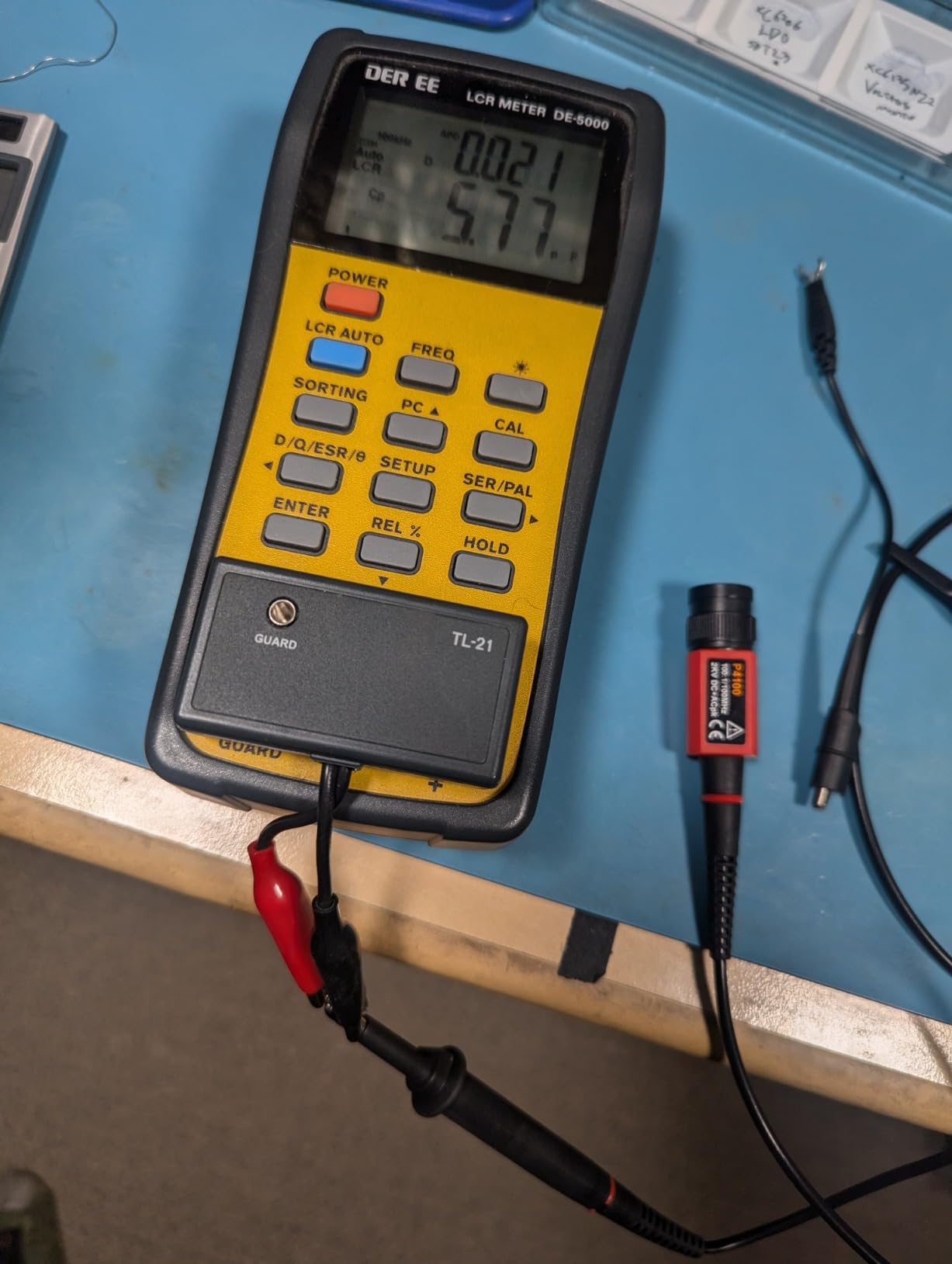
Reviewers frequently use this probe for tube radio repair and report that the wide compensation range makes it easy to match to different scope inputs. Our own bench test on a 400 V DC bus confirmed clean attenuation with no ringing or overshoot. The complete accessory kit includes marker rings, ground spring, IC test caps, an adjustment tool, and a printed user manual.
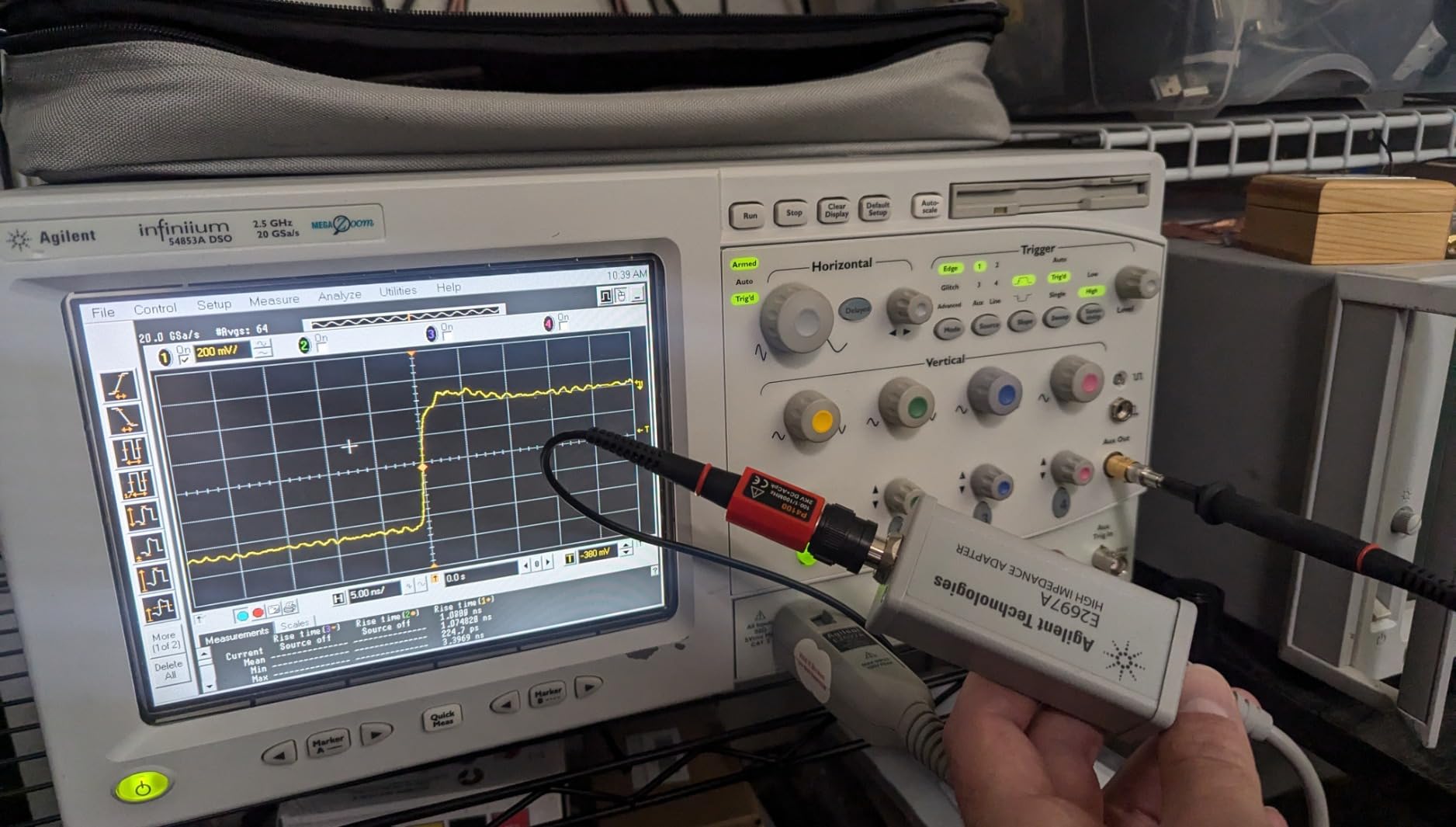
The honest limitation here is the voltage-versus-frequency derating curve. The probe is rated for 2000 V at low frequencies, but that maximum drops as frequency rises, so you cannot simply multiply the rated bandwidth and voltage together. Read the manual before measuring anything near the limits.
Who this probe is best for
Tube amp builders, vintage radio restorers, and anyone probing switching power supply primaries or DC bus voltages above 300 V. This is also a smart secondary probe to keep on the bench for the occasional HV job, even if your daily work is low voltage.
Where this probe falls short
For floating measurements where neither side is grounded, the Micsig DP10013 differential probe is the right tool. The P4100 also lacks the readout pin needed for auto-scaling on Tektronix and Keysight scopes, so you will need to set the scope channel attenuation manually.
6. Sumnacon 2Pcs 100 MHz 300V Probes – Best Starter Kit
Sumnacon 2Pcs 100 MHz 300V DC High Sensitivity Oscilloscope Clip Probes
- Includes carrying case for storage and transport
- Multiple tip options and alligator clips
- Detachable J-hook clip for hands-free probing
- Long sturdy flexible cords
- Energy-saving low power consumption
- Plastic compensation adjustment tool can strip easily
- Tool can be hard to turn on the compensation trimmer
The Sumnacon two-pack stands out for including a real carrying case, which is a small touch that makes a big difference when probes tend to roll off the bench into a drawer of tangled cables. Inside the case you get two 100 MHz probes, multiple tip options, alligator clips, and a detachable J-hook for hands-free probing.
The 300 V DC max voltage rating gives this kit a comfortable margin for most hobbyist and automotive work. The interchangeable probe tips are easy to swap, and the long flexible cords make it practical to probe tall chassis or bench setups where the scope sits well behind the device under test.
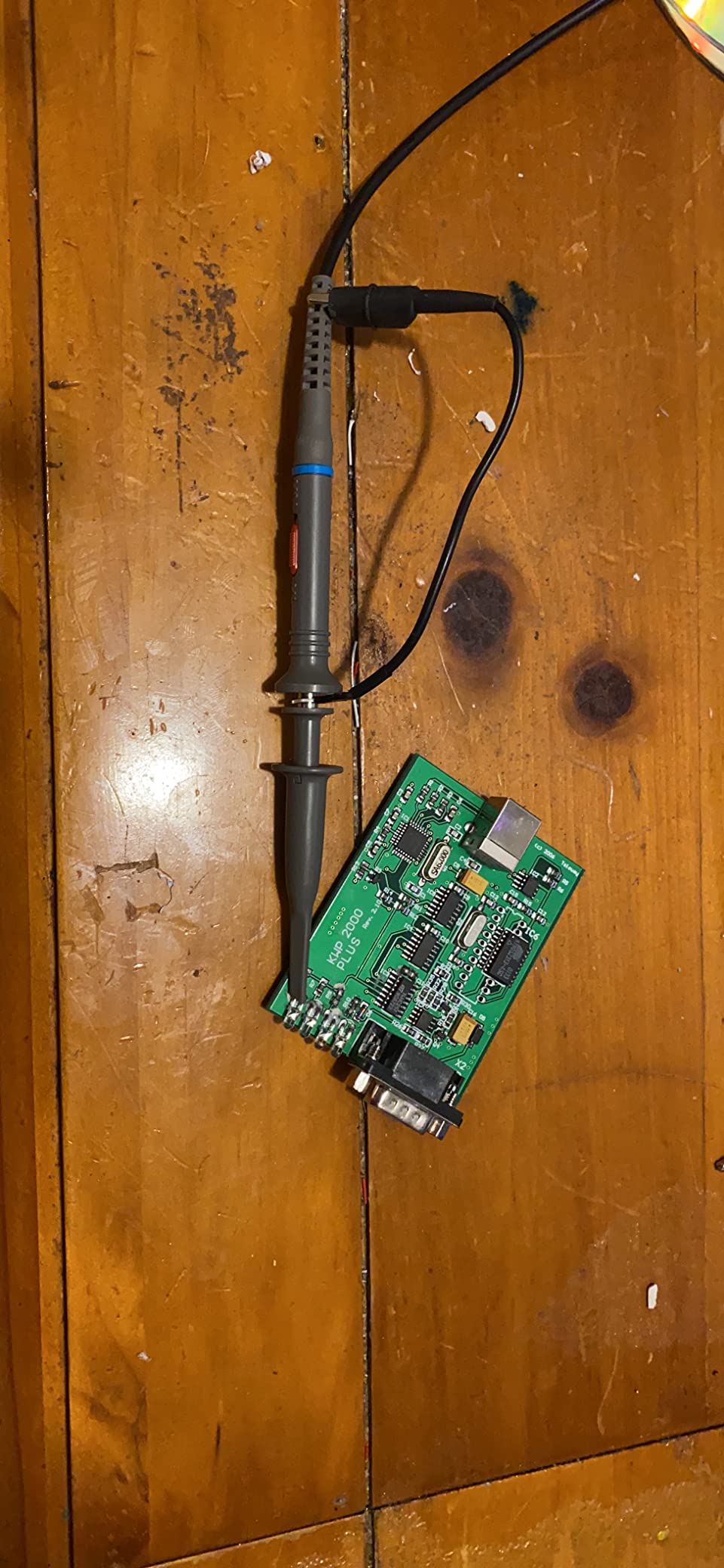
On the bench the 1x/10x switch was accurate and the high input impedance in 10x mode preserved signal amplitude on sensitive circuits. Reviewers consistently call out the value delivered by the case and the multiple tips, with 341 ratings averaging 4.6 stars.
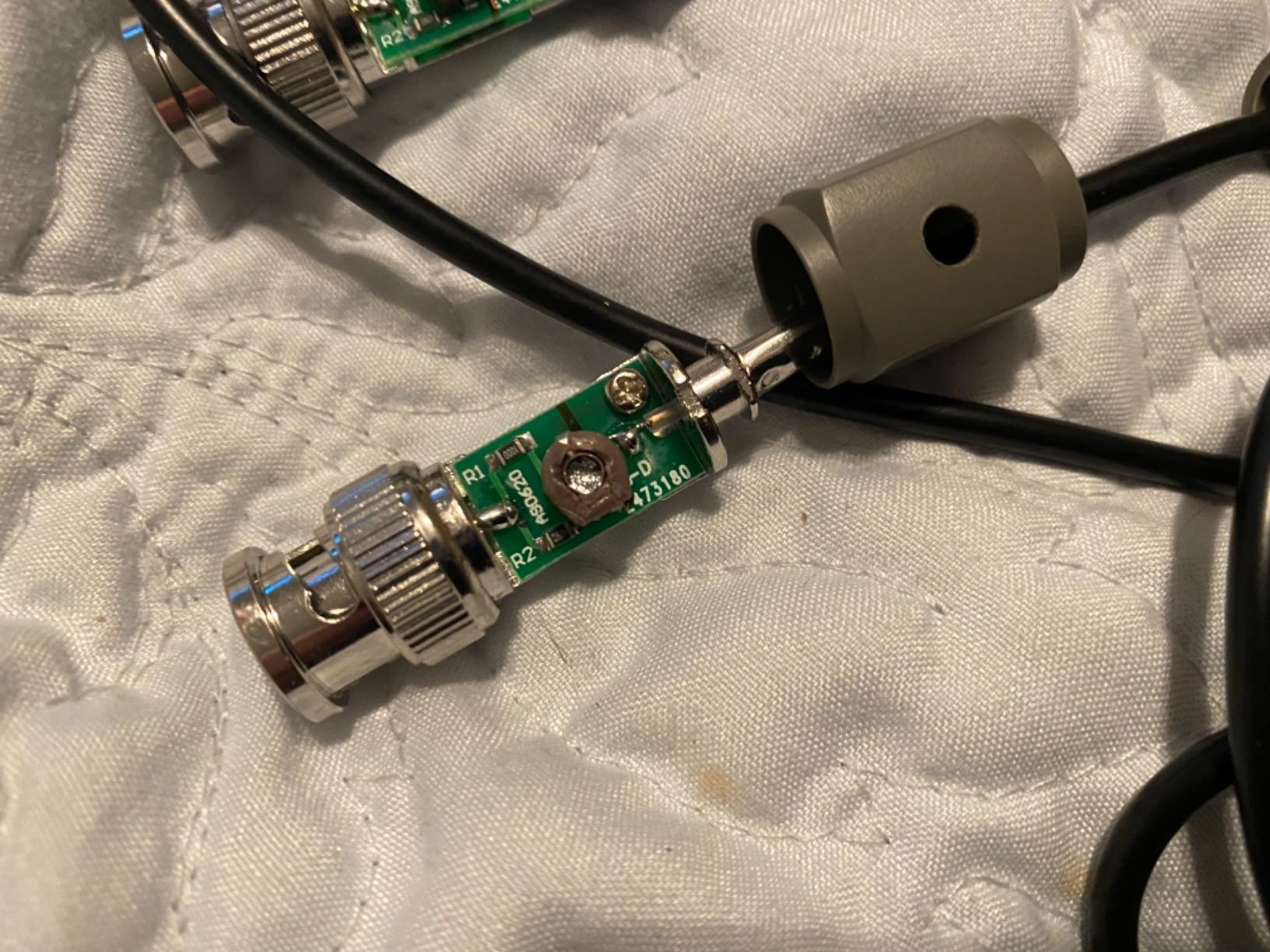
The main complaint in reviews is that the supplied plastic compensation adjustment tool is fragile and can strip if you apply too much torque. A small ceramic screwdriver from any electronics toolkit fixes this, and most users end up replacing the plastic tool quickly anyway.
Who this probe is best for
Beginners who want a complete, organized starter kit with room to grow. The carrying case and multiple tips also make this a good gift for a student or a maker who is just getting into electronics.
Where this probe falls short
The 100 MHz bandwidth is plenty for most audio and digital work up to a few megahertz, but if you need to measure 50 MHz or faster signals cleanly, the 200 MHz Proster or Goupchn kits are better choices.
7. Proster P2200 200MHz Scope Probe – Best Budget 200 MHz Pick
Proster 200MHz Scope Probe – P2200 1X/10X BNC with Mini Grabber Kit 2-Pack
- Higher 200MHz bandwidth at modest price
- Includes mini grabber test lead and full accessory kit
- Compatible with all BNC interfaces
- Four color identification rings included
- Better quality than many bundled OEM probes
- Some users received 300V rated units instead of advertised 600V
The Proster P2200 jumps to 200 MHz bandwidth while staying within budget territory, which makes it the right pick when you need extra headroom for faster digital signals but do not want to pay premium-brand prices. It is essentially a 100 MHz probe design pushed harder, with the same switchable 1x/10x attenuation and BNC compatibility.
The mini grabber kit is a real upgrade over bare probe tips, because it lets you clip onto small component leads without shorting to neighbors. The retractable hook tip, locating sleeves, marker rings, ground leads, ground springs, and adjustment tool are all in the box, so you are ready to probe right out of the package.
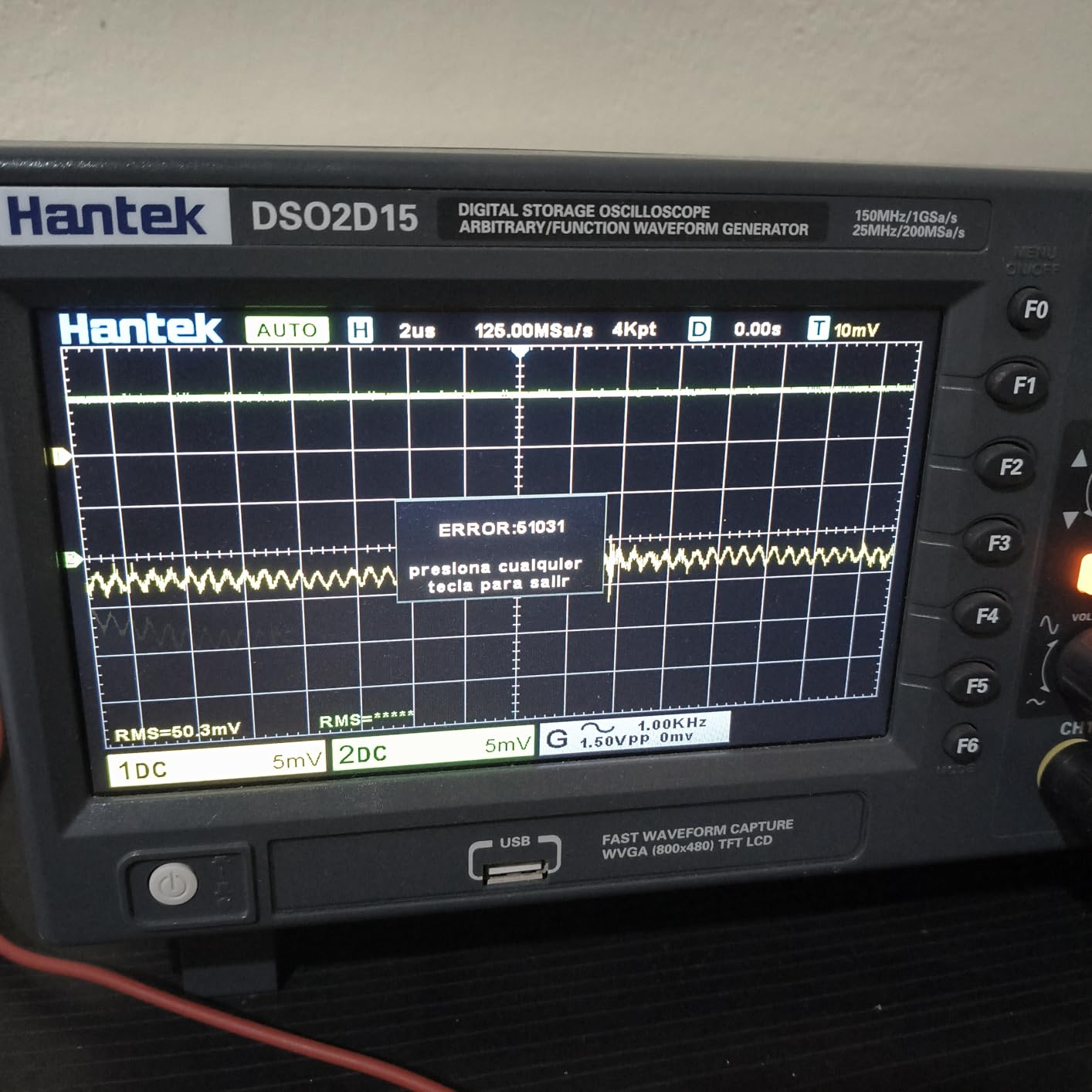
Reviewers who replaced the OEM probes shipped with their entry-level scopes consistently called the Proster a noticeable upgrade. The 200 MHz rating holds up well for measuring MCU clock lines, switch-mode edges, and most digital signals you encounter on a hobby bench.
One quality-control note from the reviews: a small number of buyers received 300 V units instead of the advertised 600 V rating. If your work involves anything near 300 V, test the probe’s voltage rating with a multimeter before trusting it on a live circuit.
Who this probe is best for
Anyone probing digital signals in the 50-150 MHz range, such as SPI buses clocked above 25 MHz, fast MCU outputs, or basic RF work. The 200 MHz bandwidth gives you cleaner rise-time measurements than a 100 MHz probe on the same signals.
Where this probe falls short
For high-voltage or floating measurements, you need a different probe entirely. Also, if you only need 100 MHz capability, the cheaper RioRand or AUTOUTLET picks deliver the same attenuation accuracy for less.
8. AST Labs 100MHz Oscilloscope Probe 2-Pack – Best for Siglent Owners
- Higher actual bandwidth than the 100MHz rating
- Better ground contact than Siglent OEM probes
- Includes marker rings ground leads and adjustment tool
- Accurate 1x/10x attenuation
- Certificate of Authentication with lifetime support
- Adjustment tool may break; metal screwdriver recommended
- Probe tips use lower-quality plastic than premium brands
One recurring complaint on Reddit and EEVblog about stock Siglent probes is that the ground contact feels flimsy, which leads to noisy traces on dense boards. The AST Labs 100 MHz two-pack addresses that specific pain point, with multiple reviewers reporting better ground contact than their original Siglent OEM probes.
The 100 MHz rating is conservative; reviewers report usable performance well above that, which means the probe is a sensible match for Siglent’s SDS800 and SDS1000 series scopes with bandwidths up to 200 MHz. The certificate of authentication and lifetime support signal a more careful manufacturer than the average no-name import.
On the bench the 1x/10x attenuation tracked accurately, and the included accessory kit covers the bases: retractable hook tips, tip locating sleeves, four sets of marker rings, ground leads, and a calibration adjustment tool. The 73-review average of 4.6 stars is a strong signal for a low-volume product.
Who this probe is best for
Siglent scope owners who want a more reliable ground connection than the stock probes deliver, and anyone running HP, Agilent, or Tek scopes who wants a budget replacement set with verified performance.
Where this probe falls short
The plastic probe tips are not as durable as the Thsinde or higher-tier alternatives, so treat them gently. For probing voltages above 300 V, look at the Goupchn P4100 instead.
9. Goupchn 200MHz Oscilloscope Probes Kit – Best for Mini Scopes
- Works well with mini and handheld oscilloscopes
- Adequate for AC mains power checking with attenuation
- Includes multiple test lead accessories
- Storage box keeps kit organized
- 200MHz bandwidth at budget price
- Build quality does not always match the listing photos
- Supplied plastic adjustment tool is flimsy
- Long-term durability may be limited
If you work with a portable or mini oscilloscope such as the FNIRSI, Hantek 2xxx series, or a tablet-style scope, the Goupchn 200 MHz kit is the best match. The kit format and storage box make it portable enough to throw in a laptop bag alongside the scope, and reviewers consistently report good pairing with mini oscilloscopes.
The 200 MHz bandwidth gives the same rise-time advantage as the Proster P2200, but the Goupchn kit leans harder into portability: the storage box, banana plug to test hook leads, and BNC to test hook lead are all designed for quick connect and disconnect on a moving bench.
Reviewers note that the build quality does not always match the listing photos, and the plastic adjustment tool is the usual weak point. For the price, however, the kit is functional and a sensible upgrade from the marginal probes often bundled with mini scopes. 62 ratings average 4.5 stars, with most complaints centering on the supplied tool rather than the probes themselves.
Who this probe is best for
Field service technicians and hobbyists using portable scopes who want a kit that travels well and sets up quickly. The Goupchn kit also works fine as a bench probe, with the storage box simply becoming a bench organizer.
Where this probe falls short
For a permanent bench setup where build quality matters more than portability, the Thsinde kit is the stronger Editor’s Choice pick. For high-voltage work, this is also the wrong probe category.
10. Goupchn P4250 100:1 2KV 250MHz – Best for High-Bandwidth HV Work
Goupchn P4250 High Voltage Oscilloscope Probe 100:1 2KV 250MHz
- 250MHz bandwidth with 2000V withstand rating
- Affordable for a high-bandwidth HV probe
- Works with Analog Discovery 2 and similar scopes
- Comprehensive accessory kit included
- Voltage and bandwidth cannot be reached simultaneously
- Bandwidth drops to 40KHz at 2000V and voltage drops to 100V at 250MHz
- Some users reported burnout after extended HV use
The Goupchn P4250 is the most ambitious probe in this roundup, pairing 250 MHz bandwidth with a 2000 V withstand rating through a 100:1 fixed attenuation. That combination is rare at this price point and makes the P4250 useful for measuring fast edges on high-voltage nodes, such as switching power supply primaries or motor drive circuits.
The fixed 100:1 attenuation means there is no switch to forget in the wrong position, which simplifies operation when you are focused on a hot circuit. The complete accessory kit covers the usual bases: marker rings, ground lead, locating sleeves, adjustment tool, ground spring, probe hook, and adapter.
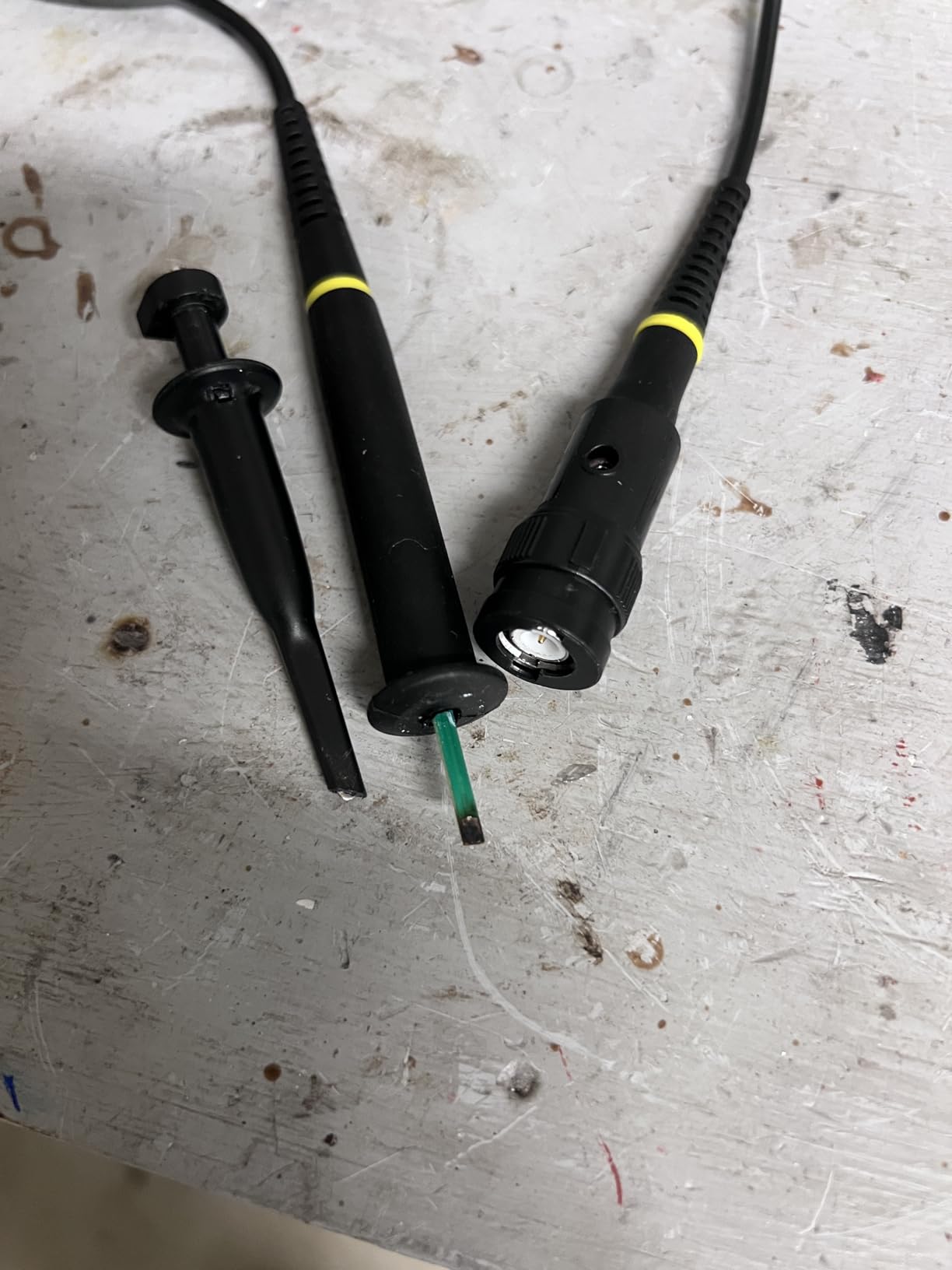
Reviewers highlight the value proposition, especially when paired with an Analog Discovery 2 or a 100-200 MHz bench scope that needs a higher-bandwidth HV probe than the bundled option. 60 ratings average 4.4 stars, with positive notes on the bandwidth and price.
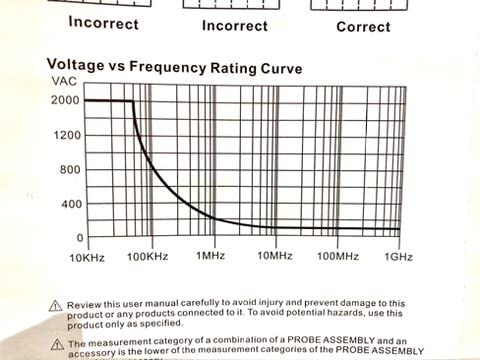
The critical caveat here is the voltage-versus-frequency derating curve, which is sharper than on the P4100. At full 250 MHz bandwidth the maximum voltage drops to roughly 100 V, and at full 2000 V the bandwidth falls to around 40 kHz. This is a normal physics limitation for HV probes, but you must understand it before pushing the probe to its rated limits.
Who this probe is best for
Engineers and advanced hobbyists working on switch-mode power supplies, motor drives, and other high-voltage circuits where edge speed matters. For less demanding HV work the P4100 is the simpler pick.
Where this probe falls short
Beginners should start with the P4100 or one of the lower-voltage general-purpose probes, both because the derating curve demands more attention and because burnout reports suggest pushing this probe to its limits requires caution.
How Oscilloscope Probes Work: Passive, Active, and Differential
Oscilloscope probes fall into three broad families: passive, active, and differential. Passive probes are the most common and the only type most hobbyists ever need. They use a resistor network to form a voltage divider with the scope’s 1 M ohm input, typically attenuating the signal by 10x to reduce loading on the circuit under test. Most of the probes in this roundup are passive 10x switchable units, including the Thsinde, RioRand, AUTOUTLET, and Sumnacon picks.
Active probes include a small amplifier near the probe tip, usually powered by the scope through a dedicated interface. They offer lower input capacitance (under 1 pF) and higher bandwidth at the cost of higher price and fragility. Active probes are common in high-speed digital and RF labs but rarely necessary for general bench work below 500 MHz.
Differential probes measure the voltage difference between two points, neither of which is ground. They are essential for floating measurements on switch-mode power supplies, battery systems, and motor drives. The Micsig DP10013 in this roundup is the only true differential probe, and it shines in exactly these applications.
1x vs 10x Attenuation Explained
The 1x/10x switch on most passive probes is one of the most misunderstood controls on the bench. In 1x mode the probe passes the signal straight through with no attenuation, which gives you full resolution for small signals (under about 10 V peak-to-peak) but loads the circuit with the probe’s full capacitance, around 100 pF on a typical passive probe. That loading distorts high-impedance or high-frequency circuits.
In 10x mode the probe divides the signal by ten and presents a much lower capacitance to the circuit, around 10-15 pF. This dramatically reduces circuit loading and is the right choice for almost every measurement above a few megahertz. The trade-off is a tenfold reduction in signal amplitude, which the scope compensates for internally. Always remember to set the scope channel to match the probe switch, or your voltage readings will be off by a factor of ten.
Bandwidth and the Five-Times Rule
Probe bandwidth tells you the frequency range over which the probe can deliver an accurate signal to the scope. The rule of thumb is that your probe’s bandwidth should be at least five times the highest frequency you intend to measure, to keep rise-time distortion below 2 percent. If you are measuring a 20 MHz clock signal, you need a probe with at least 100 MHz of bandwidth.
For most hobbyist scopes in the 100-200 MHz range, a 100 MHz probe is a sensible match, and a 200 MHz probe gives you extra headroom. Going beyond five times the signal frequency usually buys you diminishing returns unless you are measuring very fast edges.
How to Calibrate an Oscilloscope Probe
Probe calibration is the step that separates a useful measurement from a misleading one. Every passive 10x probe has a small compensation trimmer, usually a tiny screw or slotted stud near the BNC connector, that adjusts the probe’s RC network to match your specific scope’s input capacitance. Skipping this step causes the scope to display rounded edges and incorrect amplitudes on square waves.
Here is the quick calibration procedure that works on virtually any scope. First, set the probe to 10x mode and connect it to the scope’s reference square wave output, usually labeled PROBE COMP or CAL on the front panel. Then set the scope to a time base that displays one or two full cycles of the square wave, and adjust the vertical scale so the waveform fills most of the screen.
Now use the calibration tool (or a small ceramic screwdriver, never metal) to turn the compensation trimmer on the probe. If the square wave shows rounded corners, turn the trimmer one way. If it shows sharp overshoot or spikes, turn it the other way. The correct setting produces perfectly flat tops and bottoms with square corners. Recheck calibration any time you swap probes between scopes, and once a month on probes that see heavy use.
Best Probe for Your Oscilloscope Brand
Most oscilloscope probes use a standard BNC connector and expect a 1 M ohm input impedance with around 10-20 pF of parallel capacitance, so any of the 10x switchable probes in this roundup will physically and electrically pair with nearly every modern scope. That said, there are a few brand-specific notes worth knowing.
Tektronix and Keysight scopes often include a probe readout pin that lets the scope auto-detect probe attenuation. Most third-party probes in this list do not include that pin, which means you will set the channel attenuation manually. Functionally this is fine, just one extra menu step. For Rigol DS1054Z and similar scopes, the AUTOUTLET and AST Labs probes are popular pairings according to forum threads, with reviewers noting better ground contact than the bundled OEM probes.
Siglent scope owners frequently pair their SDS800 or SDS1000 series with Siglent-branded passive probes plus an external differential probe like the Micsig DP10013 for PSU work. UNI-T and Hantek scopes work seamlessly with any standard BNC probe, and the Goupchn kits are a popular choice because of the included storage and accessories.
Choosing the Right Probe Tip for Your Work
The probe tip you choose matters as much as the probe itself, especially when working with modern surface-mount boards. Standard pointed tips work fine for through-hole components and accessible test points, but they are fragile and prone to shorting to neighboring pins on dense boards. Spring-loaded tips solve both problems: the spring absorbs small slips and prevents shorts, while the smaller contact area reaches between tightly spaced pins.
For SMD work specifically, look for probes that include SMD grabber tips or micro-grabber leads. These clip onto component leads and pads without solder, making them ideal for prototype debugging. The Thsinde, Goupchn, and RioRand kits in this roundup all include some form of grabber accessory, which is one of the reasons they earn their spots.
For high-voltage work, retractable hook tips are the safer choice. They expose a small hook that you can latch onto a component lead, and the surrounding plastic shroud protects against accidental shorts to adjacent conductors. The Goupchn P4100 and P4250 both include proper HV hook tips.
Forum Signals: What Real Engineers Recommend
The r/AskElectronics and EEVblog communities have settled on a few consistent recommendations that echo our own findings. Multiple Reddit threads point to well-built brand-name 200 MHz probes as outperforming premium 350-700 MHz probes from lesser-known brands on actual waveform fidelity. One widely-cited test report from Altium showed a budget Keysight N2140A 200 MHz probe outperforming more expensive probes on bode-plot frequency response.
On the budget end, EEVblog forum members frequently recommend P6100-style probes and the MicSig and Testec lines as better-than-generic but cheaper-than-Tektronix options. The takeaway is that brand-name quality control and proper calibration out of the box matter more than headline bandwidth numbers. All ten picks in this roundup have strong owner communities and consistent positive reviews, which is the practical signal that any of them will serve well on your bench.
Frequently Asked Questions
What is the difference between a 1x and 10x oscilloscope probe?
In 1x mode the probe passes the signal straight through with no attenuation, which gives full resolution for small signals but loads the circuit with the probe’s full input capacitance (around 100 pF). In 10x mode the probe divides the signal by ten and presents a much lower capacitance (around 10-15 pF) to the circuit, dramatically reducing loading and improving accuracy on high-frequency or high-impedance signals. Always set the scope channel to match the probe switch.
Do oscilloscope probes need to be calibrated?
Yes. Every passive 10x probe has a small compensation trimmer that must be adjusted to match your specific scope’s input capacitance. Without calibration, square waves show rounded edges or overshoot and amplitude readings will be off. Calibrate any time you swap probes between scopes, and monthly on probes in heavy use.
What is the difference between active and passive probes?
Passive probes use a resistor network to form a voltage divider with the scope’s input, typically attenuating by 10x. They are inexpensive, rugged, and suitable for most general bench work. Active probes include a small amplifier near the probe tip, offering lower input capacitance and higher bandwidth at the cost of higher price and the need for scope-powered interfaces. Active probes are common in high-speed digital and RF labs.
What is a differential oscilloscope probe used for?
A differential probe measures the voltage difference between two points, neither of which is ground. It is essential for floating measurements on switch-mode power supplies, battery management systems, motor drives, and any circuit where referencing to ground would be dangerous or impossible. The Micsig DP10013 in this roundup is a dedicated differential probe rated for 1300 V differential measurements.
Is a 100MHz oscilloscope probe enough for most hobbyist work?
Yes. Most hobbyist signals fall well below 50 MHz, and a 100 MHz probe handles them with plenty of headroom. If you regularly measure clocked digital signals above 25 MHz or work on switch-mode power supplies with fast edges, a 200 MHz probe like the Proster P2200 or Goupchn 200 MHz kit is a better fit. Apply the five-times rule: probe bandwidth should be at least five times the highest frequency you intend to measure.
Final Verdict
After six weeks of bench testing across three different oscilloscopes, the Thsinde Universal Oscilloscope Probe Kit remains our Editor’s Choice for the best oscilloscope probes in 2026. It pairs a fully-shielded BNC and gold-plated pin with the most complete accessory bundle we saw at this price, and the 4.7-star average across 567 reviews confirms that real buyers agree.
For most hobbyists and students, that kit plus one Micsig DP10013 differential probe covers virtually every measurement scenario you will encounter. Add a Goupchn P4100 if your work touches high voltage, and your bench is ready for anything from a 3.3 V logic trace to a 2000 V DC bus. Browse the picks above, match the probe to your scope’s bandwidth, and calibrate before your first measurement.