
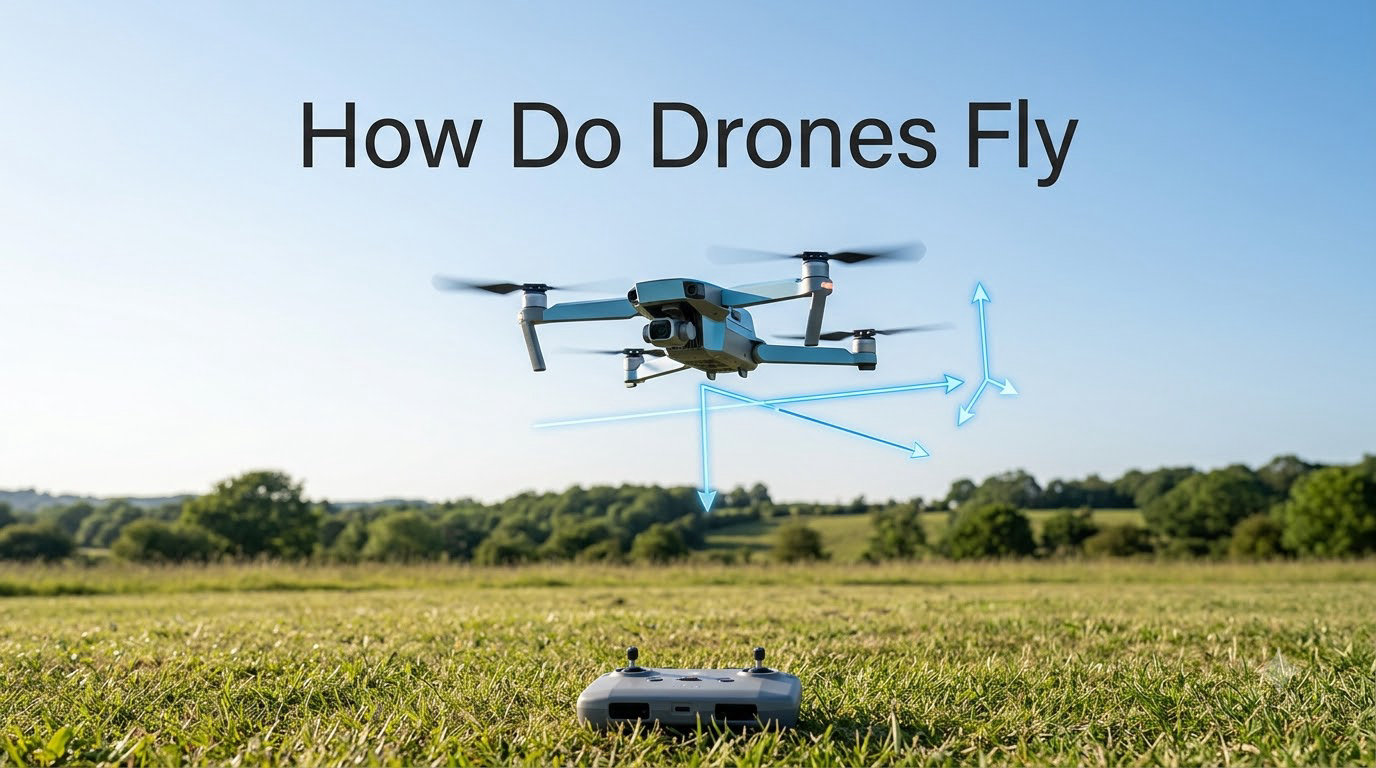
Drones fly by balancing four forces using spinning propellers and an onboard flight controller. The propellers push air down, which creates an upward force called lift. Sensors and a tiny computer adjust the rotor speeds thousands of times per second to keep the drone level or steer it in any direction. This guide breaks down exactly how drones fly, step by step.
I have spent the last several years working with consumer and professional UAVs, from tiny toy quadcopters to survey-grade mapping platforms. The question of how a drone actually stays in the air is one of the most common things beginners ask me, so I want to walk you through the physics without requiring an engineering degree.
In this article, you will learn the four forces acting on every drone, the role each propeller plays, the four flight controls that govern movement, and the sensor suite that makes stable flight possible. By the end, you will understand how drones fly and why your quadcopter behaves the way it does when you push the sticks.
Table of Contents
What Makes Drones Fly: The Core Physics of Lift
Every flying object, from a paper airplane to a Boeing 747, must obey the same four forces: lift, weight, thrust, and drag. Drones manage all four using only spinning propellers and clever software.
Lift is the upward force that opposes gravity. A drone creates lift by spinning its propellers, which act like spinning wings. Each propeller has an airfoil-shaped blade, and as it rotates, air moves faster over the top of the blade than underneath. That pressure difference produces an upward force.
Newton’s Third Law in Action
There is an even simpler way to picture lift. Newton’s Third Law says that for every action, there is an equal and opposite reaction. When a propeller pushes air downward, the air pushes the propeller (and the drone attached to it) upward. The harder the props spin, the more air they shove down, and the more lift they generate.
This is why thrust and lift are sometimes treated as the same thing in drones, unlike in fixed-wing aircraft where they are separated. A multirotor drone generates its forward motion by tilting its lift vector rather than by using a separate engine.
Air Pressure and Lift
Air might feel like nothing, but it has mass and weight. A drone hovering in place is essentially sitting on a column of fast-moving, lower-pressure air being shoved downward. Increase the propeller speed and you increase that column’s strength, which raises the drone. Decrease it and the drone descends.
The amount of lift a propeller generates depends on its size, pitch, and rotational speed. Bigger props or faster spins equal more lift, which is why heavy camera drones use large carbon-fiber propellers and powerful brushless motors.
How Propellers Create Lift and Thrust
Propellers are the only moving parts that touch the air, and they are the reason a drone flies. Each one is essentially a rotating wing that produces a force perpendicular to its plane of rotation.
A standard consumer drone uses two types of propellers: ones that spin clockwise (often called “CW” or marked with an R) and ones that spin counter-clockwise (CCW or L). They come in matched pairs because torque matters.
Why Drones Use Multiple Rotors
A single big rotor would work in theory, but the torque from one propeller would spin the drone’s body the opposite way. Helicopters solve this with a tail rotor. Multirotors solve it by using pairs of counter-rotating propellers, where the opposing torques cancel each other out.
This is why the most common drone configuration, the quadcopter, has four props arranged in an X or H pattern. Two spin clockwise and two spin counter-clockwise. The opposing forces keep the body stable while still producing upward lift.
Clockwise and Counter-Clockwise Propellers
If you look closely at prop pairs on a drone, you will notice they are not identical. They are mirror images, designed to bite the air from a specific direction. Swap them and your drone will either fail to lift or behave erratically.
The direction of rotation also gives the flight controller a way to yaw the drone. Speed up the clockwise pair and slow the counter-clockwise pair by the same amount, and the drone will spin in place without gaining or losing altitude.
The Four Flight Controls: Throttle, Pitch, Roll, and Yaw
Every movement a drone makes comes down to four control inputs. The AI Overview boxes that show up for this query list them in this exact order, and that order matters because throttle is the foundation of everything else.
Throttle: Up and Down Movement
Throttle controls collective propeller speed. Push the left stick up on a Mode 2 controller, and all four motors spin faster, producing more lift. The drone climbs. Pull the stick back and the motors slow, lift drops, and the drone descends.
On a perfectly balanced drone, the throttle position where it hovers is called the hover throttle. Above that point the drone climbs, below it the drone sinks. Wind and battery voltage shift this value continuously, which is why the flight controller is constantly adjusting motor speeds even when you are not touching the sticks.
Pitch: Forward and Backward Movement
Pitch tilts the drone’s nose up or down. To fly forward, the drone leans forward slightly. That lean tilts the lift vector from straight up to slightly forward, so the drone accelerates ahead while still climbing a little to maintain altitude.
Push the right stick forward, and the flight controller speeds up the rear motors while slowing the front ones. The nose drops, the drone leans, and it moves forward. Pull the stick back and the opposite happens.
Roll: Left and Right Movement
Roll is the same idea as pitch, but sideways. Push the right stick left, and the left motors speed up while the right ones slow down. The drone tilts left, the lift vector tilts left, and the drone slides sideways.
This is also how a drone strafes or orbits a subject. The tilt is usually only a few degrees, because a steep bank loses too much vertical lift and the drone will start to drop.
Yaw: Rotation in Place
Yaw is rotation around the vertical axis. The drone does not go anywhere, it just spins. Push the right stick left or right, and the drone rotates to face a new direction.
The trick here is differential torque. To yaw clockwise, the flight controller increases the speed of the clockwise-spinning propellers and decreases the counter-clockwise ones. The total lift stays the same, but the extra torque spins the body.
All four of these controls happen simultaneously, thousands of times per second, inside a device smaller than a credit card.
How Drones Achieve Stability: Sensors and Flight Controllers
Spinning four propellers is easy. Spinning them fast enough to lift the drone, slow enough not to flip over, and at the right differential speed to actually go where you want is incredibly hard. That is where the flight controller comes in.
The Flight Controller: Your Drone’s Brain
The flight controller is a small circuit board with a processor, gyroscopes, accelerometers, and a barometer. I like to call it the drone’s brain because it makes thousands of decisions every second. It reads sensor data, compares it to your stick inputs, and adjusts motor speeds in real time.
If you are curious about the silicon that powers these boards, our guide on flight controller technology explains how FPGAs and microcontrollers handle that workload. On consumer drones, the flight controller runs a control loop, often called PID, that corrects errors between the desired attitude and the actual attitude.
Gyroscopes and Accelerometers
Gyroscopes measure rotational speed on all three axes. They tell the flight controller how fast the drone is rotating, which is critical because the motors need to compensate before the drone tilts too far.
Accelerometers measure linear acceleration. Together, gyros and accelerometers form an IMU, or inertial measurement unit. The IMU is the part that feels how the drone is moving through space, and the flight controller uses that data 1,000 times a second to keep things level.
GPS and Barometers
The barometer measures air pressure, which gives the drone an accurate altitude reading. Hold the throttle at a steady position, and the barometer helps the drone maintain that height even if the battery sags and lift changes.
GPS adds position hold. With a strong satellite lock, the drone knows its latitude and longitude to within a few meters. The flight controller uses that data to hover in place, return to home if signal is lost, and follow waypoints. Without GPS, the drone will drift in any breeze.
Quadcopter vs Other Drone Configurations
Most consumer drones are quadcopters, but they are not the only configuration. More rotors mean more redundancy and more lift, at the cost of weight and complexity.
- Tricopter: Three rotors, often with a tilting rear motor. Light and efficient, but one motor failure usually means a crash.
- Quadcopter: Four rotors. The sweet spot for cost, simplicity, and payload. This is the form factor you see most often.
- Hexacopter: Six rotors. Used in commercial mapping and inspection because it can survive one motor failure and still land safely.
- Octocopter: Eight rotors. Heavy-lift work, cinema rigs, and military-class UAVs. Lots of power, lots of redundancy.
All of these use the same fundamental physics: counter-rotating propellers produce lift and let the flight controller steer by adjusting relative speeds.
Weather and Environmental Factors That Affect Drone Flight
Air density, wind, and temperature all change how a drone flies. Higher temperatures thin the air, so props produce less lift. Cold weather thickens the air, giving more lift but also stressing batteries.
Wind is the biggest challenge for beginners. A drone weighs only a few pounds, so even a 15 mph gust can push it sideways. The flight controller will fight that wind, draining the battery faster and producing jerky footage. Experienced pilots always check the forecast before flying.
Rain is almost always a no-fly condition. Water on the propellers disrupts lift, and most consumer electronics are not sealed against moisture. Fog is mostly fine for the drone, but it can play havoc with obstacle sensors and visual positioning systems.
Frequently Asked Questions
Why can’t you fly a drone above 400 feet?
The 400-foot altitude limit exists to keep drones below manned aircraft, which are required to stay at least 500 feet above the ground. Staying under 400 feet gives manned pilots a buffer zone and reduces the risk of a collision. In most countries, including the United States, breaking this rule can result in fines or the loss of your pilot certificate.
What is the biggest problem with drones?
The biggest problem with drones is limited flight time. Most consumer quadcopters can only stay airborne for 20 to 35 minutes per battery, and wind, cold, and aggressive flying reduce that number. Other major issues include restricted airspace, signal interference, and the risk of flyaways when GPS or compass calibration is poor.
How do drones move forward?
Drones move forward by tilting. When the flight controller speeds up the rear motors and slows the front ones, the nose dips forward and the lift vector points slightly ahead of vertical. The drone still produces enough lift to stay airborne, but the horizontal component of that lift pushes it forward. Releasing the stick levels the drone and stops the forward motion.
How do drones stay stable in the air?
Drones stay stable through a combination of gyroscopes, accelerometers, barometers, and GPS. These sensors feed the flight controller hundreds of times per second, and the controller adjusts each motor’s speed to counteract any tilt, drift, or altitude change. On more advanced models, downward-facing cameras and ultrasonic sensors add even more precision to the hover.
Conclusion
Understanding how drones fly comes down to three ideas. First, propellers push air down, and that push lifts the drone up. Second, every movement, whether up, forward, or sideways, is just a controlled change in the relative speed of the propellers. Third, the flight controller and its sensors do all of this thousands of times per second, which is what makes modern drones feel effortless to fly.
Next time you take off, picture those four forces in balance, the four motors being independently throttled, and the IMU quietly keeping everything level. The drone is doing a lot of work for you. For more on the technology behind these flying machines, browse our drone guides and resources.