
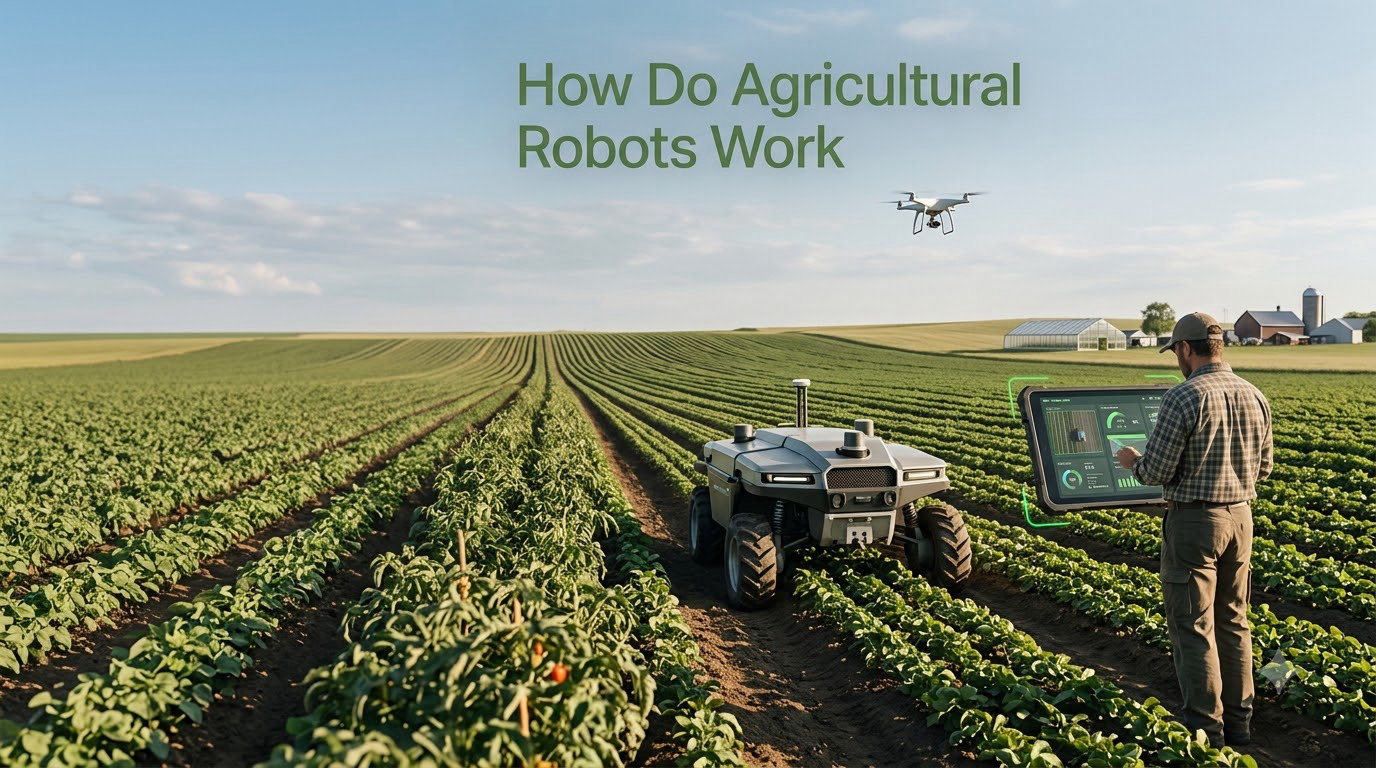
Agricultural robots are reshaping how we grow food, and I have spent the last several months studying how they actually work in the field. From autonomous tractors that till 24 hours a day to strawberry-picking arms that see ripeness through machine vision, these machines are no longer science projects. They are working tools addressing a real crisis: the agricultural labor shortage that has left crops rotting in fields across the United States and Europe.
In this guide, I will walk you through exactly how agricultural robots work, the technologies that power them, where they are being used today, and what is coming next. If you are a farmer, an ag-tech investor, or simply curious about how robotics is transforming one of humanity’s oldest industries, this is the breakdown you have been looking for.
Table of Contents
How Do Agricultural Robots Work? The 3-Phase Operating Model
Agricultural robots work through a continuous three-phase loop: they sense their environment using navigation and vision sensors, analyze that data with artificial intelligence to make decisions, and then act on those decisions using specialized tools. This sense-analyze-act cycle repeats thousands of times per hour as the robot moves through a field, greenhouse, or orchard.
Here is the same breakdown in a scannable list, the way the AI Overview at the top of Google presents it:
- Sensing and Navigation: GPS receivers, lidar units, inertial measurement units, and high-resolution cameras collect real-time data about position, obstacles, crop locations, and terrain.
- Understanding and AI: Deep learning models process the visual and sensor data, identifying weeds versus crops, assessing fruit ripeness, detecting disease, and plotting optimal paths.
- Action and Tools: Robotic arms, soft grippers, lasers, sprayers, or mechanical weeders execute the task, whether that is plucking a strawberry, zapping a weed, or planting a seed.
What makes this three-phase model different from industrial robotics is the environment. A factory robot sees a controlled space with predictable lighting, fixed object positions, and no weather. An agricultural robot faces dust, mud, variable sunlight, wind-blown leaves, and crops that are slightly different sizes and shapes from one plant to the next. Every component of the system has to be designed for that messiness.
Phase 1: Sensing and Navigation
Before an agricultural robot can pull a weed or pick a pepper, it has to know exactly where it is and what is around it. The sensing layer combines several technologies, each filling gaps the others leave.
Real-Time Kinematic GPS (RTK-GPS) provides centimeter-level positioning accuracy by correcting satellite signals with a nearby base station. A standard GPS reading drifts by several meters, which is useless between rows of crops spaced 30 inches apart. RTK brings that error down to about 2.5 cm, which is good enough to drive an autonomous tractor down the same row, year after year.
Lidar units shoot out laser pulses and measure how long they take to return, building a 3D map of the surrounding terrain. This is how robots detect fence posts, ditches, and the occasional farm worker who walked into the wrong row. Most modern agricultural robots use a combination of 2D and 3D lidar to build a 360-degree view around themselves.
High-resolution RGB cameras, multispectral cameras, and hyperspectral imagers capture the visible and invisible light bouncing off plants. Multispectral cameras can see near-infrared light, which healthy plants reflect strongly. That is how a robot tells a lush green weed from a nutrient-deficient crop that is also green but reflects less infrared light.
IMUs (Inertial Measurement Units) measure acceleration and rotation, filling in the gaps when GPS signals drop out, which is common near tree lines or buildings. Together, this sensor stack is called sensor fusion, and it is the foundation of how agricultural robots understand where they are and what they are looking at.
Phase 2: Understanding and AI
Raw sensor data is just numbers. Turning those numbers into a decision like “pick this berry, leave that one” is the job of the AI layer. Most modern agricultural robots run convolutional neural networks (CNNs) trained on tens of thousands of labeled images of crops, weeds, pests, and diseases.
The training process works like this: researchers and agronomists take thousands of field photos and label every object in them. A photo of a lettuce field might be labeled with each individual lettuce plant, every weed species visible, and notes on which weeds are at what growth stage. The network then learns the visual patterns that distinguish a young thistle from a baby carrot top, even when both are the same shade of green.
Once trained, the model runs on edge computing hardware mounted on the robot itself, so the robot can make decisions without depending on a cloud connection. This matters because cellular coverage in rural farmland is often weak, and a 200-millisecond round trip to a server is the difference between hitting a rock and missing it.
Beyond simple object detection, the AI layer also handles path planning. The robot continuously calculates the most efficient route through a field, balancing speed against battery life, and avoiding zones it has already treated. In orchards, this means the AI maps each tree and plans an approach angle that gives the picking arm the cleanest shot at the fruit.
Phase 3: Action and Execution
The action layer is where robotics gets physical. After the AI identifies a target, the robot’s end effectors carry out the actual task. End effectors are the tools mounted on the end of a robotic arm, the way a hand holds a screwdriver. In agriculture, these tools are highly specialized.
Soft pneumatic grippers use inflatable fingers to cradle delicate produce like strawberries, tomatoes, and mushrooms without bruising them. Mechanical weeders use metal blades or tines that slide just below the soil surface to sever weed roots. Laser weeders use targeted heat from a high-powered diode to burn the growing point of a weed, leaving the surrounding crop untouched.
For spraying, precision nozzles mounted on boom arms apply herbicide or fertilizer only where the AI has identified a target. This is a massive shift from broadcast spraying, which coats an entire field. According to data from laser weeding deployments, targeted approaches can cut herbicide use by up to 80 percent.
Most agricultural robots use ROS (Robot Operating System) as the software backbone that ties sensing, AI, and action together. ROS is an open-source framework that handles the message passing between cameras, AI models, motor controllers, and end effectors, much like a central nervous system. If you want a deeper look at the tools that close the action loop, our guide to end effectors breaks down the mechanical side in detail.
Key Technologies That Power Agricultural Robots
Behind every working farm robot is a stack of technologies, each one doing a specific job. Let me walk through the most important ones and explain what role they play.
Navigation Sensors: GPS, Lidar, and IMUs
Navigation is the foundation. Without knowing where it is, a robot cannot do anything useful. The three core navigation sensors are RTK-GPS for global position, lidar for local obstacle detection, and IMU for orientation and short-term motion tracking. Together they let a robot follow a pre-planned route, avoid unexpected obstacles, and keep working through brief GPS outages.
More advanced systems also use visual odometry, which means the robot’s cameras track how the ground moves past as it drives, building a secondary estimate of position. When sensor fusion combines all of these, the robot has a position estimate accurate to within a few centimeters, even in challenging conditions.
Machine Vision and Computer Vision
Machine vision is the camera-and-AI system that gives the robot its eyes. In agriculture, this means more than just taking pictures. Cameras have to handle direct sunlight, shadows, dust, and water droplets on the lens. Most agricultural cameras come with automatic lens cleaning, polarized filters, and HDR processing to deal with harsh lighting.
Computer vision algorithms then do everything from counting apples to measuring leaf area to spotting the first yellowing signs of nitrogen deficiency. A single robot can carry multiple cameras tuned to different spectra, including visible light, near-infrared, and thermal, each giving the AI a different kind of information about plant health.
Deep Learning Models and Edge Computing
Deep learning is what turns all that visual data into decisions. Modern agricultural robots typically carry an NVIDIA Jetson or similar GPU module onboard, capable of running multiple neural networks at 30 frames per second or higher. This edge processing keeps the robot autonomous even when it is far from any wireless network.
Models are usually retrained seasonally. A strawberry-picking model trained in California might need a quick round of additional training before it works in Florida, because the varieties, planting density, and lighting conditions are different. This is where over-the-air updates become critical, allowing new model versions to ship to every robot in a fleet without sending a technician to each farm.
Manipulator Arms and End Effectors
The action side of agricultural robotics relies on manipulator arms, the multi-jointed mechanical limbs that position a tool with sub-centimeter accuracy. A typical fruit-picking arm has six or seven degrees of freedom, which is the same range of motion as a human arm.
At the end of that arm sits an end effector, the specialized tool that actually does the work. The same arm can be fitted with a soft gripper for ripe fruit, a suction cup for mushrooms, a small saw for pruning, or a sprayer nozzle for spot treatment. The choice of end effectors is what defines what a robot can actually do in the field.
Sensor Fusion and Perception Systems
Sensor fusion is the software layer that takes inputs from GPS, lidar, cameras, and IMUs and produces a single, unified model of what the world looks like. This is the same idea behind self-driving cars, and it is the technology that lets a robot understand not just that there is “something” in front of it, but that the something is a chicken, a rock, or a sleeping farm cat.
Strong perception systems are what separate research demos from real working robots. A demo robot in a controlled environment can do amazing things with a single camera. A robot in a real wheat field needs perception that holds up against dust storms, low sun angles, and weeds that look almost identical to young crop plants. The fusion of multiple sensor types is what makes that reliability possible.
Main Applications of Agricultural Robots in Modern Farming
Now that you understand how agricultural robots work, it helps to see them in action. Here are the main jobs these machines are doing on real farms today.
Harvesting Robots
Harvesting is the most visible application. Strawberries, apples, tomatoes, lettuce, and asparagus are all being picked by robots in commercial operations as of 2026. The most cited example is Harvest Croo, a strawberry harvesting robot that can pick a 25-acre field in three days, replacing the work of about 30 human pickers.
The economic case for harvesting robots is strong because labor costs in agriculture have risen sharply, and seasonal worker availability has dropped. A robot that works 20 hours a day, never gets tired, and does not need a visa, has a clear payback for large operations.
The honest caveat: most harvesting robots are still slower than skilled human pickers on a per-fruit basis. Apple harvesting robots currently take 5 to 10 seconds per apple, compared to about 1 second for a trained human. The advantage is that the robot can run all night, in the dark, with lights.
Weed Control and Laser Weeding
Robotic weeding is one of the most rapidly growing segments. Traditional weeding is done either by hand, which is expensive, or by broadcast herbicide, which is increasingly restricted in many regions. Robots offer a third option: identify each weed, and kill it mechanically, thermally, or chemically with a single drop.
Carbon Robotics’ LaserWeeder is a flagship example. It uses computer vision to identify weeds and a high-powered laser to kill them, reducing herbicide use by up to 80 percent on farms that adopt it. Other systems use mechanical tines, hot water, or targeted micro-sprays. The benefit to organic farms is especially large, since they cannot use chemical herbicides at all.
Autonomous Tractors and Field Operations
Autonomous tractors are probably the largest category by dollar value. Companies like Monarch Tractor, John Deere, and CNH Industrial have all released or announced fully electric or hybrid autonomous tractors that can till, plant, spray, and mow without a driver.
The current generation usually operates with a human supervisor nearby who can take over via remote control if needed. True driverless operation is allowed in some U.S. states under specific regulations, and the rules are gradually being updated to allow more autonomy.
Seeding and Planting
Robotic seeders handle the precise placement of seeds at exact depths and spacings. This is the essence of precision agriculture: instead of broadcasting seed across a field and hoping for the best, a robot places each seed where it has the best chance of thriving.
Some advanced planters also perform real-time soil analysis as they move, adjusting seeding depth on the fly based on moisture and texture readings. This kind of variable-rate planting was impossible before robots because it requires a sensor and a decision for every square meter of the field.
Crop Monitoring and Drones
Crop monitoring robots come in two main forms: ground-based units and aerial drones. Ground-based robots move slowly through rows of crops, using cameras and sensors to gather data on plant health, fruit counts, and pest pressure. Aerial drones cover larger areas faster but with less detail per plant.
Both feed data into farm management software, which generates prescription maps. Those maps tell other robots, like sprayers, exactly where to apply treatment. This is the closed loop of precision agriculture: monitor, decide, act, repeat.
Greenhouse Automation
Greenhouses are a friendlier environment for robots than open fields. Lighting is controlled, weather is not a factor, and crops are usually arranged in predictable rows. Many greenhouse operations already use robots for transplanting seedlings, moving plant trays, pruning, and packing.
Small farm robots and open-source platforms like FarmBot are popular in this niche, especially for research, education, and small-scale specialty crop growers.
Benefits and Challenges of Farm Robots
Agricultural robots bring real benefits, but they also come with real challenges. I have tried to be honest about both based on what farmers and engineers are actually reporting in the field.
Key Benefits
Labor shortage relief is the most cited benefit. Farmers across the U.S. and Europe have reported watching crops rot in the field because they could not find enough workers to harvest them. Robots address this directly, taking on tasks that are physically demanding, repetitive, and hard to staff.
Environmental impact is another major win. Precision spraying and laser weeding cut herbicide use dramatically. Some deployments report an 80 percent reduction in chemical applications. Lower chemical use means healthier soil, less runoff into waterways, and lower costs for the farmer.
Data collection is a quieter but growing benefit. Every pass of a monitoring robot produces a detailed map of plant health, soil conditions, and yield. Over time, this data lets farmers make smarter decisions about irrigation, fertilization, and variety selection.
24-hour operation is the operational advantage. Robots do not need sleep, breaks, or daylight. They can harvest strawberries through the night under LED lights, and they can spray when the wind is calm, even at 3 a.m.
Current Challenges
Cost is the obvious one. Agricultural robots are still expensive. A single autonomous tractor can cost more than a luxury car, and a fleet of harvesting robots can run into the millions. For large operations, the math works out, but small farms are often priced out.
Complexity and maintenance is the second big issue. These are sophisticated machines operating in harsh environments. Mud, dust, and water take a toll on electronics, and repairs often require a specialist technician, not a local mechanic.
Single-purpose design is a limitation that comes up often in farmer forums. Many agricultural robots are built to do one job well, like picking one specific crop, and that means a farm might need several different robots to cover its full operation. The integration problem is real, and the industry is still working on it.
Unpredictable environments remain a core technical challenge. Unlike a factory, a field changes every day. Crops grow, weeds spread, and weather shifts. Agricultural robots have to handle all of that without falling over, which is harder than it sounds.
Frequently Asked Questions
How are robots being used in agriculture?
Agricultural robots are used for harvesting fruits and vegetables, weeding with lasers or mechanical tools, autonomous tilling and planting, crop monitoring with cameras and sensors, precision spraying, and greenhouse automation. Common examples include autonomous tractors, strawberry pickers like Harvest Croo, and laser weeders like Carbon Robotics’ LaserWeeder.
How much do agricultural robots cost?
Costs vary widely by function. Small monitoring robots and drones can start in the low five figures, mid-range autonomous tractors typically range from $50,000 to $150,000, and large specialized harvesting or laser weeding systems can cost $500,000 to over $1 million for a full fleet. The economic case usually depends on labor savings and acreage covered.
How much does an AI farm robot cost?
AI-powered agricultural robots, such as laser weeders or computer-vision harvesting systems, generally start around $200,000 for a single unit and can exceed $1 million for a multi-robot fleet. Pricing reflects the cost of high-resolution cameras, GPUs, custom end effectors, and the engineering required to make the AI reliable in real field conditions.
What is the future of agricultural robotics?
The future of agricultural robotics includes wider adoption of autonomous tractors, expansion of laser and mechanical weeding, smaller and cheaper robots for specialty crops, and better integration between monitoring, planning, and action robots. Open-source platforms like FarmBot and ROS-based systems are also making the technology more accessible to smaller farms and researchers.
The Future of Agricultural Robotics
Agricultural robots are no longer a future technology. They are a present tool that is changing how we grow food, address labor shortages, and reduce the environmental footprint of farming. The three-phase model of sensing, AI analysis, and action is the pattern that ties all of them together, whether you are looking at a strawberry picker in California, a laser weeder in the Midwest, or an autonomous tractor in the Netherlands.
For farmers, the next step is to identify which specific jobs on your operation are the most labor-constrained, the most repetitive, or the most chemically intensive, and start there. For ag-tech builders, the opportunity is in cheaper, more reliable hardware, smarter AI that handles real-world variability, and software that ties together fleets of robots from different vendors.
For everyone else, the rise of agricultural robots is one of the most important stories in food production today. As global demand keeps growing and labor keeps tightening, these machines are moving from optional to essential, and the farms that figure out how to work with them will be the ones feeding the next generation.