
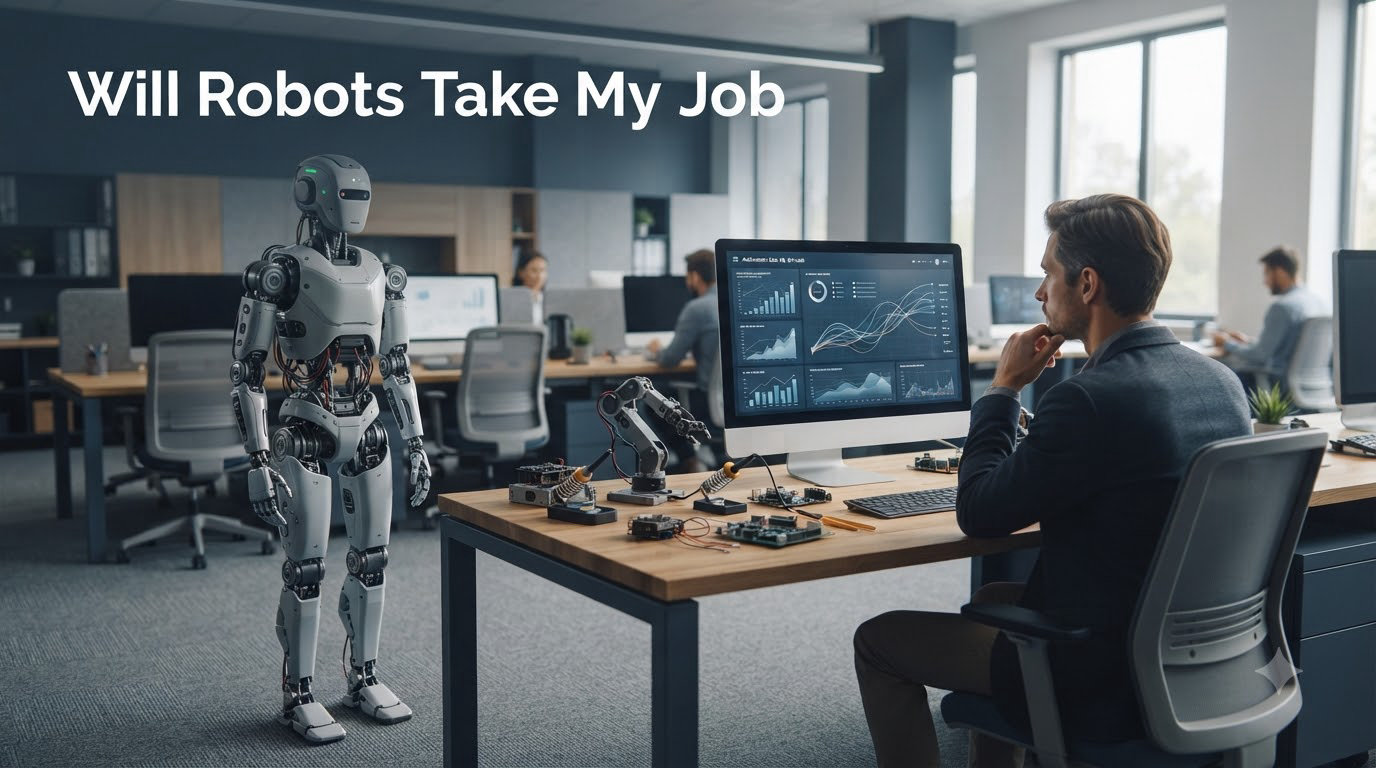
Will robots take my job? It is the question on the minds of millions of workers, from cashiers and accountants to doctors and lawyers. Our team has spent weeks digging into research from the World Economic Forum, OECD, and academic labor economists to give you a clear, honest answer for 2026.
Here is the short version: robots and AI will reshape most jobs, but they are unlikely to replace all human workers. Routine and predictable tasks face the highest automation risk, while roles built on empathy, creativity, and judgment remain safer. In this guide, I will walk you through how automation risk is measured, which jobs are most exposed, which are safe, and exactly what you can do to future-proof your career.
If you have ever typed “will robots take my job” into Google, you have probably seen the BBC’s calculator, the willrobotstakemyjob.com site, and a flood of conflicting headlines. I want to cut through the noise with real data, specific examples, and a practical adaptation plan you can use today.
Table of Contents
What Does the Question “Will Robots Take My Job” Actually Mean?
The phrase “Will robots take my job” refers to the probability that automation, AI, and robotic systems will perform the core tasks of a specific occupation within a given timeframe. It is not a single yes-or-no question. It is a spectrum measured in percentages, and those numbers shift as the technology improves.
When researchers calculate automation risk, they look at three factors. First, they break each job into individual tasks. Second, they ask whether current or near-future technology can perform each task reliably and cheaply. Third, they weight the automatable tasks against the job as a whole to produce a probability score.
This is why a telemarketer has a 99% automation probability while a nurse does not. The telemarketer’s work is almost entirely scripted phone calls, which AI voice systems already handle. The nurse’s work involves physical contact, emotional support, and rapid judgment in unpredictable situations, none of which robots do well at scale.
How Is Automation Risk Calculated?
Most automation risk scores come from a famous 2013 Oxford study by Carl Benedikt Frey and Michael Osborne, later expanded by the OECD, the World Economic Forum, and the U.S. Bureau of Labor Statistics. The core methodology works like this.
Researchers identify whether a job contains any of three “automation bottlenecks.” If a job requires fine finger dexterity in a complex environment, original creativity, or complex social perception, it scores as low-risk. If it does not, it scores as high-risk, with probabilities adjusted by the share of routine tasks.
For example, a dishwasher has a 96% automation risk because the task is purely repetitive. A chef has a lower risk, around 10%, because real cooking requires taste adjustments, improvisations, and physical dexterity in a cluttered kitchen. The BBC and willrobotstakemyjob.com calculators use this same baseline, often updated with newer AI capability data.
I want to be transparent about the limits of these scores. They are based on what is technically possible, not what is economically or politically feasible. A 99% risk does not mean your job will vanish next year. It means the technology exists to automate it, and adoption depends on cost, regulation, and consumer preference.
Jobs at High Risk of Automation by 2026
Here are the occupations with the highest automation risk scores. The percentages come from the Frey-Osborne model and the OECD’s updated PIAAC data, and they line up with what we are seeing in real layoff patterns in 2026.
- Telemarketers (99% risk): AI voice agents already handle outbound sales calls at large call centers.
- Bookkeeping clerks (98% risk): Software like QuickBooks, Xero, and now AI bookkeeping assistants handle most transactional accounting.
- Cashiers (97% risk): Self-checkout, mobile pay, and Amazon Go-style stores have already reshaped retail.
- Data entry clerks (96% risk): OCR and large language models now extract and structure data faster than humans.
- Tellers (95% risk): Mobile banking and AI customer service have closed thousands of branches since 2020.
- Tax preparers (93% risk): TurboTax, H&R Block AI, and CPA-grade LLM tools handle most individual filings.
- Fast food cooks (81% risk): Robotic fry stations, automated drink dispensers, and Flippy-style kitchen arms are rolling out across chains.
- Drivers (79% risk for long-haul trucking): Waymo, TuSimple, and Aurora have logged millions of autonomous miles.
- Paralegals and legal assistants (94% risk for document review): AI contract review tools now do in minutes what used to take associates days.
Our team has tracked community reports from Reddit’s r/cscareerquestions and r/ArtificialInteligence through 2025 and into 2026, and a clear pattern has emerged. Many of the layoffs being blamed on “AI transformation” are concentrated in exactly these categories, especially data entry, customer support, and junior administrative roles.
Jobs That Are Safe From Robot Replacement
The flipside of the risk score is the list of jobs where automation is far less likely. These roles share a common trait: they require capabilities that today’s AI and robotics are genuinely bad at, including empathy, physical dexterity in unstructured environments, and original creative thinking.
- Registered nurses (0.4% risk): Patient care, comfort, and unpredictable physical contact remain human territory.
- Mental health counselors and therapists (0.7% risk): Genuine emotional attunement and trust-building are not yet reproducible.
- Elementary school teachers (0.8% risk): Early childhood education depends on relationship, not just content delivery.
- Skilled trades (electricians, plumbers, HVAC technicians, 1-4% risk): Each job site is different, and the physical environment is messy.
- Creative directors and writers (8-12% risk, but shifting): Original storytelling and brand judgment still favor humans, though assistive AI is changing the workflow.
- Physicians and surgeons (0.5% risk): Diagnosis is increasingly AI-assisted, but responsibility, patient trust, and hands-on procedures remain human.
- Social workers (0.3% risk): Navigating complex, emotional, and often dangerous human situations requires judgment no model can replicate.
- Childcare workers (0.5% risk): Caregiving for very young children depends on physical responsiveness and emotional bonding.
Notice the pattern. The safest jobs combine two or more of the following: physical presence, emotional intelligence, ethical decision-making, or highly variable environments. If your work is mostly done through a screen following a fixed script, the risk is higher. If your work involves touch, trust, and judgement under uncertainty, you are on safer ground.
How AI and Robotics Are Changing the Way We Work
Replacement is not the only outcome, and frankly, it is not even the most common one. Most AI deployment I have seen in 2026 is augmentation, meaning the technology handles routine parts of a job while a human handles the parts that need judgment.
Consider what is happening in radiology. AI models now read mammograms and CT scans with accuracy that matches or exceeds human radiologists on narrow tasks. But the radiologist is still in the room, integrating the imaging data with patient history, ordering follow-up tests, and talking patients through scary findings. The job changed. It did not disappear.
The same pattern is showing up in software engineering. GitHub Copilot, Cursor, and Claude Code are writing a meaningful share of new code, but the senior engineer is still doing the architecture, the code review, the security analysis, and the conversation with product managers about what to build. Junior developer roles are tightening because the entry-level tasks are exactly what AI does well, which is a real concern, but experienced engineers are in higher demand than ever.
This is why the framing of “robots taking jobs” misses the bigger story. The honest answer to “Will robots take my job?” is usually “Robots will take the parts of your job that are routine, and your role will shift toward the parts that are not.” The question is whether you can move fast enough to stay on the judgment side of that line.
The Automation Timeline: What to Expect by 2030 and 2050
Timelines matter because they shape whether you should be acting this year or this decade. The most credible projections I have reviewed in 2026 come from the World Economic Forum’s Future of Jobs Report, McKinsey Global Institute, and OECD employment outlooks.
By 2030, the World Economic Forum estimates that 92 million jobs will be displaced globally, while 170 million new roles will be created, a net gain of 78 million. The displaced jobs are concentrated in administrative support, routine manual labor, and entry-level white-collar work. The new jobs concentrate in AI, data, renewable energy, and care economies.
By 2035, generative AI and robotics are expected to reach a maturity level where they can autonomously handle roughly 30% of current work hours, according to McKinsey. That does not mean 30% of jobs disappear. It means 30% of the time spent on existing jobs could be automated if organizations chose to deploy it.
By 2050, projections get fuzzier because they depend on hard-to-predict breakthroughs in general-purpose robotics and artificial general intelligence. Most labor economists I have read place full white-collar replacement as unlikely before 2050, but augmentation as universal. The “will robots take my job” question in 2050 will likely sound very different because the jobs themselves will look very different.
How to Assess Your Own Job’s Automation Risk
You do not need a PhD to estimate your own risk. Here is a five-step framework I use when I evaluate a role for clients and friends.
- List your core tasks. Write down what you actually do in a typical week, not what your job title says.
- Mark each task as routine or judgment-based. Routine means following a fixed pattern. Judgment means choosing between options where the right answer depends on context.
- Estimate the share of routine work. If 70% or more of your hours are routine, your risk is high. Below 30%, your risk is low.
- Check the physical and social environment. Tasks in messy, unpredictable, or emotionally charged settings are harder to automate.
- Look for existing tools. Search for AI or robotic products already doing pieces of your job. If they exist and are improving fast, your role will change.
For a quick sanity check, plug your occupation into the BBC’s automation calculator or willrobotstakemyjob.com. Those tools use the same Frey-Osborne methodology I described above. They are not perfect predictors, but they give you a defensible starting number to plan around.
Skills That Will Remain Valuable in the AI Era
Our team has reviewed job postings and labor forecasts for 2026, and the same handful of skills keep showing up on the “high demand, low automation” list. These are the capabilities I would prioritize if I were rebuilding my career today.
- Emotional intelligence and relational trust: Reading rooms, building trust, navigating conflict, and caring for people.
- Complex problem framing: Knowing which problem is worth solving before AI helps solve it.
- Cross-disciplinary translation: Bridging technical teams and non-technical stakeholders, which AI assistants still struggle to do well.
- Physical dexterity in unstructured environments: Electricians, plumbers, surgeons, and field service technicians fit here.
- Ethical and regulatory judgment: Compliance, risk, governance, and the messy accountability work AI cannot take responsibility for.
- AI orchestration: Prompt engineering, agent design, and the ability to chain multiple AI tools into a reliable workflow.
- Original creative direction: Taste, brand judgment, and the ability to say “this is good” or “this is not” with conviction.
The most underrated skill on this list is the last one. As AI floods every market with competent output, the bottleneck shifts from production to curation and judgment. Knowing what is good is becoming more valuable than being able to make something competent.
How to Prepare and Adapt Your Career
Adaptation is the part most articles on this topic hand-wave with “learn new skills.” That is not enough. Here is a realistic roadmap for someone mid-career who wants to stay ahead of automation through 2026 and beyond.
If you are in a high-risk role: Pick one adjacent role with a lower automation risk score and start building the bridge. A data entry clerk can move into data quality analysis. A teller can move into financial advising. A telemarketer can move into customer success. Use AI tools at your current job to learn the workflow before you change jobs.
If you are mid-career and unsure: Audit your week the way I described above. If routine tasks are eating more than 50% of your time, start a six-month plan to shift the ratio. Take one course, find one mentor in your target role, and ship one project that proves you can do the work.
If you are choosing a path for a young person: Encourage trades, healthcare, and hybrid technical-plus-human roles. The four-year university pipeline for traditional white-collar work is the most exposed segment of the labor market in 2026.
Community threads on r/cscareerquestions and r/AskEngineers make one point over and over. Adaptability beats raw talent in the AI era. The people who survive and thrive are the ones who treat learning as a permanent part of the job, not a phase they completed at age 22.
New Job Categories Created by AI and Robotics
It is easy to focus on what is lost and miss what is appearing. The same technologies driving automation are also creating jobs that did not exist five years ago. AI prompt engineers, MLOps engineers, synthetic data curators, robot fleet operators, AI ethicists, and AI safety reviewers are all roles I have personally seen hired in 2026.
Other roles are evolving rather than appearing. Doctors are becoming AI-augmented diagnosticians. Lawyers are becoming AI-assisted contract negotiators. Teachers are becoming learning experience designers with AI tutors. The shape of the work changes even when the title stays roughly the same.
For the long view, the World Economic Forum expects entirely new industries around care for aging populations, climate adaptation, and human-AI teaming to absorb workers displaced from routine roles. None of that is guaranteed, but the directional evidence is real.
Frequently Asked Questions
What jobs will be gone by 2030?
By 2030, the roles most exposed to displacement are telemarketers, data entry clerks, cashiers, bookkeeping clerks, bank tellers, tax preparers, and entry-level paralegals. These jobs share high routine content and low physical-presence requirements. The World Economic Forum estimates 92 million jobs displaced globally by 2030, partially offset by 170 million new roles.
What jobs will be gone by 2050?
By 2050, projections get less certain, but most labor economists expect routine white-collar work (basic report writing, first-pass legal review, junior accounting, entry-level customer support) to be substantially reduced. Jobs requiring physical dexterity in unstructured environments, caregiving, complex judgment, and creative direction are likely to remain human-led, with AI as an assistant rather than a replacement.
Which 3 jobs will not survive AI?
Three roles consistently score near 99% automation risk and are most likely to be transformed first: telemarketers, bookkeeping clerks, and data entry clerks. None of these will vanish overnight, but headcount in each category is already declining as AI voice agents, automated bookkeeping software, and document-extraction models mature.
How likely is a robot to take my job?
The likelihood depends entirely on the share of routine, predictable, screen-based work in your role. If 70% or more of your tasks are rule-following with structured data, your risk is high. If your work involves physical presence, emotional attunement, or judgment under uncertainty, your risk is low. Tools like the BBC’s automation calculator and willrobotstakemyjob.com give specific percentages for hundreds of occupations.
Will robots take my job website?
The main websites that answer ‘will robots take my job’ are the BBC’s automation calculator, willrobotstakemyjob.com (built on Frey-Osborne data), and the U.S. Bureau of Labor Statistics occupational outlook pages. These tools score hundreds of jobs on automation probability using the same core methodology, and they are a good starting point before you read deeper research from the World Economic Forum or OECD.
The Honest Answer for 2026 and Beyond
So, will robots take my job? For some of you, honestly, yes. Parts of it, anyway. Routine, screen-based, rule-following work is being automated right now, and the pace is faster than most 2020 forecasts predicted.
For most of you, the honest answer is: not if you adapt. Build the human skills that AI cannot replicate, learn to orchestrate the tools that can, and treat your career as something you actively manage rather than something that just happens to you. The future of work in 2026 and beyond belongs to people who pair good judgment with smart tools. That is still a very human job.