
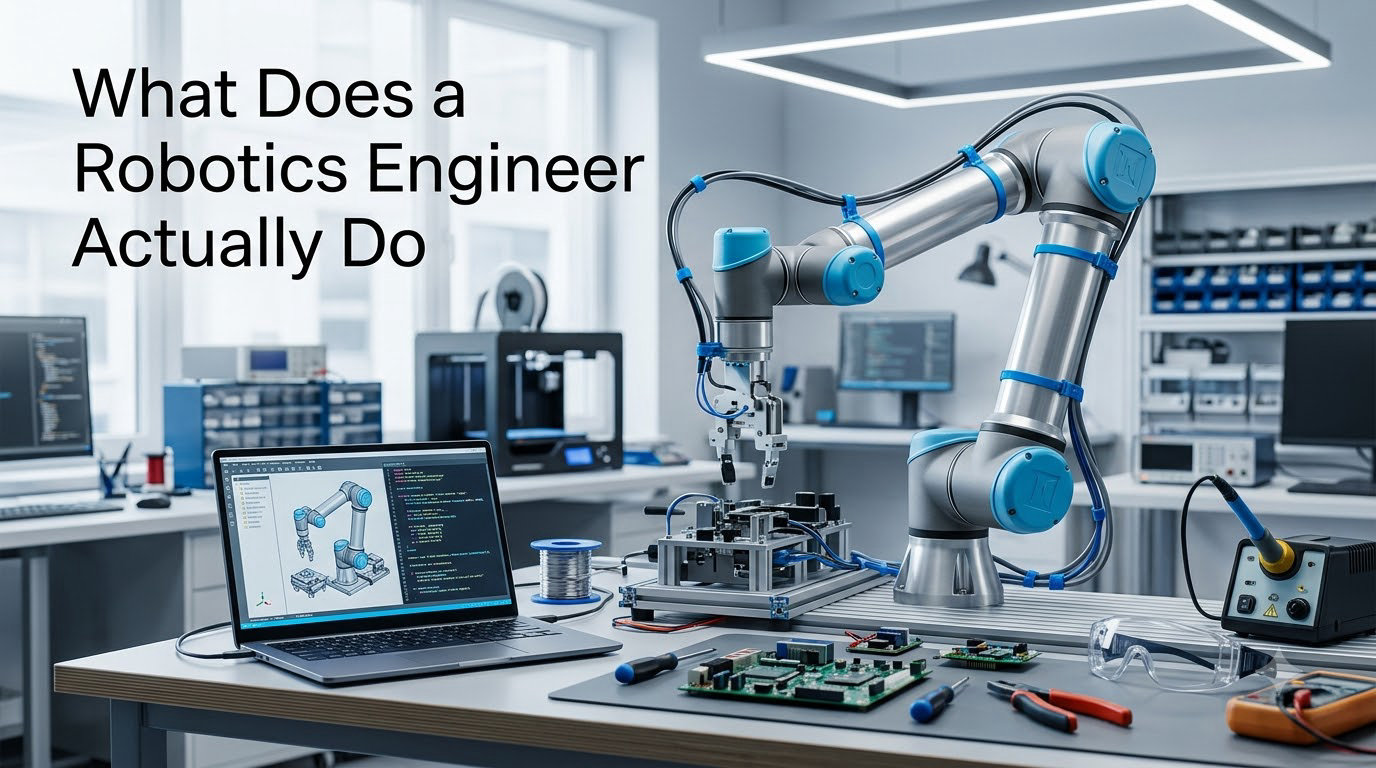
A robotics engineer designs, builds, programs, and tests robots and automated systems that work autonomously or semi-autonomously across manufacturing, healthcare, aerospace, and dozens of other industries. If you have ever asked yourself what does a robotics engineer actually do on a Tuesday afternoon, the honest answer is a mix of CAD modeling, Python and C++ coding, sensor calibration, and a lot of troubleshooting when a prototype refuses to behave.
Our team has spent the last decade covering the robotics field, and we have interviewed dozens of working engineers. In this guide, we will break down the real responsibilities, the tools, the industries, and the honest tradeoffs nobody tells you about. Whether you are a student weighing a major or a mechanical engineer eyeing a pivot, this is the full picture for 2026.
Table of Contents
What Does a Robotics Engineer Actually Do
At the most direct level, a robotics engineer designs, builds, programs, and tests robotic systems. The career sits at the intersection of mechanical engineering, electrical engineering, and computer science, so the role pulls in skills from all three disciplines. The four core duties that show up in nearly every job description are listed below, and they map directly to the way most robotics projects move from idea to working machine.
- Designing the mechanical structure, electronics, and control logic using CAD software like SolidWorks, Fusion 360, or Onshape.
- Building prototypes that integrate motors, actuators, sensors, and embedded controllers into a working system.
- Programming the software stack with Python, C++, and the Robot Operating System (ROS) to control motion and behavior.
- Testing and refining the robot in the lab and in the field until it performs reliably under real conditions.
Beyond those four pillars, robotics engineers spend serious time writing documentation, collaborating with cross-functional teams, and reviewing safety regulations. The work is rarely as glamorous as the demo videos suggest, but it is highly varied, and that is part of the appeal.
Core Duties and Responsibilities Explained
Let us unpack each duty so you can picture what a typical week looks like. I have grouped them into the four areas that show up across every robotics specialty, from surgical robots to warehouse automation.
Designing Robotic Systems
The design phase starts with a problem statement, such as moving boxes from a conveyor to a pallet without crushing them. From there, a robotics engineer models the physical structure in CAD software, selects motors and gear ratios, and lays out the electronics. You will be choosing between LiDAR, depth cameras, force-torque sensors, and IMUs depending on what the robot needs to perceive. Motion control and path planning decisions are made at this stage, often with the help of simulation tools like Gazebo or Isaac Sim.
Building Prototypes and Hardware
Once the design checks out on paper, it is time to fabricate. That means 3D printing parts, ordering machined components, soldering custom PCBs, and wiring up power systems. Many robotics engineers spend at least one or two days a week in a lab with their hands on hardware. Others, especially in software-heavy roles, may go weeks without touching a physical robot, and that gap is something to be aware of when you choose a job.
Programming Software and Control Systems
Software is where most modern robotics work happens. A typical robotics engineer writes perception code in Python, builds real-time control loops in C++, and ties it all together with ROS or ROS 2. You will also work on computer vision pipelines, machine learning models for object detection, and SLAM algorithms for mapping. According to forum discussions on r/Engineering and r/college, most robotics roles today are closer to software engineering than to mechanical tinkering, so comfort with code is non-negotiable.
Testing, Troubleshooting, and Iteration
Robots fail in creative ways. A robot that worked in the lab can collapse the moment lighting changes or the floor vibrates differently. Testing is therefore a constant, and so is debugging. Robotics engineers spend significant time instrumenting robots with logging, reviewing sensor data, and running reliability tests. This is also the phase where safety regulations and industry standards get enforced.
Day-to-Day Reality of Working in Robotics
The honest answer to what does a robotics engineer actually do all day is more mundane and more interesting than the highlight reels suggest. Based on conversations with working engineers and forum threads, a typical day often looks like this.
You start the morning reviewing overnight test logs from a robot running in the lab. A perception pipeline misclassified an object, so you spend the next two hours tweaking thresholds in Python. After lunch, you join a cross-functional meeting with mechanical and electrical teammates to discuss a design change on a gripper. By mid-afternoon, you are back in your editor writing a ROS node that coordinates two robotic arms. The day ends with a code review and a short writeup of what you learned.
A few patterns repeat across most robotics jobs. The work is fast-paced, team collaboration is essential, and the line between software and hardware is blurry. Side projects, robotics clubs, and competitions like FIRST Robotics or RoboCup make a real difference when it comes to landing your first job, because they prove you can ship a working system, not just talk about one.
Types of Robotics Engineers and Specializations
Robotics is a broad field, and most engineers specialize within two to three years of starting their careers. Here are the specializations we see most often on job boards and in our reader surveys.
Industrial Robotics Engineers
These engineers design and maintain the robotic arms and automated cells used in manufacturing and automotive plants. The work is well-defined, the tooling is mature, and the demand is steady. Programming is heavy on PLCs, ladder logic, and offline simulation in tools like RobotStudio.
AI and Machine Learning Robotics Engineers
This is the fastest-growing specialization. AI robotics engineers build the perception, planning, and decision-making layers that make modern robots adaptive. Expect deep work in computer vision, reinforcement learning, and large multimodal models.
Autonomous Systems Engineers
Autonomous systems engineers work on self-driving cars, drones, and autonomous mobile robots in warehouses. The technical stack leans on LiDAR, sensor fusion, SLAM, and real-time motion planning.
Healthcare and Surgical Robotics Engineers
Healthcare robotics engineers design surgical assistance systems, rehabilitation devices, and prosthetics. The bar for safety and precision is high, and the regulatory environment is strict, but the impact on patients is significant.
Service and Humanoid Robotics Engineers
Service robotics engineers build robots that interact with people in hotels, restaurants, and homes. The humanoid robotics field has grown fast in 2026, and roles here blend mechanical design, control theory, and human-robot interaction research.
Essential Skills and Tools Robotics Engineers Use
Robotics engineers need a working toolkit that spans three engineering disciplines. If you are planning a career in the field, these are the skills and tools that come up most often in job postings and on engineering forums.
- CAD software for mechanical design, primarily SolidWorks, Fusion 360, and Onshape.
- Programming languages including Python for rapid prototyping and C++ for real-time performance.
- Robot Operating System (ROS and ROS 2) as the standard middleware for most robotics stacks.
- Sensor integration with LiDAR, cameras, IMUs, and force-torque sensors.
- Motion control and path planning using libraries like MoveIt and tools like MATLAB.
- Machine learning and computer vision for perception, often with PyTorch or TensorFlow.
Beyond the technical stack, soft skills matter more than most job listings admit. Communication, project management, and the ability to write clear technical documentation will accelerate your career faster than any single framework.
Industries Where Robotics Engineers Work
Robotics touches nearly every modern industry, and the demand for engineers has been climbing each year. According to the U.S. Bureau of Labor Statistics, employment in closely related fields is projected to grow faster than the average for all occupations through 2026 and beyond.
The most common employers fall into a few buckets. Manufacturing and automotive companies hire industrial robotics engineers to automate assembly lines. Healthcare organizations hire robotics engineers for surgical assistance systems and rehabilitation devices. Aerospace and defense firms hire for autonomous systems, drones, and space exploration hardware. Logistics companies like Amazon, Walmart, and FedEx hire robotics engineers at scale for warehouse automation. And a growing number of startups work on service robotics, agriculture, and humanoids.
How to Become a Robotics Engineer
There is no single path into robotics, and that is part of the appeal. Most robotics engineers start with a bachelor degree in mechanical, electrical, or computer engineering, then layer on robotics-specific coursework in graduate school or through online programs. Schools with strong robotics programs include Carnegie Mellon, MIT, Georgia Tech, Oregon State, and the University of Michigan.
If a traditional degree is not an option, an alternative path is real and growing. Self-study with ROS tutorials, a portfolio of side projects, and competition experience can absolutely get you in the door. Many hiring managers we have spoken with care far more about whether you can ship a working robot than where you went to school. Robotics clubs, hackathons, and open-source contributions to projects like ROS or Gazebo are excellent signals.
Whichever path you take, plan on lifelong learning. The field moves fast, and the tools that matter today may be obsolete in five years. Staying current is part of the job.
Frequently Asked Questions
Do robotic engineers get paid well?
Yes. According to recent U.S. labor data, the median salary for robotics engineers sits in the high five figures to low six figures, and senior engineers at top companies or in high-cost areas routinely clear $150,000 to $200,000 per year. Specialists in AI robotics, autonomous systems, and surgical robotics tend to land at the higher end of that range.
Will AI replace robotics engineers?
AI is changing the tools robotics engineers use, but it is not replacing them. The same way CAD did not eliminate mechanical engineers, AI-assisted coding and simulation will not eliminate the people who design, integrate, and validate robotic systems. Demand for engineers who can combine AI tools with hands-on systems thinking is actually growing.
What skills does a robotics engineer need?
A robotics engineer needs a working mix of mechanical design, electronics, and software. The most cited skills in job postings are CAD software, Python and C++ programming, the Robot Operating System (ROS), sensor integration, motion control, and basic machine learning. Communication and documentation round out the profile.
Where do robotics engineers work?
Robotics engineers work in manufacturing plants, research labs, hospitals, aerospace and defense firms, logistics warehouses, and increasingly at robotics startups. The biggest concentrations in the United States are in the Bay Area, Boston, Pittsburgh, Seattle, and Ann Arbor, with strong clusters in Germany, Japan, South Korea, and Israel globally.
Conclusion
So what does a robotics engineer actually do? They design, build, program, and test robotic systems that touch nearly every part of modern life, from the cars we drive to the surgeries we recover from. The work blends mechanical engineering, electronics, and software into a single craft, and the demand for skilled practitioners continues to grow in 2026.
If you are considering the field, the best next step is to build something. Pick a small robot kit, run through a ROS tutorial, or join a local robotics club. The engineers who stand out are the ones who can show a working project, not just a transcript. Robotics is one of the few careers where curiosity, code, and hardware meet, and that is exactly what makes it worth pursuing.