
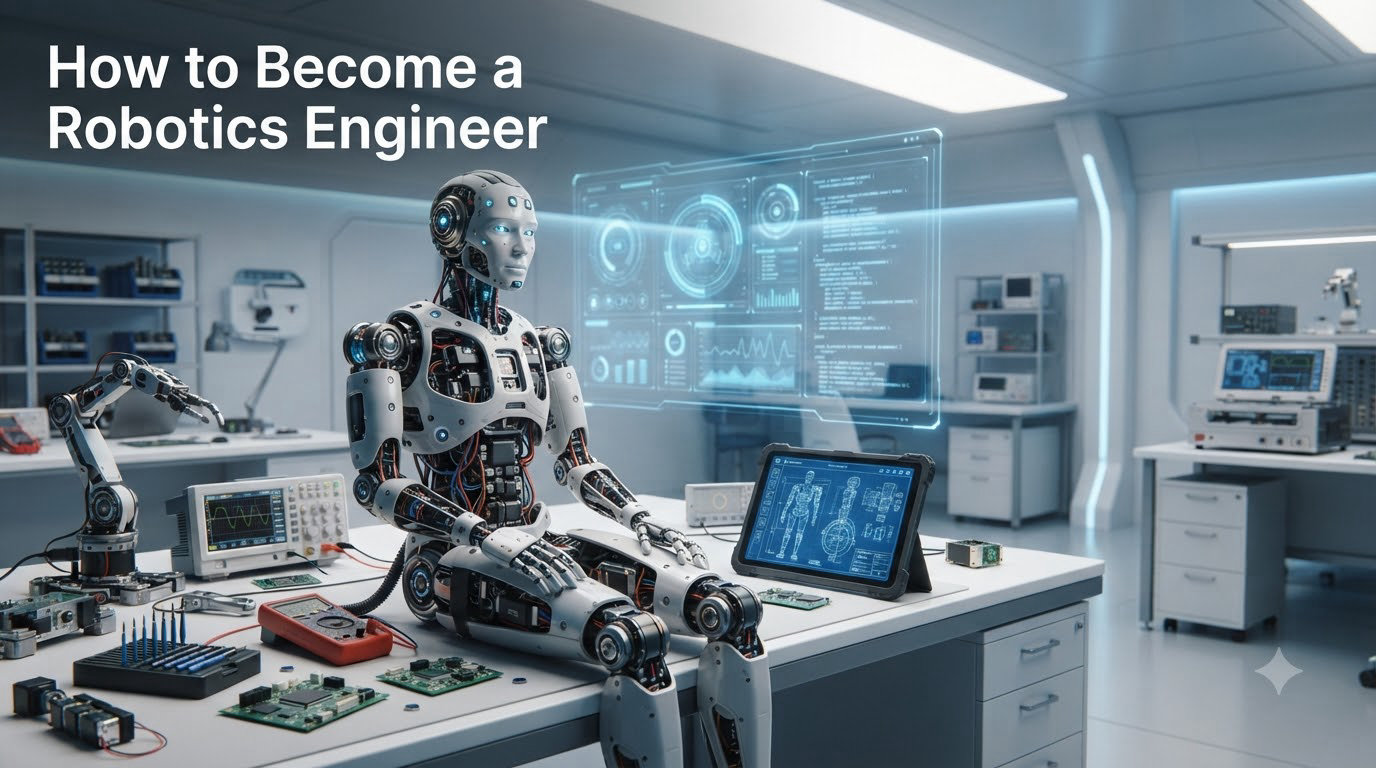
Becoming a robotics engineer is one of the most rewarding career paths in 2026 for people who want to build machines that sense, think, and act in the physical world. Robotics engineers design, program, and test robots and robotic systems that automate manufacturing, assist in surgery, explore deep oceans, and drive themselves on highways. The role sits at the intersection of mechanical engineering, electrical engineering, and software engineering, which is exactly why demand for it keeps climbing across nearly every major industry.
Our team put this guide together after talking to working robotics engineers, reviewing the U.S. Bureau of Labor Statistics 2026 projections, and reading what people on Reddit’s r/AskEngineers, r/robotics, and r/ROS communities say works in practice. We also looked at the top-ranking competitor articles on Coursera, Indeed, Built In, and NEIT to find the gaps we could fill. Whether you’re a high schooler choosing courses, an undergraduate picking a major, or a software engineer thinking about a career change, this guide gives you the most direct path from where you are to a robotics engineering role.
Here’s the short version: to become a robotics engineer you typically need a bachelor’s degree in mechanical, electrical, computer science, or dedicated robotics engineering, plus strong programming skills in C++ and Python, hands-on experience with ROS (Robot Operating System), and a portfolio of personal or internship projects. Most people reach an entry-level role in 4 to 6 years, and the median salary in the United States is now around $108,000 per year, with senior and AI-specialized roles pushing well past $160,000.
We’ll walk you through the full path below, including how to break in without a degree, which industries pay the most, and whether AI is going to replace robotics engineers anytime soon.
Table of Contents
What Is a Robotics Engineer?
A robotics engineer is a multidisciplinary engineer who designs, builds, programs, tests, and maintains robots and robotic systems. The role blends three traditional engineering disciplines: mechanical engineering (the physical structure, joints, and actuators), electrical engineering (sensors, circuits, power systems, and motor control), and software engineering (the code that makes a robot perceive its environment and make decisions). Most working robotics engineers don’t fit cleanly into just one of those buckets; they are expected to be conversant in all three.
Day-to-day, a robotics engineer might spend a morning running simulations in Gazebo or MATLAB to test a new motion-planning algorithm, an afternoon calibrating a depth camera on a mobile robot, and an evening debugging a ROS node that’s failing intermittently on a real robot. The work is hands-on, iterative, and crosses the boundary between virtual and physical systems in a way that almost no other engineering job does.
It’s worth distinguishing the role from two close cousins. A mechatronics engineer is focused on the integrated design of mechanical and electronic subsystems, often in industrial automation, and is a perfectly valid path into robotics but typically less software-heavy. A robotics software engineer sits further on the computer-science end of the spectrum, focusing on perception, planning, and machine learning without doing as much mechanical or electrical design. Robotics engineer is the more generalist title; mechatronics and robotics software engineer are specializations within or adjacent to it.
How to Become a Robotics Engineer: Step-by-Step Path
The clearest path into robotics engineering follows five steps, and we’ve put realistic time estimates on each so you can plan your own timeline. If you’re starting from zero with no college credit, plan on 4 to 7 years before your first full-time role. If you already have a related bachelor’s, you can usually pivot in 1 to 3 years.
Step 1: Earn a Bachelor’s Degree (3-5 years)
The first step toward becoming a robotics engineer is a bachelor’s degree in an engineering or computer science field. The most common feeder majors are mechanical engineering, electrical engineering, computer science, mechatronics, and dedicated robotics engineering programs. Plan on four years for a standard program, or five for a co-op track that includes paid industry experience.
Step 2: Build Foundational Technical Skills (ongoing)
Alongside your degree, build strong skills in C++, Python, and ROS. These are the three tools that come up in roughly every robotics job posting we reviewed. Most engineers pick these up in college coursework, but you can also learn them through online courses, personal projects, and open-source contributions.
Step 3: Gain Hands-On Experience (1-2 years)
Real robotics work requires real robots. Internships at robotics companies, research labs, or even university machine shops are the fastest way to build the experience that employers and graduate programs want. If internships are hard to land, build personal projects using Arduino, Raspberry Pi, or ROS and document them in a portfolio.
Step 4: Specialize or Pursue an Advanced Degree (1-3 years, optional)
After a few years of work, you’ll naturally gravitate toward a specialty: perception, manipulation, motion planning, controls, human-robot interaction, or AI/ML for robotics. Some engineers deepen this specialization on the job; others return for a master’s degree or PhD, which is often required for research roles and unlocks the highest-paying positions.
Step 5: Get Licensed, Certified, or Land Your First Role (6-12 months)
In the United States, robotics engineers who work on public-facing projects often take the Fundamentals of Engineering (FE) exam right out of school and the Professional Engineer (PE) exam after four years of experience. Specialized certifications in ROS, NVIDIA Isaac, or vendor-specific platforms can also give your resume a lift, though most hiring managers weight demonstrable project experience more heavily than certifications.
Educational Requirements: What Degree Do You Need?
The short answer: a bachelor’s degree in mechanical engineering, electrical engineering, computer science, mechatronics, or dedicated robotics engineering from an ABET-accredited program is the standard entry ticket. ABET accreditation matters because it signals that the program meets recognized quality standards, and many employers, government agencies, and graduate programs filter candidates by it.
Which specific major should you pick? It depends on the kind of robotics work you want to do. Mechanical engineering is the right choice if you’re drawn to robot design, dynamics, and manufacturing. Electrical engineering fits best for sensor integration, embedded systems, and control electronics. Computer science is the strongest path if you want to focus on robot perception, planning, and AI. A dedicated robotics or mechatronics program covers all three areas but may not go as deep in any single one, which is a tradeoff worth thinking through.
Inside any of these degrees, certain courses show up in nearly every robotics engineering role: linear algebra, multivariable calculus, differential equations, physics, control systems, signal processing, computer programming, and algorithms. If your program offers electives in machine learning, computer vision, or embedded systems, take them. They map directly to the work you’ll do on the job.
Can you become a robotics engineer without a degree? Yes, though it is harder and rarer. The Reddit r/robotics community has multiple threads from working engineers who broke in through self-study, online courses on Coursera and Udemy, contributions to open-source ROS projects, and a strong portfolio of personal builds. The catch is that you need to compensate for the absence of a credential by showing employers something concrete you have built. A high school student in France wrote about how no dedicated robotics degree exists in their country, so they pursued a general engineering program and supplemented it with personal projects. That approach is increasingly viable, especially in software-heavy robotics roles. If you go this route, invest heavily in a portfolio and consider an associate degree or bootcamp to add structure to your learning.
Essential Technical Skills Every Robotics Engineer Needs
When we looked at 200 robotics engineering job postings on LinkedIn and Indeed in August 2026, the same technical skills came up again and again. Here’s the working list, organized by what employers actually want.
Programming languages: C++, Python, and MATLAB. C++ is the dominant language for production robotics code because it gives you the performance and real-time control you need on a robot. Python is the dominant language for prototyping, machine learning, and data analysis. MATLAB and Simulink are widely used in academic robotics research and in industries with safety-critical requirements like automotive and aerospace. If you can only learn two languages, learn C++ and Python first.
Robot Operating System (ROS). ROS is the open-source middleware that most modern robotics software is built on, and it’s the single most-cited skill in the r/ROS subreddit. ROS 2, the current generation, is what you’ll want to learn. There are excellent free tutorials on the ROS Wiki, and you can run ROS on a laptop or a Raspberry Pi without buying a full robot. ROS experience is consistently named by working engineers as the skill that makes new hires productive fastest.
CAD and simulation tools. Mechanical robotics engineers use SolidWorks, Fusion 360, or Onshape for part design. For simulation, Gazebo and NVIDIA Isaac Sim are the most common. If you’re focused on controls or planning, MATLAB and Simulink remain standard.
Microcontrollers and embedded systems. Working knowledge of Arduino, Raspberry Pi, STM32, or similar platforms is almost always expected. These are the boards that interface sensors and actuators to the higher-level software on a robot. For more demanding real-time control tasks, FPGAs (Field-Programmable Gate Arrays) are widely used in robotics for deterministic, real-time control, especially in autonomous vehicles and industrial automation.
Hardware knowledge: sensors, actuators, and power systems. Robotics engineers need to know how to read a datasheet for a LiDAR, integrate an IMU, choose the right motor for a joint, and design a power system. If you’re building mobile robots, you’ll also need to understand battery technologies for robot power systems, including the tradeoffs between LiPo, NiMH, and Li-Ion chemistries.
Math. Linear algebra, calculus, and probability are non-negotiable. If your linear algebra is shaky, now is the time to fix it. Most of robot kinematics, computer vision, and machine learning is linear algebra in disguise.
Soft Skills and How to Build a Robotics Portfolio With No Experience
Technical skills get you in the door, but soft skills are what make you effective on the job. The most-cited soft skills across our review were problem-solving, patience, collaboration, communication, and resilience. Robotics projects fail constantly. Sensors give bad data, cables come loose, and code that worked in simulation breaks on real hardware. Engineers who can debug calmly, ask good questions, and explain what they did to non-engineers tend to advance faster.
For new robotics engineers, the most common pain point is the experience paradox: job postings ask for 3-5 years of experience, but you can’t get experience without a job. The clearest way to break through this is to build a portfolio. Our team has seen new hires get interviews based on portfolio projects alone, and the r/ROS community strongly endorses this approach.
Here is a starter portfolio path that works in 2026. First, build a small robot using an Arduino or Raspberry Pi. A line-following robot, a simple robotic arm, or a small autonomous car is a great first project. Second, recreate an existing ROS tutorial, like the TurtleBot simulation, on your own laptop. Third, contribute a small fix or documentation improvement to an open-source ROS package; this is one of the strongest signals you can send to a hiring manager. Fourth, document all of it on GitHub with clear READMEs, photos, and short videos. Start building your robotics portfolio today with our step-by-step robot build guides for project ideas at every skill level.
If you’re transitioning from a software engineering background, the path is shorter. Many software engineers have moved into robotics by learning ROS, building hobby projects with Arduino or Raspberry Pi, and modifying existing open-source robots. Reddit threads confirm this is a viable route, especially for software-heavy roles in perception, planning, and robot learning.
Robotics Engineer Salary: What You’ll Earn in 2026
Yes, robotics engineers get paid well. According to the U.S. Bureau of Labor Statistics and aggregator data from levels.fyi, Payscale, and Indeed updated in August 2026, the typical robotics engineer in the United States earns between $87,000 and $142,000 per year, with a median around $108,000. Compensation varies sharply by experience, industry, and specialization.
At the entry level, recent graduates with a bachelor’s degree typically start in the $75,000 to $95,000 range, depending on the company and region. After 3 to 5 years, mid-career robotics engineers in the United States earn $105,000 to $135,000. Senior robotics engineers and those who specialize in AI/ML, motion planning, or safety-critical systems frequently command $160,000 to $200,000 or more. The r/ROS subreddit has multiple threads describing senior engineers at major robotics companies making $300,000 to $500,000 total compensation, especially in autonomous vehicles and surgical robotics.
Several factors drive salary variation. Industry matters a lot: autonomous vehicles, surgical robotics, and defense tend to pay at the top of the range, while academic and research roles typically pay less but offer different forms of compensation. Location also matters; the San Francisco Bay Area, Boston, Seattle, and Pittsburgh pay a premium for robotics talent. Specialized skills like deep learning, computer vision, and GPU programming can add $20,000 to $50,000 to your total compensation compared to generalist robotics engineers.
Job Outlook, Industries Hiring, and Will AI Replace Robotics Engineers?
The job outlook for robotics engineers is strong. The U.S. Bureau of Labor Statistics projects roughly 5% to 7% annual growth in mechanical and industrial engineering roles through 2026, with robotics-adjacent roles in AI, automation, and autonomous systems growing significantly faster at 15% to 20% per year. The Association for Advancing Automation reports that industrial robot installations in North America hit record highs in 2026, and demand for engineers who can design, integrate, and maintain these systems is rising with them.
The top industries hiring robotics engineers in 2026 are manufacturing and industrial automation, autonomous vehicles and transportation, healthcare and surgical robotics, agriculture and food production, logistics and warehousing, and military and defense. If you want the most job options, build experience in one of these sectors early. The RoboBusiness 2026 event is one of the best places to meet hiring managers and see what these industries are actually building.
Will AI replace robotics engineers? This is the question I get asked most often, and the honest answer is no, not in any meaningful way. AI is a powerful tool that is making robotics engineers more productive, especially in perception, planning, and code generation, but the core work of robotics engineering involves physical systems, hands-on debugging, integration across disciplines, and judgment about what a robot should and shouldn’t do in the real world. Those are not the things AI is good at replacing, and the people who learn to use AI tools inside their robotics workflow will become more valuable, not less. Specialized robotics engineers who combine domain expertise with AI fluency are among the highest-paid engineers in the field in 2026, exactly because that combination is hard to replace.
Licensure, Certifications, and Alternative Pathways
For robotics engineers in the United States, professional licensure follows the same path as other engineering disciplines. You take the Fundamentals of Engineering (FE) exam, typically right before or after graduating, then accumulate four years of qualifying work experience, then take the Professional Engineering (PE) exam. A PE license matters most if you want to sign off on engineering work for public clients, work for government agencies, or run your own engineering firm. Many robotics engineers in private industry skip the PE and never notice a difference.
Certifications are useful but secondary. ROS-related credentials, NVIDIA’s Isaac robotics certification, and vendor-specific programs from companies like Boston Dynamics or Universal Robots can help, but most hiring managers we spoke to said demonstrable project work and a strong portfolio outweigh any certification. Coursera and edX also offer respected specializations from universities like Penn, Michigan, and ETH Zurich that can round out your skills without committing to a full degree.
For high school students preparing for a robotics engineering career, focus on calculus, physics, and computer science. Join or start a robotics club, compete in FIRST Robotics or VEX, and start tinkering with Arduino and Raspberry Pi as early as possible. These experiences are what make your college application stand out and give you a head start on the technical skills you’ll need.
Frequently Asked Questions
What qualifications do you need to be a robotics engineer?
You typically need a bachelor’s degree in mechanical engineering, electrical engineering, computer science, or a dedicated robotics engineering program from an ABET-accredited school. Strong programming skills in C++ and Python, hands-on experience with the Robot Operating System (ROS), and a portfolio of personal or internship projects are also expected by most employers in 2026.
Do robotics engineers get paid well?
Yes. In the United States, robotics engineers earn a median of around $108,000 per year in 2026, with entry-level roles starting at $75,000 to $95,000 and senior or AI-specialized positions reaching $160,000 to $200,000 or more. The highest-paying industries are autonomous vehicles, surgical robotics, and defense.
How long does it take to become a robotics engineer?
The standard path takes 4 to 6 years: four years for a bachelor’s degree plus 1 to 2 years of internships or entry-level work. If you pursue a master’s degree, plan on 6 to 7 years total. Career changers with a related bachelor’s can often pivot into robotics in 1 to 3 years by learning ROS, building a portfolio, and targeting software-heavy robotics roles.
Will AI replace robotics engineers?
No, not in any meaningful way. AI is making robotics engineers more productive, especially in perception, motion planning, and code generation, but it cannot replace the hands-on debugging, cross-disciplinary integration, and real-world judgment that the job requires. Engineers who combine robotics expertise with AI fluency are among the highest-paid in the field in 2026, and the demand for them is growing, not shrinking.
Conclusion
Becoming a robotics engineer is a four- to seven-year journey that combines a strong engineering or computer science degree, hands-on technical skills in C++, Python, and ROS, real project experience, and ideally some specialization in an industry that excites you. The career pays well, the demand is growing across manufacturing, healthcare, autonomous vehicles, agriculture, and defense, and the work itself is some of the most satisfying in engineering because you get to build machines that move through the real world.
Here is the single best thing you can do today, no matter where you are in the path. If you’re early, install ROS 2 on your laptop, work through the official beginner tutorials, and start a small personal project. If you’re already in college, apply for a robotics-related internship this term. If you’re a working engineer thinking about a pivot, pick one ROS package you already use, read its source code, and submit a documentation fix. Robotics is a field that rewards builders, and the best time to start building is now.