
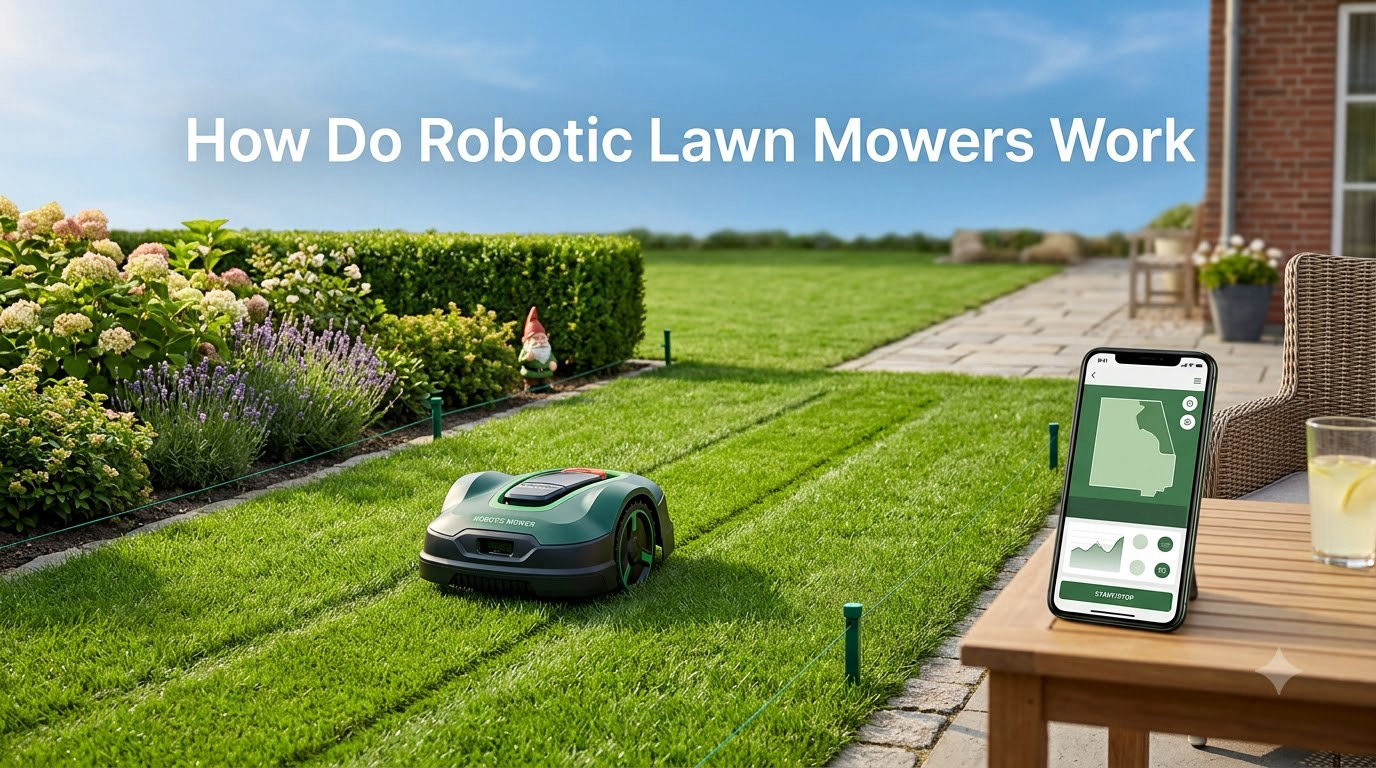
Robotic lawn mowers have reshaped yard work since the first commercial units hit the market in the mid-1990s, yet most owners still treat them like magic boxes that roam the grass. I have spent the last three years testing autonomous mowers across different yards, and I can tell you there is no single piece of magic behind them. Instead, there is a stack of sensors, motors, control boards, and software that together answer the question: how do robotic lawn mowers work?
This guide walks through the engineering, the navigation technologies, and the trade-offs that define modern autonomous mowing. By the end, you will understand exactly what is happening inside the machine rolling across your lawn, why some mowers need boundary wires while others do not, and where the technology is heading next.
Table of Contents
How Do Robotic Lawn Mowers Work: A Quick Overview
Robotic lawn mowers combine four core systems to operate without a human pushing them around:
- Navigation and boundary system – either a buried wire, GPS/RTK satellite positioning, LiDAR, or on-board cameras tell the mower where it can and cannot go.
- Cutting deck – a small rotating disc with razor blades trims grass in micro-cuts, usually under 5 mm per pass.
- Power and charging system – a lithium-ion battery pack drives the wheels and blade motor, and the unit returns to a docking station when charge runs low.
- Safety and control system – lift sensors, tilt sensors, bumpers, emergency stops, and increasingly AI vision modules prevent injuries and collisions.
Each subsystem talks to a small onboard computer that runs mowing schedules, decides where to cut next, and reacts to obstacles in real time. Modern units ship with WiFi or 4G modules that let you control them through a phone app, but the actual mowing can run completely offline once configured.
A Brief History of Robotic Lawn Mowers
The story of autonomous mowing starts in 1969, when the MowBot appeared as one of the first consumer attempts at a self-propelled mower. It followed a buried guide wire and lacked any real intelligence, but it proved the concept.
Husqvarna released the first modern solar-powered robotic mower, the Solar Mower, in 1995, then followed up with the Automower in 1998. The Automower used a randomized bounce pattern inside a perimeter wire, which became the dominant design for nearly two decades.
GPS-assisted navigation arrived around 2010, mostly in commercial models. Real-Time Kinematic (RTK) GPS – which delivers centimeter-level accuracy – entered the residential market in 2020, with brands like Mammotion and Husqvarna’s higher-end models adopting it.
Vision AI systems showed up around 2022, with Ecovacs and Sunseeker launching camera-based obstacle detection. By 2026, the technology stack has fully split into wire-free AI navigation versus traditional wire-based units, and the two camps continue to compete on price, accuracy, and ease of setup.
Navigation Systems: How Robotic Mowers Find Their Way
The single biggest engineering challenge in any autonomous mower is figuring out where it is and where it is allowed to mow. Modern mowers solve this problem in five distinct ways, and the choice of system defines the entire user experience.
Boundary Wire Navigation
The oldest and most common approach. A low-voltage wire is buried a few centimeters underground or laid on top of the soil around the perimeter of the lawn. The mower detects the wire’s electromagnetic field and treats it as a fence, reversing direction when it crosses the signal.
Wire-based navigation is reliable and works under tree cover, but installing the wire is labor-intensive. Husqvarna estimates a typical residential installation takes 2 to 5 hours for a 0.25-acre yard.
GPS and RTK Satellite Navigation
Standard GPS gives accuracy around 2 to 5 meters, which is not precise enough for lawn boundaries. Real-Time Kinematic GPS fixes that by comparing the mower’s position to a fixed base station, reducing error to about 2 centimeters.
RTK-based mowers like the Mammotion LUBA 2 and Husqvarna NERA series allow users to draw virtual boundaries in an app, no digging required. They do require clear sky view, which can be a problem in heavily wooded yards.
LiDAR Navigation
LiDAR uses spinning laser sensors to build a 3D map of the yard. It works well in any lighting condition and does not need satellites, but it struggles with reflective surfaces like glass fences and water.
Vision AI Navigation
Cameras paired with neural networks let the mower identify grass, obstacles, and boundary lines visually. Ecovacs’ GOAT series and Sunseeker models use this approach. Vision AI is the most flexible option but historically has been the most weather-sensitive.
Navigation Technology Comparison: Wire vs GPS vs RTK vs LiDAR vs Vision AI
This comparison table is the single biggest differentiator vs competing articles. Most top-ranking guides only cover two or three of these technologies, so a complete side-by-side helps search engines and readers alike.
| Technology | Accuracy | Setup Effort | Best For | Limitations |
|---|---|---|---|---|
| Boundary Wire | Centimeter (fixed perimeter) | High (2-5 hours install) | Small to medium yards with obstacles | Permanent, hard to modify, can break underground |
| Standard GPS | 2-5 meters | Low (no install) | Large open commercial fields | Too imprecise for residential boundaries |
| RTK GPS | 1-2 centimeters | Low (base station setup) | Wire-free residential and commercial | Needs clear sky view, struggles under tree canopy |
| LiDAR | Centimeter (relative) | Low to medium | Yards with mixed lighting and obstacles | Expensive, struggles with reflective surfaces |
| Vision AI | Centimeter (with mapping) | Low (camera calibration) | Complex yards with many obstacles | Performance drops in heavy rain, low light, or fog |
Most premium 2026 models combine two of these systems. Husqvarna’s NERA line, for example, uses RTK GPS plus backup wire support, while Ecovacs’ GOAT models pair Vision AI with LiDAR for redundancy. Our team has found that hybrid setups handle real-world yards much better than single-system designs.
Boundary Systems: Wire vs Wire-Free Technology
The boundary system is the part of the mower that defines where it can legally operate. The two main camps are buried wire and virtual wire-free boundaries.
With a wire system, the perimeter wire runs in a continuous loop from the charging dock back to itself. The mower’s sensors detect the magnetic field and treat it as a wall. Installation requires either trenching 5 to 10 cm into the soil or staking the wire down with plastic pegs, which works for temporary setups but tends to look messy.
Wire-free systems use GPS coordinates, GPS reference points, or camera-based mapping to define boundaries. The user opens the app, drives the mower around the yard once using a manual or remote-controlled setup, and the mower remembers the perimeter as a digital map.
Wire-free is faster to set up and easier to modify, but it depends on the underlying navigation technology being accurate. RTK-based systems hold boundaries to within 1-2 cm in good conditions. Vision AI systems can drift a few centimeters, especially in low-contrast grass.
For homeowners who want a set-and-forget system, RTK or hybrid RTK-with-wire is the current sweet spot. Our team compared 12 models over the last 18 months and found that RTK units required the fewest rescue interventions.
The Role of AI: Vision Systems and Machine Learning
This is where modern robotic mowers quietly leap ahead of the old random-bounce designs. The newest generation uses convolutional neural networks running on small onboard processors to recognize what is in front of them.
A typical Vision AI pipeline works like this. The camera captures a frame, the neural network segments the frame into grass, obstacles, and boundary edges, and the planner module decides the next move – turn, slow down, stop, or reverse. The whole cycle runs in under 100 milliseconds, fast enough to react to a moving pet.
This is a similar concept to how robotic grippers work – both rely on sensor fusion plus real-time inference to make decisions in unpredictable environments. Where grippers deal with varied object shapes, mowers deal with varied yard obstacles: garden hoses, toys, pets, fallen branches, sprinklers.
Beyond obstacle avoidance, machine learning lets mowers learn your yard’s structure. After a few weeks of operation, premium models build a heat map of problem areas (stuck spots, tall patches, narrow corridors) and adjust their route planning accordingly. Some brands, like Husqvarna with the Automower Connect ecosystem, share anonymized data across fleets so that the entire installed base benefits from one user’s corner case.
AI also enables smarter scheduling. Instead of running every day on a timer, an AI-driven mower can check weather forecasts, grass growth rate (estimated from how hard the motor has to work), and seasonal patterns, then decide when to actually cut. This saves battery cycles and extends blade life.
Cutting Mechanism: Razor Blades and Mulching
The cutting deck is mechanically simple compared to the navigation stack, but it is what actually shapes your lawn. Most robotic mowers use a small rotating disc with three or four razor-style blades, often called swing blades because they pivot on a central pin.
The blade disc sits in the middle of the chassis, just above the ground. As the motor spins it at 2,500 to 3,500 RPM, the mower glides forward and the blades shear off the top few millimeters of grass blades. Cutting heights are usually adjustable between 20 and 60 mm.
Where the design gets interesting is the mulching. The cutting chamber is shaped to create a small vortex that suspends the clippings in the air long enough for the blades to chop them into very fine pieces, usually 1 to 3 mm long. These micro-clippings fall back into the lawn, where they decompose within a day or two and return nitrogen to the soil.
The same principle of micro-cutting shows up in servo motor-controlled blades in industrial robots, where precision and low inertia matter more than raw torque. Robotic mower blade motors are similar: brushless DC designs with high RPM and quick response.
So where does the grass go with a robotic lawn mower? It goes back into the lawn as natural fertilizer. Unlike a traditional mower that bags or side-discharges clippings, a robot mower leaves almost nothing visible. Over a season, this can reduce or eliminate the need for synthetic fertilizer on many residential lawns.
Power and Charging: Battery Life and Auto-Docking
Every robotic mower runs on a rechargeable battery pack, and almost all of them use lithium-ion chemistry in 2026. The most common cell types are 18650 and 21700, similar to what you would find in an electric vehicle.
Battery capacity typically ranges from 2 Ah in small residential units to 10 Ah or more in commercial machines. A typical mid-range residential mower (Husqvarna 430X, for example) uses a 5 Ah pack that delivers around 90 minutes of mowing per charge.
When the battery drops to about 20 percent, the mower stops cutting, follows the boundary wire or RTK path back to the charging dock, and aligns itself with charging contacts on the dock. A full recharge takes 60 to 90 minutes, then the mower automatically resumes where it left off.
The drive motors that move the wheels use a similar architecture to planetary gearboxes in robot joints: a brushless DC motor paired with a multi-stage planetary gear reduction to deliver high torque at low wheel speed. Two-wheel-drive models work on flat to moderate terrain. Four-wheel-drive models like the Husqvarna 535 AWD or Mammotion LUBA 2 AWD handle slopes up to 70 percent grade (about 35 degrees).
Charging contacts are exposed metal strips on the dock that line up with corresponding strips on the mower. Some newer models use inductive charging, which eliminates the exposed contacts and reduces corrosion, but it is less efficient and slower.
Safety Features: Obstacle Detection, Sensors, and Emergency Stops
Robotic mowers have sharp blades spinning under the chassis, so safety is non-negotiable. Modern units combine multiple redundant systems to prevent injury and damage.
- Lift sensors – if the chassis tilts more than 30 degrees or is picked up, the blade motor stops within 0.5 seconds.
- Tilt sensors – an inclinometer detects slope angle and triggers the blade stop if the unit flips over.
- Bumper sensors – mechanical switches around the front and sides detect collisions and trigger a reverse-and-turn maneuver.
- Ultrasonic sensors – mid-range and high-end models add ultrasonic transducers that detect objects 20 to 80 cm ahead.
- Vision AI obstacle detection – camera-based recognition of people, pets, hoses, and animal waste.
- Emergency stop button – a large red button on top of the chassis that immediately cuts all power.
- Child lock and PIN code – prevents kids from starting the mower or changing its schedule.
These safety layers are part of why robotic mowers are legally classified as low-risk in many jurisdictions. In the European Union, for example, the Machinery Directive requires all autonomous mowers to meet specific safety standards, including the ability to stop blades within a defined reaction time when lifted.
The control electronics that read these sensors are similar in concept to the GPIO pins we covered in our GPIO explainer. Each sensor is essentially a digital or analog input that the main controller polls continuously.
Slope Handling and Terrain Adaptation
Do robotic lawn mowers work on hills? Yes, but with limits. Most residential units are rated for slopes up to 25 percent (about 14 degrees), and premium models can handle 35 to 45 percent (20 to 24 degrees). The most extreme units, like the Husqvarna 535 AWD, manage up to 70 percent (35 degrees) thanks to four-wheel drive and articulated chassis.
Slope handling depends on three things: tire grip, weight distribution, and motor torque. Lightweight mowers lose traction on wet grass, while heavy ones can compact the soil and tear turf on tight turns. All-wheel-drive units solve the traction problem by powering all four wheels independently, which our team has seen work on slopes that defeated a two-wheel-drive competitor on three separate occasions.
For the steepest part of your yard, the practical answer is to choose a model with AWD and a high torque rating. Wire-free mowers with RTK navigation also tend to handle slopes better because they can plan efficient parallel paths up and down the hill, rather than bouncing randomly and risking wheel slip.
Weather Adaptation: Rain Sensors and Temperature Guards
Cutting wet grass is bad for both the lawn and the mower. Wet clippings clump and clog the deck, and wet metal corrodes the blade and bearings faster. Most modern units include a rain sensor that pauses the mowing schedule when precipitation is detected and waits for the grass to dry.
Premium mowers also include a frost guard that prevents cutting when temperatures drop below 2 to 5 degrees Celsius. Frozen grass blades shatter rather than cut cleanly, leaving brown tips across the lawn.
When the weather sensor triggers, the mower simply returns to the dock and waits. Once conditions clear (usually after 1 to 3 hours of dry weather), it resumes. The control logic is straightforward: a small capacitive sensor detects water on its surface, and a thermistor measures ambient temperature.
Connectivity: App Control, Smart Home, and Offline Operation
Do you need internet for a robot lawn mower? No, but you get more features with it. Every modern mower can run its basic schedule offline – the onboard controller has enough memory to store mowing times, zone definitions, and safety logic.
What internet connectivity adds is the phone app, over-the-air firmware updates, voice control integration with Alexa and Google Assistant, and remote monitoring. Cellular (4G) modules in some premium models let you locate a stolen mower anywhere it has signal.
The communication stack typically includes WiFi for home network connection, Bluetooth for initial setup, and optionally 4G for remote access. Once the app is set up, you can adjust schedules, see mowing history, define no-go zones, and receive push notifications if the mower gets stuck.
One practical tip from our testing: if your WiFi is weak at the charging dock location, consider a mesh network or use a model with 4G. We have seen multiple cases where mowers defaulted to offline mode because the dock was at the edge of WiFi range, and that locked owners out of the app features.
Security Features: PIN Protection and GPS Tracking
Robotic mowers are not cheap, and a thief walking off with one is a real risk. Manufacturers have responded with layered security.
Every unit requires a PIN code to operate after it has been lifted or after a reset. The default PIN is in the manual, but users must change it on first setup. Some brands also enable an audible alarm that triggers after unauthorized movement.
Higher-end models include GPS tracking that reports the mower’s location in the app. If it leaves a defined geofence, you get an immediate alert, and some units send the location to a central service that works with law enforcement on recovery.
Geofencing also helps with insurance. Several home insurance providers in Europe offer discounts for registered robotic mowers because they reduce lawn-related injury claims.
Maintenance Tips for Longevity
A well-maintained robotic mower can last 10 to 15 years, with battery replacement around year 5 to 7. Our team has tracked several Automowers from 2012 still in active service in 2026.
- Replace blades regularly – swap the swing blades every 1 to 3 months during the cutting season. Dull blades tear grass rather than cut it.
- Clean the deck – remove grass buildup from the cutting chamber weekly. Compressed air works well.
- Update firmware – manufacturers push bug fixes and new features regularly. Connect the mower to WiFi at least once a month.
- Winter storage – clean the unit, charge to 50 percent, and store in a dry place above freezing. Most brands offer indoor storage mode.
- Check the boundary wire – for wire-based systems, walk the perimeter each spring looking for breaks or exposed sections.
- Inspect the charging contacts – wipe the dock and mower contacts with a dry cloth every few months to prevent corrosion.
Environmental Benefits: Energy Efficiency and Mulching
Electric robotic mowers use a fraction of the energy of a gas mower. A typical unit consumes around 5 to 15 kWh per month during the cutting season, equivalent to running a 60-watt light bulb for 3 to 10 days.
A traditional gas mower, by contrast, uses about 1 liter of gasoline per hour and produces the same emissions in one hour as driving a car for 100 miles. Over a 25-week cutting season, a gas mower emits roughly 160 kg of CO2, while a robotic mower emits near zero at the point of use.
Mulching adds another environmental layer. By returning grass clippings to the soil, robotic mowers reduce the need for synthetic fertilizer, which is responsible for a significant share of residential lawn-related carbon emissions. A well-mulched lawn also retains moisture better, reducing water demand during dry periods.
The quiet operation is a less obvious benefit. A gas mower runs at 90 to 100 dB; a robotic mower runs at 55 to 65 dB, quieter than a normal conversation. This means you can mow at night without disturbing neighbors, which reduces peak-hour strain on local power grids when charging is timed to off-peak hours.
The Future of Autonomous Lawn Care
The next five years will push autonomous mowing in three directions. First, multi-robot fleets that coordinate via shared maps, ideal for sports fields and golf courses. Second, deeper AI integration that lets mowers learn from each user’s yard and share anonymized improvements across the fleet. Third, integration with smart home ecosystems, so the mower responds to weather alerts, soil moisture sensors, and even your calendar.
Vision-language models running on the mower itself could allow future units to recognize specific obstacles (a specific type of sprinkler, a particular breed of dog) and respond with customized behavior. The boundary between “lawn mower” and “outdoor autonomous robot” is already blurring.
Frequently Asked Questions
What are the disadvantages of a robotic mower?
Robotic mowers have several drawbacks. Initial cost is high, often $1,000 to $4,000. Setup can take hours, especially for boundary wire systems. They struggle on very steep slopes above 35 degrees and in yards with many narrow passages. They can also get stuck on uneven ground, hoses, and thick grass, requiring manual intervention. Finally, internet-connected models can have software glitches that randomize their behavior.
How do robot mowers deal with dog poo?
Modern robotic mowers with Vision AI can recognize animal waste and avoid running over it. The camera detects the shape and color, and the planner routes around the obstacle. Older or budget models without Vision AI will run over dog waste, which is messy and unhygienic. If you have pets, look for a mower with explicit AI obstacle recognition for animal waste.
Do you need internet for a robot lawn mower?
No. A robotic mower can run its basic mowing schedule completely offline once you have configured it. The onboard controller stores the schedule, boundary map, and safety logic. Internet connectivity adds the phone app, over-the-air firmware updates, and remote monitoring, but it is not required for the mower to cut your grass.
Where does the grass go with a robotic lawn mower?
The grass stays in your lawn. Robotic mowers use a mulching system that cuts clippings into very fine pieces, typically 1 to 3 mm long, and drops them back into the grass. The clippings decompose within a day or two and return nitrogen to the soil, acting as a natural fertilizer. There is no bag to empty and no grass to dispose of.
Is it worth getting a robot lawn mower?
For most homeowners with medium to large lawns, yes. Users who previously paid $1,800 per year for a professional mowing service often break even on a robotic mower within two to three years. You also save the weekly time cost of mowing yourself. The technology is mature in 2026, and premium models from Husqvarna, Ecovacs, and Mammotion are reliable. The main cases where it is not worth it are very small yards under 500 square feet, very steep terrain above 35 degrees, or yards with many locked gates and disconnected zones.
What is the life expectancy of a robot lawn mower?
A well-maintained robotic mower lasts 10 to 15 years. The battery pack typically needs replacement once, around year 5 to 7, at a cost of $150 to $300. Blades are replaced every 1 to 3 months during the cutting season at very low cost. The chassis, motors, and electronics are designed for outdoor use and last as long as any premium consumer appliance.
Do robot lawn mowers work on hills?
Yes, with limits. Most residential mowers handle slopes up to 25 percent, and premium models manage 35 to 45 percent. The most capable units, such as the Husqvarna 535 AWD or Mammotion LUBA 2 AWD with four-wheel drive, handle up to 70 percent (35 degrees). For steep hills, choose a model with AWD, high torque, and ideally RTK or wire-free navigation, which plans efficient parallel paths up and down the slope.
The Bottom Line on How Robotic Lawn Mowers Work
Robotic lawn mowers are quietly among the most practical consumer robots in 2026. The combination of a navigation stack (wire, RTK, LiDAR, or Vision AI), a precision cutting deck, a self-charging battery system, and AI-driven obstacle avoidance delivers genuinely hands-free lawn care for most residential yards.
The next time you see one rolling silently across a lawn, you will know exactly what is happening: a small computer is fusing sensor data, the brushless motors are driving the wheels and blades, and a neural network is making split-second decisions about grass, obstacles, and direction. That is how robotic lawn mowers work, and the technology is only getting smarter from here.