
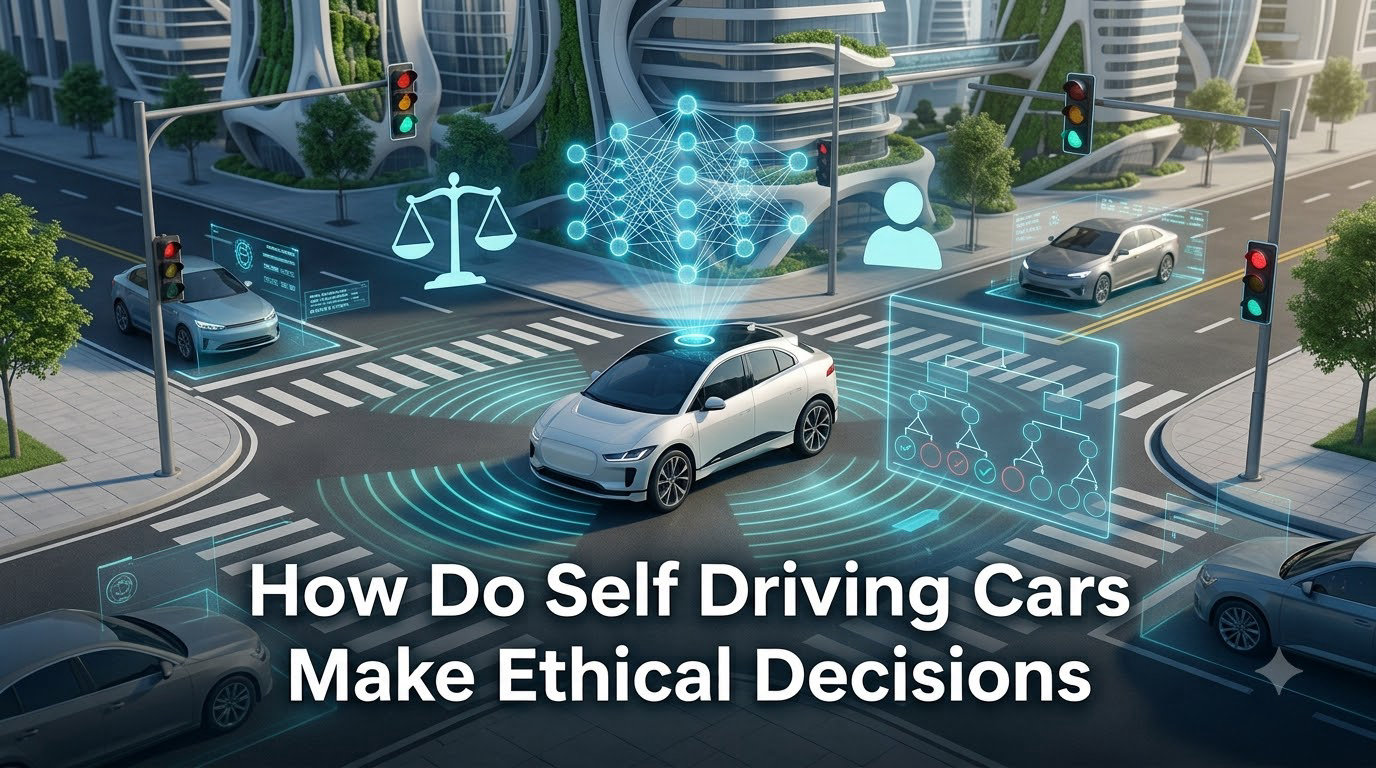
When I first read about the MIT Moral Machine experiment, I spent an hour clicking through impossible choices:swerve into a wall and kill the passenger, or stay the course and hit three pedestrians? Self-driving cars have to answer questions like that in milliseconds, and the answer is rarely simple.
How do self-driving cars make ethical decisions? They combine sensor data, machine learning models, and pre-programmed ethical rules to choose the action that minimizes total harm in any given situation. In this guide, I’ll walk you through the trolley problem as it applies to AVs, the technical pipeline behind every split-second choice, and what the research actually shows about how machines weigh human lives.
Table of Contents
The Ethical Issues of Self-Driving Cars Explained
The ethical issues of self-driving cars go far beyond the famous trolley problem. They touch on liability, fairness, transparency, and how we want a machine to value one human life against another.
Why Ethics Matter for Autonomous Vehicles
Every year, roughly 1.19 million people die in road traffic crashes worldwide, according to the World Health Organization. Autonomous vehicles promise to cut that number dramatically, but the way they reduce harm is itself a moral question. A human driver makes instinctive, sometimes flawed choices. An AV makes calculated, transparent, and reproducible decisions. That shift turns private moral judgment into public code.
When a car is driving itself, three groups are affected by every choice: the passenger inside, the people outside, and society at large. Each group has different stakes, and the car has to balance them without a human at the wheel.
Core Categories of Ethical Concerns
Researchers at Stanford HAI and the NIH group the ethical questions into four buckets. First, the moral dilemmas around unavoidable crashes: who does the car protect when it cannot protect everyone? Second, the question of risk distribution across society. Third, the question of who bears legal liability when the algorithm chooses. Fourth, the broader issue of consent: do passengers and pedestrians have a say in how a car decides?
Each bucket has its own research literature, and none of them have a clean answer yet. That’s exactly why this topic matters for anyone who will share a road with an autonomous vehicle in 2026 and beyond.
How the Trolley Problem Relates to Self-Driving Cars
The trolley problem is a thought experiment first published by philosopher Philippa Foot in 1967. It asks whether you would pull a lever to redirect a runaway trolley, killing one person to save five. It became the central metaphor for AV ethics because it forces programmers to put a number on a human life.
The Classic Trolley Problem
In the original version, a runaway trolley is heading toward five people tied to the track. You stand next to a lever. Pull it, and the trolley switches to a side track where one person is tied. Most people say they would pull the lever. The math is simple: one death is better than five.
But add a twist. Instead of pulling a lever, you have to push a large man off a bridge to stop the trolley. The math is identical, yet most people refuse. The difference is emotional, not mathematical, and that gap is the entire reason the trolley problem matters for AVs.
Why It Applies to Autonomous Vehicles
An AV faces trolley-style choices every time it brakes too late to avoid a collision. Swerve left, hit a mother with a stroller. Swerve right, hit a barrier and risk the passenger. Brake hard, hit the pedestrian in the crosswalk. These are the scenarios engineers have to code for, even if they never become headline news.
Unlike a human driver, an AV cannot rely on instinct. Its decision must be defensible, repeatable, and ideally defensible in court. That requirement is what turned a 60-year-old philosophy puzzle into an engineering specification.
MIT Moral Machine Research
In 2016, MIT researchers built the Moral Machine, a website that presented millions of users with 13 hypothetical crash scenarios. By 2018, they had collected 40 million decisions from 233 countries and territories. The data showed clear patterns: respondents preferred sparing humans over pets, preferred many lives over few, and preferred sparing the higher-status occupants.
More striking were the cultural differences. People in Latin American countries were more likely to spare jaywalkers. People in East Asian countries were more likely to spare the elderly. People in Western countries put more weight on sparing the lawful. None of these patterns is “correct” in a universal sense, which is exactly the problem programmers face when they try to encode ethics into a single vehicle.
How Self-Driving Cars Actually Make Decisions in Real Time
The phrase “ethical decision” makes AVs sound like philosophers on wheels. In practice, the decision is a chain of engineering calculations running in milliseconds. Here is what actually happens from the moment a pedestrian steps into the crosswalk to the moment the car chooses a path.
The Technical Decision Pipeline
Step 1: perception. Cameras, radar, and lidar capture the environment in real time. The car’s computer identifies every object, classifies it (pedestrian, cyclist, vehicle, debris), and tracks its motion.
Step 2: prediction. Machine learning models forecast where each object will be in 0.5, 1, 2, and 5 seconds. The pedestrian keeps walking or stops? The oncoming truck swerves or holds its lane? The model assigns probabilities to each outcome.
Step 3: trajectory planning. The car generates multiple candidate paths. Each path is scored on safety, legality, comfort, and efficiency.
Step 4: ethical weighting. The path planner applies the ethical rules the manufacturer programmed in. Most companies use a combination of traffic law compliance and a utilitarian risk-minimization layer.
Step 5: actuation. The chosen path is sent to the steering, throttle, and brakes. The car commits.
Sensor Fusion and Object Detection
Sensor fusion is the process of combining data from cameras, radar, and lidar so the car has a single, reliable picture of its surroundings. Cameras read signs and lights. Radar measures speed and distance in poor weather. Lidar builds a 3D point cloud. No single sensor is good enough on its own, and that redundancy is what makes AV perception trustworthy enough to base moral decisions on.
Path Planning and Risk Calculation
Path planning is where the ethical rules actually bite. A planner evaluates each candidate path against a cost function. The function might assign a high cost to hitting a pedestrian, a moderate cost to violating a traffic law, and a lower cost to jarring the passenger. The path with the lowest total cost wins. That cost function is, in effect, the car’s moral philosophy, written in math.
Utilitarian vs Deontological Ethics in AV Programming
Two ethical traditions dominate the conversation about AV programming. Utilitarianism focuses on outcomes and aims to maximize total well-being. Deontology focuses on duties and rules, regardless of outcome. Engineers have to choose between them, and most end up blending the two.
Utilitarian Approach
A purely utilitarian AV would always pick the action that minimizes total harm, even if that means breaking a traffic law or sacrificing the passenger. If braking hard kills one pedestrian but continuing kills three, the utilitarian car brakes. The math wins.
Critics argue this approach treats people as interchangeable variables. It also creates a perverse incentive: a utilitarian car might make a dangerous maneuver because it predicts a better outcome, even when the prediction is uncertain.
Deontological Approach
A deontological AV follows rules strictly. It never runs a red light, never crosses a double yellow line, and never exceeds the speed limit, even if breaking a rule would save lives. The rules are the rules, and the car obeys them.
Critics argue this approach can be monstrous in edge cases. A car that refuses to swerve to avoid a child because swerving would cross a line is a difficult moral outcome. Most ethicists think a pure deontological approach is too rigid for driving.
Hybrid Models in Practice
Real AVs use a hybrid. The default behavior follows traffic law and a strict safety hierarchy (protect humans, then property, then convenience). When an unavoidable collision is imminent, a secondary layer of utilitarian-style risk minimization kicks in. This is what most manufacturers describe as “risk minimization” in their public safety reports, and it is the closest thing the industry has to a shared ethical standard.
Real-World Collision Scenarios AVs Must Navigate
Philosophers love the trolley problem. Engineers love the edge cases that show up at 35 mph in a school zone. Here are the most common scenarios an AV has to handle, and how the decision logic tends to play out.
Pedestrian vs Passenger Dilemmas
This is the classic trolley setup. A pedestrian steps out from behind a parked car, and braking distance is insufficient. The AV has to choose between hitting the pedestrian or swerving into a barrier that may injure the passenger. Most manufacturers program the car to swerve if the barrier is empty and braking is futile, but the passenger is rarely told about this priority in the owner’s manual.
Unavoidable Crash Scenarios
Sometimes there is no good option. A child runs into the road, the oncoming lane is a truck, and the shoulder is a ditch. The car has to pick. In these cases, the AV’s decision is determined by which object has the highest safety score in its risk model. Pedestrians almost always win over roadside objects, but the margin is software-defined, not human-defined.
Edge Cases in Daily Driving
Most ethical decisions are quieter than the trolley problem. Should the car inch forward at a four-way stop to claim right-of-way? Should it speed up to clear a yellow light? Should it block an aggressive merge? Engineers call these “implicit ethics,” and they happen thousands of times per trip. They are also the cases where different manufacturers diverge most sharply.
How Waymo, Tesla, and Cruise Approach Ethics Differently
No two companies program their cars identically. Waymo, Tesla, and Cruise have all published safety frameworks, and the differences reveal a lot about how each company thinks about ethics.
Waymo’s Conservative Approach
Waymo’s system is built around a detailed 3D map of every route it drives. That pre-mapping lets the car know what to expect, which makes it more conservative in ambiguous situations. Waymo cars tend to yield more often, brake earlier, and refuse maneuvers that other systems would attempt. The trade-off is smoother rides in mapped cities, limited geographic reach, and an ethical posture that prioritizes caution over efficiency.
Tesla’s Vision-First Strategy
Tesla’s Autopilot and FSD rely almost entirely on cameras, with no lidar and no pre-built maps. The car has to interpret everything from raw video in real time. That makes Tesla’s ethical decisions more reactive and harder to predict. The company argues that vision is closer to how humans drive. Critics point out that vision-only systems struggle in poor weather and unusual lighting, which raises the cost of every ethical choice the car has to make.
Cruise and Industry Variation
Cruise, Zoox, and other robotaxi companies have generally followed a hybrid model. They use lidar plus cameras, deploy in limited urban areas, and rely on remote operators for edge cases. Each company’s safety report is slightly different, but the ethical pattern is similar: minimize harm, follow traffic law, defer hard calls to the remote operator when possible. The variation is in the details, not the philosophy.
Legal and Liability Considerations in AV Crashes
When a self-driving car crashes, the legal system is often the last place to catch up. Liability, regulation, and insurance are all still being defined, and the answers are different in every state and country.
Who Is Liable
In most current US jurisdictions, the manufacturer is liable when an AV’s autonomous system causes a crash while operating in self-driving mode. Passengers are generally not held responsible, because they are not driving. Pedestrians and other drivers can still file claims, and the burden usually falls on the company that deployed the system. That is why companies like Waymo carry billions in liability coverage.
Current Regulatory Landscape
As of 2026, the US federal government has issued the Automated Vehicle Transparency and Safety Act framework, and individual states have layered their own rules. California requires a permit for robotaxi deployment, Arizona allows them with fewer restrictions, and Texas sits in between. The patchwork means the same car can be legal in one city and banned in the next, which complicates ethical standardization.
Insurance Implications
Insurance is the quiet driver of ethical decisions. Most AV policies now write premiums based on the manufacturer’s safety record, not the individual owner. That shifts accountability toward the company, which in turn puts pressure on engineers to build cars that are demonstrably safe, not just cars that feel safe. The result is a market incentive that pushes ethical decisions toward caution.
Cultural Differences in Ethical Preferences
The MIT Moral Machine study made one thing obvious: there is no global consensus on how a car should weigh human lives. Cultural background shapes moral intuition, and that has direct consequences for AV programming.
Regional Variations in Moral Choices
The Moral Machine data showed that respondents in collectivist cultures placed more weight on saving groups, while respondents in individualist cultures placed more weight on saving the lawful. Respondents in countries with high inequality were more accepting of sparing the higher-status person. None of these patterns is universal, and most countries showed internal disagreement.
For a globally deployed AV manufacturer, this is a serious problem. The same code cannot satisfy every market without alienating someone. Some companies have responded by making ethical parameters region-specific, which is itself an ethical choice.
Why One-Size-Fits-All Programming Is Hard
Even within a single country, ethical preferences vary by age, income, and politics. A car that minimizes total harm might please an ethicist and anger a parent. A car that strictly follows traffic law might please a lawyer and frustrate an emergency room doctor. There is no neutral design, which is why researchers increasingly argue for transparency: let people see the rules their car follows, even if they cannot change them.
Frequently Asked Questions
What are the ethical issues of self-driving cars?
The main ethical issues of self-driving cars are how the car should choose between harming different people in an unavoidable crash, who is legally liable when the system causes harm, how risk is distributed across society, and whether passengers and pedestrians have any say in the rules the car follows. Researchers group these into four categories: moral dilemmas, risk distribution, liability, and consent.
How does the trolley problem relate to self-driving cars?
The trolley problem relates to self-driving cars because it forces engineers to put a number on a human life. In an unavoidable crash, the car has to choose between actions that harm different people in different ways. The trolley problem is the clearest way to think through that trade-off, even though real driving involves much messier scenarios than the classic version.
What ethical dilemmas do self-driving cars face?
Self-driving cars face ethical dilemmas like the pedestrian vs passenger choice, swerving into oncoming traffic to avoid a cyclist, choosing between hitting a jaywalker and risking the passenger, and edge cases like how to behave at a four-way stop. Most of these happen at low speed, but the high-profile cases involve unavoidable crashes at higher speeds.
Who is liable if a Waymo crashes?
In most US jurisdictions, Waymo is liable when its autonomous system causes a crash while operating in self-driving mode. The passenger is generally not held responsible because they are not driving. Waymo carries large liability policies to cover these claims, and the legal framework is still evolving as more crashes occur.
Are self-driving cars statistically safer than human drivers?
Early data from Waymo and Cruise suggests self-driving cars are involved in fewer serious crashes per mile than human drivers, especially in mapped urban areas. However, the comparison is not yet definitive because AVs drive in easier conditions and fewer miles overall. The honest answer is that AVs look promising in 2026, but the data is still maturing.
Can self-driving cars truly make moral decisions?
Self-driving cars can apply programmed ethical rules to a situation, but they cannot reason about morality the way humans do. They follow a cost function that engineers have written. That is a kind of moral decision, but it is more like following a recipe than deliberating about right and wrong. Most ethicists treat AV ethics as applied ethics, not true moral agency.
The Future of Self-Driving Car Ethics
How self-driving cars make ethical decisions will keep evolving long after the technology stabilizes. Engineers will refine the cost functions, regulators will tighten the rules, and society will keep arguing about whose values get encoded into the vehicle. The MIT Moral Machine showed that humans do not agree on these questions, so the cars we build will always reflect someone’s idea of the right answer.
If you want to follow this space, watch the published safety reports from Waymo, Cruise, and Tesla, the rulemaking from NHTSA, and the academic work coming out of Stanford HAI and the MIT Media Lab. Each one tells you a little more about how machines are being asked to make decisions that humans have struggled with for centuries.