
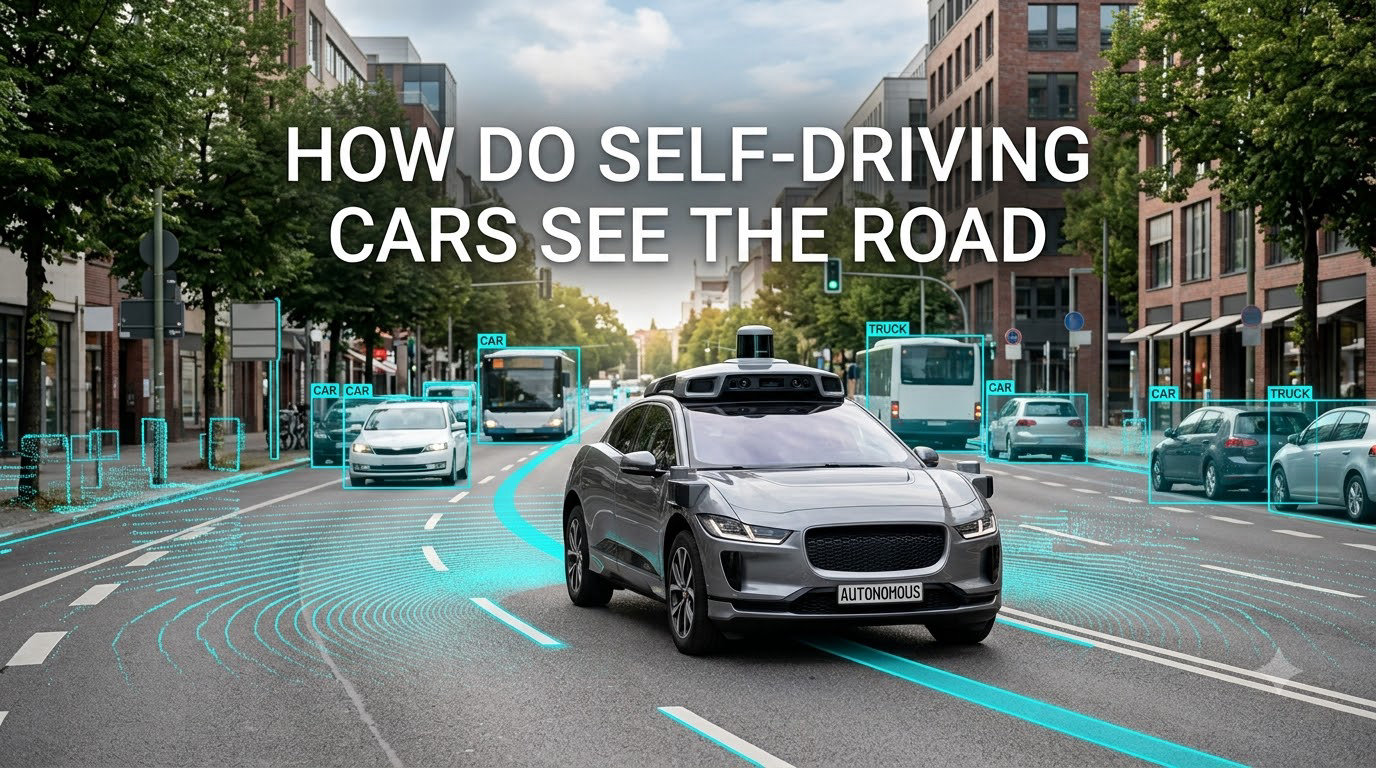
Self-driving cars see the road by combining cameras, lidar sensors, and radar systems that work together to build a real-time 3D map of their surroundings. Cameras capture visual details like traffic lights and lane markings. Lidar fires millions of laser pulses per second to measure exact distances. Radar uses radio waves to track objects and their speed in any weather. Software called sensor fusion merges every input into one picture the car’s brain can act on, often faster than a human can blink.
I have spent weeks reading engineering papers, talking to AV researchers, and reviewing public crash data to put this guide together. If you have ever wondered how an autonomous vehicle actually makes sense of a busy intersection, here is the full picture.
Table of Contents
How Self-Driving Cars Perceive the Road Through Multiple Sensors
Self-driving car perception is a layered problem that no single sensor can solve on its own. Each technology has blind spots, so autonomous vehicles stack multiple sensing methods and let software reconcile them in real time.
Most modern self-driving cars rely on a core sensor suite of cameras, lidar, and radar, with ultrasonic sensors and GPS filling in the gaps. A typical test vehicle from Waymo, Cruise, or Pony.ai carries between 20 and 40 individual sensors mounted around the chassis.
Together, these sensors answer four questions a driver must answer every second: where am I, what is around me, what is moving, and what should I do next. We will unpack each sensor in the sections below.
Camera Systems: The Eyes of Autonomous Vehicles
Cameras are the closest analog to human eyes in a self-driving car sensor stack. Most autonomous vehicles use an array of high-resolution cameras placed around the vehicle to capture a 360-degree view of the road.
A typical setup includes a narrow forward camera for long-range detection up to 250 meters, wide-angle cameras for intersections, and side and rear cameras to cover blind spots. The combined video feed runs at 30 to 60 frames per second, generating gigabytes of data per minute.
Computer vision algorithms then process this stream to recognize lane markings, traffic signs, traffic lights, pedestrians, cyclists, and other vehicles. Tesla’s vision-only approach, for example, leans almost entirely on cameras combined with neural networks.
The strength of cameras is detail. They read text on signs, distinguish colors of brake lights, and interpret the same visual cues human drivers use. The weakness is that cameras struggle in low light, heavy rain, fog, snow, and direct glare from the sun.
Lidar: Laser-Based 3D Mapping Technology
Lidar, short for Light Detection and Ranging, is one of the most talked-about self-driving car sensors. It works by firing tens of millions of laser pulses per second and measuring how long each pulse takes to bounce back from nearby objects.
Each returning pulse becomes a point in a 3D map called a point cloud. By spinning the laser array, usually on a rooftop unit, lidar builds a precise 360-degree scan of everything within roughly 200 meters. The resulting point cloud can identify the shape of a pedestrian, the distance to a curb, or the height of a highway overpass down to a few centimeters.
Waymo’s fifth-generation Driver system uses a combination of short-range and long-range lidars. The short-range unit sees close objects in detail, while the long-range unit spots vehicles and obstacles at highway speeds.
Lidar works in complete darkness because it provides its own light source, and it cuts through most weather better than cameras. Heavy fog and snow still scatter the laser pulses, which is why lidar is almost never used alone. It is also expensive, although solid-state lidar units have dropped the cost from tens of thousands of dollars to a few hundred.
Radar Systems: Radio Wave Detection in Self-Driving Cars
Radar has been used in cars for adaptive cruise control since the late 1990s, and it remains a core part of any self-driving car sensor stack. Radar sends out radio waves and listens for the echo to determine an object’s distance, angle, and speed.
The biggest advantage of radar is reliability in poor weather. Radio waves pass through rain, fog, snow, and dust that would confuse a camera or weaken a laser. Modern automotive radar can detect a vehicle several hundred meters away and measure its closing speed within a few kilometers per hour.
There are two main types. Long-range radar, usually mounted behind the front grille, handles highway driving and emergency braking. Short-range radar covers blind spots and supports lane-change assist.
Radar cannot read signs or recognize a child’s face, so it works in concert with cameras and lidar. Companies like Mobileye and Arbe are now rolling out imaging radar that combines wider bandwidth with finer resolution, closing the gap on detailed object recognition.
Ultrasonic Sensors and GPS: Supporting Perception
Ultrasonic sensors and GPS are the supporting cast in self-driving car perception, but they handle tasks the main sensors cannot.
Ultrasonic sensors emit high-frequency sound waves to detect objects very close to the vehicle, typically within a few meters. They are cheap, reliable, and perfect for parking, low-speed maneuvers, and detecting curbs and nearby pedestrians when creeping through traffic.
GPS, often paired with an inertial measurement unit (IMU), gives the car a global position. On its own, standard GPS is only accurate to about 2 to 5 meters, which is not precise enough to know which lane a car is in. Self-driving cars combine GPS with high-definition maps and odometry to localize within a few centimeters.
Sensor Fusion: How Self-Driving Cars Combine Multiple Data Sources
Sensor fusion is the brain of a self-driving car, the software layer that takes raw data from every sensor and turns it into one coherent picture of the world. Without it, the sensors would just be a pile of conflicting inputs.
Most teams use a technique called Kalman filtering, sometimes extended with particle filters, to predict where objects should be in the next frame and correct that prediction using new sensor data. The result is a tracked list of objects, each with a position, velocity, classification, and a confidence score.
Here is roughly how the process works in a single perception cycle:
- Each sensor reports raw detections on its own clock, often at different rates.
- Time-stamping aligns the data so the system knows which camera frame matches which radar hit.
- Objects from each sensor are correlated by location, motion, and shape.
- A unified track is created for every object, with the strongest sensor filling in the gaps left by the others.
- The fused output is fed to the planning module, which decides steering, throttle, and braking.
When sensors disagree, the system uses confidence weights and safety rules to break the tie. If a camera sees a plastic bag but radar sees nothing, the car usually trusts the radar and keeps moving. If both sensors agree, the system commits to the object and plans around it.
Computer Vision and Machine Learning in Autonomous Driving
Behind every camera is a stack of deep learning models that turn pixels into meaning. Object detection networks such as YOLO, CenterNet, and transformer-based architectures identify cars, pedestrians, and cyclists in real time.
Semantic segmentation goes one step further by labeling every pixel in an image, so the car knows exactly which pixels are road, sidewalk, sky, or vegetation. Lane detection networks draw precise lane boundaries even when markings are faded.
These models are trained on millions of miles of driving data, then validated against rare edge cases. Tesla, Waymo, and Cruise all operate large data centers where fleets continuously upload driving footage for retraining.
On top of perception, a behavior prediction model forecasts what other drivers, cyclists, and pedestrians will do in the next few seconds. A pedestrian stepping off the curb at a crosswalk gets a different predicted trajectory than one standing on a corner talking on a phone.
Challenges and Limitations of Self-Driving Car Vision
Even with all of this technology, self-driving cars still face real problems. The biggest issue is handling rare and unusual situations that human drivers handle with intuition.
Weather Conditions and Sensor Performance
Weather remains one of the toughest problems in self-driving car perception. Heavy rain, snow, and fog scatter lidar lasers, wash out camera contrast, and occasionally fool radar with reflections from the road surface. Waymo has openly admitted that its system struggles in Phoenix dust storms and San Francisco fog.
Engineers counter this with sensor cleaning systems, heated sensor housings, redundant sensor coverage, and trained weather models. The honest answer is that no current system matches human flexibility in a blizzard.
Edge Cases That Test Autonomous Perception
Edge cases are the long tail of driving, the rare moments that do not show up in most training data. Examples include construction zones with hand signals, a mattress falling off a truck, a child chasing a ball, or a flock of birds crossing the road.
Each of these scenarios requires a perception system to correctly classify the situation and predict what will happen next. A 2025 study from the Insurance Institute for Highway Safety found that most autonomous vehicle disengagements still happen in these unusual conditions.
Comparing Human Vision to Self-Driving Car Sensors
Humans see with two eyes that have roughly 180-degree forward field of view, dynamic range that handles bright sun and dark shadows, and a brain trained on a lifetime of context. Self-driving cars, in contrast, see with 8 to 40 sensors that cover 360 degrees, never blink, and never get tired, but they lack common sense.
The SAE snippet that ranks first in search puts it well: by combining cameras, radar, and lidar, developers can create a detection system that can see a vehicle’s environment better than a human in narrow, measurable ways, while still losing to humans in unpredictable situations.
The end goal is not to copy human vision but to combine multiple sensing modalities with enough redundancy to drive safely. We are closer to that goal than we were five years ago, but we are not there yet.
Frequently Asked Questions
How do self-driving cars see the road?
Self-driving cars see the road by combining cameras, lidar, and radar sensors that feed data into a sensor fusion system. The fusion software merges every input into a 3D map that the car uses to detect objects, lane markings, and traffic signs in real time.
What sensors do self-driving cars use?
Most self-driving cars use cameras for visual detail, lidar for 3D laser mapping, radar for speed and distance in bad weather, ultrasonic sensors for close-range detection, and GPS plus an IMU for global positioning. Together these sensors cover what no single technology can.
How does lidar work in self driving cars?
Lidar fires millions of laser pulses per second and measures how long each one takes to bounce back from nearby objects. The returning pulses form a 3D point cloud that shows the shape and distance of everything within roughly 200 meters, even in complete darkness.
Can self-driving cars see in the rain?
Cameras lose contrast in heavy rain, lidar pulses scatter, and radar can pick up reflections from the road surface. Modern autonomous vehicles counter this with sensor cleaning, heated housings, and redundant sensing, but heavy weather still degrades performance compared to clear conditions.
What is the biggest problem with self-driving cars?
The biggest problem is handling rare and unusual driving situations that humans solve with intuition, like construction zones with hand signals, unexpected debris, or unpredictable pedestrians. Weather, edge cases, and the difficulty of replicating human common sense remain the leading challenges.
Final Thoughts on How Self Driving Cars See the Road
Self-driving cars see the road by stacking cameras, lidar, and radar, then letting sensor fusion software turn those streams into a 3D understanding of the world. Each technology covers a weakness in the others, which is why no serious autonomous vehicle program relies on a single sensor.
The technology has improved faster in the last five years than in the previous twenty, and the cars of 2026 are far more capable than the prototypes of 2018. Still, the next breakthroughs will come from better edge-case handling, more weather-resilient hardware, and machine learning models that can finally match human intuition in messy real-world driving.
If you want to follow the field, watch the safety reports from Waymo, Cruise, and Mobileye, and pay attention to how regulators treat disengagement data. That is where the real progress in how self-driving cars see the road will show up first.