
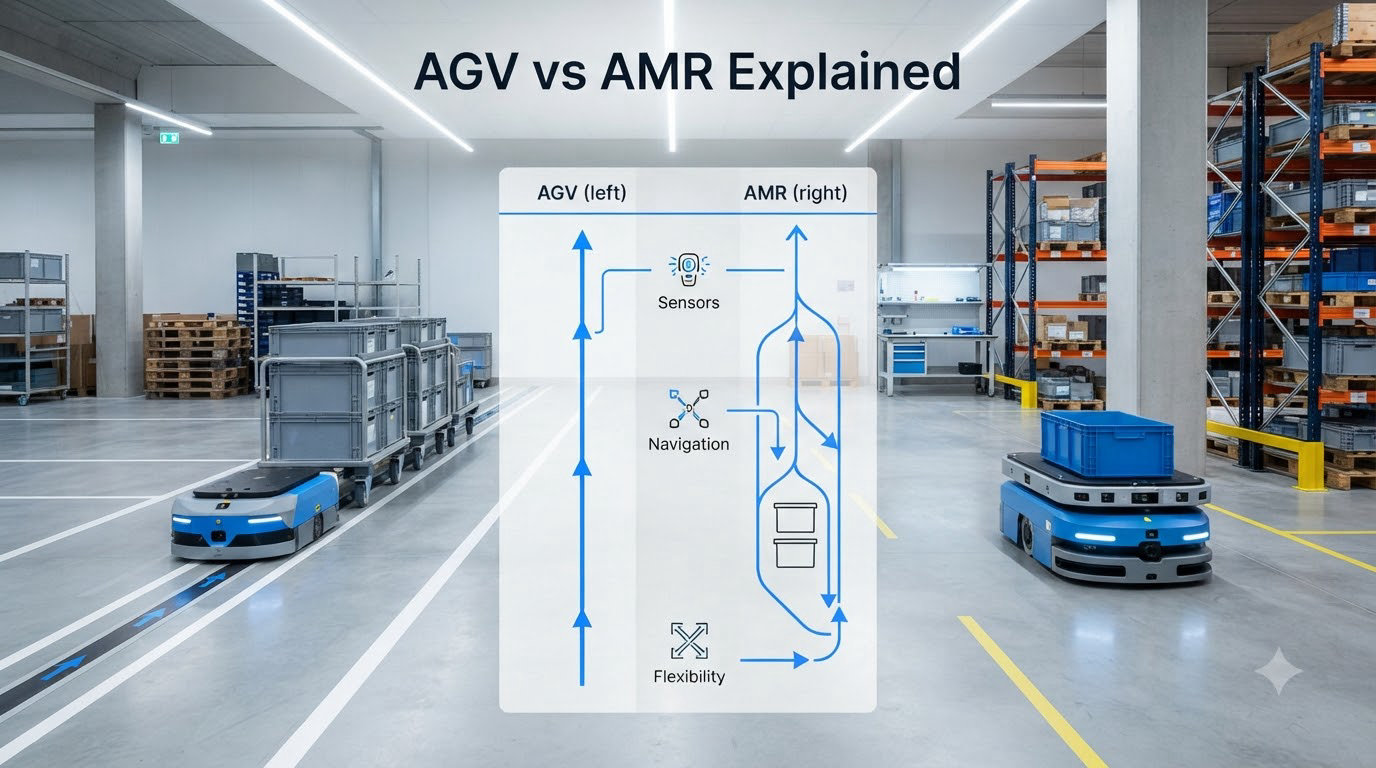
If you are weighing AGV vs AMR for your warehouse or factory floor, you have come to the right place. AGV stands for Automated Guided Vehicle, while AMR stands for Autonomous Mobile Robot. Both move materials without a driver, but they take very different paths to get there, and that difference shapes everything from upfront cost to daily flexibility.
I have spent the last few months talking to operations managers, integrators, and a few Reddit users who actually run these fleets. The short version: AGVs follow fixed infrastructure like rails for materials, while AMRs use sensors and AI to think on the fly. That single distinction drives a chain reaction through cost, setup time, obstacle handling, and ROI. In this guide, I will walk you through what each technology does, where each one wins, and how to decide which fits your operation.
By the end, you will understand the real differences between AGVs and AMRs, what each one costs to deploy, and how to match the right robot to your facility. I will also include a comparison table, specific cost numbers from the field, and answers to the questions people ask most often about warehouse automation.
Table of Contents
What Does AGV Stand For and How Does It Work?
AGV stands for Automated Guided Vehicle. It is a self-propelled vehicle that follows a predetermined path using physical guidance systems embedded in or on the floor. The term dates back to the 1950s, when the first AGVs towed materials through factories on wire-guided tracks. The category has grown since then, but the core idea is the same: a defined route, a defined destination, repeatability.
Modern AGVs use one of three guidance methods. The oldest approach uses inductive wires buried in the floor that the vehicle detects with an antenna. A more common method today is magnetic tape or magnetic strips adhered to the floor surface. The most precise AGV setup uses laser targets mounted on walls and columns, which the vehicle triangulates to determine its position.
AGVs excel at repetitive, high-volume transport between fixed points. A typical setup is a tugger AGV pulling carts from the end of a production line to a staging area, or a unit-load AGV shuttling pallets between two conveyors. The vehicle knows its job because its environment tells it exactly where to go.
The tradeoff is rigidity. Change the route, and you change the floor. I have seen operations managers quote 2 to 4 weeks of downtime to re-lay magnetic tape for a new layout. That is why AGVs work best in stable environments where product flow rarely changes.
Common AGV Types
You will run into a few AGV variants in the wild. Unit-load AGVs carry single pallets or large containers on a flat deck. Tugger AGVs pull trains of carts behind them, common in automotive assembly. Forklift AGVs automate pallet pickup and drop-off using an integrated mast. Finally, hybrid AGV/AMR units are starting to appear, blending fixed-path operation with onboard sensors for limited deviation.
What Does AMR Stand For and How Does It Work?
AMR stands for Autonomous Mobile Robot. It is a self-driving vehicle that understands its environment through onboard sensors, builds and maintains its own map, and plans its own routes in real time. AMRs emerged in the 2010s as the cost of LiDAR sensors dropped and computing power became small enough to mount on a mobile platform.
The sensor stack on a typical AMR includes 2D or 3D LiDAR for distance measurement, depth cameras for object recognition, and sometimes ultrasonic sensors for close-range detection. The vehicle uses SLAM, which stands for Simultaneous Localization and Mapping, to build a map of the facility the first time it runs, then localize itself within that map on every subsequent run.
When an AMR receives a task, its software plans a path, executes it, and adapts on the fly. If a person walks across its route, the AMR stops, recalculates, and takes an alternative path. If a pallet is missing from its pickup location, it flags the issue rather than blocking the aisle. This is the heart of the AGV vs AMR difference: AMRs decide, AGVs follow.
The flexibility comes at a price, both literal and computational. AMRs cost more per unit than AGVs and require more sophisticated software. But they install faster because they do not need any floor infrastructure. Most AMRs go from box to productive work in a few days.
Common AMR Types
AMRs come in several form factors. Mobile manipulators combine a mobile base with a robotic arm for picking tasks. Pallet-moving AMRs handle full pallet loads with integrated forks or lifts. Cart-transport AMRs follow workers through facilities, similar to a robotic assistant. And the newest category, personable AMRs, navigate busy public spaces like hospitals and hotels with social navigation behaviors.
Key Differences Between AGV and AMR
The core differences between AGV and AMR come down to navigation, flexibility, and infrastructure. AGVs follow fixed paths defined by wires, tape, or laser targets in the facility. AMRs create their own paths using onboard sensors and AI. This single difference cascades through every other aspect of deployment.
I put together a quick comparison table to make this concrete. The numbers are general ranges from industry data and user reports, not quotes from any specific vendor.
| Attribute | AGV (Automated Guided Vehicle) | AMR (Autonomous Mobile Robot) |
|---|---|---|
| Navigation | Fixed path (wire, tape, laser targets) | Sensor-based (LiDAR, cameras, SLAM) |
| Setup time | 2-6 weeks for new routes | 2-5 days for full facility mapping |
| Infrastructure | Floor work required (buried wire, tape, reflectors) | None required |
| Obstacle handling | Stops and waits | Detects, plans around, continues |
| Route changes | Requires physical re-installation | Updated via software |
| Upfront cost per unit | Lower | Higher |
| Total cost of ownership | Higher infrastructure cost | Lower installation and change cost |
| Best for | Stable, high-volume routes | Dynamic, mixed-use environments |
| Typical ROI | 12-24 months | 3-12 months |
You will notice the inverse relationship: AGVs look cheaper on the invoice but cost more over time when you factor in floor work, downtime for changes, and dedicated staff. AMRs cost more up front but adapt quickly and need less babysitting.
How AGVs and AMRs Handle Obstacles Differently
Obstacle handling is where the AGV vs AMR difference becomes obvious on the warehouse floor. AGVs operate in protected environments. If a person steps into the AGV’s path, the vehicle stops and waits for the obstruction to clear. It does not have the sensors or software to reroute, so the route stays blocked until someone moves the obstacle.
This behavior creates a well-documented problem in busy facilities. Operations managers on Reddit have described AGV fleets that stop multiple times per shift for blocked paths, each stop requiring manual intervention. In one automotive plant I read about, the AGV fleet needed two full-time staff just to rescue stuck vehicles and clear aisles.
AMRs handle the same situation differently. The onboard LiDAR and cameras detect the person, the path planner calculates an alternate route around them, and the AMR continues its mission. If no alternate route exists, the AMR waits, but it does so without blocking other traffic in a busy aisle.
The obstacle handling gap matters most in facilities with mixed traffic, people, forklifts, and robots sharing the same space. In a sealed AGV-only zone, this difference shrinks. In a real warehouse with people on foot, it grows large enough to change the productivity calculation entirely.
Cost Comparison: AGV vs AMR Total Investment
The honest cost comparison is where most articles fall short, so I will dig into the numbers. Upfront, an AGV costs less per unit than an AMR. A simple tow-tractor AGV starts around half the price of a comparable AMR, before counting installation. But that gap reverses when you add up total cost of ownership.
Reddit users running small AMR fleets report initial costs between $120k and $200k for 2 to 3 units, before integration and software. The integration step often adds 20-30% on top of the hardware. For AGVs, the hardware might be cheaper, but the floor work adds up fast. A single facility with 5-10 routes can spend $50k-$150k on magnetic tape installation or wire burial alone.
Then there is the staff cost. AGV fleets in busy environments typically need dedicated operators or rescue staff. Users report 1-2 full-time equivalents per shift to keep AGVs moving. AMRs, with their autonomous obstacle handling, run with much less human intervention, often a single fleet manager per shift regardless of fleet size.
ROI timelines diverge sharply because of these factors. AGV projects typically take 12-24 months to pay back through labor savings. AMR projects often hit positive ROI in under 6 months, with some operations reporting payback in as little as 3 months when labor savings are tallied honestly.
Hidden Costs to Watch For
A few hidden costs catch first-time buyers off guard. AGV integration with warehouse management systems (WMS) often requires custom middleware, which can run six figures. AMR software subscriptions are sometimes priced per robot per month, adding recurring cost to the higher upfront price. Both technologies require periodic sensor calibration and software updates, though AMRs generally update over the air while AGVs may need vendor service visits.
Setup and Infrastructure Requirements
AGV setup is a construction project. Installing wire-guided paths means cutting trenches in the concrete, laying wire, and resurfacing. Magnetic tape installation is faster but still requires careful floor prep, accurate placement, and curing time. Laser-guided AGVs avoid the floor work but require mounting reflectors at precise locations on walls and columns, plus a survey of the facility.
AMR setup looks more like onboarding a new employee. You unbox the robot, walk it through the facility to build a map, define pickup and drop-off points in the software, and start running missions. Most AMRs are productive within 2-5 days of arrival, even in complex environments.
This setup difference matters most in leased buildings. If you cannot cut into the floor or you might relocate in 2-3 years, AGVs become a poor fit. AMRs leave no permanent mark on the building, which is why you see them more often in third-party logistics warehouses and e-commerce fulfillment centers that change layouts frequently.
When to Choose AGV Over AMR (and Vice Versa)
Pick an AGV when your operation is stable, repetitive, and high-volume. If you move the same pallets between the same two points, thousands of times a month, with minimal layout changes, an AGV will run reliably for years. Automotive assembly lines, paper mills, and large beverage plants are classic AGV territory.
Pick an AMR when your operation is dynamic, mixed-traffic, or evolving. If product flow changes seasonally, if people and forklifts share the same space, or if you anticipate growth that will require new routes, an AMR pays for itself faster. E-commerce fulfillment, third-party logistics, and any facility running mixed SKU inventory lean AMR.
Consider a hybrid approach when neither fits cleanly. Some operations run AGVs on their longest, most repetitive routes and AMRs in the dynamic zones, with handoffs at fixed transfer points. This combination captures the per-trip cost advantage of AGVs in stable areas and the flexibility of AMRs where it matters.
Decision Checklist
Ask these questions before you commit. Does your product flow change more than twice a year? If yes, lean AMR. Are your routes longer than 100 meters with no obstacles? If yes, lean AGV. Do people regularly walk through the robot’s path? If yes, AMR. Is your floor sealed concrete you can cut into? If no, AMR. Do you have stable power and network coverage throughout the facility? If no, AGVs may be more predictable.
Industry Applications and Real-World Examples
Warehouse automation drives the most AMR adoption, but the technology spreads across industries. In automotive manufacturing, AGVs have delivered parts to assembly lines for decades, and they remain the right tool for that job. In e-commerce fulfillment, AMRs dominate because order profiles change daily and the same floor needs to support thousands of SKUs.
Cold chain logistics is a newer AMR frontier. Cold storage facilities, where temperatures hover around -20C, are hard on battery-powered equipment but ideal for AMRs because no floor modifications are needed. Reddit users in cold chain report rapid AMR adoption for this reason.
Healthcare and hospitality use personable AMRs for linen delivery, meal transport, and supply restocking. These AMRs navigate around visitors and staff, which AGVs simply cannot do. Manufacturing transport for line-side delivery is split: heavy pallet flow stays AGV, while kitted parts and totes increasingly move on AMRs.
Some of the biggest names in industrial robotics fall into the so-called Big 4 of robotics: ABB, KUKA, FANUC, and Yaskawa. These companies make stationary robotic arms, not mobile robots, but their customers increasingly pair those arms with mobile platforms from AGV and AMR vendors to create flexible cells.
Safety Standards and Integration with WMS
Both AGVs and AMRs must meet ISO 3691-4 for driverless industrial trucks. This standard covers safety-rated stop circuits, obstacle detection, audible and visual warnings, and emergency stop behavior. Vendors that ship to North America also meet ANSI/ITSDF B56.5. Make sure any vendor you evaluate provides documentation of these certifications.
Integration with warehouse management systems (WMS) and enterprise resource planning (ERP) platforms is where many projects stumble. AGVs typically integrate through vendor-specific middleware that translates between the WMS and the AGV fleet manager. AMRs often support open APIs and standard protocols, which can shorten integration time, but the depth of integration still depends on the WMS vendor.
The software stack running on the robot matters too. ROS, the Robot Operating System, is common in research and prototype deployments. ROS2 is increasingly used in commercial AGV and AMR fleets because it offers better real-time performance and security. If you plan to develop custom behaviors or integrate with other robotics, ask vendors about ROS2 support.
The Future of AGV and AMR Technology
Both technologies are converging, but from different directions. AGVs are gaining sensors and AI to handle more dynamic environments, evolving into what some call smart AGVs. AMRs are gaining heavier payload capacity and tighter fleet coordination, pushing into traditional AGV territory.
Sensor fusion is the underlying trend. Modern AMRs combine 2D LiDAR, 3D depth cameras, inertial measurement units, and wheel odometry to localize with centimeter accuracy. As the cost of these sensors drops, expect even smaller AMRs with similar capabilities to enter the market.
Fleet intelligence is the other frontier. The next generation of fleet managers uses AI to predict traffic congestion, balance battery charging across the fleet, and reroute proactively when an obstacle appears on the map. Continuous learning means the fleet gets smarter the longer it runs, which compounds the ROI advantage over fixed-path AGVs.
For anyone evaluating warehouse automation in 2026, the choice between AGV and AMR is less about which technology is newer and more about which one matches your operation. Stable, high-volume routes still favor AGVs. Anything dynamic, mixed-traffic, or evolving tilts toward AMRs, and that gap will keep widening as AMR software matures.
Frequently Asked Questions
What is the difference between AMR and AGV?
The main difference between AMR and AGV is navigation. AGVs (Automated Guided Vehicles) follow fixed paths defined by wires, magnetic tape, or laser targets in the floor or walls. AMRs (Autonomous Mobile Robots) use onboard sensors like LiDAR and cameras to map their environment and plan routes in real time, with no floor infrastructure required.
What does AGV stand for?
AGV stands for Automated Guided Vehicle. It is a self-propelled vehicle that follows a predetermined path using physical guidance systems like inductive wires, magnetic tape, or laser targets. AGVs are widely used in manufacturing and warehousing for repetitive material transport tasks.
What does AMR stand for?
AMR stands for Autonomous Mobile Robot. It is a self-driving mobile robot that uses onboard sensors, SLAM mapping, and AI path planning to navigate dynamic environments without following a fixed path. AMRs detect and avoid obstacles in real time.
Are AGVs the same as AMRs?
No, AGVs and AMRs are not the same, even though both move materials autonomously. AGVs follow fixed paths and need infrastructure like wires or magnetic tape, while AMRs navigate freely using sensors and software. This makes AMRs more flexible but AGVs more predictable in stable environments.
How much do AMR robots cost?
AMR robots typically cost between $40,000 and $100,000 per unit depending on payload capacity, sensor configuration, and software features. A small initial fleet of 2-3 AMRs usually runs $120,000 to $200,000 before integration costs, which can add another 20-30% on top. Despite the higher upfront cost, AMRs often deliver ROI in under 6 months through labor savings and reduced infrastructure.
Can you give me an example of an AGV?
A common example of an AGV is a unit-load vehicle that shuttles pallets between a production line and a warehouse staging area in a beverage plant. Other examples include tugger AGVs that pull trains of carts in automotive assembly, and forklift AGVs that automate pallet pickup and drop-off in distribution centers.
Final Verdict: Which One Is Right for You?
Choosing between AGV vs AMR comes down to your operation, not the technology. If your routes never change and your traffic is segregated, an AGV is a proven, lower-upfront solution that will run reliably for years. If your facility evolves, your traffic mixes with people, or you cannot modify the floor, an AMR will pay for itself faster and adapt as you grow.
My recommendation is to start by mapping your product flow honestly. Count how many trips per day run between the same two points, how often your layout changes, and how much human traffic crosses the robot’s path. Run those numbers against the cost ranges I gave above, and the right answer usually shows up quickly. For most growing operations in 2026, that answer is increasingly AMR, but the AGV is far from obsolete in the right environment.
Ready to dig deeper? Check our coverage of warehouse automation, mobile robot fleets, and material handling systems to see which vendors and platforms are leading the field this year.