
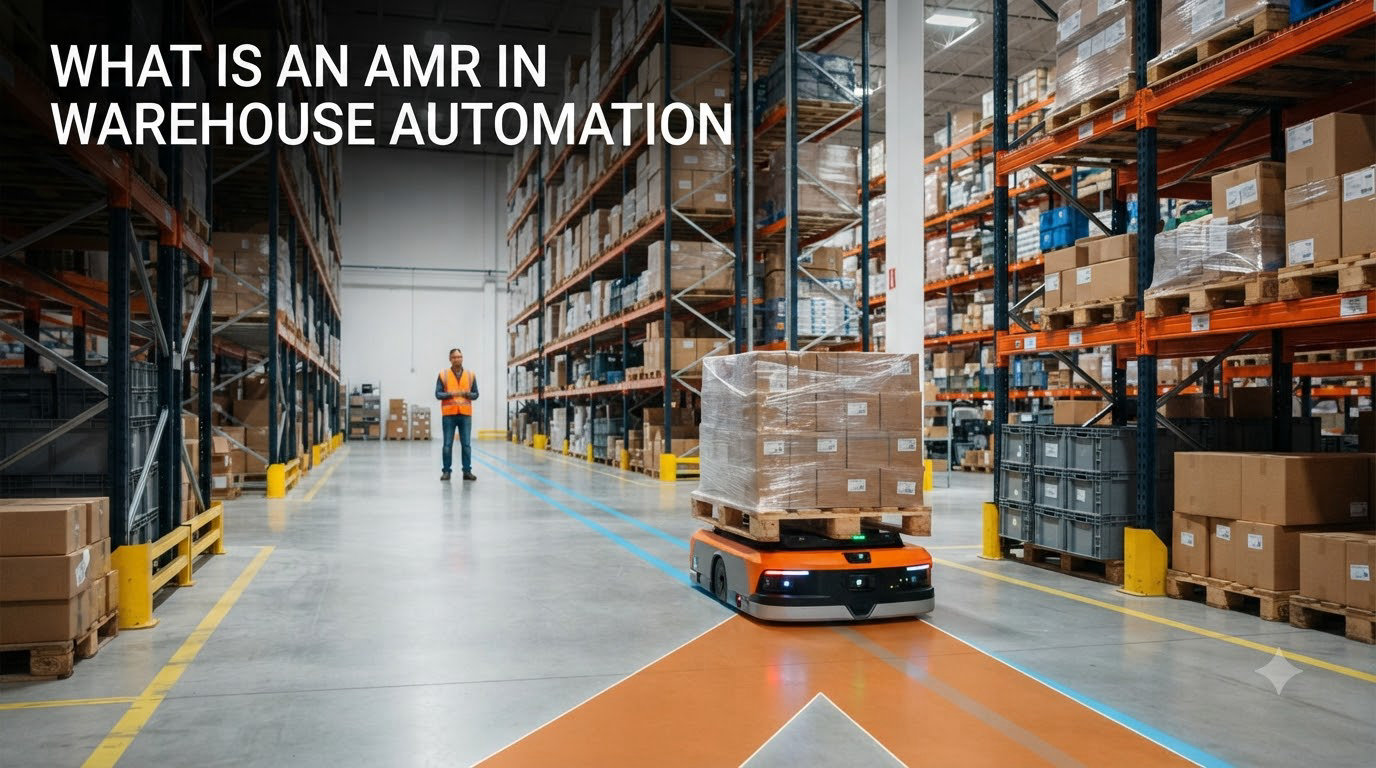
An AMR (Autonomous Mobile Robot) in warehouse automation is a self-navigating robot that uses sensors, cameras, and onboard AI to move materials and goods inside a facility without following fixed paths or needing a human driver. Unlike older guided vehicles, AMRs read their surroundings in real time, plan their own routes, and reroute around obstacles on the fly.
I have spent the last several months talking to warehouse operators, integrators, and AMR vendors while writing about warehouse robotics for Smashing Robotics. The short version: AMRs are no longer experimental. They are the fastest-growing segment of intralogistics, and if you operate a distribution center, you have probably already felt the pressure to evaluate them. This guide explains what an AMR is, how it works, and where it actually fits in a modern warehouse.
Table of Contents
What Is an AMR in Warehouse Automation?
An AMR, or Autonomous Mobile Robot, is a mobile robot that uses onboard sensors, mapping, and decision-making software to move through a warehouse without being tied to a fixed path such as a magnetic strip, wire, or rail. The acronym AMR stands for Autonomous Mobile Robot, and the term covers everything from small goods-to-person picking bots to heavy-duty pallet movers.
In practical terms, an AMR is any wheeled robot that can drive itself from point A to point B in a working warehouse while carrying a payload, avoiding people and equipment, and adapting to changes in the environment. You can think of it as the warehouse equivalent of a self-driving car, just scaled down and built for shelves, totes, and pallets.
The market definition matters because vendors and trade groups draw a sharp line between AMRs and AGVs (Automated Guided Vehicles). If you remember nothing else, remember this: AGVs follow infrastructure, AMRs follow maps they build themselves.
How Do AMRs Navigate in a Warehouse?
AMRs navigate using a combination of LiDAR, 2D and 3D cameras, IMUs, and wheel odometry, all fused together by an onboard computer running a SLAM algorithm. SLAM stands for Simultaneous Localization and Mapping. The robot builds a map of the warehouse the first time it drives around, then localizes itself inside that map every time it moves.
When a warehouse management system sends an AMR a new task, three things happen in roughly this order:
- The robot localizes itself in the existing map to within a few centimeters.
- The fleet manager calculates the optimal route, factoring in traffic, battery state, and task priority.
- The AMR drives the route, using its sensors to detect and avoid anything that was not in the map, from a fallen box to a worker walking through an aisle.
Sensor fusion is what makes this work in the real world. LiDAR gives long-range distance, cameras read signs, labels, and QR markers, and the IMU tracks tilt and acceleration. Combined, they let an AMR operate in dynamic warehouses where racks, pallets, and people are constantly moving.
Modern AMRs also use machine vision to read labels, identify the right tote, and confirm a pick. This is a big step up from older AGVs, which only knew where they were in physical space, not what they were carrying.
Key Components of an AMR
Every AMR is built from the same basic stack of hardware and software. If you are evaluating a vendor or planning a deployment, these are the parts to ask about.
- Sensors: LiDAR for 360-degree scanning, depth cameras for object recognition, safety bumpers, and wheel encoders.
- Onboard computer: A small industrial PC or system-on-module that runs the navigation stack and the safety PLC.
- Software stack: SLAM, fleet management, task dispatcher, and a REST or MQTT interface to your WMS or ERP.
- Power system: Almost always lithium-ion today, though some legacy fleets still use lead-acid. We compared the tradeoffs in our guide to battery options for warehouse AMR robots.
- Payload interface: Rollers, conveyors, lift tops, or cart hitches depending on the use case.
- Wireless radios: Wi-Fi for fleet communication, plus optional 5G or private cellular on newer units.
The fleet manager is the unsung hero. It runs on a server (or increasingly in the cloud) and tells each AMR what to do next. Without it, you do not have a fleet, you have a collection of very expensive paperweights.
AMR vs AGV: What’s the Difference?
The AMR vs AGV question is the single most common one I get from warehouse leaders, and it is the question that shows up most in People Also Ask boxes. The short answer is that AGVs follow fixed paths and AMRs choose their own.
Here is a more detailed comparison across the dimensions that matter most for warehouse planning.
- Navigation: AGVs use magnetic tape, wires, or QR codes on the floor. AMRs use LiDAR and SLAM with no floor modifications.
- Flexibility: AGVs need a re-engineering project to change routes. AMRs can be re-routed through software in minutes.
- Installation time: AGV projects can take months because of floor work. AMRs are often running within days of delivery.
- Cost: AGVs are typically cheaper per unit but cost more to install. AMRs have higher unit cost and lower installation cost.
- Safety: Both meet ISO 3691-4, but AMRs generally have richer sensor suites for detecting human workers.
- Best fit: AGVs shine in repetitive, high-volume routes like production line feeding. AMRs shine in mixed, changing environments like e-commerce fulfillment.
If your warehouse has fixed aisles, fixed products, and minimal change, an AGV may still be the right answer. If you re-slot regularly, run multiple SKUs, and deal with seasonal volume swings, an AMR will almost always pay back faster.
Common Warehouse Use Cases for AMRs
AMRs are versatile, but the warehouse use cases that show up most often in real deployments fall into a handful of buckets.
Goods-to-person picking is the biggest one. Small AMRs slide under a shelving unit, lift it, and bring the whole shelf to a stationary picker. This collapses travel time and lets a single picker handle 300 to 600 picks per hour.
Pallet transport is the second biggest. Heavy-duty AMRs with lift tops move finished pallets from picking to staging, from receiving to put-away, or from warehouse to shipping dock. They replace forklifts for repeatable, long-haul moves.
Order picking, sortation, returns processing, and cross-docking are all seeing AMR adoption in 2026. The common thread is that each of these workflows involves a lot of horizontal travel and relatively simple decision-making, which is exactly what AMRs are good at.
Inventory management is a quieter but growing use case. Some AMRs now carry RFID or computer vision payloads that scan shelves while driving, giving operations teams near-real-time inventory accuracy without cycle counts.
Benefits of AMRs in Warehouse Automation
When I talk to warehouse managers who have actually deployed AMRs, the benefits they mention cluster into five areas. Here is what the data and the field experience keep pointing to.
- Labor relief: AMRs absorb the dull, repetitive travel that drives warehouse turnover. In tight labor markets, this is often the deciding factor.
- Flexibility: Routes and zones can be edited in software the same day. No facilities team, no downtime, no floor paint.
- Scalability: Most vendors let you add units one at a time, so capex tracks revenue growth instead of front-loading it.
- Safety: Modern AMRs meet ISO 3691-4 and use multi-layer sensors to stop on contact, slow on approach, and reroute on detection.
- Data: Every move is logged. That data feeds back into slotting, staffing, and capacity planning in ways that forklifts never could.
The benefit that gets undersold is data. Once an AMR fleet is running, you suddenly have a second-by-second picture of how product, people, and space actually move through your building. That picture is worth more than the labor savings on its own.
Implementation Considerations and Challenges
AMR deployments are easier than AGV deployments, but they are not magic. The teams I have talked to flag the same handful of issues, and they are worth planning for.
Integration with your WMS is usually the longest pole in the tent. Most modern AMRs expose a REST or MQTT API, and a competent integration team can stand up a working connection in a few weeks, but the work to map your existing task types to the robot’s task primitives takes longer than anyone expects.
Fleet management at scale is a real discipline. A handful of robots can be managed with a spreadsheet. Hundreds cannot. Plan for a dedicated point person once you cross roughly twenty units, and read up on Wi-Fi control for robot fleets because your wireless network becomes mission-critical infrastructure.
ROI varies more than vendors admit. Reddit threads and trade show case studies all converge on the same point: payback depends heavily on warehouse layout, labor cost, and how disciplined your operations team is. One warehouse manager I interviewed saw twelve-month payback on a ten-robot fleet. Another saw thirty months. The difference was not the vendor. It was the prep work.
Maintenance is the other under-discussed topic. AMRs have wheels, batteries, sensors, and lift mechanisms. Plan for preventive maintenance windows, spare parts inventory, and a clear service-level agreement with your vendor before you sign anything.
Safety Standards and Human-Robot Collaboration
Safety is the area where I push every warehouse leader to do extra homework, because the rules are tighter than most people expect and they keep evolving.
The baseline standard is ISO 3691-4, which covers driverless industrial trucks, including AMRs. In the United States, ANSI/RIA R15.08 is the equivalent national standard and is increasingly being adopted by state OSHA programs. Both standards define safety-rated speed, braking distance, sensor coverage, and how the robot has to behave in mixed traffic.
From the human side, training matters more than vendors admit. Workers who have never shared space with a mobile robot need to understand the lights, sounds, and stop zones. A two-hour onboarding class and clear floor markings go a long way.
From the robot side, modern AMRs use multi-zone safety: a long-range LiDAR for slow-down, a mid-range scanner for stop, and a contact bumper as a final fallback. This layered approach is what lets an AMR run at full speed in an aisle and stop cleanly when a person steps out two meters ahead.
Future Trends in AMR Technology for 2026
The AMR market is moving fast. Three trends are worth watching as you plan your 2026 roadmap.
First, AI navigation is getting sharper. The latest advances in autonomous mobile robots for 2026 include vision-language models that let robots read signs and follow natural-language instructions, plus better crowd prediction in busy aisles.
Second, regulation is starting to catch up. The FCC robot ruling affecting warehouse automation is a useful starting point, but expect more state-level rules on shared-space robotics in the next few years.
Third, sustainability is becoming a procurement criterion. Lithium iron phosphate batteries, regenerative braking, and idle power-down modes are all showing up in vendor RFPs. A modern AMR fleet can cut material-handling energy use by 20 to 40 percent compared with a forklift-only operation.
Frequently Asked Questions
What is AMR in automation?
AMR stands for Autonomous Mobile Robot. In warehouse automation, an AMR is a self-navigating robot that uses onboard sensors, cameras, and AI software to move materials and goods without following fixed paths or requiring a human driver.
What does AMR stand for?
AMR stands for Autonomous Mobile Robot. The term covers any wheeled robot that can navigate a workspace on its own, plan its own routes, and avoid obstacles in real time.
What is the difference between an AGV and an AMR?
An AGV (Automated Guided Vehicle) follows fixed infrastructure like magnetic tape, wires, or floor markers and can only travel along predefined paths. An AMR (Autonomous Mobile Robot) uses LiDAR, cameras, and SLAM to build and update its own map, so it can choose its own routes and reroute around obstacles without floor modifications.
What does AMR stand for in manufacturing?
In manufacturing, AMR stands for Autonomous Mobile Robot. In a factory or warehouse setting, an AMR moves parts, tools, finished goods, or pallets between workstations, storage, and shipping areas without an operator on board.
How do AMRs navigate warehouses without fixed paths?
AMRs navigate without fixed paths by using a combination of LiDAR, 2D and 3D cameras, IMU sensors, and wheel odometry. These feed into a SLAM (Simultaneous Localization and Mapping) algorithm that builds a map of the warehouse and localizes the robot inside it. The robot then plans its own routes in real time and reroutes when it detects new obstacles.
Conclusion
An AMR in warehouse automation is a self-navigating robot that maps its environment, plans its own routes, and moves materials without a fixed path or a human driver. Compared to legacy AGVs, AMRs install faster, adapt more easily, and produce a stream of operational data that older material handling equipment simply cannot match.
If you are evaluating AMRs for your facility in 2026, start with a clear use case, a clean WMS integration plan, and a realistic ROI model. Then run a small pilot. The technology is proven, the vendors are mature, and the rest comes down to the same fundamentals as any other warehouse automation project: clean data, engaged operators, and patient change management.