
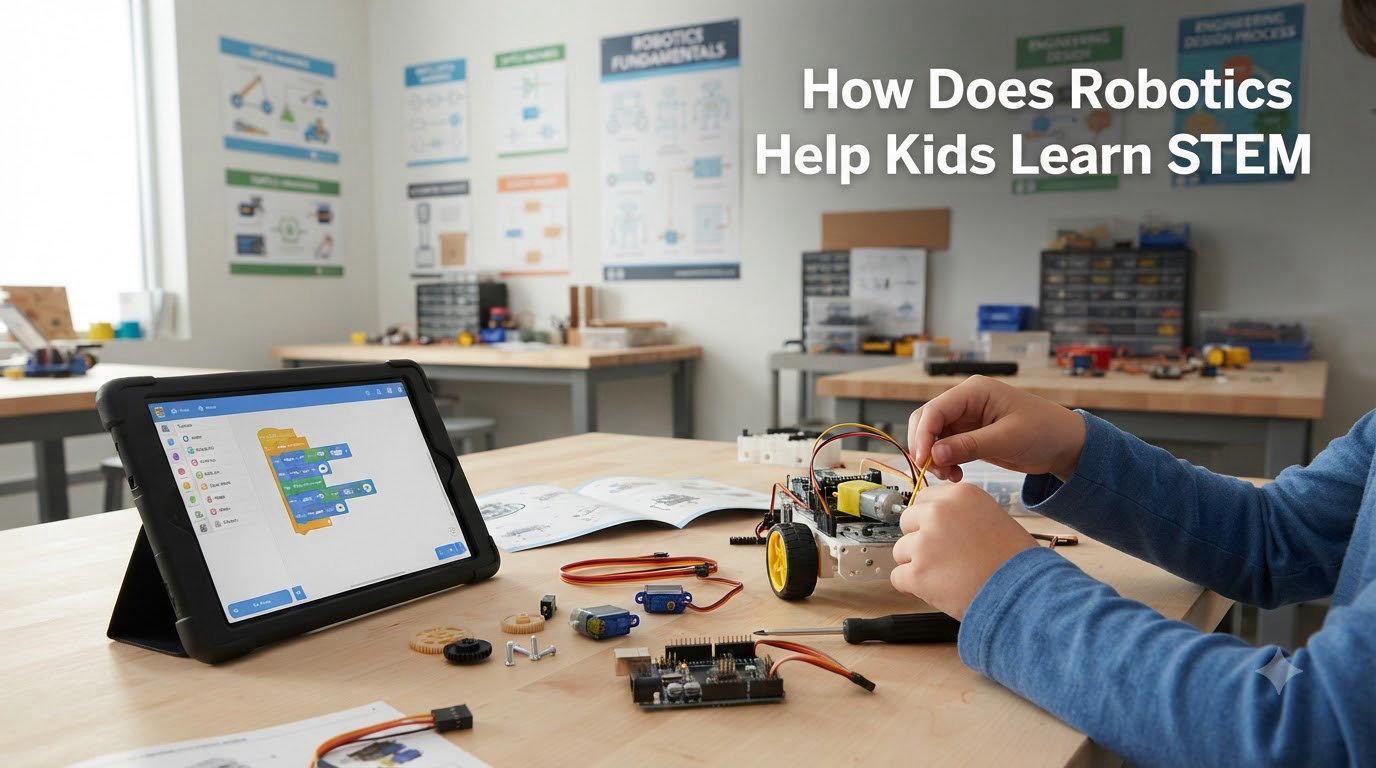
If you have ever watched a child program a small robot to roll across the floor, light up, or wave its arm, you have seen the answer to how does robotics help kids learn STEM in real time. It turns abstract science and math into something a ten-year-old can touch, test, and break on purpose.
Robotics is one of the few learning tools that combines every STEM discipline at once. Children who build and code robots practice engineering, computer science, math, and applied physics in a single project, while also picking up the soft skills that employers and universities keep asking for. In this guide, our team breaks down exactly what the research shows, what each age group can handle, and how parents and teachers can get started without needing a robotics degree.
Table of Contents
What Is Robotics Education for Kids and Why Does It Matter?
Robotics education for kids is the practice of using age-appropriate robots, kits, and programming tools to teach STEM concepts through hands-on building and coding. Instead of reading about circuits or memorizing code syntax, children design a machine, write the instructions, and watch their creation respond in the real world.
Robotics matters because it collapses the gap between theory and application. A student studying fractions on a worksheet rarely feels the math; a student programming a robot to turn 90 degrees at a wall feels the geometry immediately. That physical feedback loop is what makes robotics one of the most effective ways to teach STEM skills to children today.
How Robotics Develops Core STEM Skills
Robotics develops core STEM skills by forcing children to define a problem, design a solution, test it, and iterate when it fails. Each stage of the process maps directly to a thinking skill that classroom work often leaves abstract.
When a robot does not turn at the right angle, the child has to diagnose why. Was the wheel slippy? Did they write 45 instead of 90 in the loop? Is the sensor miscalibrated? That kind of structured debugging is what educators call computational thinking, and it shows up in nearly every career path a STEM student might choose later.
Three core skills stand out in our research and the published evidence:
- Problem-solving under uncertainty. A robot rarely works on the first try. Kids learn to break a big failure into smaller testable questions.
- Critical thinking. Children have to evaluate which fix to try first instead of guessing randomly.
- Computational thinking. Sequencing, loops, conditionals, and pattern recognition become tools the child reaches for, not vocabulary they memorize.
Coding and Programming Skills Kids Build Through Robotics
Robotics teaches coding and programming by giving every line of code a physical consequence. Scratch-based block coding, Python, and even C++ all show up in modern kids’ kits, and the same concepts transfer to web development, data science, and AI later on.
For younger children, robotics platforms use visual block programming. Kids drag commands like “move forward 2 seconds” or “if sensor detects obstacle, turn.” That is real programming logic, just without the syntax barrier. By upper elementary, most children can move to text-based languages without feeling overwhelmed because they already understand the underlying patterns.
For a deeper look at the AI side of modern robotics education, our piece on What Is Edge AI in Robotics shows how the same machine-learning principles kids see in simple robot behaviors are now running inside production robots.
Hands-On Active Learning: Why Building Beats Watching
Robotics is one of the purest forms of active learning because the robot ignores whatever the child was “supposed” to do. It only does what the code says. That instant, physical feedback is something a video lesson or textbook cannot match.
Active learning research consistently shows that students who build, test, and revise their own projects retain more and transfer skills to new problems better than students who only watch demonstrations. Robotics makes that active learning default, not optional, because the child has to touch the hardware, write the code, and observe the result in the real world.
It also helps with the screen-time question many parents ask. The child is still in front of a device, but they are directing a physical object and seeing it move through space, which is a very different cognitive activity than passive consumption.
Real-World STEM Connections Kids See Through Robotics
Robotics connects STEM to the real world by showing children that the math, science, and engineering they learn in school actually powers the world around them. The same sensors on a classroom robot are used in self-driving cars, warehouse automation, and medical devices.
A few examples that resonate with kids:
- Math: Calculating wheel rotations, gear ratios, and distances turns arithmetic into a tool.
- Physics: Friction, balance, and center of gravity become obvious when a robot tips over.
- Engineering: Designing a sturdy arm to lift a cup teaches structure and load.
- Computer science: Writing loops and conditionals becomes a real skill, not an abstract lesson.
This is the bridge that traditional worksheets struggle to build, and it is exactly what makes robotics a powerful learning tool for STEM.
Creativity, Innovation, and Persistence
Robotics builds creativity and innovation by giving children an open-ended medium with a real constraint: their robot has to work. There is no single right answer, but there is a working answer, and finding it teaches kids to combine ideas in new ways.
Robotics also builds persistence. Robots fail in obvious, public ways. A gear slips, a wire comes loose, a sensor returns the wrong reading. Children who learn to debug a robot at age eight carry that same resilience into harder problems at sixteen. In a recent feature on robots that learn on the job, we explored how that same trial-and-error cycle is now showing up in industrial robots, and the same principle applies at the kitchen-table scale.
Teamwork, Communication, and Collaboration
Robotics naturally builds teamwork because most kits, clubs, and competitions require more than one brain. Someone builds, someone codes, someone documents, someone tests, and they all have to talk to each other for the project to work.
In a classroom robotics project, students practice explaining their thinking to a teammate, negotiating design trade-offs, and dividing work fairly. In competitive robotics, the team has to strategize, prototype, and present under time pressure. These collaboration skills are exactly what employers and universities point to when they describe the next generation of STEM workers.
Age-Appropriate Robotics: A 3-18 Progression Guide
The best robotics experience depends on the age of the child. Our team put together a progression that matches how kids actually develop cognitively, so parents and educators can pick the right level without overshooting or under-challenging.
Ages 3-5: Screen-Free and Story-Based
Preschoolers do best with screen-free or block-based coding toys that respond to physical cards or buttons. At this stage the goal is sequencing, cause and effect, and listening to directions. The robot is really a story prop that the child programs with their hands.
Ages 6-10: Block Coding and Simple Builds
Early elementary is the sweet spot for visual block coding on tablets or laptops combined with snap-together robot kits. Children can write their first multi-step programs, build their first sensors, and run their first challenges like line-following or maze-solving.
Ages 11-14: Text Coding and Engineering Challenges
Middle schoolers can move to text-based languages like Python while tackling more complex builds with multiple sensors, motors, and mechanical linkages. Competition formats like FIRST LEGO League or VEX IQ start to fit naturally here.
Ages 15-18: Advanced Robotics and Real-World Problems
High schoolers can engage with full text-based programming, CAD design, 3D printing, and team-based engineering challenges. Projects start to mirror real industry work, and many students at this level publish code, enter national competitions, or contribute to open-source robotics projects.
What the Research Says: Meta-Analysis and E-E-A-T Evidence
Robotics has been studied in classrooms longer than most ed-tech tools, and a 2023 meta-analysis cited by more than 300 researchers found that hands-on robotics instruction produces statistically significant gains in problem-solving, spatial reasoning, and computational thinking compared with traditional instruction alone.
Earlier randomized studies in middle schools showed that students who spent a semester on robotics outperformed their peers on standardized measures of science and math reasoning. The effect was strongest for students who started with lower baseline confidence, which suggests robotics is also a useful equity tool, not just a high-achiever enrichment.
For Smashing Robotics readers, the takeaway is that the claims we make here are not just parent anecdote. Robotics is one of the better-evidenced STEM interventions available to schools and families in 2026.
Future Career Preparation Through Early Robotics Exposure
Robotics prepares kids for the future job market by building the exact skills that automation, AI, and engineering roles demand. Even children who do not grow up to be robotics engineers benefit from the analytical habits robotics teaches.
Today’s fastest-growing career clusters, including physical AI, industrial automation, and embodied intelligence, all depend on the same foundations that robotics kits introduce at the kitchen table. Our coverage of 5 Physical AI Infrastructure Platforms Shaping Robotics shows just how much of the future economy depends on the building blocks kids can start practicing now.
Beyond the obvious engineering path, robotics also feeds into medicine, agriculture, logistics, and education. A child who learns to debug a robot today has a head start on debugging any complex system tomorrow.
How Parents and Educators Can Start Robotics at Home or School
Starting robotics is easier than most parents expect, and you do not need a technical background to support it. Our team has used a simple four-step rollout with families and after-school programs that has worked across ages.
Step 1: Pick a Kit That Matches the Child’s Age
Match the kit to the child, not the trend. Younger children do best with screen-free or block-based kits, while older children can handle programmable robots with sensors. Durability and reusability matter more than brand recognition because the kit will be rebuilt many times.
Step 2: Set a Single First Project
Pick one small goal, such as “make the robot travel in a square,” instead of a vague “learn robotics.” A clear project gives the child a target, a way to measure success, and a reason to debug.
Step 3: Let the Child Lead, Coach When Stuck
Resist the urge to fix the robot for them. Ask questions like “what did you expect to happen?” and “what happened instead?” That coaching pattern is what builds problem-solving, not the answer itself.
Step 4: Connect to a Community
Find a robotics club, library program, or online community for the child to share projects with. Forum discussions on r/STEMToys and r/Parenting repeatedly show that kids stick with robotics longer when they have peers to show off to.
Pros and Cons of Robotics Education for Kids
Robotics education has clear strengths, but it is not a magic solution. Here is the balanced view our team gives to parents and teachers.
Pros:
- Combines multiple STEM subjects in one hands-on activity
- Builds problem-solving, persistence, and computational thinking
- Strong research backing for measurable learning gains
- Scales from preschool to high school and beyond
- Encourages teamwork and communication
Cons:
- Quality kits and classes can be expensive
- Some platforms are locked to a single ecosystem, limiting long-term use
- Requires some adult support, especially for younger children
- Online robotics classes vary widely in quality
The pros and cons are real, but for most families the benefits outweigh the costs, especially when a kit is shared between siblings or with a neighborhood robotics club.
Frequently Asked Questions
How is STEM related to robotics?
STEM and robotics are tightly linked because robotics pulls science, technology, engineering, and math into a single project. A child designing a robot uses math to calculate distances, science to understand sensors, engineering to design the structure, and technology to write the code. Robotics is often called the integrative STEM discipline because it makes the rest of STEM visible in one place.
What are the benefits of robotics for kids?
Robotics helps kids develop problem-solving, critical thinking, coding skills, creativity, persistence, and teamwork. It also gives them a tangible reason to engage with math and physics. Most children who learn robotics report higher confidence with technology, and the research shows measurable gains in computational thinking and science reasoning.
Does robotics count as STEM?
Yes. Robotics counts as STEM, and many educators treat it as an integrative STEM activity because it combines science, technology, engineering, and math in one project. A single robotics lesson can cover physics, math, coding, and design thinking, which is why it is often used as a flagship STEM activity in K-12 schools.
What is the best age to start robotics?
Most children can start exploring robotics concepts around age 3-5 with screen-free coding toys. Ages 6-10 is the sweet spot for block-coding kits like LEGO Spike or VEX, while ages 11-14 can move into text-based programming and competitive robotics. The best age really depends on the child’s interest and the type of kit being used, but starting early with light exposure is usually better than waiting.
Why is robotics education important for schools?
Robotics education is important for schools because it is one of the few subjects that teaches problem-solving, coding, and engineering at the same time. Schools that add robotics see improved engagement in math and science, especially among students who do not connect with traditional instruction. Robotics also prepares students for the AI and automation jobs that are growing fastest in the workforce.
What are the pros and cons of robotics for kids?
The main pros of robotics for kids are stronger problem-solving, coding fluency, creativity, persistence, and teamwork. The main cons are kit cost, the time required from parents or teachers to support younger children, and uneven quality of online robotics classes. Choosing a reusable kit and connecting to a local club or library program helps reduce most of these downsides.
What is the best way to start robotics at home?
The best way to start robotics at home is to pick an age-appropriate kit, set one small first project, and let the child lead while you coach. For ages 3-5, start with screen-free coding toys. For ages 6-10, choose a block-coding kit like LEGO Spike Prime or a similar platform. Pair the kit with a robotics club, online community, or library program so the child has peers to share projects with.
Final Verdict: Why Robotics Is One of the Strongest STEM Tools for Kids
So, how does robotics help kids learn STEM? It turns STEM into something children can build, test, and see move through the real world. Instead of memorizing formulas, they use them. Instead of reading about code, they write it. Instead of hearing about teamwork, they live it every time the robot misbehaves five minutes before the deadline.
Our recommendation for parents and educators is simple. Pick an age-appropriate kit, set one small first project, and let the child drive. Pair the kit with a club, a class, or an online community so the learning extends past the kitchen table. The research is clear, the tools are more affordable than ever, and the skills your child builds will matter long after the robot is put back in the box.