
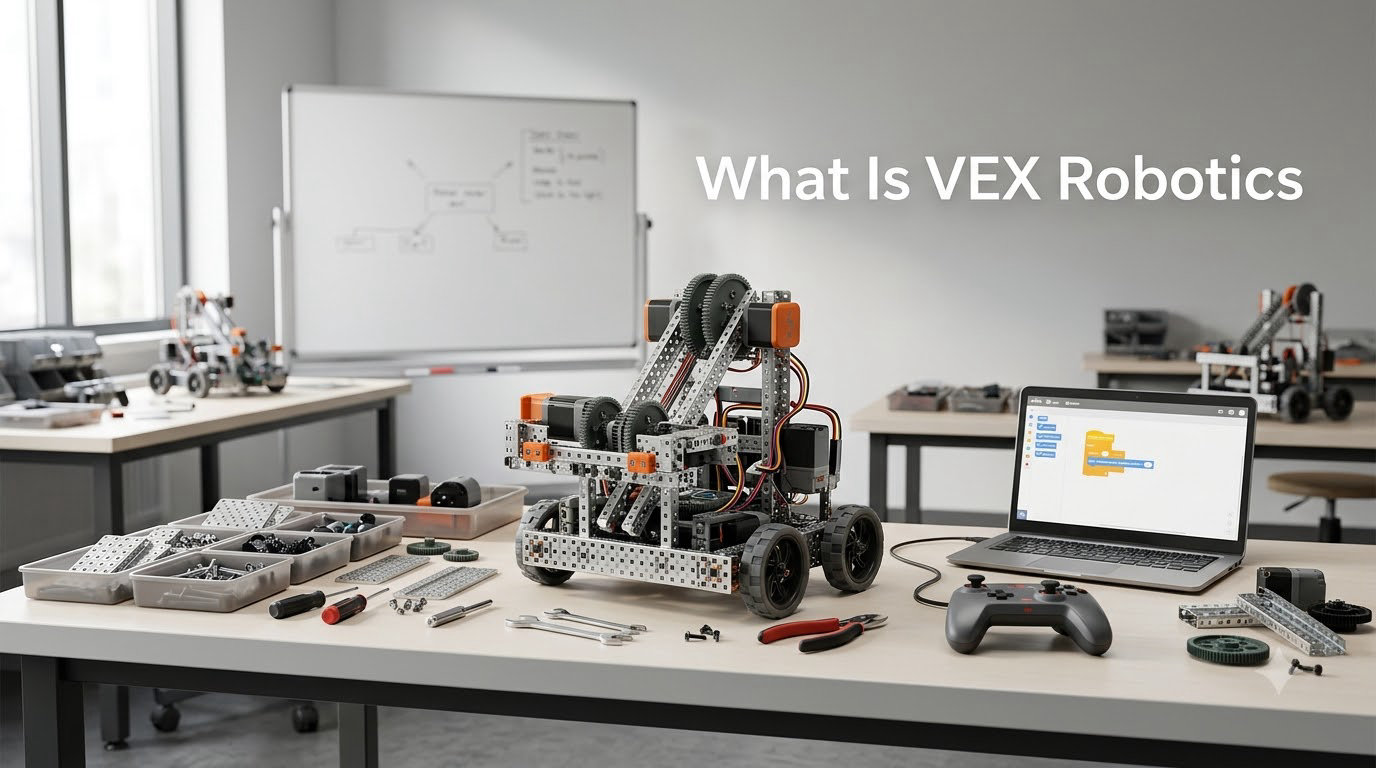
VEX Robotics is a global educational robotics platform that teaches students from elementary school through college how to design, build, and program robots for hands-on STEM learning and competition.
I have been following the VEX program for years, and what strikes me most is its scale. Tens of thousands of student teams compete each year across more than 60 countries, all using the same kit-based parts and the same annual game. If you are asking what is VEX Robotics, the short answer is above. The longer answer covers platforms, games, programming, and how to actually get started, and that is what this guide covers.
Table of Contents
How VEX Robotics Works
VEX Robotics works through a three-step cycle of designing, building, and programming robots using standardized parts, then competing with them in annual games that change every year.
The hardware is built around snap-together plastic pieces for younger divisions and a mix of metal structural components, motors, sensors, and a programmable brain for older students. Teams use VEXcode, the official software, to write programs that control their robot’s behavior in both autonomous and driver-controlled modes.
What I like about the system is the consistency. Every student around the world is working with the same legal parts list, the same controllers, and the same software tools. This means a middle school team in Texas competes on a level playing field with one in Tokyo, and a coach in one country can troubleshoot with a coach in another.
- Build: Snap-together parts, motors, sensors, and structural metal pieces
- Program: VEXcode supports blocks, Python, and C++ depending on age and skill
- Compete: Annual game with rules, scoring, and a path to the VEX World Championship
VEX Robotics Age Divisions and Programs
VEX Robotics is organized into four age-appropriate programs that scale in complexity from early elementary through university-level engineering.
The structure makes it possible for a school or club to start a student in VEX GO and follow the same child all the way into college-level VEX U without switching ecosystems.
VEX GO (Ages 5 to 8)
VEX GO is the entry-level platform aimed at elementary classrooms and after-school programs. It uses large plastic snap-together pieces and a simple tablet-based coding app. Robots are pre-engineered in the sense that the structural options are limited, which means younger students can get a working robot moving in a single class period.
VEX IQ (Ages 8 to 13)
VEX IQ targets elementary and middle school students. The parts are larger, plastic, and air-powered, which I think is one of the safest robotics kits for younger builders. VEX IQ teams use a smaller, plastic-clasped version of the metal system seen in V5, with a control brain that runs block, Python, and C++ code.
VEX V5 (Ages 14 to 18)
VEX V5 is the high school competition platform and the most widely recognized VEX product line. The structural pieces are powder-coated metal, the motors are stronger, and the controller runs a full version of VEXcode including text-based languages. Most teams you see at the VEX World Championship are running V5.
VEX U (University Level)
VEX U is for college and university teams. Students design two robots instead of one, build with V5 parts plus a more open list of additional components, and face more complex engineering challenges. VEX U is also a path into professional engineering and aligns with what students might see in a research or industry robotics environment such as the University of Florida robotics lab for industrialized construction and similar academic programs.
VEX Robotics Competition Format
VEX Robotics competition is an annual head-to-head and skills-based contest where teams play a new game that changes every April and culminates in the VEX World Championship in May.
The structure is what sets VEX apart from a one-off STEM kit. Every team in the world gets the same game manual, the same field, and the same scoring rules. This creates a level of strategic depth you do not see in classroom-only robotics.
- Game reveal: A new game is announced each spring, with rule updates released throughout the year
- Match format: Two-on-two alliances, with 15-second autonomous and 1:45 driver-controlled periods
- Skills matches: Solo timed runs that let teams post scores independent of an alliance partner
- Path to Worlds: Local, regional, state, and signature events feed into the VEX World Championship
The VEX World Championship is held every May and brings together over 3,000 teams from around the globe. Tickets are won through a season-long ranking system, and qualification events draw thousands of spectators. For many students, Worlds is the first time they see how large the global VEX community actually is.
Programming Languages in VEX Robotics
VEX Robotics programming is handled through VEXcode, a free software suite that supports three languages matched to student experience: blocks for beginners, Python for intermediates, and C++ for advanced users.
The same VEXcode app is used across VEX IQ, VEX V5, and VEX U, which makes it easier for students to grow their skills without switching platforms.
Block-Based Coding (Beginner)
Block-based coding in VEXcode is the entry point and works similarly to Scratch. Younger students and absolute beginners can drag and drop commands like “drive forward” or “spin motor for 90 degrees.” I have watched second graders build a working autonomous routine in under an hour this way.
Python (Intermediate)
Python is the bridge between visual and text coding. Students who are comfortable with algebra can read and write Python that controls motors, reads sensors, and structures decision logic. Most middle school VEX IQ teams move to Python by their second season.
C++ (Advanced)
C++ is the language of choice for high school and university VEX teams. It gives students fine-grained control over timing, sensor fusion, and complex autonomous routines. C++ is also the language most robotics careers use professionally, so the skills transfer directly to fields like edge AI in robotics and embedded systems.
VEX vs LEGO and FIRST Robotics
VEX Robotics sits between LEGO-based platforms and FIRST programs in terms of cost, complexity, and competition intensity, and the right choice depends on the student’s age, budget, and goals.
This is the question I get asked most often by parents comparing programs, so let me break it down directly.
VEX vs LEGO Mindstorms and SPIKE Prime
LEGO robotics kits are excellent for classroom and home learning, and the parts are more creative-friendly because almost any LEGO piece is allowed. VEX is more restrictive, with a strict legal parts list, but that restriction is also what makes competition fair. VEX IQ parts also feel closer to real engineering hardware than LEGO, which I think helps bridge the gap to high school and college robotics.
- LEGO strengths: Open-ended building, familiar to most kids, classroom-friendly
- VEX strengths: Closer to professional robotics, larger global competition, year-over-year progression
VEX vs FIRST Robotics (FTC and FRC)
FIRST Tech Challenge (FTC) uses a similar scale of robot to VEX V5 and is a common alternative for high schoolers. FIRST Robotics Competition (FRC) jumps significantly in cost, team size, and build season intensity. Teams looking for a serious engineering experience that is not all-consuming often find VEX V5 to be the right balance, which is one reason many schools run both programs side by side.
For high-achieving teams, VEX is also a strong stepping stone into the broader robotics industry. Coverage of platforms like the physical AI infrastructure platforms shaping robotics shows how VEX-style iteration maps onto real-world deployment.
Cost and Getting Started With VEX Robotics
Getting started with VEX Robotics typically costs between $200 and $2,000 depending on the platform, with a full VEX V5 competition team commonly investing $1,500 to $2,500 in the first year including parts, registration, and travel.
The cost is the part most articles gloss over, so I will be specific. These figures come from what schools and families report in active VEX forums and are a reasonable planning range for 2026.
- VEX GO classroom bundle: Around $200 to $400 for a class set
- VEX IQ starter kit: Around $450 to $600 for a single team
- VEX V5 competition kit: Around $1,200 to $1,800, with additional parts pushing totals higher
- Event registration: League and tournament fees typically run $50 to $150 per event
One cost-control feature unique to VEX is the restricted parts list. Unlike LEGO, where the catalog is essentially unlimited, VEX teams can only use approved VEX parts. Coaches and parents on VEX forums often mention that this restriction is what keeps costs predictable. A team cannot suddenly decide to add a $400 specialty sensor mid-season.
To get started, students can join an existing team through their school, a local club, or the REC Foundation team directory. The REC Foundation also supports new teams with grants in many regions. If there is no team nearby, VEX provides curriculum through STEM Labs that lets a parent or teacher run a small program with a single VEX GO or VEX IQ kit before scaling up.
Skills Students Gain From VEX Robotics
Students who participate in VEX Robotics develop engineering design habits, programming ability, and teamwork skills that transfer directly into STEM college programs and robotics careers.
This is where I think the program stands out. The competition is the hook, but the skill set is the real product.
- Iterative design: Build, test, redesign is the daily rhythm of a VEX team
- Programming fundamentals: Real syntax, real debugging, real algorithms
- Teamwork and communication: Driver, programmer, builder, and strategist roles must coordinate
- Project management: Match strategy, parts ordering, and iteration deadlines mirror engineering project work
Forum users who have moved from VEX into college engineering often credit the program for teaching them how to fail productively. A robot rarely works on the first try, and learning to debug mechanical and software systems together is a habit that pays off across every STEM career, including the cutting-edge work being done by companies like HII partnering with Path Robotics and GrayMatter.
Frequently Asked Questions
What do you do in VEX Robotics?
In VEX Robotics, students design, build, and program a robot using a standardized kit of VEX parts, then compete in an annual game against other teams. They use VEXcode software to write programs in blocks, Python, or C++ that control the robot during autonomous and driver-controlled match periods.
How much does a VEX robot cost?
A VEX robot costs between $450 and $1,800 for the kit alone, with a full first-year VEX V5 competition team typically spending $1,500 to $2,500 including parts, registration, and event fees. VEX GO classroom bundles start around $200 to $400, and VEX IQ starter kits usually run $450 to $600 for a single team.
Is VEX Robotics similar to LEGO robotics?
VEX Robotics is similar to LEGO robotics in that both use snap-together parts and teach STEM skills, but VEX uses a strict legal parts list, scales up to high school and college, and runs a global competition series. LEGO is more open-ended for creative building, while VEX is more structured and closer to professional engineering hardware.
Who owns VEX Robotics?
VEX Robotics is owned by Innovation First International (IFI), a Texas-based company founded by Tony Norman and Bob Mimlitch in 1996. The Robotics Education and Competition (REC) Foundation runs the competition events and team support programs under license from IFI.
Final Thoughts on VEX Robotics
VEX Robotics is one of the most established and accessible ways for students to learn real engineering and programming through hands-on competition, and the program scales from elementary school through college without forcing students to switch platforms.
If you are evaluating VEX for a child, a classroom, or a community program, the practical next steps are simple. Decide which age division fits, budget for a kit plus one or two events, and connect with an existing team through the REC Foundation team directory to see a robot in action before committing. That single visit is what usually turns a curious question into a full season of VEX Robotics.