
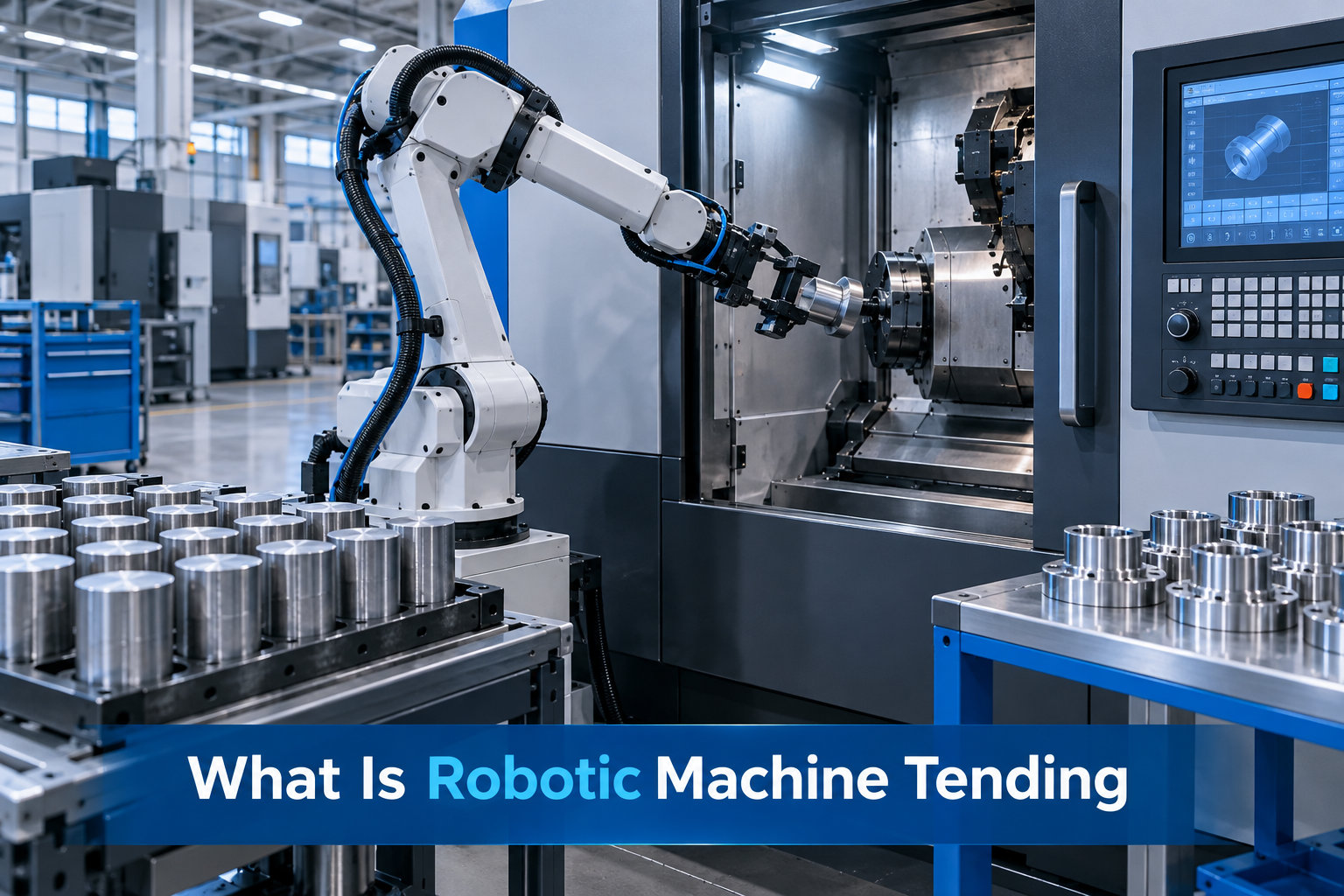
Robotic machine tending is the use of industrial robots or collaborative robots (cobots) to automatically load raw workpieces into CNC machines and unload finished parts after processing. The system replaces a human operator standing at the machine door, opening the chuck or door, placing stock, and waiting for the cycle to finish. By automating this step, factories can run production for hours or days without direct human intervention, which is the foundation of what most people call machine tending applications in modern automation.
In this guide, our team breaks down exactly how robotic machine tending works, the robot types involved, real benefits, integration steps, safety rules, and the cost picture for shops considering a move into lights-out manufacturing. We will also answer the questions we hear most often from plant managers and CNC operators on the floor.
Table of Contents
What Is Robotic Machine Tending?
Robotic machine tending is the automated servicing of CNC machine tools and similar production equipment by a robot rather than a human operator. The robot picks up a raw blank, places it into a lathe, mill, or machining center, closes the door or chuck, waits for the cycle to complete, removes the finished part, and often performs secondary tasks like deburring, inspection, or stacking. The work the human used to do at the machine becomes the robot’s job.
At its core, machine tending answers a single question: who (or what) puts parts in and takes them out while the spindle is running? When that answer is a robot arm fitted with a gripper, the entire cell can run unattended during nights and weekends, which is the basic definition of lights-out manufacturing.
Two terms you will see used almost interchangeably are robotic machine tending and CNC machine tending. They refer to the same idea applied to computer-controlled machines. The “robotic” part simply makes the tending automatic and repeatable, instead of relying on a person standing next to the machine.
How Robotic Machine Tending Works
A typical machine tending cell includes a robot arm, a gripper or other end effector, a feedstock station, a finished-part tray, and some form of communication with the CNC controller. When the cycle is complete, signals pass between the robot and the machine, and the robot does the physical work of swapping parts.
The Loading and Unloading Process
The cycle follows a predictable sequence. The robot starts in a home position next to the CNC machine. It moves to the feedstock rack, grips a raw workpiece, and transfers it to the machine’s chuck, fixture, or worktable. The robot signals the CNC that loading is complete, the operator or pre-programmed cycle starts the spindle, and the robot retracts to a safe position.
When the cycle ends, the CNC sends a “cycle complete” signal to the robot. The robot opens the door or accesses the part, removes the finished piece, and places it on an outfeed conveyor, inspection station, or stacking tray. If the part requires any post-processing like deburring, the robot can perform that step before setting the part down. The cell then repeats the sequence, often for thousands of cycles before operator intervention.
Role of End Effectors and Grippers
The gripper is the part of the system that actually touches the workpiece. Pneumatic or electric parallel grippers handle rectangular billets and turned parts, while three-jaw grippers work well for round bar stock. More advanced cells use vacuum grippers, magnetic grippers, or custom fingers designed for a specific part family.
Choosing the right gripper depends on part weight, geometry, surface finish, and required cycle time. Our guide on robotic gripper technology walks through the options in more detail, and our end effector explainer covers the broader category of tools robots use at the end of the arm. Getting the gripper wrong is the single most common reason a machine tending project underperforms, so this choice deserves real engineering attention.
Types of Robots Used in Machine Tending
Machine tending is one of the most flexible robot applications because almost any articulated or selective-compliance arm can be configured for it. In practice, you will see three main families in shops: industrial articulated robots, collaborative robots (cobots), and SCARA arms for high-speed pick-and-place tending.
Industrial Robots
Industrial six-axis robots, made by companies like FANUC, Yaskawa, ABB, KUKA, and Kawasaki, dominate heavy-duty machine tending cells. They offer high payload capacity, long reach, fast cycle times, and the rigidity needed for repeated loading of heavy chucks. In a factory running dozens of CNC lathes, you will often see articulated industrial robots shared between multiple machines in a row.
These robots are powerful but require safety fencing, dedicated space, and integration expertise. For larger manufacturers running high-mix or high-volume production, industrial robots are usually the most cost-effective answer.
Collaborative Robots (Cobots)
Collaborative robots, led by Universal Robots, Techman, FANUC CR series, and Doosan, are designed to operate safely near people without extensive guarding in many cases. Cobots are popular for small and medium-sized shops, low-volume production, and cells where space is tight. Their lower payload and reach compared to industrial robots is offset by easier programming, faster deployment, and lower overall cell cost.
Universal Robots in particular shows up constantly in forum discussions about machine tending, partly because their teach pendant programming is approachable for operators without a robotics background. A cobot can often be commissioned in days rather than weeks, which is a big deal for a small shop evaluating its first automation project.
Key Benefits of Robotic Machine Tending
Adopting robotic machine tending delivers a wide range of operational, financial, and human benefits. The biggest wins show up in uptime, part quality, and workplace safety, especially when production runs are long and repetitive.
Productivity and Uptime
A robot does not need breaks, shift changes, or sleep. Once a cell is running, it can keep tending a CNC machine for an entire eight-hour shift without any human involvement, and many cells run for ten or more hours unattended. For a shop running three shifts, that effectively turns one machine into three in terms of spindle hours, which has a direct effect on revenue per asset.
Because the robot loads and unloads faster than a human in many cases, spindle utilization also climbs. Spindles that used to sit idle waiting for an operator to come back from a break now run continuously. In high-mix shops, modern robots can also handle part changeovers quickly, keeping the spindle turning between small batch runs.
Quality and Repeatability
Robots place every workpiece in the same position, with the same force, every cycle. That consistency translates to fewer tolerance violations, less scrap, and more predictable cycle times. When a robot is the one seating the part in the chuck, variables like operator fatigue or rushing at the end of a shift disappear from the process.
For tight-tolerance work in aerospace, medical, or precision components, this repeatability is often the deciding factor in winning a contract. Customers want documented process capability, and a robot tending the same machine 10,000 times in a row can deliver that with measurable data.
Robotic Machine Tending Applications and Industries
Machine tending shows up wherever a CNC machine or similar process equipment needs a part put in and taken out. The most common industries are metal cutting, but the same principles apply to other processes like injection molding, additive manufacturing, and testing.
In CNC milling and turning, robots tend horizontal and vertical machining centers, lathes, and multi-axis cells. Aerospace shops use tending robots to load aluminum and titanium billets into five-axis mills, where the value of the spindle hour is high and the risk of human error is expensive. Automotive suppliers deploy tending cells for engine blocks, transmission housings, and brake components in high volumes.
Beyond cutting, machine tending also covers press brake tending, where a robot feeds flat stock and removes formed parts, and plastic injection molding, where the robot unloads molded parts and inserts. Additive manufacturing is a growing area as well, where robots service 3D printers by removing finished builds and reloading build plates, a task that pairs well with collaborative robots in particular.
Integration Requirements and Programming
Getting a robot and a CNC machine to talk to each other cleanly is the hardest part of any cell. The robot needs to know when the cycle is complete and when it is safe to open the door, and the CNC needs to know when the robot has finished loading. Most modern cells use a mix of hard-wired I/O signals, fieldbus protocols like PROFINET or EtherNet/IP, and increasingly OPC UA for higher-level data exchange.
Programming falls into three broad categories. Teach pendant programming lets an integrator or operator move the robot through waypoints by hand and record positions, which is the standard approach for cobots. Offline programming uses simulation software to generate robot paths without taking the cell offline, which is faster for complex cells. And increasingly, no-code or low-code interfaces are making basic tending cells accessible to shops without dedicated robotics engineers.
Vision systems are also a major integration piece, especially for cells that need to handle random part orientation or mixed SKU feedstock. 2D and 3D cameras help the robot find parts in a bin, check orientation, and confirm the finished part is in the right place. Our payload capacity guide is a useful reference when sizing the robot for these vision-enabled applications, since cameras and lights add weight to the end of the arm.
Safety, Compliance, and Workforce Implications
Safety is non-negotiable in any machine tending cell. The risk assessment starts with a clear understanding of what can go wrong, from a dropped workpiece to a robot collision with a person, and the controls in place to prevent it. ISO 10218 covers industrial robot safety, while ISO/TS 15066 specifically addresses collaborative robot applications and includes force and speed limits for contact scenarios.
For industrial cells, physical fencing, light curtains, safety-rated scanners, and interlocks on the CNC door are standard practice. Cobot cells may rely on power and force limiting plus speed and separation monitoring, but even cobots often need extra guarding in real production environments because the loads, speeds, and part shapes involved in machining are harsher than cobot lab demos suggest.
Workforce implications are real and worth addressing openly. Some CNC operators worry that a robot will take their job. In our experience, the more common pattern is a shift in the operator’s role, from standing at the machine to supervising multiple cells, handling exceptions, and doing higher-value work like setup, programming, and quality inspection. The skill transition from manual operation to robot supervision is one of the most under-discussed topics in the industry, and a good automation plan includes training time and clear career paths for affected workers.
Costs, ROI, and Small Business Applicability
Robotic machine tending used to be a project only large manufacturers could justify. A full industrial cell with integration could easily run into the high six figures when you added the robot, fixturing, guarding, integration labor, and downtime. Today, the picture is much more accessible, especially for small and medium-sized businesses.
A cobot-based cell with a Universal UR10e or similar, basic fixturing, and a turntable can be deployed for a small fraction of the cost of a fully fenced industrial cell. Many cobot vendors and integrators now offer pre-engineered machine tending kits that drop onto a CNC mill or lathe in a day or two. For shops producing 50 to 500 parts per shift, the economics often pencil out within 12 to 24 months, particularly in labor-tight markets.
Payback Period Expectations
Most machine tending cells pay back in 12 to 36 months, depending on labor cost, shift pattern, and the value of the spindle hours recovered. A shop running two shifts with a $25 per hour operator can justify a cell much faster than a single-shift shop with a $15 per hour operator in a low-cost region. The best way to estimate your own payback is to multiply recovered labor hours by loaded labor cost, then add the value of extra spindle hours, and divide the cell cost by that annual saving.
For very small shops, mobile tending robots that you can wheel between machines are now on the market, letting you spread the investment across multiple work cells. This kind of flexibility is reshaping how small job shops think about their first automation project.
Future Trends in Robotic Machine Tending
Several trends are reshaping what robotic machine tending will look like in the next few years. AI-driven vision systems are improving rapidly, which means robots can handle more variation in part orientation and finish without reteaching. Learning-based robot programming, where the robot picks up new tasks by demonstration rather than explicit waypoint teaching, is moving from research into commercial products, and we have covered this in our article on robots that learn on the job.
Sustainability is another growing focus. Robots that tend machines for long stretches of time enable true lights-out production during off-peak energy hours, which can shift energy use to lower-carbon grid periods. Predictive maintenance, where sensors on the robot and the CNC flag wear before a failure, also reduces scrap and energy wasted on bad parts. These gains are small individually but meaningful at the factory scale.
Finally, hybrid human-robot workflows are likely to become the norm in small and medium shops. A cobot tends a CNC mill during unattended hours, and a human operator takes over for complex changeovers, setups, and quality checks during the day. Rather than full replacement, this partnership model is the most realistic future for the majority of machine shops, and one that more vendors are designing their products around.
Frequently Asked Questions
What is robotic machine tending?
Robotic machine tending is the use of an industrial robot or cobot to automatically load raw workpieces into a CNC machine or similar production equipment and unload finished parts after the cycle is complete. It enables unattended or lights-out production and replaces a human operator standing at the machine door.
What is the difference between a cobot and an industrial robot for machine tending?
Industrial robots are larger, faster, and carry heavier payloads, but require safety fencing and more integration. Collaborative robots, or cobots, are smaller, easier to program, and can often operate near people without extensive guarding, making them a good fit for small and medium-sized shops and low-volume production.
How long does it take to implement robotic machine tending?
A simple cobot-based cell can be deployed in a few days to a couple of weeks, especially with pre-engineered tending kits. A full industrial cell with custom fixturing, safety systems, and integration into factory MES or ERP systems typically takes four to twelve weeks from kickoff to first production part.
Is robotic machine tending safe?
Yes, when properly risk-assessed. Industrial cells use fencing, interlocks, and safety-rated devices under ISO 10218. Cobot cells follow ISO/TS 15066 and use power and force limiting, speed and separation monitoring, and often additional guarding given the heavy parts and sharp tools involved in CNC machining.
Can small and medium-sized businesses use robotic machine tending?
Yes. Cobot-based machine tending kits, mobile tending robots, and pre-engineered cells have made the technology affordable and practical for small job shops. Many SMEs see payback within 12 to 24 months, especially when labor is tight and spindle hours are valuable.
Conclusion
Robotic machine tending is what happens when you replace the human standing at the CNC machine door with a robot arm, a gripper, and a reliable handshake with the machine controller. The result is longer unattended production runs, higher spindle utilization, more consistent part quality, and a safer shop floor. Whether you choose a heavy industrial articulated robot or a smaller collaborative robot, the core idea is the same: let the spindle make chips while the robot handles the parts.
If you are evaluating your first machine tending project, start with a clear use case, a realistic payback model, and an honest conversation with your operators about how their roles will shift. Our complete guide to end effectors and our breakdown of how to calculate payload capacity are good next reads as you move from concept to spec. Updated for 2026, the technology is more accessible, more capable, and more affordable than at any point in the last decade, and the shops that move now will be the ones setting the pace for the rest.