
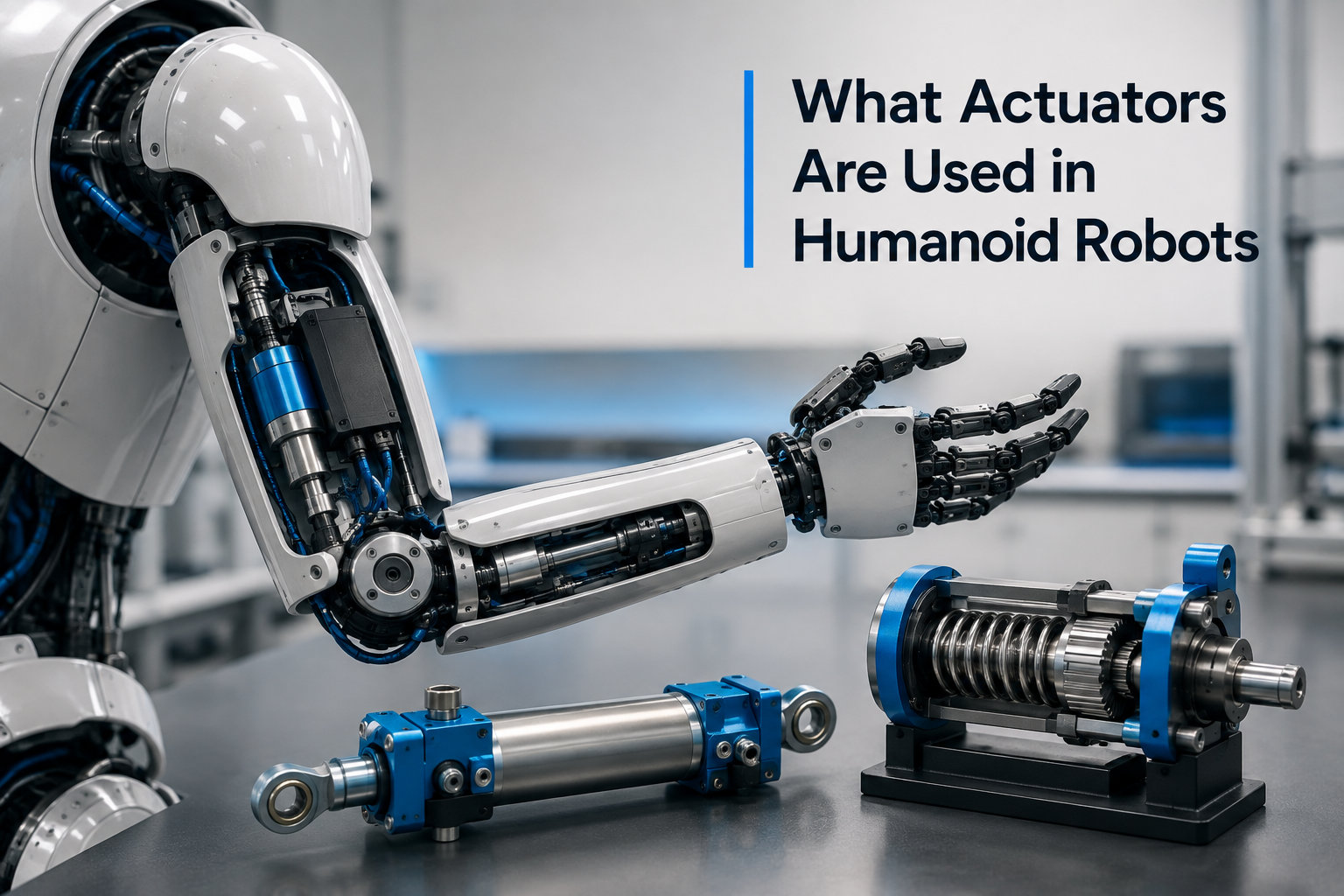
Humanoid robot actuators are the mechanical “muscles” that convert stored energy into physical movement at every joint, allowing a robot to walk, lift, grasp, and balance. Without them, even the smartest AI is just a statue. Most modern humanoids rely on electric motors with gear reductions, but a growing share now uses series elastic designs for force control.
In this guide, I break down every major actuator type used in today’s humanoid robots, explain how each one works, and show you what real platforms like Tesla Optimus, Boston Dynamics Atlas, and Unitree H1 actually use. I also cover the engineering tradeoffs that decide whether a robot can walk for hours or overheat in minutes.
Table of Contents
What Is an Actuator in a Humanoid Robot?
An actuator in a humanoid robot is a mechanical assembly that converts stored energy, whether electrical, hydraulic, or pneumatic, into controlled physical movement at a joint. It is the part of the robot that actually does the work of moving the limbs.
If you think of a humanoid as a body, the actuators are its muscles. The brain (the onboard computer) sends a command, and the actuator moves a hip, knee, shoulder, or finger to execute that command. Every walking step, every hand grasp, and every head turn depends on at least one actuator.
Actuators sit between the control system and the physical structure. They receive an electrical or fluid signal and produce torque (rotary force) or linear force as output. That output is what swings a leg forward, pushes a knee straight, or curls a finger around a cup.
In practical terms, an actuator in a humanoid robot bundles four jobs into one unit: a motor that generates raw force, a reducer that trades speed for usable torque, an encoder that reports joint position, and a controller that closes the loop at high frequency. The quality of that bundle determines whether a robot can lift 20 kg without stalling or maintain a steady gait for an entire shift.
The Three Main Actuator Types: Electric, Hydraulic, and Pneumatic
The three main actuator types used in humanoid robots are electric, hydraulic, and pneumatic. Electric actuators dominate modern designs because they are clean, controllable, and cheap to maintain. Hydraulic systems offer the highest power density, while pneumatic actuators provide simple, compliant motion at low cost.
Each type represents a different tradeoff between power, precision, weight, and maintenance. Here is how they compare at a glance.
- Electric actuators use brushless DC motors (BLDC) coupled to a gear reducer. They deliver high efficiency, precise position control, and minimal maintenance. Almost every shipped humanoid platform in 2026 uses electric actuators for at least the upper body.
- Hydraulic actuators use pressurized fluid driven by a pump to move a piston. They pack enormous force into a small package, which is why the original Boston Dynamics Atlas and the Sarcos Guardian could lift hundreds of kilograms. The tradeoff is pumps, hoses, leaks, and noise.
- Pneumatic actuators use compressed air to extend or contract a chamber. They are cheap, light, and naturally compliant, but they are hard to control precisely and need a constant air supply. Most modern humanoids avoid them in the legs, where precision matters most.
So why did electric win? The shift became official when Boston Dynamics retired its hydraulic Atlas in 2024 and shipped an all-electric version in 2025. Hydraulic systems are powerful but expensive to maintain, hard to miniaturize, and notoriously messy. Electric actuators scale better, integrate with modern motor controllers, and let a humanoid ship in a clean factory or home environment.
Hydraulic still has a role. In heavy-payload humanoids, search-and-rescue robots, and research platforms that need raw force, hydraulics remain a strong choice. But for any robot designed to operate near people, electric is the default.
Rotary Actuators: The Spinning Joints
Rotary actuators produce torque around a rotating axis, exactly what a shoulder, hip, or elbow needs to swing through an arc. They are the most common actuator type in humanoid robots and account for the majority of joints in nearly every commercial platform.
A modern rotary actuator combines three core parts. A frameless BLDC motor generates the raw rotational force. A harmonic drive or cycloid reducer drops the high-speed, low-torque output of the motor into a low-speed, high-torque output suitable for moving a leg. An encoder at the output side tells the controller exactly where the joint is at any moment.
Rotary actuators excel in joints that need to sweep through large angles. The shoulder of a humanoid robot uses one or two rotary actuators to lift the arm in three dimensions. The hip uses three rotary actuators arranged at right angles to mimic the ball-and-socket motion of a human hip. The wrist, neck, and waist also rely on rotary units.
Where rotary actuators struggle is in joints that see high shock loads. When a humanoid foot hits the ground at walking speed, the impact energy travels up the leg. Harmonic drives, the most popular reducer in rotary actuators, are sensitive to that shock. Forum builders on r/robotics report flexspline fractures after thousands of impact cycles, which is why some teams are moving knees and ankles to linear actuators instead.
Linear Actuators: The Pushing Joints
Linear actuators produce force along a straight line, the same way your quadriceps push your knee straight. They are growing in popularity for the legs of humanoid robots because they handle shock loads far better than rotary units and let designers mimic human muscle geometry directly.
A linear actuator converts the rotation of a motor into straight-line motion through a screw mechanism. The motor spins, the screw translates that spin into push or pull, and the output moves a joint directly. The most common screw types are ball screws and planetary roller screws.
- Ball screws use steel balls rolling along a helical groove. They are efficient, low-friction, and inexpensive, but they have a fixed fatigue life from cyclic loading.
- Planetary roller screws use multiple threaded rollers orbiting a central screw. They offer much higher load capacity, longer life, and better shock tolerance. This is why most high-performance humanoid legs use them.
Linear actuators shine in the knees and ankles. A linear unit placed along the femur acts like a quad muscle, pushing the lower leg forward. A linear unit along the tibia acts like a calf muscle, controlling ankle push-off. The result is more human-like motion and better energy absorption when the foot lands.
The tradeoff is weight and complexity. A linear actuator with a planetary roller screw and a powerful BLDC motor can weigh 2-4 kg per joint. Multiply that by 12 leg joints and you have a 30+ kg actuator mass before you add a battery. Engineers spend hours shaving grams to keep the robot under 60 kg total weight.
Key Sub-Components Inside a Modern Electric Actuator
A modern electric actuator in a humanoid robot is built from a frameless BLDC motor, a gear reducer, an output encoder, and a dedicated controller. Each sub-component has a specific job, and the choice between them defines the actuator’s performance class.
The frameless BLDC motor is the heart of the actuator. Unlike a packaged servo motor, a frameless motor ships as just a rotor and a stator. The robot’s joint housing becomes the motor housing, which saves space and weight. Frameless BLDCs can spin at 6,000-10,000 rpm and produce high specific torque (torque per kilogram).
The reducer trades that high speed for usable torque. The most common options are:
- Harmonic drives (also called strain wave gears) use a flexible spline and a wave generator to achieve reduction ratios of 80:1 to 160:1 in a single stage. They offer zero backlash, which is critical for precise joint control.
- Cycloid reducers use an eccentric cam and roller pins to achieve similar ratios with better shock tolerance. They are heavier but more robust.
- Planetary roller screws (used inside linear actuators) provide extremely high load capacity in a small package.
The encoder tracks joint position with sub-degree accuracy. Most high-end humanoid actuators use absolute encoders at the output side so the robot knows its joint angle the moment it powers on, without needing to home first.
The controller is a small motor drive that runs at 1 kHz or faster, closing the position and torque loops locally. By handling low-level control inside the actuator, the main robot computer can focus on higher-level motion planning instead of fighting with 50+ individual joints.
Series Elastic Actuators (SEA): Adding Compliance to the Equation
A series elastic actuator (SEA) is an actuator that places a spring or other elastic element between the motor and the output joint. The spring decouples the motor’s inertia from the joint, which makes the actuator safer around people and dramatically improves force control.
Standard electric actuators are stiff. When a robot’s elbow hits a person, the impact is sudden and hard. With an SEA, the spring compresses on contact, absorbing energy and giving the controller time to react. This is the same principle used in modern collaborative robot arms.
SEAs also enable precise force sensing without expensive torque sensors. The controller measures how far the spring has compressed, multiplies by the spring constant, and knows exactly how much force the joint is applying. That makes SEAs ideal for assembly tasks, physical interaction, and any motion where the robot needs to feel its way through an unfamiliar environment.
The cost is bandwidth. Because the spring adds a mechanical low-pass filter, SEAs cannot respond as quickly as stiff actuators. They are slower, which is why most high-speed walking humanoids use them sparingly, if at all. The classic example is the MIT Cheetah series, which used SEAs in early prototypes to study compliant running gaits before some platforms moved to direct-drive units.
Today, SEAs are most common in humanoid research platforms and in upper-body applications where force control matters more than speed, like robotic hands and arms doing delicate manipulation.
How Many Actuators Does a Humanoid Robot Need?
A modern humanoid robot uses between 20 and 56 actuators, depending on its design goals. Walking-only platforms need as few as 20, while full-body humanoids with dexterous hands can exceed 50.
The count breaks down roughly by body region as follows:
- Legs: 12-14 actuators (3 per hip, 1 per knee, 2 per ankle, repeated for both legs)
- Arms: 14-16 actuators (3 per shoulder, 1 per elbow, 2 per wrist, repeated for both arms)
- Hands: 10-20 actuators per hand (one or two per finger, plus thumb opposition)
- Torso and neck: 3-5 actuators (waist rotation, lateral bend, and 2-3 for the neck)
Tesla Optimus reportedly uses 28 rotary and linear actuators for the body plus 11 per hand for a total around 50. Boston Dynamics’ new electric Atlas uses around 28-30 main body actuators. Unitree H1 sits on the lower end with 20 total, optimized for fast walking rather than manipulation.
The trade is clear: more actuators give you more degrees of freedom and more human-like motion, but each actuator adds weight, cost, and points of failure. The right number depends on what the robot is supposed to do.
Industry Examples: Tesla Optimus, Boston Dynamics Atlas, and Unitree H1
Looking at shipped platforms shows how the industry is converging on electric actuators while still disagreeing on architecture. Here is what three leading humanoids actually use.
Tesla Optimus uses a mix of rotary and linear electric actuators. Tesla has publicly highlighted its custom rotary actuators with integrated gear reducers, and the design leans heavily on linear units in the legs. Tesla manufactures its own actuators to control cost and supply chain, with each unit reportedly around 28 actuators driving the main body.
Boston Dynamics Atlas (electric, 2026) moved away from hydraulics entirely in its latest generation. The new Atlas uses high-torque rotary electric actuators at the hips and shoulders, and linear electric actuators in the knees and ankles for shock absorption. The shift from hydraulics was driven by maintenance cost, noise, and the need to operate near humans without leaks.
Unitree H1 uses 14 rotary actuators in the legs alone, with additional units for the torso. Unitree is known for using quasi-direct drive (QDD) modules, which are low gear-ratio actuators that preserve backdrivability. The H1 can already do backflips and run at over 3 m/s, an impressive feat for the actuator technology on board.
Other notable platforms include Figure 02, which uses rotary electric actuators throughout, and Agility Robotics’ Digit, which uses linear actuators in the legs for efficiency and robustness on warehouse floors.
The Emerging Architecture: Linear Below, Rotary Above
The clearest trend in humanoid actuator design is what some engineers call the “Linear Below, Rotary Above” architecture. Linear actuators handle the high-shock, high-force joints in the legs, while rotary actuators handle the precise, low-force joints in the arms, head, and hands.
This split exists for a simple reason. The legs see the worst shock loads. Every foot strike at walking speed sends a force pulse up through the knee and hip. Linear actuators with planetary roller screws absorb those pulses without the brinelling and flexspline cracks that plague harmonic drives. The arms, by contrast, see smooth motion with much lower impact, where rotary actuators excel at precise positioning.
There is also a weight optimization angle that engineers call the mass penalty spiral. A 200 g error in ankle actuator weight multiplies as you move up the leg. By the time you reach the hip, that 200 g has become 1.3 kg of additional structural mass to support the extra load. Linear actuators, with their inline force path, let designers place mass closer to the joint, breaking the spiral.
The result is a robot whose knees and ankles push and pull like human muscles, and whose shoulders and hips rotate like ball-and-socket joints. This is the architecture that Tesla Optimus, Agility Digit, and the new Atlas all converge on, and it is where most new designs are heading.
Engineering Challenges: Backdrivability, Thermal Limits, and Supply Chain
Even the best humanoid actuators run into three stubborn engineering problems: backdrivability, thermal management, and supply chain concentration. Each one limits what a humanoid robot can do in the real world.
Backdrivability is the ability of an external force to move a joint backward through the gearbox. High gear ratios give you torque but kill backdrivability. When someone bumps a highly geared arm, the joint resists and the energy bounces back as a hard impact. Low gear ratios, like those in quasi-direct drive actuators, preserve backdrivability and let the robot feel contact forces naturally. The trade is lower peak torque per unit weight, so designers must choose carefully per joint.
Thermal management is the silent killer of humanoid demos. A robot rated to lift 50 kg can often only do so for a few seconds before the motor windings heat up and the controller throttles output. Continuous-duty torque is often half the peak torque. This is why forum users emphasize sustained-load testing over press-release numbers. Real work means operating near the continuous rating, not the peak.
Supply chain concentration is a strategic bottleneck. Fewer than 10 suppliers worldwide can manufacture high-performance harmonic drives and planetary roller screws at scale. The top names, including Harmonic Drive Systems, Nabtesco, and a handful of European specialists, sit on multi-year backlogs. When Tesla, Figure, and Unitree all need millions of actuators, the supply of these precision components becomes the limiting factor in humanoid production, not software or AI.
Other failure modes are equally real. Side-loaded micro actuators in the fingers can grind themselves apart if the tendon routing is off. Bowden cable friction in remote-actuated hands creeps over time and changes the joint response. Thermal stalls during continuous walking shut down the robot mid-stride. Each of these issues is a reason why shipping a reliable humanoid is so much harder than building a working prototype.
Frequently Asked Questions
What types of actuators are used in humanoid robots?
The three main types of actuators used in humanoid robots are electric, hydraulic, and pneumatic. Electric actuators with brushless DC motors and gear reducers dominate modern designs. Hydraulic actuators are used in heavy-payload and research platforms, while pneumatic actuators appear mainly in soft robotics and research. Series elastic actuators (SEA) are a fourth category used when force control and compliance are critical.
How many actuators does a humanoid robot need?
A modern humanoid robot needs between 20 and 56 actuators, depending on its design goals. Walking-only platforms use around 20 actuators. Full-body humanoids with dexterous hands need 30-50+ actuators. The breakdown by region is roughly 12-14 for the legs, 14-16 for the arms, 10-20 per hand, and 3-5 for the torso and neck.
What is the difference between rotary and linear actuators?
Rotary actuators produce torque around a rotating axis and are used in joints like shoulders, hips, elbows, and wrists. Linear actuators produce force along a straight line, similar to how human muscles push and pull bones. Linear actuators are increasingly used in the knees and ankles of humanoid robots because they handle shock loads better than rotary units.
What is a BLDC motor and why do humanoid robots use it?
A BLDC (brushless DC) motor is an electric motor that uses electronic commutation instead of brushes to switch current between windings. Humanoid robots use BLDC motors because they offer high torque density, long life, high efficiency, and precise speed control. Frameless BLDC motors, which ship as just rotor and stator, can be embedded directly inside joint housings to save space and weight.
What is backdrivability in robotic actuators?
Backdrivability is the ability of an external force to push a joint backward through its gear train. Highly geared actuators, like harmonic drives, resist backdrivability and feel stiff. Low-ratio actuators, like quasi-direct drive (QDD) units, preserve backdrivability and let the controller feel contact forces naturally. Backdrivability is important for safe physical interaction and compliant motion.
Why did electric actuators win over hydraulic in humanoid robots?
Electric actuators won over hydraulic in humanoid robots because they are cheaper to maintain, easier to miniaturize, quieter, and integrate cleanly with modern motor controllers. They also avoid the leaks, pumps, and noise that come with hydraulic systems. Boston Dynamics retired its hydraulic Atlas in favor of an all-electric version, marking the industry’s shift.
What is a Series Elastic Actuator (SEA)?
A Series Elastic Actuator (SEA) is an actuator that places a spring or other elastic element between the motor and the output joint. The spring decouples motor inertia from the joint, improves safety around people, and enables precise force sensing by measuring spring compression. SEAs are common in research humanoids and upper-body applications where force control matters more than speed.
Who builds the actuators used in humanoid robots?
Major suppliers of actuators used in humanoid robots include Harmonic Drive Systems and Nabtesco for precision gear reducers, and companies like Tesla, Boston Dynamics, and Unitree for custom-designed actuator modules. A small number of global suppliers, fewer than 10, can manufacture high-performance harmonic drives and planetary roller screws at scale, which creates a strategic supply chain bottleneck for the industry.
Conclusion
The actuators used in humanoid robots are the single most important factor in whether a robot can actually move through the real world. Electric actuators with brushless DC motors, gear reducers, and high-speed controllers have become the industry standard, while linear units are taking over the legs and series elastic designs hold a niche in research and upper-body applications.
If you are evaluating a humanoid platform, focus on three things: the actuator count and breakdown by body region, the type of reducer in the legs, and the supplier behind the harmonic drives or roller screws. These tell you more about real-world performance than any AI demo. The next 12 months will see more linear-actuator legs, more quasi-direct drive modules, and continued pressure on the small handful of suppliers who can actually build the precision components at scale.