
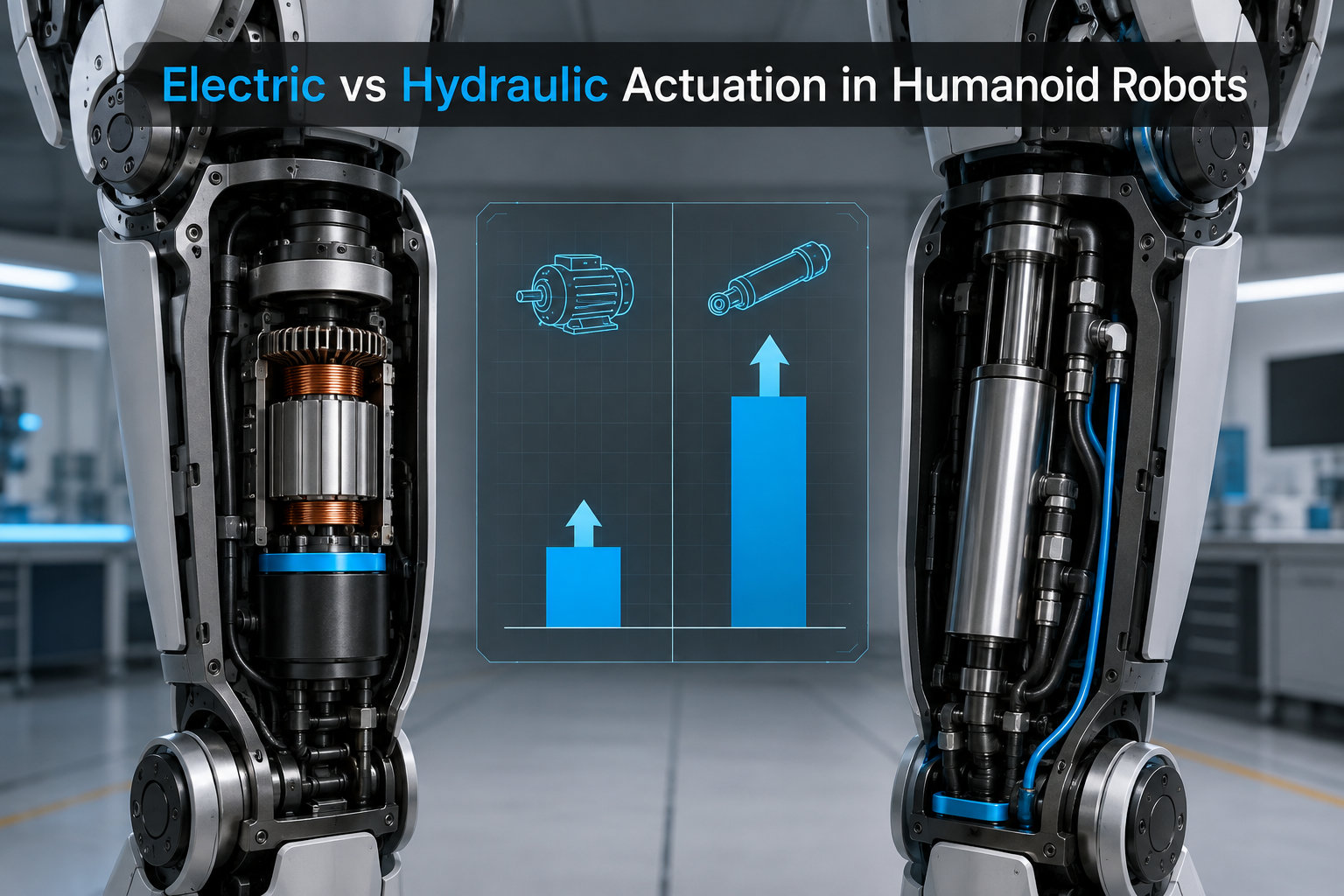
When Boston Dynamics retired the hydraulic Atlas in April 2024 and unveiled an all-electric successor, the company did more than redesign a robot. They signaled the end of a 15-year debate about which actuation philosophy could carry humanoid robots from research labs into factory floors and homes. Today, electric actuators dominate every major commercial humanoid platform except those designed for heavy industrial lifting.
This guide covers the electric vs hydraulic actuation decision in humanoid robots with the depth our engineering audience expects. You will see real numbers, named robot examples, and the mechanical reasoning behind why electric won the legs while hydraulics still owns the torso in some platforms. We will also cover the emerging hybrid approaches and the bridge technologies (series elastic actuators and quasi-direct drive) that blur the line between the two camps.
For background on how these joints fit into a complete robot architecture, see our degrees of freedom in humanoid joints guide. For cost context on what makes factory deployment viable, the factory floor cost constraints article is essential reading.
Table of Contents
What Kind of Actuators Are Used in Humanoid Robots?
Humanoid robots today use three main actuator families: electric (BLDC motors with gear reduction), hydraulic (pressurized fluid cylinders), and pneumatic (compressed air). Electric actuators dominate the 2026 humanoid market, with Boston Dynamics Atlas, Tesla Optimus, Figure 02, Agility Digit, and Unitree H1 all running brushless DC motors paired with planetary roller screws or harmonic drives. Hydraulic actuation survives in the original Atlas HD legacy research and in heavy-lift platforms like those from Sanctuary AI and NASA Valkyrie derivatives. Pneumatic systems appear mostly in soft robotics research and in soft-gripper hands, not in main locomotion joints.
Most modern humanoids use 28 to 40 degrees of freedom (DoF), which means 28 to 40 individual actuator units per robot. Multiply that by the millions of robots companies like Tesla and Figure aim to deploy, and the actuator choice becomes the single most expensive and most failure-prone subsystem. The industry has effectively voted: 95% of new commercial humanoids in 2026 use electric actuators for legs and arms, with a small hydraulic revival in torso-mounted lift cylinders for heavy-payload applications.
Electric Actuators: How They Work in Humanoid Robots
Electric actuators in humanoids convert electrical energy into mechanical motion through three integrated components: a brushless DC (BLDC) motor, a gear reduction stage, and an output mechanism (rotary or linear). The BLDC motor spins at high RPM (typically 6,000 to 20,000) and produces relatively low torque. The gear stage trades speed for torque, multiplying output by 80:1 to 200:1. The output then drives either a rotary joint (shoulder, hip rotation) or a linear actuator (knee extension, ankle push-off).
The two most common gear technologies in 2026 humanoids are planetary roller screws and harmonic drives. Planetary roller screws use threaded rollers between a screw shaft and nut, converting rotary motion into linear motion with 85-92% mechanical efficiency and excellent shock load tolerance. Tesla Optimus and Boston Dynamics electric Atlas use roller screws in their leg joints for exactly this reason: when a foot lands from a 30 cm drop, the screw absorbs the impact without stripping. Harmonic drives use a flexspline, wave generator, and circular spline to achieve high reduction ratios in a compact package, but the flexspline is a known failure point under repeated shock loads and high torque.
Control happens through field-oriented control (FOC), which decouples torque and magnetic flux in the BLDC motor to achieve precise current control. FOC runs at 10 kHz to 50 kHz loop rates on modern motor controllers, giving millisecond response times. Force feedback comes from strain gauges or torque sensors on the output shaft, which is what gives electric humanoids their ability to back-drive (you can push the joint and it moves smoothly, returning compliant force). That backdrivability is critical for safe human interaction and is one of the strongest arguments for electric actuation in humanoids.
Hydraulic Actuators: How They Work in Humanoid Robots
Hydraulic actuators convert fluid pressure into mechanical force through a pump, valves, and cylinders. An electric motor (separate from any actuator output) drives a hydraulic pump that pressurizes fluid (typically mineral oil or synthetic) to 3,000 to 5,000 PSI. The high-pressure fluid routes through proportional or servo valves to double-acting cylinders. When fluid enters one side of the cylinder, the piston extends or retracts, producing linear force. Rotary hydraulic actuators use a similar principle with a vane or piston motor instead of a cylinder.
The original Boston Dynamics Atlas (the HD version used in DARPA Robotics Challenge research from 2013 to 2024) ran 28 hydraulic actuators powered by a 5 kW onboard pump running at 3,000 PSI. The system could lift 11 kg per arm and absorb significant shock through the inherent fluid compliance. For a robot weighing 180 kg doing backflips and parkour, hydraulics delivered power density that electric could not match in 2013. The cost: efficiency hovered around 30-40% system-wide, the pump never shut off, and the robot could not operate near humans due to leak risk and 75-85 dB pump noise.
Valve control determines hydraulic actuator precision. Proportional valves modulate flow continuously for smooth motion, while servo valves provide faster, more accurate control at higher cost. Both approaches struggle with the backdrivability question: hydraulic cylinders are inherently stiff because pressurized fluid resists external force. Adding compliant elements (accumulators, series elastic elements) recovers some safety, but adds complexity and weight.
Electric vs Hydraulic Actuator Comparison Table
Electric and hydraulic actuators differ across 12 key engineering parameters that matter for humanoid robots. Electric wins on efficiency, noise, cost, and maintenance. Hydraulics win on instantaneous power density, raw force, and shock tolerance.
Here is a side-by-side parameter comparison for humanoid robot deployment in 2026:
- System efficiency: Electric 80-90%, Hydraulic 30-40%
- Power density (W/kg): Electric 200-500, Hydraulic 1,000-2,000
- Noise level (dB at 1m): Electric 45-55, Hydraulic 75-85
- Idle power draw: Electric ~0W (per actuator), Hydraulic 500-2,000W (pump must run)
- Response time (ms): Electric 1-5, Hydraulic 5-20
- Backdrivability: Electric Yes (with proper gearing), Hydraulic No (requires added compliance)
- Force control precision: Electric +/- 0.1% via FOC, Hydraulic +/- 1-2% via valve control
- Maintenance interval: Electric 5,000+ hours, Hydraulic 500-1,000 hours
- Annual maintenance cost: Electric ~$5,000, Hydraulic $50,000+
- Leak risk: Electric None, Hydraulic Constant (seals degrade)
- Initial cost per actuator: Electric $200-$2,000, Hydraulic $1,500-$5,000
- Commercial deployment readiness: Electric High, Hydraulic Low-Medium
For the first time in humanoid history, the efficiency gap is decisive. An electric humanoid returning 85% of battery energy to motion outperforms a hydraulic humanoid that wastes 60-70% as heat, even when the hydraulic system has higher peak power. Battery technology improves by roughly 8% per year, and you can read the battery technology for electric actuation impact in our detailed guide.
Power Density and Efficiency Analysis
Power density (W/kg) used to be hydraulic’s strongest argument. A hydraulic actuator weighing 0.5 kg can deliver 4 kW peak, while an electric actuator of the same weight delivers 1-2 kW. That is the 2:1 to 4:1 power density advantage that kept Atlas on hydraulics through 2024. But power density is not the same as energy efficiency, and the two metrics tell very different stories over a full operating day.
Energy efficiency is where electric wins by a factor of 2.5. A hydraulic system running at 38% efficiency wastes 62% of input energy as heat. An electric BLDC system at 85% efficiency wastes only 15%. Over an 8-hour work shift, that gap means an electric humanoid draws roughly 1.5 kWh from its battery, while a hydraulic humanoid drawing equivalent mechanical work pulls 4 kWh. The hydraulic robot needs nearly 3x the battery capacity to do the same job, which adds 50-80 kg of weight, which the legs must carry, which costs more energy. The penalty compounds.
For instantaneous power delivery (lifting a 25 kg box in 0.3 seconds), hydraulics still lead. The fluid can deliver 4,000 PSI instantly without thermal throttling, while an electric motor must be oversized to handle that peak. But humanoids rarely need that kind of burst. Walking, picking, placing, and tool use all fall within electric’s continuous power envelope, which is why 95% of new humanoids in 2026 run electric.
Control Precision: FOC vs Valve Control
Field-oriented control (FOC) and hydraulic valve control are fundamentally different control philosophies. FOC runs in software at 10-50 kHz, adjusting motor current phase and amplitude to produce exact torque at any speed. It is deterministic, repeatable, and debuggable on a bench. Hydraulic valve control modulates fluid flow, but fluid compressibility, temperature-dependent viscosity, and valve deadband introduce nonlinearities that are difficult to model precisely.
In practice, electric actuators achieve force control precision of +/- 0.1% of full scale, while hydraulic systems achieve +/- 1-2%. For a humanoid arm lifting a 5 kg payload, that is the difference between 5.005 kg and 5.10 kg of force accuracy. Sub-1% precision matters when the robot is handing a glass of water to a human or threading a needle on an assembly line.
Backdrivability is the second control dimension where electric dominates. A backdrivable joint lets an external force push the joint and feel smooth resistance, like a human muscle. This is critical for safe human-robot interaction: if a person leans on the robot, the joint should give way smoothly, not lock up rigidly. Electric actuators are naturally backdrivable (especially with low-ratio gearing or roller screws). Hydraulic cylinders are stiff and require added compliance (accumulators, series elastic elements) to approximate that behavior. Adding compliance costs efficiency, weight, and complexity.
Cost Analysis: Initial Cost and Total Cost of Ownership
Initial cost per actuator favors electric by a factor of 5 to 10. A planetary roller screw actuator for a humanoid knee joint runs $800 to $2,000 in volume. A comparable hydraulic cylinder, valve, and pump plumbing for the same joint runs $1,500 to $5,000. Multiply by 28-40 actuators per robot and the upfront savings reach $20,000 to $120,000 per robot before any maintenance math.
Total cost of ownership (TCO) is where the gap widens dramatically. Electric actuators need almost no maintenance: no seals to replace, no fluid to change, no valves to recalibrate. Annual maintenance cost runs $2,000 to $5,000 per robot. Hydraulic systems need fluid changes every 1,000 hours, seal replacement every 2,000 hours, valve servicing annually, and constant leak monitoring. Annual hydraulic maintenance runs $30,000 to $70,000 per robot, even on a well-maintained system. Over a 10-year deployment, the TCO difference is $250,000 to $650,000 per robot.
The ROI math is simple. A $30,000 electric humanoid pays back its incremental cost over a $500,000 hydraulic humanoid in under 6 months of warehouse work, because the per-shift operating cost is dramatically lower. That is the math that pushed Boston Dynamics, Figure, Tesla, Apptronik, and Agility all-electric for their commercial humanoids. It is also the math behind our factory floor cost constraints analysis of why humanoids must hit $20K-$50K unit cost to scale.
Boston Dynamics Atlas: Why They Switched to Electric
Boston Dynamics retired the hydraulic Atlas in April 2024 and revealed an all-electric successor. The new Atlas uses custom rotary and linear electric actuators at every joint, eliminating the 3,000 PSI hydraulic pump, reservoir, and plumbing that defined the original. The company cited three reasons publicly: commercial viability (hydraulics cannot deploy in customer environments at scale), safety (leak risk and pump noise made human coexistence impractical), and control fidelity (FOC-based electric actuators deliver the precision needed for dexterous manipulation).
What the company did not say publicly is the efficiency math. The hydraulic Atlas could operate for roughly 90 minutes on its battery pack because the pump drew 1.5-2 kW continuously. The electric Atlas runs for 4-6 hours on a similar battery pack because each actuator only draws power when it is actually moving. That 4x runtime improvement is the difference between a research demo and a productive warehouse worker.
The transition also signals a strategic shift. Boston Dynamics built its reputation on hydraulic Atlas doing backflips, parkour, and dance routines. Switching to electric means accepting that the new Atlas cannot match the hydraulic version’s raw strength or agility. But it can operate near humans, run all day, and deploy at commercial scale. For a company now owned by Hyundai and targeting factory automation, that trade is the only one that matters. The 28-to-40 joints across each Atlas unit use a mix of rotary actuators (for shoulders, hips, wrists) and linear actuators (for elbows, knees, ankles), all driven by brushless DC motors.
Biomechanics: Why Electric Wins for Humanoid Legs
Human legs are linear, not rotary. Your knee extends through a tendon pulling on a bone, not through a gear rotating a shaft. Your quadriceps is a linear actuator wrapped around a pulley. When you walk, your muscles contract linearly and apply force along a tendon path. The mechanical structure underneath your skin is a series of linear tendons driving rotary joints.
This biomechanical fact is why linear electric actuators (planetary roller screws) work so well in humanoid legs. The roller screw produces linear force exactly where the human body produces linear force. Hydraulic cylinders also produce linear force, but they are stiff and cannot replicate the compliant spring-like behavior of a human tendon. Electric roller screws can be back-driven, have tunable compliance through control software, and absorb shock through the gear’s natural elasticity.
The shock load question is critical. When a 70 kg humanoid drops from a 30 cm height onto one leg, that leg experiences roughly 2,000 N of impact force over 50 ms. Harmonic drives crack under that repeated shock because the flexspline fatigues. Planetary roller screws handle it because the rollers distribute load across multiple threads and the screw has a fatigue life of 10+ million cycles. That is why every humanoid designed for real walking (not just flat-floor demos) has migrated to roller screws in the legs. It is also why the original Atlas hydraulic system used compliant fluid accumulator elements at the ankles: the engineers needed to absorb shock the same way roller screws do naturally.
Where Hydraulics Still Win
Hydraulic actuation still wins in three specific humanoid use cases: heavy payload lifting, hazardous environment operation, and burst power applications. Sanctuary AI’s Phoenix uses hydraulic upper-body actuators to lift 25 kg payloads continuously, which would require a much larger electric motor and gearbox. NASA’s Valkyrie derivative research platforms run hydraulics because they operate in disaster zones where fluid leaks are acceptable but battery fires are not. And for instantaneous peak power (catching a 50 kg falling object, jumping 1 meter), hydraulic pressure-on-demand delivers energy faster than any electric system can spool up.
Heavy industrial humanoids targeting automotive assembly (lifting chassis components, holding welding tools) still consider hydraulics for the upper body. The payload-to-weight ratio favors hydraulics by 2x for sustained heavy work, and the operating environment (factory floor with concrete, no people nearby) accepts the noise and leak risk. For consumer-facing humanoids (home assistance, retail, healthcare), hydraulics are functionally excluded by safety and noise requirements.
The emerging third path is hybrid actuation. Some research platforms use electric actuators in the legs (where efficiency, backdrivability, and noise matter most) and hydraulic actuators in the torso (where heavy lifting concentrates). Reddit discussions in r/robotics and r/MachineLearning frequently surface this hybrid approach, and at least three startup designs in 2026 are exploring it for industrial humanoids. The trade-off is plumbing complexity: routing 3,000 PSI fluid through an articulated robot adds failure modes, but the payload benefit can justify it for specific applications.
Future Outlook: Hybrid and Emerging Actuators
Series elastic actuators (SEA) and quasi-direct drive (QDD) are two bridge technologies that blur the line between electric and hydraulic. SEA adds a mechanical spring between the motor and output, providing inherent compliance and shock tolerance similar to what hydraulic fluid provides, but with electric control precision. QDD uses a low-ratio gear (3:1 to 6:1) instead of high-ratio (100:1), sacrificing peak torque for transparency and backdrivability. MIT Cheetah uses QDD; Agility Digit uses a SEA-inspired design in its arms.
Battery technology improvement is the long-run tailwind for electric actuation. Lithium-ion energy density grows 8-10% per year, and solid-state batteries entering production in 2026 promise another 30-40% jump. As energy density improves, electric humanoids can carry larger batteries for longer runtime, narrowing the operational gap with hydraulic systems without touching the actuator design itself. This is why nearly every humanoid roadmap is electric-first with battery improvements as the scaling lever.
Standardization efforts are also emerging. The Humanoid Robot Standardization White Paper (drafted in 2025 by a consortium of manufacturers) proposes common actuator interfaces, communication protocols, and safety ratings. Standardization would reduce actuator cost by 30-50% through volume manufacturing and would let customers mix-and-match actuators from different vendors, accelerating deployment. Until then, every humanoid maker designs its own actuators in-house, which is the single biggest cost driver in current humanoid bills of materials.
For a deeper look at the joints these actuators drive, read our degrees of freedom in humanoid joints guide. For the battery side of the equation, our battery technology for electric actuation article covers the energy density improvements that make all-electric humanoids viable.
Frequently Asked Questions
What kind of actuators are used in humanoid robots?
Humanoid robots use three main actuator types: electric (brushless DC motors with planetary roller screws or harmonic drives, used in 95% of modern humanoids like Boston Dynamics Atlas, Tesla Optimus, and Figure 02), hydraulic (pressurized fluid cylinders at 3,000-5,000 PSI, used in heavy-lift platforms like Sanctuary AI Phoenix and legacy Atlas), and pneumatic (compressed air, mostly in soft robotics research and grippers). Electric dominates because of 80-90% efficiency, backdrivability, and 45-55 dB noise versus 75-85 dB for hydraulic pumps.
What are the disadvantages of electric actuators?
Electric actuators have lower instantaneous power density than hydraulic systems (200-500 W/kg versus 1,000-2,000 W/kg), making them less suitable for sustained heavy lifting above 25 kg per arm. They also generate heat during continuous high-torque operation, requiring thermal management, and harmonic drive variants can fail under repeated shock loads in leg joints. Battery energy density is still a limiting factor for fully mobile humanoids, though solid-state batteries entering production in 2026 promise 30-40% energy density improvements.
What are the downsides of using a hydraulic robotic arm?
Hydraulic robotic arms have six major downsides: 30-40% system efficiency wasting 60-70% of energy as heat, constant 500-2,000W idle pump draw even when not moving, 75-85 dB noise unsuitable for human-adjacent environments, leak risk from degrading seals, $50,000+ annual maintenance cost versus $5,000 for electric, and inherent stiffness preventing backdrivability needed for safe human interaction. These factors made Boston Dynamics retire hydraulic Atlas in April 2024 in favor of an all-electric successor.
What are the key differences between hydraulic and electric actuators?
The key differences between hydraulic and electric actuators are: efficiency (electric 80-90% vs hydraulic 30-40%), power density (hydraulic wins 2-4x), noise (electric 45-55 dB vs hydraulic 75-85 dB), backdrivability (electric yes, hydraulic requires added compliance), annual maintenance cost (electric ~$5,000 vs hydraulic $50,000+), initial cost per actuator (electric $200-$2,000 vs hydraulic $1,500-$5,000), and commercial deployment readiness (electric high, hydraulic low-medium). Electric wins on 8 of 12 key humanoid parameters; hydraulics win on power density and instantaneous peak force.
Conclusion
Electric vs hydraulic actuation in humanoid robots is no longer a close debate. Electric won. The combination of 80-90% efficiency, backdrivability, 45-55 dB noise, and $5,000 annual maintenance versus $50,000+ for hydraulics makes electric the only commercially viable choice for humanoids operating near people. Boston Dynamics’ April 2024 retirement of hydraulic Atlas confirmed what Tesla, Figure, Agility, and Apptronik had already decided: the future of humanoid robots runs on brushless DC motors and planetary roller screws.
Hydraulics survive in three niches: heavy-lift industrial humanoids where 25+ kg continuous payload matters, hazardous environment robots where battery fires are worse than fluid leaks, and research platforms needing burst power for parkour. For the 95% of humanoids designed for warehouses, factories, retail, healthcare, and homes, electric actuation is the only path that scales. The bridge technologies (series elastic actuators and quasi-direct drive) and the hybrid electric-hydraulic approach will fill specific gaps, but the dominant architecture for 2026 and the next decade is all-electric with improving battery energy density as the scaling lever.
If you are designing a humanoid, building a warehouse deployment, or evaluating humanoid robotics investments, the actuator decision is the single largest cost and reliability lever you control. Choose electric, plan for roller screws in the legs, budget for 4-6 hour battery runtime, and design for backdrivability from day one. The rest is software.