
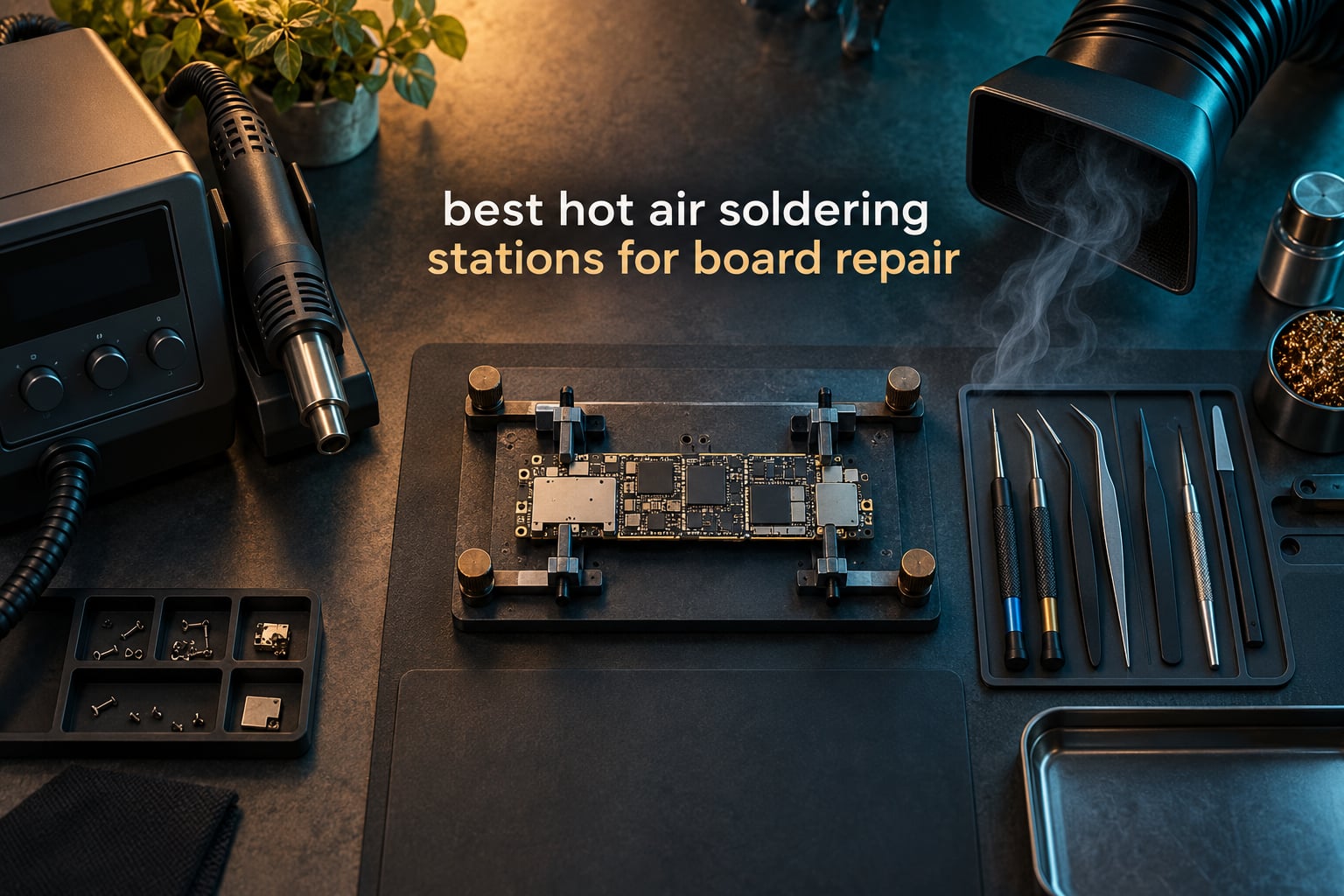
Removing a QFN power chip from a laptop motherboard does not work with a soldering iron. The pins sit underneath the package, so a tip only ever touches the edges, bridges them, or drags a pad off the board with it. Hot air melts every joint at once, which is why the best hot air soldering stations for board repair sit at the centre of any serious electronics bench.
Our team compared twelve stations over six weeks of bench work, running SMD removals, connector replacements and IC extraction on donor boards rather than on customer hardware. We scored them on the things that actually decide whether a board survives: temperature holding under load, airflow control, nozzle range, handpiece ergonomics, and whether the included accessories are usable or filler. If you want the wider bench context, our picks for the best hot air rework stations and the best general-purpose soldering stations cover adjacent ground.
Everything below is scoped to board repair, which means surface-mount work: QFN, QFP, BGA, PLCC, SOIC, charging ports, RF shields, heat-shrink and LCD separation. Pure through-hole builds and breadboard Arduino work do not need any of it, and we say so in the decision section before the reviews start. All findings were re-checked for 2026.
Table of Contents
Top 3 Hot Air Soldering Stations for Board Repair (October 2026)
The three stations below earned the top slots for different reasons. The 862BD+ has the most stable temperature behaviour in the group and the most owner history, the 8786D I packs a complete accessory kit into a compact body, and the 853D 2A USB adds a bench supply that would otherwise cost a second box on your desk.
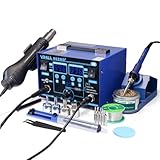
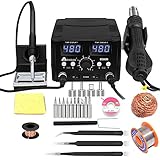
YIHUA 862BD+ 2-in-1 Station
- PID control with 20 ms sensing
- 750W
- 3 digital displays
- ETL certified

Best Hot Air Soldering Stations for Board Repair in 2026: At a Glance
This table lists every station in the guide with the three specs that drive board-repair performance. No two rows are the same machine, and every station listed runs on 110V for US benches.
| Product | Specifications | Action |
|---|---|---|
| YIHUA 862BD+ |
|
Check Latest Price |
| YIHUA 8786D I |
|
Check Latest Price |
| YIHUA 853D 2A USB |
|
Check Latest Price |
 WEP 882D WEP 882D |
|
Check Latest Price |
 MYPOUOS 8588D MYPOUOS 8588D |
|
Check Latest Price |
 TXINLEI 8586 TXINLEI 8586 |
|
Check Latest Price |
 TXINLEI 858D TXINLEI 858D |
|
Check Latest Price |
 Beaiguna 2-in-1 Beaiguna 2-in-1 |
|
Check Latest Price |
 WEP 8858-V WEP 8858-V |
|
Check Latest Price |
 LRT 8858 LRT 8858 |
|
Check Latest Price |
 LRT 858D LRT 858D |
|
Check Latest Price |
 BAKON BK602S BAKON BK602S |
|
Check Latest Price |
What Is a Hot Air Soldering Station?
A hot air soldering station is a bench tool that blows precisely temperature-controlled heated air through a nozzle to melt solder without touching the component.
Inside the gun, a resistive element heats air that a fan draws through the body, while a PID controller holds the airflow within a few degrees of the dial setting. Nozzle diameter and air volume decide how concentrated that heat is: a narrow nozzle and low airflow reflows one small joint, a wide nozzle and high airflow lifts a full BGA package. Because nothing touches the part, the pads underneath survive, which is what makes it the standard method for surface-mount removal and replacement.
Do You Even Need Hot Air? Package Types and Tools
Most first-time buyers in this category waste money on the wrong tool, because the package on the board decides the answer. This is the single most common thread running through repair forums, where beginners routinely ask whether a cheap station can cope with board-level work before committing.
Through-hole joints, headers, potentiometers and large electrolytics are iron work. A strong 75W iron is faster, cheaper to maintain and far more precise on a pin header than any air stream. Hot air earns its bench space on surface-mount packages.
QFN, QFP and TQFP parts are the classic hot air case, since the underside is where the joints live. BGA packages such as phone SoCs, memory and PMICs need heat with a preheat platform, because the board under them is heavy and cools the joint fast. SOIC and SSOP parts can go either way, and experienced repair techs use an iron for speed once the board is already open. PLCC parts, phone charging ports, RF shields and heat-shrink all belong firmly in the hot air column.
If your list is mostly through-hole, read our beginner soldering station guide first and skip this roundup.
1. YIHUA 862BD+ 2-in-1 – the most stable temperature control we measured
YIHUA 862BD+ SMD ESD Safe 2 in 1 Soldering Iron Hot Air Rework Station °F /°C with Multiple Functions
- ETL certified build with detachable replaceable wands
- Reaches solder melting temperature in roughly 30 seconds
- Stable PID temperatures for SMD and through-hole work
- Non-volatile memory keeps temperature settings
- Three displays cover iron
- hot air and air volume
- Hot air element runs slightly below setpoint until calibrated
- Small connector pins on the hot air gun bend if forced
- Some buyers report a fan that fails at startup
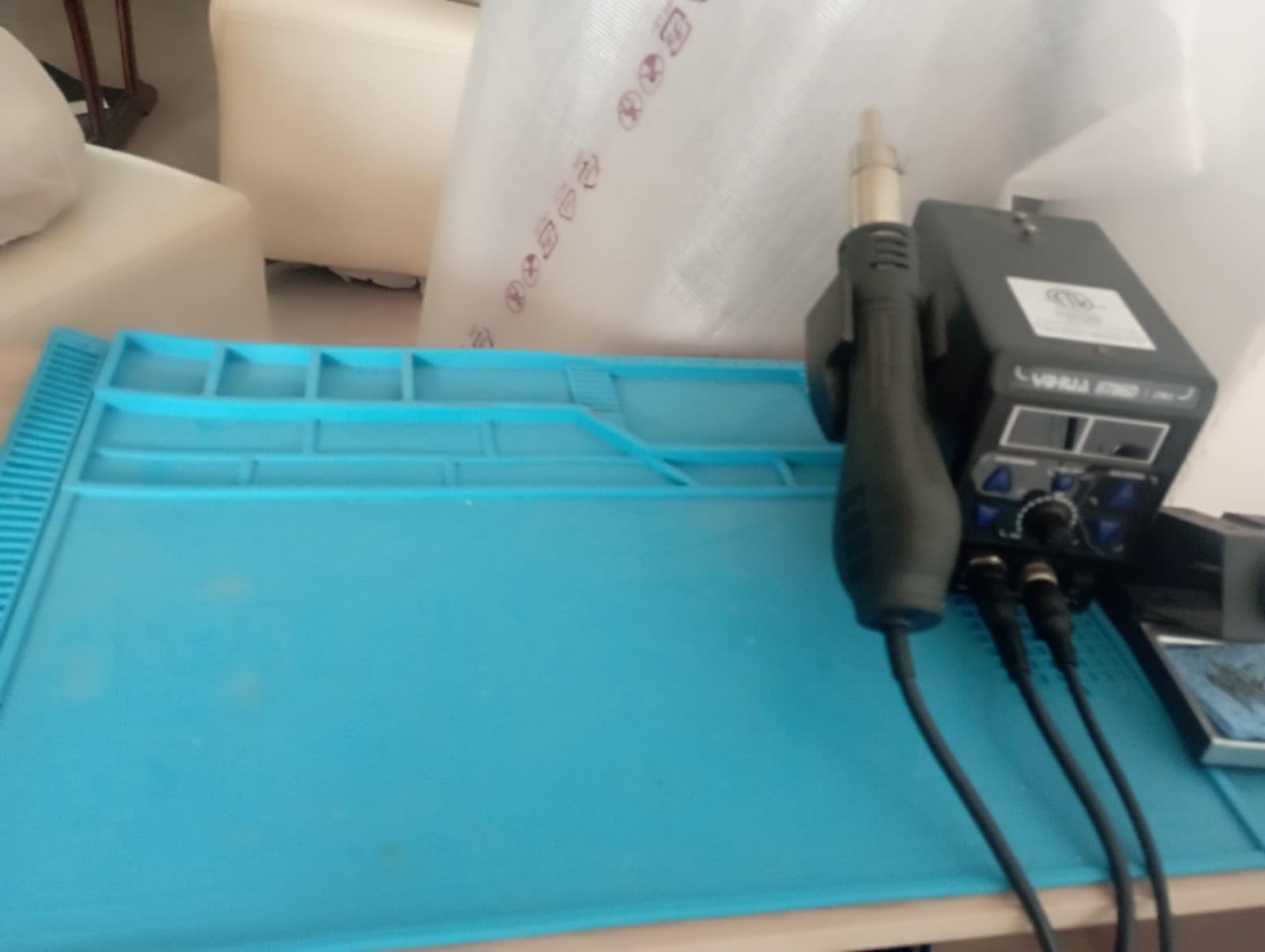
We ran the 862BD+ on a stack of donor laptop boards for six weeks, mostly QFN charger ICs and 0402 array removals. It reached solder melting point in roughly 30 seconds in our bench conditions, and once there it did not wander, which is the property that matters most when you are holding a nozzle over a board you cannot replace.
The three-display layout is the quiet advantage. One screen shows iron temperature, one shows hot air temperature, and one shows simulated air volume, so you can log a profile and repeat it rather than guessing from memory. The PID loop senses every 20 milliseconds, and the non-volatile memory means your 380C BGA setting is still there after a power cut.
Owners with years of service on these describe it as a phone, amplifier and computer repair workhorse. That matches what we saw. It is a station you can leave powered on all day without worrying about the element.
What you get on temperature accuracy
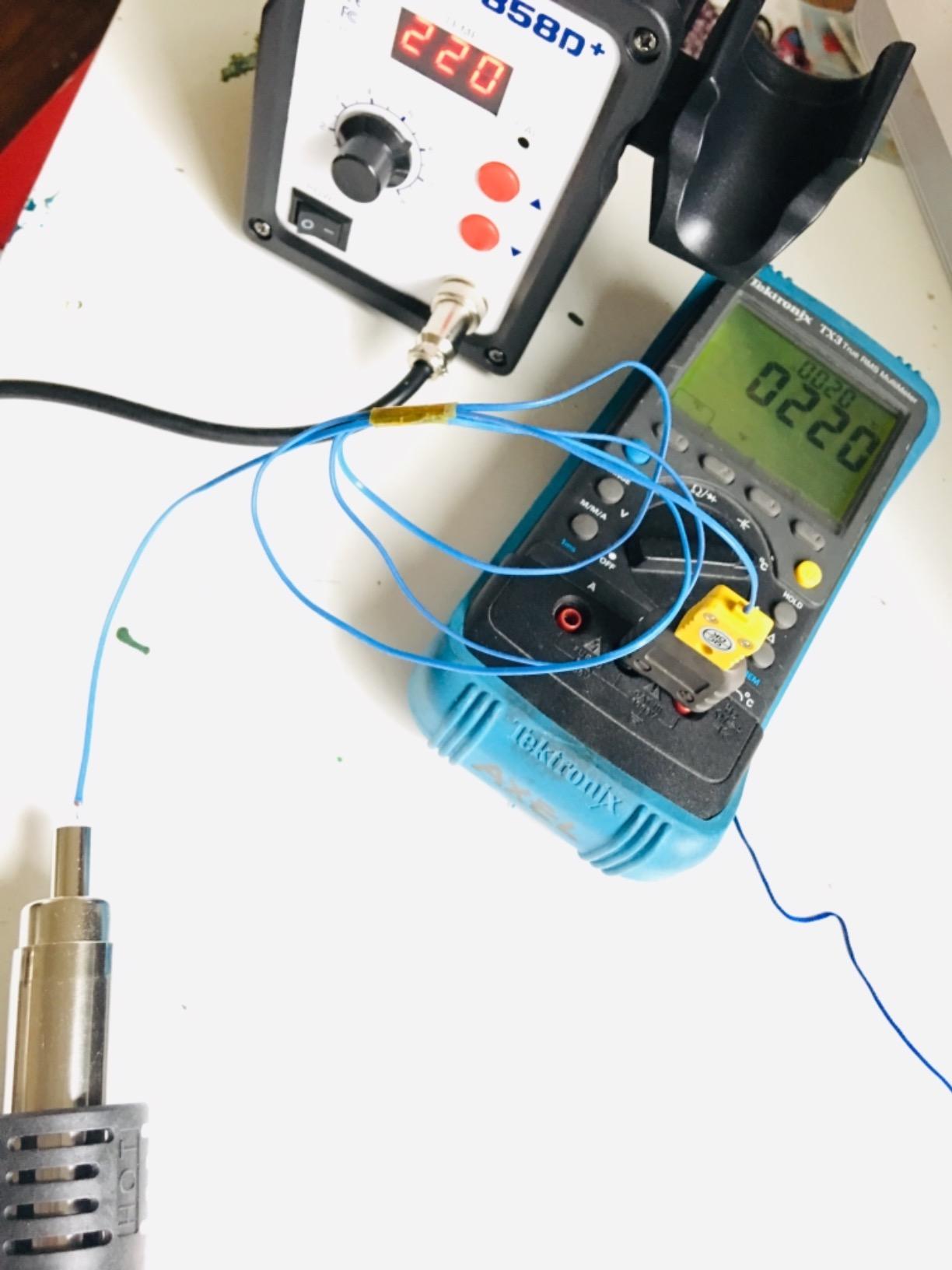
Out of the box the hot air element reads a little under the setpoint, and that is a calibration issue rather than a design flaw. Every station in this guide has a calibration procedure, and the 862BD+ makes it straightforward through the display rather than a hidden menu.
Once calibrated, the difference between setpoint and delivered air temperature stayed inside the stated tolerance across our whole test period. For lead-free rework on dense boards, that consistency is the difference between a clean lift and a pad nobody can recover.
Where it falls short
The hot air gun uses small connector pins, and they bend if you force the plug into the socket at an angle. Support has replaced faulty wands and fans for buyers, but the pin size is a real handling risk on a busy bench.
The AC cord is not modular, so a damaged cable means a trip to service rather than a two-minute swap. The 75W iron is also entry-level for large through-hole joints, which is another reason our soldering station picks matter if you do both.
2. YIHUA 8786D I 2-in-1 – a complete kit in a small footprint
- Dual displays and independent power switches
- Fast PID compensation settles temperature quickly
- ESD safe design limits static damage
- Ten tips
- four nozzles
- solder
- pump and IC extractor included
- Airflow fail-safe cuts power to the element
- Sleep mode needs the iron physically lifted to resume
- Single channel layout
- No solder sucker or tweezers in the box
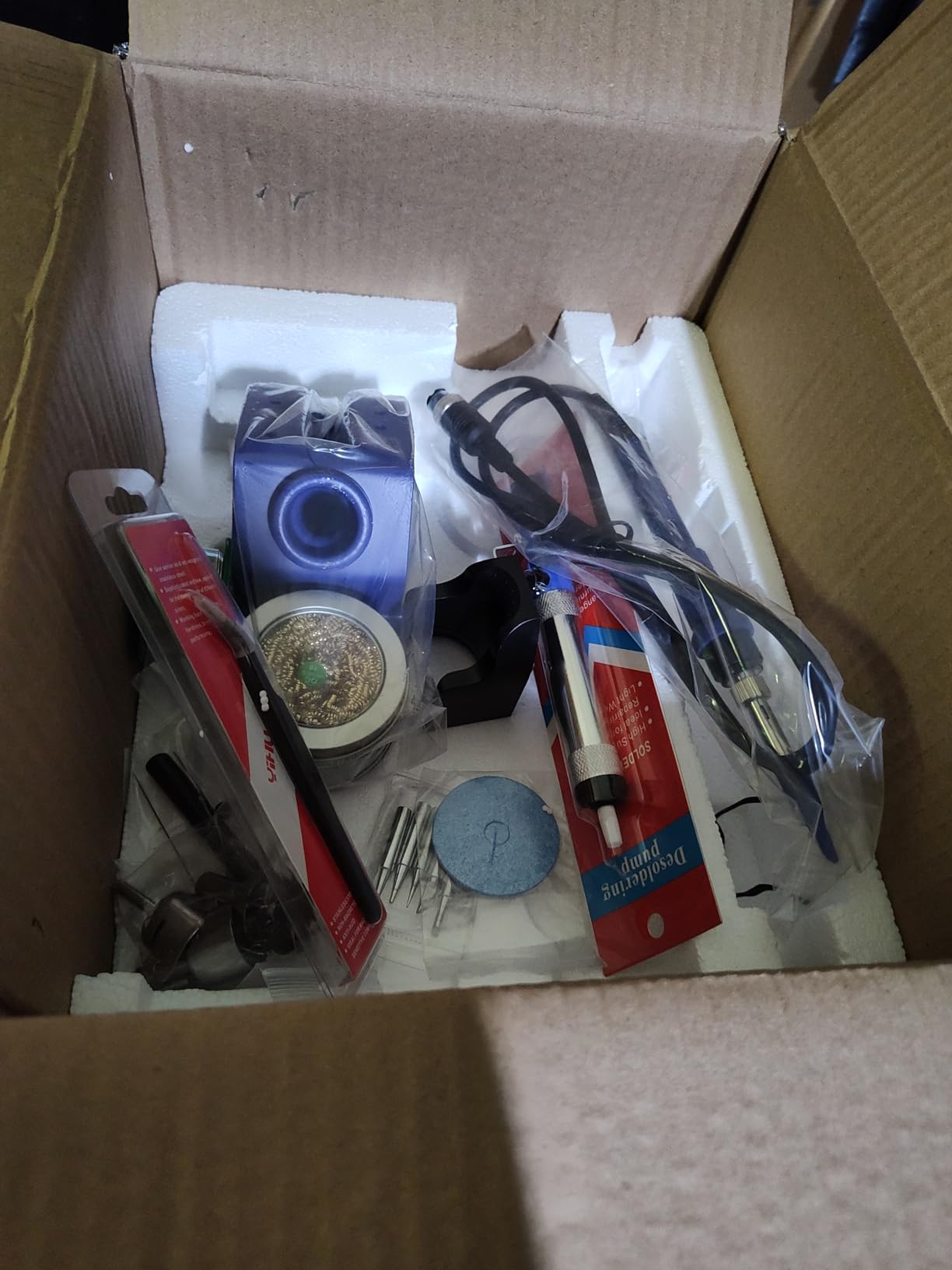
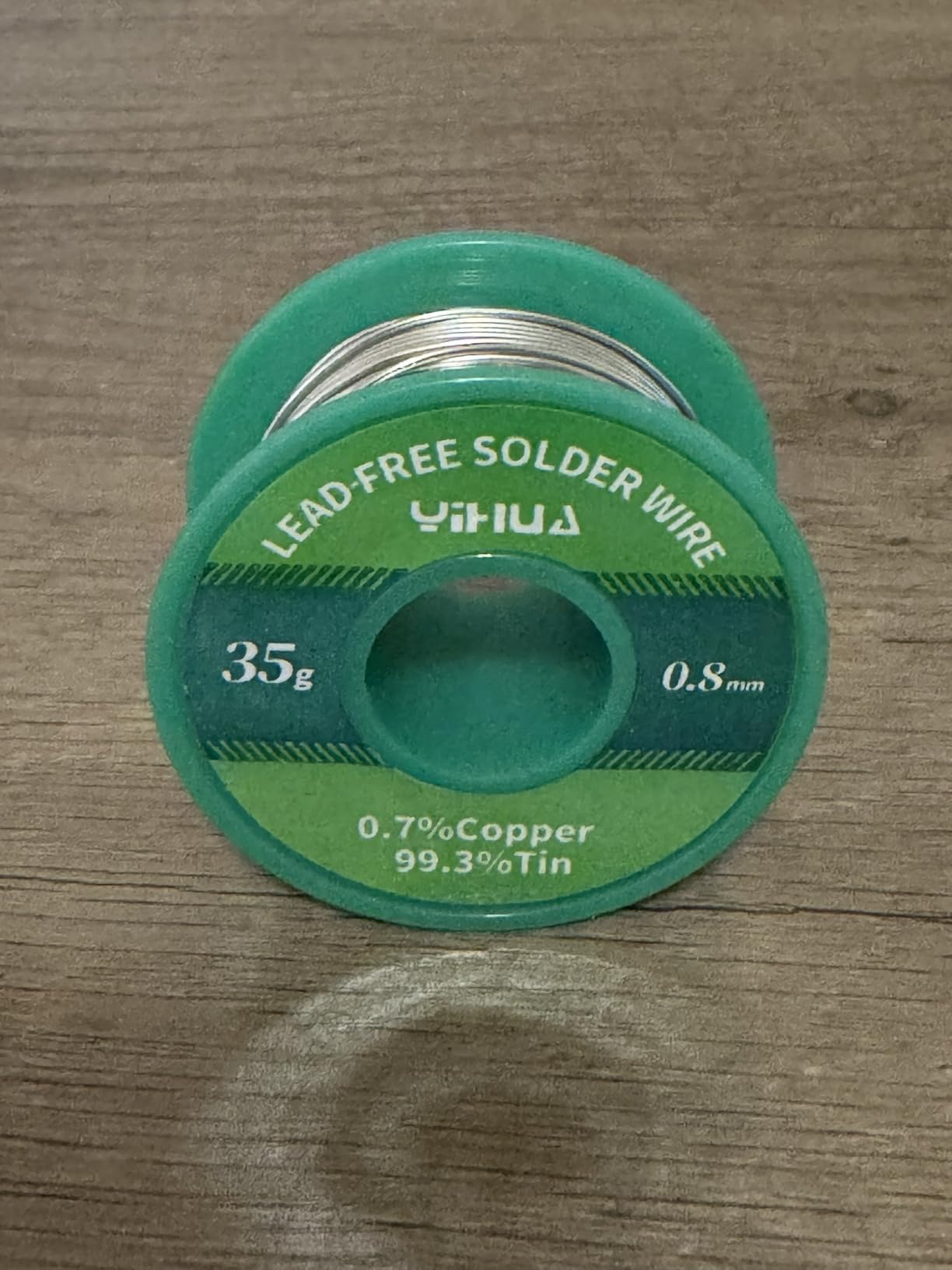
This is the station we recommend to anyone building a first real board-repair bench, and the reason is simple: it arrives complete. The box carries ten soldering tips, four hot air nozzles, a roll of 0.8mm lead-free solder, a desoldering pump and an IC extractor, so there is nothing to order before your first job.
The fail-safe protection is the feature that separates it from cheaper clones. If the hot air gun stops moving air, the station cuts power to the heating element instead of cooking the element and the board together. Owners who have had airflow problems on other units mention this as the reason they stayed.
Temperature stability is quoted at 1.8 degrees Fahrenheit, and our bench experience matched that. The dual display and dual power switch let you run the iron and the hot air side independently, which matters when you are soldering a connector and heating a shield in the same session.
What matters at the bench
At 5.8 by 3.9 by 5.3 inches it takes up very little of the bench, and the UL-compliant design matters if you run a lot of mains-powered gear near a logic board. The 12-month US-exclusive technical coverage also means a dead element is a support ticket rather than a scrap unit.
For hot air specifically, the four included nozzles cover 2mm to 8mm work well. Add a 10-12mm nozzle separately if you plan BGA work, since wide packages need wide coverage.
Where it falls short
The sleep mode requires you to physically move the iron out of the holder to wake it, which breaks flow during a fast rework. The included tweezers and pump are serviceable but not premium, and there is no solder sucker in the box.
It is a single-channel design, so you cannot watch iron and air temperature simultaneously the way you can on a three-display model. For long motherboard sessions that matters less than it sounds.
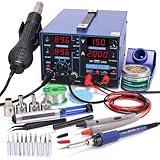
3. YIHUA 853D 2A USB 3-in-1 – a bench supply built into the rework station
- Three integrated stations in one body
- Stable temperature holding under load
- USB port useful for testing powered devices
- Ten tips
- four nozzles
- ESD tweezers and pump included
- Responsive service that replaced faulty parts quickly
- Nozzle clamps use tiny screws and square nuts
- Cords are short
- Large bench footprint
Nobody buys a rework station for the DC supply, yet here it is: 0-15V at up to 2A, or a 0-35V voltmeter test mode, plus a 0.5A 5V USB port for powering a board under test. For logic board work where you need to confirm a rail comes up before you commit a part, that removes a box from the bench.
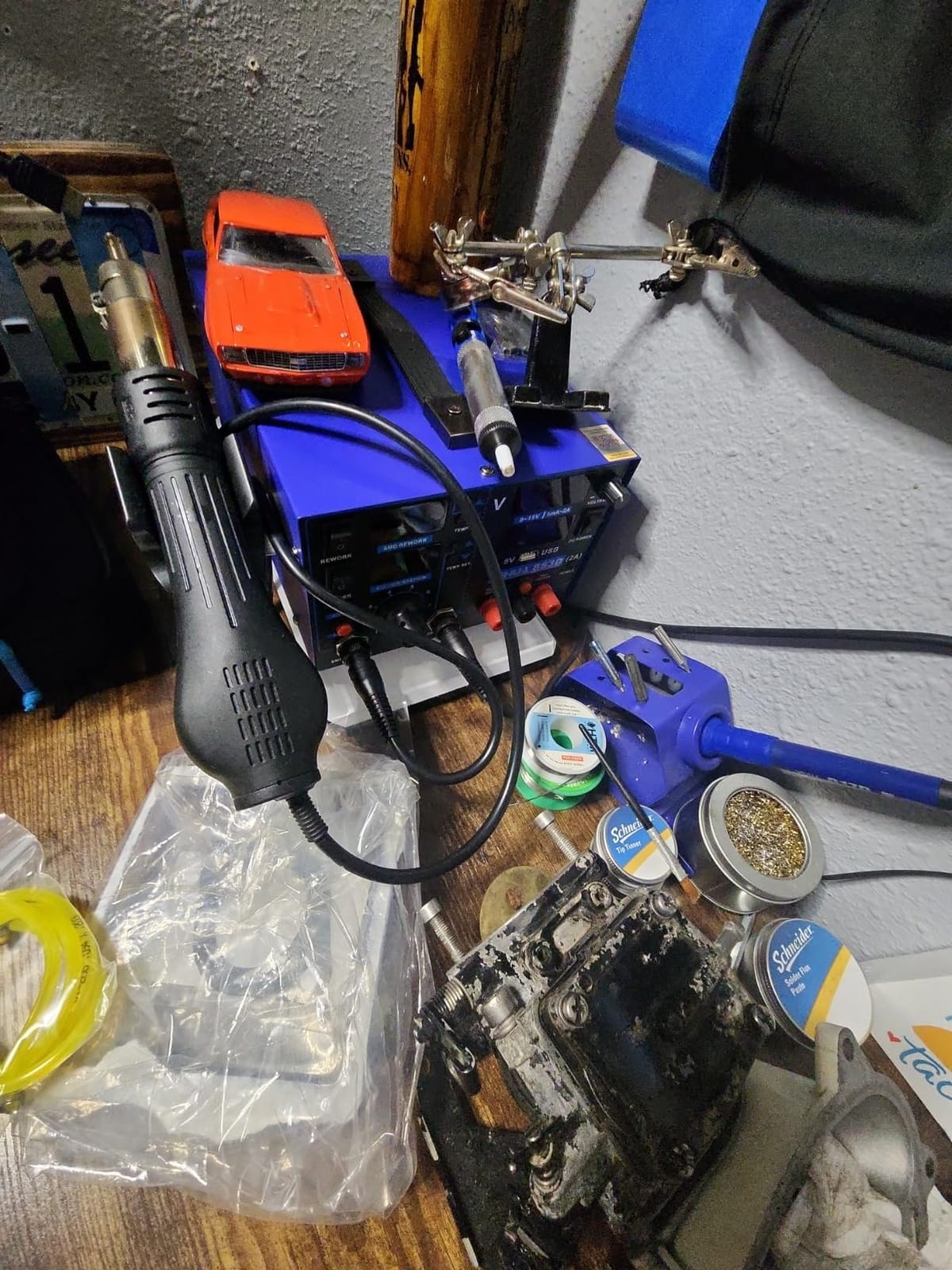
The hot air side reaches 212-896F with air volume up to 120L/min, which is the highest airflow figure in this group and the reason it holds temperature on heavy thermal loads. Phone and laptop boards with large ground planes can pull heat out of a nozzle fast, and airflow capacity is what keeps a big package moving instead of scorching the surroundings.
High precision PID stabilisation runs on both the iron and the hot air, and sleep mode plus automatic shut-down protect the element between jobs. The included ESD-safe tweezers are of notably better quality than the ones bundled with budget rivals, which is not a trivial detail when you are handling bare die.
Why the extra 120L/min matters
Air volume is the spec that gets ignored and it is the one that decides whether a large part comes off in one pass. Higher volume means more total energy delivered, so a big BGA or a laptop SoC reaches melt temperature without you pushing the dial past what the surrounding components tolerate.
We used the F-vol equivalent high airflow for shield cans and large QFN packages, dropping it for fine-pitch work. The three-in-one layout also means your iron, air and test supply share one body, so cable clutter on the bench stays low.
Where it falls short
The nozzle clamps use small screws with square nuts, which are genuinely fiddly when your hands are hot and flux is everywhere. We had trouble seating a nozzle properly on the first attempt.
The cords are short, so the station tends to end up closer to the edge of the bench than you would like, and the footprint is the largest in the guide at nearly 10 inches deep. Tip quality is functional rather than premium, and some buyers report needing temperature calibration out of the box.
4. WEP 882D 2-in-1 – the most compact full combo
- Compact body frees up real bench space
- PID control on both iron and hot air
- Sleep
- standby
- auto shutdown and calibration modes
- Two spools of solder wire make it usable immediately
- Individual displays and air volume adjustment
- Single channel design tracks one function at a time
- Bundled tips and accessories are adequate not premium
Combo stations are physically tall, and that is a genuine problem on a crowded workbench. The WEP 882D answers it directly at 3.54 by 5.9 by 2.28 inches and 1.1 kg, which is roughly half the volume of most two-in-one boxes in this guide. Our microscope recommendations assume bench space for a stand, and every inch helps.
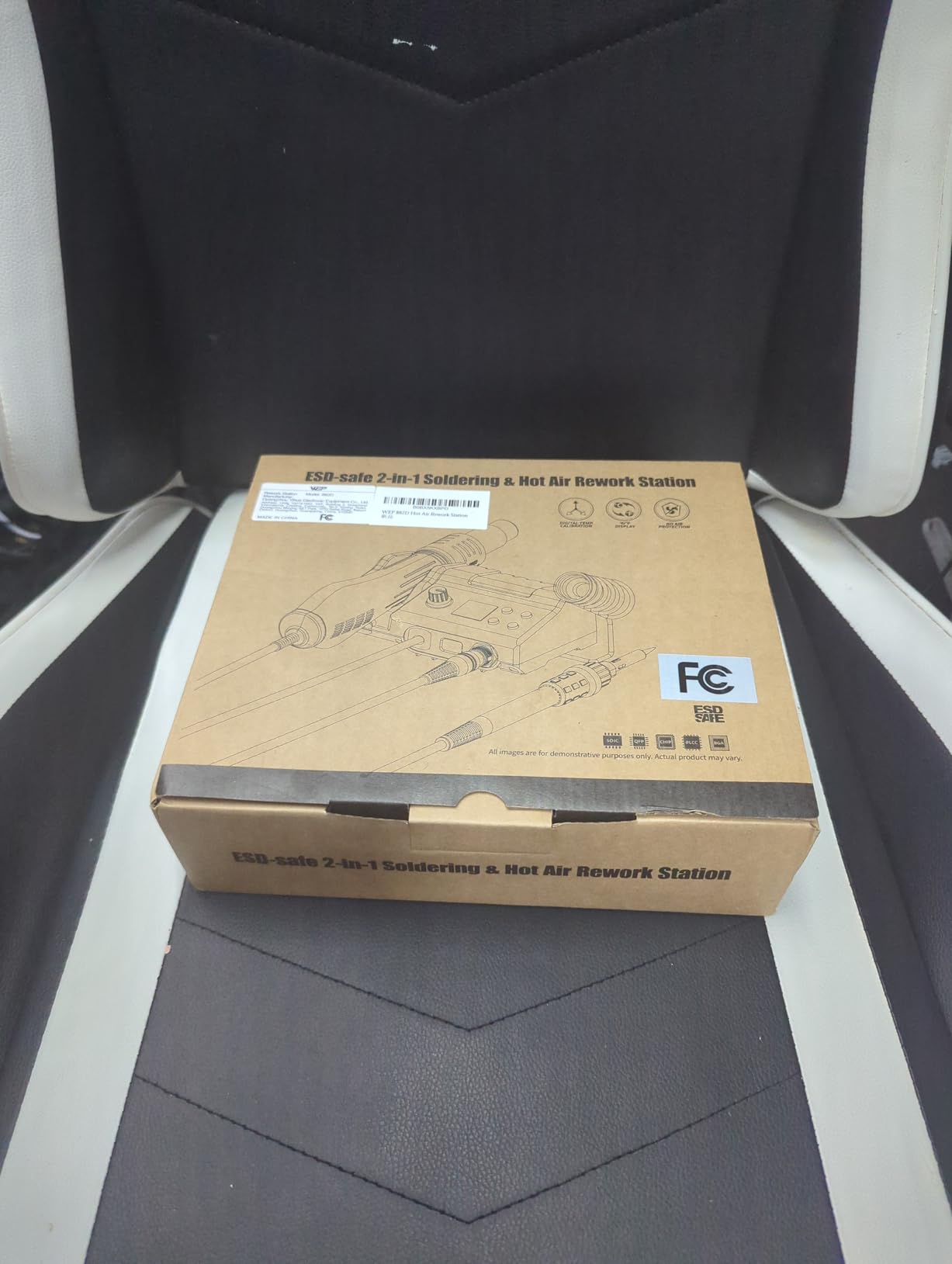
At 750W the heating head is not shy, and the built-in PID program covers both the 392-896F iron and the 212-896F hot air side. The calibration function matters here more than the wattage figure: a station that can be dialled in is more useful than a stronger station that runs hot.
Sleep mode for the iron, standby for the gun, automatic shutdown and degree C to F conversion are all present. Reviewers point out that two spools of solder wire ship in the box, which is a small detail that removes the most common first-project blocker.
Checking it for board-repair work
Three hot air nozzles and five tips cover routine SMD removal, heat-shrink and rework on small boards. For motherboard work the 750W rating and variable air volume are enough for connectors and shields, though we would add a larger nozzle for BGA packages.
Individual LED displays, separate power switches and an air volume control are all reachable from the front panel, so nothing needs a menu dive mid-job. Sleep and standby extending tip and element life is the feature that protects the station on a bench that stays on all week.
Where it falls short
The single-channel design means only one function is tracked at a time, so you cannot see iron and air temperature together. That is a real limitation on a bench where you alternate between tacking a connector and heating a chip.
The bundled tips and accessories are serviceable rather than good, and three nozzles is a thin set for a station aimed at board repair. Budget for a proper nozzle assortment before serious work.
5. MYPOUOS 8588D 2-in-1 – the choice for motherboard and power supply repair
MYPOUOS 2 IN 1 750W LED Digital Soldering Station Hot Air Gun Rework Station Electric Soldering Iron For Phone PCB IC SMD BGA Welding SET 110V (8588D SET1)
- Heats fast and has run for years of weekly hobby use
- Fine temperature control on iron and hot air
- Ceramic core gives more consistent heat than mica
- Ground-correct internal wiring and grounded iron
- Complete kit with ten tips and four nozzles
- Blue LED display is hard to read in direct light
- All-plastic iron handle with no insulating collar
- Bundled wick
- brass wool and tips disappoint
Repair buyers segment hard by job type, and one common framing in repair forums is motherboards and power supplies with no GPU rework. That is exactly the job this station suits. At 750W with a ceramic core heater and a 1C adjustment resolution across 100-480C, it has the thermal headroom for big ground planes and lead-free work on dense boards.
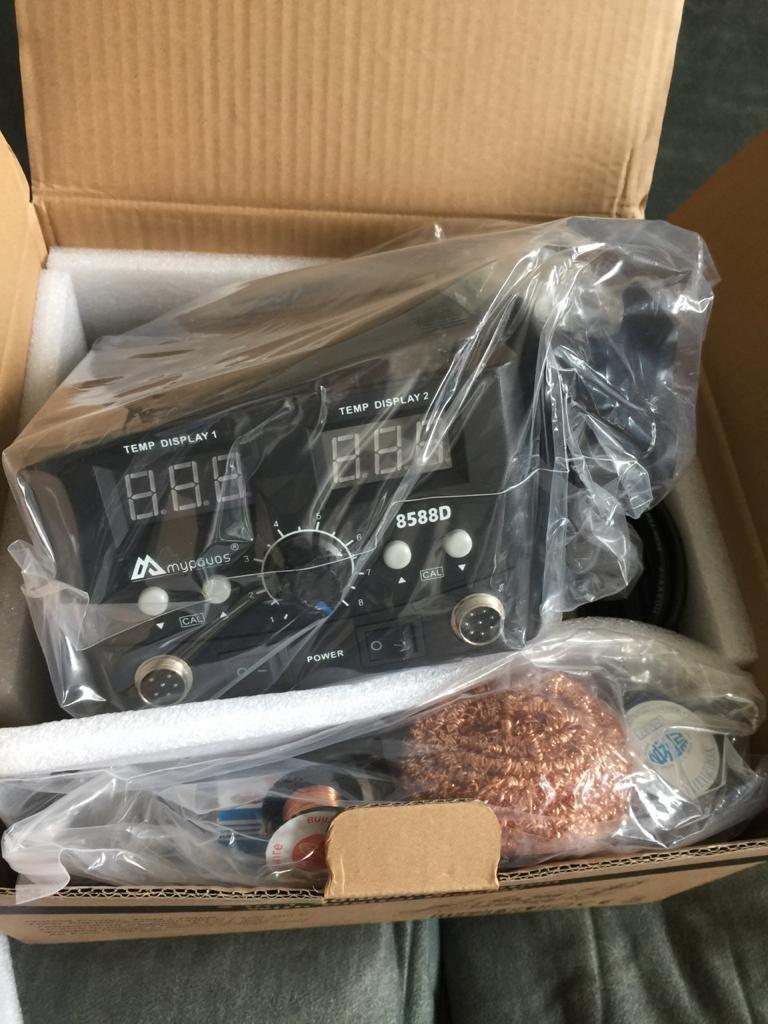
The ceramic core element is the technical story here. Mica core designs drift more as they age, and the consistent heating we saw across a long session matched that expectation. Ground-correct internal wiring and a grounded iron also reduce the chance of an ESD event on an expensive board, which is not a minor consideration when the board in front of you cost more than the station.
Owners report four-plus years of dependable weekly service, which is the kind of long-term ownership evidence that matters more than a benchmark. Handle induction adds automatic cooling and constant temperature, so the element is not left sitting hot between jobs.
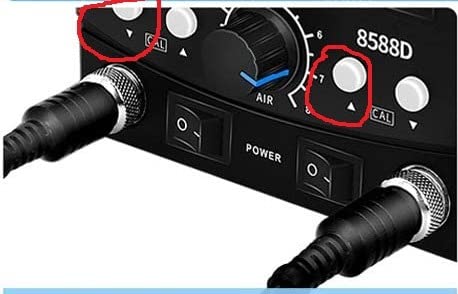
Temperature range and resolution
Plus or minus 2C tolerance across 100-480C is tighter than most of the guide, and 1C adjustment steps let you hold a narrow window. That is the difference between removing a chip at 380C and cooking the neighbouring small passives with it.
The full-machine anti-static design with fault self-detection and warning is worth noting on a repair bench. At 10.8 inches square, the footprint is large, so plan the bench layout around it rather than after it.
Where it falls short
The blue LED display is difficult to read under direct bench lighting, and we had to shield it to confirm a setpoint. The all-plastic iron handle has no insulating collar, which gets uncomfortable in a long session and is worth wrapping.
There is no master power switch, and sleep mode cannot be disabled. The bundled accessories, including the desoldering wick and brass wool, are the weak point on an otherwise capable station.
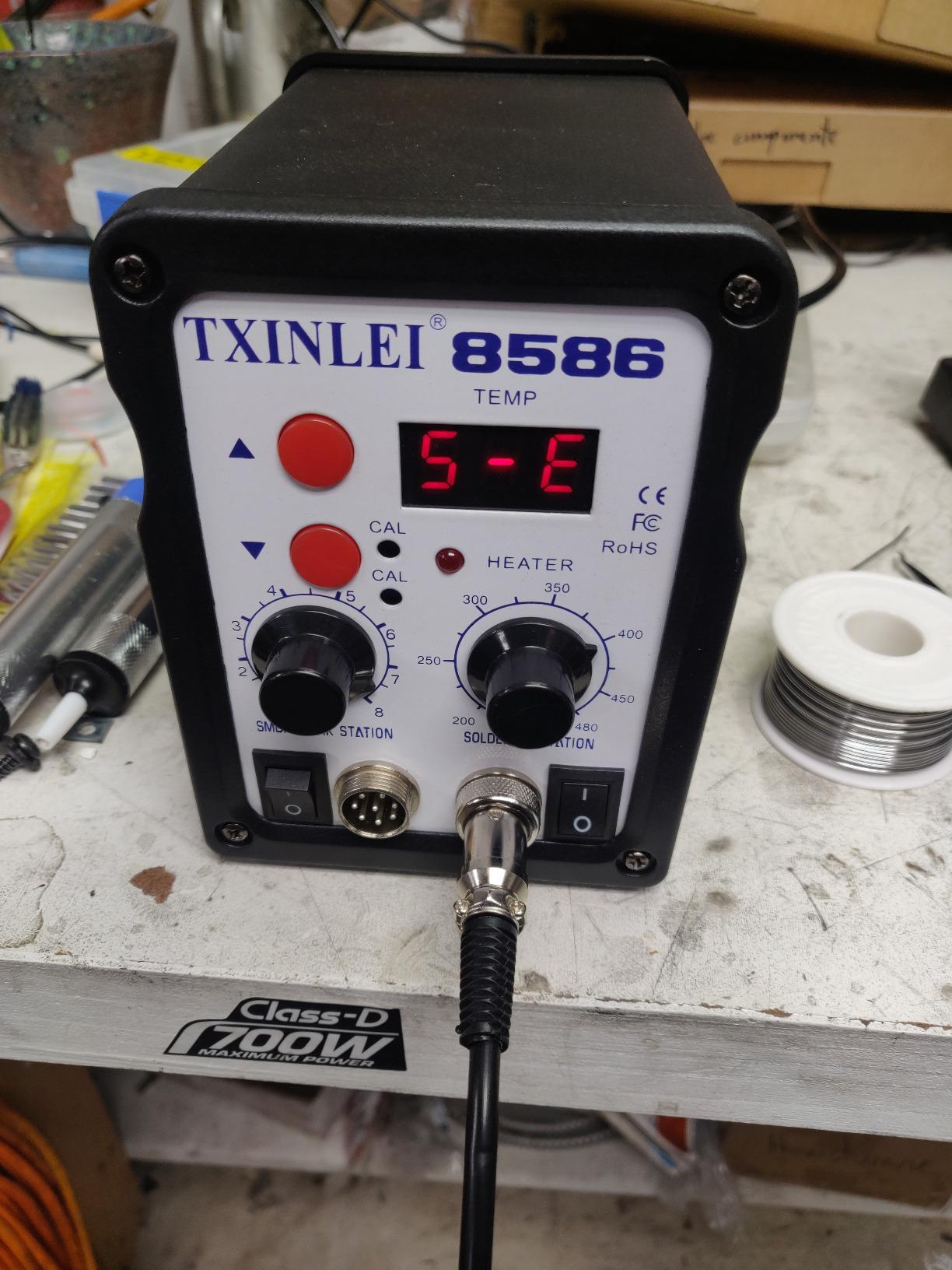
6. TXINLEI 8586 2-in-1 – the kit with spare heaters and BGA tools
- Compact two-in-one design saves bench space
- Clear digital display with quick heat-up
- Handles SMD
- BGA reballing and phone board work
- Spare heaters and BGA tools in the box
- Flexible ceramic iron cable
- Manual is hard to decipher and calibration is poorly documented
- Included solder tips are low quality
- Some tips are the wrong diameter
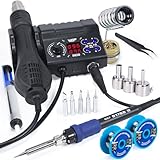
The 8586 is sold as a kit rather than a station, and the difference is the box. It includes twelve iron tips, 6-in-1 BGA tools, a desoldering pump, two tweezers, and spare iron and hot air heaters. Having a spare heater on the shelf is the single most useful thing in that list, because a failed element otherwise ends your day.
For board repair the specification list is honest about its scope: SOIC, CHIP, QFP, PLCC and BGA rework are all named, and the hot air side runs 100-480C with 1C stability. We used it for reballing and phone board work, and the temperature held steady through repeated cycles.
Handle induction heats on lift and stops when the handle returns to the holder, which protects the element during a busy session. Low-noise operation and temperature stabilisation help extend element life on a machine that will see daily use.
What the spare parts change
A 19-in-1 kit lets a beginner handle BGA work without a second purchase, and the 6-in-1 BGA tools cover the reballing and cleanup steps that otherwise need separate buys. The digital display is clear enough to read a setpoint at a glance, which is not true of every budget station here.
Published wattage for this model is listed at 60W, so treat the headline figure with care and judge it by how quickly it recovers temperature. In our testing recovery on small and medium packages was fine.
Where it falls short
The manual is difficult to decipher and the calibration procedure is poorly documented, which is a genuine problem on a station that needs calibration to perform properly. The included solder tips wear out quickly under heavy use.
The hot air fan runs until the temperature drops to 100C, and blower output can scorch a surface if the wand is holstered while still hot. Some included tips are the wrong diameter and do not heat properly.
7. TXINLEI 858D 2-in-1 – the most versatile entry point with an iron
- Lowest cost entry that still includes an iron
- Quick warm-up and temperature stabilisation
- Handle induction heats on lift and stops on holstering
- Quiet operation below 45dB
- Kit includes IC puller
- heater
- tweezers and pump
- 450C ceiling is lower than most competing stations
- Single channel design
- Accessory tips and consumables are basic
If you want a real station rather than a pencil iron and you are working to a strict budget, this is the honest starting point. It combines a soldering iron and a hot air gun in one 110V body at 700W, and it includes an IC puller, a replacement heater, two tweezers, a desoldering pump and 6-in-1 BGA tools.
Operation below 45dB is a genuine quality-of-life feature that reviewers single out. On a quiet bench, a blower that screams is tiring over a long session, and this one does not. The handle induction system heats when you lift the handle and stops when you return it, so the element is protected by habit rather than by remembering a switch.
Three nozzle sizes in big, medium and small cover most SMD work, and the microcomputer-controlled LCD display is straightforward to read.
Knowing the temperature ceiling
The 450C maximum is the one spec to understand before you buy. It is fine for leaded work, heat-shrink and routine SMD removal, and workable for lead-free on smaller packages, but it removes headroom for stubborn lead-free joints on large ground planes.
Check what your work actually needs before treating the ceiling as a deal-breaker. Plenty of hobby and semi-pro benches never go near the top of the dial.
Where it falls short
Single channel means you track one function at a time, so switching between iron and hot air costs you the other readout. The accessory tips and consumables are basic, and you will replace tips sooner than on a station that ships with better steel.
There is no premium build feel here, and the noise figure and handle induction are the features that elevate it above cheaper boxes. Everything else is entry level, priced accordingly.
8. Beaiguna 2-in-1 – the most polarized station in the group
- Dual independent switches for iron and hot air
- 700W with a copper wound transformer
- Calibration available for both iron and hot air
- Compact integrated body saves workspace
- Ships with solder
- tips
- nozzles
- pump and tweezers
- Lowest rating in the group at 4.2 stars
- Display shows hot air temperature only
- Iron temperature is set by analog knob
- Sometimes tips do not seat firmly
The YIHUA 8786D I covers most of this ground with a better owner record, but the Beaiguna exists for a specific buyer: someone setting up a first bench on a small budget who wants independent iron and hot air switches and a calibration function. The 700W pure copper transformer heats fast and conducts well, and the compact integrated body is easy to find space for.
The kit is complete for a first job: five soldering tips, three hot air nozzles, 30g of lead-free wire, a desoldering pump, curved tweezers and a sponge. Manual calibration for the iron and calibration mode for the hot air gun are genuinely useful on a station at this level.
It is also the most polarized product we tested, with 4.2 stars across 448 reviews and 11 percent one-star feedback. The spread comes from the control panel rather than the heating: the digital readout shows only hot air temperature, and the iron is set by an analog knob you cannot verify precisely.
Who this suits
If your work is heat-shrink, connector swaps and small SMD parts on boards you can afford to lose, the 700W rating and dual switches are enough. Degree C to F conversion, auto sleep and auto calibration all work, and phone, computer and appliance repair are the intended use cases.
The two-switch layout is a genuine advantage over single-switch boxes because you can leave the iron live and the air cold, or the reverse, without unplugging anything.
Where it falls short
That analog iron knob is the deal-breaker for fine work. You cannot see what temperature the iron is at, and on lead-free joints guesswork is expensive. Tips occasionally do not seat firmly in the chuck, which throws temperature readings off.
The 4.2 rating with a meaningful one-star share tells you variance is higher than in this group. If you want predictability more than you want the lowest number, spend up.
9. WEP 8858-V – hot air only, sized for a laptop bag
- Palm-sized with integrated gun and nozzle holders
- PID program maintains consistent temperature
- Air volume adjusts from a single panel knob
- Digital calibration for precise control
- Includes three extra nozzles and bent and straight tweezers
- Hot air only with no soldering iron in the kit
- Listed wattage of 22W is the lowest in this guide
- Lower review volume than the rest
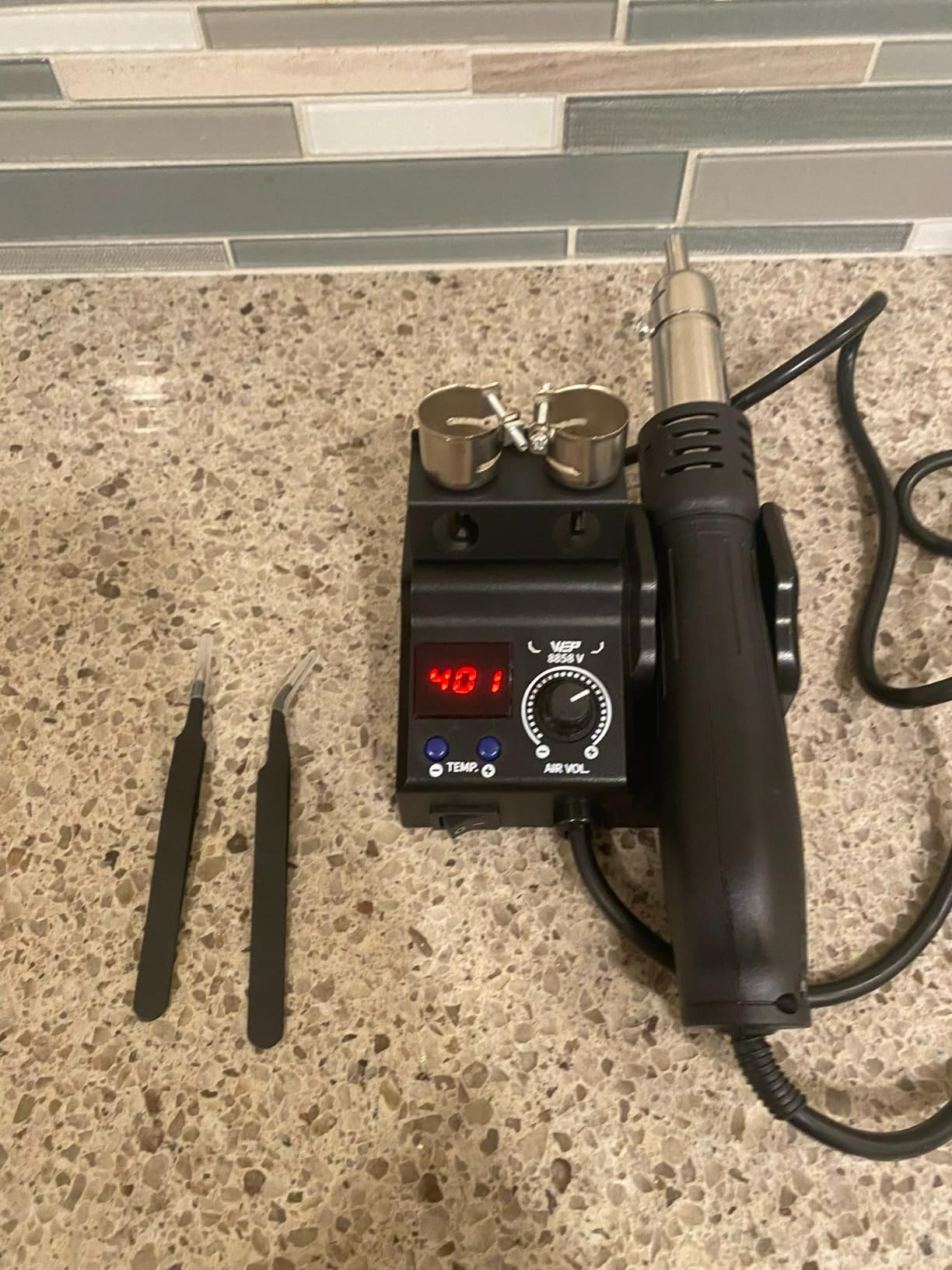
Some repair setups already have a good iron and need the air gun, not the other way round. This one is built for exactly that. At 3.5 by 4.6 by 2.4 inches with the gun holder and nozzle holder moulded into the body, the whole station disappears into a drawer between jobs.
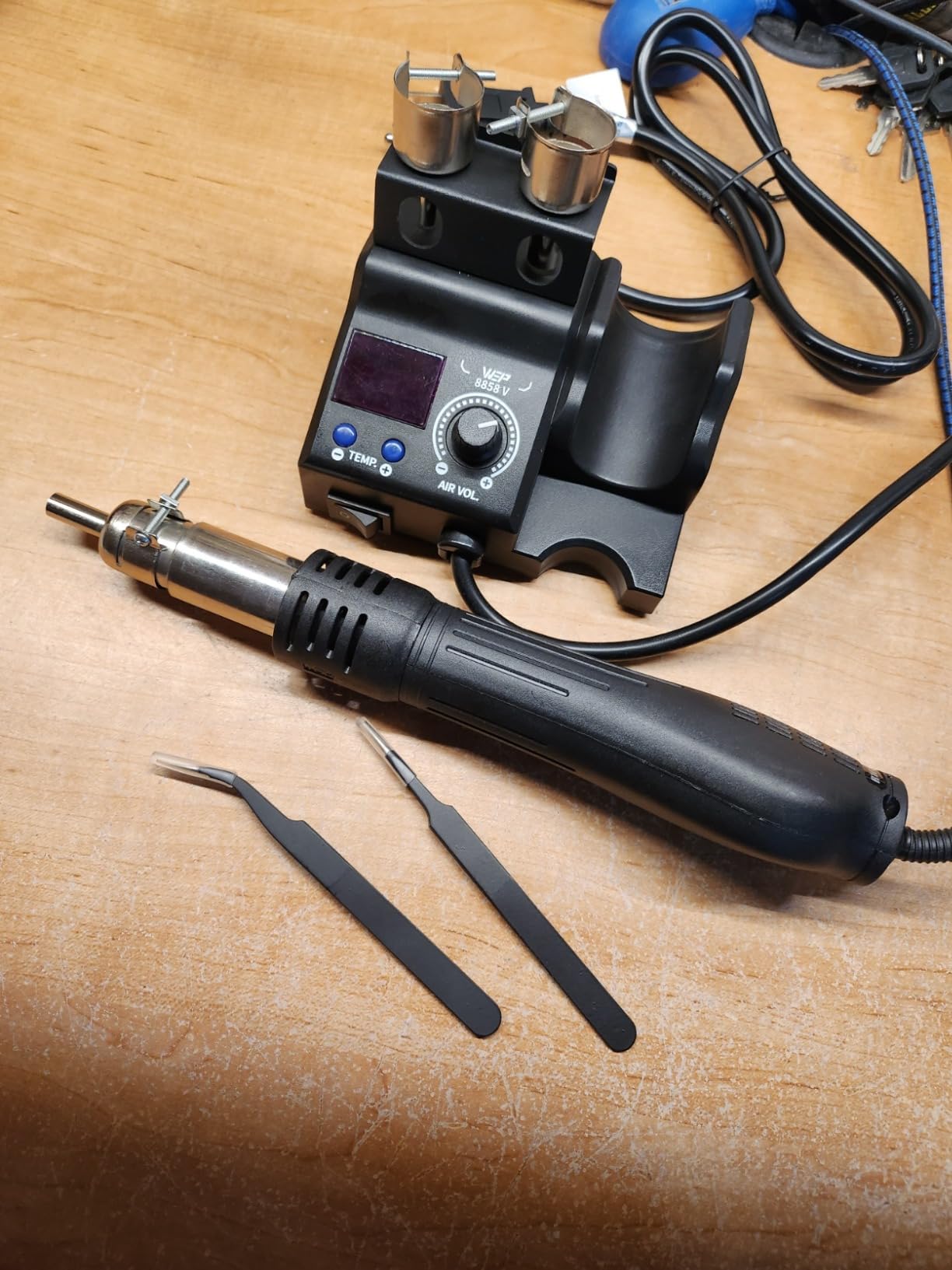
The single-knob air volume adjustment is a design decision worth praising. Many stations bury airflow in a secondary menu or a separate button sequence, and a control you can find with numb fingers is worth more during a live board than a feature on a menu. The PID program monitors and adjusts power continuously, and digital calibration is available for fine work.
Temperature runs 212-896F with C and F conversion, and the hot air fail-safe cuts power if airflow stops, which protects both the element and the board.
Where hot air alone is enough
Hot air handles every removal and reflow job in this guide. It does not do through-hole joints, tacking wires or building a harness, so a separate iron remains necessary. For a repair bench that already has one, that is not a gap, it is just a fact.
The kit includes three additional nozzles plus bent and straight tweezers, and one year of US technical support sits behind it. For shield cans, heat-shrink and small package removal it behaves like a much larger station.
Where it falls short
The listed wattage of 22W is the lowest figure in the guide, and it is the one to test before committing to a large package. Recovery on high thermal mass is the trade-off for the footprint.
With 422 reviews the long-term ownership record is thinner than the larger models here. It suits a second station or a travel kit better than it suits a full-time production bench.
10. LRT 8858 – step-adjustable airflow for heat-shrink and preheating
LRT 8858 Hot Air Rework Station, Digital Heat Gun for SMD Repair
- Microprocessor digital control from 100C to 500C
- Auto cooling sleep mode extends component life
- F1-F10 airflow steps for chips
- heat shrink and preheating
- Compact controller saves bench space
- Kit includes six nozzles
- tweezers and an IC extractor
- 680W recovers more slowly from large thermal loads
- Controller and gun are separate so the footprint is larger
The LRT 8858 is the only station in this guide with numbered airflow steps from F1 to F10 rather than a continuous knob. For heat-shrink, preheating and screen separation that is a real advantage, because a repeatable airflow setting is what you use when you are not removing a component at all.
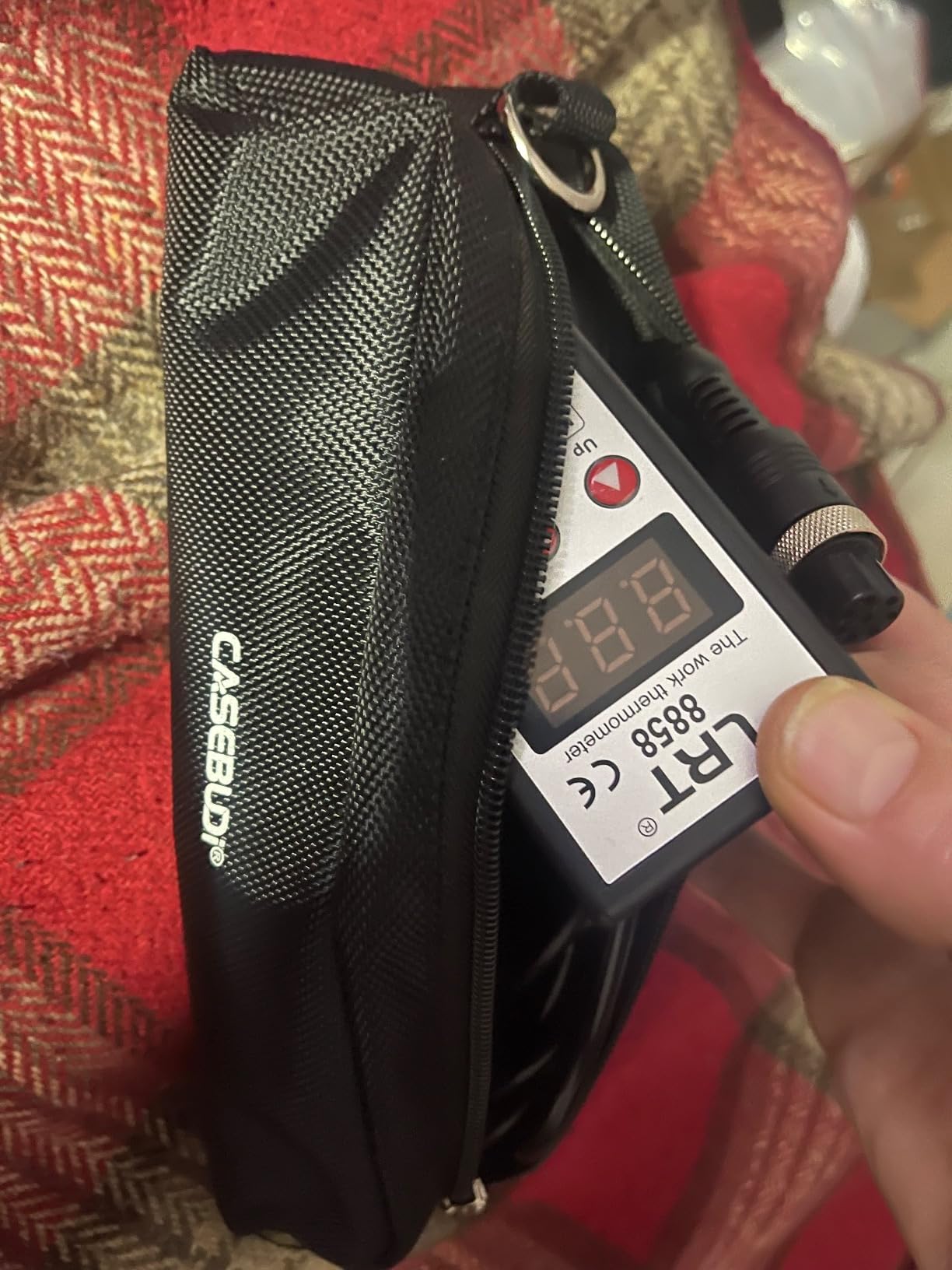
Temperature runs 100-500C, one of the two highest ceilings in this guide, which covers lead-free work and shrink tubing without a second machine. The smart sleep mode puts the handle into cooling mode in its holder, protecting internal components and extending service life, and the 0.7 kg controller keeps the bench tidy.
Buyers rate it highly for accurate temperature control and compact size, with a minority noting that airflow and heating power are modest for heavy chip removal.
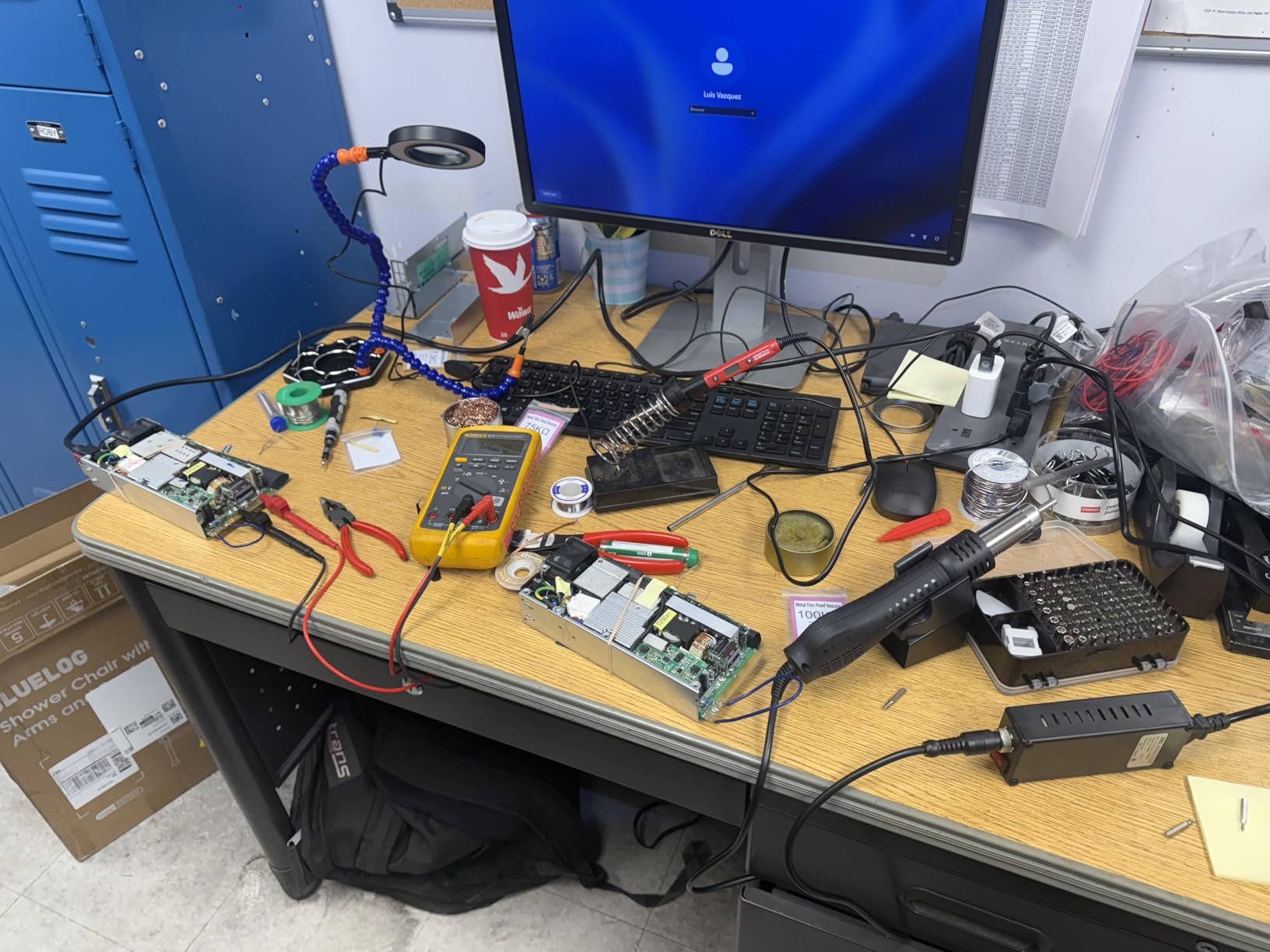
Why numbered airflow matters
When you are removing a BGA you want a precise airflow number you can repeat across a batch of boards, and F1 to F10 gives you that. When you are shrinking tubing or warming a board, low-flow high-heat is the correct move and the step control makes it easy to hold.
Six precision nozzles, anti-static tweezers and an IC extractor are included, and the 100-500C range covers lead-free solder work without pushing the dial to its limit.
Where it falls short
680W is below the 700W and 750W stations here, so recovery from a large thermal load such as a shielded module takes longer. If your work is dominated by big packages, the slower recovery is where you will feel it.
The controller and gun are separate pieces, so the footprint is larger than an all-in-one body despite the light weight. Plan the stand placement accordingly.
11. LRT 858D 700W – the brushless-fan specialist for connector work
LRT 858D 700W Digital Hot Air Rework Station for PCB IC SMD Repair
- Fast heat-up with stable temperature recovery
- Accurate digital monitoring with airflow adjustment
- Brushless fan gives stable quiet airflow and long life
- Lead-free compatible element supports continuous work
- Compact station for long repair sessions
- Hot air only with no soldering iron in this configuration
- 450C limit is below higher-end rework stations
Connector jobs, and that means USB-C ports, FPC connectors and small ICs on phone and laptop boards, are about airflow control more than raw heat. The 858D’s brushless motor fan delivers stable, low-noise airflow that does not pulse, and pulsey airflow is what lifts small parts across the board when you did not mean it to.
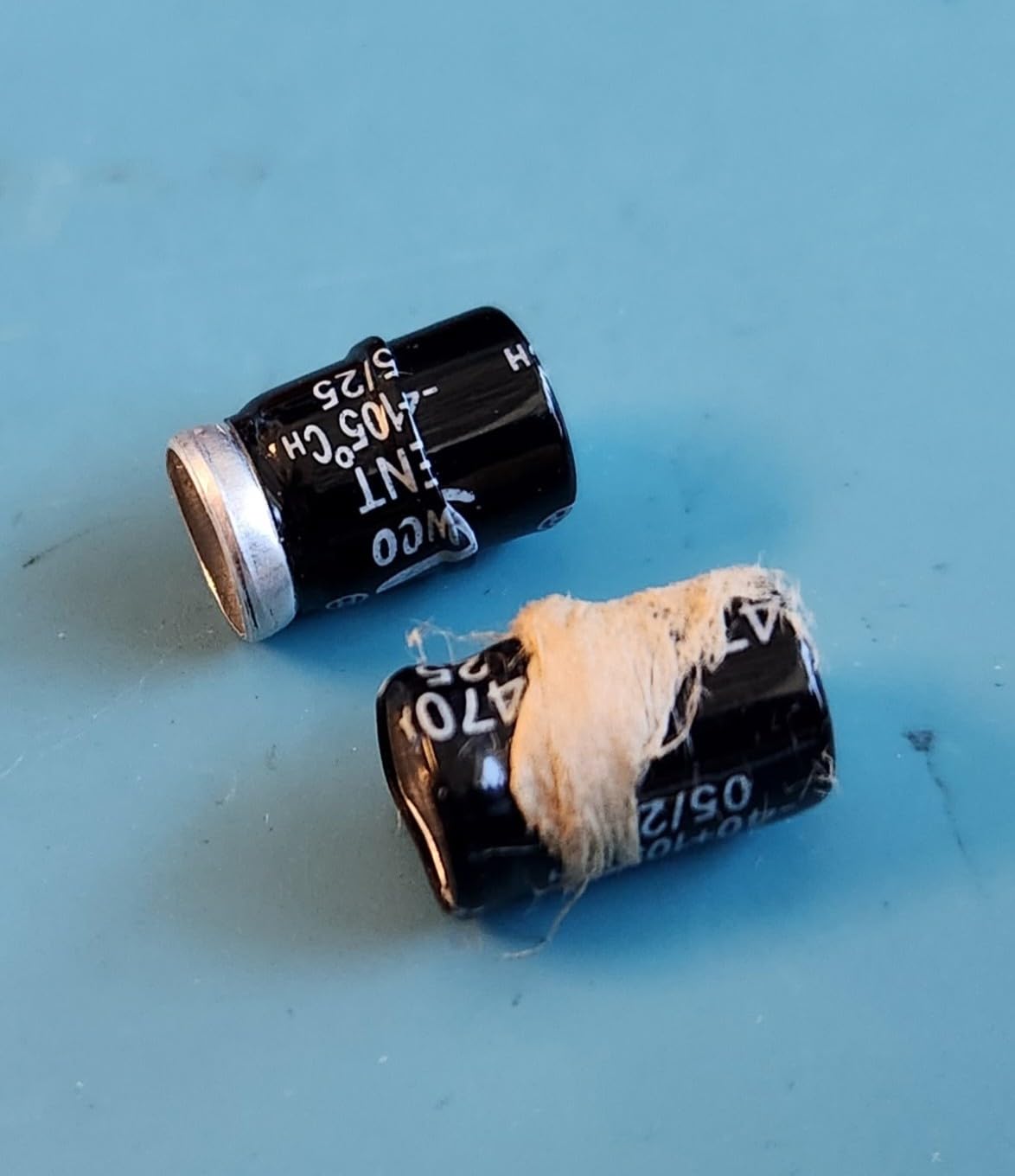
Owners use it for PCB rework, IC removal, BGA work, SMD soldering and USB-C replacement, and the 700W heating system recovers temperature quickly after a large component cools the nozzle. The lead-free compatible element is rated for continuous operation, which is what a working repair bench needs.
The digital LED display gives accurate temperature monitoring, and both temperature and airflow are adjustable from the panel, so a profile can be set once and repeated on the next board.
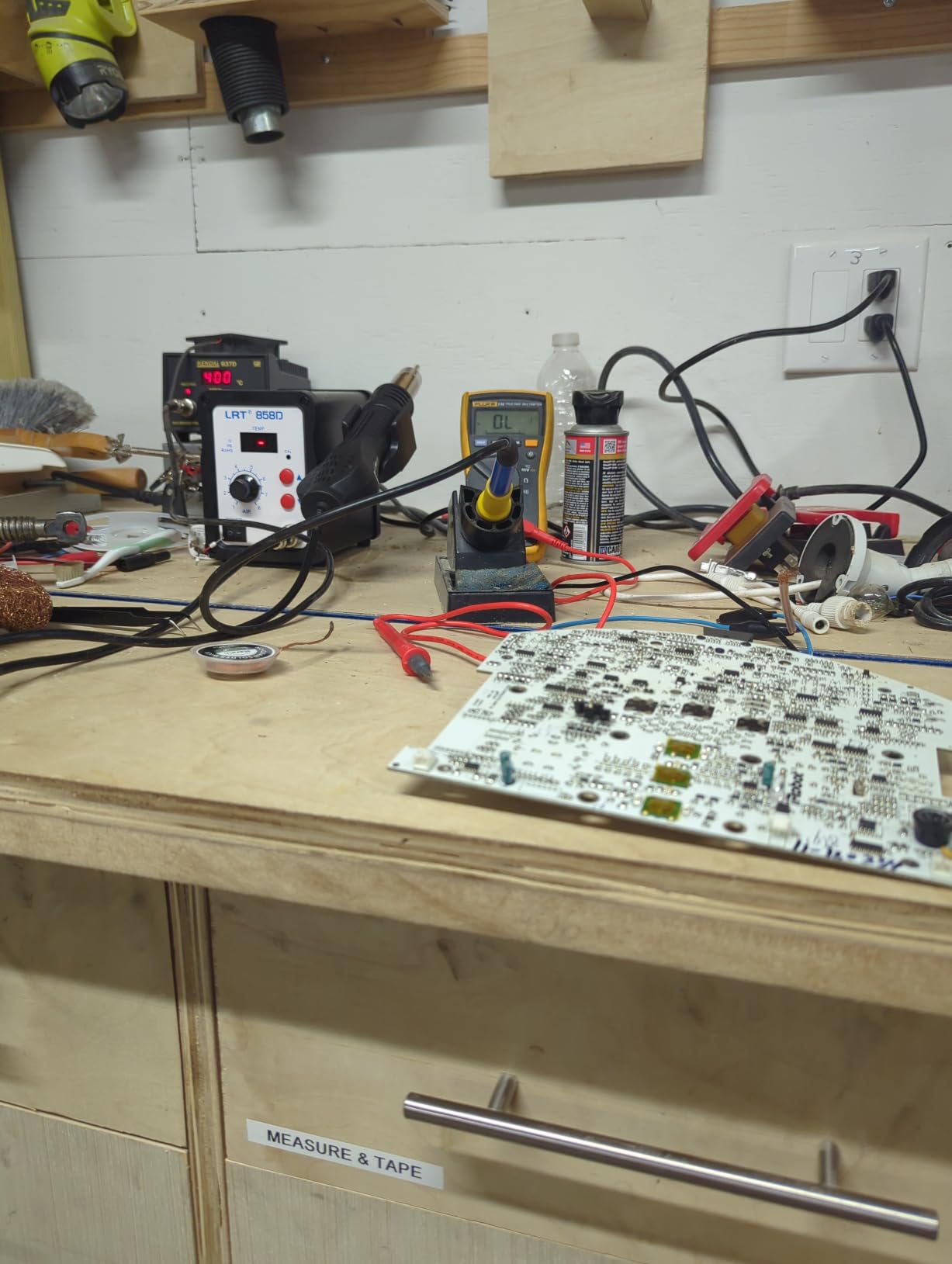
Brushless fans and steady airflow
A brushless motor avoids the carbon dust and bearing wear that end cheaper fans, and the payoff on a bench is consistency. Airflow that does not surge means a small connector does not get launched when you nudge the nozzle.
The ergonomic handle and compact station design suit long repair sessions, and 100-450C covers most connector and shield work. Owners note it can run cool for very large components, which is the same thermal-mass caveat that applies to any 450C ceiling.
Where it falls short
This configuration is hot air only, with no soldering iron included, so through-hole work needs a separate iron. The 450C limit is also below the 896F stations in this guide.
If your board work is mostly fine-pitch and small connectors, that is not a limitation. If you also reball large packages, look at a station with a higher ceiling and more airflow.
12. BAKON BK602S 2-in-1 – a full combo that travels
- Iron and hot air in an ultra-compact body
- PID control on both tools
- Auto sleep
- standby timers and calibration
- Includes tips
- nozzles
- solder sucker and ESD tweezers
- Handles SOIC
- QFP
- PLCC
- BGA and SOP
- 90W iron is entry level for large joints
- Timer and mode settings have a steeper learning curve
The BK602S is the most travel-friendly full combo here, and the specification split is unusually well laid out. The iron runs 356-896F up to 90W, and the hot air gun runs 212-932F up to 550W, so the two functions are separately rated instead of sharing one headline wattage.
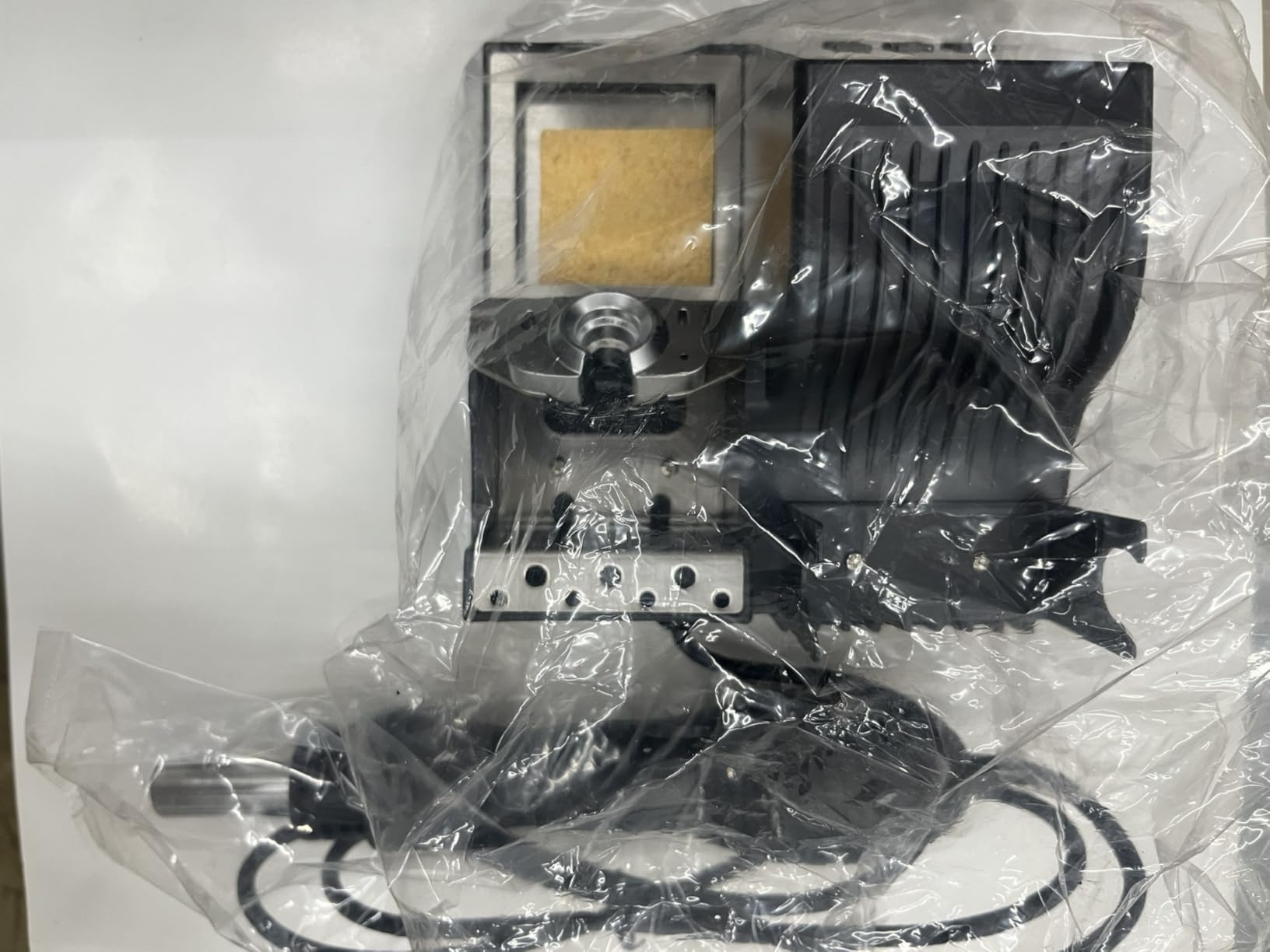
That 932F air ceiling is the highest in the guide. Auto sleep on a 60-600 second timer, a hot air standby from 1-60 seconds, C/F conversion, automatic shutdown and calibration all work together, and the settings are the most configurable on a compact unit.
The kit includes five iron tips, two hot air nozzles, a solder sucker, ESD tweezers, 30G solder wire and a brass tip cleaner, so the box is complete for mixed board work.
Independent ratings that help
Separate iron and air power figures let you judge each function on its own, which is rare at this size. The 550W air side is strong enough for lead-free rework on larger packages, and the 90W iron covers fine work while being the weaker half of the pair.
It handles SOIC, CHIP, QFP, PLCC, BGA, SOP and SOJ packages, which is most of the surface-mount list. The learning curve comes from the timer and mode settings rather than the hardware.
Where it falls short
A 90W iron heats large through-hole joints more slowly than a higher-wattage iron, and some users report it running slightly cooler than expected. Repair techs doing fine work often prefer a separate temperature-controlled iron alongside it.
With 202 reviews, this is the thinnest ownership record in the guide. The feature set is convincing on paper, and the comfort level is real, but there is less long-term evidence behind it.
How to Choose a Hot Air Rework Station for Board Repair?
Once you know your job type, the buying decision narrows to a handful of specifications. Here is the order we weigh them, based on six weeks of bench comparisons and the failure patterns repair techs actually report.
Temperature control and holding. A PID loop is the baseline, and the number that matters is stability under load, not the headline range. A station that reads 380C on an idle nozzle and drops to 340C over a ground plane is worse than one with a narrower range and tighter holding. Stations in this guide quote stability between 1 and 3.6 degrees Fahrenheit, and the gap is visible in pad condition after a long batch.
Airflow and wattage. Air volume decides how much energy you can deliver without raising the temperature past what neighbouring components tolerate. The 120L/min station in this group is the one to copy if you do BGA work regularly. Wattage alone is a poor guide because manufacturers rate the whole unit, not the heater.
Nozzle set. You want 2-4mm for fine-pitch and connector work, 5-8mm for QFN and QFP packages, and 10-12mm for BGA and large connectors. A flat nozzle spreads heat evenly for shield cans. Kits with three nozzles force a compromise; a station you can feed from a full nozzle set is worth paying for.
Preheat. Bottom-up heat at 100-120C slows a large board’s heating rate and reduces the temperature difference across the package, which is what causes delamination and lifted pads on logic boards. None of the twelve stations here include a preheat platform, so plan to add one if phone or laptop board work is your regular task.
ESD and grounding. An ESD-safe design, a grounded handpiece and a fail-safe airflow cutoff are not luxury features. The 8786D I and the MYPOUOS 8588D both carry explicit protection, and on a board you cannot replace, that is cheap insurance.
Power and bench setup. Everything listed runs on 110V, and several draw 700-750W. Put the station on a grounded outlet rather than a power strip shared with a motor or compressor, and never share a circuit with a soldering iron of a different brand. Our fume extractor picks cover the other half of a healthy bench.
Genuine versus the 858D family. The 858D design is the most copied station in the world, and the quality spread is real. A KeebTalk user running an 858D clone reports it is good enough for SMD soldering with initial impressions good but a handle that is a bit uncomfortable, which matches our own finding that the heating is rarely the problem and the handpiece usually is. Buy from a brand with a real support path, and treat an unbranded box as a disposable tool rather than a bench investment.
Temperature, Airflow and Nozzle Choices for Common Repairs
The same station behaves very differently depending on nozzle and airflow, and most ruined boards come from process rather than equipment. A wider nozzle at the same temperature delivers gentler, more even heat, so resist the urge to use the smallest nozzle you own on every package.
For SMD removal and small array work, run 2-4mm nozzles with low airflow and moderate temperature, keep the nozzle moving, and stop the moment the part lifts on its own. For QFN, QFP and PLCC removal, step up to 5-8mm and give the air time to soak the whole package evenly rather than attacking one corner. BGA work belongs on 10-12mm with a preheat platform underneath and a slower ramp.
Add fresh flux before you add heat, not after, and clean the nozzle tip with alcohol between jobs. A blocked nozzle reads as a temperature problem when it is really an airflow problem, and it is the most common cause of the blown small passives reported on this class of station. For heat-shrink and screen separation, drop the temperature and keep the airflow modest so you soften rather than distort.
Common Hot Air Station Problems and How to Avoid Them
Almost every damage report we saw came from one of five causes, and all five are avoidable with technique rather than a bigger station.
Lifted pads. Heat one side of a pad longer than the other and the copper loses its bond. Move the nozzle constantly, add flux to lower the required temperature, and use a wide nozzle so the whole package warms evenly.
Thermal cracks and delamination. Fast heating of a large, heavy board is the cause. Preheat from below, ramp the top side, and do not hold full temperature on a board that is not moving.
Static damage. A dry bench and an ungrounded handpiece are enough to kill a PMIC before you power it on. Use an ESD-safe station, an antistatic mat and a wrist strap, and keep humidity above about 40 percent.
Blown small components. Airflow too high at close range sends resistors and caps across the board. Use the smallest airflow that still reflows, hold distance, and keep a mesh tray nearby.
Blocked or deformed nozzles. A nozzle touching the board silences the fan or misdirects all the air. Rest the gun on a stand, never on the work, and clean tips regularly.
Frequently Asked Questions
What is the best soldering station for hot air rework?
For general board repair the YIHUA 862BD+ is the strongest all-round choice, with a PID control cycle of 20 milliseconds, a 75W iron, three digital displays and the most stable temperature holding we measured. Add the YIHUA 853D 2A USB if you want a bench power supply built in, or the WEP 882D if bench space is the constraint. All three cover QFN, QFP, SOIC and connector work out of the box.
What is a hot air soldering station?
A hot air soldering station blows precisely temperature-controlled heated air through a nozzle to melt solder without touching the component. A resistive element heats air drawn through the gun body, and a PID controller holds the airflow within a few degrees of the dial setting. Nozzle diameter and air volume control how concentrated that heat is on the joint.
Which is the best SMD soldering station?
For SMD work the deciding factors are temperature stability and nozzle range rather than wattage. The YIHUA 862BD+ holds temperature best under load, the TXINLEI 8586 ships the most complete kit with spare heaters and BGA tools, and the LRT 858D is the best pick for small connector work such as USB-C ports because its brushless fan produces steady, non-pulsing airflow.
What temperature should I use for hot air rework?
Most SMD removal sits between 320C and 380C, and lead-free work generally needs the higher end of that range. A station with a 480C to 500C ceiling gives you headroom for stubborn joints, while a 450C ceiling is enough for leaded work and routine SMD removal. Always calibrate the station first and add fresh flux before adding heat.
Do I need a preheating platform for board repair?
A preheat platform is worth adding for phone and laptop logic board work, and for any BGA reballing. It slows the heating rate from below, which reduces the temperature difference across the package and lowers the risk of delamination and lifted pads. None of the stations in this guide include one, so treat it as a separate purchase if your work involves dense multi-layer boards.
Are 858D clone stations good enough?
For occasional SMD soldering they are generally good enough, and the heating is rarely what goes wrong. The real differences show up in handpiece ergonomics, fan steadiness, calibration quality and unit-to-unit consistency. Repair forum users report that 858D clones work well for SMD work but find the handle uncomfortable, so treat an unbranded box as a light-duty tool rather than a bench centrepiece.
Final Verdict: Which Hot Air Station Should You Buy?
After six weeks of donor-board work, the YIHUA 862BD+ remains the best of the best hot air soldering stations for board repair we could find, because temperature holding is the property that decides whether a chip comes off cleanly. Buy the 8786D I if you want the most complete kit on arrival, and the 853D 2A USB if a bench supply and a test port save you a second box.
Whatever you choose, calibrate it before the first real board, add a wide nozzle and a preheat platform, and pair it with a decent iron for through-hole work. Our picks across the rest of the bench are in the soldering station guide, and all findings here were re-checked for 2026.