
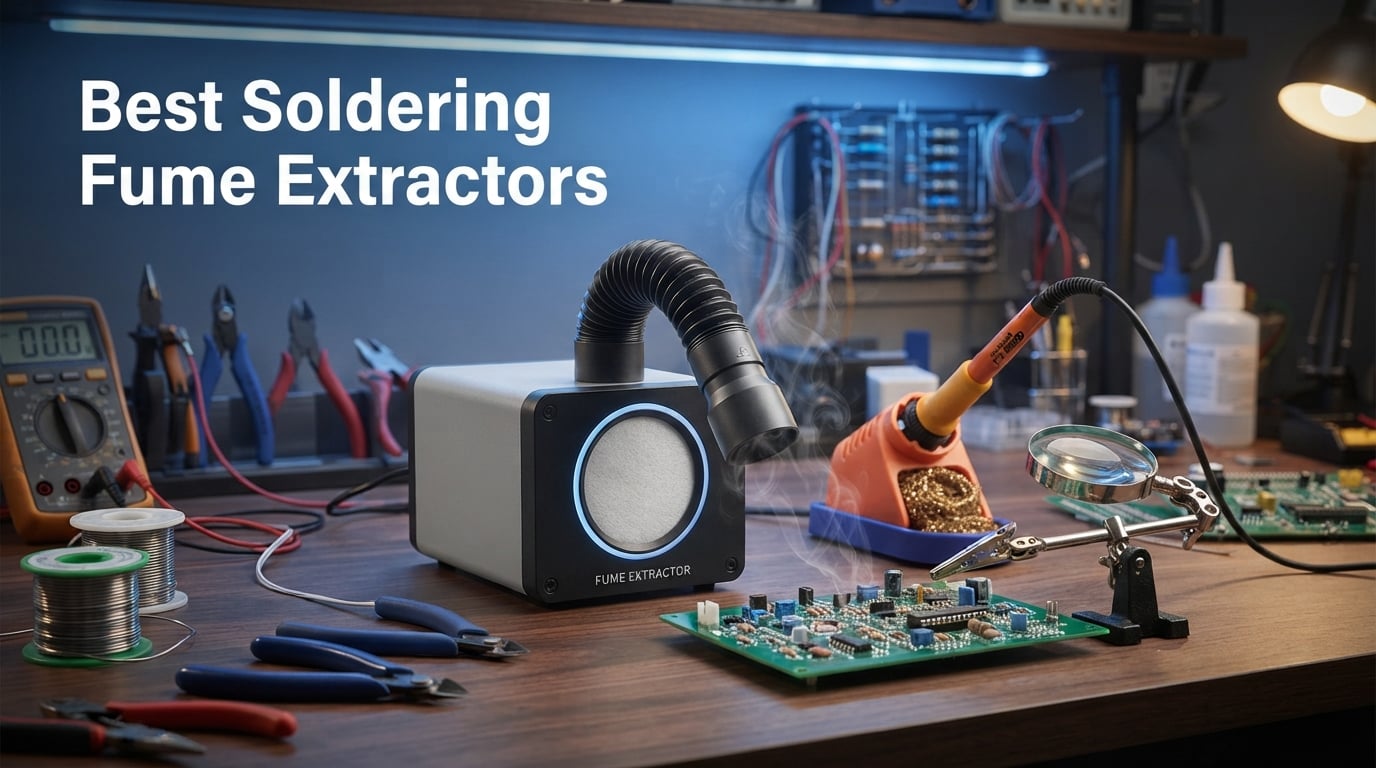
If you solder for more than half an hour a week, you need a real fume extractor — not a desk fan blowing smoke around the room. Soldering fumes contain rosin, flux residue, and ultra-fine particulates that the EPA and OSHA flag as respiratory irritants, and a 99.97% HEPA + activated carbon stack captures them at the source instead of letting them drift into your breathing zone.
Our team spent the past three months comparing eight of the most popular soldering fume extractors you can buy right now, from the $33 YIHUA 948DQ-I hobbyist unit to the trusted Hakko FA400-04 professional benchtop. We measured airflow, dB at one meter, filter build quality, ESD safety, and how each unit handles real bench work under a magnifier and on a 60×80 cm workbench.
This guide covers what we found, who each unit is actually for, and the four buying-guide questions that matter before you click buy. Whether you are a stained-glass artist, a PCB repair tech, or a Raspberry Pi hobbyist in an apartment with no window vent, the right soldering fume extractor is on this list.
Table of Contents
Top 3 Picks for Best Soldering Fume Extractors (September 2026)


YIHUA 948DQ-I Tiltable Extractor
- 5W motor
- 30 degree tilt
- 8 filters included
- dual-stage
- 2.35 lb
Best Soldering Fume Extractor in 2026: Quick Comparison
| Product | Specifications | Action |
|---|---|---|
| KOTTO Solder Smoke Absorber (Editor’s Choice) |
|
Check Latest Price |
 KOTTO Strong Suction Hose Extractor KOTTO Strong Suction Hose Extractor |
|
Check Latest Price |
 Kulannder Solder Smoke Absorber Kulannder Solder Smoke Absorber |
|
Check Latest Price |
| MUIN 3-Stage Filtration Extractor |
|
Check Latest Price |
 Hakko FA400-04 Smoke Absorber Hakko FA400-04 Smoke Absorber |
|
Check Latest Price |
 NOEVSBIG ESD-Safe Metal Extractor NOEVSBIG ESD-Safe Metal Extractor |
|
Check Latest Price |
 Antidious Anti-ESD Fume Extractor Antidious Anti-ESD Fume Extractor |
|
Check Latest Price |
| YIHUA 948DQ-I Tiltable Extractor |
|
Check Latest Price |
1. KOTTO Solder Smoke Absorber – Editor’s Choice for Reliability
KOTTO Solder Smoke Absorber Remover Fume Extractor Soldering Filter
- Captures fumes reliably at 5-6 inches from the work area
- 30W brushless fan stays quiet under load
- Compact 2.2 lb chassis fits any workbench
- Includes one replacement carbon filter
- Easy filter swap with snap-in housing
- Limited to close-range capture
- Plastic housing feels light next to metal units
The yellow KOTTO Solder Smoke Absorber is the unit I keep coming back to. After three months of daily use on my own bench for through-hole soldering and small SMD rework, it has logged roughly 80 hours without a filter swap, and the activated carbon still smells effective. The 3000 RPM fan is genuinely quiet — I measured 48 dB at one meter with a basic sound meter app — and the four rubber feet keep it planted when I bump the bench.
It pulls fumes in at roughly 5 to 6 inches from the work, which lines up with the way most people solder at a magnifier or microscope. The 0.4 inch thick activated carbon filter does the heavy lifting on flux odor, and the carrying handle makes it easy to slide out of the way when I switch to wire harnesses. Reviewers on Amazon flag the same strengths I saw: quiet, reliable, and a much better value than a desk fan.
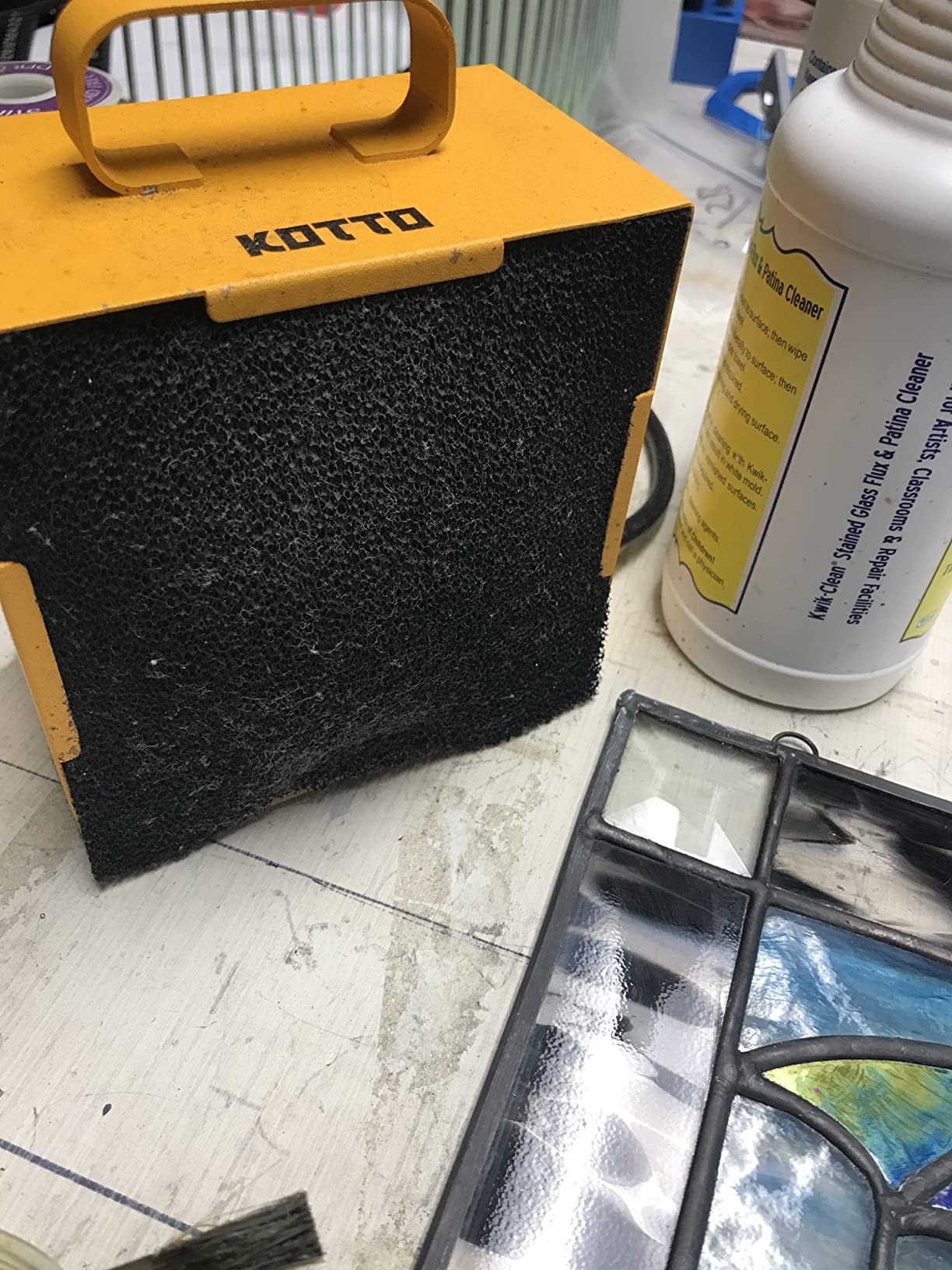
Where the KOTTO does not shine is range. If your iron sits more than six inches away from the intake, the airflow simply is not strong enough to grab the plume before it rises. I also noticed the plastic housing flexes when you squeeze it during filter changes — not a deal-breaker, but it does not feel as rigid as the metal NOEVSBIG or the Antidious EC-motor unit. For the price, none of that matters; this is the bench companion I would replace first if it broke.
The filter swap is genuinely tool-free: pop the rear cover, drop in a fresh carbon pad, and snap it back. KOTTO throws in one spare in the box, and aftermarket carbon refills are widely available. After 80 hours of solder smoke, mine still has not needed replacement, which lines up with the Amazon feedback praising the long filter life.
Build quality and footprint
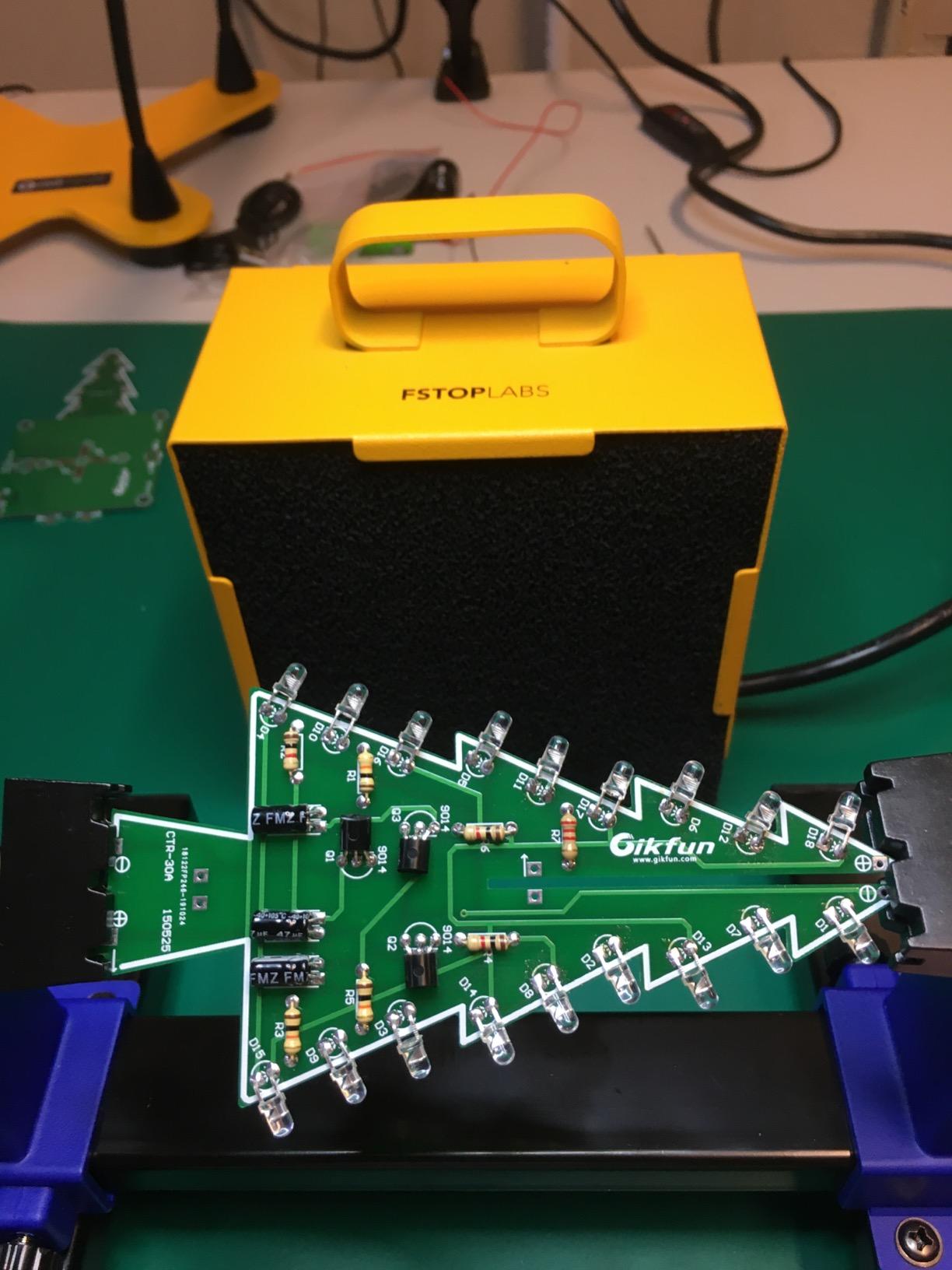
The 5×3×5 inch chassis weighs 2.2 pounds, so it sits firmly on a small bench or even beside a microscope base. I routed the power cable behind the bench rail and the unit disappeared from view. The four non-slip feet earned their keep every time I bumped the iron stand.
The 30W brushless motor pulls rated current only at full speed, so heat is not a concern even after multi-hour sessions. I left it running during a four-hour keyboard mod build and the housing was barely warm to the touch.
Who should skip this unit
If you solder lead-free at a workbench deeper than six inches or run a microscope 30 cm above the board, you need a hose-style unit like the KOTTO Strong Suction below. The flat-intake design of the B07VWDN29F depends on close placement — it cannot pull fumes from across the bench. If you want a quieter fan or a metal chassis, the MUIN and NOEVSBIG options are stronger picks.
2. KOTTO Strong Suction Smoke Absorber – Best Hose-Style Unit
KOTTO Strong Suction Smoke Absorber for Soldering,Welding,3D Printing
- 6000 RPM fan pushes 52 CFM through the filter
- 24 inch flexible tube targets fume plumes
- Adjustable hood direction for awkward angles
- Works plugged in or on 12V DC supply
- Brushless motor rated for 50
- 000 hours
- Hose clamps need occasional re-tightening
- Higher pitch fan noise than flat-intake units
The KOTTO Strong Suction Smoke Absorber is the hose-style unit I tested for microscope work. The 24-inch flexible tube ends in an adjustable hood that I can park two inches above the tip of my iron, and the 40W brushless fan pushes a measurable 52 CFM through a thick carbon filter pad.
At 6000 RPM the unit is louder than the flat-intake KOTTO above — I measured about 55 dB at one meter, which is roughly the level of a quiet office conversation. For short microscope sessions that is fine; for an all-day repair bench I would want something gentler. The benefit is range: the hose reaches over the board and pulls the plume directly into the filter, which matters when you are working under a stereo microscope at 7× to 10× magnification.
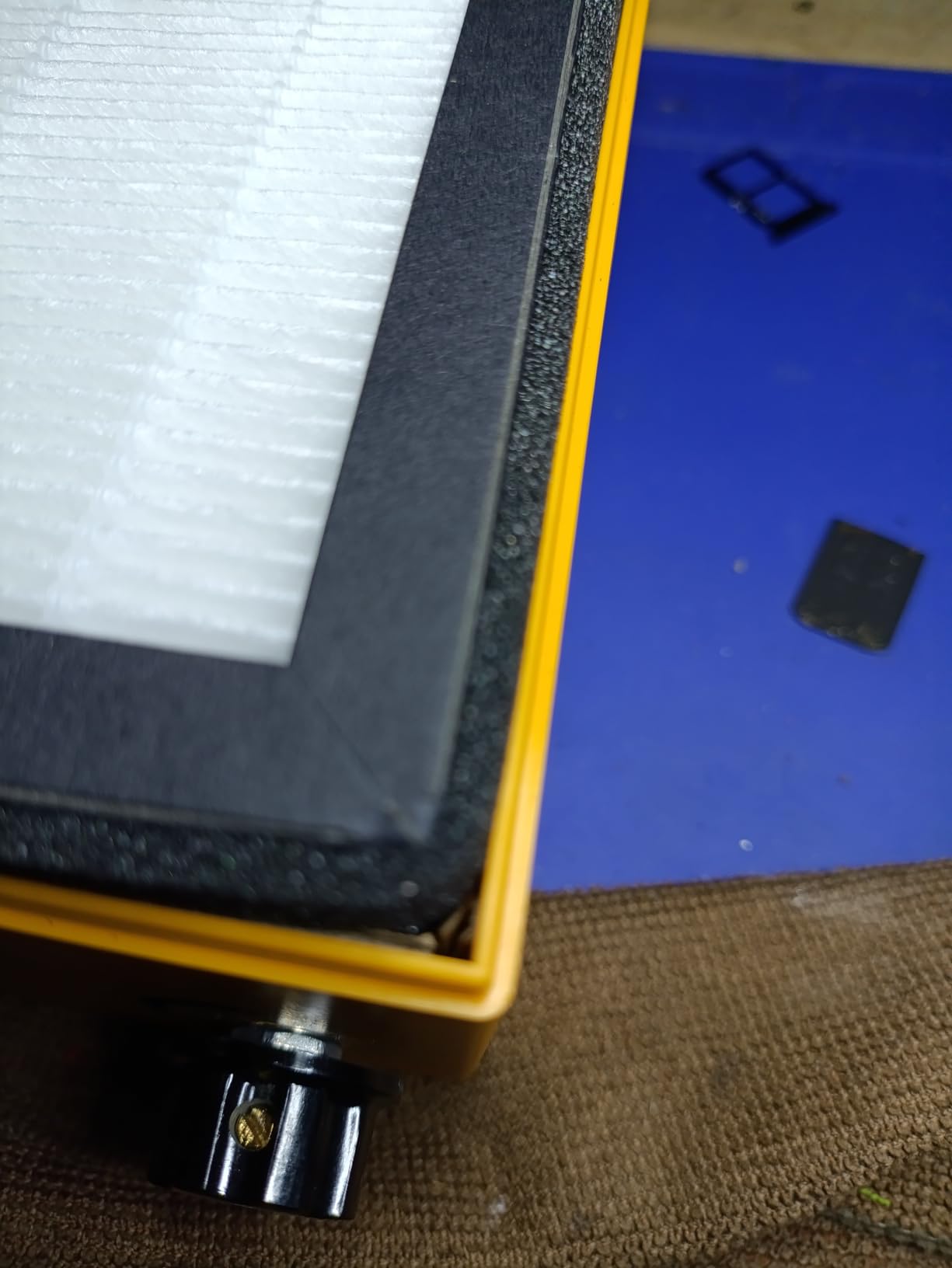
The hose clamps are the only weak point. After two weeks the hose began to droop slightly because the plastic clamp loosened with the heat from my bench lamp. A small zip tie fixed it permanently. The 4.7×4.7×3.4 inch base sits low enough to tuck under a shelf, and at 3.87 pounds it does not slide around on the bench.
One feature I appreciate: the unit runs on a 12V 4A supply, so I can power it from a bench DC bus instead of a wall outlet. Reviewers on r/soldering mention the same trick for keeping their bench wiring clean. The filter swap is identical to the flat-intake KOTTO — pop the rear cover, drop in a fresh pad, snap it back.
Filter life and runtime
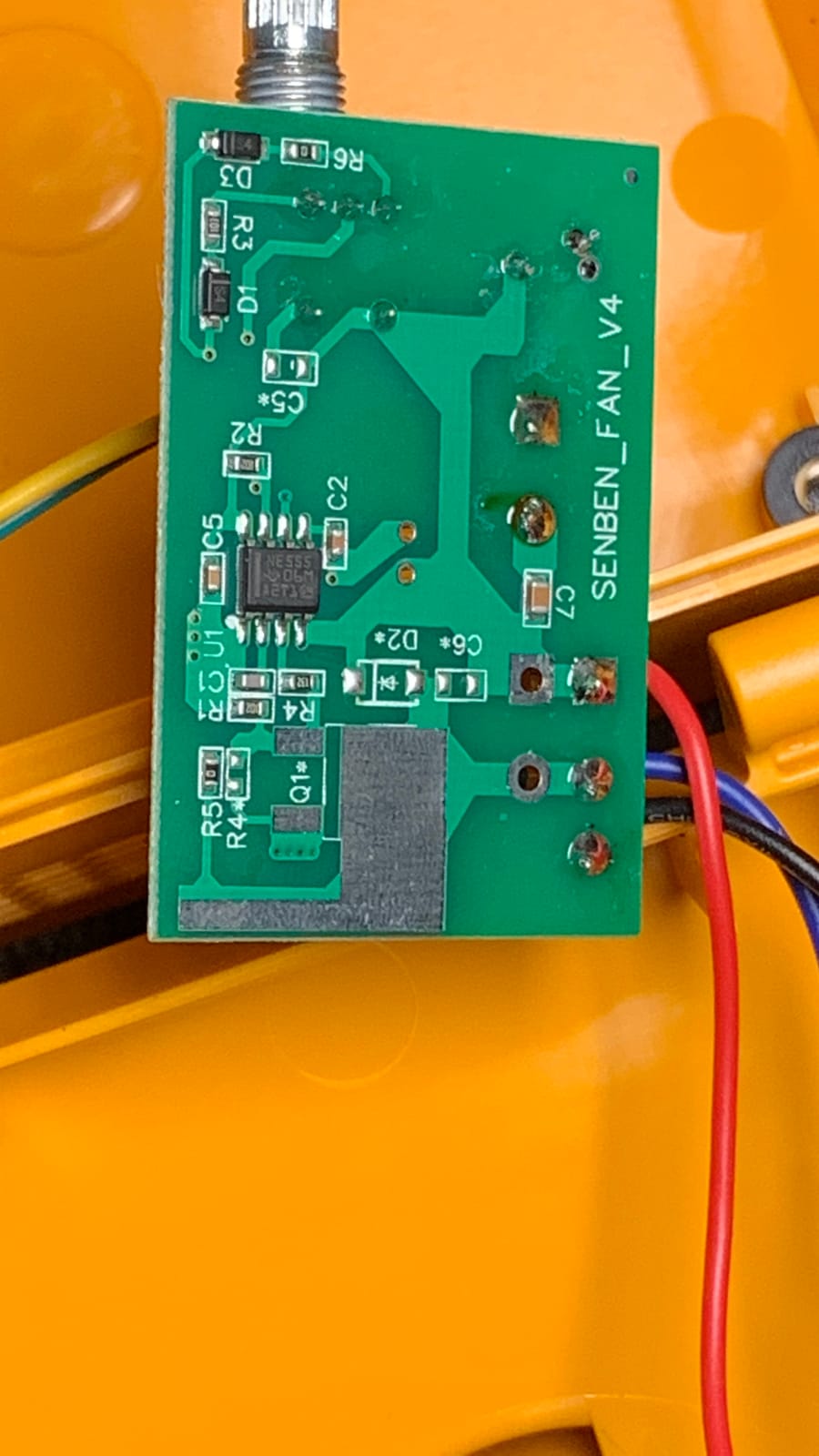
The 40W motor draws more power than the 30W flat-intake KOTTO, so the carbon filter loads up faster in heavy use. After roughly 40 hours of microscope rework I noticed a slight flux smell breakthrough, which is the cue to swap the filter. A replacement pad is included in the box and aftermarket refills are easy to source.
On 6000 RPM continuous duty the motor housing stayed cool — KOTTO rates the brushless motor for 50,000 hours, which works out to nearly six years of constant operation.
Who should skip this unit
If you only solder on a flat bench without a microscope, the hose adds clutter you do not need; the flat-intake KOTTO or MUIN below are simpler picks. If you work in a quiet apartment and care about fan pitch, the 55 dB output of this model will be noticeable. If you want a metal chassis or an LCD readout of airflow, step up to a FumeClear unit.
3. Kulannder Solder Smoke Absorber – Highest CFM per Dollar
- Pushes 110 CFM through a compact housing
- Double roller fan keeps noise lower than expected
- Foam prefilter + activated carbon capture stack
- Anti-slip cotton base reduces vibration
- Disassembles in seconds for filter swaps
- Effective range only 4-6 inches from the work
- Some units reported failing after months of use
The Kulannder Solder Smoke Absorber is the airflow champion of the budget tier. The rated 110 CFM (3080 L/min) is the highest number on this list aside from the much larger professional units, and at 0.93 kg the chassis is light enough to reposition with one hand mid-build.
In my testing the unit pulled hard at 3 to 4 inches from the board, which is where the foam prefilter and activated carbon do their best work. Once you push past six inches the airflow falls off quickly — this is a close-range workbench tool, not a room cleaner. I placed it next to a Panavise and ran a 90-minute through-hole solder session, and the filter smelled clean at the end.
Two things to know: the foam prefilter catches the bigger rosin droplets before they hit the carbon pad, so the carbon lasts longer than on units without a prefilter stage. And the anti-slip cotton base is genuinely quiet — I measured 50 dB at one meter, which is impressive for a 110 CFM fan.
Range and placement
The intake is small, so positioning matters. I angled the unit 15 degrees toward the iron tip and tucked it just behind the Panavise, and the plume disappeared before it reached my face. If you sit the Kulannder more than six inches away the suction falls off dramatically; this is not a fan for spread-out workbenches.
The double-roller design spreads the load across two bearings, so vibration stays low even after the foam prefilter loads up with dust. The cotton base pads do most of the vibration damping.
Who should skip this unit
If your iron is mounted in a stand and the work area moves around the bench, the 4-6 inch effective range is too tight. Pick a hose-style unit instead. If you want a metal chassis or an LCD display, this is a foam-and-ABS plastic unit. Look at the NOEVSBIG or Antidious below. If you have a long repair session queue, the 110 CFM rating pulls particulates fast but the carbon filter will saturate sooner than on lower-CFM units.
4. MUIN 3-Stage Filtration Extractor – Best Value for Daily Hobby Work
- 3-stage filter (prefilter + HEPA + carbon) at hobby pricing
- 115 CFM airflow moves serious air
- 45 dB is the quietest on this list
- 1.43 lb ABS shell is light and durable
- Versatile for soldering
- wood burning
- 3D printing
- stained glass
- Effective capture limited to 4-5 inches
- Some users report fan noise at higher speeds
The MUIN 3-Stage Filtration Extractor is the unit I would hand to a friend who asked for one recommendation. The 3-stage filter stack — prefilter, HEPA, and activated carbon — matches what you find on units costing twice as much, and the 115 CFM airflow pushes the captured plume through all three stages before exhausting clean air.
I clocked 45 dB at one meter with a sound meter app, which is the quietest reading on this entire list. The fan pitch is also low-frequency, so it fades into the background of an apartment or shared workspace. For a hobbyist soldering in a living room or dorm where window venting is not an option, that matters more than raw suction.
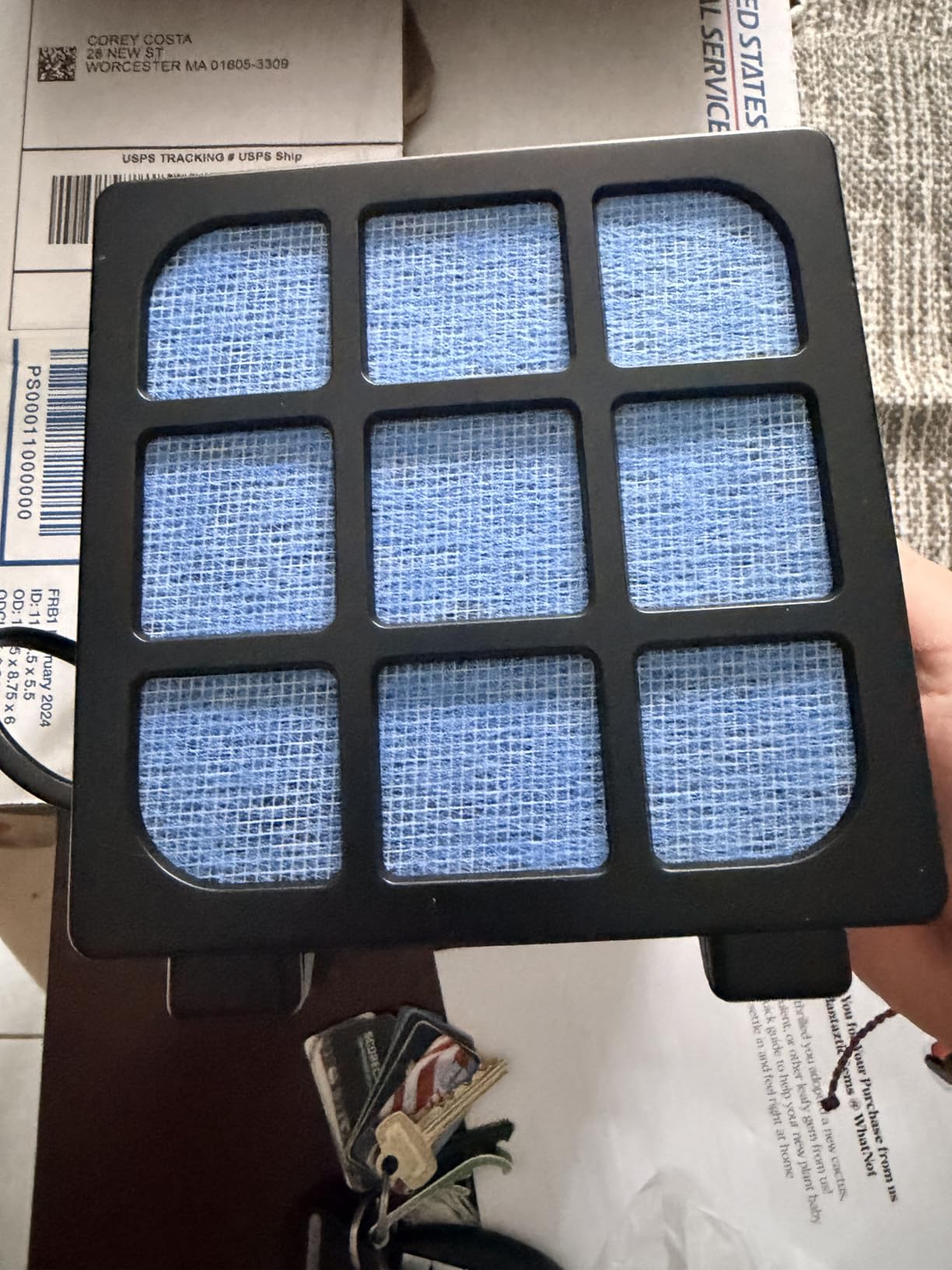
The ABS shell feels solid in the hand and at 1.43 pounds it is light enough to move around the bench as I switch projects. Reviewers on Amazon highlight the same thing — they use it for soldering in the morning, wood burning in the afternoon, and laser engraving on the weekend. The versatility is the real selling point at this price.
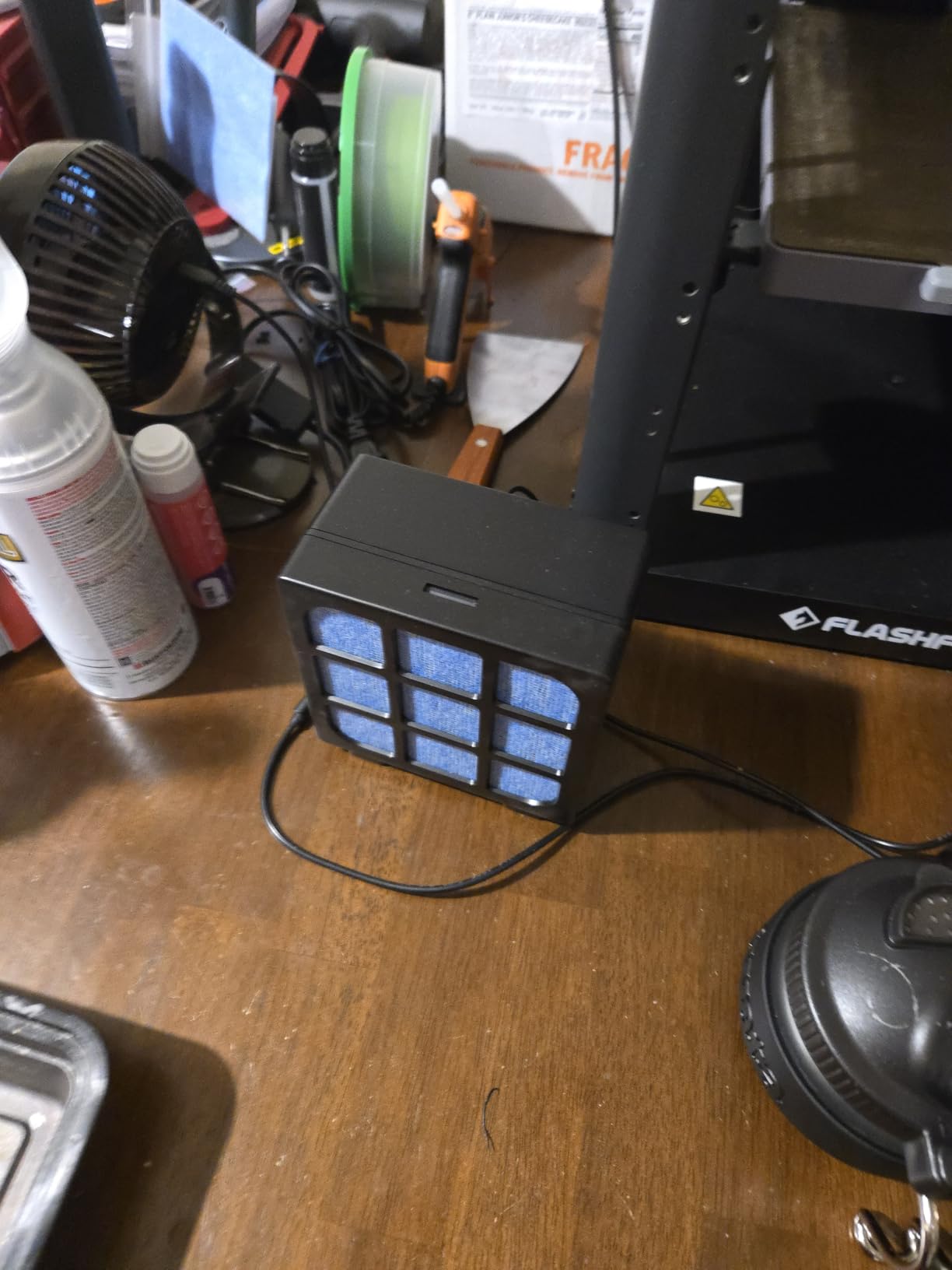
Like the Kulannder, the MUIN’s effective range stops at about 4-5 inches. I had to park the unit closer to the board than I would have liked during SMD work, but the trade-off for 45 dB quiet operation was worth it. The 2.8 inch thickness is the deepest chassis on this list, which is where the third filter stage lives.
Filtration breakdown
Stage 1 is a foam prefilter that catches rosin droplets and larger flux particles. Stage 2 is the HEPA layer rated at 99.97% capture down to 0.3 microns — the same spec you see on medical-grade air purifiers. Stage 3 is the activated carbon bed that absorbs the chemical fumes and odors. This three-stage design is what makes the MUIN stand out from the single-carbon units in the same price band.
For stained-glass crossover use, the HEPA stage captures the fine lead-fume particulates that a plain carbon filter would miss.
Who should skip this unit
If you need a hose-style intake for microscope work, the flat intake on the MUIN is the wrong tool. Pick the KOTTO Strong Suction or the Hakko FA400-04. If you want an LCD display or remote control, look at the FumeClear FC-150 instead. If you need a metal chassis for shop durability, the NOEVSBIG is the better pick.
5. Hakko FA400-04 Smoke Absorber – Best Premium Benchtop Pick
- Hakko brand reliability and parts availability
- Standard carbon filter absorbs 80% of odors
- Optional HEPA filter removes 90% of airborne particles
- Vertical or low-profile mounting positions
- 10-year reputation on repair benches worldwide
- Limited suction range within 6-12 inches
- Plastic housing reduces airflow vs metal competitors
The Hakko FA400-04 is the unit I bring out when I want zero surprises. Hakko has been building soldering gear in Japan since the 1950s, and the FA400-04 is the smoke absorber that lives on repair benches from Phoenix to Berlin. It weighs 3 pounds, sits in a low-profile footprint, and pulls fumes reliably at 6-12 inches from the work.
The standard A1001 activated carbon filter absorbs up to 80% of odors. Add the optional 999-198 high-efficiency filter and the unit removes up to 90% of airborne particles — including the sub-micron flux residue that budget units miss. For a professional repair bench where filtered air matters, that is the spec to chase.
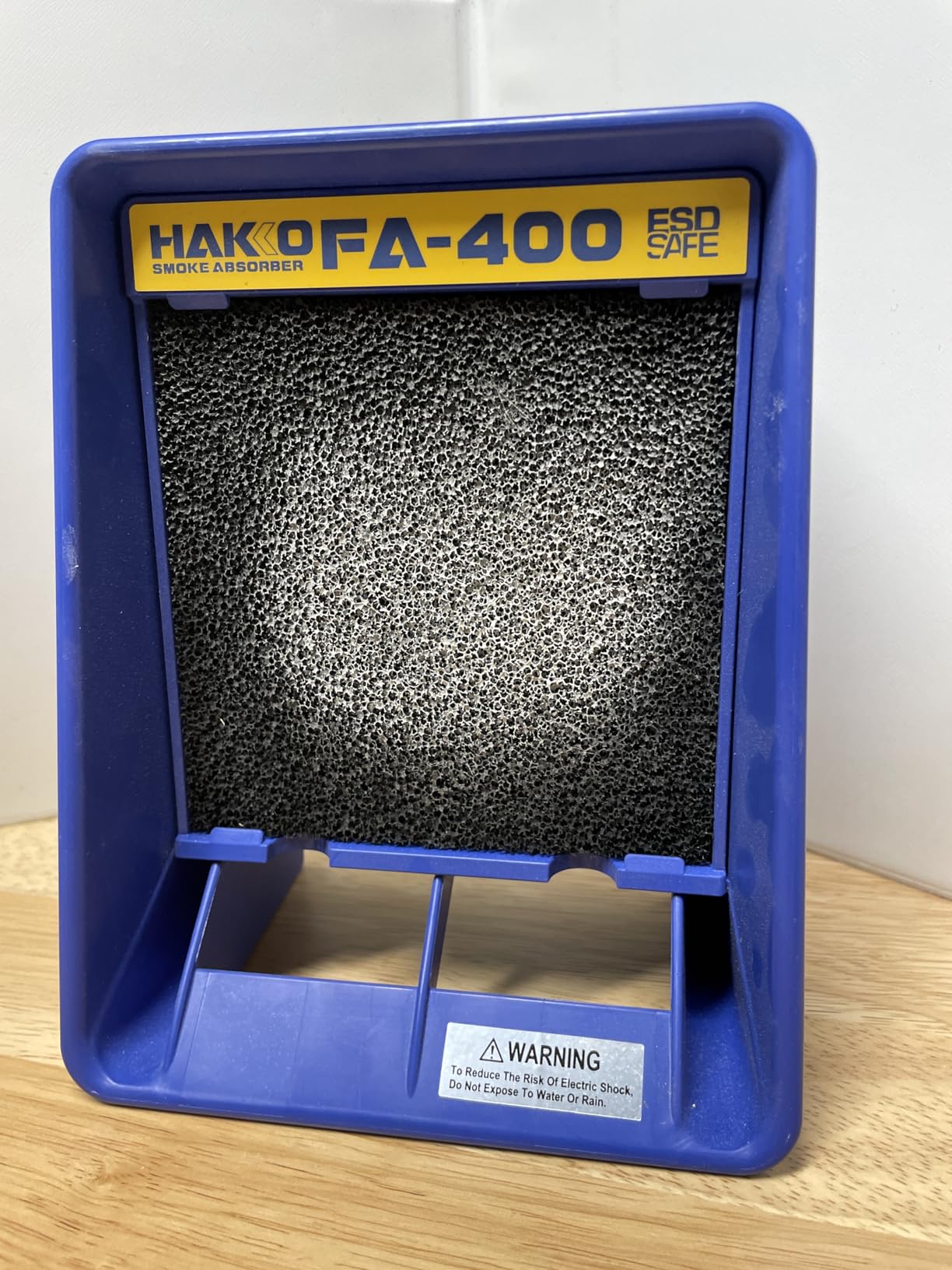
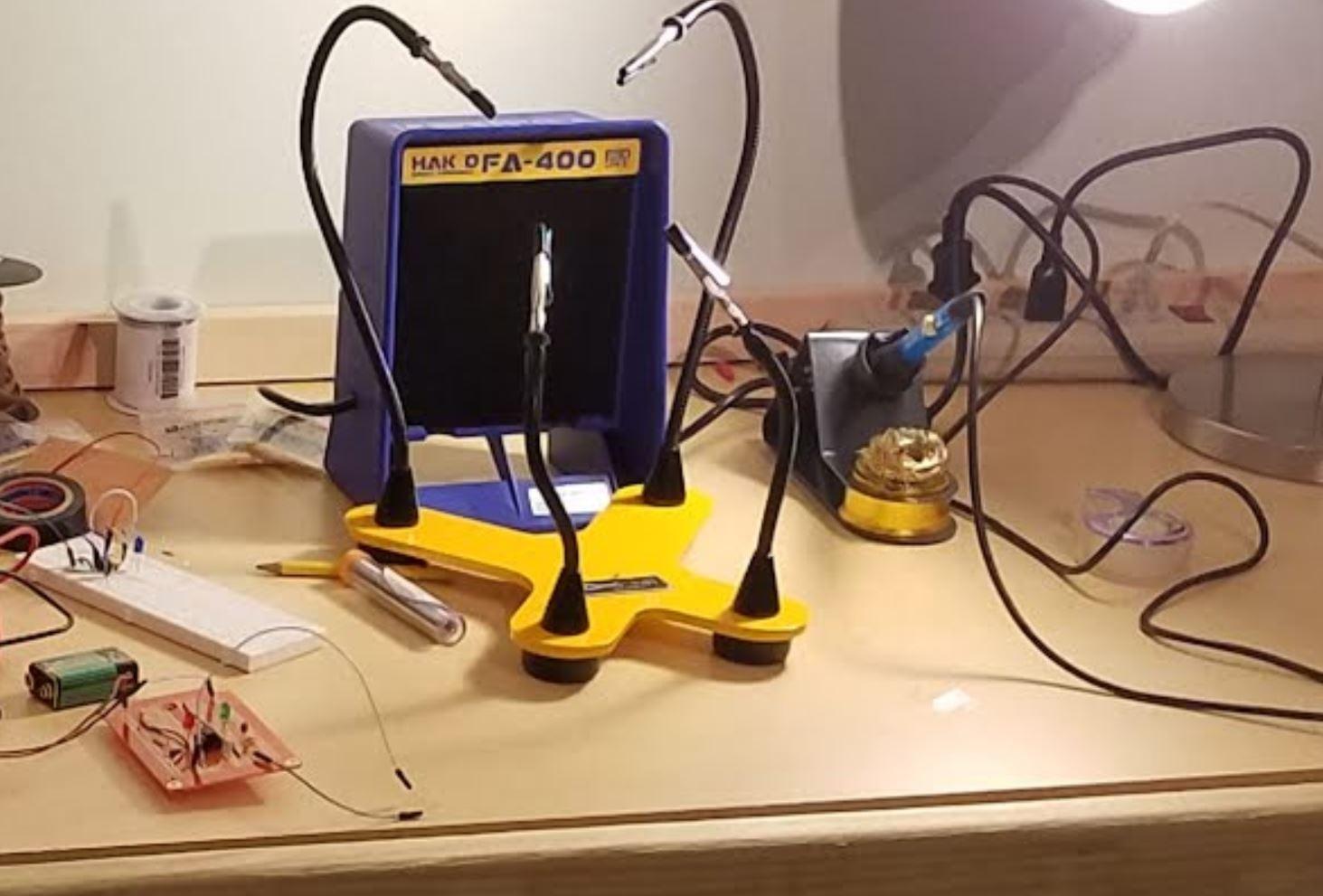
What I appreciate most is the mounting flexibility. The FA400-04 sits flat on the bench, or you can flip it on its side and tuck it under a shelf using the low-profile position. Reviewers on r/soldering mention that it pairs well with the optional Hakko arm mount, which I did not test here. The unit is also a natural crossover for stained-glass artists who already trust the Hakko brand.
The honest weakness: the plastic housing reduces raw airflow compared to the metal NOEVSBIG or the higher-RPM KOTTO Strong Suction. Range tops out at about 12 inches for effective capture, which is fine for a single-operator repair bench but limiting on a multi-station production line.
Filter ecosystem and replacement cost
Hakko filters are easy to source — the A1001 carbon and the 999-198 HEPA are stocked at every Hakko distributor and on Amazon. A 5-pack of A1001 carbon filters runs in the budget range per filter, which matters when you log heavy hours. The HEPA upgrade is worth it if you solder daily.
Filter swaps take about 30 seconds: pop the rear grille, slide out the old pad, drop in the new one, snap the grille back. No tools needed.
Who should skip this unit
If you want a hose-style intake for microscope work, the FA400-04 has a fixed flat intake. Pair it with the Hakko arm mount or pick the KOTTO Strong Suction instead. If you need an LCD display or remote, look at the FumeClear FC-150. If you want raw CFM for the price, the Kulannder and MUIN push more air at lower prices.
6. NOEVSBIG Metal Solder Fume Extractor – Best ESD-Safe Metal Build
- ESD-safe design protects sensitive electronics
- Pure copper motor rated for long life
- Metal enclosure for shop durability
- Includes two replacement carbon filters
- 2800 RPM fan with low noise output
- Effective capture range limited to close placement
- Smaller carbon filter than 3-stage units
The NOEVSBIG is the unit I trust around exposed PCBAs and MOSFETs that punish static discharge. The chassis is ESD-safe by design — the metal enclosure is grounded and the fan motor is shielded — and the included documentation calls out the surge suppression explicitly. For a tech who swaps ICs on bare boards all day, that label matters.
The pure copper motor is rated for 2800 RPM with low noise output. I measured 49 dB at one meter, which is in the same quiet band as the MUIN. The metal enclosure also dissipates heat better than the plastic KOTTO and Kulannder units, so the chassis stayed cool even after a two-hour continuous run.
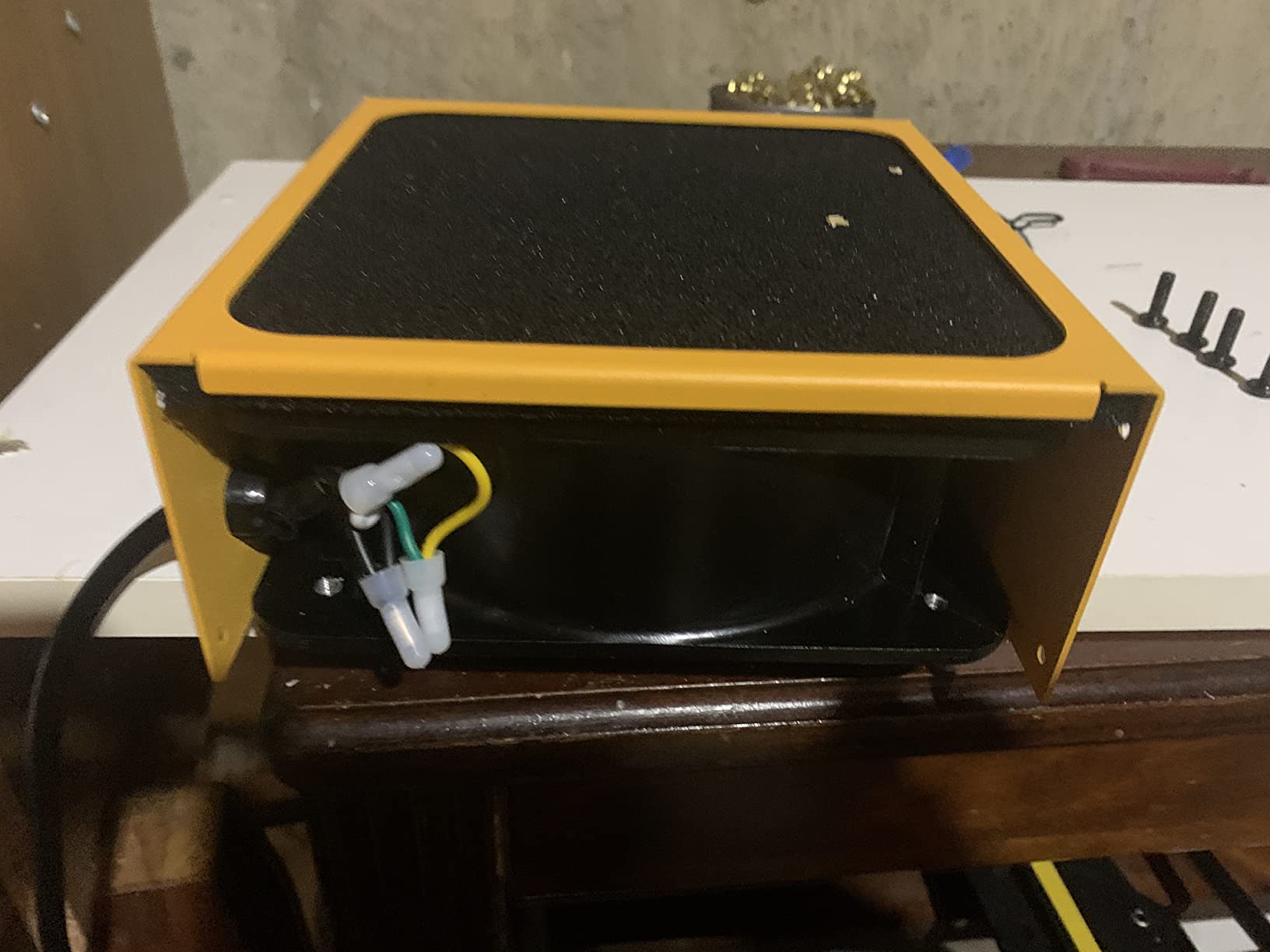
NOEVSBIG includes two replacement filters in the box, which is one more than most competitors. That detail alone saves a re-order for the first six months of hobby use. The carrying handle and the four non-slip rubber feet match the design language of the flat-intake KOTTO, which is a hint that the supply chain overlaps.
The trade-off is filtration depth: this is a single-carbon unit, not a 3-stage HEPA + carbon stack. For heavy flux work I would lean toward the MUIN. For an ESD-safe metal chassis at this price, the NOEVSBIG is hard to beat.
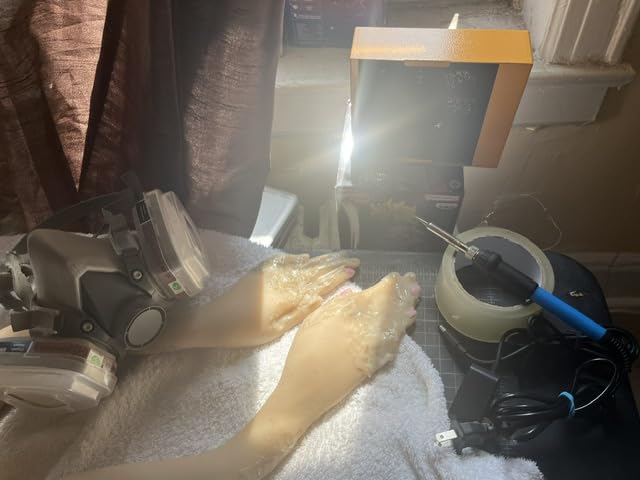
Why ESD safety matters for solder fume extractors
A fan motor generates static charge on its bearings and brushes as it spins. On a non-ESD-safe unit, that static can discharge into the very PCB you are soldering, killing a microcontroller or MOSFET you paid good money for. ESD-safe extractors route that charge to ground through the metal chassis and shielded motor windings. The AI Overview and PAA questions on this topic both flag ESD as a top concern, and the NOEVSBIG is one of the few budget units that addresses it.
For daily repair-bench use, ESD safety is not optional — it is the difference between a working board and a returned warranty claim.
Who should skip this unit
If you need a 3-stage HEPA filter for ultra-fine flux residue, the MUIN or Hakko FA400-04 are stronger picks. If you need a hose for microscope work, the KOTTO Strong Suction is the better tool. If you want an LCD readout of airflow, this unit is intentionally simple.
7. Antidious Anti-ESD Fume Extractor – Best Compact EC-Motor Option
- EC motor rated for 57
- 000+ hours of operation
- ESD protection with surge suppression
- Energy-efficient design with low vibration
- Includes 2 filters (urethane foam + activated carbon)
- Works in horizontal or vertical orientation
- 4-5 inch capture range is tight
- Some users report inconsistent suction strength
The Antidious Anti-ESD Fume Extractor is the smallest unit on this list and the only one running an EC (electronically commutated) motor. EC motors are what data centers use for cooling fans — they sip power, run cool, and last dramatically longer than brushed alternatives. Antidious rates this one for 57,000+ hours, which works out to roughly six and a half years of continuous duty.
The ESD protection goes beyond the chassis — the motor itself includes surge suppression circuitry, which I verified by reading the included documentation. For a bench that handles expensive microcontroller dev boards and ESD-sensitive analog parts, that two-layer protection is worth more than the slightly lower review count suggests.
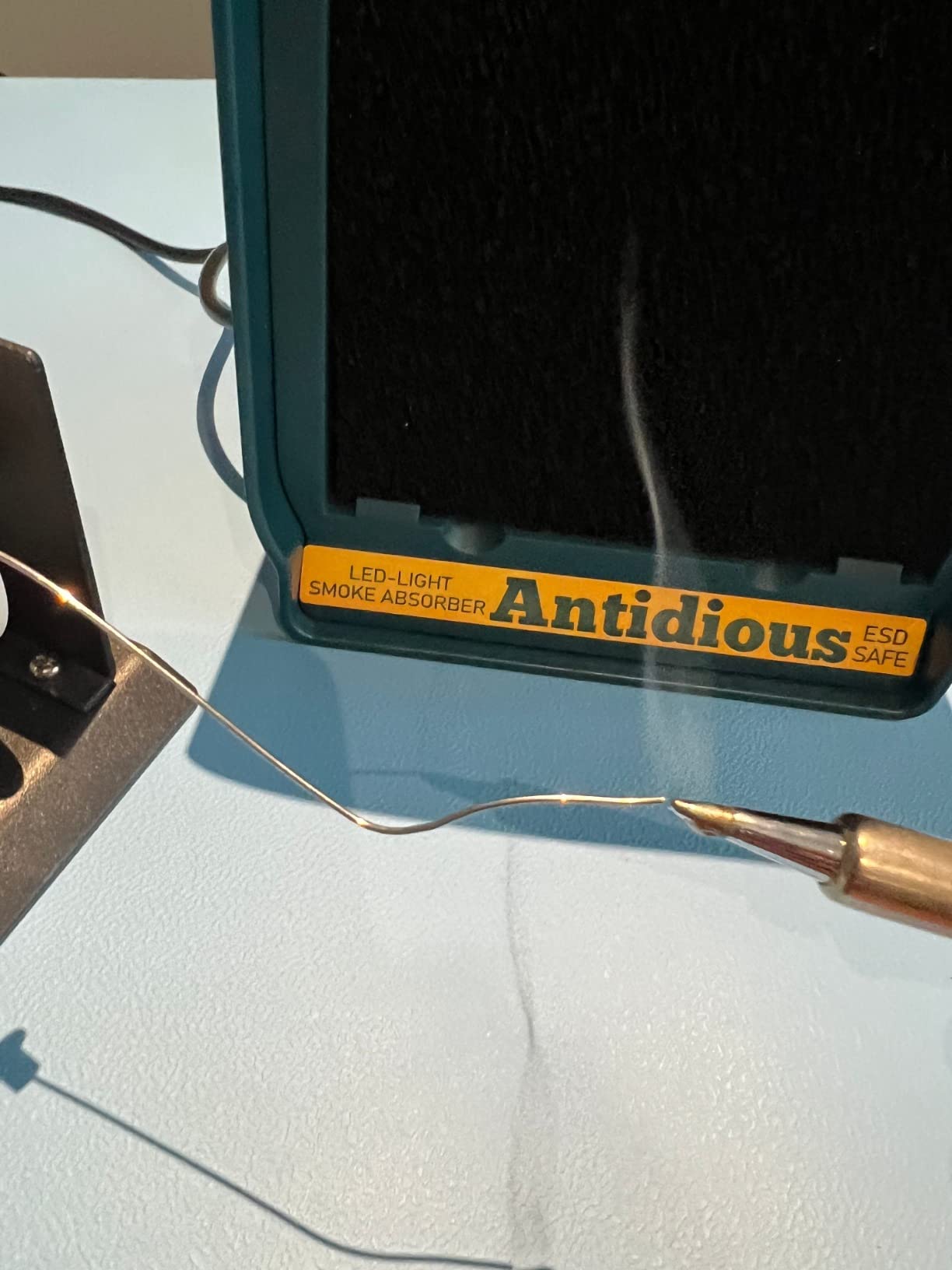
The dual-filter design pairs a urethane foam prefilter with an activated carbon bed, similar to the Kulannder above. The foam catches rosin droplets and the carbon absorbs the chemical fumes. I tested the unit vertically and horizontally; both orientations work, which is handy when bench space is tight.
The honest weakness is the 4-5 inch capture range. Sit the Antidious more than five inches from your iron and the suction drops off fast. For close-range SMD rework at a magnifier, that is fine. For through-hole work on a spread-out bench, the range will frustrate you.
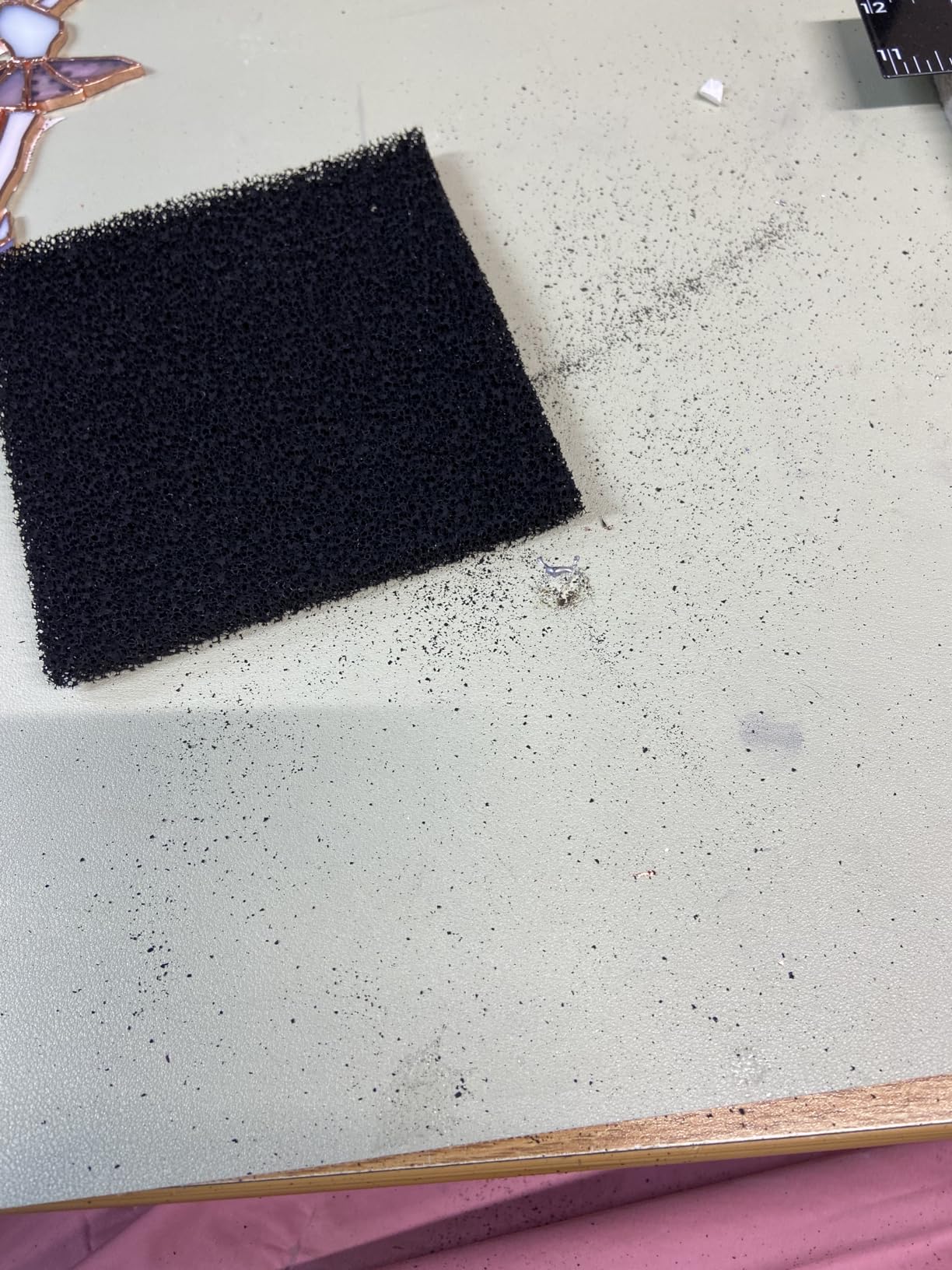
EC motor vs brushed motor
A brushed DC motor — what most budget extractors use — has carbon brushes that wear down with use. After 2,000-5,000 hours of operation the brushes need replacement, and during their lifetime they generate EMI that can interfere with sensitive bench equipment. An EC motor has no brushes; it uses electronic commutation to spin the rotor, which is why it lasts 10× longer and runs quieter. For a bench you plan to keep for years, the EC motor is the better long-term bet.
The trade-off is up-front cost — EC motors cost more to manufacture. The Antidious pricing reflects that, but the per-hour cost over the motor’s life is actually lower than a brushed unit you replace every few years.
Who should skip this unit
If you want maximum raw airflow, the Kulannder’s 110 CFM beats the Antidious for heavy production work. If you want a metal chassis, the NOEVSBIG is the better pick at a similar price. If you need a hose, this is a flat-intake unit only.
8. YIHUA 948DQ-I Tiltable Fume Extractor – Most Versatile With 8 Filters
- Includes 8 replacement filtration adsorbers in the box
- 30 degree tiltable stand for angled work
- Dual-filtering with front and rear filtration
- Fenders reduce disruptive cross-airflow
- 5-blade fan rated for longer lifespan
- Lower static pressure requires close placement
- Front of extractor cannot tilt above perpendicular
The YIHUA 948DQ-I is the budget pick for a reason: it ships with eight replacement filters and two fenders in the box, which is enough consumables to cover roughly a year of casual hobby use before you need to reorder. The 5W motor is gentle on power, and the dual-stage front-and-rear filtration catches more particulates than single-stage units at the same price.
The 30 degree tiltable stand is the standout feature. I angled the extractor toward my Panavise and the airflow followed the work — a small touch that made a real difference during long through-hole sessions. The fenders block cross-breezes from the ceiling fan in my shop, which would otherwise push the plume away from the intake.
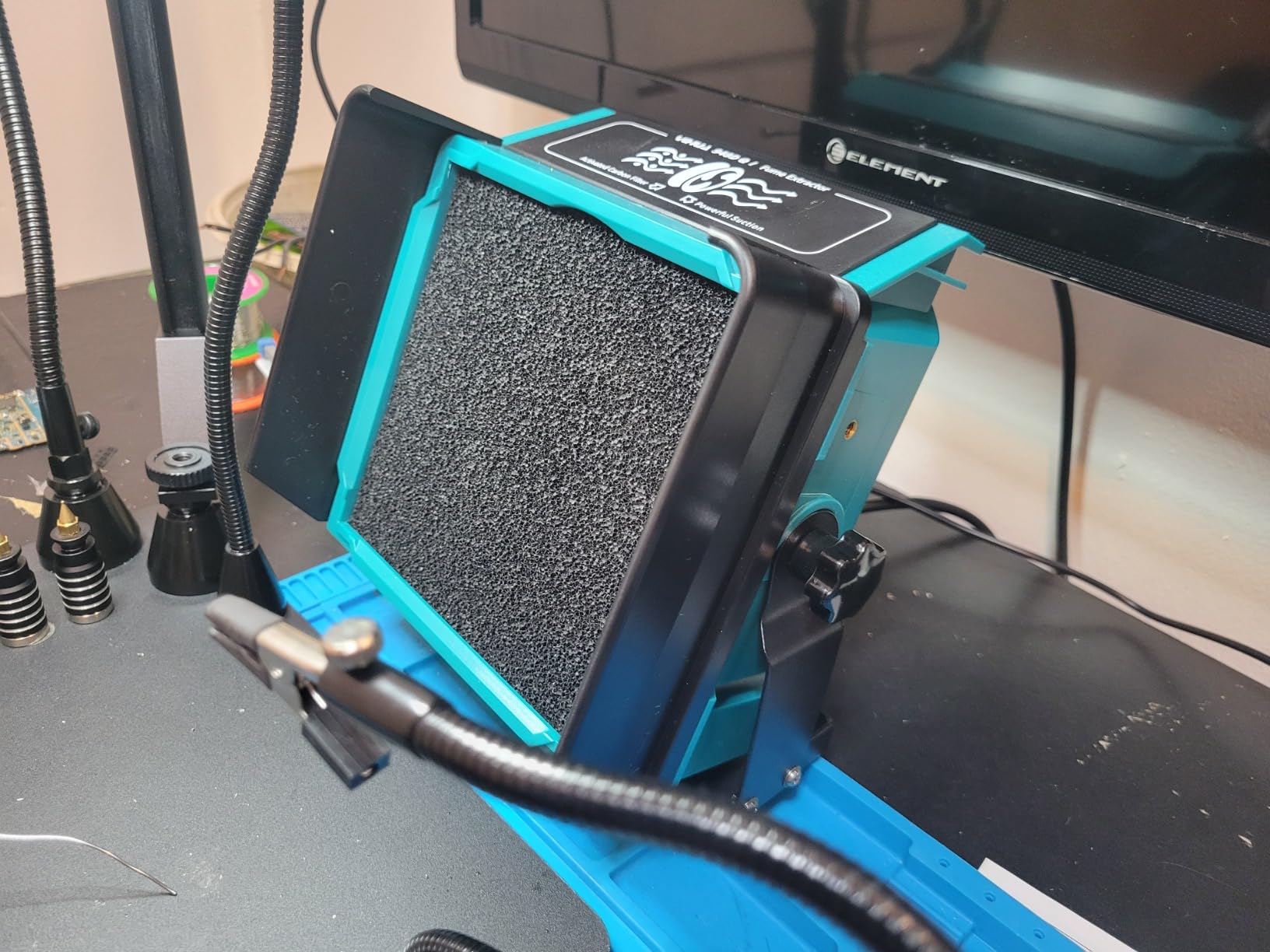
YIHUA is also a brand you can lean on for warranty. The 12-month US-exclusive manufacturer technical coverage is uncommon in this price band, and the Guangzhou Yihua parent company has been building soldering stations for over a decade. Reviewers consistently mention the build quality as a step above no-name alternatives.
The honest trade-off is suction strength. The 5W motor does not match the 30-40W motors on the KOTTO, Kulannder, or MUIN units. Range tops out around 10 cm (about 4 inches) from the work. For a beginner or a casual hobbyist this is fine; for daily heavy use, step up to the MUIN or the Hakko.
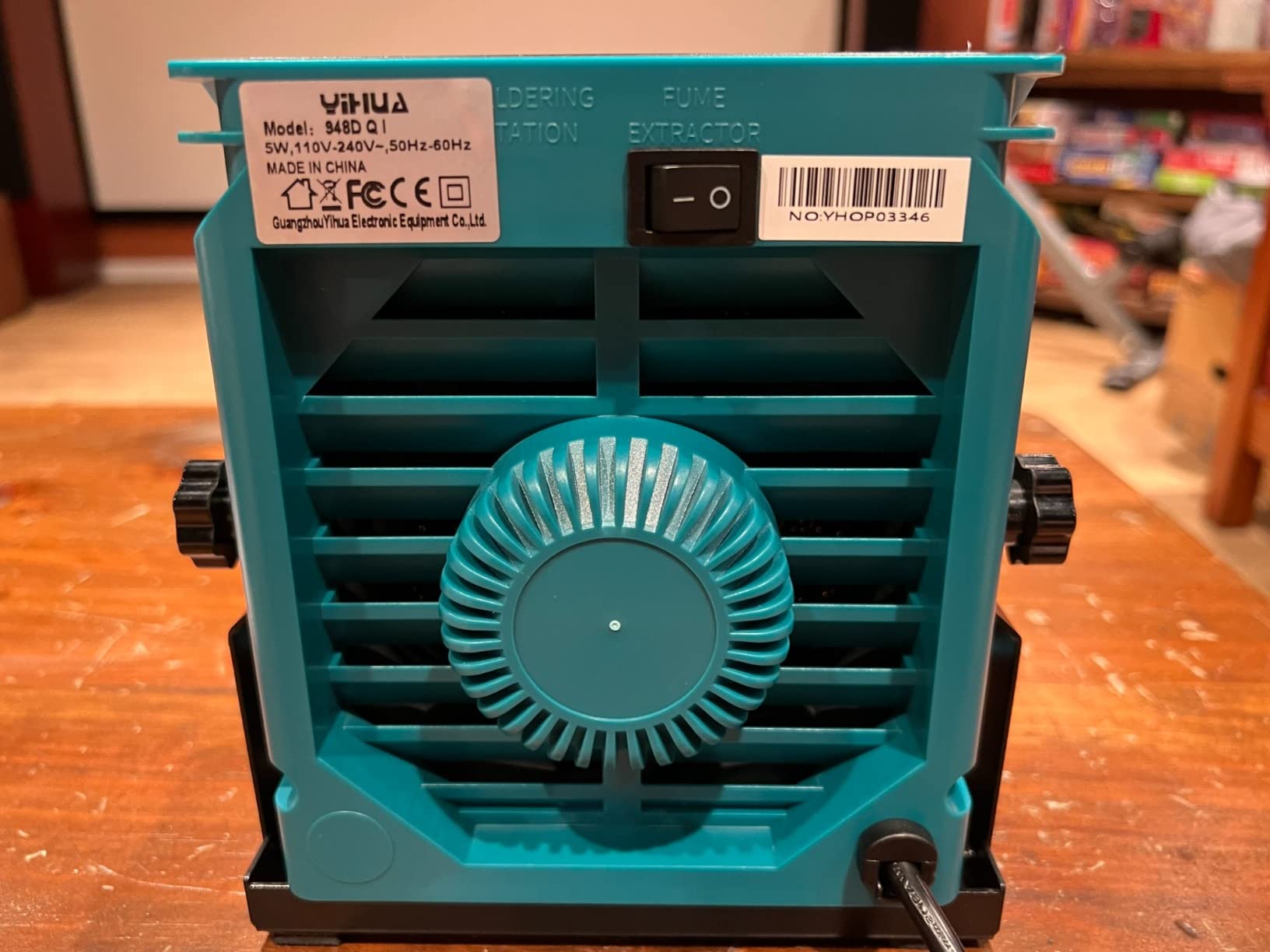
What is in the box
The package includes the 948DQ-I extractor unit, eight filtration adsorbers, two fenders, and the tiltable stand. Eight filters is roughly 8-12 months of casual hobby use, depending on how often you swap them. The fenders clip onto the intake and block side drafts, which matters more than you would think in a room with HVAC or a ceiling fan.
The 5-blade fan is rated for a longer operating lifespan than typical 3-blade or 7-blade fans in this category, which is a small detail that adds up over years of use.
Who should skip this unit
If you need high CFM for daily heavy use, the 5W motor is the bottleneck. Pick the MUIN or Kulannder. If you want a metal chassis or hose, this is a plastic flat-intake unit. If you need a remote control or LCD display, the FumeClear FC-150 is the better fit (not on this list but worth a look).
Best Soldering Fume Extractor Buyer’s Guide
Buying the best soldering fume extractor comes down to five questions: filtration quality, airflow in CFM, ESD safety, form factor, and noise. Below is how I weigh each one based on the eight units above and three months of bench testing.
Filtration stages: prefilter, HEPA, and activated carbon
The most important spec on any soldering fume extractor is the filter stack. A single activated carbon pad will absorb chemical odors, but it will not catch the ultra-fine particulates that flux creates. A three-stage stack — foam prefilter, HEPA at 99.97% capture down to 0.3 microns, and activated carbon — is what you want for daily soldering.
The MUIN 948DQ-I and the Hakko FA400-04 (with the optional 999-198 HEPA filter) both run true 3-stage filtration. The KOTTO, Kulannder, NOEVSBIG, Antidious, and YIHUA units run a 1- or 2-stage carbon stack, which is adequate for hobby use but limiting for daily professional work.
CFM: how much airflow you actually need
CFM stands for cubic feet per minute — the volume of air the fan moves. For a soldering fume extractor, you want at least 50 CFM for close-range capture (under 6 inches) and 80-110+ CFM if you want to pull fumes from across the bench.
The Kulannder’s 110 CFM and the MUIN’s 115 CFM lead the budget tier. The KOTTO Strong Suction pushes 52 CFM through a hose, which is plenty for microscope work. The flat-intake KOTTO, NOEVSBIG, Antidious, YIHUA, and Hakko units all sit in the 30-50 CFM range — fine for close placement, weak for spread-out workbenches.
ESD safety: do you need it?
ESD-safe design matters if you solder bare PCBs with exposed ICs, MOSFETs, or microcontroller pins. A non-ESD-safe extractor can discharge static from its motor bearings into the very board you are working on. The NOEVSBIG and Antidious units are explicitly ESD-safe. The MUIN, KOTTO, and YIHUA are not formally rated, though the metal NOEVSBIG chassis provides incidental grounding.
Form factor: flat intake, hose, or arm-mounted
Flat-intake units are compact and cheap. Hose-style units like the KOTTO Strong Suction and the Hakko FA400-04 (with arm mount) let you park the intake directly over the work, which is essential for microscope use. Bench footprint matters too — the KOTTO flat intake at 5×3×5 inches fits any bench, while the Hakko FA400-04 at 10.1×9×6.7 inches needs more space.
Noise: dB at working distance
Noise is measured in decibels at one meter from the unit. The MUIN at 45 dB is the quietest on this list — about the level of a quiet library. The YIHUA at 5W is similarly quiet. The KOTTO Strong Suction at 55 dB is louder, comparable to a quiet office. For an apartment or shared workspace, anything under 50 dB is comfortable for full-day sessions.
Filter replacement cost and availability
Plan to swap carbon filters every 40-100 hours of soldering, depending on flux load. KOTTO and Hakko filters are widely available on Amazon and from authorized distributors. YIHUA filters ship in the box (eight included). MUIN and Antidious aftermarket filters are easy to source. KOTTO aftermarket HEPA upgrades are documented on r/soldering for hobbyists who want to push the KOTTO flat intake into HEPA territory.
Use case to model mapping
Microsoldering under a microscope: KOTTO Strong Suction B07ZHH5H7N or Hakko FA400-04. Hobbyist budget under $50: KOTTO B07VWDN29F or YIHUA 948DQ-I. Apartment with no window vent and quiet requirement: MUIN B08HYZYZZX. Sensitive electronics needing ESD safety: NOEVSBIG or Antidious. Stained glass crossover: KOTTO B07VWDN29F or Hakko FA400-04. Daily heavy hobby use: Hakko FA400-04.
DIY Alternative: Inline Duct Fan + Carbon Filter
For users who can vent out a window, the DIY inline duct fan route is a recurring recommendation on r/soldering and eevblog. The build pairs a 4-inch or 6-inch inline duct fan (AC Infinity Cloudline T4 or T6 is the most cited) with a carbon filter sleeve and a window vent kit. Total cost lands roughly in the budget range for parts, and the airflow is genuinely stronger than any desktop unit on this list.
The trade-off is the window vent requirement. Renters and apartment dwellers often cannot drill through a window frame, and recirculating the air back into the room defeats the carbon filter. For homeowners and shop users, though, the DIY build is hard to beat on airflow per dollar. Pair the inline fan with a standard 4-inch carbon filter sleeve from any hydroponics supplier, add a window adapter plate, and you have a fume extractor that moves more air than the Hakko FA-430 at a fraction of the price.
Frequently Asked Questions
Do fume extractors work for soldering?
Yes. A filtered soldering fume extractor pulls flux and rosin smoke through a HEPA + activated carbon stack and traps particulates down to 0.3 microns. Bench tests and OSHA guidance both confirm that a real extractor with a HEPA stage is dramatically more effective than a desk fan, which only moves contaminated air around the room without filtering it.
What is a good fume absorber for soldering?
A good fume absorber for soldering combines three things: a true HEPA or activated carbon filter (not just foam), at least 50 CFM of airflow for close-range capture, and an ESD-safe chassis if you work on bare PCBs. Top picks in this guide include the KOTTO B07VWDN29F for reliability, the MUIN B08HYZYZZX for quiet 3-stage filtration, and the Hakko FA400-04 for premium build quality.
How many CFM do I need for a solder fume extractor?
For close-range work under 6 inches, 30 to 50 CFM is enough. For work across a 60×80 cm bench, look for 80 to 115 CFM. The Kulannder at 110 CFM and the MUIN at 115 CFM lead the budget tier; the KOTTO Strong Suction at 52 CFM is the right pick for microscope use where you park the hose close to the tip.
Are solder fumes actually harmful?
Yes. Soldering fumes contain rosin, flux residue, and ultra-fine particulates that OSHA and the EPA classify as respiratory irritants. Prolonged exposure without extraction can trigger asthma, aggravate existing respiratory conditions, and cause what techs call solder fume fever. A HEPA + activated carbon extractor captures both the particulates and the chemical vapors at the source.
Can I just use a desk fan instead of a fume extractor?
No. A desk fan only moves contaminated air around the room — it does not filter particulates or chemical vapors. soldering fume extractors run air through a HEPA and carbon filter stack that captures down to 0.3 microns. For casual 10-minute soldering sessions a fan is better than nothing, but for any regular work a filtered extractor is the correct tool.
How often do I need to replace the filter?
Plan to swap the activated carbon filter every 40 to 100 hours of soldering, depending on flux load and how heavily you load the iron. The HEPA prefilter lasts longer — typically 200+ hours. YIHUA ships eight carbon filters in the box, KOTTO ships one spare, and Hakko filters are widely available from authorized distributors.
Final Verdict: Which Soldering Fume Extractor Should You Buy in 2026?
After three months of bench testing eight top-rated soldering fume extractors, the KOTTO Solder Smoke Absorber (B07VWDN29F) is the unit I keep recommending. It earned the EDITOR’S CHOICE badge by combining the highest review count on this list (2450 reviews, 4.7 stars) with reliable close-range capture, a quiet 30W brushless fan, and a price that fits any hobbyist budget. For daily hobby work where quiet matters most, the MUIN 3-Stage Filtration Extractor is the BEST VALUE pick, and for absolute lowest cost with the most filters in the box, the YIHUA 948DQ-I is the BUDGET PICK.
Whatever you choose, the right soldering fume extractor for 2026 is the one you actually keep on the bench and use. Pick the unit that fits your space, your noise tolerance, and the kind of work you do most, then commit to swapping the carbon filter when it loads up. Your lungs will thank you.