
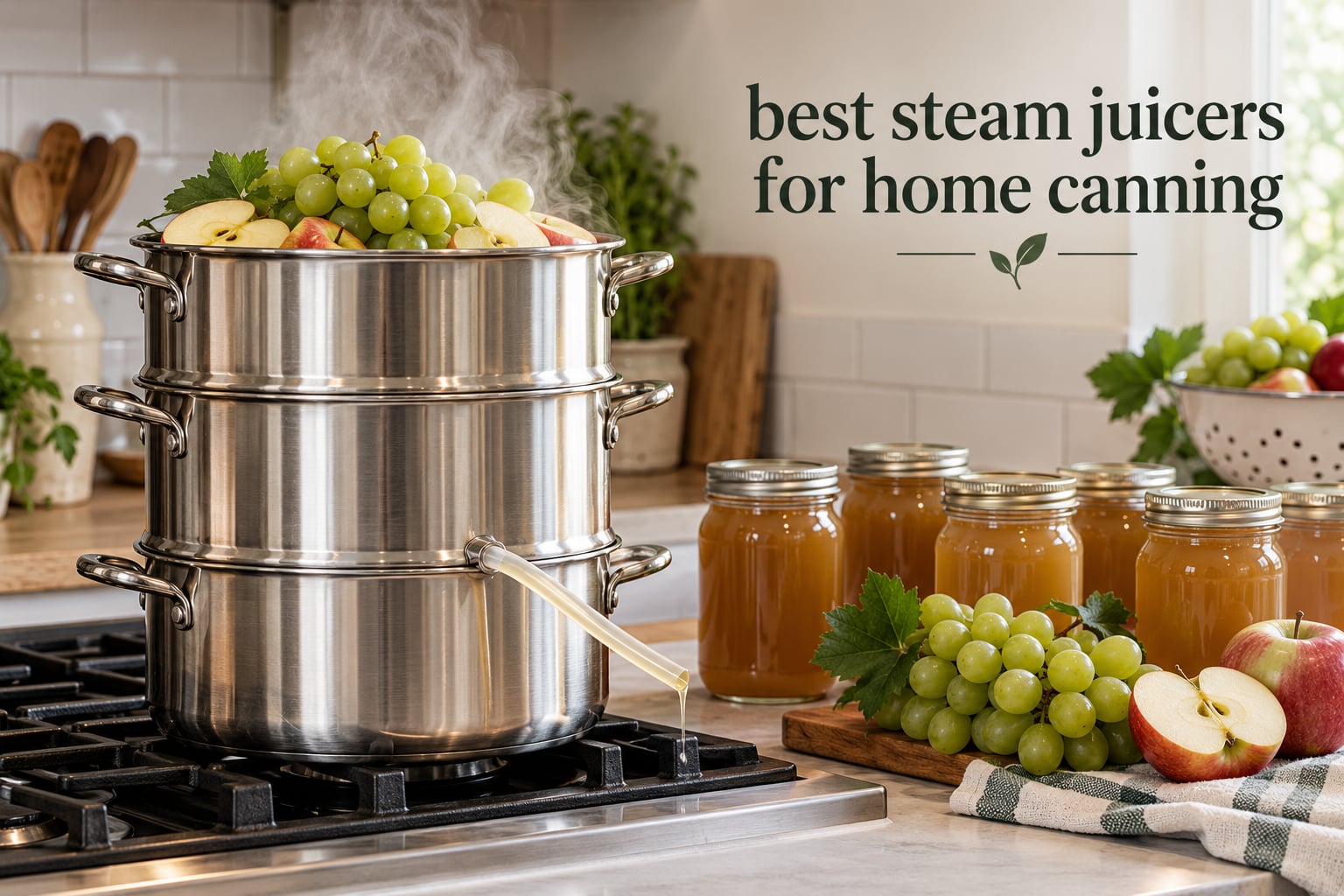
There comes a point in every backyard orchard where the branches are bending under fruit you cannot eat, cannot store, and cannot give away fast enough. Grapes by the armload. Apples in bushel baskets. Elderberries in foam containers that keep multiplying. At that point the question stops being what to cook and becomes what equipment turns a surplus harvest into shelf-stable jars.
A steam juicer is the answer for most home canners. It is a three-tier stainless steel pot stack that uses rising steam to rupture fruit cells and drain the juice out, leaving the pulp behind. Unlike a centrifugal or masticating juicer, it never crushes seeds or oxidizes the juice, which is exactly why the result stays clear enough to can, strain a second time, or reduce into syrup without turning muddy.
We put together this guide to the best steam juicers for home canning after running side-by-side comparisons of the ten models that dominate this category, from 8-quart multipots to 11-quart workhorses. Every unit here is stainless steel with a clad or encapsulated base, every one works on induction, and every one includes the hose and clamp that carries juice to your jars. The differences come down to capacity, how you monitor the fruit, how you drain the juice, and what you can do with the pots afterward.
Before we get into the picks, one safety point that belongs above everything else in this article, because the single most common question in canning communities is about it.
Table of Contents
Steam Juicer vs Steam Canner: The Safety Difference You Need to Know
A steam juicer cannot be used as a steam canner, and the two devices should never be confused. A steam juicer extracts juice from raw fruit using steam and a spigot or hose. It has no jar rack, no processing time, and no validated heat treatment built into it. A steam canner does the opposite: it holds sealed jars of already-filled food and runs them through a specific, timed steam treatment so that the jars reach a safe internal temperature.
That distinction matters because the juice you collect in a steam juicer is not canned yet. It is raw, hot, and shelf-unstable. To preserve it you still need a water bath canner or pressure canner, plus a tested recipe from a source you trust, such as the National Center for Home Food Preservation or a current extension service publication. Never improvise processing times for home canned juice, and never use a steam juicer to heat filled jars.
A water bath canner is the usual companion piece for juice, because juice is generally acidic enough for a boiling water bath. A pressure canner is for low-acid foods such as plain tomatoes. Steam canning exists as a third option, but it has a narrower set of tested uses and more variables, so we do not recommend it as a substitute for either standard method.
Members of r/Canning describe steam juicers as a juice extraction tool, full stop, and the forums consistently treat the water bath canner as the separate device that does the actual preserving. Getting that straight protects both your food and your equipment.
Top 3 Steam Juicers for Home Canning (October 2026)
Three units earned a place above the rest once we weighed capacity, monitoring, cleanup and build quality together. The Cook N Home leads on the strength of its review history and even heating, the Giantex delivers the most complete package for the money, and the VINEYARD Deluxe is the most flexible of the three with its oven-safe pots and cool-touch handles.

Cook N Home 11-Qt Steam Juice Extractor
- 11-quart capacity
- Aluminum layered base
- Induction compatible
- Dishwasher safe

Giantex 11 Quart Juice Steamer
- Tempered glass lid
- Loop handles on all pots
- Induction compatible
- Three separate pots

VINEYARD Deluxe 8-Quart Steam Juicer
- 5-year warranty
- Oven safe to 400F
- Cool-touch handles
- Tempered glass lid
The VIVOHOME and Cooks Standard are both excellent picks we cover in full below, and the Mehu-Liisa is the build you buy when you intend to keep a juicer for a decade.
All 10 Steam Juicers Compared Side by Side in 2026
Here is the whole field at a glance. We kept the feature columns to the details that actually change a canning session: capacity, lid type, base construction, and how many hoses you get for jar positioning.
| Product | Specifications | Action |
|---|---|---|
| Cook N Home 11-Quart Steam Juice Extractor |
|
Check Latest Price |
| Giantex 11 Quart Juice Steamer |
|
Check Latest Price |
| VINEYARD Deluxe 8-Quart Steam Juicer |
|
Check Latest Price |
 Mehu-Liisa 11 Liter Steam Juicer Mehu-Liisa 11 Liter Steam Juicer |
|
Check Latest Price |
 Norpro 619 Steamer Juicer Norpro 619 Steamer Juicer |
|
Check Latest Price |
 Euro Cuisine EC9500 Steam Juicer Euro Cuisine EC9500 Steam Juicer |
|
Check Latest Price |
 Cooks Standard 11 Quart Steam Juicer Cooks Standard 11 Quart Steam Juicer |
|
Check Latest Price |
 VIVOHOME 11 Quart Steam Juicer VIVOHOME 11 Quart Steam Juicer |
|
Check Latest Price |
 Lehman’s Mehu-Maija 11 Quart Lehman’s Mehu-Maija 11 Quart |
|
Check Latest Price |
 FOHERE 11Qt Steam Juicer Extractor FOHERE 11Qt Steam Juicer Extractor |
|
Check Latest Price |
Two things stand out immediately. Every serious contender here uses a clad or composite base rather than bare aluminum, and every one of them ships with a hose that runs to wherever your jars are sitting. Those are not premium features anymore; they are table stakes.
How to Use a Steam Juicer Step by Step
The workflow is the same on every model in this roundup, and once you have run one batch the process becomes almost automatic. Budget 45 to 90 minutes per load depending on the fruit.
1. Set up the stack. Put the water pot on the burner with roughly two-thirds of its capacity in water. If you are doing several loads in a row, dropping a handful of clean marbles into the water pot gives you an audible warning before the water gets dangerously low.
2. Load the fruit above the steam. Wash and stem your fruit, then fill the perforated steamer basket no more than two-thirds full. Fruit packed to the rim will steam unevenly and the top layer stays raw. Grape and berry canners on r/Canning report running about 15 pounds of frozen grapes through an 11-quart basket in under 90 minutes.
3. Assemble and clamp. Seat the juice pan in the water pot, set the basket in the juice pan, and fit the lid. Run the silicone hose through the clamp on the juice pan spigot and direct the free end into your first jar. A second hose, on the Cooks Standard and VIVOHOME, lets you swap jars without losing the flow.
4. Watch the first ten minutes. Bring the water pot to a boil and then drop the heat to a steady, gentle steam. You want visible vapor but not a rolling boil, which will push juice straight past the fruit into the pot.
5. Keep an eye on the water. This is the one task nobody can automate. Every 15 minutes or so, glance at the water pot through the gap where the hose exits. Running the pot dry scorches the fruit and can burn the base, which is the failure mode VIVOHOME owners specifically warn about in their reviews.
6. Know when to stop. Extraction is finished when the flow slows to a trickle, the fruit in the basket looks collapsed and drained, and the juice coming out has lost its cloudy, foamy head. You do not need a timer once you learn the visual cues after your first batch.
7. Stow the juice properly. Hot fill into sterilized jars with the correct headspace, or let the juice cool and refrigerate it for the shortest path to a tested recipe. For jelly clarity, pass the collected juice through cheesecloth or a fine mesh strainer before filling.
Do not skip step seven. Raw steam juice keeps for a short window in the refrigerator, and the decision about how to preserve it needs a validated recipe rather than a guess.
1. Cook N Home 11-Quart Steam Juice Extractor – Best Overall
Cook N Home Stainless Steel Steam Juice Extractor, 11-Qt Steam Juicer Pot
- Large 11-quart capacity for full harvests
- Works on gas
- electric
- glass
- halogen
- ceramic and induction
- Three pots usable separately as juicer
- steamer or soup pot
- Dishwasher safe for faster cleanup
- Hand washing recommended even though listed dishwasher safe
- Weighs 8.5 pounds when full
This is the unit we recommend to most people, and the reason is the volume of consistent feedback behind it. With more than two thousand reviews averaging 4.8 stars, this is the model where buyers agree about what works, and the design is simple enough that a first-time canner will not be second-guessing the setup.
The bottom pot carries a layered aluminum disc that spreads heat across the base rather than scorching it in one spot. On an induction cooktop that evenness is the difference between a pot that heats steadily for an hour and one that scorches the fruit sitting above a hot spot. Owners on r/Canning repeatedly credit this even heating for browning-free extraction across long batches.
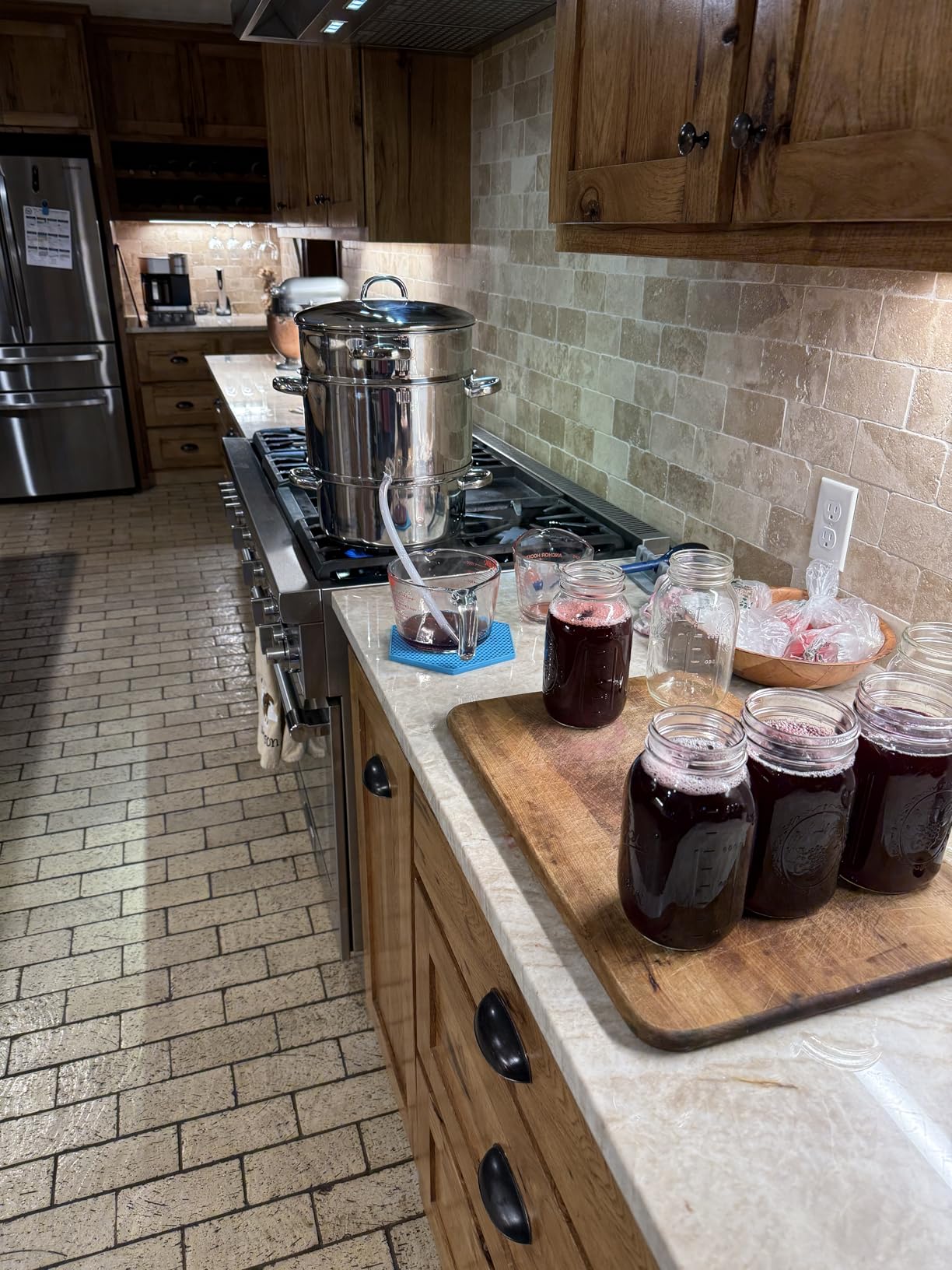
All three pots carry side loop handles, so moving the full stack is manageable but not one-handed. The lid is a solid stainless piece rather than glass, which means you lift it to check on the fruit and let a burst of steam escape. That is the main trade-off against the glass-lidded models, and on a slow extraction with grapes it costs you a little efficiency.
Reviewers report the dishwasher-safe designation holds up for the pots, though the manual still recommends hand washing. At 8.5 pounds empty, it is a real object to lift, so plan your counter space before the first batch.
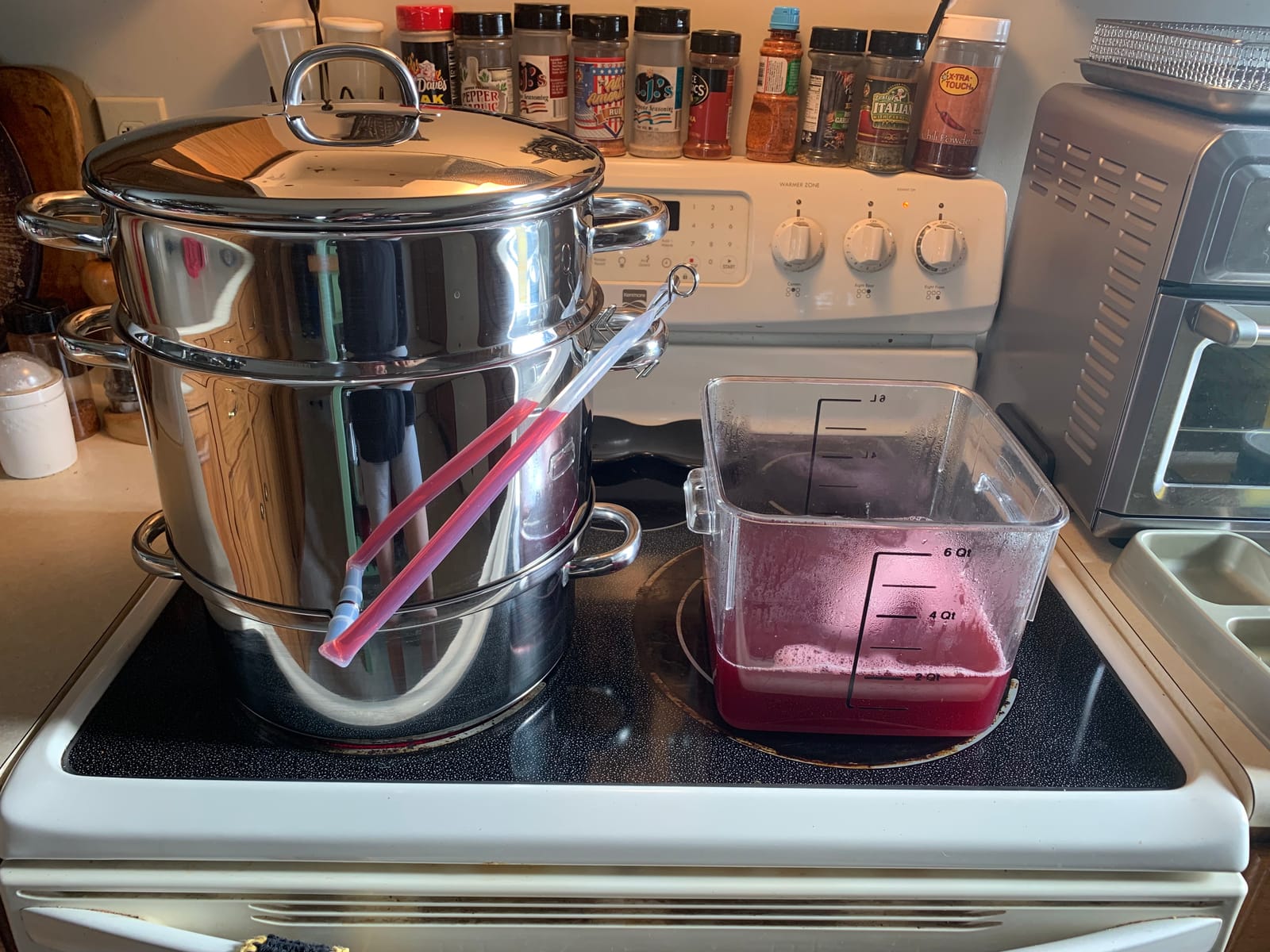
How it performs across a multi-batch harvest day
The 11-quart capacity means fewer water changes than most competing units, and that matters when you are processing a week of fruit. On r/Canning, owners running large harvests describe working through a stack of loads while rotating jars at the spigot.
Because the base is layered rather than a single disc, the water pot recovers to a boil quickly after you top it up. That recovery speed is what makes an all-day session realistic rather than exhausting.
Where it falls short for home canners
The solid lid is the honest weakness here. During a two-hour extraction, every time you lift it to check the fruit you vent steam and extend the batch, and a glass lid removes that temptation entirely.
Some owners also report the hose running warm during draining, which is common across this category. Route it away from your hand and let it cool before you detach the clamp.
2. Giantex 11 Quart Juice Steamer – Best Value
- Tempered glass lid with stainless edge protection lets you watch the fruit
- Loop handles welded on all three pots
- Flat aluminum-clad bottom for even heating
- Three pots usable separately
- Hand wash only
- Some users report the lid handle gets hot
The Giantex is the pick if you want glass-lid monitoring and multi-pot versatility without stepping up a tier. It holds a 4.8 rating across 750 reviews, which puts it in the same credibility band as the models that cost considerably more.
The tempered glass lid with a stainless steel edge rim is the feature that separates it from the budget tier. You can watch berries collapse and grapes split without lifting the lid, which keeps the steam sealed and shortens the batch. For someone processing fruit they are not sure is ripe enough, that visibility is worth more than any other single spec on this list.
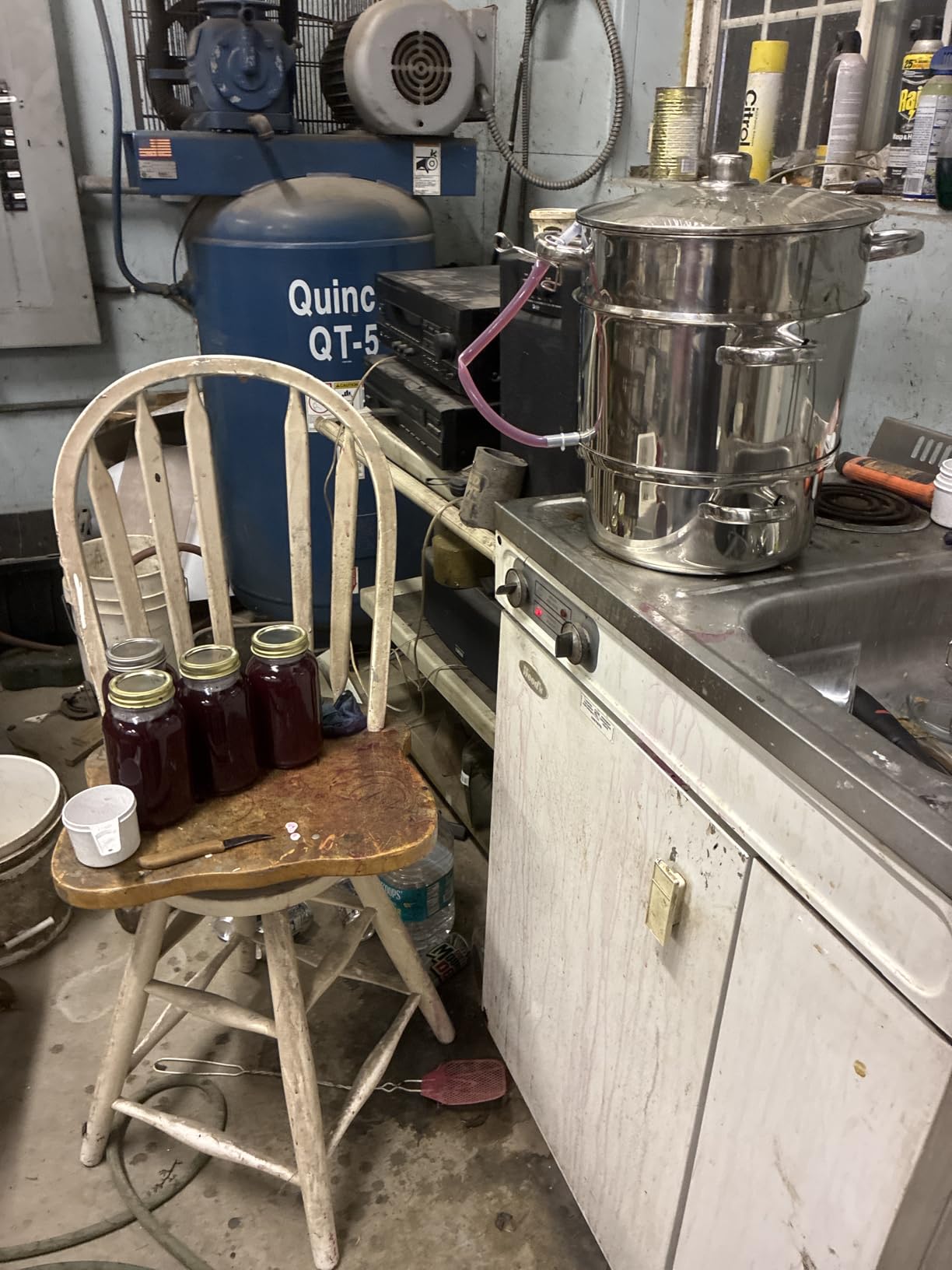
The flat aluminum-clad bottom distributes heat evenly across the 12-inch base and works on induction. Handles are welded loop style on all three components, which is sturdier than the riveted handles found on cheaper imports and matters when you are lifting a basket heavy with wet fruit.
Three pots that work separately is a genuine advantage for a home canner who also steams vegetables for dinner or makes stock in the same pot. One user on a canning forum described running a week of vegetable broth in the same pot used for juice the night before.
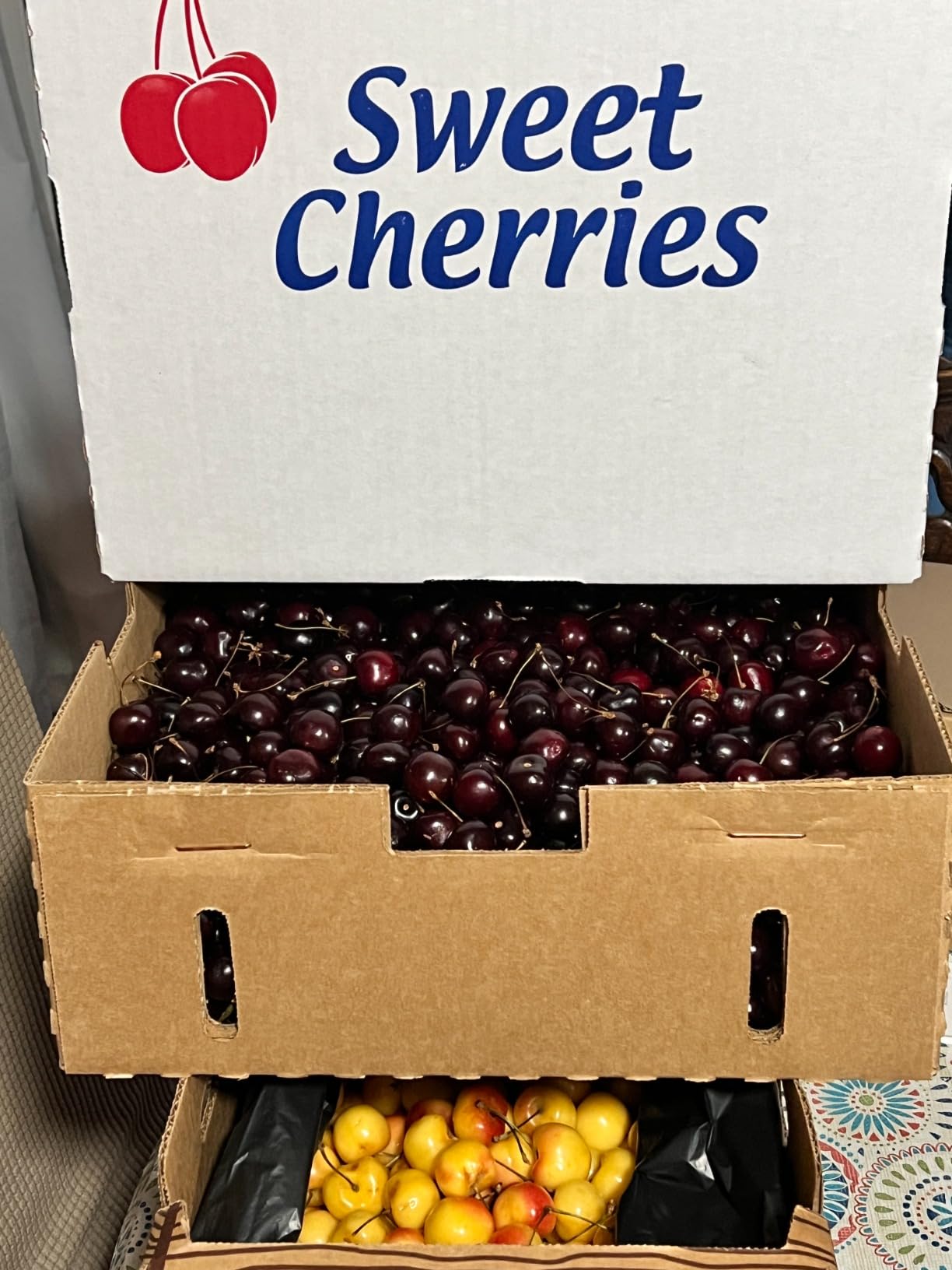
What monitoring the fruit actually looks like
Through the glass you can see when the fruit layer stops steaming and starts to slump. For elderberry and raspberry batches, owners use that view to pull the fruit out the moment the color deepens, before the juice takes on a cooked flavor.
The lid also makes checking the water level easier, since you can angle a mirror or your phone camera through the glass instead of lifting the whole stack.
Where it falls short for home canners
This one is hand wash only, so cleanup takes longer than with the dishwasher-safe models. Juice residue hardens inside the hose if you do not flush it while warm, which is a habit you need to build from day one with any steam juicer.
A few reviewers note the lid handle itself warms up during long batches. Use a towel to lift it, and do not lean over the pot when the lid comes off.
3. VINEYARD Deluxe 8-Quart Steam Juicer – Best for Versatility
VINEYARD Deluxe Stainless Steel Steam Juicer & Roaster Set – Induction Friendly, Tempered Glass Lid, Cool-Touch Handles, 8 Quart Capacity
- Five-year warranty on the set
- Silicone-coated handles stay cool on long batches
- Bottom pot oven safe to 400F for roasting
- Tempered glass lid with stainless rim
- Smaller 8-quart capacity than most competitors
- Heaviest unit here at 11.3 pounds
- Higher price point
The VINEYARD Deluxe is the set to buy if you want one appliance to cover roasting, steaming and juice extraction. It holds a 4.7 rating over 661 reviews and is the only unit in our group with a five-year warranty attached to the whole set.
Silicone-coated loop handles stay comfortable through a ninety-minute extraction, which is the most practical difference in this category once you have run a long batch on bare stainless. The bottom pot goes into the oven at up to 400F, so the same set that makes grape juice can roast the fruit concentrate afterward.
The three-piece set breaks down into an 8-quart colander, a 4-quart juice kettle and an 8-quart soup pot, each usable on its own. The tempered glass lid with a stainless rim gives you the same visibility the Giantex offers, so you are not trading monitoring for durability.
A clad bottom on all three vessels keeps induction performance steady. Clad construction is also why this unit resists the pinhole failure that owners report on older aluminum-bodied juicers after years of boiling.
Whether the 8-quart size is a problem for your harvest
Eight quarts means more water changes than an 11-quart unit, but the fruit basket is generous enough for a serious weekend session. Owners batching apples report two loads from a bushel, which is a reasonable trade for the lighter handles and oven capability.
If your harvest runs to hundreds of pounds, the bigger pots will save you time on water changes alone. If you are preserving smaller quantities, the VINEYARD is easier to store and lift.
Where it falls short for home canners
At 11.3 pounds, this is the heaviest unit in the group, and that weight is concentrated in the bottom pot. Lifting a full stock of water while checking the burner is the part owners mention most.
The 4-quart juice kettle also holds fewer finished quarts before you need to stop and swap containers, which lengthens the collection side of a batch.
4. Mehu-Liisa 11 Liter Steam Juicer – Premium Pick
- Professional gauge 18/10 stainless throughout
- Ten-year manufacturer warranty on steel parts
- Original Finnish design with a recipe book included
- Deep 11-liter capacity for full harvests
- Highest price point in the group
- Weight and dimensions are not listed
The Mehu-Liisa is the build to buy once, if you intend to keep juicing for years. It is the only unit here with a ten-year warranty on its steel parts, and the only one made from professional gauge 18/10 stainless across the entire stack.
Professional gauge steel is thicker and heavier than the standard-gauge sheet used in budget models. That mass holds heat, resists warping on an induction burner, and is the reason this pot stack is expected to outlast several cheaper juicers stacked end to end.

The set breaks down into a 10.5-quart steamer insert and a 4.23-quart water pot with a silicone tube, stainless clamp and lid. A recipe book is included, which is unusual at this tier and useful when you are figuring out headspace and processing times for a fruit you have never canned before.
The design dates to a Finnish original introduced in 2008, and the whole stack is induction compatible. Owners on canning forums who own both this and a budget model report the finish and weld quality as the visible difference.

How the warranty changes the ownership decision
A ten-year steel warranty means a canner processing fruit every fall can amortize the cost across a decade of harvests. That is a different calculation than comparing sticker prices between two models you might use five seasons.
If your volume is small and occasional, that math does not work in your favor. The value here is durability, not price.
Where it falls short for home canners
This is the most expensive unit in the roundup, and the listing does not publish weight or dimensions, so plan the cabinet space before ordering. Three nesting pots of this gauge take real shelf depth.
Thicker steel also means more retained heat, so the pot cools slowly between batches. That is a genuine advantage during a long canning day but a minor inconvenience if you only juice once a year.
5. Norpro 619 Steamer Juicer – Best for Oven Use
- Works as oven roaster
- stovetop cooker and covered baker
- Encapsulated base spreads heat evenly
- Recipe and instruction booklet included
- Professional gauge stainless steel
- Smaller 4-quart juice container
- Tall profile at 18.5 inches
- Higher price point
The Norpro 619 is the most genuinely multi-purpose unit we tested, and it earns its place for canners who want the same pots to handle roasting and baking between juice sessions. It holds 4.7 stars across 367 reviews.
The breakdown is unusually well proportioned for a three-tier juicer: a 7.25-quart water pot, a 4-quart juice container and an 11.75-quart steamer insert. The insert is the largest fruit basket in the group, which means fewer loads for a big apple harvest.
Every pot is oven safe to 400F, so the water pot becomes a roasting vessel and the stack doubles as a covered baker or server. The encapsulated base gives even heating on gas, electric and induction alike, which is the same thermal engineering that stops fruit from scorching over a long batch.
A recipe and instruction booklet ships in the box. For anyone new to steam juicing, having the manufacturer guidance alongside the pots shortens the first session considerably.
Whether the tall profile fits your kitchen
At 18.5 inches tall overall, this stack needs more vertical clearance than most of the group. Check the clearance under your cabinet or range hood before ordering, especially on a cooktop with a raised back.
Owners who have cleared the space report the steam behaves predictably because the taller column of water pot holds a stable boil longer between checks.
Where it falls short for home canners
The 4-quart juice container is the smallest collection vessel here. You will swap receiving containers more often than with an 8-quart or 11-quart juice pan, and each swap interrupts flow.
It also sits in the upper price band for what is fundamentally a juicing tool, so the oven versatility is the reason to pay it rather than a need you have to justify.
6. Euro Cuisine EC9500 Steam Juicer – Best for Compact Batches
- Built-in spigot simplifies draining juice
- Weighs only 7 pounds in the group
- Three-year warranty
- Induction
- electric and gas compatible
- Hand wash only
- Spigot is harder to clean
- Some users report the hose runs hot
The Euro Cuisine EC9500 solves one problem better than any other model here: draining juice. Instead of a hose and clamp, it uses a built-in spigot on the juice container, which you open and close like a cooler tap.
That single design choice removes the fiddliest part of a canning session. There is no clamp to fit and no silicone tube to position, so your jars can sit anywhere on the counter instead of on the floor beside the pot.
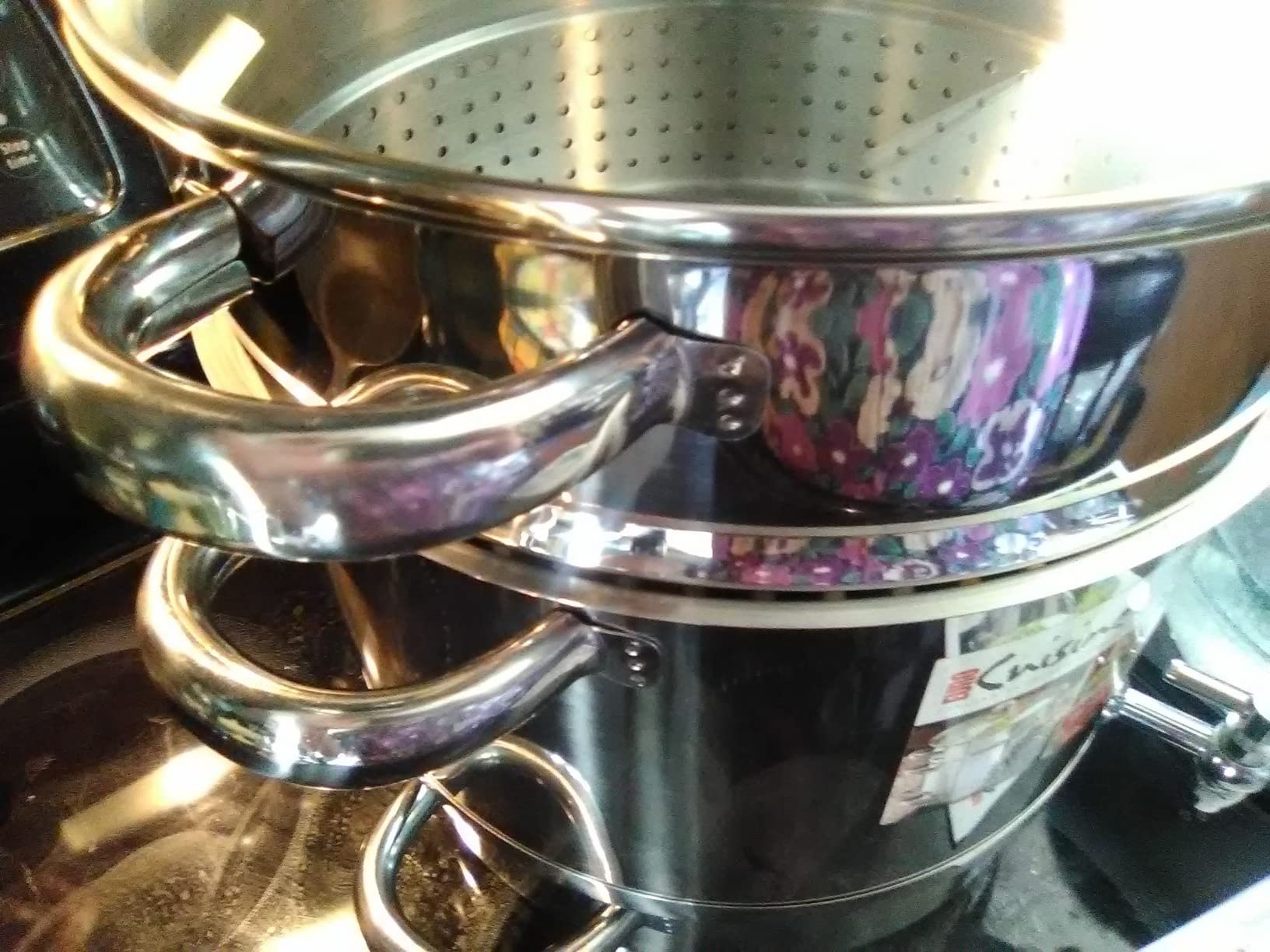
At 7 pounds this is the lightest unit in the group, which matters if you are lifting a full water pot to check the burner. The set includes an 8-quart juice container, an 8-quart steamer basket, a 5-quart water reservoir and a glass lid, and it works on induction, electric and gas.
A three-year warranty is included, and the steamer basket doubles as a vegetable steamer for everyday cooking.
How the spigot compares with a hose system
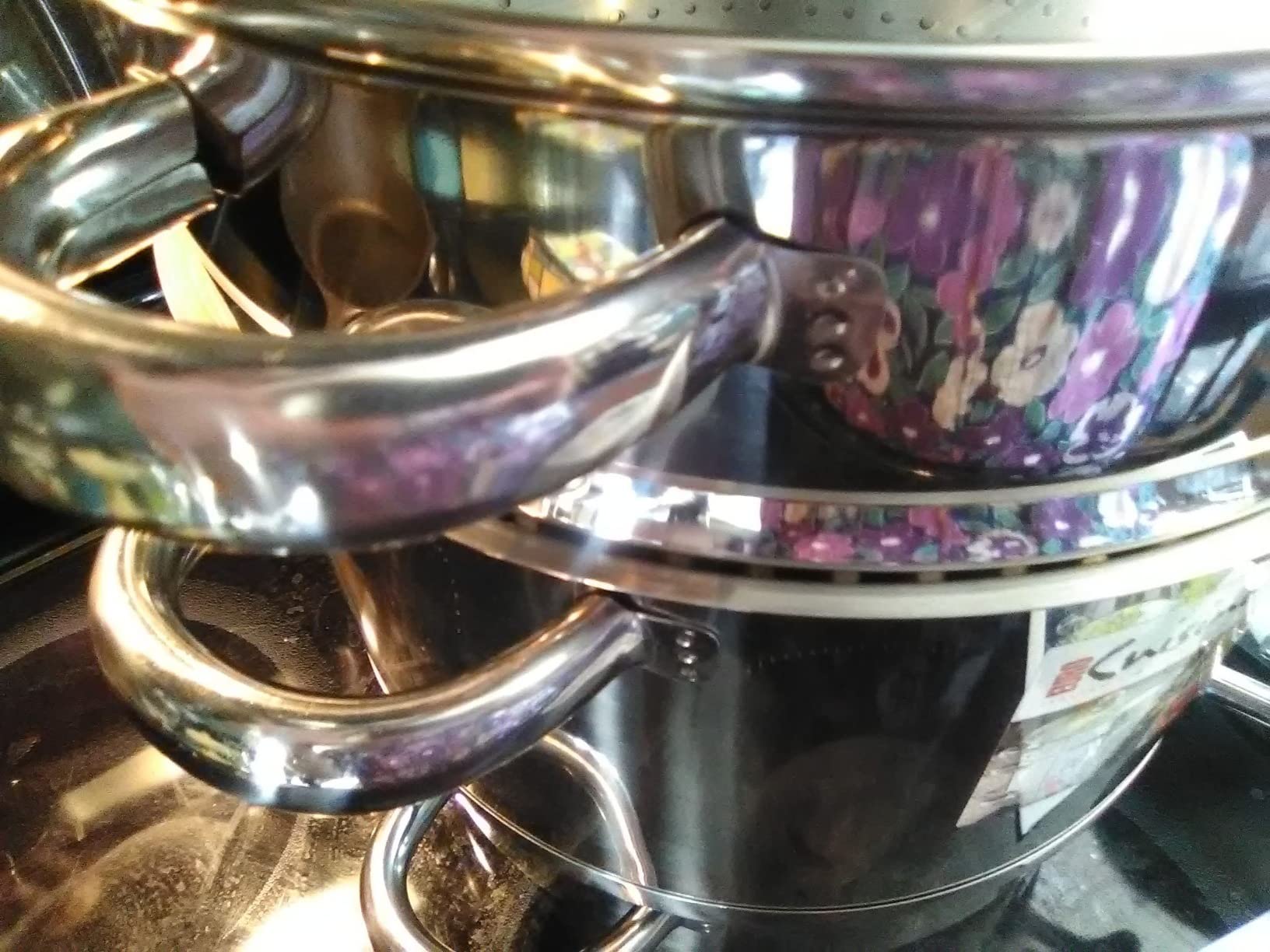
With a hose, flow control is a clamp you pinch or a hose you pinch. With a spigot, you open it when you want juice and shut it when you want to swap containers. Users find that control noticeably faster over a full harvest day.
The trade is placement. A hose lets you direct juice into a row of jars on the counter, while the spigot means you hold the container or position a single vessel beneath it.
Where it falls short for home canners
Reviewers consistently note the spigot is harder to clean than an open spigot or a hose. Juice residue collects in the valve seat and needs a brush and warm water after each session.
The hose, if you route one through the spigot for extended draining, is reported to run hot during use. This is also the lowest-rated unit in our group at 4.5 stars, with a small share of one-star reviews.
7. Cooks Standard 11 Quart Steam Juicer – Best for Mason Jar Packers
Cooks Standard Steam Juicer Pot 11 Quart Stainless Steel
- Two hoses let you fill two jars at once
- Listed Mason jar compatible for canning
- Oven safe to 500F
- Dishwasher safe
- Slower extraction than most rivals
- Hose can run hot during draining
- Hose length is limited
The Cooks Standard is the model to look at if you are filling Mason jars directly off the spigot during extraction. It is explicitly listed as Mason jar compatible and it is the only unit here that ships with two hoses.
Two hoses means you can run juice into two jars simultaneously, so you are not stopping the flow every time one jar fills. For a home canner working through a bushel of apples, that removes a surprising amount of dead time.
The build is polished stainless with an encapsulated aluminum base for fast, even heat distribution, and it is oven safe to 500F with the glass lid rated to 350F. It is also fully dishwasher safe, which matters after a full day of sticky juice.
At 11 quarts with a tempered glass lid, it covers the same feature set as the models above it while holding a 4.8 rating across 254 reviews.
What direct-to-jar filling actually requires
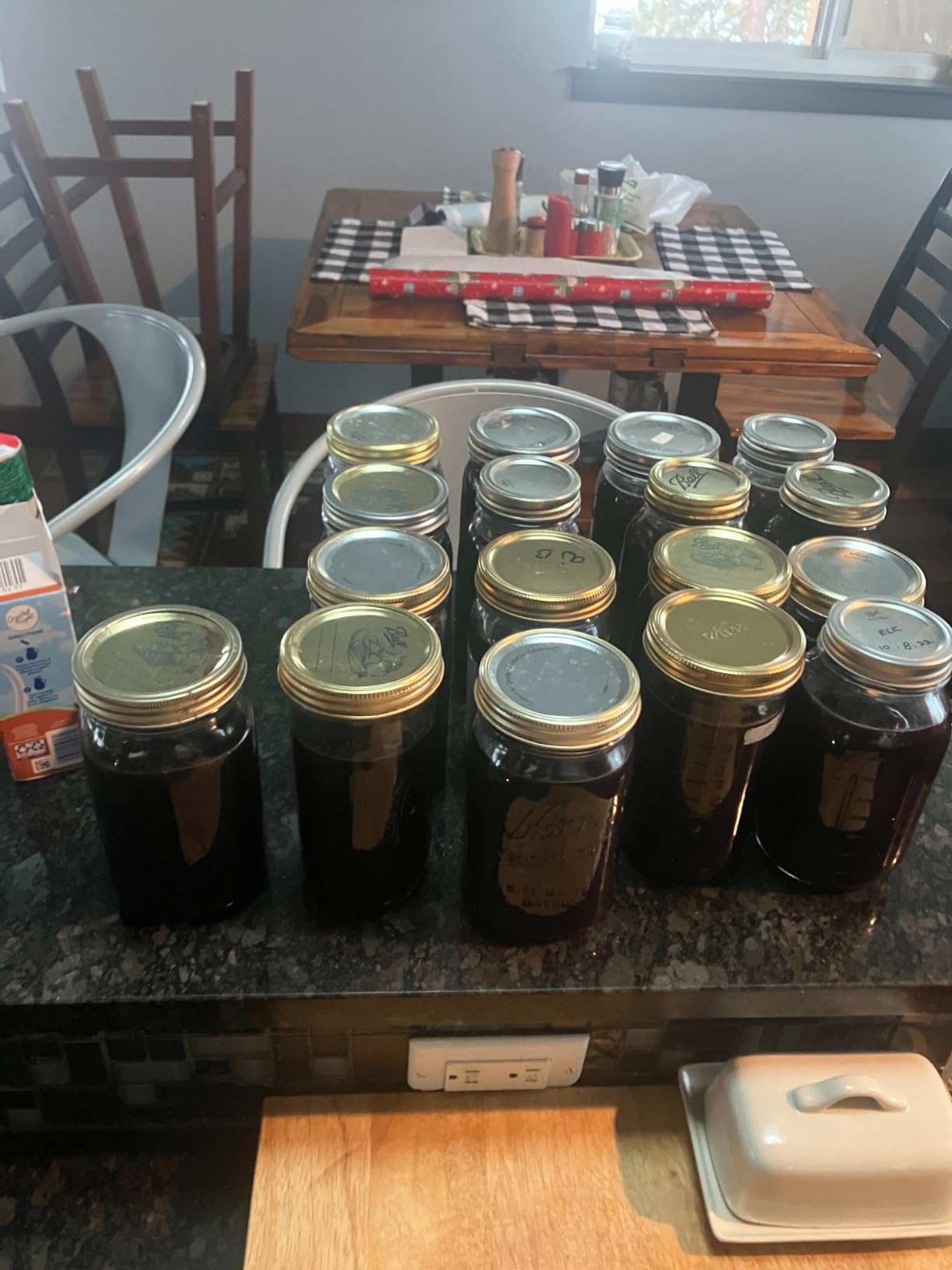
Filling straight into jars means keeping the juice hot and pouring into sterilized containers with correct headspace, then processing them in a water bath canner. The jar-compatible rating tells you the spigot flow is sized for standard Mason jar mouths.
You still need a tested recipe for processing times. The jar compatibility is about hardware fit, not about food safety.
Where it falls short for home canners
Extraction is reported as slower than on several rivals, so plan on the longer end of the 45 to 90 minute range for a full fruit load. The thoroughness is real, it just takes time.
The hoses run warm during draining and one reviewer found the length short for a countertop jar arrangement. Longer clamps or a small stand can solve that.
8. VIVOHOME 11 Quart Steam Juicer – Best for Easy Cleanup
VIVOHOME Stainless Steel Steam Juicer for Canning Fruit and Grape Juice
- Every part is dishwasher safe
- Three-layer composite bottom spreads heat evenly
- Available in 5 quart
- 9.3 quart and 11 quart sizes
- Two hoses included
- Tall profile at 18.9 inches
- Dry heating can damage the base
- Some one-star reports at 4 percent
The VIVOHOME is the pick if cleanup time is what you care about most. Every part is dishwasher safe, including the glass lid and the pots, and that is unusual in this category. It holds 4.6 stars across 529 reviews.
The lid is 4mm tempered glass with a stainless steel edge rim, thicker than the glass on most competing lids and better protected at the corners where chips usually start. You can watch the fruit collapse without venting steam.
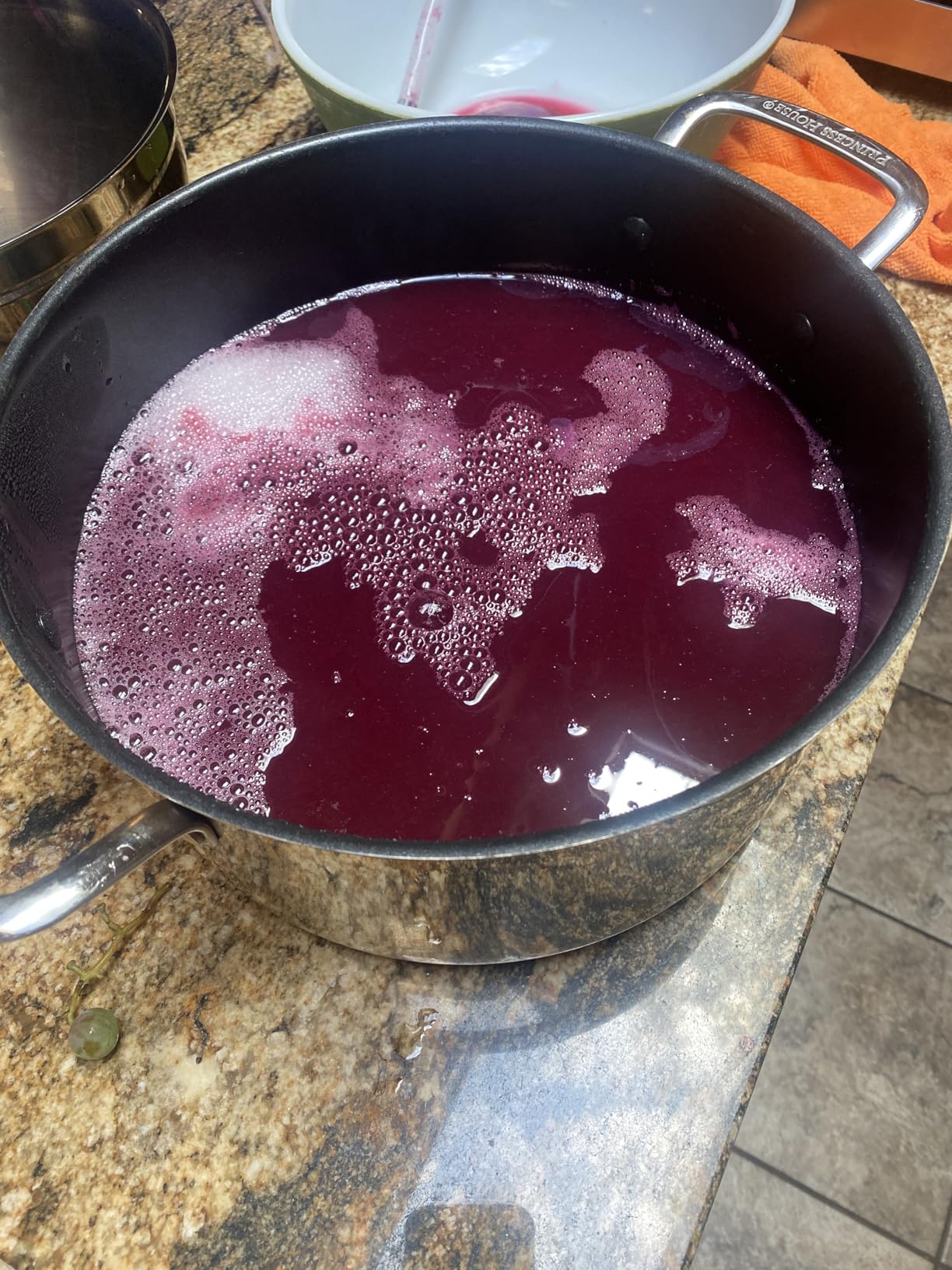
Users report pulling roughly three quarts of juice from a single water load on this design, which means fewer water changes across an afternoon than units with smaller bottom pots. The three-layer composite bottom handles induction and spreads heat evenly.
This model also comes in 5-quart and 9.3-quart versions alongside the 11-quart, so you can size the purchase to your counter and to how much fruit you actually process.
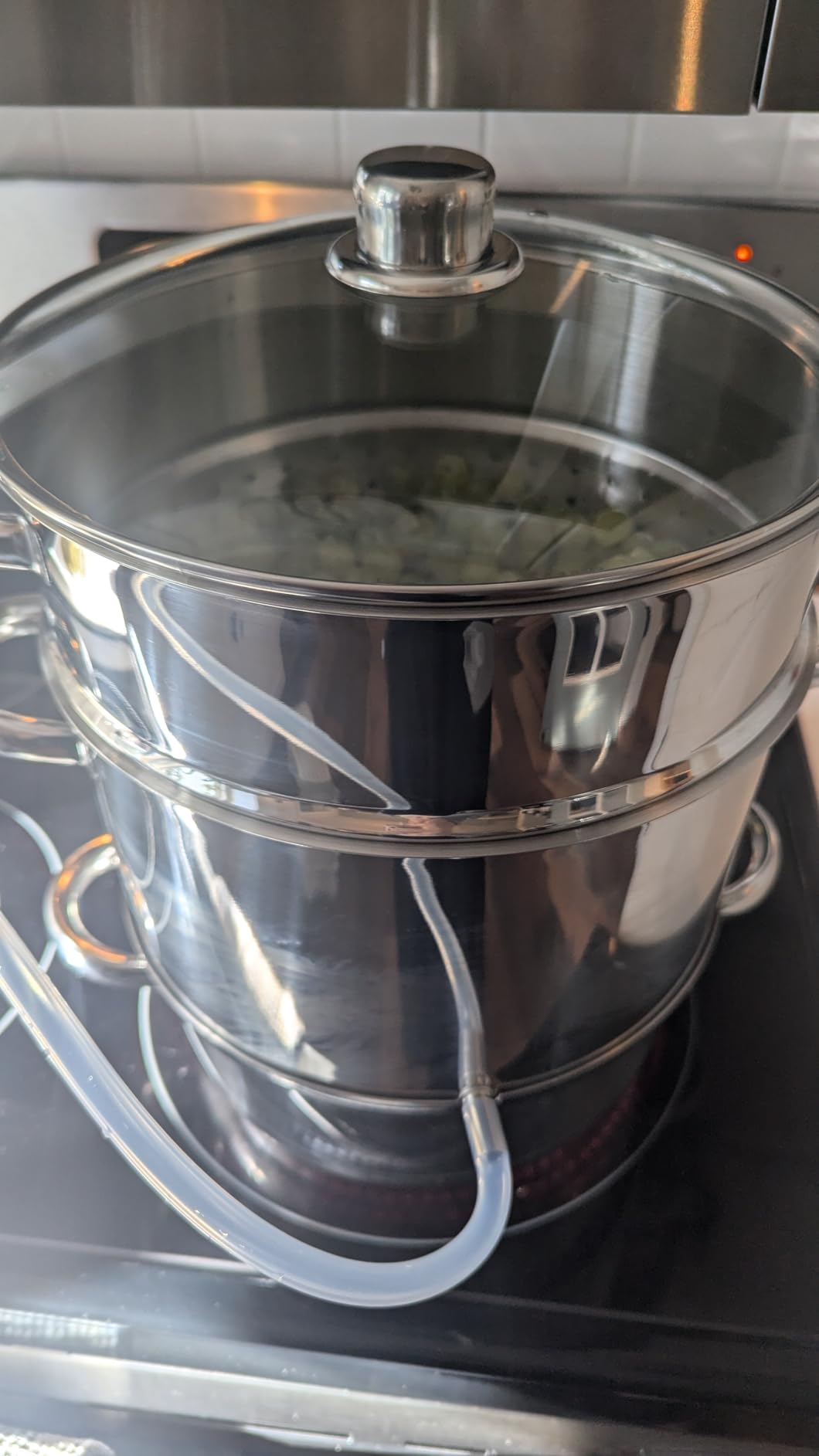
Whether full dishwasher cleaning is realistic
Pots, lid and handles all go in the dishwasher. The hose does not, and it should not. Flush it with hot water while it is still warm and clamp it open over the sink so it drains and dries.
Owners who build that habit into the end of the session report the whole cleanup taking a few minutes rather than a chore.
Where it falls short for home canners
At 18.9 inches, this is the tallest stack in the group. Check overhead clearance, particularly under a range hood or upper cabinet with a lowered trim.
Reviews repeatedly caution against dry heating. Let the pot cool with water in it, and do not set an empty base on a hot burner for even a minute.
9. Lehman’s Mehu-Maija 11 Quart – Best for Whole Fruit
Lehman’s Mehu-Maija Steam Juicer, 11 Quart Stainless Steel with Lid, Hose, Clamp, Loop Handles, Multipot Cookware for Making Juices, Jelly, Sauces
- Processes whole fruit such as grapes on the stem and whole berries
- Compact 14-inch height clears most cabinets
- Works on any stove including induction
- Glass lid
- hose and clamp included
- Hand wash only
- Fewer reviews than the mainstream brands
- Higher price than most 11-quart rivals
The Lehman’s Mehu-Maija is built around a simple idea: if the basket is deep enough, you can skip the prep. It processes whole fruit, meaning grapes straight off the stem and berries straight from the container, and it rates 4.6 stars over 123 reviews.
That is a real time saver during harvest. The trimming and stemming step is often longer than the extraction itself, and a deep 11-quart fruit basket removes it from the workflow for the fruits that do not need it.
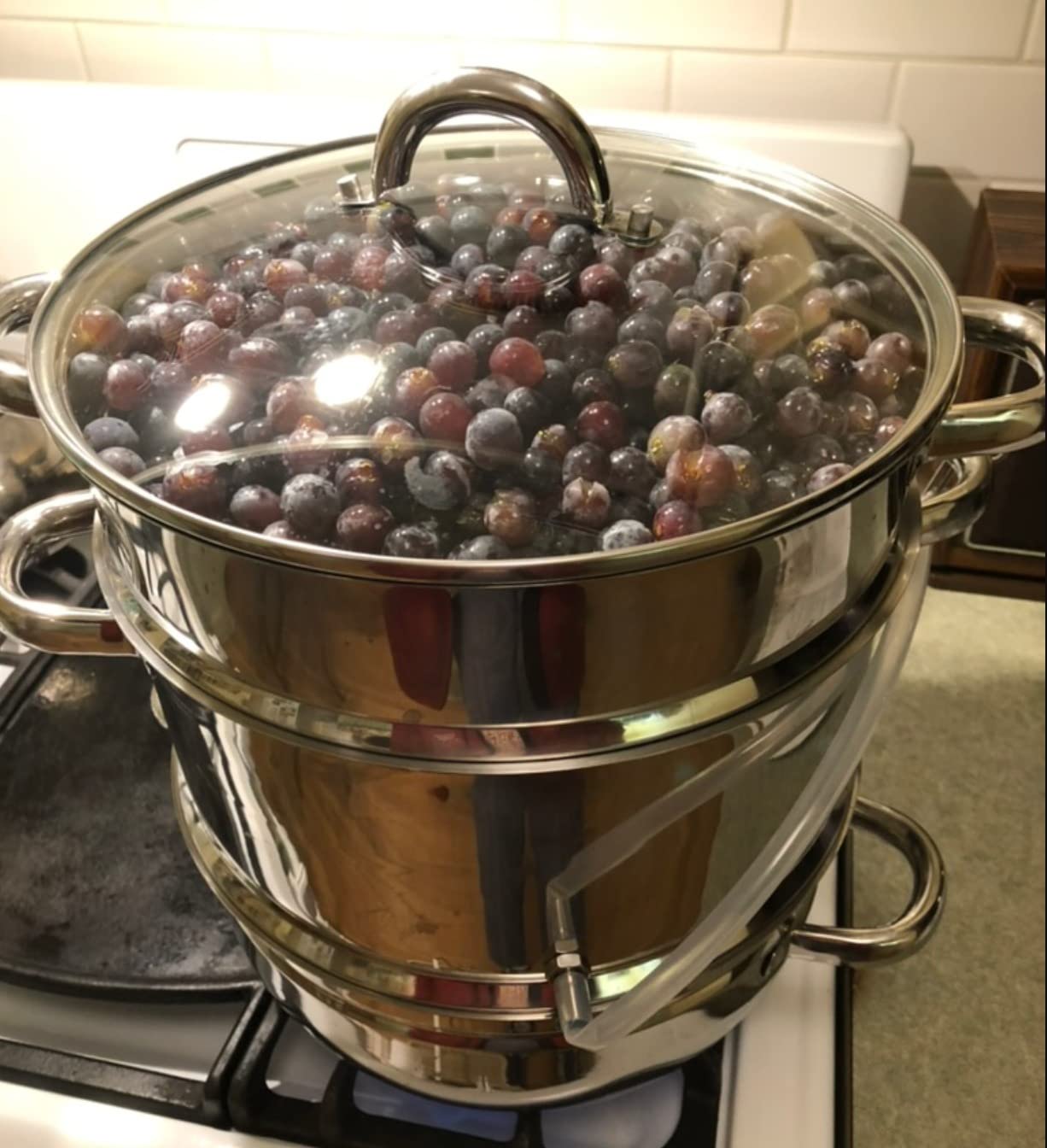
At 14 inches tall it is the most compact 11-quart stack here, which means it nests and stores more easily than the taller VIVOHOME or Norpro builds. The 18/8 stainless body works on any stove, induction included, and the set includes a glass lid, a 17-inch drain hose and a clamp.
A useful detail from a winemaking forum discussion: pits and seeds left in whole fruit do not break inside a steam juicer, which is why it is considered safe to leave them in. That is specific to steam extraction, where nothing is crushed.
How whole-fruit processing changes the workflow
Load the basket, close the lid, and let the steam work. You skip the sorting table entirely for grapes and berries, which on a backyard harvest can be the difference between processing fruit on the day you picked it or a day later.
The compact profile also means you can run a load on a portable outdoor propane burner, a setup foragers on canning forums use for harvest batching away from the kitchen.
Where it falls short for home canners
Hand wash only, so the pots and hose need scrubbing rather than a dishwasher cycle. That is a meaningful extra step at the end of a long day.
With 123 reviews this has the smallest feedback base in the group, so you are buying on design reputation rather than a deep pool of owner reports. Budget accordingly for your comfort level.
10. FOHERE 11Qt Steam Juicer Extractor – Budget Pick
- 304 food-grade stainless steel construction
- Dishwasher safe parts
- Stackable design saves cabinet space
- Tempered glass lid with protective rim
- Smallest review base in the group
- Lower rating at 4.5 with a few one-star reports
- Newer brand with a shorter track record
The FOHERE is the entry point into steam juicing. It uses 304 food-grade stainless steel, a tempered glass lid with a protective rim, and a layered bottom chassis for even heat, and it rates 4.5 stars across 138 reviews.
At 11 liters it matches the capacity of units far above it in the list, which makes it the sensible first purchase for someone testing whether steam juicing fits their routine before committing to a heavier build.
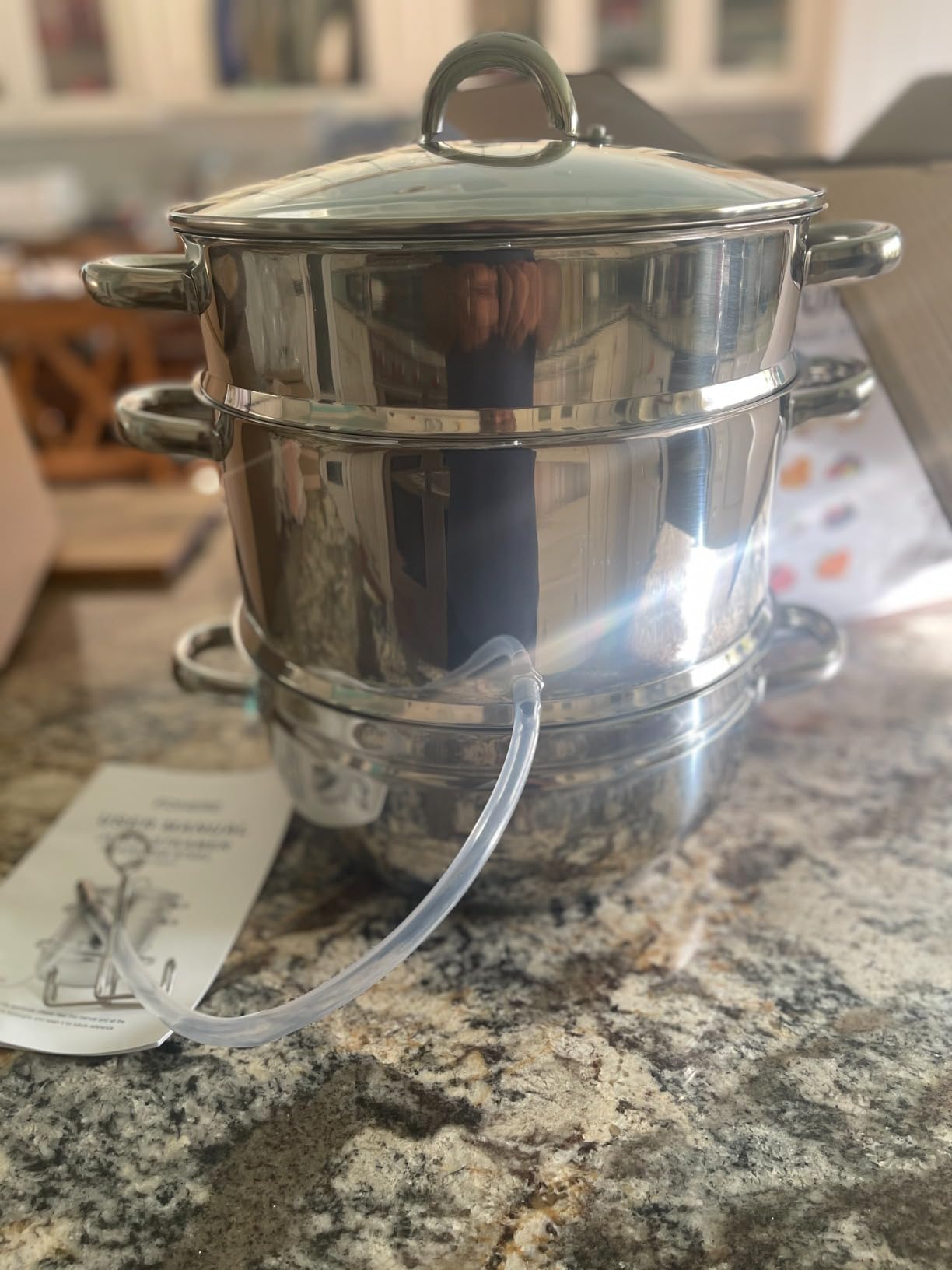
The stackable three-layer design is a real advantage in small kitchens, where three nesting pots can otherwise occupy an entire cabinet. The pots pull apart for individual use as a soup pot, steamer or juice extractor, and the whole set is dishwasher safe.
The layered chassis distributes heat for induction cooking, and the curved lid handle is shaped for lifting with an oven mitt, which is a practical detail given how hot that lid gets after an hour of steaming.
What you get at the entry tier
For a first harvest you get the glass lid, the hose and clamp, the loop handles and 11 liters of capacity. Nothing essential is missing, which is unusual for the bottom of this category.
Starting here makes sense if your fruit volume is a few jars a season rather than a full preserving operation. You can step up later without having wasted anything.
Where it falls short for home canners
This has the smallest review base and a lower average rating than the top of the group, with a small share of one-star reviews. There is less long-term owner history to draw reassurance from.
Handle it the same way you would any stainless juicer and it performs to spec, but if you plan on processing fruit every week of the season, a unit with a multi-year warranty is the better investment.
How to Choose a Steam Juicer for Home Canning?
Six criteria decide whether a steam juicer works for your kitchen. We have set pass and fail thresholds for each so you can filter the list above quickly instead of reading every review twice.
1. Capacity and batch size. Eleven quarts is the sweet spot for most home canners because it holds a meaningful fruit load without requiring a large burner. Pass if the steamer basket takes at least 8 quarts. Fail below that if you process more than a few jars per season, because water changes dominate your time otherwise.
2. Lid material and visibility. A tempered glass lid with a stainless steel edge rim lets you monitor fruit breakdown without venting steam. Pass if the lid is glass. Solid stainless lids work but every check costs you steam and time, and for a batch that runs an hour or more that adds up. Users frequently single out glass lids as the feature that makes a batch easier to judge.
3. Base material and heat distribution. Pass on a clad, encapsulated or composite aluminum base. Fail on bare aluminum. This is not a preference. Owners on canning forums warn explicitly about cheaper aluminum-bodied juicers developing pinholes over years of boiling, which leaks juice toward the burner and can ruin a batch and damage the pot. Every stainless unit in this roundup has a clad base, which is why we did not include bare aluminum models.
4. Induction compatibility and burner size. Induction needs a magnetic base layer, which all ten units here have. The real issue is footprint. Older induction cooktops use an oval burner element, and a perfectly round pot will not register on one. Check your cooktop for a round or square element before buying, and measure the diameter against the largest burner ring. Our heaviest stacks, the Norpro at 18.5 inches and the VIVOHOME at 18.9 inches, also need overhead clearance under a range hood.
5. Hose and collection system. The hose, clamp and spigot are where design differences actually change your workflow. Pass on a system that lets you position jars wherever you want, ideally with two hoses. Fail on a design that forces you to hold the collection vessel. The Euro Cuisine spigot is the fastest to operate; the Cooks Standard dual-hose setup is the best for filling multiple Mason jars at once.
6. Cleanup and storage. Dishwasher-safe parts save real time, and hand-wash-only models add a scrubbing step to the end of a long day. Storage matters just as much. Three nested stainless pots occupy a full cabinet, so check your shelf depth against the stacked height, particularly for the taller units. If you have limited storage, the smaller 5-quart and 9.3-quart VIVOHOME variants or the compact 14-inch Lehman’s stack are more realistic.
On brands, the pattern is clear. Nordic-designed units such as the Mehu-Liisa and the Lehman’s Mehu-Maija emphasize whole-fruit baskets and long warranties. American brands like the Norpro and the Cook N Home emphasize multi-purpose cookware with oven-safe pots. Value-tier brands such as the Giantex, Cooks Standard, VIVOHOME and FOHERE have converged on nearly identical feature sets, and at that point the tempered glass lid and the warranty are what separate them.
One more practical note on power and outages. Harvest days are long, and a mid-session power cut with a full pot on the burner is a genuine risk. If you are juicing off-grid or in an area with unreliable service, our guides to home backup generators and home battery backup systems cover the setups that keep a long canning day from ending early.
Are Steam Juicers Worth It for Home Canners?
For anyone who processes more than a few jars of fruit a season, yes. A steam juicer produces noticeably clearer juice than a mechanical juicer because nothing is crushed or spun at speed, and clarity is what lets you skip a second straining pass before jelly or syrup reduction.
The people who regret the purchase share one trait: they did not expect the cleaning. Every forum thread on this topic returns to the same point. If the juice hose is not flushed while still warm, residue hardens inside and clogs, and a clogged hose means dismantling the juice pan. Build that habit from the first batch.
The honest list of disadvantages runs longer than the marketing suggests. You babysit the water level for 45 to 90 minutes a load. You occupy a cabinet with three nested pots. You still need a separate water bath canner and validated recipes to actually preserve the juice. And bulk fruit yields less juice than its volume suggests, which surprises nearly everyone the first season.
Set against that, a backyard orchard producing fruit you cannot use, an owner on r/Canning reports working through 2,000 apples in about four days with a steam juicer setup. That is the use case the appliance exists for, and for that volume nothing else compares.
For households automating the rest of the home, the same planning logic shows up in our smart home hub coverage: measure the boring failure modes before committing to hardware.
How to Clean and Maintain Your Steam Juicer?
Five steps, done at the end of every session, keep a stainless juicer in service for years. The order matters more than the products you use.
1. Flush the hose while warm. Before anything goes cool, run hot water through the hose and clamp it open over the sink. Juice residue left to cool will harden and eventually clog the line, and clearing a blocked spigot means pulling apart the juice pan.
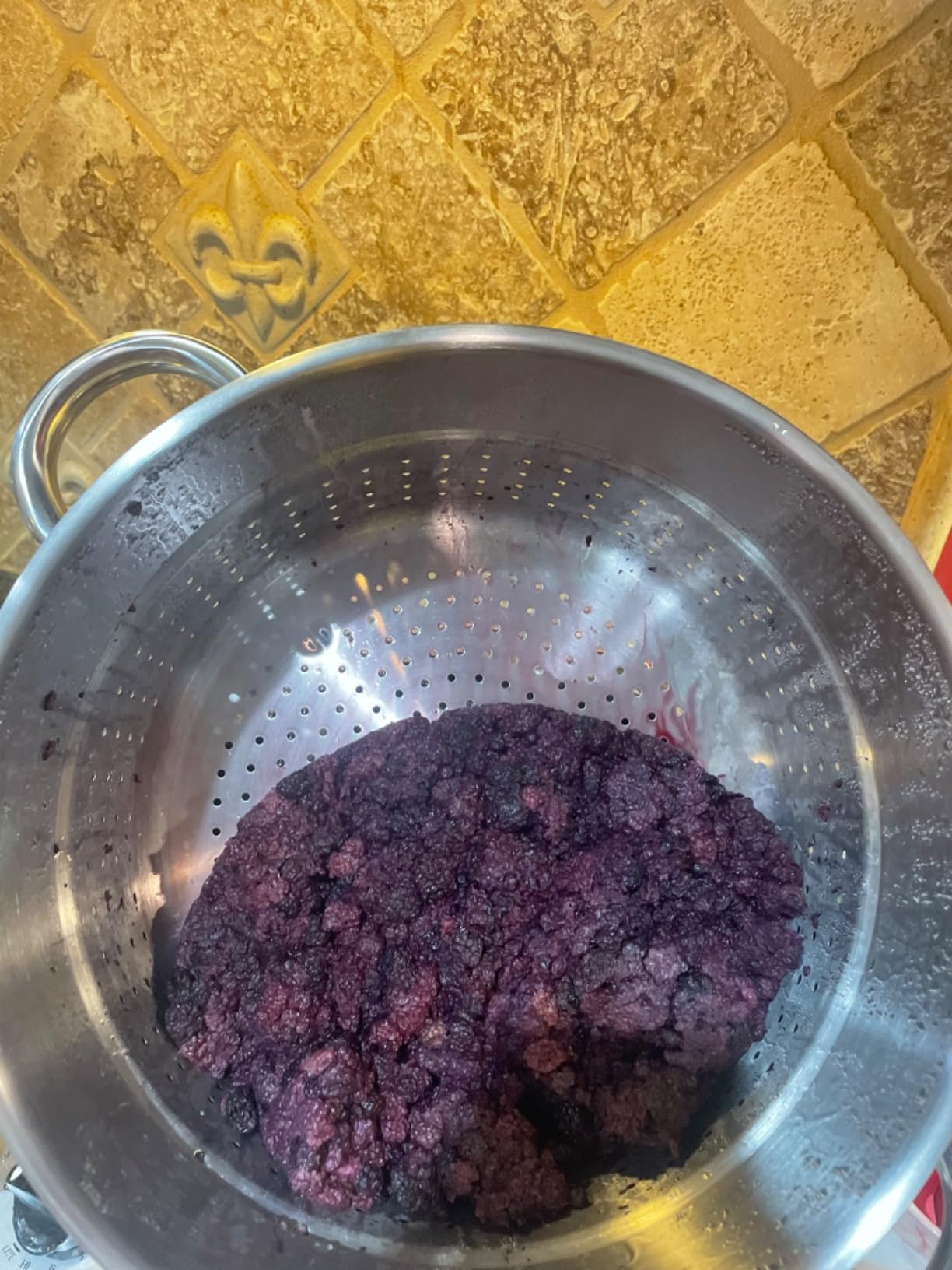
2. Empty the pulp. Tip the fruit basket out outdoors or into a compost bin. Pulp left in the basket holds heat against the perforated base and odors that are difficult to remove later.
3. Wash the stack. Pots and lids on the dishwasher-safe models such as the Cook N Home, VIVOHOME, FOHERE and VINEYARD go straight in. For hand-wash models, use hot soapy water and a non-abrasive pad on the glass lid rim and any stainless spigot seat.
4. Dry fully before storing. Trapped moisture in a nested stainless stack causes spots at the seams. Air the pots separately on a rack before nesting them.
5. Check the clamp and base twice a year. Rubber clamps perish and lose grip. A base that has warped or shows a pinhole needs replacing before you lose juice down the burner.
Total time for a full teardown after a large batch is about ten minutes once the hose flushing habit exists. That ten minutes is the entire difference between a steam juicer people keep and a steam juicer that ends up in a closet.
Frequently Asked Questions
Can a steam juicer be used as a steam canner?
No. A steam juicer extracts raw juice from fruit using steam and a spigot or hose. It has no jar rack and performs no timed heat treatment, so it cannot process filled jars. You need a separate water bath canner for acidic juice or a pressure canner for low-acid foods, plus a tested recipe from a source such as the National Center for Home Food Preservation.
What are the disadvantages of steam juicing?
The main ones are constant water-level monitoring over a 45 to 90 minute batch, a juice hose that must be flushed while still warm or it clogs, and a three-pot stack that occupies a full cabinet. You also still need a separate canner and validated recipes, and bulk fruit yields less juice than its volume suggests, which surprises most first-season canners.
Are steam juicers worth it for home canning?
For most home canners, yes. Steam juicing produces clearer juice than mechanical juicing because nothing is crushed, which reduces second straining and gives better jelly and syrup. The payoff is largest when you have a surplus harvest. If you process only a few jars a year, the appliance earns its space more slowly than the cost suggests.
What is the best steam juicer?
The Cook N Home 11-quart is the best overall pick for most home canners, with the largest review base in the category and even heating from a layered aluminum base. The Giantex 11-quart is the best value if you want a tempered glass lid, and the Mehu-Liisa 11-liter is the best long-term buy, with professional gauge 18/10 steel and a ten-year warranty.
How do you tell when a steam juicer is done?
Extraction is finished when the juice flow slows to a trickle, the fruit in the basket looks collapsed and drained rather than plump, and the liquid running out has lost its cloudy, foamy head. With a glass lid you can see the fruit slump directly. After your first batch these visual cues are more reliable than any timer.
Which brand of juicer is considered the best?
Brand reputation tracks design heritage rather than a single winner. The Finnish-designed Mehu-Liisa and Lehman’s Mehu-Maija emphasize whole-fruit baskets and long warranties. American brands such as Norpro and Cook N Home lean toward multi-purpose oven-safe cookware. Value-tier brands such as Giantex, Cooks Standard, VIVOHOME and FOHERE now offer near-identical core features.
How do you clean a steam juicer hose?
Run hot water through the hose while it is still warm, then leave the clamp open so it drains and dries overnight. If residue has already hardened, soak the hose segment in hot soapy water rather than trying to scrub it dry. Never run a clogged hose under pressure, since a blocked spigot usually means dismantling the juice pan.
Which steam juicers work with induction cooktops?
All ten models in this roundup have a clad, encapsulated or composite base and are induction compatible. The real limitation is burner shape. Older induction cooktops use an oval element, and a perfectly round pot will not register on one. Measure the pot diameter against your largest burner ring and check for overhead clearance on the taller stacks.
Final Verdict: The Steam Juicer Setup We Recommend
Start with the Cook N Home 11-quart. Its layered aluminum base, broad stovetop compatibility and the deepest review history in the category make it the least risky choice for a first serious canning season, and the three pots earn their cabinet space by working as steamer and soup pot between harvests.
Pick the Giantex instead if you want to watch your fruit through a tempered glass lid without venting steam. Pick the Mehu-Liisa if you plan to juice every year for a decade and want a ten-year warranty behind the steel. Whatever you choose, buy stainless with a clad base, avoid bare aluminum, and give yourself cabinet space for three nested pots.
One last reminder, because it is the answer that matters most for the best steam juicers for home canning: the juicer extracts, it does not preserve. Pair it with a water bath canner, follow a tested recipe, and the surplus on your trees becomes a winter shelf instead of a compost bin.