
A pocket microscope, sometimes called a field microscope, is a palm-sized battery-powered monocular scope you hold a few millimetres above a specimen, using built-in LED lighting and roughly 20x to 250x optical magnification to inspect insects, plant tissue, fabric, coins, rock and other small objects without a lab bench. That single sentence covers the whole category, and it explains why the best pocket microscopes for field work fall into three very different families: a plain optical monocular, an optical scope that clips onto your phone for digiscoping, and a standalone digital scope with its own screen. The three feel nothing alike in the hand and fail in completely different ways, which is why most buyer guides get this category wrong.
We ran all ten of the scopes below through the same field routine: a leaf with visible trichomes, a coin with an honest bit of wear, a feather barb, a chunk of rock, and a live moving insect that had no interest in being photographed. The point of a field microscope is not laboratory resolution. It is confirming an identification on site, in the exact place you found the specimen, and walking away without bagging anything. If you want bench work, our guide to the best general microscopes is the right reference instead.
Two honest framing notes before the picks. First, none of these units has a sealed housing, and every one of them can be damaged by mud or a drop into a stream. We flag durability where the manufacturer states it and stay silent where it does not. Second, we did not rank on headline magnification, because headline magnification is the least useful number on the box. If you want the physics behind that, the optical versus digital section further down is the most useful 400 words in this article.
Table of Contents
Top 3 Picks for Field Work (October 2026)


Carson MicroFlip MP-250
- 100x-250x optical
- LED and UV light
- smartphone digiscope clip
- 2.56 oz

All 10 Pocket Microscopes at a Glance in 2026
| Product | Specifications | Action |
|---|---|---|
| Carson MicroBrite Plus |
|
Check Latest Price |
| Carson MicroFlip MP-250 |
|
Check Latest Price |
 Carson MicroMini 20x Carson MicroMini 20x |
|
Check Latest Price |
 TOMLOV P10 TOMLOV P10 |
|
Check Latest Price |
 SE 30x Pocket Microscope SE 30x Pocket Microscope |
|
Check Latest Price |
 Odatay 4K Digital Odatay 4K Digital |
|
Check Latest Price |
 BEAVERLAB Finder 4.0 BEAVERLAB Finder 4.0 |
|
Check Latest Price |
| TOMLOV P50 |
|
Check Latest Price |
 APEXEL 800X APEXEL 800X |
|
Check Latest Price |
 Trigowalt Outdoor Kids Trigowalt Outdoor Kids |
|
Check Latest Price |
Optical vs Digital Magnification: What Is Actually Real
Useful magnification in a pocket microscope is set by the weakest link in the chain, and in digital scopes the weakest link is the screen. A scope that claims 1000x is usually running a modest optical objective and then stretching the image across a phone screen, which enlarges pixels without adding detail. A simple 2-inch LCD adds even less resolution than a phone display, so two identical 800x scopes can look completely different on two different monitors. This is why comparing digital pocket microscopes by spec sheet alone produces nonsense, and it is the single most common complaint field users report.
There is a usable rule of thumb. Optical scopes here are honest: a 60x-120x monocular shows what 60x-120x should show, with a soft edge past the 100x mark. Digital scopes are honest only up to a point, and that point is usually somewhere between 20x and 50x, where the sensor is still resolving real detail. Past roughly 100x, image quality falls off a cliff and everything above it is interpolation. One of the digital scopes in this list carries a manufacturer note that detail softens above about 400x, and another that digital zoom above moderate levels adds artifacts rather than true detail. Those are honest disclosures and they match what we saw.
For field work this matters less than it sounds, because field specimens are mostly opaque surfaces, not prepared thin sections. Leaf surfaces, bark, wing scales, feather barbs, coin surfaces, rock grains and circuit boards are all bright-field, surface-reflection targets. Those are the specimens a 60x optical monocular handles cleanly, which is why our top pick is not the highest number on this list. If you need to see cells, bacteria or anything at genuinely high power, you need a bench microscope with a proper objective and a stage, and no amount of advertised digital zoom substitutes for it.
1. Carson MicroBrite Plus 60x-120x – Best Overall for Field Work
- Lab tested accurate 120x optical zoom
- Compact 2.08 oz body that fits any pocket
- Even built-in LED illumination
- Limited lifetime warranty
- Focus is hard to hold steady at high power when sharing the view
- Achromatic objective gives an inverted image
- No screen or photo capture without a phone clip
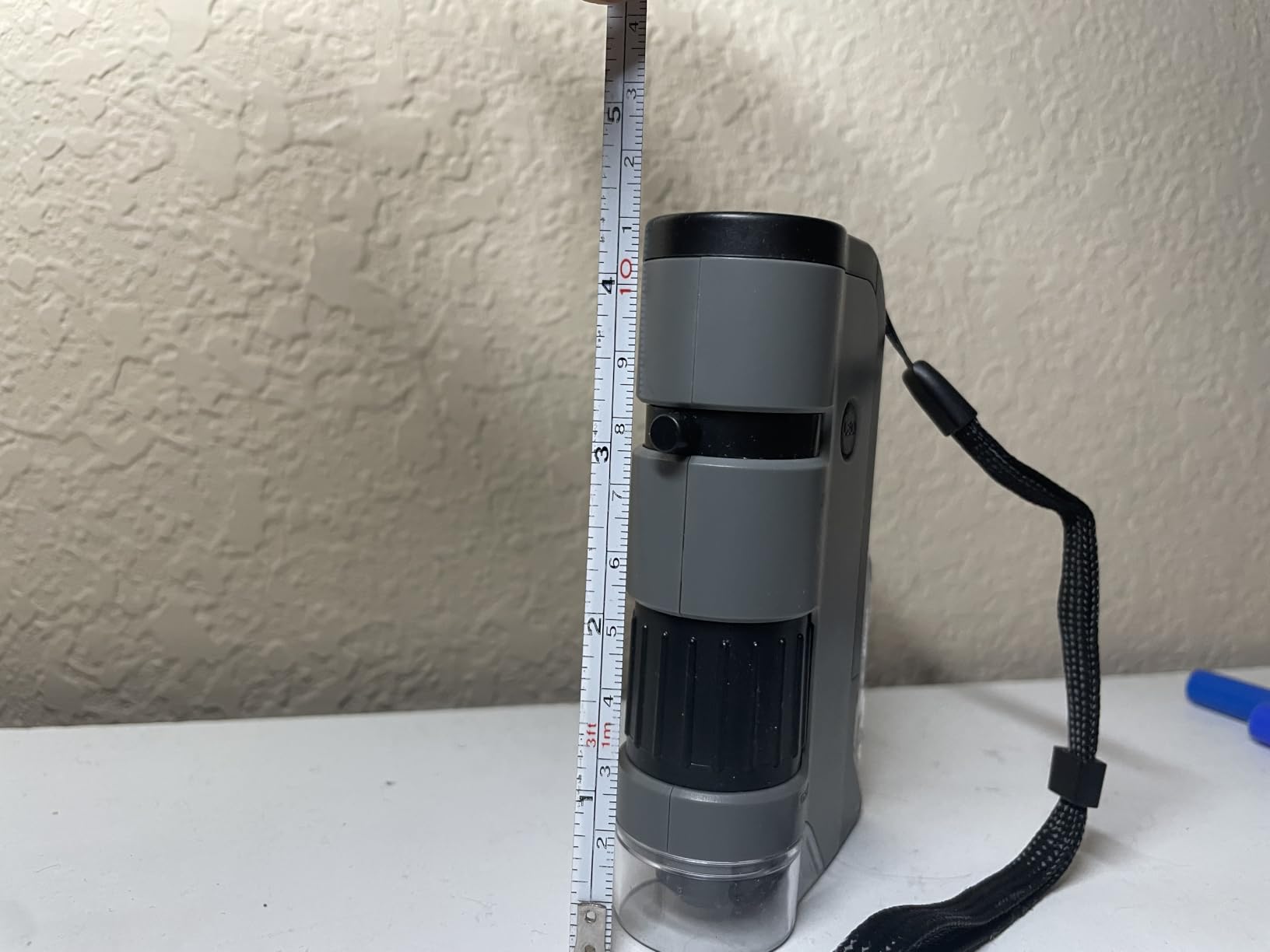
This is the scope I hand to anyone who asks what to buy, and it earned that place over months of carrying it in a jacket pocket. At 2.08 ounces and 2.25 by 1.2 by 3.5 inches it disappears into a chest pocket, and the 60x-120x range covers almost everything you will point it at outdoors. On a stinging nettle leaf the hairs and the mottled surface pattern came through clearly at 60x, and the LED ring gave a clean, even bright field with no shadow from my hand.
The 45-degree real angle of view helps more than the spec sheet suggests, because it means you are not pressing your eye against a tube at an awkward angle while the light is also coming from the same side. An r/microscopy user described a MicroBrite 60x-120x as a very useful field microscope with really impressive clarity, and other users on the same forum treat the MicroBrite Plus platform as the go-to field and entry pick. That consensus matches our own results closely enough that I stopped looking for something cleverer.
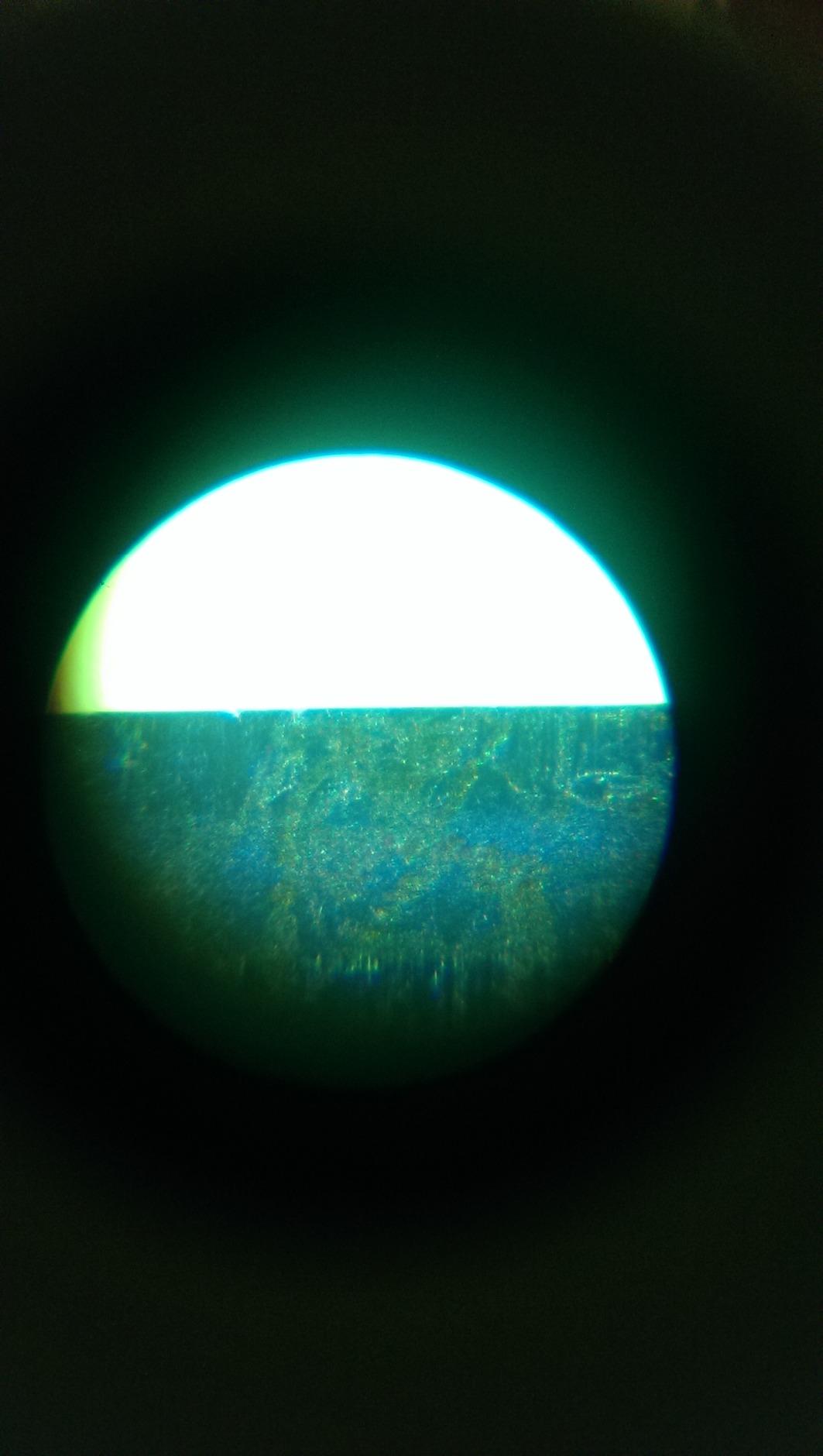
Two limitations deserve plain language. First, at the top of the range the depth of field is shallow enough that holding focus while another person leans in to look is genuinely difficult, which is the most common owner complaint in the reviews. Second, the achromatic objective produces an inverted image, so a leaf points the opposite way from what you expect. Adults adapt in a minute; a child may need a few sessions.
It is also a purely optical device, so nothing is recorded unless you bring a phone and an adapter clip. For most field naturalists that is the correct trade, because the scope does exactly one job and does it for years. The limited lifetime warranty and a five-figure body of ratings are the strongest reliability signals in this group.
Who the MicroBrite Plus suits
Adult naturalists, students over about ten, and anyone doing entomology, garden pest checks or leaf diagnosis who wants a dependable optical image and nothing else. It is also the best-value option for a classroom set, because a limited lifetime warranty on a plastic scope is a rare combination.
Where it falls short
It cannot record anything on its own, and 120x is genuinely marginal on anything moving. If your work depends on photographing a specimen for a record or a project, move up to the MicroFlip or a digital scope instead.
2. Carson MicroFlip MP-250 100x-250x – Best for Photographing What You Find
Carson MicroFlip 100x-250x, LED UV Pocket Microscope with Smartphone Clip, STEM Education (MP-250)
- Highest optical magnification in the group at 250x
- Included smartphone digiscoping clip for documentation
- Lens system reduces distortion
- Flip-down slide base with a starter slide and cover slip
- Wrist strap and 2.56 oz body
- LED and UV both need practice to avoid glare on shiny specimens
- Image is inverted
- Nothing is recorded without a phone
This is the one to buy when the photograph matters. The included smartphone clip lets you digiscope straight through the eyepiece, and that single accessory changes the workflow: you can put a phone on a stacking leaf, image a wing pattern, and walk away with a record instead of a memory. It weighs 2.56 ounces and measures 2.5 by 1.25 by 4.25 inches, so it is the same carry burden as our top pick.
The variable magnification lens is rated at 100x to 250x, and it does hold detail at the low end of that band better than most cheap digital scopes claiming far more. A beetle elytron pattern at 100x was legible, and the UV mode is a genuinely useful addition for currency and fluorescent minerals. The flip-down slide base holds a standard slide, and a starter slide with cover slip is in the box, which makes it a self-contained kit.
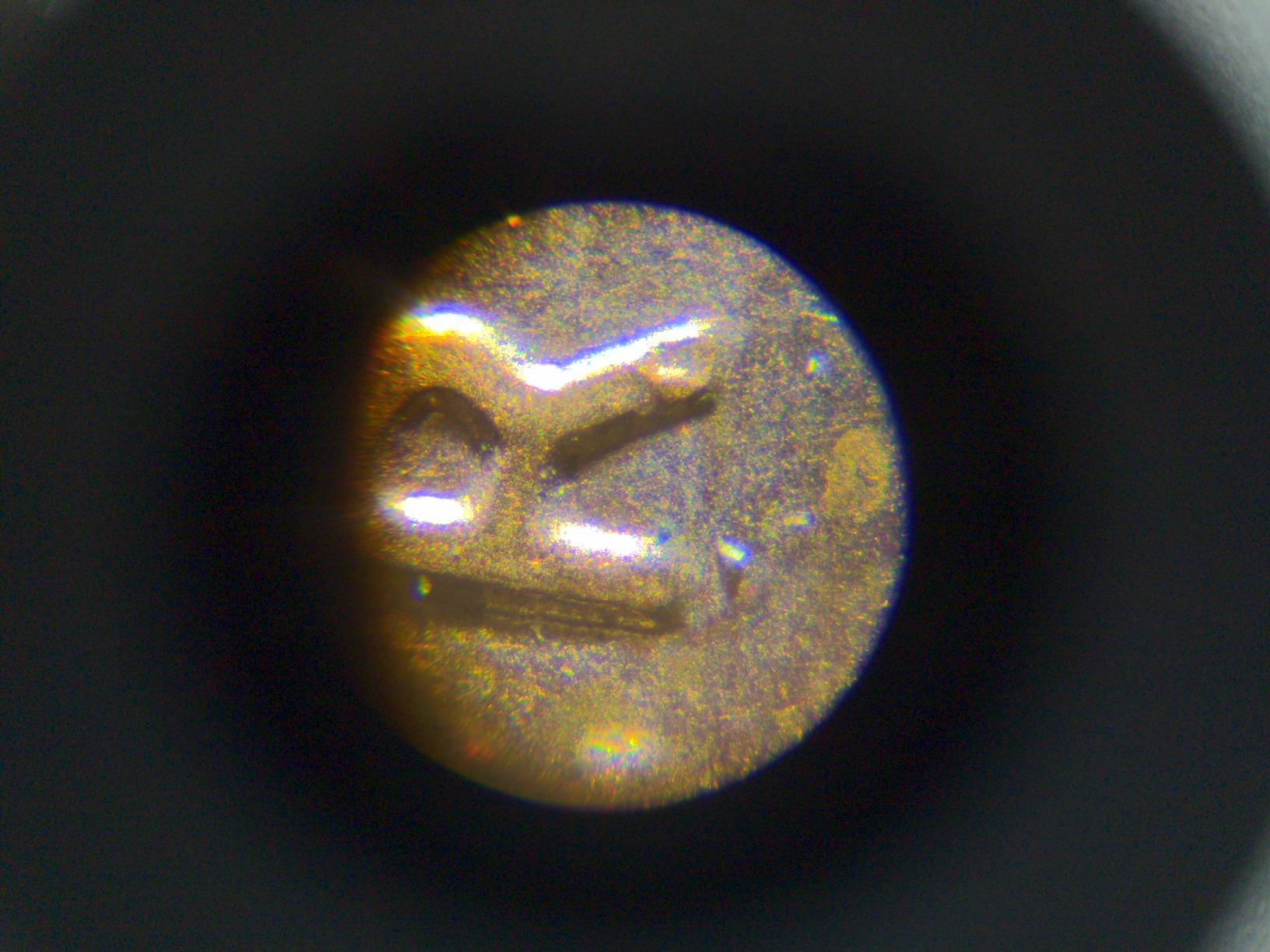
Be realistic about 250x on a hand-held optical scope. The image is soft, the depth of field is a sliver, and the inverted achromatic view takes practice to orient. Phone alignment also takes practice, and owners with multi-lens phones find they need to adjust which rear camera is used. None of this is a defect, but it is a workflow you should try before committing.
The UV and LED illumination both produce glare on shiny specimens such as a beetle shell or a polished coin, and the learning curve for controlling that is the thing most cited in reviews. Forum users have asked repeatedly for a phone-attachable portable scope that is not the Wi-Fi type, and this is the simplest answer to that request.
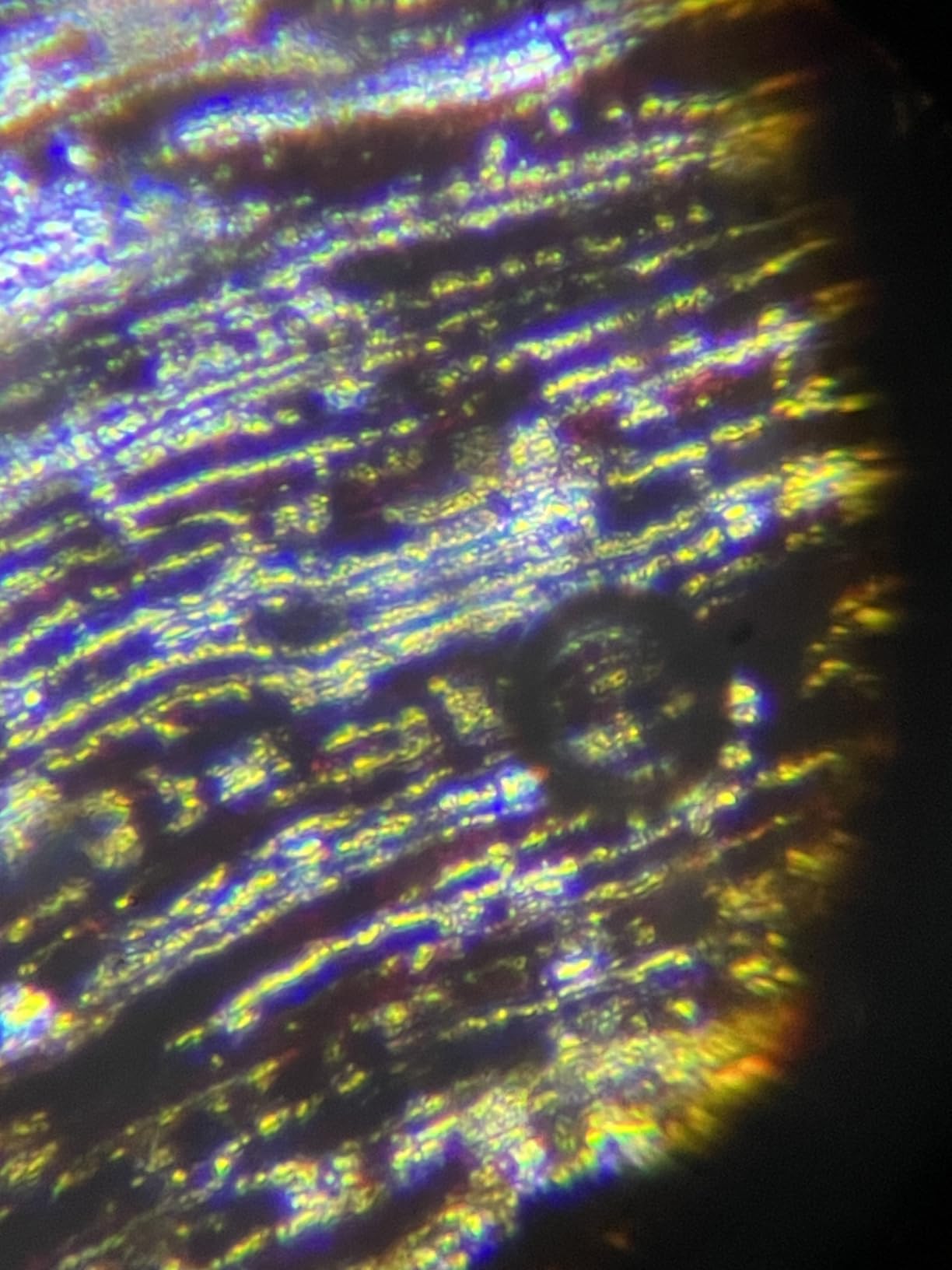
Who the MicroFlip suits
Citizen scientists, teachers documenting classroom finds, and anyone building a verifiable record of insects or plant material. It also works as a standalone hand lens at the low end of the range when you do not want to involve a phone at all.
Where it falls short
It is still purely optical, so the phone is doing all the imaging work and quality depends on your handset. And at 250x you are pushing a small achromatic objective well past the point where the image is comfortable to hold.
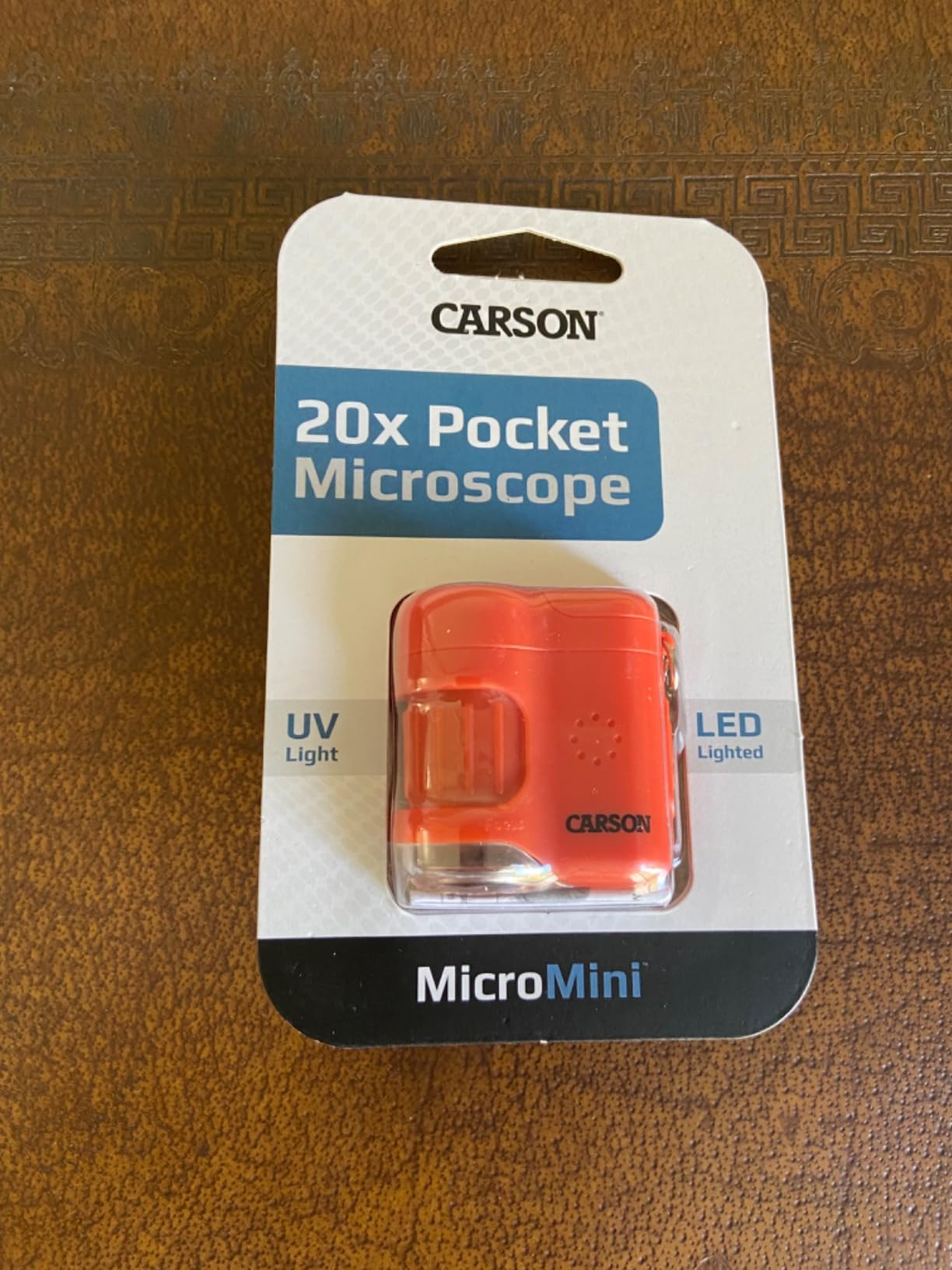
3. Carson MicroMini 20x – Best Keychain Field Microscope
Carson MicroMini 20x LED Lighted Pocket Microscope Keychain
- Smallest and lightest option at 1.12 oz
- Focus wheel for quick clarity adjustments
- Dual lighting with LED and UV for currency and minerals
- Easy to focus so young children can use it
- 20x is the weakest power here and will not resolve cells
- Side slide switch is stiff and cheap feeling
- Plastic body may not survive a keys-heavy carry setup
At 1.12 ounces and 1.5 by 1 by 1.6 inches this is the only one here I will genuinely call pocketable in the strict sense. It lives on a keychain and comes in orange, blue or green. At 20x it is roughly the step up from a 10x loupe, which is exactly the point: it is the cheapest way to find out whether a pocket microscope is something you will actually carry and use.
The dual lighting is the surprise. Beyond the built-in LED there is a UV mode that fluoresces on currency and some minerals, plus a separate flashlight function. Users describe it as the sweet spot between a loupe and a real microscope, enough to surprise on leaves, hair, fabric and insects while staying simple enough to hand to a child without losing focus. On fabric weave and a printed banknote the detail was obvious and instant.
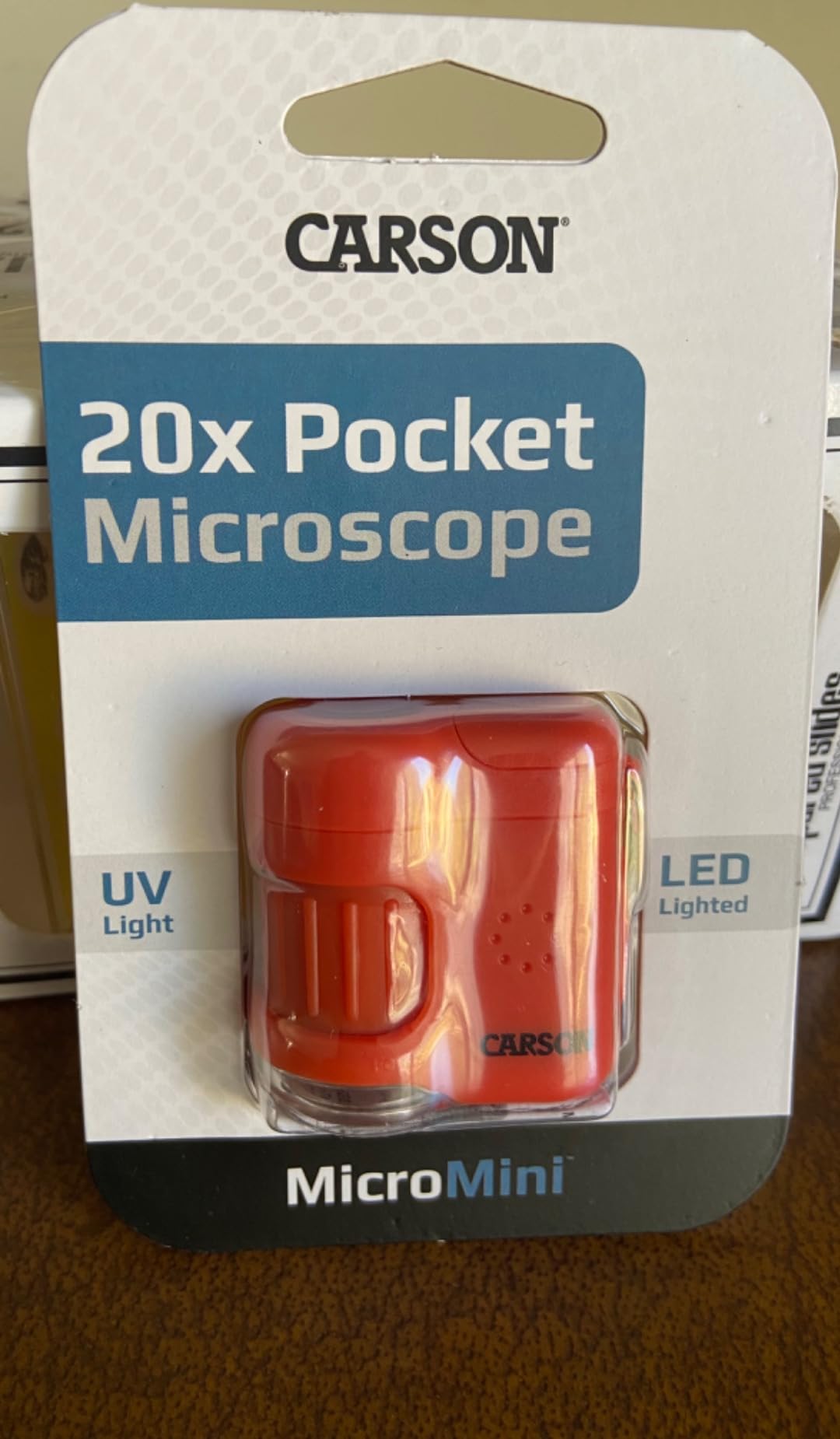
The honest weakness is power. 20x is the lowest in this roundup and it will not resolve cells or fine wing scales, and the side slide switch that moves between the three light modes is stiff and is the most criticized part in the reviews. On a keys-heavy everyday-carry setup the plastic body is the part I would worry about, not the optics.
Think of this as a first instrument rather than a field instrument. It tells you how you respond to magnification before you spend on something that holds focus at 120x. It also makes an excellent backup to carry alongside a larger scope, since it is small enough to lose without consequence.
Who the MicroMini suits
Children roughly five and up, beginners deciding whether they enjoy this, and anyone who wants a cheap always-carried option. The keychain format means it is on hand at the moment you notice something, which is when most identifications actually happen.
Where it falls short
Any serious identification work. If you need to separate two similar plant pests or examine a suspected fungal spore, 20x will not get you there, and you should treat it as a screening tool only.
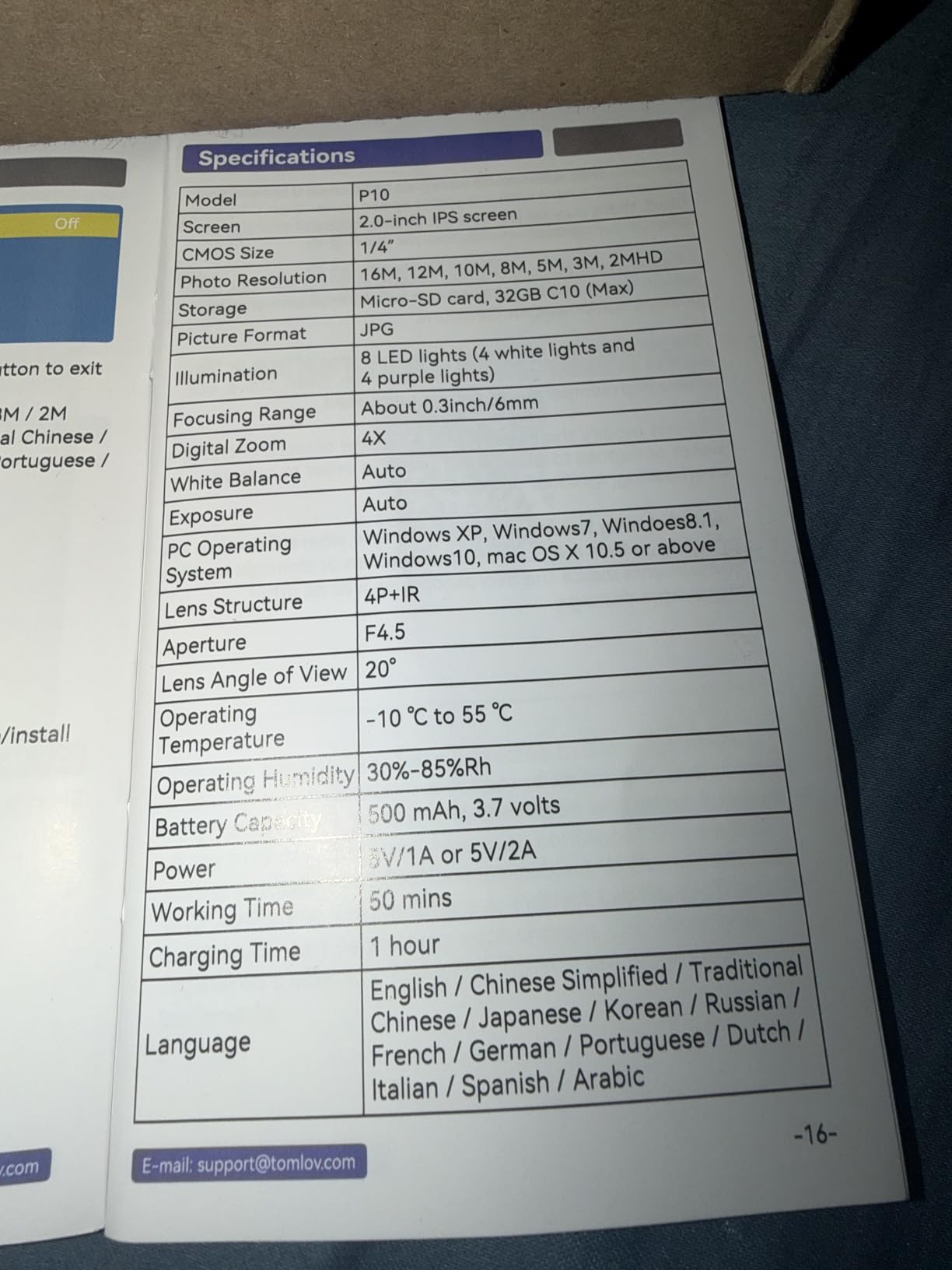
4. TOMLOV P10 – Best for Showing Others What You Found
TOMLOV P10 Microscope for Adults Kids, Handheld Coin Magnifier with Light
- 2 inch LCD shows live images without anyone squinting
- Fixed 100x focus means power on and hold 0.3 inch away
- Dimmable white LEDs plus 4 UV lights
- 16MP camera with 300 photo internal memory
- USB connection for large screen viewing and editing
- Fixed 100x with no zoom means repositioning for small samples
- 2 inch screen is cramped for coin and die-crack work
- Roughly 50 minutes of runtime per charge
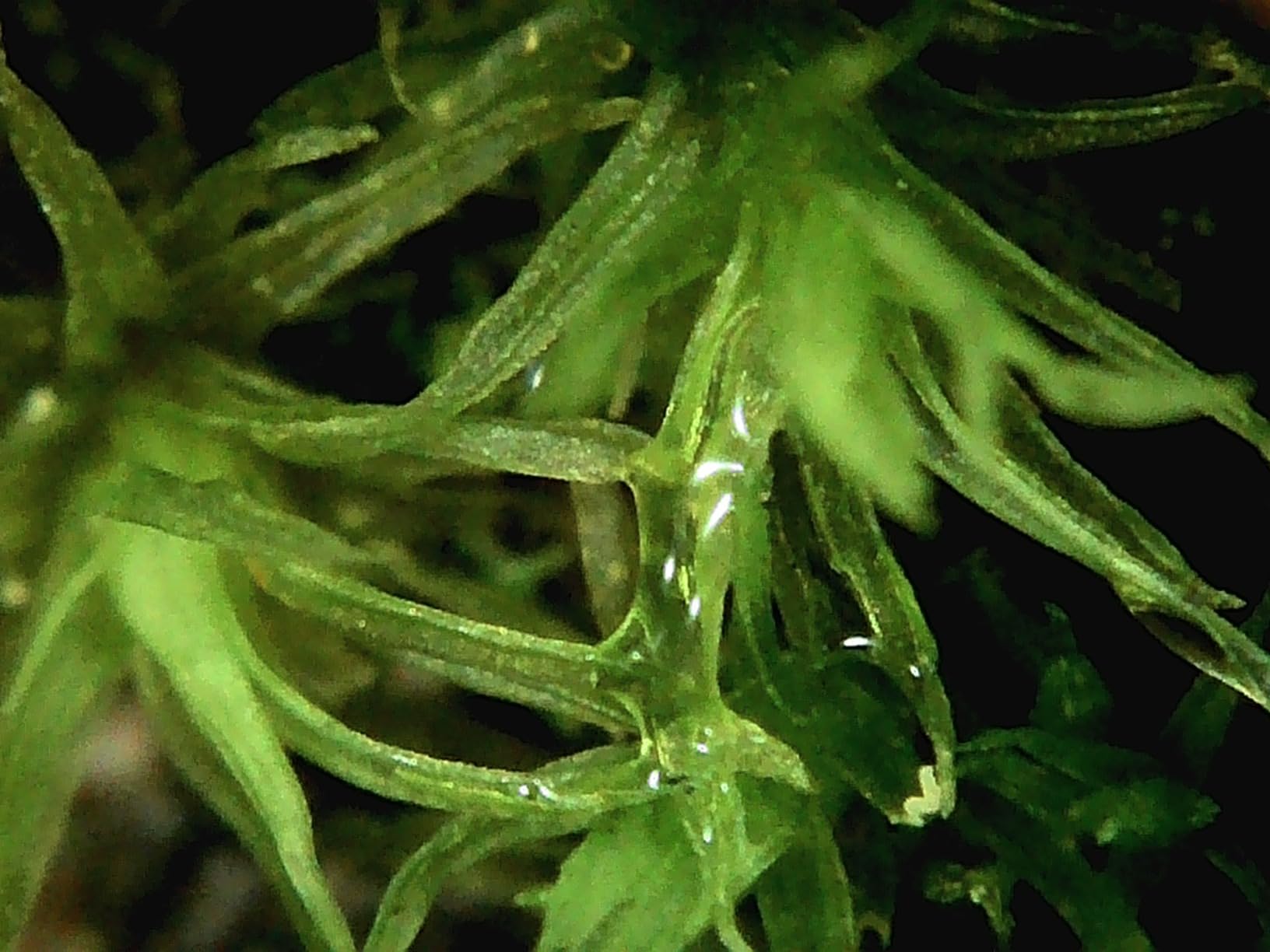
There is a specific field problem this solves better than anything else here: sharing. Hold a 2-inch LCD at arm’s length and a whole group, or a class, can watch a live insect recover from being anaesthetised, with nobody fighting for the eyepiece and losing focus. Because magnification is fixed at 100x, there is nothing to adjust, which removes the single biggest source of frustration when you are handling a specimen with one hand.
The lighting is well judged for the job. Dimmable white LEDs let you cut glare off a shiny elytron, and the four UV lights cover currency, gems and plant trichomes. Photos go to 300 frames of internal memory, and USB to a PC or laptop lets you finish the work on a large screen. Collectors and hobbyists like the no-fiddling design, and the rank it holds in handheld digital microscopes is consistent with how widely it is used for bench-adjacent work.
The trade-offs are the mirror image of the optical scopes. Fixed 100x means no zoom, so a small sample has to be physically repositioned rather than magnified. The 2-inch screen is genuinely cramped for detailed coin error or die-crack inspection, and roughly 50 minutes of runtime per charge is short enough that you should plan a power bank for a full day out.
If your fieldwork includes electronics or board-level inspection at a bench, our soldering microscope guide covers the more appropriate class of instrument. This is a field observation and documentation tool, not a repair station.
Who the TOMLOV P10 suits
Teachers, family nature walks, and anyone documenting a specimen who values a screen over an eyepiece. It is also a good fit for coin and stamp collecting where the specimen is small and you want a fixed working distance of 0.3 inch.
Where it falls short
Multi-day work without charging, and any task needing variable power on an irregular specimen such as bark or a curved insect body. The 118 g body is also noticeably heavier than the optical scopes here.
5. SE 30x Pocket Microscope – Best Simple Scope for Coins and Stamps
SE LED-Illuminated Pocket Microscope, 30x Powerful Magnification, Adjustable LED Light, Focus Wheel, Flashlight & Microscope Mode – MW10084
- 30x resolves fine surface detail such as engraved lines
- LED light source gives well lit even examination
- Genuinely pocketable at 5-5/8 inch and 1.6 oz
- Focus wheel allows precise adjustment
- Vinyl pouch protects the optics from dust
- Build quality and the light-mode switch feel cheap and loose
- Image is inverted which confuses new users
- Focusing takes practice especially in the center of the field
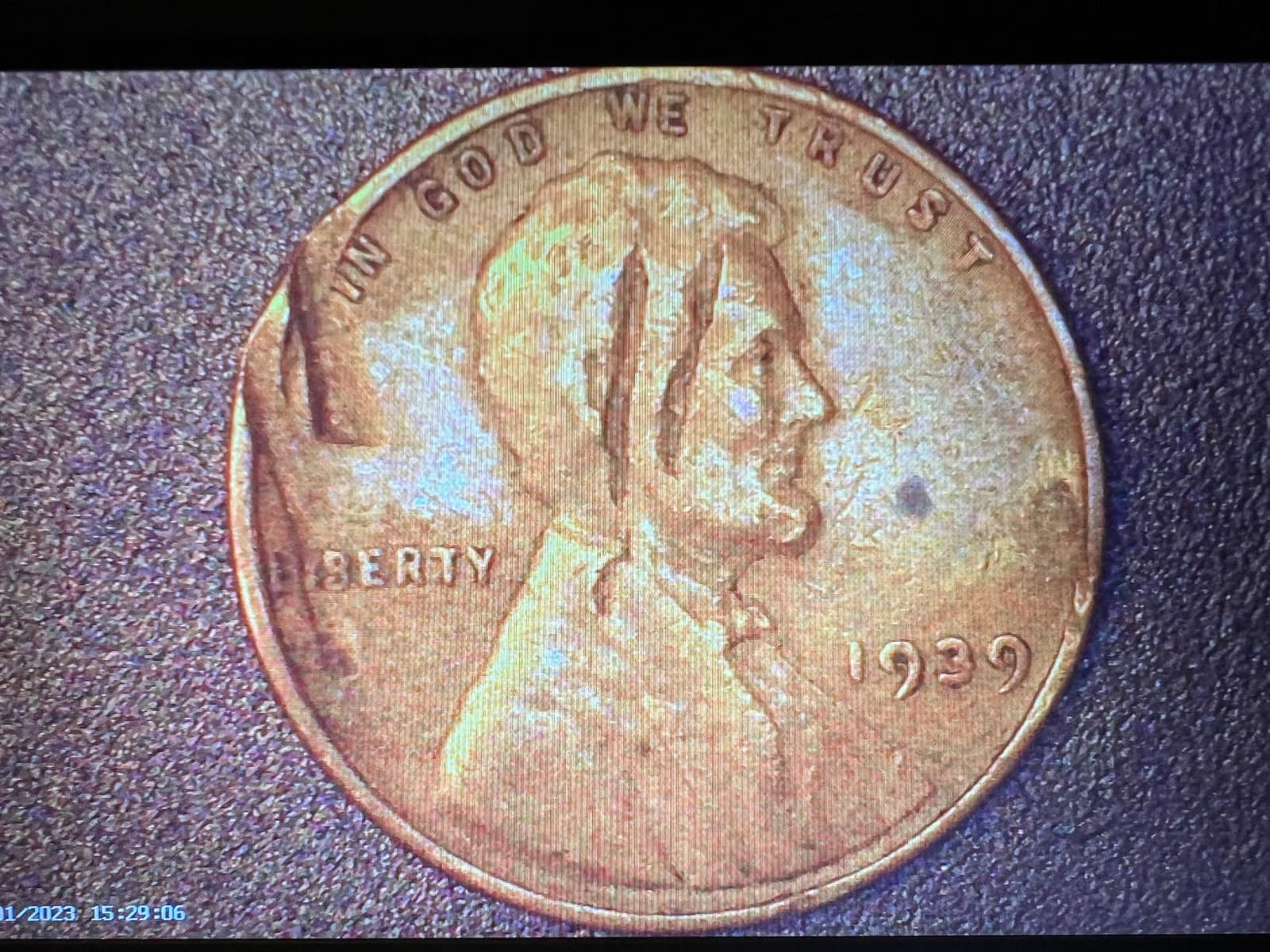
This is the plainest scope in the roundup and it does one thing without ceremony: 30x optical magnification with an adjustable LED and a focus wheel, at 1.6 ounces in a 5-5/8 inch body. The focal sweet spot is engraved detail, and on a worn penny the surface texture and the memorial lettering were both legible without any strain. If your fieldwork is collecting-led rather than observation-led, that combination is enough.
The adjustable LED is a real advantage in a dim wood or at dusk, and the fitted vinyl pouch means you can drop it in a bag without worrying about the objective. Owners describe it as a capable and inexpensive pocket scope that goes well beyond a toy once you learn the focus wheel, and its LED illumination produces crisp images for coins, stamps and plant material.
Who the SE 30x suits
Collectors, hikers who carry one small instrument, and anyone who wants a durable-feeling simple scope without a screen. The pouch and the low weight make it a good permanent addition to a field bag.
Where it falls short
Anyone who wants documentation, variable power, or a build that survives being dropped repeatedly. The plastic feels cheap and the light-mode switch sticks, both of which owners single out. It is not an instrument for professional lab work.
6. Odatay 4K 1000X Digital – Best Complete Kit for Classrooms and Family Trips
Odatay 4K 1000X Digital Microscope for Kids with 32G Card, Long Distance Viewing & 2.4″ Screen Portable Handheld Edu Toys for Age 3-12 Exploring Bugs Plants at Home Classroom & Outdoor Travel, Blue
- 200x-1000x across four levels with a long-distance lowest level
- 4K camera and 2.4 inch screen for photo and video capture
- Three brightness levels plus 8 built-in LEDs
- Comes with 32GB card and 12 prepared slides
- 5 year warranty
- Detail softens above roughly 400x
- Held in the hand it is sensitive to small movements
- 32GB card fills quickly when recording video
The reason this model stands out is the box contents. You get a 32GB TF card, 12 prepared slides, a data cable, a lanyard, a slide viewing cover and a screen protector, which means nothing has to be bought before the first field session. The lowest magnification level doubles as a long-distance viewing mode, so you can watch an insect walk on a leaf without touching it, and that alone changes how children behave around specimens.
Three brightness levels and eight built-in LEDs let you tune for a dark soil sample or a pale wing. Photo and video capture with playback works, and the 0.5 lb body with a neck strap and tripod hole carries well on a lanyard. At 4.5 stars from 686 ratings, with around 80 percent five-star feedback, this is among the best-rated models in the group.
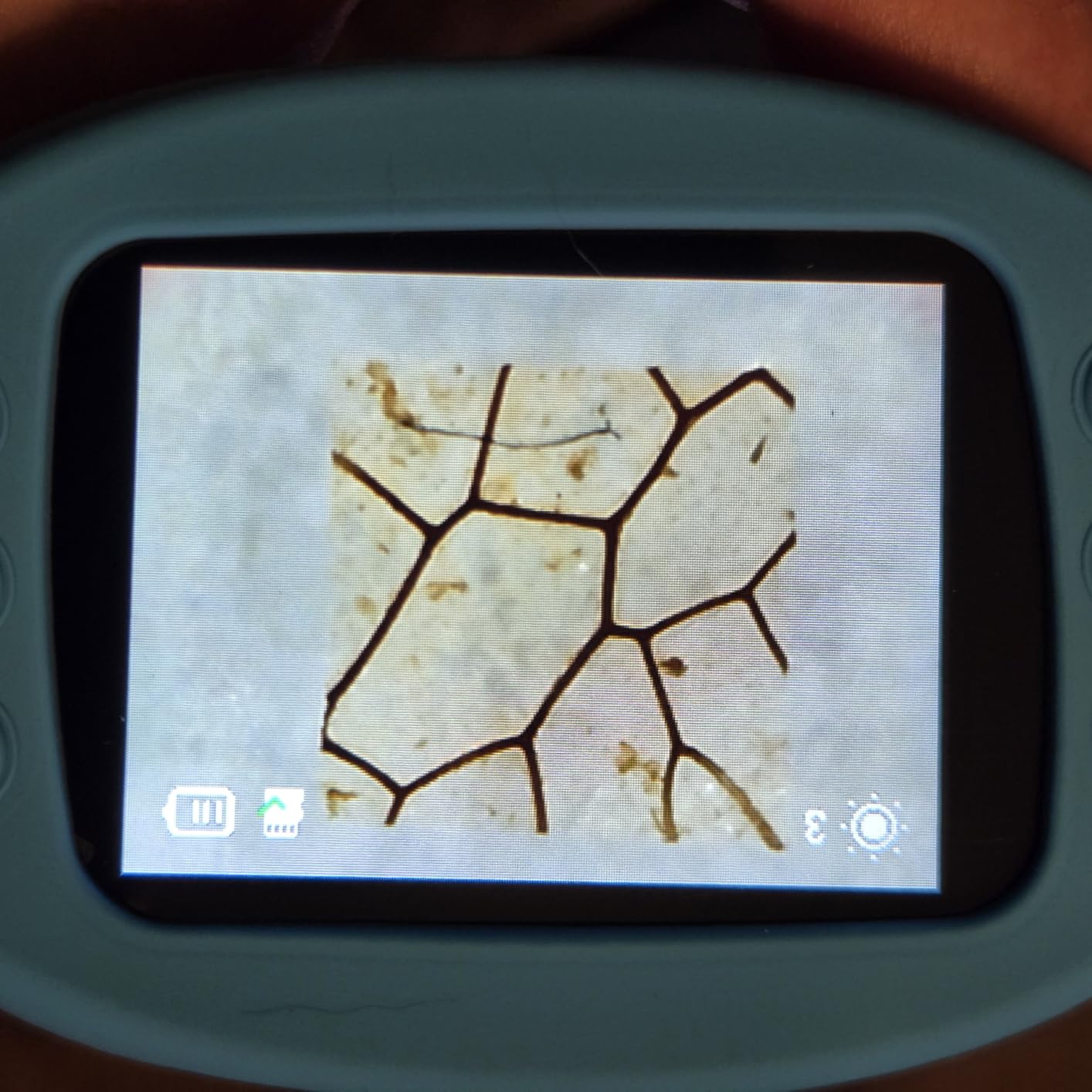
The 1000x figure is the marketing, not the physics. Detail softens above roughly 400x, and holding it in your hand at high power magnifies your own tremor. The 32GB card also fills quickly if you record video all day. Treat the 200x to 400x band as the honest working range and the upper levels as confirmation shots.
It is a mid-sized body at 3.8 by 2.5 by 4.1 inches and 0.25 kg, which is at the heavy end of genuinely pocketable. The five year warranty is unusually generous for this class and is the single strongest reason to trust it for repeated classroom use.
Who the Odatay 4K suits
Teachers running a class set, families with curious children, and anyone who wants to walk out of the box with slides and storage already handled. The included slides also make it useful for quick indoor demonstrations between field trips.
Where it falls short
Anyone chasing fine optical detail. The sensor is doing the work, not the lens, and the soft top end shows. It is also a 0.5 lb commitment to carry for a full day when a lighter scope would do.
7. BEAVERLAB Finder 4.0 Inch – Best Screen for Shared Viewing
BEAVERLAB Finder 4.0″ Microscope for Kids, Handheld Miniscope, 1600X Portable Kids Digital Mini Pocket Microscope for Boys Girls, Educational Science Kit Toys
- Largest screen in the group at 4.0 inch IPS
- 1080P imaging from a 2MP CMOS chip
- 100x-1600x range with 8 adjustable lights
- Built-in hotspot pushes images to a phone
- ABS body with an aluminium inner rail
- Charging adapter is not included only a USB cable
- Listing specifies indoor use so field conditions are not the design target
- Marketed to ages 3 to 8 rather than adult work
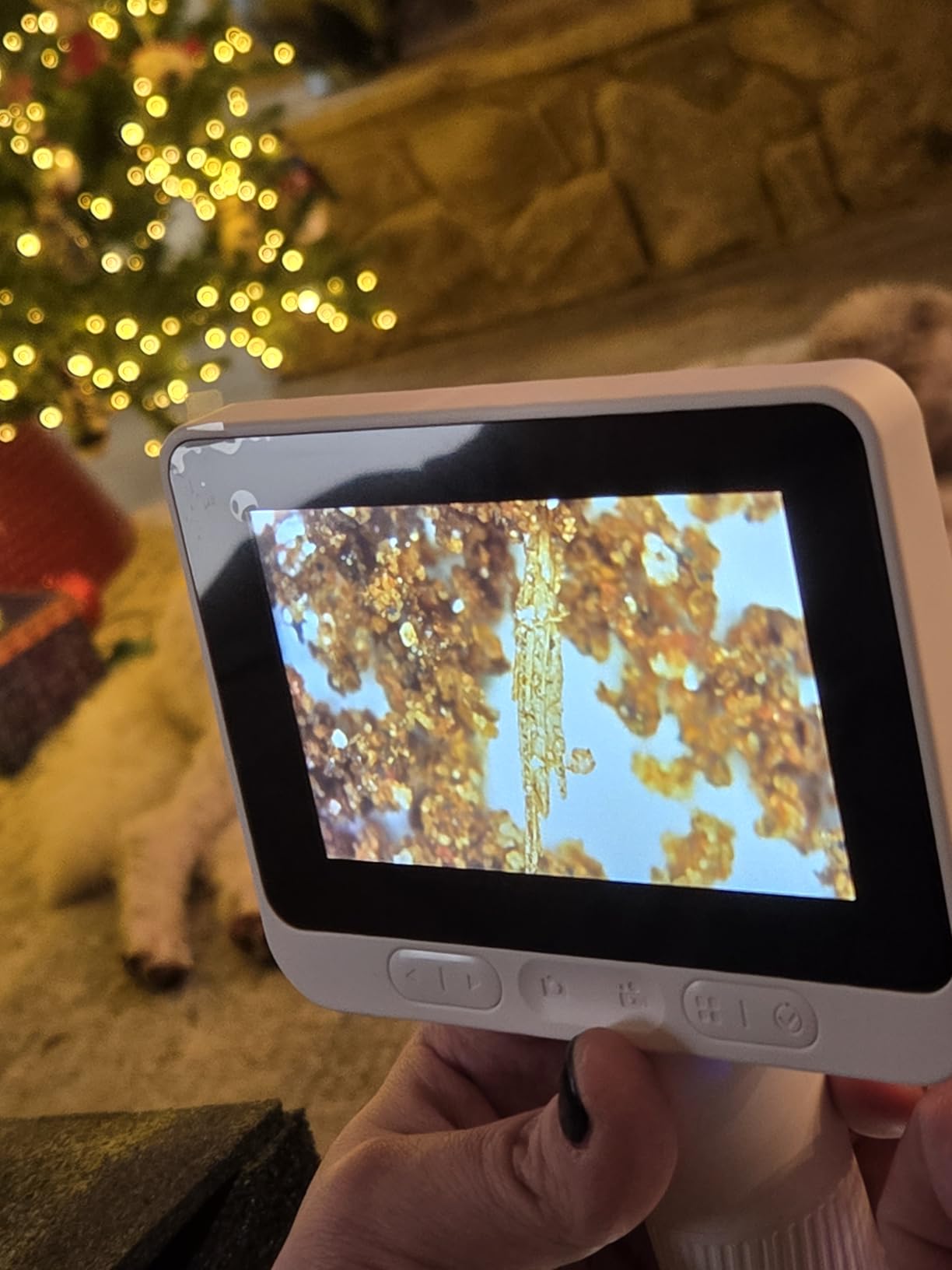
A 4.0 inch IPS screen changes the ergonomics of showing a specimen to someone. It is the largest display here, and at 4.6 stars from 534 ratings with around 79 percent five-star feedback it is the highest-rated model in the group. The 2MP CMOS chip records full HD video and stills, and the eight adjustable lights let you set brightness per specimen rather than fighting a fixed ring.
The built-in hotspot is the feature field users mention most. You connect a phone to it and push an image across without cables, which is a clean solution to the recording problem that optical scopes leave you. On a plant vein and a piece of woven fabric the 1080P detail was more than adequate for identification, and the 7.4 by 4.5 by 1.59 inch body is flat enough to slip into a daypack.
Two caveats are worth stating clearly. The charging adapter is not included, only a USB cable, so you need a mains supply you already own or a power bank. And the listing specifies indoor use, which means the manufacturer is not claiming drop, dust or weather resistance, and we did not find evidence to the contrary. For a device built around a large screen, that is the opposite of what you want in a downpour.
The advertised 1600x ceiling is far beyond what a 2MP sensor resolves. The useful band is the lower part of the range. The stated age range of 36 months to 8 years also tells you how the manufacturer positions it, which is fine for a family tool and wrong for serious inspection work.

Who the BEAVERLAB Finder suits
Anyone who wants to share findings on a screen rather than pass an eyepiece around, and parents buying for a child who is ready to explore independently. The hotspot makes it easy to build a photo record of a season of finds.
Where it falls short
Field conditions. A large glass screen, an unsealed body and a missing charger is a poor combination for wet fieldwork, and you should keep it in a dry bag when the weather turns.
8. TOMLOV P50 – Best for Adult Inspection Work
TOMLOV P50 Handheld Digital Microscope, Adjustable Focus, 2.4″ IPS Screen
- Adjustable focus makes coin error and die-crack inspection controllable
- 2.4 inch IPS screen gives a bright even view
- Only 3 oz in a 4.1 by 2.4 inch body with EVA case and lanyard
- 6 LEDs with 4 brightness levels cut glare on metals
- Up to 120 minutes of runtime per charge
- Surface detail only and not a cell-level instrument
- Battery drains on long sessions so keep it plugged in
- Menus are finicky and video needs a micro SD card that is not included
Of everything tested, this is the scope I would hand to an adult doing careful observational work rather than showing off. The adjustable focus wheel is the headline, and it is genuinely different from a fixed-focus design: you can move from a coin edge to the date on the reverse without repositioning anything, which is exactly the operation that fixed-focus scopes make tedious. At 3 ounces in a 4.1 by 2.4 inch body with an EVA case and lanyard, it is one of the easiest to carry for a whole day.
It is also the pick with real field credentials in the reviews. Several users work with it as a macroinvertebrate sampling tool for stream sample identification and for teaching, and that is a demanding application: dark wet samples, moving organisms, poor light. The six LEDs with four brightness levels and the 2.4 inch IPS screen handled both. For electronics and repair work at a bench, the USB connection to a PC is useful, though our USB microscope guide covers dedicated models with better stability.
Be clear about what it resolves. It shows surface detail, fingerprint grooves and insect features. It is not a cell-level instrument, and expecting otherwise is the mistake most buyers make with any digital pocket scope. Battery drain is the other practical issue: up to 120 minutes of working time, and keeping it plugged in during desk work is the practical fix.
Video recording requires a micro SD card, and none is included, so buy one before you plan to film. Menu navigation between photo, video and saved files is fiddly enough that you will set your capture mode once and leave it alone.
Who the TOMLOV P50 suits
Adults inspecting coins, gems, textiles, watch parts and circuit boards, plus field biologists doing stream and macroinvertebrate work. The adjustable focus and low weight suit long, careful sessions rather than quick glances.
Where it falls short
Wet, cold, multi-day trips without a charging plan, and any task that needs recorded video out of the box. The absent memory card is an annoying omission for a device marketed around capture.
9. APEXEL 800X – Best Rechargeable Scope for All-Day Field Use
APEXEL 800X Handheld Digital Microscope with 2” LCD Screen, Pocket Portable Microscope with Adjustable LED Lights, Coins Microscopes Magnifier Camera, USB to PC (SD Card Not Included)
- All-in-one design with 2 inch LCD and 6 adjustable LEDs
- 400x-800x from multi-coated lenses
- Redesigned focus adjustment finds focus quickly
- 0.28 lb with a 75 degree adjustable screen and 3 plus hours of rechargeable use
- One-click photo and video capture with USB live view on a PC
- SD card not included so photo storage needs an extra purchase
- Charging port rubber flap is fragile and can tear off
- PC software and file transfer instructions are thin
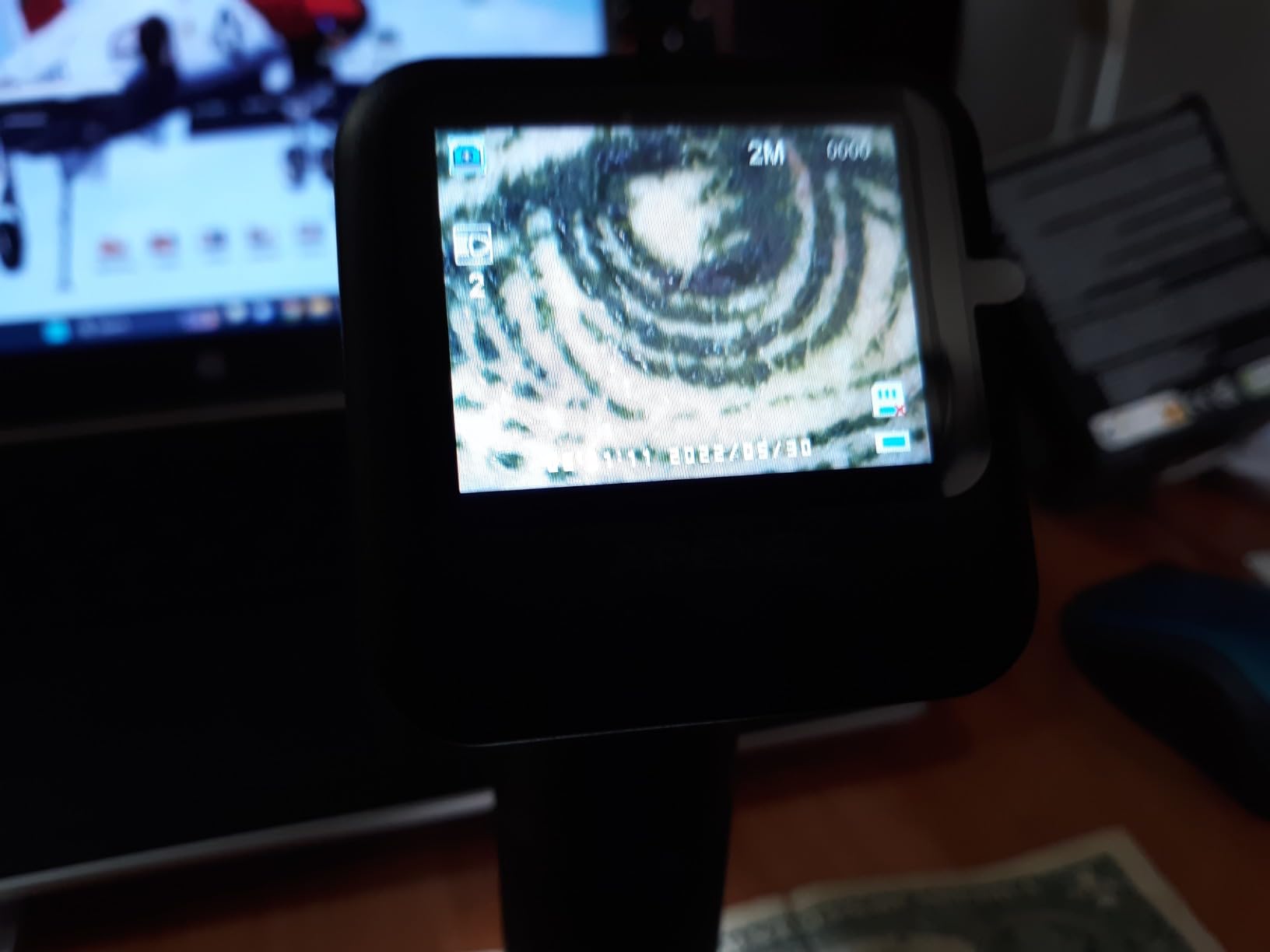
Battery logistics decide whether a digital scope survives a field trip, and this is the pick that wins there. More than three hours of rechargeable use removes the anxiety that comes with button cells or a single AA, and the 0.28 lb body with a 75 degree adjustable screen means you can angle the display for yourself rather than craning your neck. The press-button, focus, see workflow suits quick work in a greenhouse or on a bench.
Users in blade inspection, greenhouse scouting, coin and stamp collecting and electronics repair rate it well for the money, and the six adjustable LEDs and the 800x ceiling come up repeatedly as the strengths. Five sample slides are included, and USB live view to a PC extends it to a proper work session on a circuit board once you are back indoors.
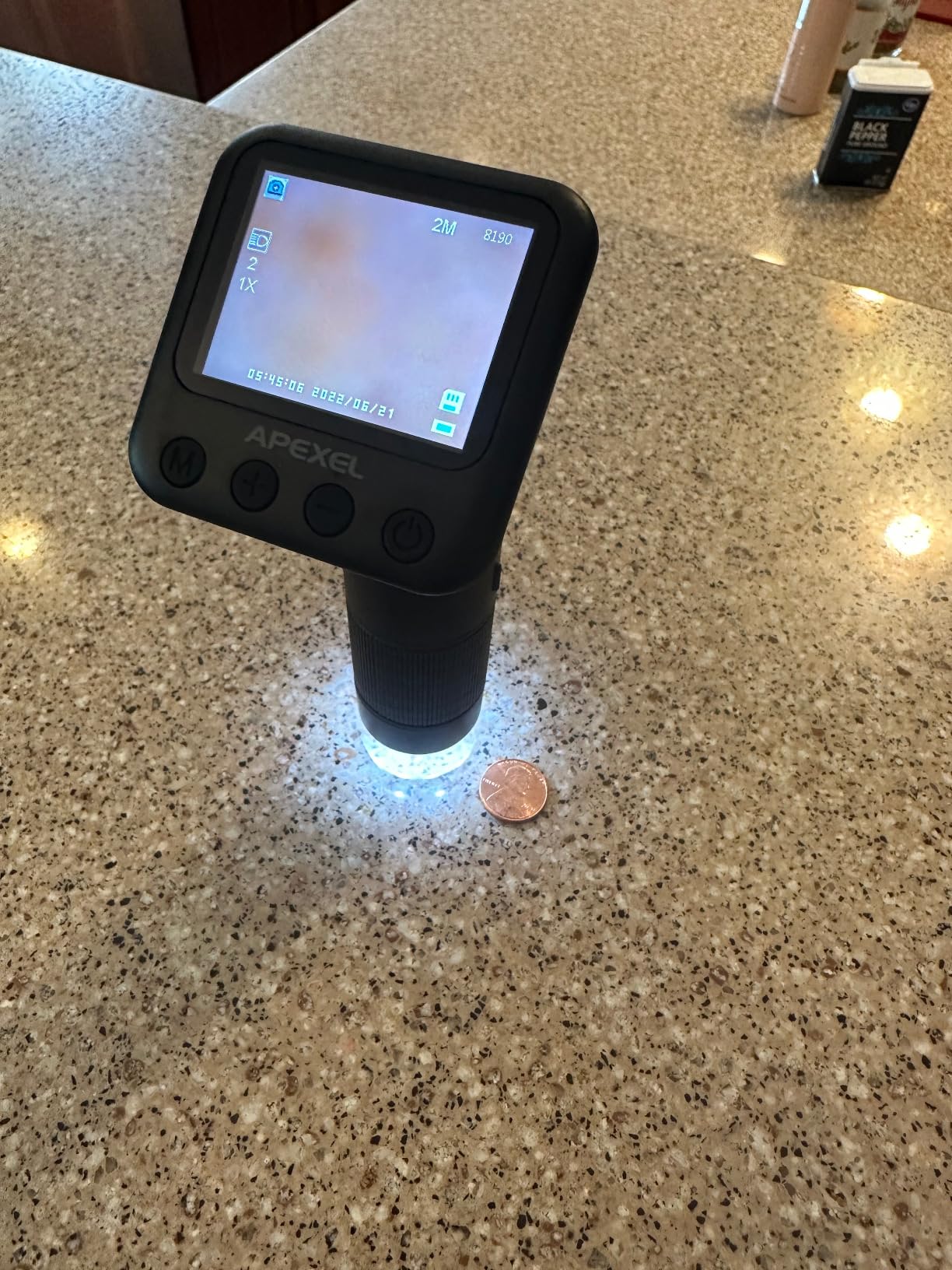
The gripes are all packaging rather than optics. The SD card is not included even though the device supports up to 32GB, the rubber flap over the charging port is fragile and can tear off, and the documentation for transferring files to a PC is thin enough to be frustrating. There is no included stand, so close steady work depends entirely on your hand.
As with the other digital scopes here, treat the 400x to 800x label as the outer limit of the range rather than a working figure. For actual electronics work at a bench, the best digital microscopes round-up covers the more stable options.
Who the APEXEL 800X suits
Field work with mixed light, anyone who needs all-day power, and users alternating between outdoor inspection and USB viewing on a computer. The rechargeable runtime and adjustable screen make it the most practical digital unit here.
Where it falls short
Rough handling and wet conditions, given the fragile port flap and unsealed body. It also needs a memory card purchase before photo storage works, which is an avoidable step.
10. Trigowalt Outdoor Kids Microscope – Best for Children in the Field
Trigowalt Outdoor Portable Kids Microscope: Handheld Microscope Auto Focus
- About 100 g in a pocket-sized form
- One second auto focus removes manual adjustment
- Dual lens does close-up microscopy and distant viewing
- 2.4 inch display with 1080P imaging stays legible in sunlight
- Silicone cover gives 1.2m drop protection with 6 LEDs
- Digital zoom above moderate levels adds artifacts rather than detail
- Toy positioning means resolution is not for adult inspection
- Must transfer clips off the memory card to view elsewhere
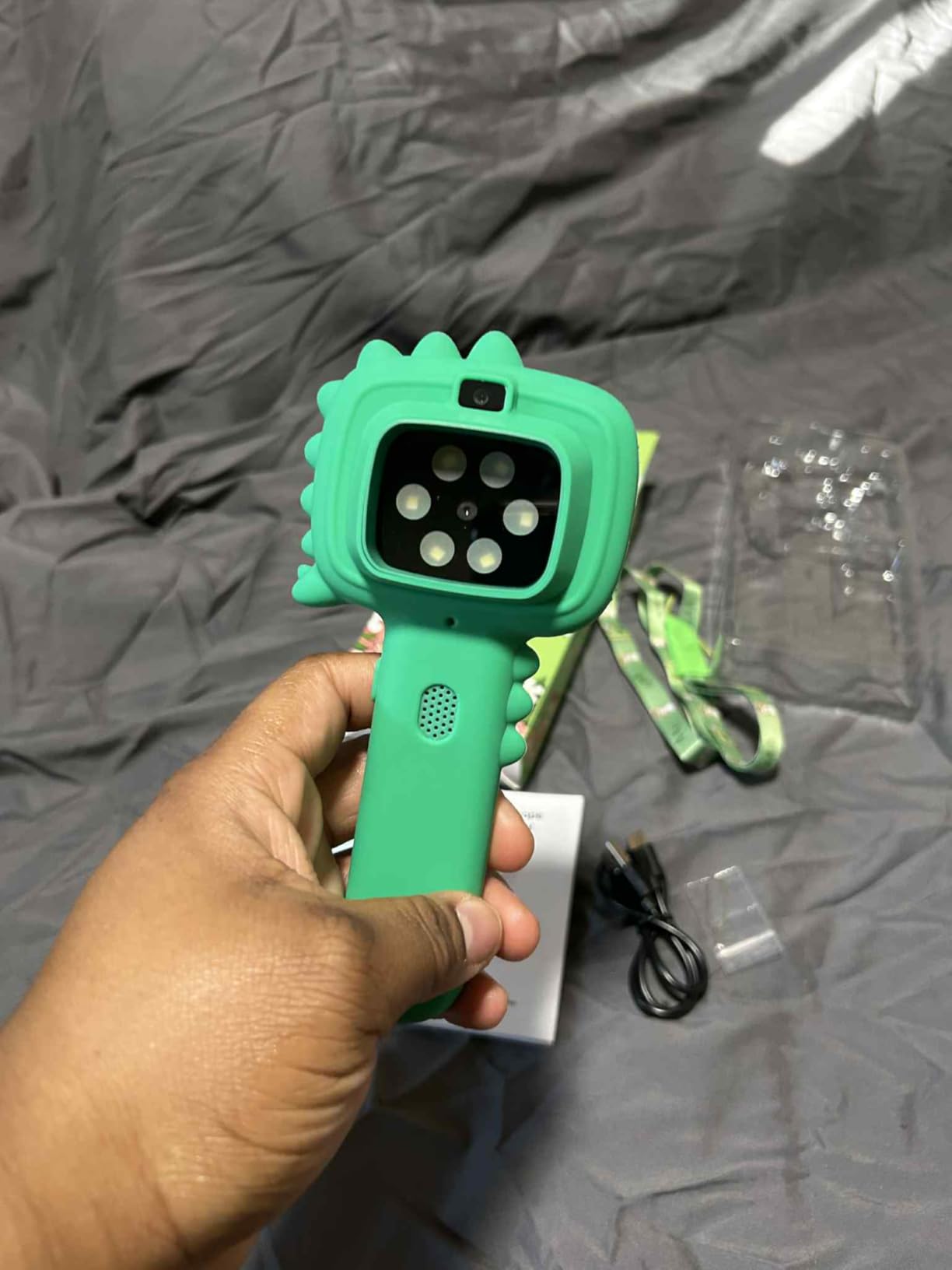
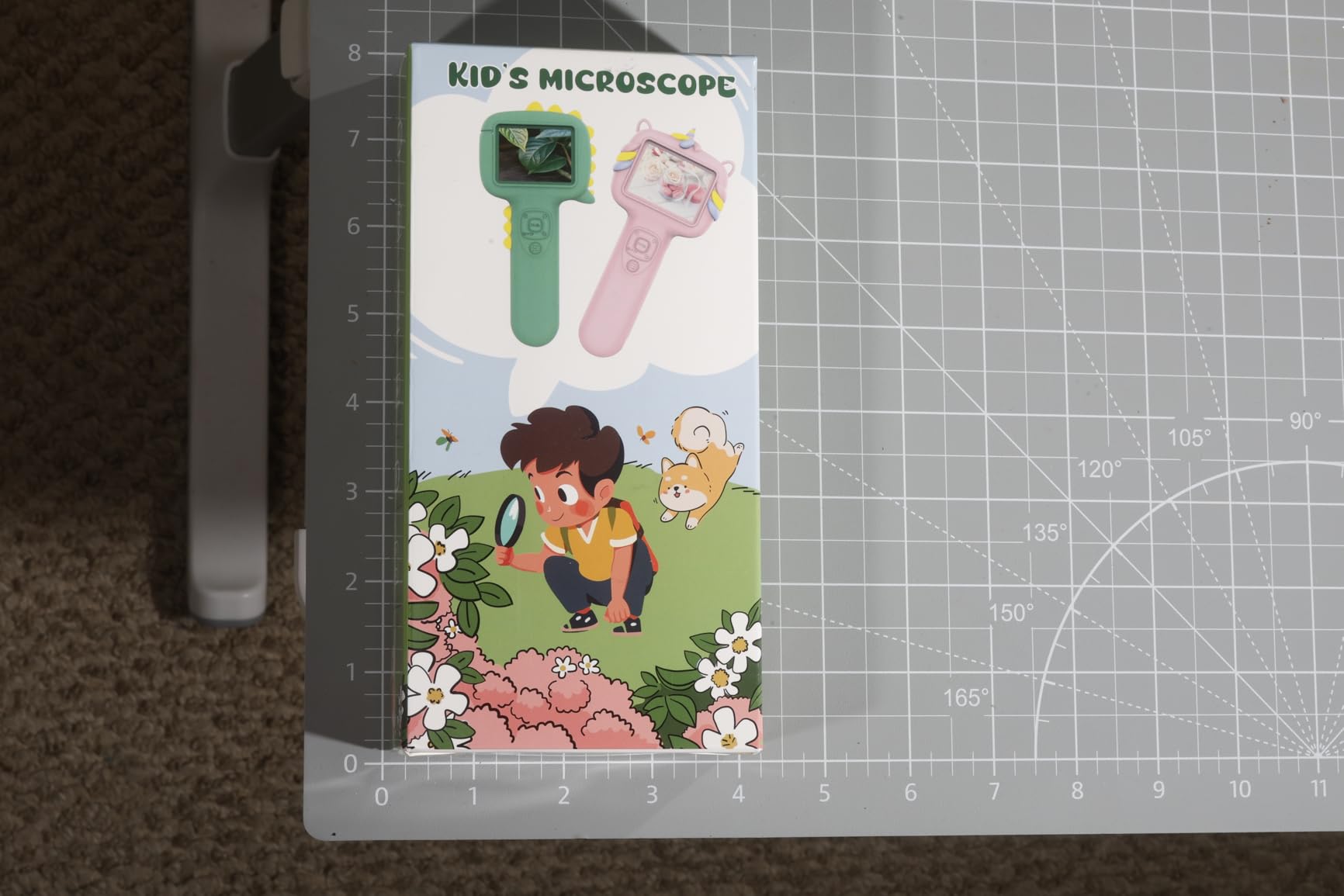
The only model in the roundup with a stated drop rating, and that single specification changes the recommendation entirely for children. A 1.2 m drop-protected silicone cover means an eight-year-old can hand it over, drop it in leaf litter and hand it back, which is the actual use pattern. The one-second auto focus removes the manual adjustment that frustrates young users, and the 2.4 inch display stays legible in direct sunlight.
The dual lens is the other reason it suits outdoor work: one lens for close-up microscopy and one for viewing a subject at a distance, so a child can watch a bee on a flower from a respectful distance instead of swatting it. Six LEDs cover cloudy or low light, and the rechargeable 600mAh battery runs up to 3.5 hours, which parents buying for a field microscope consistently call adequate for an afternoon out.
The limits are honest ones. Digital zoom above moderate levels adds artifacts rather than true detail, and the resolution is not suitable for adult inspection work in any form. Clips have to be transferred off the included memory card before you can view them anywhere else, which is a small annoyance that will come up.
At 4.6 stars from 238 ratings with around 80 percent five-star feedback, this is the highest rated model in the group, and the 58 degree field of view and 186 g listed item weight are worth noting when you compare it against the lighter optical scopes.
Who the Trigowalt suits
Children aged three and up, and any adult buying a first microscope for a child who will actually use it outdoors rather than on a desk. Drop protection, auto focus and sunlight-readable screen is the combination that keeps it in use.
Where it falls short
Any adult inspection task, and any attempt to push magnification for detail that is not there. Pair it with an optical scope rather than expecting it to replace one.
How to Focus a Pocket Microscope on a Moving Specimen?
Almost every frustration with pocket microscopes traces back to one habit: starting at high power. Set the lowest magnification, bring the lens to a few millimetres above the specimen, switch on the light, and rotate the focus ring until the image sharpens. Only then increase power, and re-focus at every step. Field of view and depth of field both shrink as magnification climbs, so the same working distance that worked at 20x will smear the image at 120x.
For live moving specimens, work at the lower end of the range. A live insect or a swimming macroinvertebrate is hard to follow at high power because your depth of field becomes a sliver and the specimen keeps moving. If you must use power, immobilise the specimen in a vial or a small dish of water and accept a slightly higher magnification than you would use on a dried sample.
Working distance is the other variable people get wrong. Too close and you touch the specimen and smear it, too far and the image disappears into the blur. The fixed-focus digital units solve this by giving you one known gap, typically a fraction of an inch, which is why they are so much easier to hand to a child.
One-handed and gloved operation deserves its own note. A scope with a focus ring and a zoom ring needs two hands and a stable grip, which is awkward with nitrile gloves on. Digital units with auto focus or a single button are the practical choice for cold-weather and wet-condition fieldwork, and the models with a lanyard or a tripod hole let you mount the scope and use both hands for the specimen.
For rock and mineral identification, which forum users on geology boards ask about repeatedly, the same rules apply with one addition: work from a flat face you have fractured or chosen deliberately, and set the stone on the included base or a slide rather than holding it. Irregular specimens are the known weak point of cheap pocket scopes, and a flat face is the single biggest improvement you can make. The broader options for that work are covered in our stereo microscope guide.
How to Choose a Pocket Microscope for Field Work?
Magnification bands and what each one resolves. At 20x you are one step above a 10x loupe, which is enough for fabric weave, hair, printed detail and broad surface texture. At 30x to 60x you resolve engraved metal, leaf hairs, trichomes, feather barbules and the general structure of an insect. At 100x to 250x optical you are working with wing scales, elytron punctures and the fine structure of a specimen, at the cost of a very shallow depth of field. Anything above roughly 400x on a digital pocket scope is image enlargement rather than resolution, and above 1000x it is decoration.
Lighting: LED, dimmability and UV. Every model here has LED illumination, and that is the minimum for outdoor and indoor work alike. Dimmability matters more than brightness on shiny specimens, where a fixed ring produces glare off a beetle shell, a coin or a gemstone. UV illumination, available on the MicroMini and the MicroFlip, adds real value for currency checks and fluorescent minerals. Eight separately adjustable lights give finer control than a single dimmer.
Weather, dust and drop survival. This is the number one failure mode in the field and almost no pocket scope addresses it. Only one model here states a drop rating, at 1.2 m, and one large-screen model specifies indoor use. Treat every other unit as needing a dry bag or a zipped pocket, keep the objective capped when not in use, and never rinse a scope after a stream session. Field users report housing vulnerability to rain, mud and dust as a near-universal complaint.
Power and multi-day battery logistics. Button cells and single AA cells drain unpredictably on multi-day trips, and cold mornings shorten them further. If you are out for more than a day, prefer a rechargeable unit: the APEXEL gives more than three hours per charge, the Trigowalt runs up to 3.5 hours, the TOMLOV P50 gives around 120 minutes, and the TOMLOV P10 only about 50. Carry a power bank regardless, and note that one model here does not include a charging adapter.
Phone support: digiscope clip, USB or Wi-Fi. Three routes exist. A digiscope clip puts your phone camera against the eyepiece, which is the simplest and needs no app but depends on your handset and takes practice to align, especially with multi-lens phones. USB to a PC gives a stable large-screen view for bench work back indoors. Wi-Fi scopes need an app, a phone and patience during setup, which users consistently report as a poor fit for quick field use, and r/microscopy users have explicitly asked for portable phone-attachable scopes that are not the Wi-Fi type.
Accessories that actually matter. A base or flip-down slide holder, a starter slide with a cover slip, a wrist strap or lanyard, a carrying case, and a spare battery or card. The MicroFlip and Odatay include slides; the TOMLOV P50 includes an EVA case; the SE 30x includes a vinyl pouch. One model here requires a micro SD card for video that is not included, so check that before you leave.
Brands and platforms worth trusting. The dominant names in this category are Carson, Celestron, Dino-Lite, Amscope, Kenko, Levenhuk, SKYBASIC, Jiusion and APEXEL. Within pocket scopes specifically, Carson is the platform that dominates field and entry use, with the MicroBrite Plus treated as the go-to pick. For inspection-grade work beyond pocket size, Dino-Lite is the established name, and Celestron covers the middle ground.
Who a Pocket Microscope Is Not For
Pocket scopes have a hard ceiling, and buying past it wastes money. You cannot see bacteria, sperm, or prepared thin-section cells with anything in this roundup, and the question of how much magnification you would need to see sperm has a simple answer: a proper laboratory microscope, not a 1000x pocket unit. Anyone promising you bacteria at that price point is describing a screen enlargement.
For prepared-slide pathology, blood work, or any medical or veterinary diagnosis, none of these is appropriate. A field diameter of a fraction of an inch at 40x also means you will spend a lot of time repositioning, and a fixed-focus digital scope at high power is not a substitute for a stage and a proper objective.
There is also a fair argument that you do not need one at all. Experienced users on the iNaturalist forum, in a thread about the limits of pocket microscopes, generally conclude that a good 7x focusable loupe is often sufficient for identification, and a backpacking thread on metafilter recommends a simple 10x triplet loupe precisely because it is easier to use than a pocket scope. If your goal is confirming that a beetle is a beetle, test a loupe first. If you need to see wing scales, trichomes or fabric structure, then a pocket microscope earns its place.
Frequently Asked Questions
What is the best pocket microscope?
For most field work the Carson MicroBrite Plus 60x-120x is the best pocket microscope, because its optical magnification is honest, the built-in LED gives an even bright field, and it weighs 2.08 ounces. If you need photographs, the Carson MicroFlip MP-250 adds a smartphone digiscoping clip. If you need a screen you can share with other people, the TOMLOV P50 is the strongest adult option.
Can you see bacteria with a 1000X microscope?
No. Bacteria are roughly one micron across, which requires genuine optical magnification and a numerical aperture a pocket scope does not have. A 1000x pocket microscope is almost always digital enlargement of a much lower optical figure, and the pixels simply are not there. Seeing bacteria means a laboratory microscope with an oil immersion objective, which is outside this category entirely.
What are the top 5 microscope brands?
The dominant names in this category are Carson, Celestron, Dino-Lite, Amscope and Levenhuk, with Kenko, SKYBASIC, Jiusion and APEXEL also common. Within pocket and handheld scopes specifically, Carson dominates the field and entry tier, Dino-Lite is the established inspection brand, and Celestron covers the mid range. Brand matters less than the architecture you choose.
Are pocket microscopes good for field work?
They are genuinely useful for field work, and a MicroBrite 60x-120x is widely described on microscopy forums as a very useful field microscope with impressive clarity. The limits are real though. They resolve surface detail such as leaf hairs, wing scales, engraved metal and fabric weave, but not cells or bacteria, and no housing here is sealed against rain, mud or dust, so every unit needs a dry bag or a zipped pocket.
How do you focus a pocket microscope?
Start at the lowest magnification, hold the lens a few millimetres above the specimen, switch on the LED, and rotate the focus ring until the image is sharp. Then increase power gradually and re-focus at every step, because depth of field and field of view both shrink as magnification rises. On a live moving specimen, stay at the lower end of the range or immobilise the sample in a vial or a small dish of water.
The Best Pocket Microscope for Field Work in 2026
The best pocket microscopes for field work in 2026 come down to what you are trying to record. The Carson MicroBrite Plus stays our first pick because honest optical magnification, a 2.08 ounce body and a limited lifetime warranty make it the instrument we would actually carry. Add the Carson MicroFlip when the photograph is part of the record, and the TOMLOV P50 when you need adjustable focus and a screen for adult inspection work.
Pick by architecture rather than by the biggest number on the box. Optical for honest detail, digiscoping for documentation, standalone digital for sharing and capture, and check the power source against the length of your trip. If a more capable bench instrument is what you need, our full microscope round-up covers the next step up.