
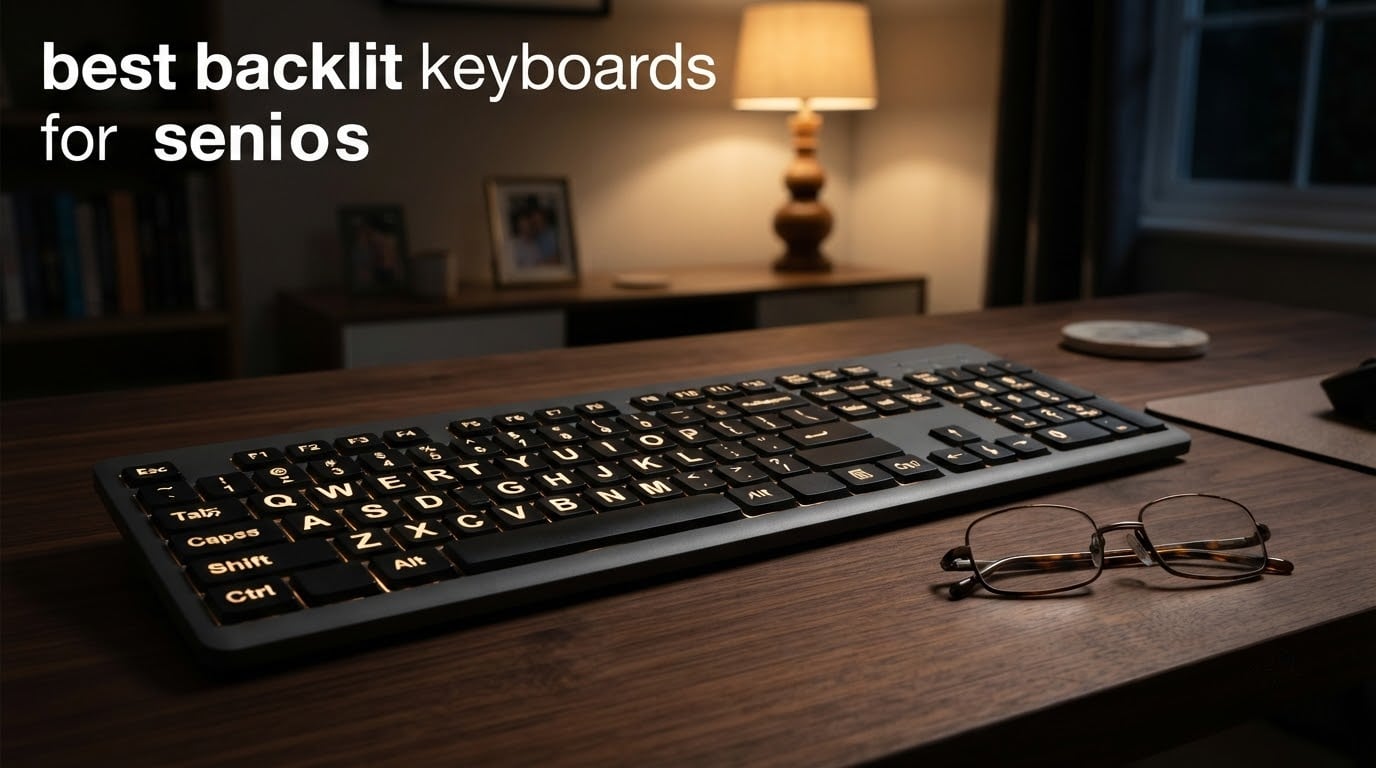
If you have ever typed a password in a dim room, squinted at a QWERTY layout you used to know by heart, or helped a parent re-enter an email address for the fourth time, the problem is almost never the computer. It is the legends on the keys. The best backlit keyboards for seniors solve one problem and one problem only: they make each character visible without a lamp and without guessing. Everything else on this list is a preference, not a requirement.
I compared eight large print boards with real LED backlighting, wired and wireless, across three months of reading user reviews and spec sheets. My picks at a glance: the Perixx PERIBOARD-317 is the one to buy for almost anyone, with a 4x larger print, an even white backlight and a wired plug-and-play setup that cannot fail. The SABLUTE K21PRO wins if wrist comfort matters more than anything. The KOPJIPPOM board has the highest rating in the group and the boldest print on the desk.
What surprised me most while reading 15,000-odd reviews was how often the complaint is not brightness at all. It is forgetting that the brightness was changed, or that a keyboard which looked perfect at 2pm was invisible at 9pm. That is why every pick below is judged on three things together: how large the print is, how many brightness steps the light actually has, and whether the light stays where you left it.
If you are shopping for a whole household rather than one person, our guides to the best TVs for seniors with simple remotes and the best smartwatches for seniors cover the other two devices in the same evening-use scenario.
Table of Contents
Top 3 Backlit Keyboards for Seniors in 2026

All 8 Picks Compared (October 2026)
| Product | Specifications | Action |
|---|---|---|
| Perixx PERIBOARD-317 |
|
Check Latest Price |
 SABLUTE K21PRO SABLUTE K21PRO |
|
Check Latest Price |
 KOPJIPPOM Large Print Keyboard KOPJIPPOM Large Print Keyboard |
|
Check Latest Price |
 X9 Performance Large Print X9 Performance Large Print |
|
Check Latest Price |
 QUASIO Large Print Backlit QUASIO Large Print Backlit |
|
Check Latest Price |
 Hamile Wireless Large Print Hamile Wireless Large Print |
|
Check Latest Price |
 HeengYanson Large Print Backlit HeengYanson Large Print Backlit |
|
Check Latest Price |
 SABLUTE K11PRO SABLUTE K11PRO |
|
Check Latest Price |
1. Perixx PERIBOARD-317 – The One to Buy for Almost Anyone
Perixx PERIBOARD-317 Wired Backlit USB Keyboard, Big Print Letter with White Illuminated LED, US English Layout,Black
- 4x larger legends readable with reading glasses
- Bright evenly distributed white backlight
- Quiet low-profile membrane keys
- Wired USB needs no charging or pairing
- Long 5.25 ft cable for desk placement
- Membrane action feels soft to mechanical users
- Keys can feel tight and occasionally miss
- Backlight on disables Scroll Lock
- No adjustable tilt feet
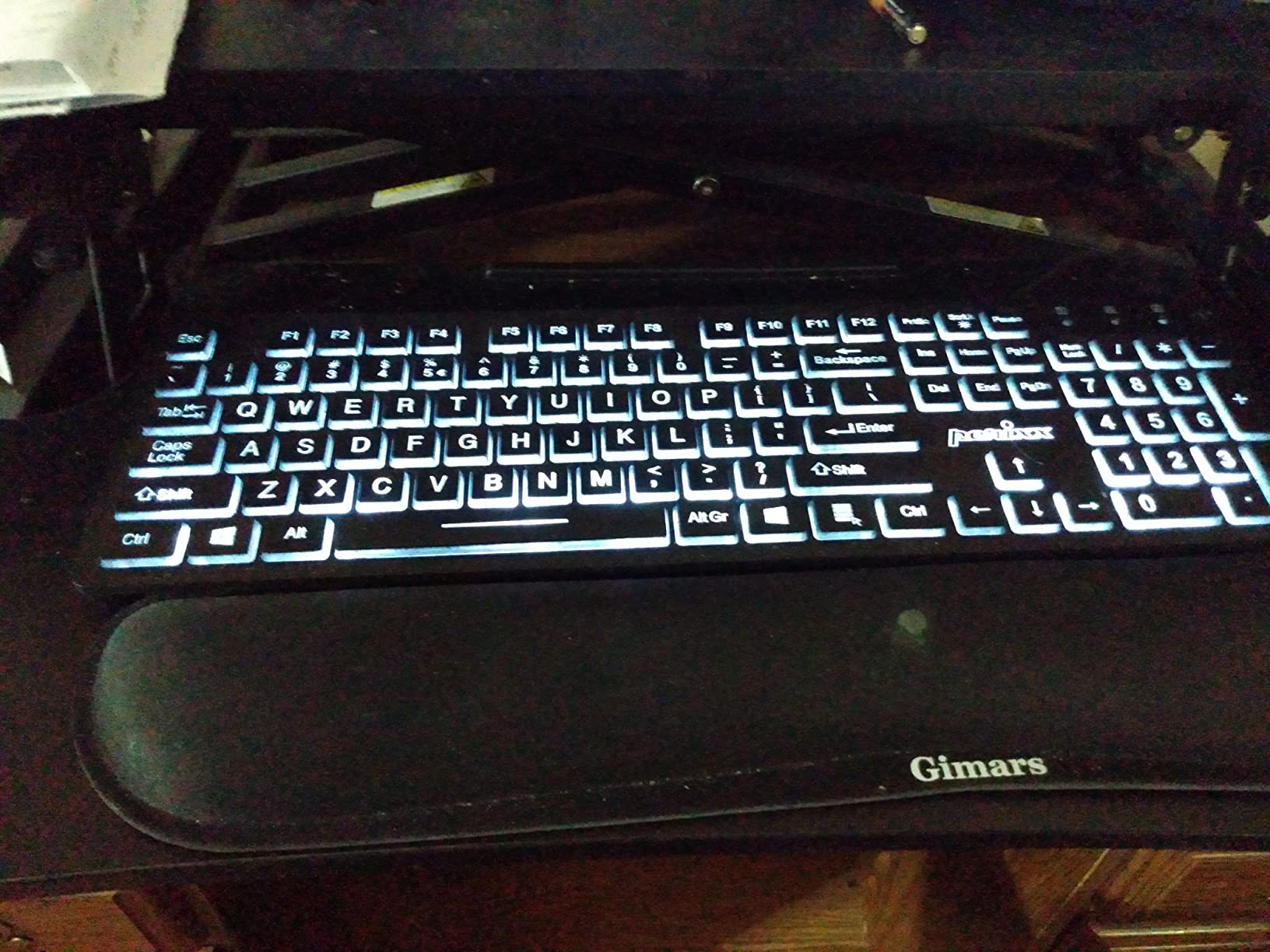
This is the highest-reviewed board in the group by a wide margin, and reading through the long-term owners explains why so many never replaced it. The print is four times larger than a standard keycap font, which is the single most useful thing a keyboard can do for ageing eyes, and the white LED light sits evenly across the whole board rather than in one bright patch.
It is wired, and in a roundup full of Bluetooth boards that reads like a limitation until you remember what it means in practice. There is no pairing to break, no dongle to lose under the sofa, and no flat battery on the morning of a telehealth appointment. It draws power from the same USB port that already charges the laptop.
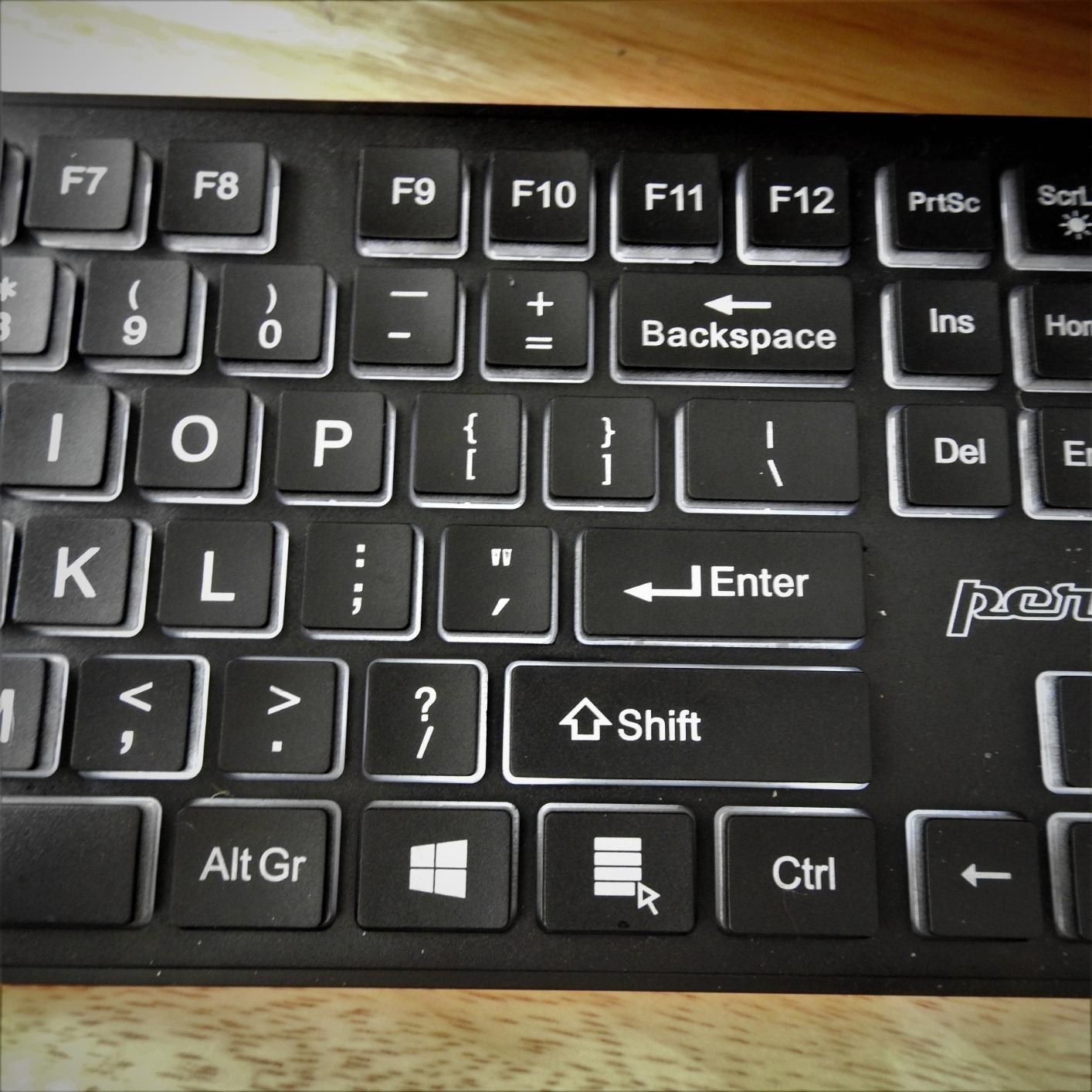
The trade-offs are honest ones. Membrane switches mean the bottom of each key feels soft rather than crisp, and a segment of buyers who came from mechanical boards notice it immediately. Several owners also report keys sitting snugly tight in their sockets, which occasionally turns into a stiff or missed press.
One quirk catches people out. With the backlight switched on, the Scroll Lock function is disabled, and it comes back when the light is off. If you use spreadsheets with a senior and they suddenly cannot lock a cell, that is why.
Check this before you buy it
This is a Windows board. It is listed for Windows 7 through 11 and it will physically plug into a Mac, but the key labelling and any special functions follow the Windows layout, which matters more for a first-time user than for an experienced one.
Legend wear is the other long-term concern. The print is wear-resistant ABS rather than double-shot plastic, so heavy daily use over several years eventually softens the sharpest characters. At the 8,275-review mark, plenty of owners report exactly that, and plenty report four-plus years of service anyway.
Who should skip it
Skip it if you type all day and want a crisp mechanical key action, or if you need Bluetooth. There is no wireless version of this particular board. If your desk is shared with someone who needs cord-free freedom, jump to the wireless pick further down.
Skip it also if you need adjustable height. There are no tilt feet on this model, so the typing angle is fixed and flat, which is fine for a few hours and unkind to a wrist over a full working day.
2. SABLUTE K21PRO – Best for Wrists and Long Sessions
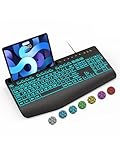
SABLUTE Large Print Wired Keyboard, Ergo Wrist Rest, 7 Colors Backlight
- Integrated palm rest cuts wrist fatigue
- Large bold legends reduce eye strain
- Seven colors and seven brightness levels
- Wired so there is nothing to charge
- Two-year warranty
- Backlight setting resets at every power-up
- Light sometimes cycles colors on its own
- Some buyers report keys stopping to register
- Space bar is louder than other keys
This is the pick for anyone who spends real time at the keyboard, because the moulded palm rest is part of the chassis rather than an add-on strip. Older users with arthritic hands mention it as the first thing they noticed, and the oversized keycaps are genuinely large to look at, not just a few points larger than standard.
Backlight control is the deepest in this group alongside the K11PRO. Seven colors and seven brightness levels means there is a comfortable setting for a dim bedroom and a different one for a bright kitchen table at lunchtime, which is more than most rivals at this tier offer.
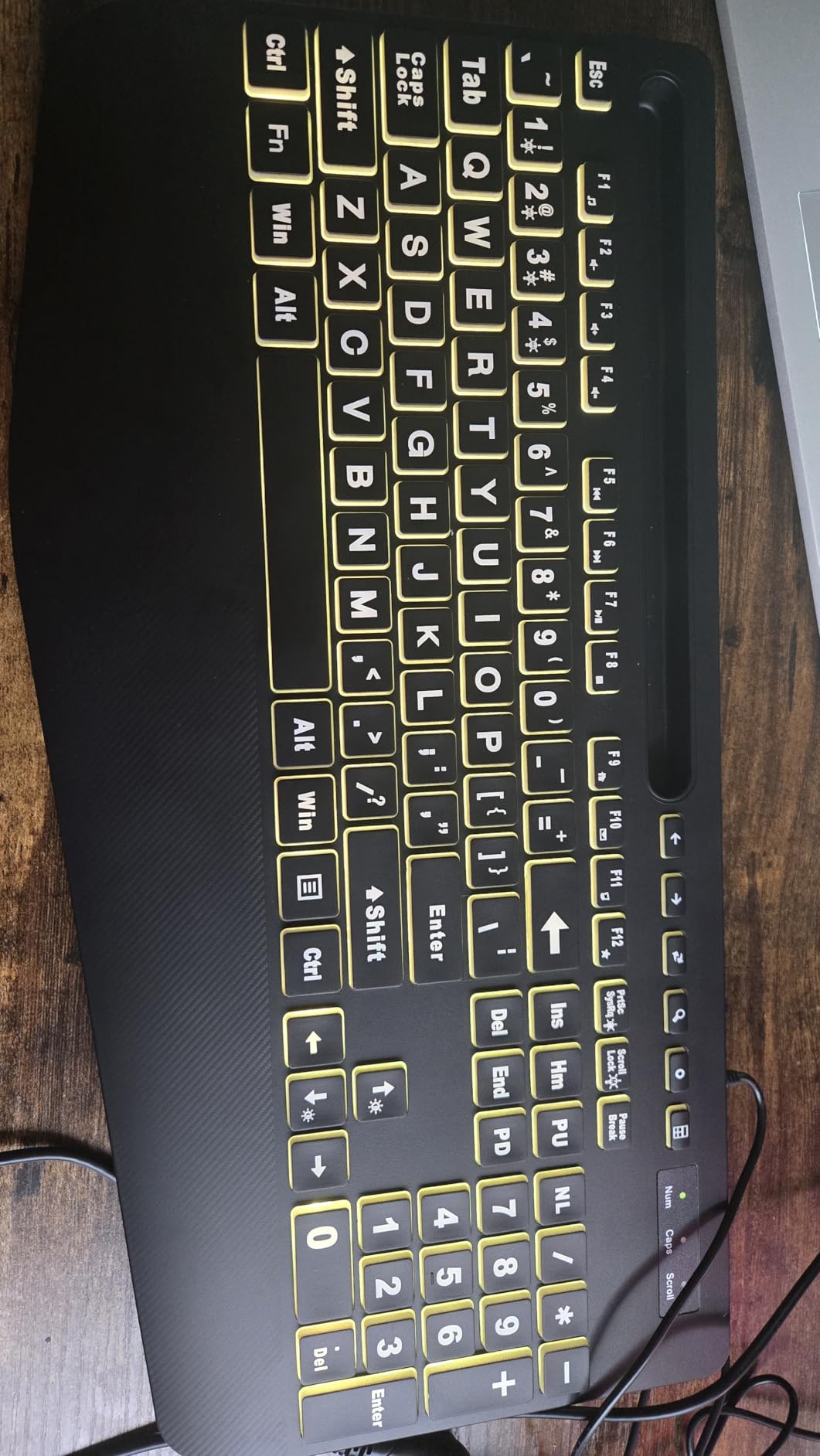
The flaw that annoys regular users most is that the light has no memory function. Whatever color and brightness you chose is forgotten when the power goes, so the color has to be re-selected at the start of every session. For a senior who has just found a setting they like, that is a small but repeated irritation.
There is also a smaller but real reliability signal in the reviews: a minority of owners report the number keypad or individual keys ceasing to register after several months. SABLUTE’s after-sales replacement is described as responsive, which turns a durability worry into a service question rather than a lost keyboard.
Check this before you buy it
It includes a phone or tablet holder, which is genuinely useful for video calls, but it does not charge the device. If a parent expects to prop a phone there and have it top up, that will not happen.
The listed spec sheet is slightly inconsistent about the key count, and the physical board is a full-size layout with a number pad and multimedia and calculator keys. Confirm the layout is full-size in the box art if the number pad is essential to them.
Who should skip it
Skip it if the backlight is going to be set once and forgotten, because this model will not remember the choice. If the light needs to survive a power cycle unchanged, the wireless board later in this list keeps the setting.
Skip it if noise is the deciding factor. The space bar is noticeably louder than the surrounding keys, and several reviewers point that out as the one sound that breaks the quiet feel.
3. KOPJIPPOM Large Print Keyboard – Highest Rated With Heavy Bold Print
- 4x extra-large bold key legends
- Seven colors and three brightness levels
- Quiet soft-touch keys that do not clack
- Heavy build that stays put while typing
- Spill-resistant and driverless
- Printed legends wear where thumbs land
- Backlight toggle sits in an easy-to-bump spot
- Function key labels are abbreviated
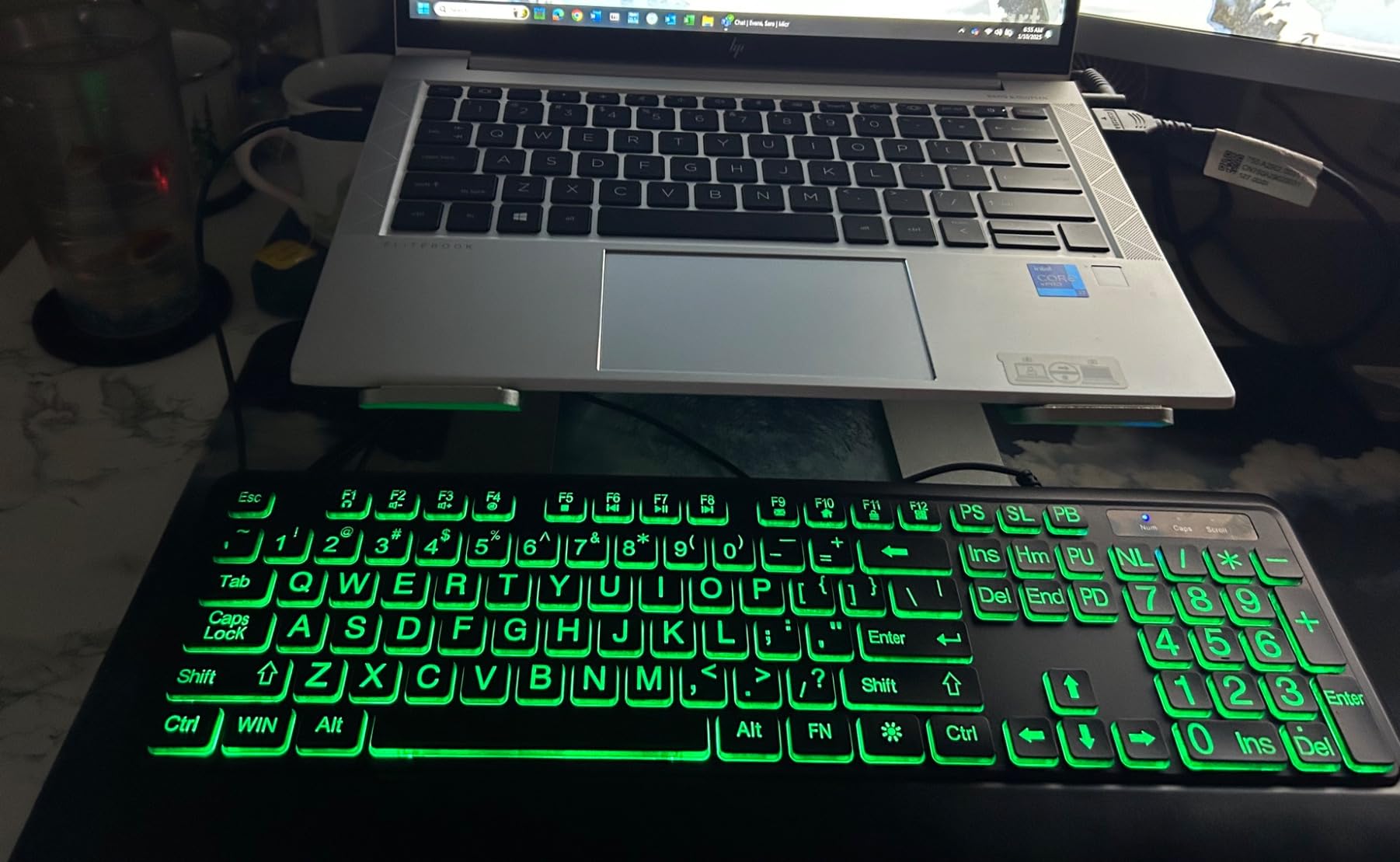
Rated 4.6 with 81% of reviews at five stars, this is the highest-rated board in the selection, and the reason is the print. The fonts are four times larger than standard keycap text and the characters are heavy and bold, so they read at an arm’s length in a dim room without the user leaning in.
It is also the board I would hand to someone who has already said the words I do not want to hear. The rubber dome membrane is quiet enough for late-night use, it does not clack, and the chassis is heavy enough that it does not walk across the desk during a typing session.
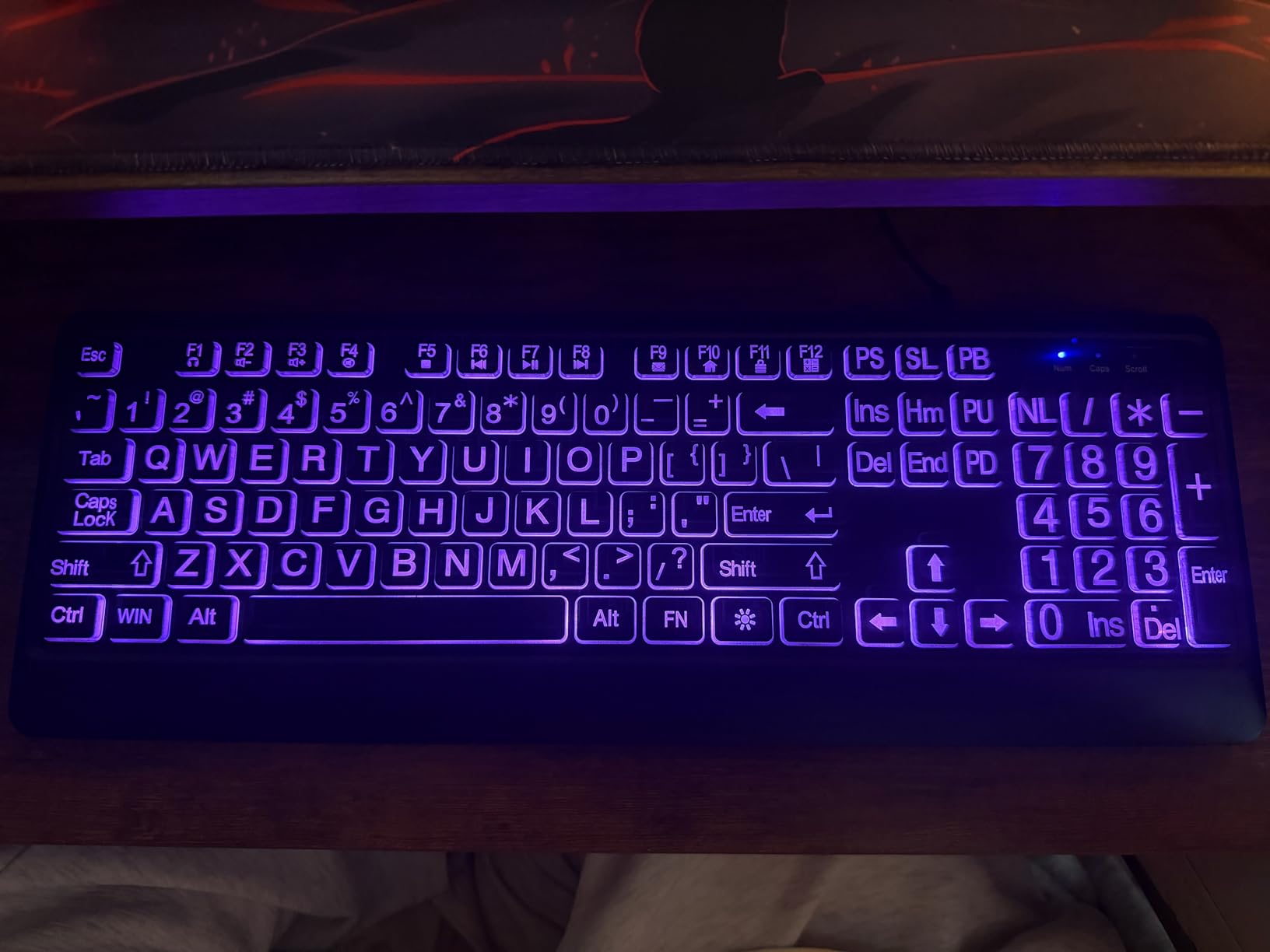
The criticisms are mostly cosmetic, which is unusual and a good sign. The printed coating rubs off on heavily used keys and leaves a lighter wear patch. The backlight color-change key sits between the Ctrl and Fn keys, which is precisely where a thumb lands.
One more that matters for a new user: to fit the large print, the function key labels are abbreviated, so Page Down appears as a shortened form. Anyone learning the top row from scratch will need a one-time explanation of what those keys do.
Check this before you buy it
It lists compatibility with Windows, Mac, ChromeOS and Raspberry Pi, and it is a USB keyboard that needs no drivers at all. The caveat is that the multimedia keys may not fully work on macOS, so test those two or three keys before handing it over.
It is also rated as spill-resistant, which in practice means a knocked cup of tea is a survivable event rather than a funeral. It is not waterproof, and no keyboard in this roundup is.
Who should skip it
Skip it if the board lives in a bright, sunlit room all day. A backlight adds little when daylight is already lighting every legend, and in that situation contrast and print size do the work instead.
Skip it if the cable length matters. Owners note the cable is shorter than on many comparable boards, so a desk where the computer sits well to one side may not reach.
4. X9 Performance Large Print – Best for Extra Shortcut Keys
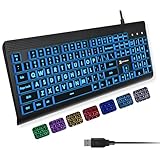
- Extra-large bold legends easy to see at a glance
- Four brightness levels for different lighting
- 107 keys with number pad and 12 shortcuts
- No software or drivers to install
- Slim one-inch body
- Domed membrane action feels less crisp
- Backlight adds little in a bright daylight room
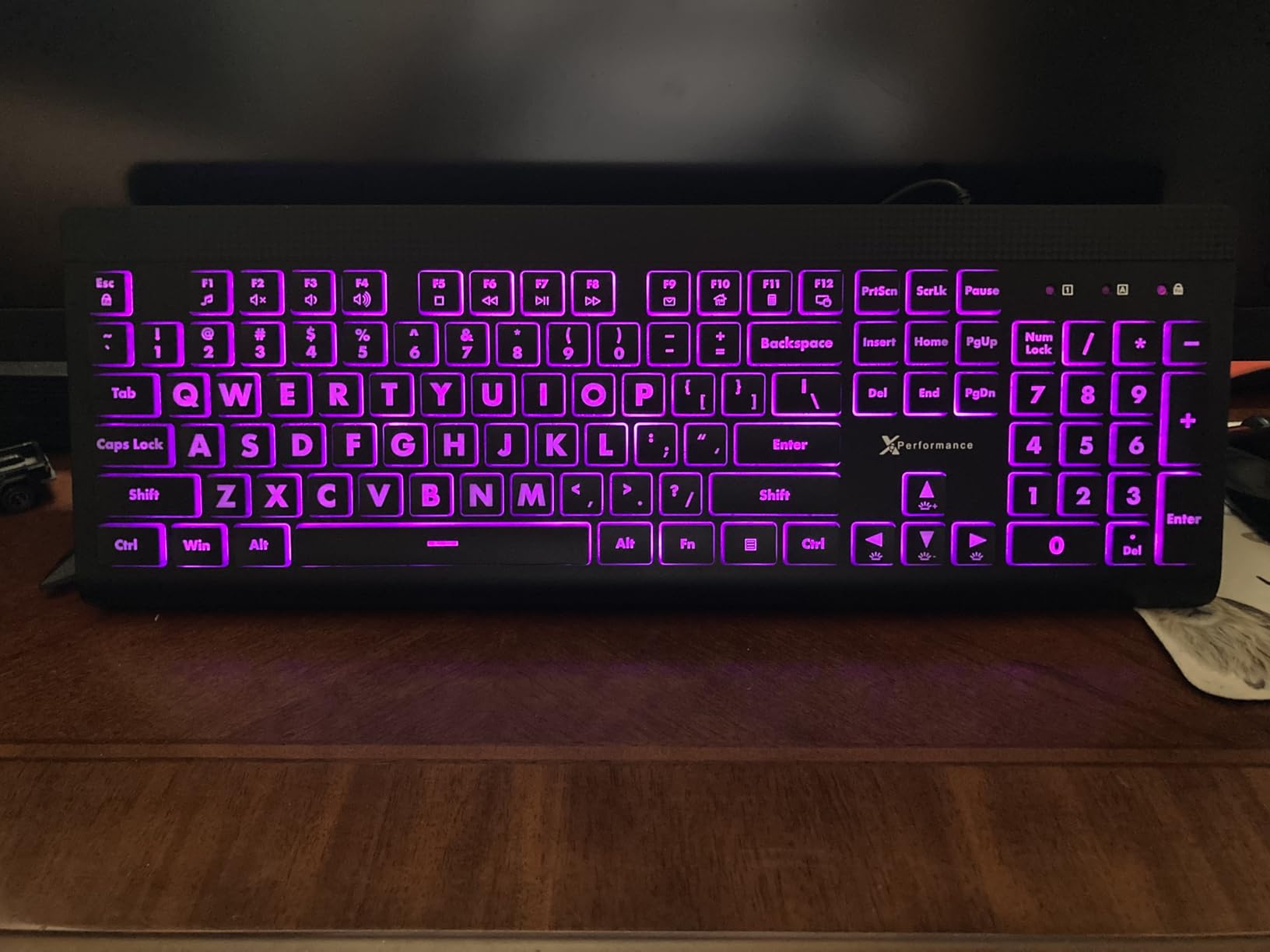
This is the pick if the person typing is being handed shortcuts to learn rather than being asked to find letters. It carries 12 dedicated shortcut keys above the number pad, and at 4.5 stars across 587 reviews the satisfaction is consistently about the same two things: the print size and the four brightness steps.
Four brightness levels is one more step than most boards in this price band, and in practice that extra step is the difference between a setting you can use across a whole evening and one you have to keep adjusting.
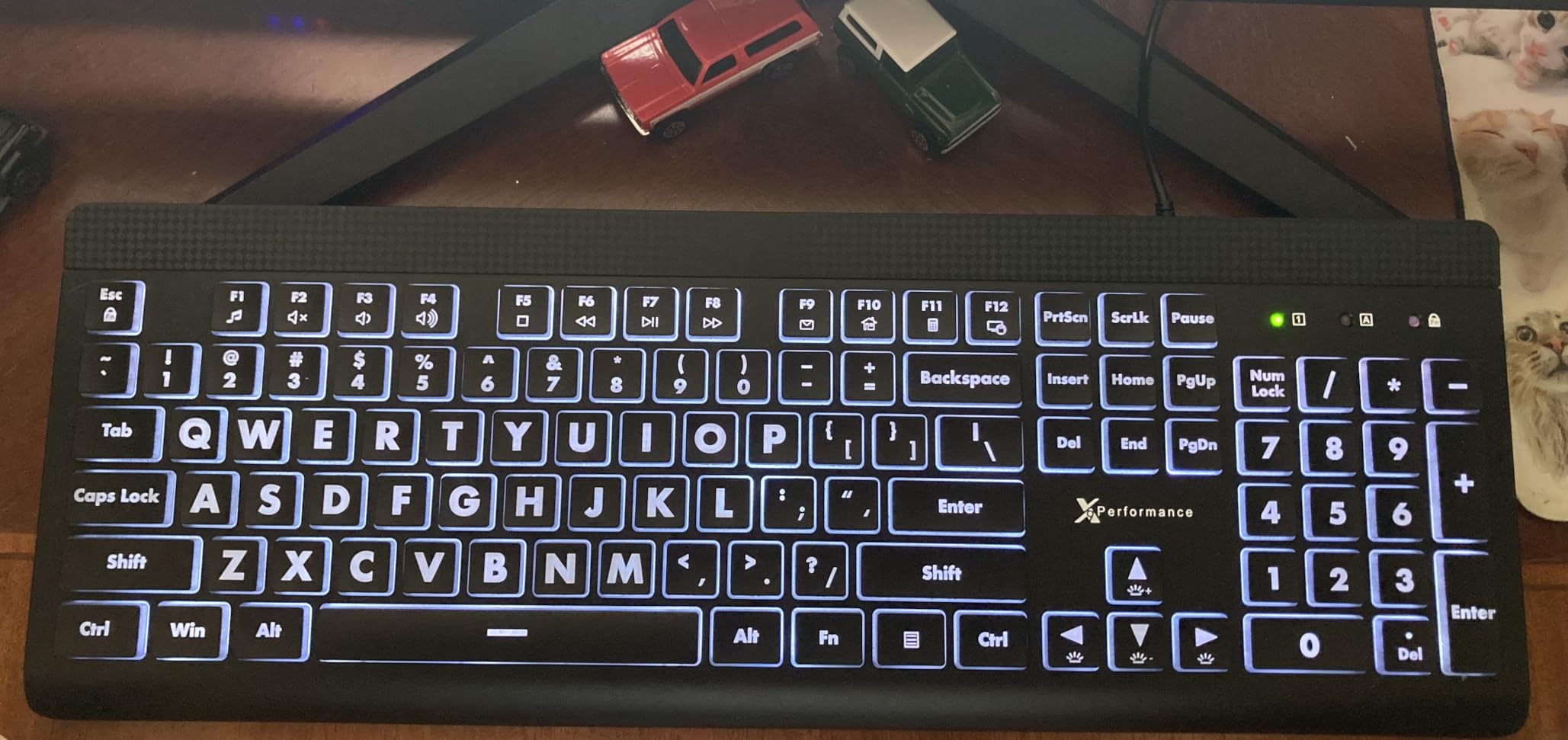
The 107-key layout is full-size, with an independent number pad, which is what a senior doing online banking or a telehealth form actually needs. It is a USB plug-and-play board for PC, Chromebook or laptop, with no software to install and nothing to configure.
Physical build is a slim 1.02 inch body, which keeps the typing angle shallow. That is comfortable for light use and less supportive over a long session, and it is why this is not the board to pick for all-day wrist support.
Check this before you buy it
Confirm the shortcut key positions with the eventual user before it arrives. Twelve shortcut keys are a genuine asset for someone learning Zoom or a browser, and a genuine distraction for someone who only ever types messages.
It is a domed membrane board. If the person has used a modern laptop keyboard, this will feel familiar. If they learned on a mechanical board, the feedback is lighter and less distinct.
Who should skip it
Skip it if the desk sits in a bright room. The lighting is a bonus, not a necessity, and in daylight the large bold print is doing all the work on its own.
Skip it if wrist support is the main concern. There is no palm rest and the profile is thin, so a board built around comfort would serve better.
5. QUASIO Large Print Backlit – For Quiet Typing and Retro Round Keys
- Raised round caps are easy to see and press
- Quiet crater switch action
- Works on Windows Mac and ChromeOS
- Retro round raised keycaps
- Printed legends fade with regular use
- Navigation cluster rearranged from standard positions
- Bottom row of keys does not light up
Quietness is the number one thing reviewers bring up about this category, and this is the board that answers it. The crater mechanism under each key gives a soft near-silent action, and several owners in their seventies with poor eyesight describe it as the easiest board they have used.
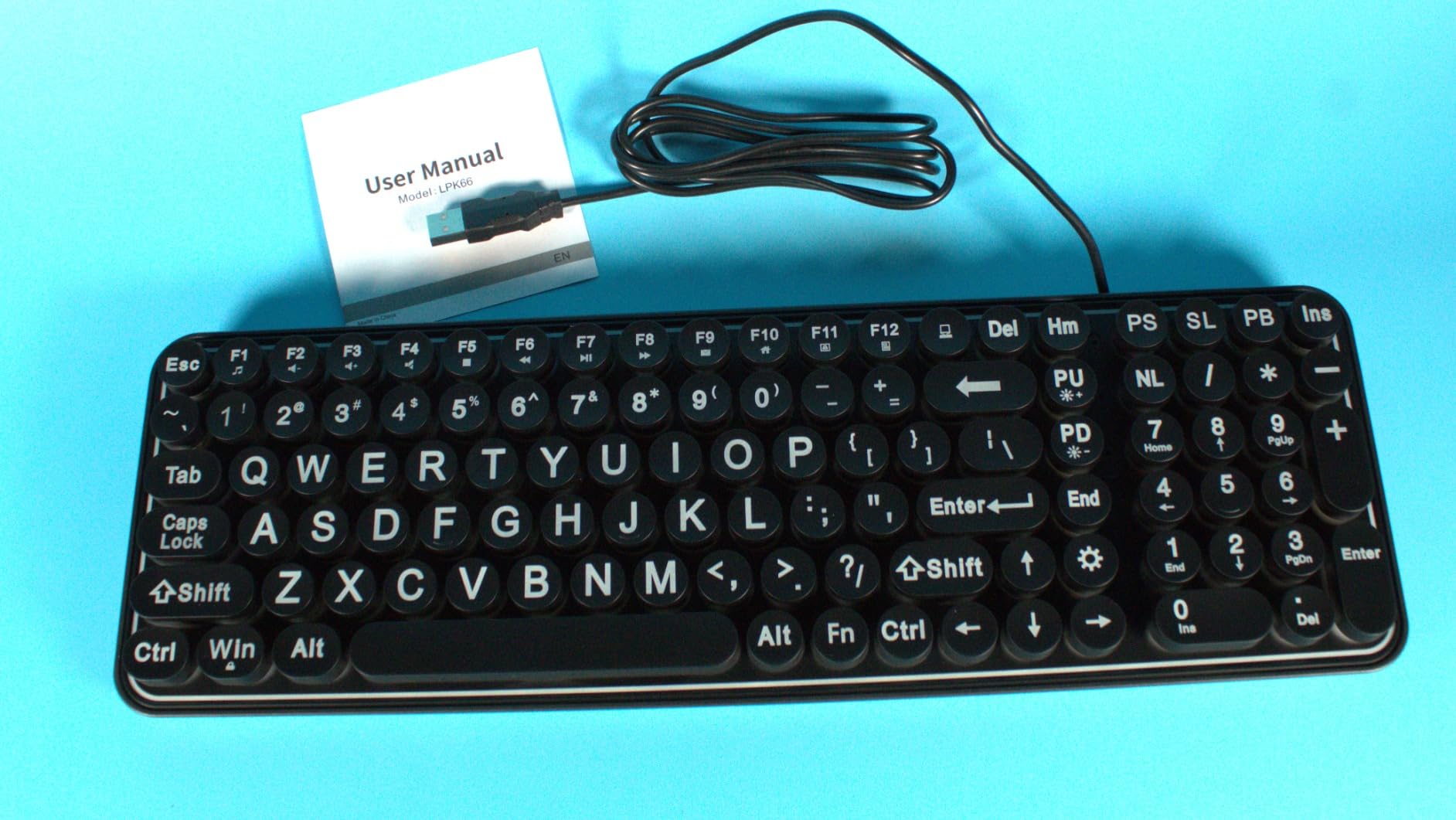
The retro round raised keycaps are a real usability feature, not decoration. A raised, separated, high-contrast key is easier to locate by touch and by eye than a flat rectangle, and the print is four times larger than a traditional layout.
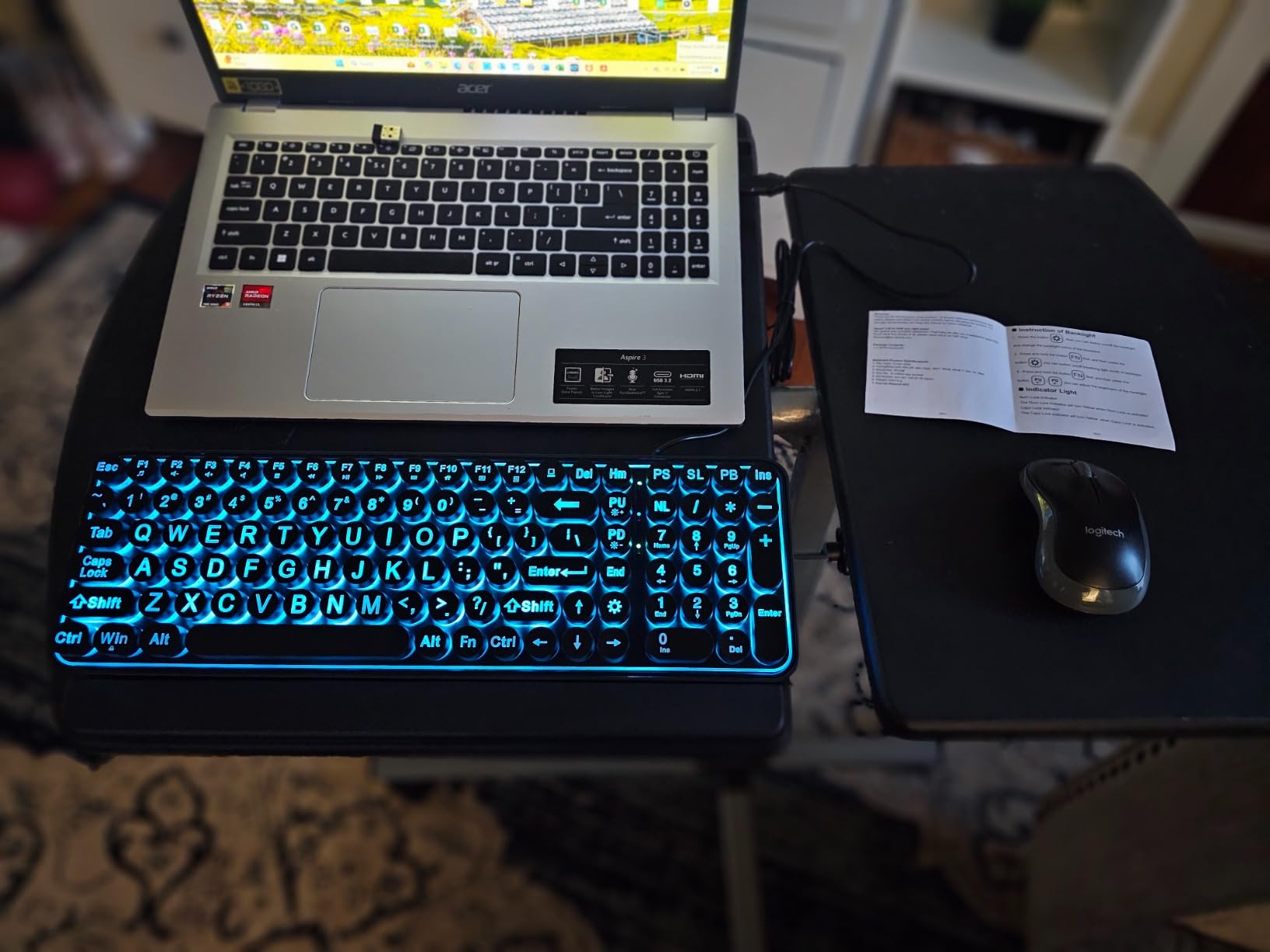
Two layout issues are worth knowing before it arrives. The navigation cluster with Home, Page Up, Page Down and End has been rearranged from the standard positions, which disrupts muscle memory for anyone switching from another board. The Home key also sits close to Delete.
The bottom row, covering Ctrl, Win, Alt and the space bar, is not backlit. In practice almost nobody needs to look at the space bar, but it is a fair question to ask a shop assistant holding the box.
Check this before you buy it
It works on Windows, Mac and ChromeOS from a single USB connection with no drivers, which makes it the safest of the eight to hand to someone who might switch computer types. Backlight offers seven colors, three brightness levels and two modes.
Check the physical width against the desk space. At roughly 104 keys it is full size, though slightly more compact than a desktop board, and the round keycaps take a few days to get used to.
Who should skip it
Skip it for someone who types a lot and intends to keep the same keyboard for years. The printed legends fade with regular use, and that is the one thing you cannot replace or reconfigure.
Skip it if a standard layout is important. Moving the navigation cluster creates a relearning period that some older users find genuinely disorienting.
6. Hamile Large Print Wireless – Best for a Cord-Free Desk
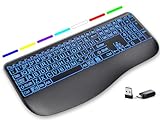
Hamile Large Print Wireless Backlit Keyboard for Windows, Black
- Backlight remembers your last color and brightness
- Quiet scissor keys with a laptop feel
- Wide curved wrist rest and adjustable stand
- Rechargeable with up to 3 months standby
- Widest layout here at 112 keys
- 2.4G wireless only with no Bluetooth
- No mouse included
- Small receiver dongle is easy to misplace
This is the only wireless board in the group, and the feature that matters most here is not the wireless at all. It remembers the last backlight color and brightness after power-off, which is precisely the setting-forgetting problem that frustrates owners of the wired multi-color boards.
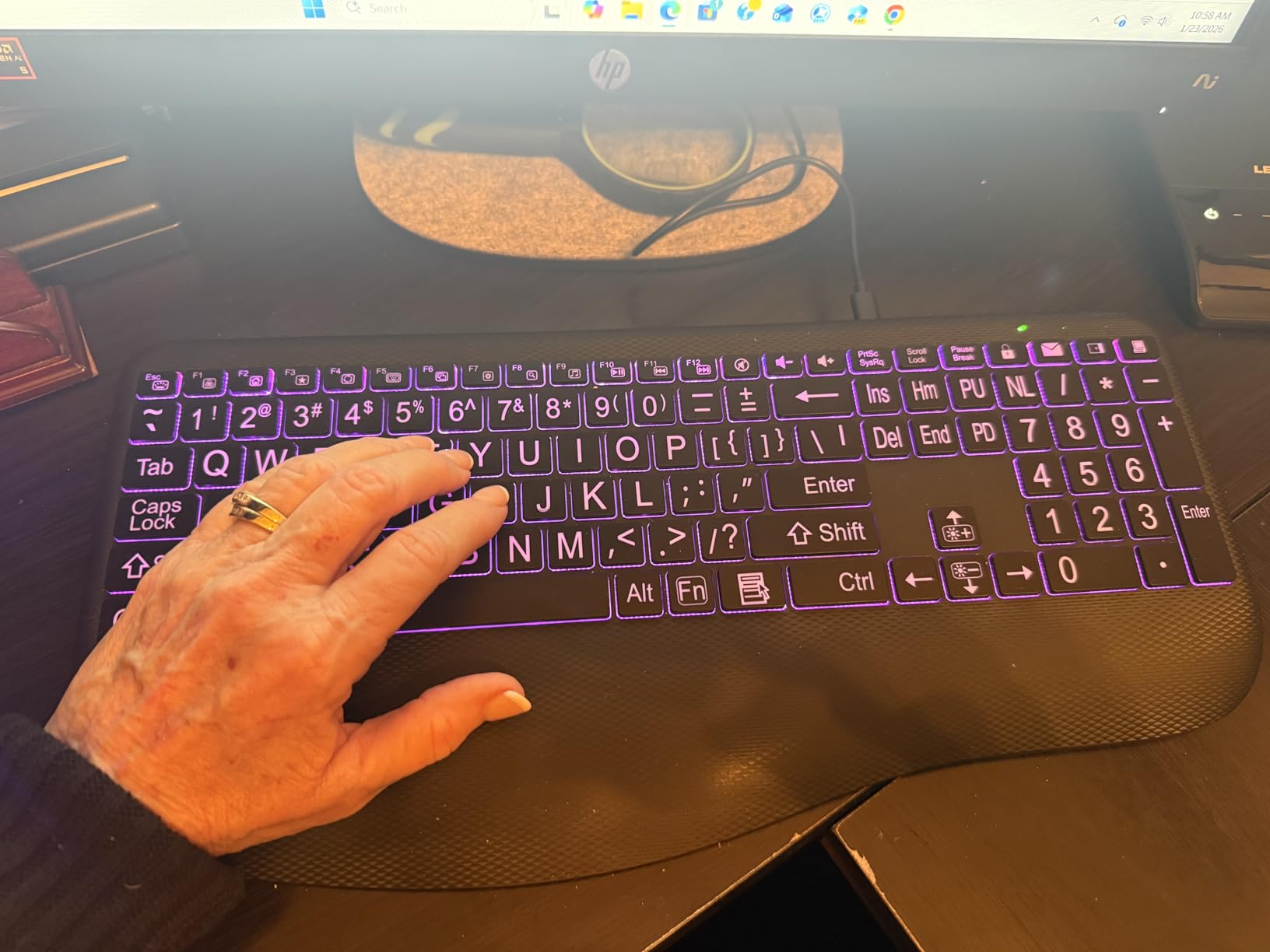
The keys are low-profile scissor switches, so the feel is closer to a laptop than to a desktop board, and they are quiet. A wide curved wrist rest and an adjustable stand give it one of the roomiest typing positions in the group, with a raised angle option.
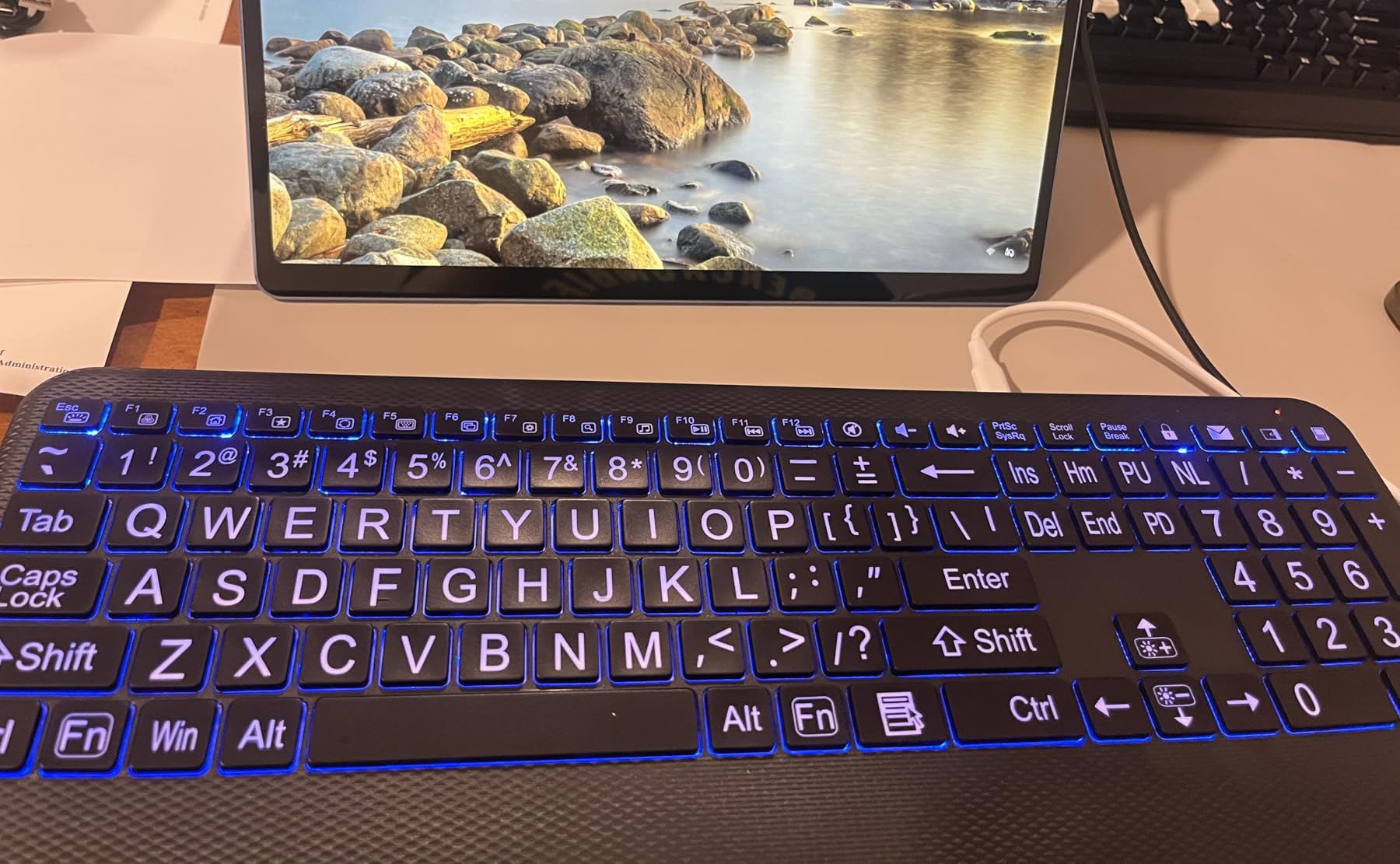
Battery life is the other quiet win. It is rechargeable over USB-C and rated for around 25 days of continuous use with the backlight off, or roughly three months on standby. For someone whose computer is in another room, that is a genuinely good outcome.
Now the honest caveat, and it is a real one for this audience. It connects over 2.4G only, with no Bluetooth. That means a small USB receiver must be plugged in and physically kept, and those receivers are famous for ending up behind the television stand.
Check this before you buy it
Check what device the computer is. It is listed for Windows and Android, and the multimedia keys may not fully work on macOS. Standard typing is the part that behaves normally everywhere.
Note what is in the box: keyboard, manual, USB-C charging cable, USB receiver and a Type-C adapter. No mouse is included, so a wireless setup still needs a pointing device bought separately.
Who should skip it
Skip it if the computer changes often or moves between rooms. A 2.4G receiver is tied to one machine, and there is no Bluetooth to fall back on for a tablet or a second desktop.
Skip it if the review base matters to you. At 453 reviews it has the thinnest evidence behind it of the picks here, so it is the one to buy when the feature set fits, not when you are still deciding.
7. HeengYanson Large Print Backlit – Best Value Pick
- Wrist rest and 7-degree angle for long sessions
- Quiet soft-touch membrane keys
- Full 104-key layout with number pad
- Ready in about 10 seconds with no drivers
- Membrane feel is less responsive
- Wired cable limits desk placement
- No mouse included
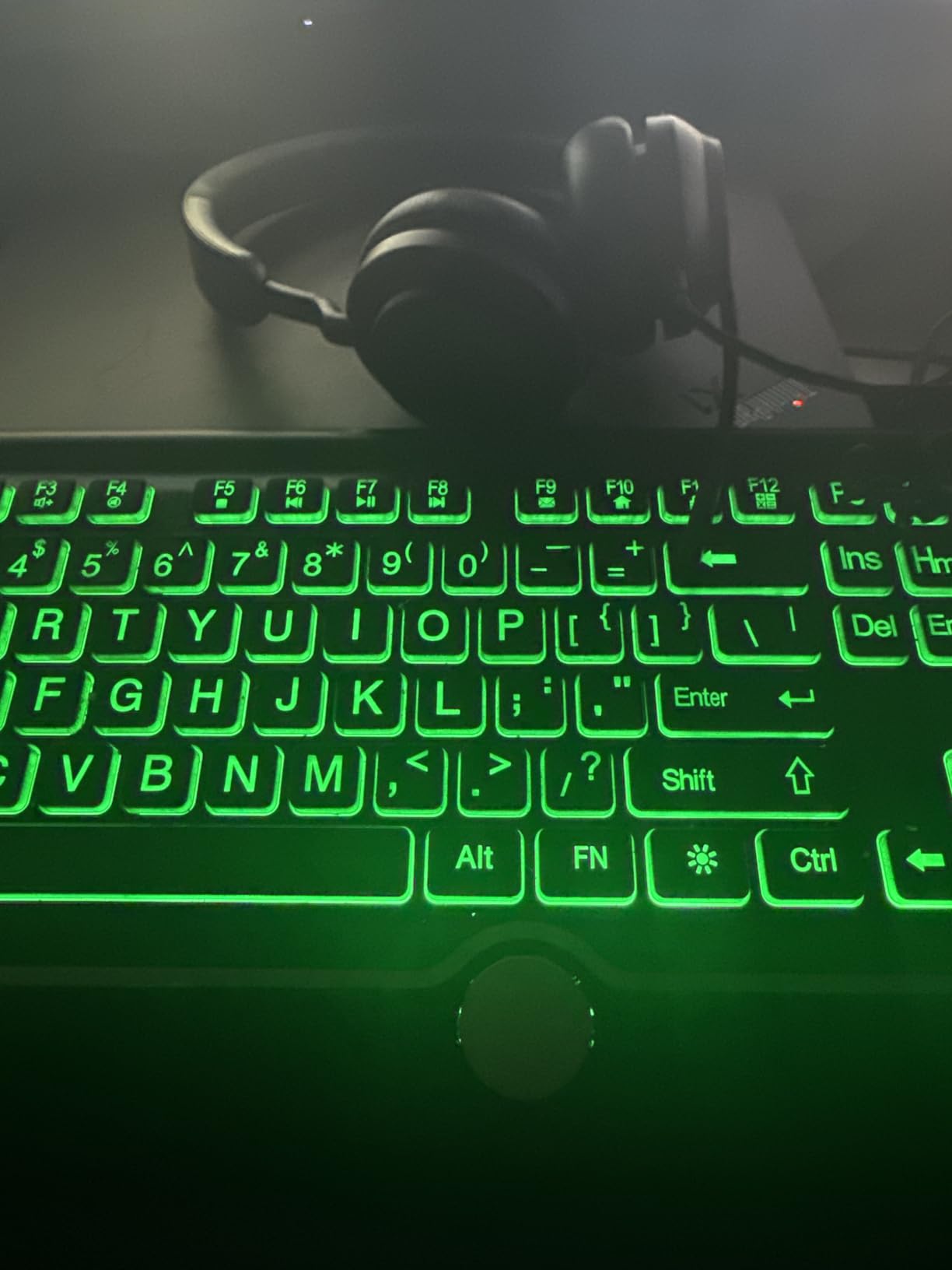
This is the board I recommend when someone wants a wrist rest, a large print and a colored backlight without paying for the one that remembers its settings. It pairs a moulded wrist rest with a 7-degree kickstand angle, and at 4.4 stars across 689 reviews the combination is well liked.
The soft-touch membrane keys are quiet enough for late-night use, which is the second most common request in this category after visibility. Backlight control covers three brightness levels across seven colors.
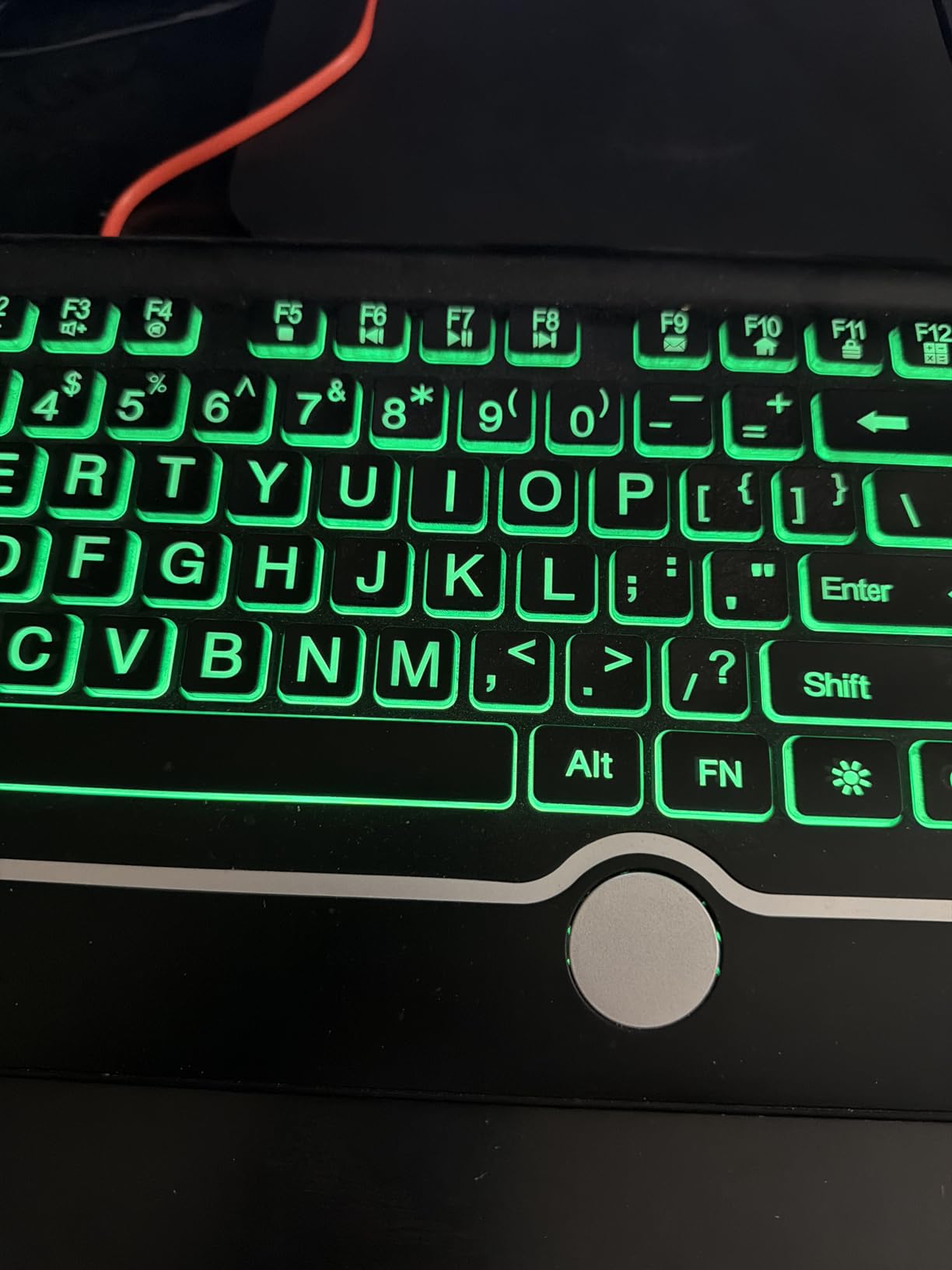
Compatibility is broader than most of the list, covering Windows, Mac and Raspberry Pi from a plain USB connection. As with the other multi-key boards here, the multimedia keys may not fully function on macOS, so those two or three keys are worth testing on day one.
The cable is fixed and there is no wireless sibling in the range, so desk layout is decided on day one. For a desk where the computer sits directly in front of the user, that is rarely a problem.
Check this before you buy it
Note that the mouse is not included and the keyboard is wired only. A buyer expecting a complete wireless desktop set will be disappointed, and the listing itself flags this as a point to confirm before buying.
Dimensions are 17.4 by 7.4 by 1 inches at about 1.5 pounds, so it is a full-depth board with a real palm rest rather than a slim laptop-style slab. Measure the desk depth if space is tight.
Who should skip it
Skip it if the person came from mechanical switches. Soft-touch membrane is lighter and less crisp, and typists who care about feedback feel the difference immediately.
Skip it if the backlight has to hold its setting through a power cycle. This board has no memory function, so the same re-selection routine applies as with the other wired multi-color models.
8. SABLUTE K11PRO – Budget Pick With the Most Backlight Control
- Deepest backlight control in this group
- 3X enlarged print
- Yellow status indicators for lock keys
- Foldable tilt stand gives two angles
- Multimedia keys are engineered for Windows
- Membrane linear feel is soft
- Smaller review base than the rest
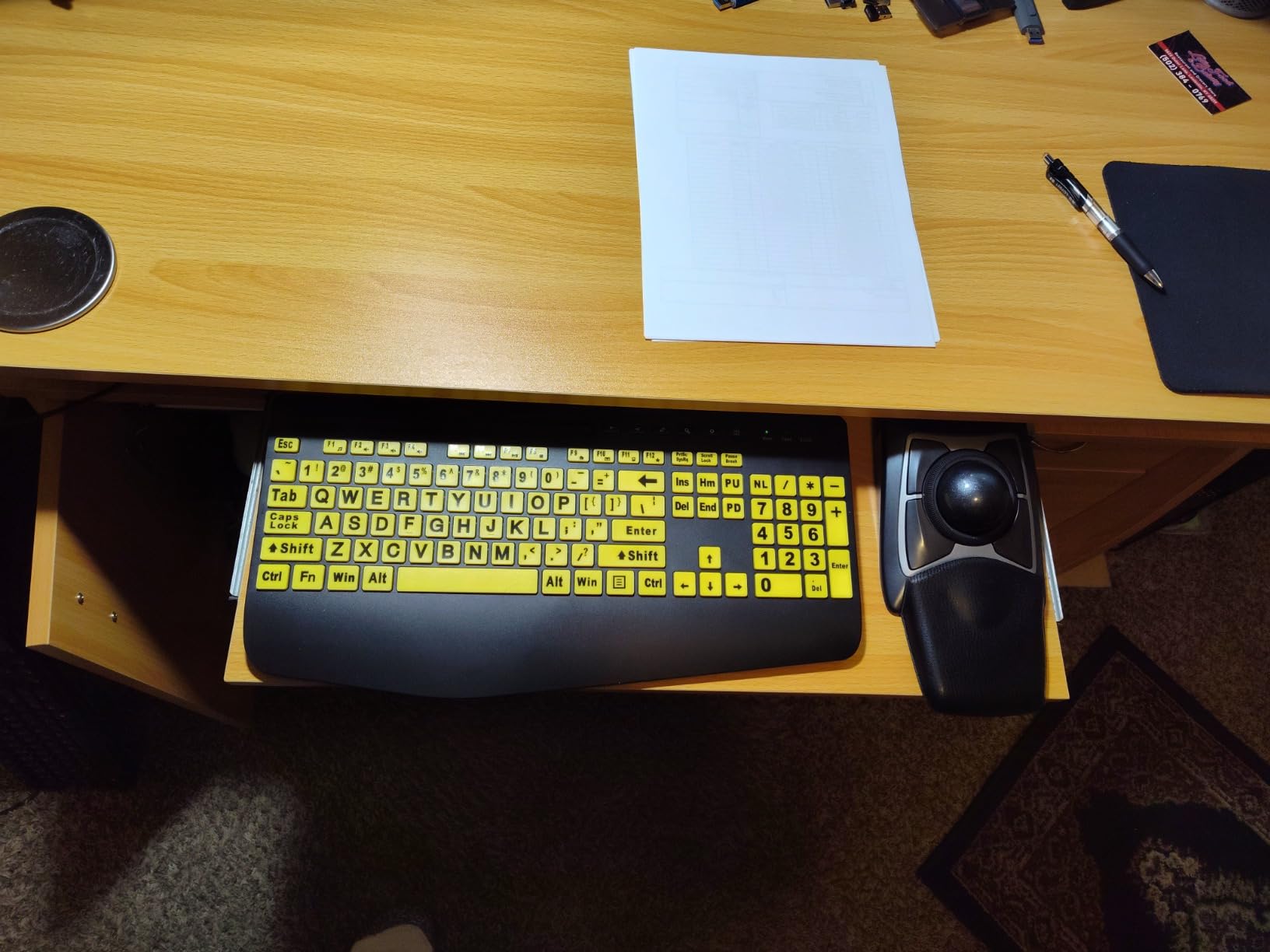
This board pairs 3X enlarged print with the deepest backlight control in the group. Seven colors, four static or breathing modes, eight brightness levels and six speed controls is more adjustment than any other pick here, and for someone who wants to tune the light to a specific evening routine that matters.
The print here is 3X larger than standard keycap fonts rather than 4X, so it is a step below the boards above it in pure legibility, but it is still far larger than a normal desktop keyboard. The status indicators for Num Lock, Caps Lock and Scroll Lock glow yellow when active, which is a small touch that answers a real question for a new user.
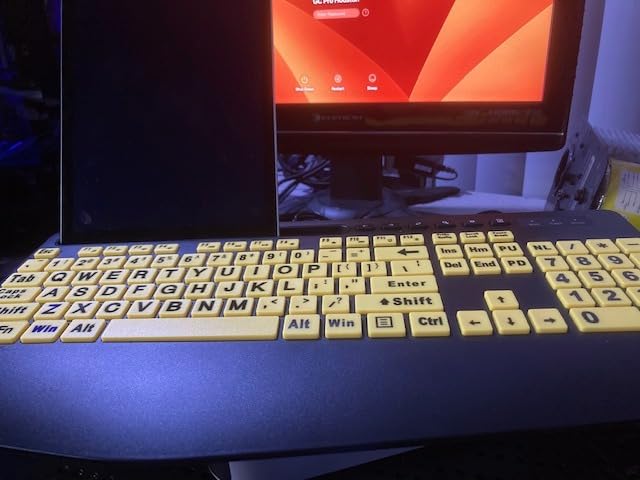
A foldable tilt stand gives two typing angles, and the 5.2 foot USB cable draws stable power from the port. It is a full 104-key US layout with an independent number pad, and it is a 2-year hardware warranty rather than the 12 months on several rivals.
The 12 dedicated multimedia keys are a Windows design using the FN row. Standard typing still works on macOS and Chrome, but the shortcut behavior follows Windows, and that is worth knowing before a mixed-platform household buys it.
Check this before you buy it
Compare the print size side by side with a 4X board if the person’s vision is the main concern. At 3X it is still a large-print keyboard, but it is a visible step down from the boldest legends in this roundup.
Check the brightness control is physically reachable. Eight brightness levels and six speed controls are only useful if the keys that change them are easy to find and not buried in a shortcut.
Who should skip it
Skip it if key action matters. The membrane construction with a linear feel gives a light, low-contrast press with little audible feedback, which is the opposite of what many typists look for.
Skip it if the household uses Macs. Typing is fine, but the shortcut keys follow a Windows layout, and that mismatch is confusing for someone learning the keys from scratch.
Is a Backlit Keyboard Worth It for Seniors?
Yes, for most people, and the reason is narrower than the marketing suggests. A backlight is worth buying when the type happens in low light, when the person has to lean toward the screen to read, or when the screen itself is hard to read and the keyboard is becoming the easier half of the interaction. In those cases it cuts hesitation, typing errors and the low background frustration of typing in the dark.
It is not worth buying for speed, and nothing in the eight boards above makes anyone type faster. Three conditions make it clearly worthwhile: the user types after dark, the user reads a screen with difficulty, or the user is typing accuracy-critical information such as a password or a bank detail. A fourth, quieter condition is shared computers, where the light is the only thing that changes when a teenager hands the desk back.
One thing most listings do not say clearly: on several of these boards, the secondary symbols on the shifted keys are not illuminated. If your parent regularly types an email address or a password containing an at sign or a hash, check the unshifted character is the one that lights up before you buy.
When a Backlit Keyboard Is Not Worth It?
Skip the backlight entirely if vision is corrected with glasses and typing is occasional. A large print high-contrast keyboard with no light at all does the same job for a daytime user, and it will not be one more device to set up, charge or explain.
It is also not worth it for full-time daylight work. Backlights earn their keep in the dark; in a sunlit room they add nothing to a legend that is already clearly printed. Save the budget for print size and contrast instead.
Two more cases. Wireless is a real convenience and a real reliability risk, so a wireless backlit keyboard is not worth it for a person who will not remember to charge it or who has already lost a small USB receiver. And for screen-reader users, a backlit keyboard is the wrong tool entirely, because the barrier is not light, it is not knowing where the keys are.
How to Choose a Backlit Keyboard for a Senior: 6 Steps
1. Decide wired against wireless first. A wired USB keyboard cannot lose its connection and cannot need charging, which is why seven of the eight picks here are wired. Wireless only pays off when the computer sits in another room, and even then check whether the board uses 2.4G with a receiver or Bluetooth with pairing, because pairing is the part that fails.
2. Check the legend size, not the key size. This is the mistake shoppers make most often. A keyboard with physically large keys but small printed legends helps nobody. Look for legends described as 3X or 4X larger than standard keycap fonts, and remember that 4X is meaningfully easier to read than 3X.
3. Separate large print from high contrast. Large print is about character height. High contrast is about the brightness gap between the legend and the keycap, and it is the more useful of the two in a dim room. A high-contrast white-on-black or yellow-on-black legend reads faster than a slightly larger dark-grey-on-grey one.
4. Count the brightness levels. Three levels is the practical minimum, and it is what most boards in this roundup offer. Four or more is better because it lets one setting cover a whole evening. One level is not a brightness control, it is an on and off switch.
5. Prefer warmth over color. Seven-color RGB is a gaming feature that happens to be available here. For ageing eyes and long evenings, a single white light set to a low level is more comfortable than a colored one, and the boards with a single white LED are often the calmest to use. A backlight that is too bright in a dark room causes as much trouble as one that is too dim.
6. Confirm plug-and-play and check the key feel. No drivers and no software is the correct answer for this buyer, and every board in this roundup qualifies. Then check that a full-size layout with a number pad is what you need, and that a wired membrane board’s soft action is acceptable, because mechanical and scissor boards feel very different. Our guides to mechanical keyboards explain the switch types if you want the deeper background.
A final note for the person who is not the user. A board with tactile or mechanical switches and a firmer keycap can be a problem for reduced dexterity, where a light-touch membrane key is easier to trigger. Choose the softest-feeling board that still gives clear visual feedback, and check the actuation is not so light that resting hands cause stray letters.
Set the Backlight Once So Nobody Has to Touch It Again
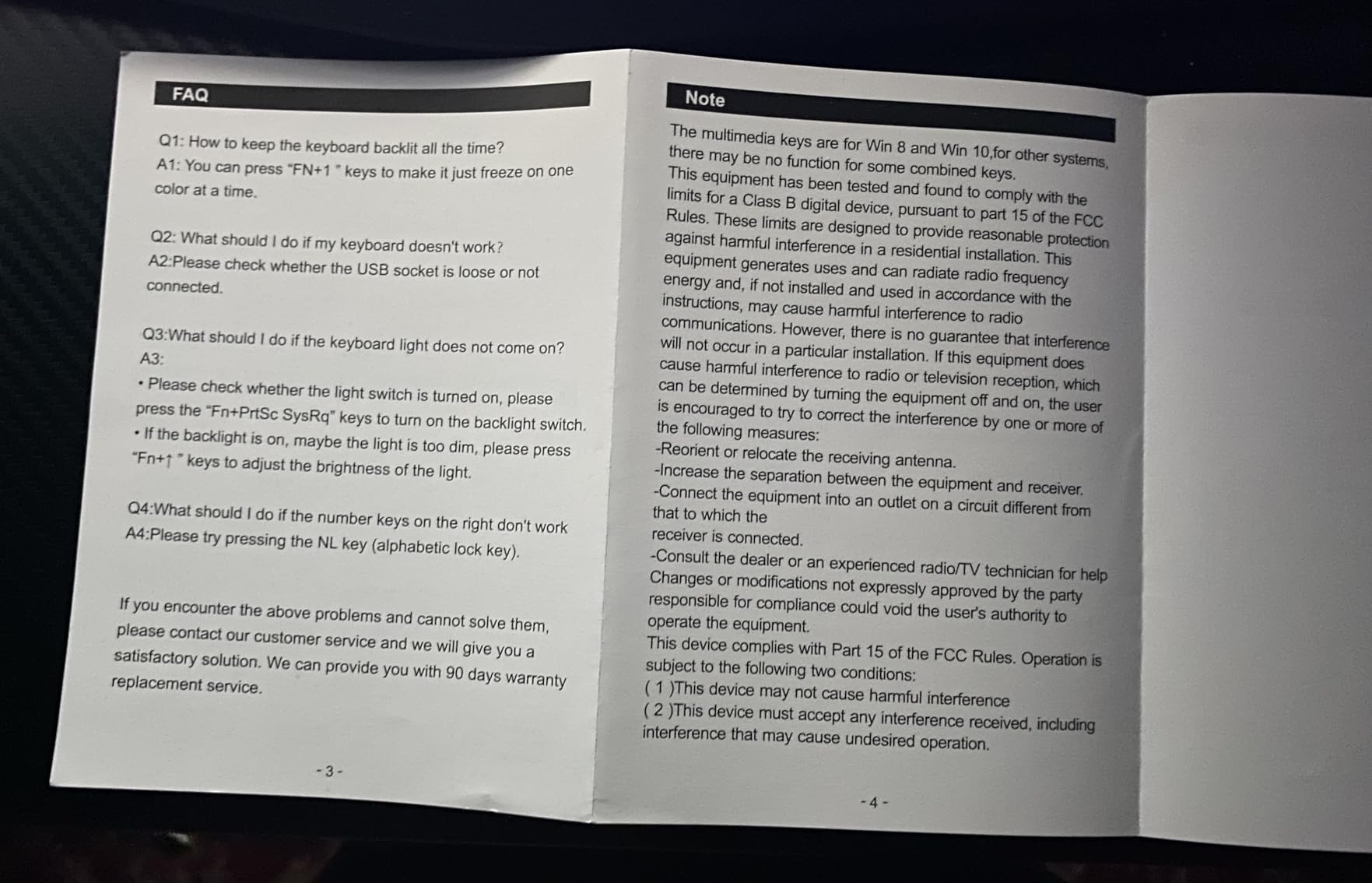
The most common complaint in the reviews is not that the light is dim, it is that the setting is lost. Three boards here have no memory function, so the color and brightness are reset every time the power goes.
Sit the keyboard in its final position at the actual time of day the user will type in, usually the evening, and set the light there rather than in a bright shop.
Step through the brightness levels and choose the lowest one that still reads clearly from a normal sitting distance. It will look too dim in a bright room and correct in the dark.
Pick one color and stop. White is the easiest for most eyes; a colored light is fine if the person prefers it, but it should be a choice, not a cycle.
Write the key combination on a slip of paper and tape it underneath the keyboard, and leave the board plugged in rather than switching it off at the wall.
One last thing worth doing before you give it over. Open an email address or a note and have the user type the @ symbol, a # and a $ in front of you, so you can see immediately whether the shifted characters are readable on that particular board.
Frequently Asked Questions
What is the best keyboard for older people?
The best keyboard for older people combines oversized high-contrast key legends with a white LED backlight and a wired USB connection. The Perixx PERIBOARD-317 is the strongest all-round choice, with 4x larger print, an even white backlight with adjustable brightness and a 104-key layout that needs no pairing or charging. Add a wrist rest if long sessions are expected, and look for a yellow-on-black high-contrast variant if contrast rather than size is the main problem.
Is it worth getting a backlit keyboard?
Yes, when typing happens in low light, when the user leans toward the screen to read, or when accuracy matters such as entering passwords or bank details. It reduces hesitation and typing errors in those conditions. It is not worth it for someone with corrected vision who types occasionally in daylight, because a large print high-contrast keyboard does the same job without anything to set up or charge.
What are the downsides of using a backlit keyboard?
The main downsides are a light that is too bright in a dark room, extra settings to manage, and a higher power draw. On multi-color models the backlight often has no memory function, so the color and brightness must be re-selected after every power cycle. On several boards the shifted secondary symbols on keys such as the at sign and hash are not illuminated, which breaks accurate typing until the user knows to look at the unshifted character.
What is the best large print keyboard for visually impaired people?
Look for legends described as 4x larger than standard keycap fonts, a high-contrast white-on-black print, and a backlight with at least three brightness levels. Among the boards reviewed, the KOPJIPPOM has the boldest print and the highest rating, while the Perixx PERIBOARD-317 pairs 4x print with a large review base. The Hamile board is the pick when contrast matters more than print size, with oversized high-contrast letters and a light that remembers its last setting.
What is the best keyboard for low vision users?
For low vision users the priority is contrast and adjustable brightness rather than key size. A single white LED set to a low level is usually more comfortable than a colored RGB backlight, and a board whose light holds its setting after power-off avoids repeated adjustments. The Hamile Large Print Wireless keeps its last color and brightness, and the Perixx PERIBOARD-317 offers an even white backlight with brightness adjustment on a wired board that cannot lose its connection.
How do I make my keyboard backlit keys brighter?
The brightness control is usually a key in the F1 to F12 row, or a shortcut using the FN key, and pressing it repeatedly steps through the levels until it reaches the brightest setting, then usually off. If nothing happens, check that the keyboard is plugged into a working USB port, since most of these boards are powered by the cable. Once you find the right level, tape the key combination underneath the board so the setting can be restored without guesswork.
The Best Backlit Keyboards for Seniors
Buy the Perixx PERIBOARD-317 for the widest case: 4x larger print, an even white backlight with brightness adjustment, and a wired connection that never needs pairing or charging. If wrists are the problem, take the SABLUTE K21PRO with its moulded palm rest. If the goal is the boldest print on the desk, the KOPJIPPOM board has it, along with the highest rating in our testing group.
Whatever you choose, set the brightness once at the real time of day the keyboard will be used, check that the @ and # symbols are readable, and leave the board plugged in. For households thinking about the rest of the evening setup, our guide to companion robots for seniors covers the voice side of the same problem.