
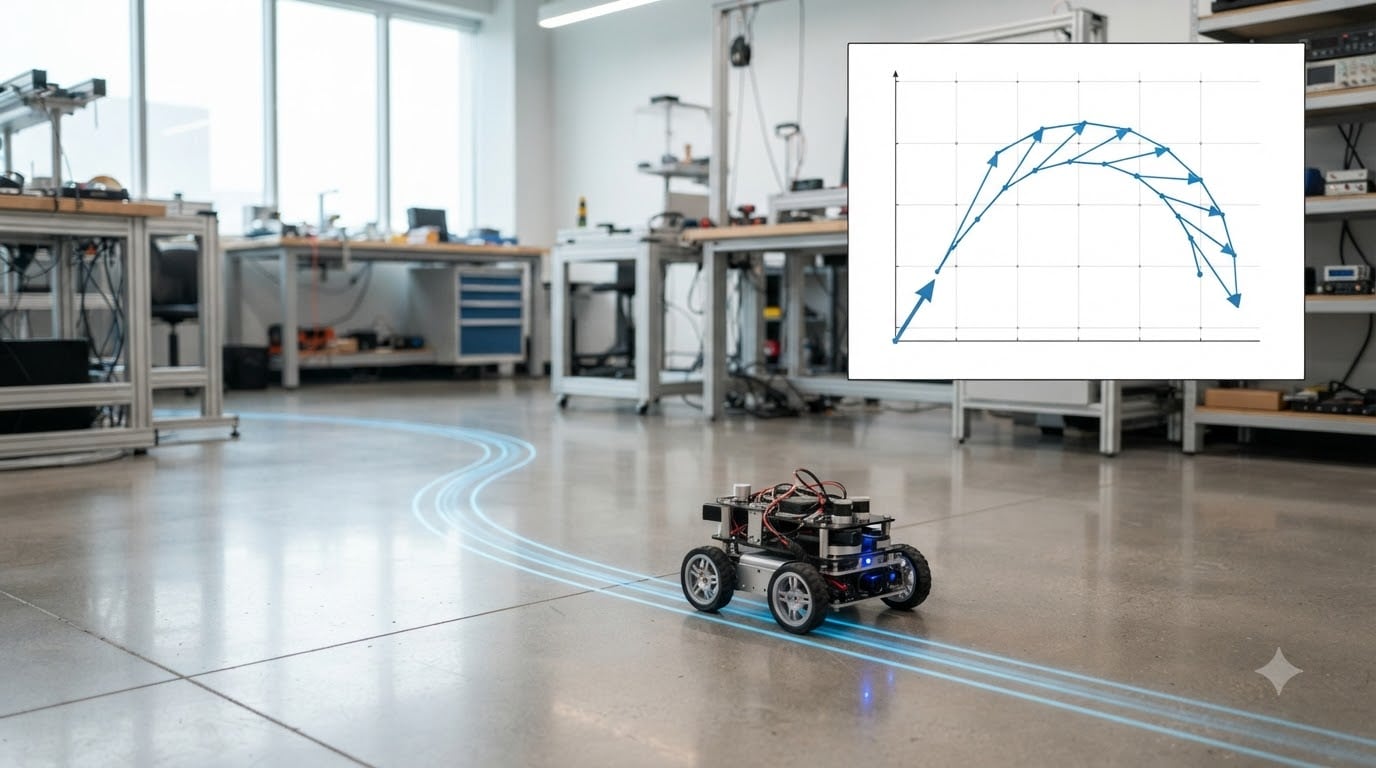
Dead reckoning in robot navigation is the process of estimating a robot’s current position by starting from a known location and adding up how far and in what direction the robot has moved since. The name comes from the old航海 phrase deduced reckoning, and the technique has been used by sailors, pilots, and now robots for centuries.
In this guide I will walk you through exactly how dead reckoning works inside a robot, what sensors make it possible, why it drifts, and how engineers fight that drift in practice. Whether you are building a small indoor rover, a drone, or a walking robot, the same fundamental idea applies: track every step, wheel rotation, or accelerometer pulse, and integrate that motion into a position estimate.
Table of Contents
What Is Dead Reckoning in Robot Navigation
Dead reckoning in robot navigation is a self-contained localization method that calculates a robot’s current pose by integrating measured motion from a previously known starting point. No external signals like GPS, beacons, or landmarks are required. The robot only needs internal sensors that can sense how it is moving.
The phrase itself is a contraction of deduced reckoning. Sailors in the 16th and 17th centuries had no way to fix their position once clouds hid the stars, so they would log their heading and speed and deduce where they must be. A robot does the same thing: it knows where it started, it measures how its wheels turn or how its body accelerates, and it deduces where it is now.
For mobile robots this matters because most indoor, underground, underwater, and space environments have no usable GPS. A warehouse robot rolling between metal shelves, a Mars rover climbing a crater rim, and a pool-cleaning robot tracking across a tile floor all rely on dead reckoning for at least part of their pose estimate.
How Dead Reckoning Works Step by Step
Dead reckoning works by starting from a known fix, then updating the position every short time step using the robot’s measured velocity and heading. Over many steps, the robot maintains a running estimate of where it is, without ever talking to the outside world.
The Position Update Formula
At each time step the robot does three things: it measures how far it has traveled, it measures which direction it is facing, and it adds that motion to its previous position. In a 2D plane, the math looks like this:
- xnew = xold + v · cos(θ) · Δt
- ynew = yold + v · sin(θ) · Δt
- θnew = θold + ω · Δt
Here, v is the linear speed, θ is the heading, ω is the turn rate, and Δt is the elapsed time of the step. The robot simply starts from an initial pose and applies this update hundreds of times per second.
A Simple Worked Example
Imagine a small wheeled robot starting at position (0, 0) facing east. Its wheel encoders report that it has moved 0.5 meters, and its IMU reports that it has turned 30 degrees to the right over the same interval.
Using the formula: the new x is 0 + 0.5 · cos(30°) = 0.433, the new y is 0 + 0.5 · sin(30°) = 0.25, and the new heading is 30°. The robot now believes it is at (0.433, 0.25) facing 30 degrees north of east. That single update is the entire idea of dead reckoning, repeated over and over.
Key Components of a Dead Reckoning System
Every dead reckoning system in a robot depends on three pieces of information: distance traveled, direction faced, and the elapsed time over which both happened. Different sensors cover these pieces, and most robots combine more than one.
- Wheel encoders: Optical or magnetic sensors on each drive wheel that count ticks as the wheel turns. They give very accurate short-term distance and, by comparing left and right wheels, a good estimate of turn rate. This is the workhorse of indoor mobile robot dead reckoning.
- IMU (Inertial Measurement Unit): A chip-scale module that contains a 3-axis accelerometer and a 3-axis gyroscope. It reports linear acceleration and angular velocity, which the robot integrates to estimate velocity, orientation, and position.
- Gyroscope: Measures angular velocity directly. Gyro-based heading integration is more accurate in the short term than magnetometer-based heading, which is why it dominates in dead reckoning.
- Accelerometer: Measures linear acceleration. When double-integrated over time, it gives displacement, but accelerometer-only position estimates drift very fast due to small bias errors being squared.
Wheeled robots usually lead with encoders, legged robots lead with IMUs, and drones lean on IMUs almost exclusively because there are no wheels to count.
Why Dead Reckoning Drifts: Error Accumulation Explained
Dead reckoning drifts because every measurement has a small error, and those errors are added up forever. There is no external reference to ever reset them, so the position estimate slowly walks away from the real position. This is the single biggest limitation of the method.
The most common error sources I see in real robots are:
- Wheel slippage: If a wheel skids, slides, or lifts off the floor, the encoder still counts ticks as if the robot moved. The dead reckoning system then believes it traveled further than it really did.
- IMU bias: A MEMS gyroscope does not read exactly zero when the robot is still. That tiny constant offset, when integrated over hours, becomes a huge heading error.
- Accelerometer double integration: A small constant offset in acceleration, integrated once to get velocity and again to get position, grows quadratically with time. Within a few minutes the position estimate can be off by tens of meters.
- Wheel diameter error: Encoders assume a perfect wheel radius. If the tire is slightly flat or under-inflated, every measured tick is the wrong distance.
This is why, on the r/robotics and r/drones forums, users consistently report that pure dead reckoning with only an IMU drifts within minutes, and even good encoder systems drift within tens of meters over a long hallway run. The drift is not a bug. It is a fundamental property of integrating noisy measurements.
How to Reduce Dead Reckoning Errors
Engineers rarely run dead reckoning alone in a production robot. They combine it with absolute measurements to keep the drift in check. Three approaches dominate modern robotics.
Sensor fusion with a Kalman filter. A Kalman filter mathematically combines the dead reckoning estimate with another sensor, like a GPS fix, a landmark observation, or a SLAM loop closure, and produces a single, statistically optimal pose. The filter knows the noise characteristics of each sensor and weights them accordingly. The Extended Kalman Filter (EKF) and the Unscented Kalman Filter (UKF) are the two most common choices on real robots.
Complementary filtering. A simpler approach that uses a high-pass filter on the gyroscope and a low-pass filter on the accelerometer or magnetometer. It is cheap to compute and is the foundation of almost every hobby IMU library, including the Madgwick and Mahony filters used in drones.
Periodic absolute corrections. A robot may use dead reckoning between known markers, like floor fiducials, wall features, or GPS waypoints, and reset its position estimate every time it sees one. This is the same idea as a sailor taking a star sight to get a fresh fix.
Inside ROS, the robot_localization package implements EKF and UKF sensor fusion out of the box and is the standard way production robots handle dead reckoning drift.
Dead Reckoning vs GPS, SLAM, and Inertial Navigation
Dead reckoning is rarely a choice against GPS or SLAM. In real systems it is the layer underneath them. Understanding the trade-offs between these methods helps you decide what your robot actually needs.
Dead reckoning vs GPS. GPS gives an absolute position anywhere outdoors with a clear sky. Dead reckoning gives a relative position everywhere else. GPS is also sampled slowly (1 to 10 Hz) and jumps around by meters; dead reckoning is sampled at hundreds of Hz and is smooth but drifts. A car navigation system usually runs dead reckoning at 100 Hz and corrects with GPS every second.
Dead reckoning vs SLAM. SLAM (Simultaneous Localization and Mapping) builds a map and localizes the robot within that map at the same time. It is far more powerful than dead reckoning alone, but it requires a lidar, camera, or other feature sensor and enough computational power to maintain the map. SLAM systems almost always use dead reckoning internally as their motion model because it provides a smooth short-term pose between sparse feature matches.
Dead reckoning vs inertial navigation. Inertial navigation is essentially pure IMU-based dead reckoning, which is the original form of the technique in submarines, aircraft, and spacecraft. Robotic dead reckoning usually adds wheel encoders, making it a hybrid inertial and odometric system.
For most robots, the right answer is: dead reckoning for smooth short-term motion, corrected by something absolute like GPS, SLAM, or fiducials for long-term accuracy.
Practical Applications in Modern Robotics
Dead reckoning shows up wherever a robot needs to know where it is without depending on the outside world. I have seen it used across very different platforms, and the underlying math is always the same.
- Indoor mobile robots: Warehouse AGVs, hospital delivery robots, and home vacuum robots use wheel encoder dead reckoning between SLAM or wall-feature updates. The dead reckoning layer is what makes their motion feel smooth instead of jumpy.
- UAVs and drones: Quadcopters almost entirely use inertial dead reckoning between GPS fixes, and inside buildings they fall back to optical flow or visual-inertial odometry, which is dead reckoning in disguise.
- Underwater ROVs and AUVs: GPS does not work underwater, so these vehicles rely on a Doppler velocity log plus an IMU, then correct with periodic surface GPS or seabed transponder fixes.
- Walking robots: Legged robots like the CMU Ambler used leg kinematics as a form of dead reckoning, fusing foot contact with IMU data to estimate pose across rough terrain.
Each of these cases shares the same pattern: a dead reckoning core running at high rate, with a slower absolute correction layer keeping the drift bounded.
Frequently Asked Questions
What is a dead reckoning in navigation?
Dead reckoning in navigation is the process of calculating the current position of a moving object by using a previously determined position, called a fix, and adding the estimated distance and direction traveled since that fix. It does not rely on external signals like GPS or landmarks.
What is the concept of dead reckoning?
The core concept of dead reckoning is incremental position update: start from a known pose, then at each short time step add the measured velocity multiplied by elapsed time to the previous position, and add the measured turn rate to the previous heading. The new pose becomes the starting point for the next step.
What does dead reckoning mean in aviation?
In aviation, dead reckoning means flying a pre-computed heading and airspeed for a known time to estimate the aircraft’s position, usually as a backup when radio navigation aids or GPS are unavailable. Pilots still learn it as a fundamental skill for cross-country flight.
What are the six rules of dead reckoning?
The six classical rules of dead reckoning are: know your starting fix precisely, log your heading continuously, log your speed or distance continuously, account for wind or current, apply corrections at known checkpoints, and never trust the estimate longer than your last absolute fix.
Conclusion
Dead reckoning in robot navigation is the oldest navigation trick in the book, dressed up in sensors and code. A robot starts from a known position, integrates measured motion, and keeps a running estimate of where it is, with no need for GPS, beacons, or maps. It is fast, cheap, and works in every environment, which is why almost every mobile robot still has it at the heart of its localization stack.
The catch is drift, and the only real cure is to fuse dead reckoning with an absolute sensor and a Kalman filter. If you are building your first robot, start with wheel encoders plus an IMU, log your pose at 50 Hz or more, and plan to add a correction source like GPS, AprilTags, or SLAM as soon as you can.